
Emerald Green Kitchen Design Ideas: 19 Stunning Looks You’ll Love
Emerald green kitchen design ideas use a jewel-toned green (hex #046A38 to #50C878) on cabinets, islands, backsplash tiles, and accent walls to build a kitchen with depth, warmth, and botanical richness that neutral palettes cannot deliver. Emerald green sits between blue and yellow on the color wheel, carrying the calming quality of blue and the energy of yellow in a single saturated hue. Below are 19 approaches organized by surface, material pairing, and accent metal, followed by a how-to painting guide, a comparison table, and FAQs on paint selection, countertop coordination, and resale impact.
1. Emerald Green Shaker Cabinets with Brass Hardware
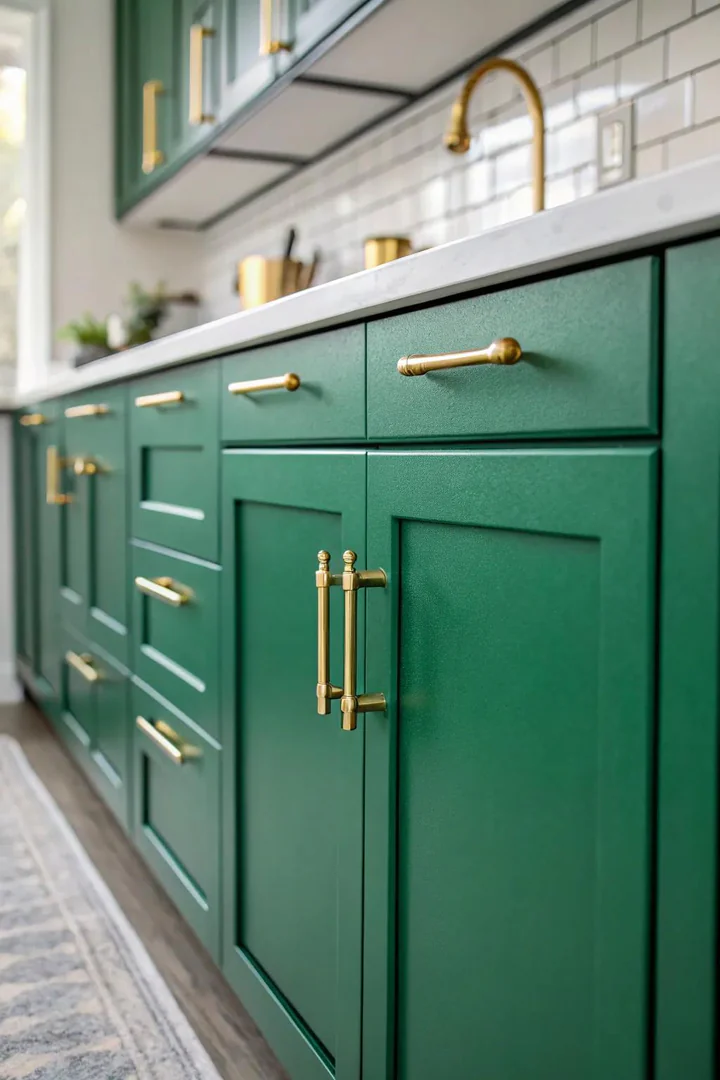
Painting full-height Shaker cabinets in Benjamin Moore Green Bay 2045-20 or Sherwin-Williams Derbyshire SW 6741 and pairing with brushed brass cup pulls from Emtek Select ($12 each) creates the most traditional version of an emerald kitchen. Brass hardware against emerald green references the gemstone-and-gold pairing found in jewelry design, where the warm metal amplifies the green’s depth. The Shaker door profile keeps the cabinet style restrained so the bold paint color carries the personality.
A full emerald Shaker kitchen (all perimeter cabinets and island in the same green) works best in rooms with 150+ square feet, 8-foot or higher ceilings, and at least one window wall. Smaller kitchens benefit from a two-tone approach: emerald lowers with white or light gray uppers. Satin or semi-gloss paint finish on emerald cabinets reflects light and prevents the dark green from absorbing too much brightness, keeping the room from reading as a cave.
2. Emerald Green Island with White Perimeter Cabinets
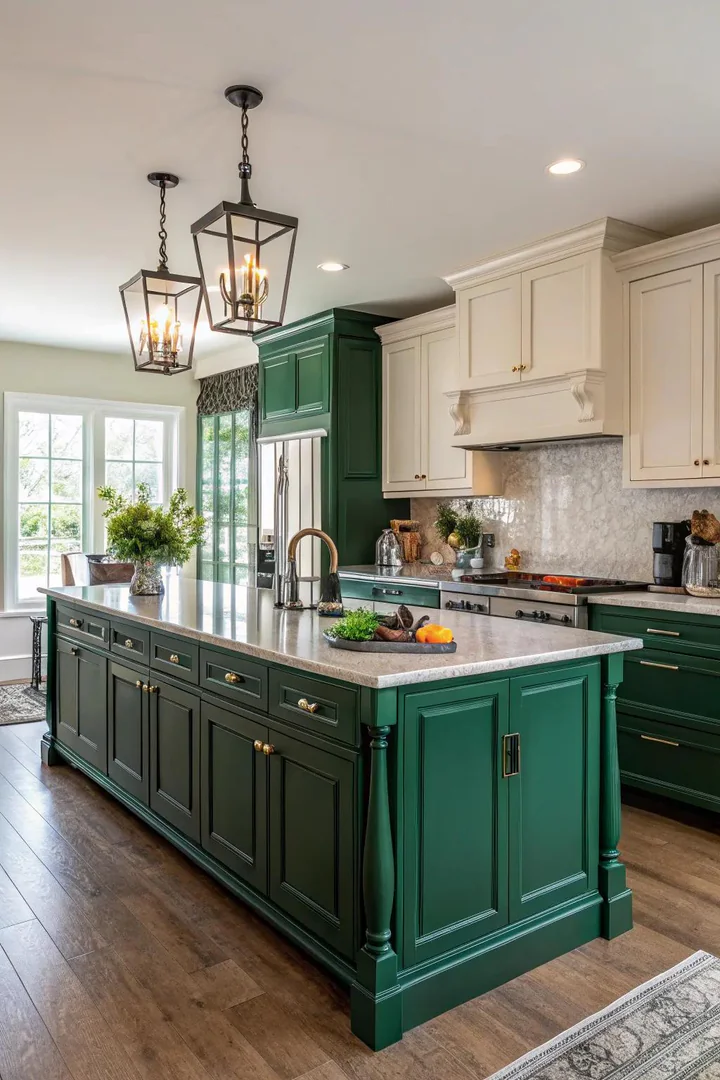
Painting only the island in Farrow & Ball Beverly No. 310 (emerald green) while keeping all perimeter cabinets in white (Benjamin Moore Chantilly Lace OC-65) confines the bold color to a single freestanding piece of furniture at the center of the room. The emerald island commands attention without overwhelming the kitchen’s overall brightness. A white perimeter ensures the room reflects daylight efficiently while the green island provides a grounding focal point.
A waterfall-edge countertop on the emerald island wraps white marble or quartz down the island’s sides, creating a material contrast between the green-painted base and the white stone waterfall. A butcher-block top in walnut or white oak on an emerald island warms the green with natural wood grain and references the botanical connection between green paint and live wood. Match the island hardware to the perimeter hardware in the same metal finish so the two-tone split reads as one coordinated kitchen.
3. Green Marble or Verde Alpi Countertop
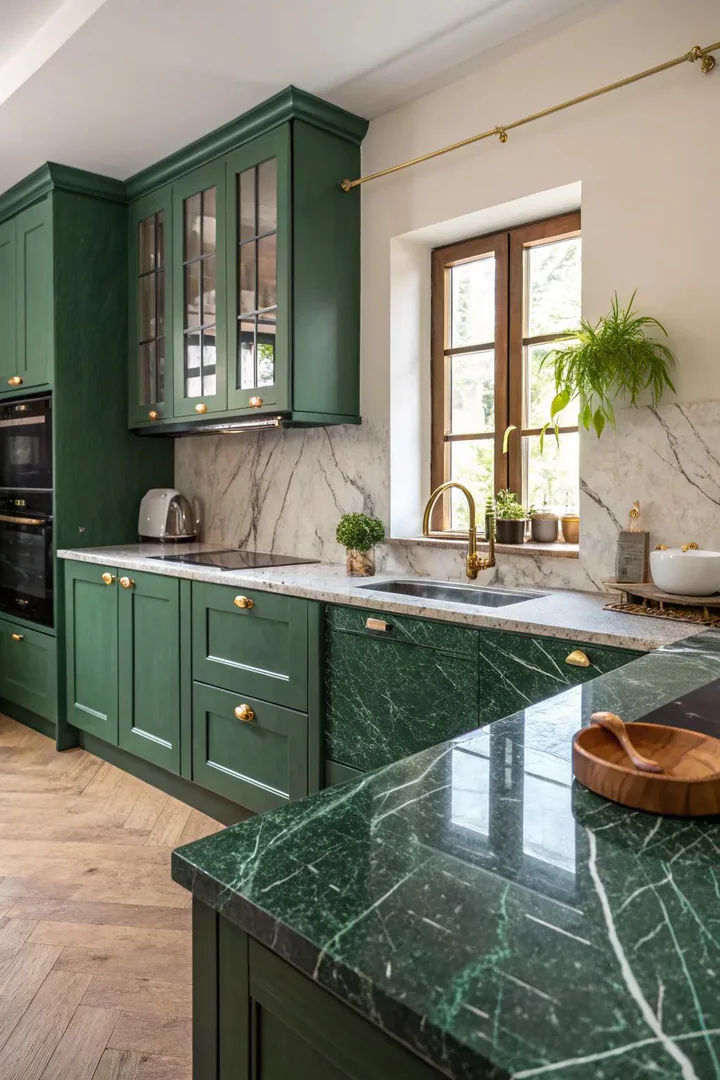
A Verde Alpi marble countertop ($60 to $90 per square foot installed) from Italian quarries carries white veining on a dark forest-green to emerald field, creating a countertop that functions as both a green accent and a natural stone surface. Verde Alpi (also sold as Verde Guatemala) ranges from deep bottle green to lighter jade depending on the slab, so view full slabs at the stone yard rather than selecting from a sample chip.
Pair a green marble countertop with white or pale gray cabinets to let the stone carry the emerald color story without competing with a second green surface. Green marble shares the same sealing and etching characteristics as Carrara and Calacatta marble: seal every 6 to 12 months with a penetrating impregnator like Miracle Sealants 511 and avoid direct contact with acidic liquids. A honed finish on green marble shows etching less visibly than polished and gives the surface a velvety matte quality.
4. Dark Moody Emerald with Black Fixtures
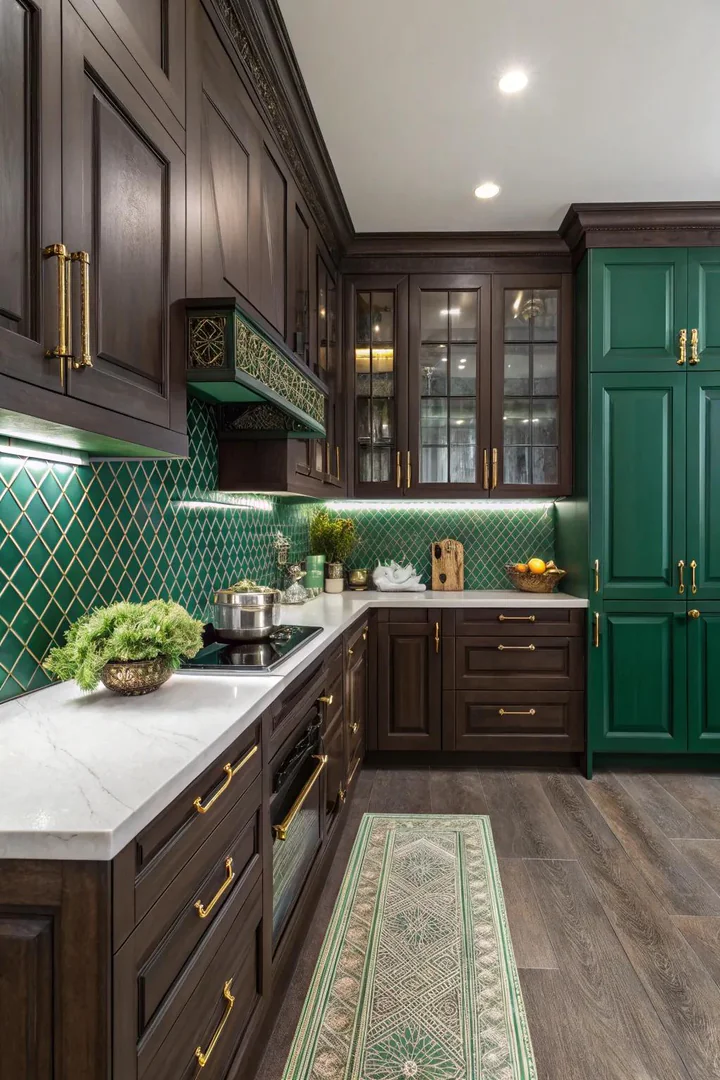
Painting cabinets in a deep emerald like Benjamin Moore Forest Green 2047-10 (LRV 5) or Sherwin-Williams Roycroft Bottle Green SW 2847 (LRV 4) and pairing with matte black hardware, a matte black faucet from Delta Trinsic ($300), and black pendant lights from Schoolhouse Electric ($200) creates a dramatic, low-key kitchen where every surface absorbs light. The effect reads as evening, library, or jewel-box, suited to kitchens that double as entertaining spaces.
A dark moody kitchen requires deliberate lighting to function as a workspace: under-cabinet LED strips in 2700K warm white, in-cabinet puck lights, and two to three oversized pendant fixtures above the island. Without layered lighting, a deep emerald kitchen reads as flat and cave-like after sunset. Balance the dark cabinets with a light countertop (white marble, white quartz, or honed white granite) so the work surface remains visible and bright under task lighting.
5. High-Gloss Lacquered Emerald Cabinets
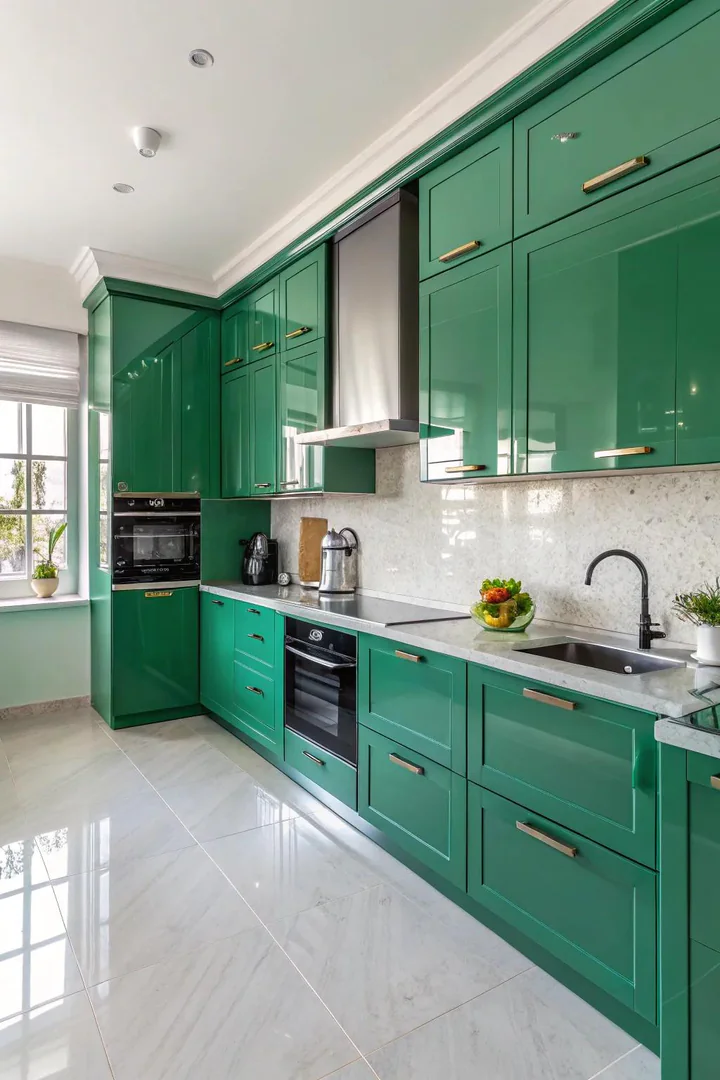
A high-gloss lacquer finish on emerald cabinets reflects light like a mirror, turning the green surface into a luminous, depth-rich feature that matte paint cannot produce. Custom spray lacquer ($150 to $250 per linear foot) or IKEA KALLARP high-gloss dark green doors ($60 per door) deliver the glass-like reflectivity. High-gloss emerald suits Art Deco, mid-century modern, and contemporary glam kitchens where the reflective quality becomes part of the lighting design.
High-gloss surfaces show fingerprints, water spots, and dust more than matte finishes. A daily wipe with a microfiber cloth and diluted white vinegar keeps the lacquer looking polished. Pair high-gloss emerald cabinets with matte countertops (honed marble, leathered granite, concrete) so each surface plays a distinct role: the cabinets shine and the counter absorbs, creating a reflective-versus-matte dialogue. Chrome and polished nickel hardware complements the high-gloss finish better than matte black, which absorbs light and creates dark spots on the shiny surface.
6. Botanical Wallpaper on the Range Wall
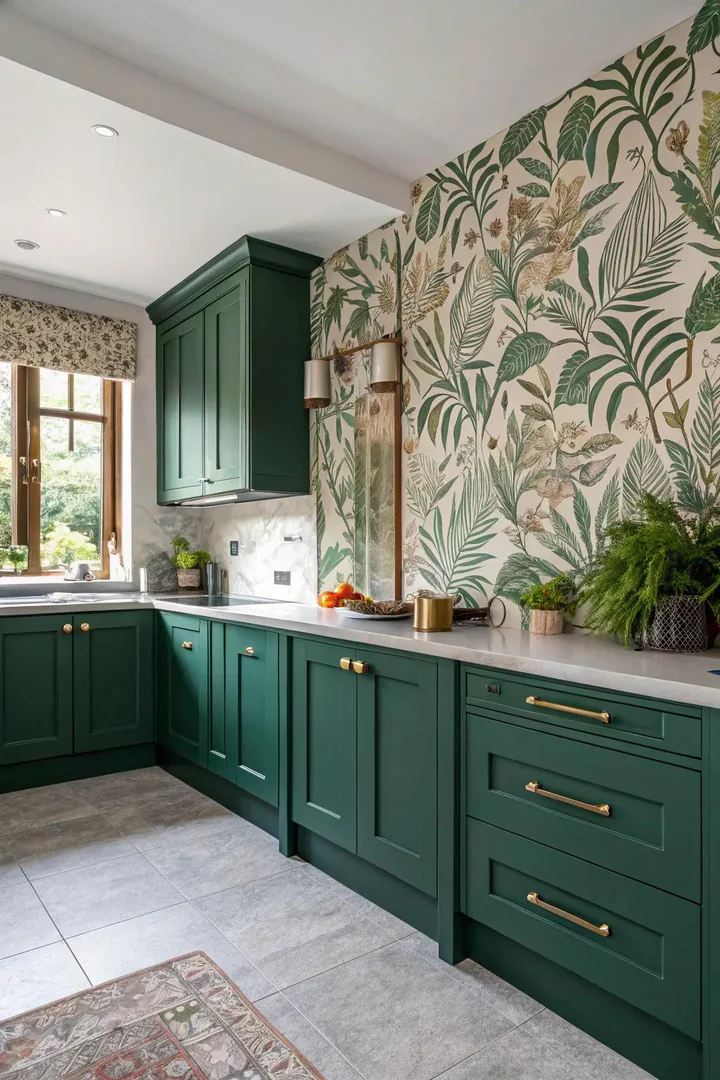
Applying a botanical-print wallpaper from Rifle Paper Co. Peacock ($100 per roll, 20.5 inches wide) or Graham & Brown Tropical ($80 per roll) on the wall behind the range or on a feature wall above a shelf rail adds layered pattern to a kitchen that already features emerald-painted cabinets or an emerald island. Palm frond, monstera leaf, fern, and trailing vine patterns in green, gold, and cream reinforce the botanical theme that emerald green suggests.
Install a clear glass or acrylic backsplash panel ($25 per square foot) over the wallpaper behind the range to protect the paper from cooking grease and splatter while keeping the pattern visible. Peel-and-stick wallpaper from Tempaper ($40 per roll) offers a renter-friendly, removable alternative to paste-applied paper. Limit the wallpaper to one wall (the range wall or the wall opposite the sink) to prevent the pattern from overwhelming a small kitchen. Pair with solid-color emerald cabinets so the patterned wallpaper has one quiet surface to rest against.
7. Emerald Cabinets with Warm Wood Shelving and Flooring
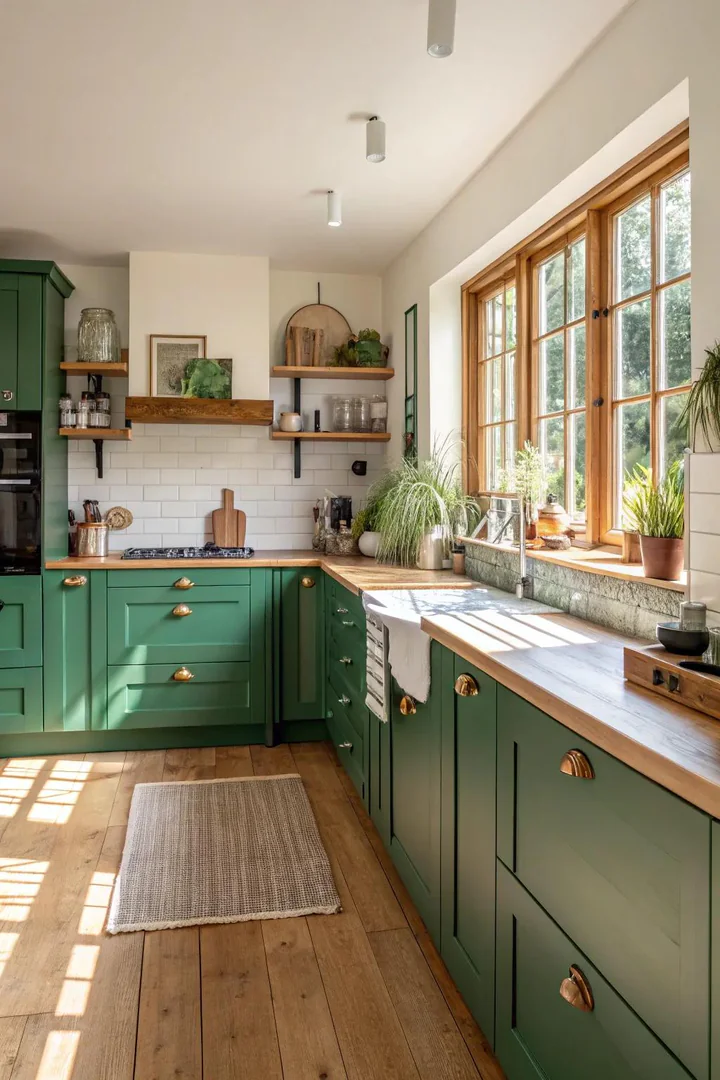
Pairing emerald cabinets with white oak floating shelves ($25 per linear foot), a walnut butcher-block island top ($50 per square foot), and wide-plank oak flooring ($8 per square foot) grounds the bold green in natural materials that soften the color’s intensity. Wood’s warm tone and organic grain prevent emerald from reading as industrial or artificial. The brown-to-amber wood tones and the green paint sit next to each other on the warm side of the color wheel, creating an analogous palette rooted in the forest.
Match the wood tone across all exposed wood surfaces (shelves, island, flooring) for a cohesive material story. White oak in a natural or light-honey finish works with mid-tone emerald, while walnut in a dark brown finish works with deep forest emerald. A matte polyurethane finish on all wood surfaces resists kitchen moisture without adding the reflective sheen that would compete with high-gloss paint finishes.
8. Emerald Island with White Marble Countertop
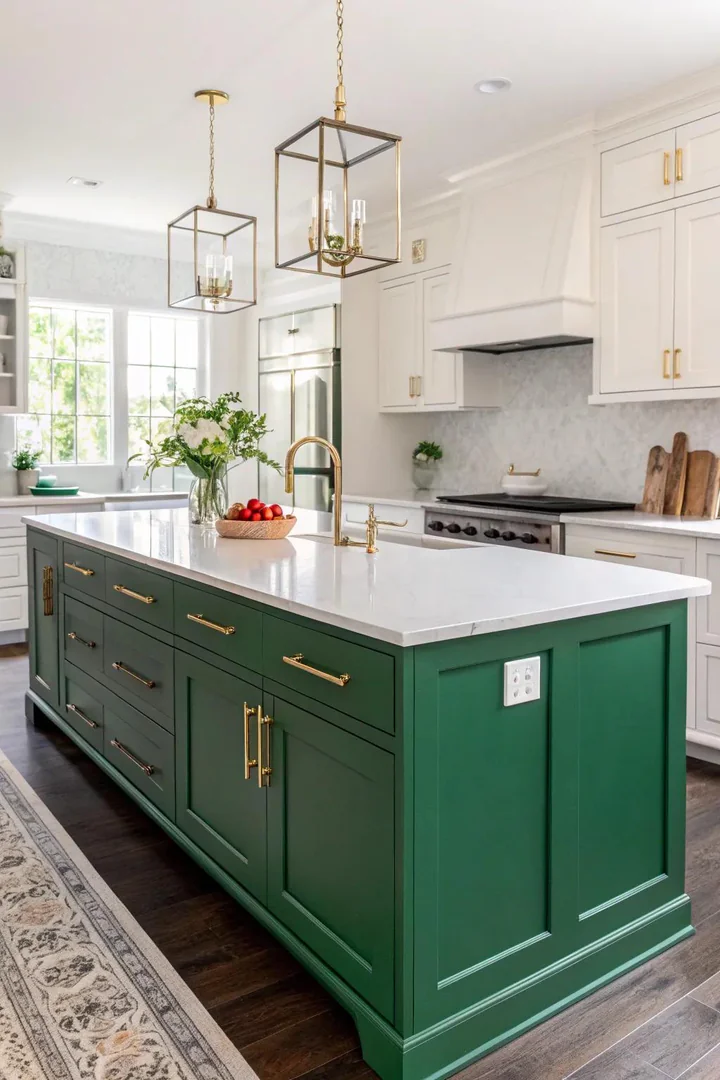
A Calacatta marble countertop ($80 to $120 per square foot) on an emerald-painted island creates a two-material focal point where the white stone’s gray veining echoes the cool undertone in the green paint below. Calacatta marble’s bold, dramatic veins pair better with emerald than Carrara’s finer, quieter veining because the scale of Calacatta veining matches the boldness of the emerald color.
A mitered edge on the marble (where the marble wraps around the island edge at a 45-degree joint to appear 3 inches thick instead of the standard 1.25 inches) adds visual weight that balances the heavy emerald paint below. White marble on an emerald island requires the same sealing protocol as any marble countertop: penetrating impregnator before use and every 6 to 12 months thereafter. For a maintenance-free alternative, Caesarstone Calacatta Maximus 5114 ($75 per square foot) replicates the Calacatta pattern in non-porous quartz.
9. Emerald Accents in a Black-and-White Kitchen
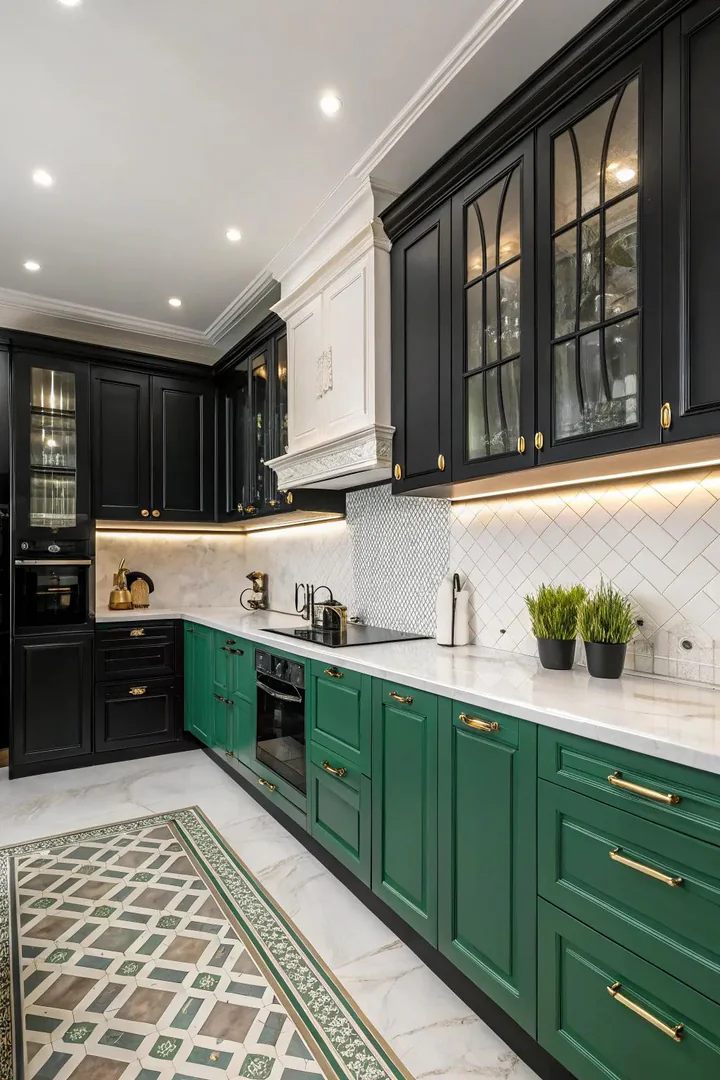
Adding emerald through bar stools (upholstered in emerald velvet, $200 each from Article), pendant light shades (painted emerald metal, $150 from Rejuvenation), and ceramic accessories (emerald vases, canisters, and trays from West Elm, $30 to $60) injects the jewel tone into a black-and-white kitchen without committing to painted cabinets. Emerald accents function as removable color that can be swapped for another accent (navy, terracotta, mustard) when the homeowner’s taste shifts.
Limit emerald accents to 3 to 5 objects distributed across three zones (seating, lighting, and counter decor) so the color reads as intentional rather than scattered. A single large emerald accent (a velvet upholstered banquette, an oversized art print, or a floor-to-ceiling drape) anchors the color more effectively than a dozen small accessories. Emerald green reads as a neutral luxury tone in a black-and-white kitchen because green’s position between warm and cool makes the accent color compatible with both black and white without temperature clash.
10. Emerald Wall Behind Open Shelving
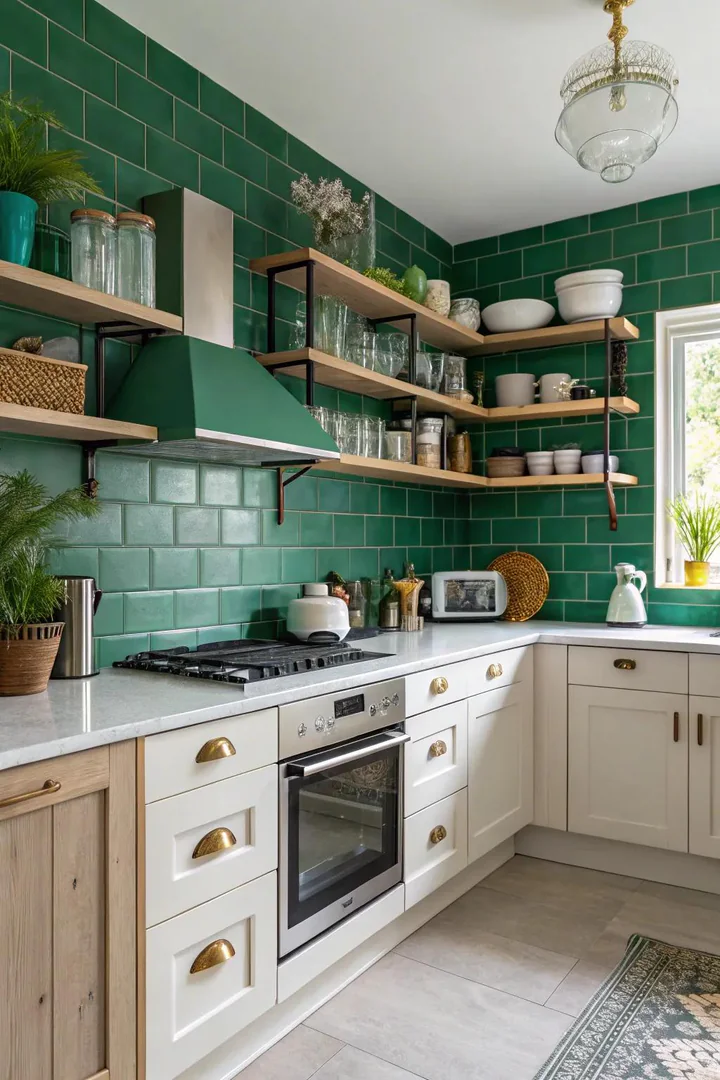
Painting the wall behind open shelves in Benjamin Moore Calico Blue 707 (a blue-leaning emerald) or Farrow & Ball Arsenic No. 214 (a true deep green) creates a dramatic backdrop that makes white dishes, wooden cutting boards, and copper canisters pop forward from the wall. The dark green wall acts as a display case backdrop, adding depth and contrast that a white wall cannot provide.
Open shelves on an emerald wall require curated, minimal styling: too many objects against the bold color create visual noise. Group items in odd numbers (3 or 5 per shelf), vary heights within each group, and maintain a restricted material palette (white ceramic, clear glass, warm wood, one warm metal). Leave 30% to 40% of the shelf surface empty so the green wall shows between objects, serving as a resting point for the eye. Browse more cabinet and wall color approaches at grey kitchen cabinet ideas.
11. Brass Pendant Lights and Emerald Range Hood
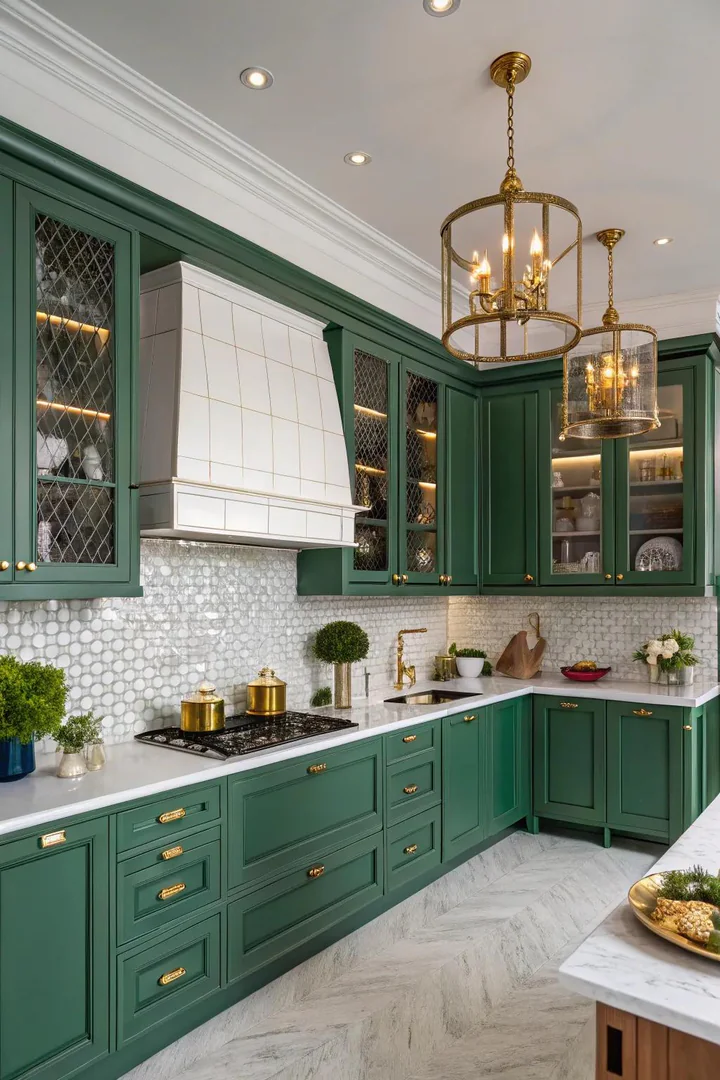
Painting a custom plaster or wood range hood shell in the same emerald as the cabinets and hanging unlacquered brass pendant lights from Schoolhouse Electric Grandview ($250 each) or Rejuvenation Eastmoreland ($200 each) above the island concentrates the emerald-and-brass pairing at the room’s two focal points: the cooking wall and the island. Brass develops a warm patina over time that deepens the green-and-gold relationship as the metal ages.
Unlacquered brass fixtures tarnish to a mottled honey-to-brown tone within 6 to 12 months of installation, adding vintage character that lacquered (sealed) brass does not develop. For a consistent shiny appearance, choose lacquered brass or polished brass fixtures and wipe monthly with brass cleaner. Two pendants over a 72-inch island or three over a 96-inch island, hung 30 to 36 inches above the countertop, provide balanced task lighting across the full island surface.
12. Emerald and Gray Two-Tone Kitchen
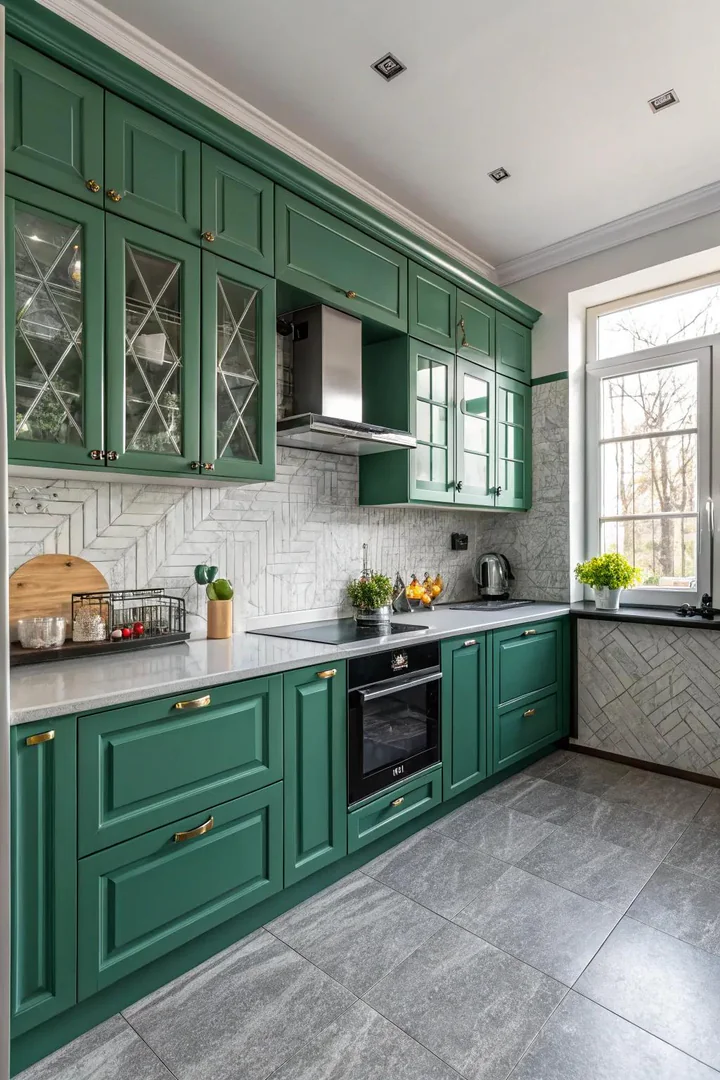
Painting upper cabinets or the island in emerald and the remaining cabinets in a medium gray like Sherwin-Williams Dorian Gray SW 7017 creates a two-tone kitchen where the saturated green provides the accent and the neutral gray provides the grounding. Gray softens emerald’s intensity without diluting it the way white does, producing a more sophisticated, muted palette suited to transitional and contemporary kitchens.
The gray should carry a warm undertone (greige or taupe) to harmonize with emerald’s warmth. Cool blue-grays compete with emerald’s blue undertone and create a tension that reads as unresolved. A gray countertop (honed gray quartz or gray soapstone) on emerald lower cabinets extends the gray-green dialogue from vertical to horizontal surfaces. Brushed nickel or satin chrome hardware bridges the gray and green with a cool metallic that does not compete with either paint color. Find more gray cabinet pairings at white kitchen gray countertops ideas.
13. Minimalist Emerald Flat-Panel Cabinets
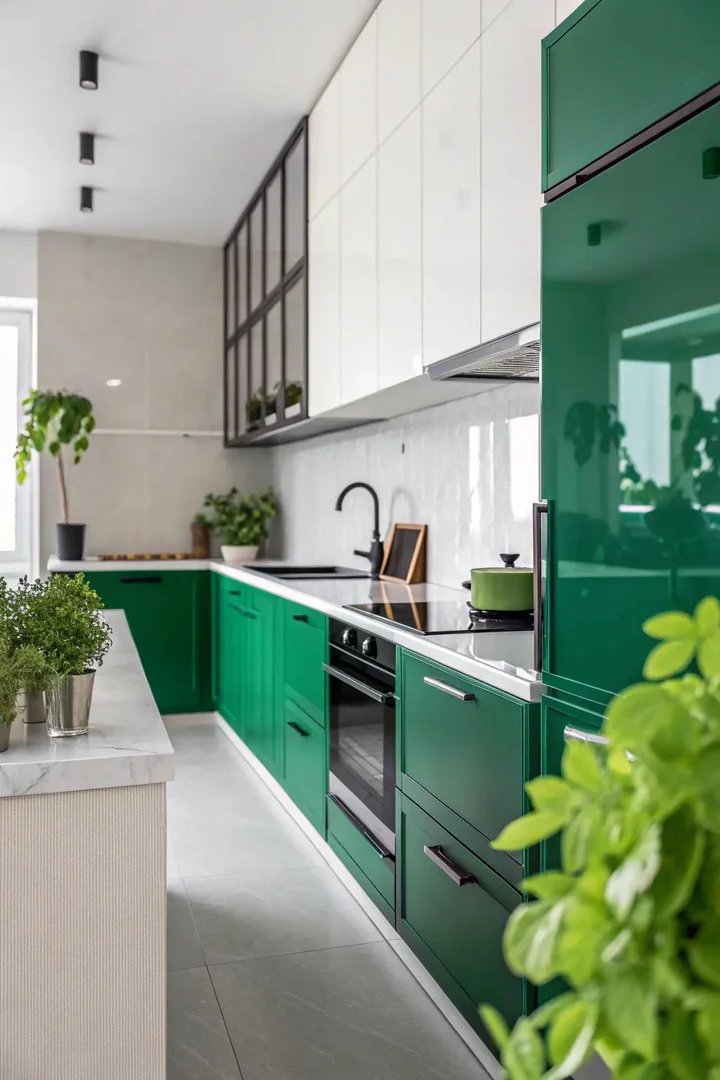
A slab-front (flat-panel) cabinet in emerald with integrated j-pull handles or push-to-open latches strips the kitchen to color-and-geometry without molding, beading, or visible hardware. The emerald paint becomes the sole decorative element on an otherwise featureless surface, giving the color maximum visual presence. Flat-panel emerald cabinets suit modern and Scandinavian kitchens where ornamentation is eliminated in favor of material quality and color.
A matte or eggshell finish on flat-panel emerald cabinets creates a soft, velvety surface that absorbs light gently. High-gloss finish on the same flat panel creates a lacquered, gem-like effect. Choose based on the desired mood: matte reads calm and organic, gloss reads polished and glamorous. Pair minimalist emerald cabinets with a simple white quartz countertop and a thin-profile undermount sink to maintain the clean-line aesthetic from cabinet door to countertop edge.
14. Emerald and Blush or Pastel Pairing
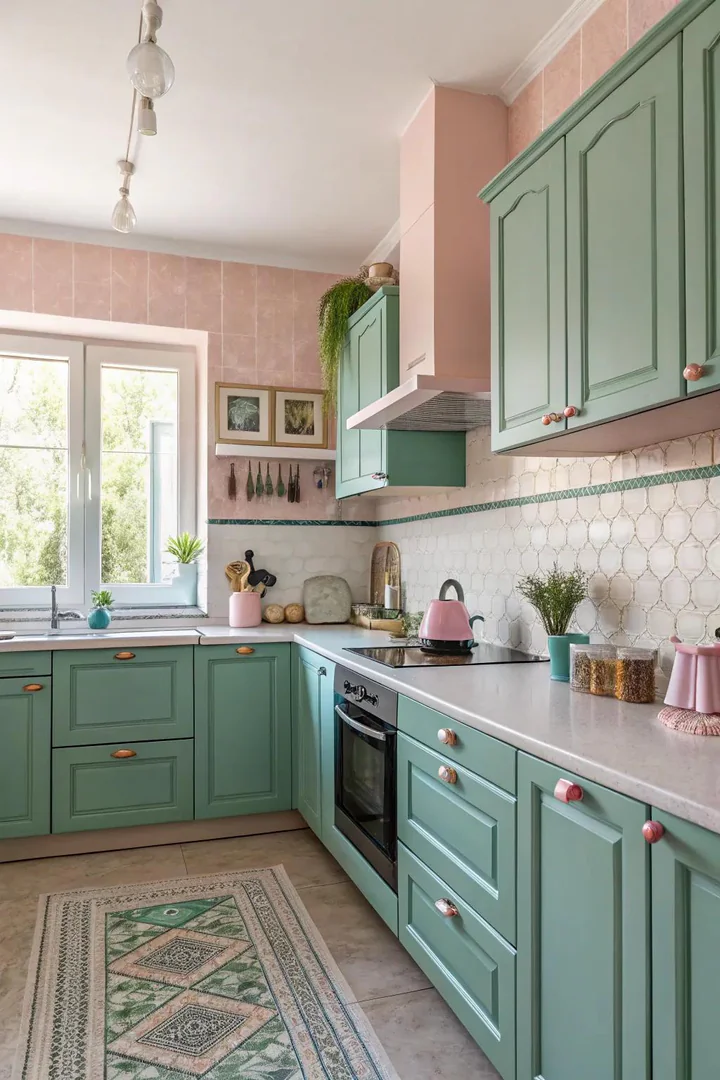
Pairing emerald cabinets with a blush pink backsplash tile from Fireclay Tile in Pink Salt ($18 per square foot) or pale pink walls in Farrow & Ball Setting Plaster No. 231 creates a green-and-pink color pair that references botanical design (leaves and flowers). Pink softens emerald’s intensity and prevents the kitchen from reading too dark or too masculine. The pairing works in both modern and traditional kitchens because the botanical reference transcends style categories.
Limit the pink to one surface (backsplash or walls, not both) so the emerald remains dominant. A blush countertop in Caesarstone Topus Concrete 4023 (warm blush-gray) bridges the emerald and pink without introducing a third strong color. Brass hardware and warm wood accents reinforce the warm side of the palette. The emerald-and-blush combination reads most natural under warm 2700K lighting and can appear awkward under cool 4000K fluorescent tubes that strip the pink of its warmth.
15. Emerald Cabinets with Natural Stone Backsplash
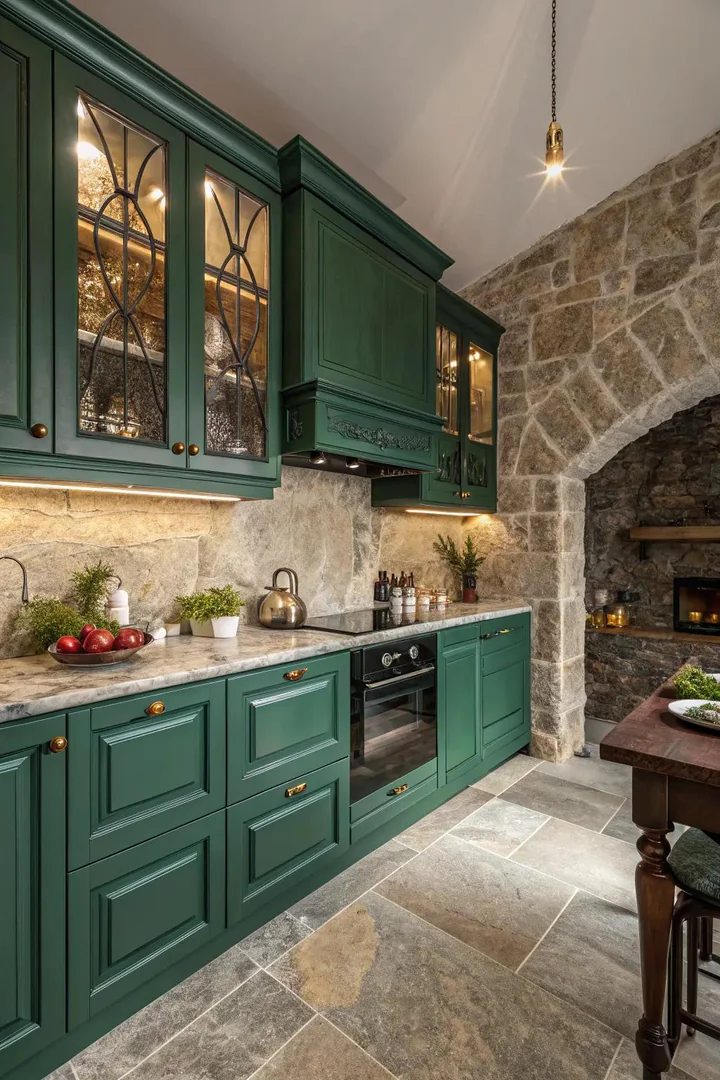
A natural stone mosaic backsplash in tumbled travertine, split-face slate, or stacked stone ledger panels from MSI Golden Honey Stacked Stone ($12 per square foot) adds an earthy, organic texture between emerald cabinets and a white countertop. Natural stone’s irregular surface and warm earth tones (gold, cream, rust, gray) connect the deep green to the ground, reinforcing the forest-and-earth material story that emerald suggests.
Seal natural stone backsplashes before grouting and annually with a penetrating stone sealer to prevent grease absorption behind the range. A tumbled stone backsplash with wide 1/8-inch grout joints in a beige or tan grout creates a rustic texture that suits Mediterranean, Tuscan, and craftsman kitchens. A sleek honed marble slab backsplash in white or gray provides a more refined stone alternative for modern and transitional emerald kitchens. Browse more material-and-cabinet pairings at kitchen storage ideas.
16. Contemporary Emerald Accent on One Wall
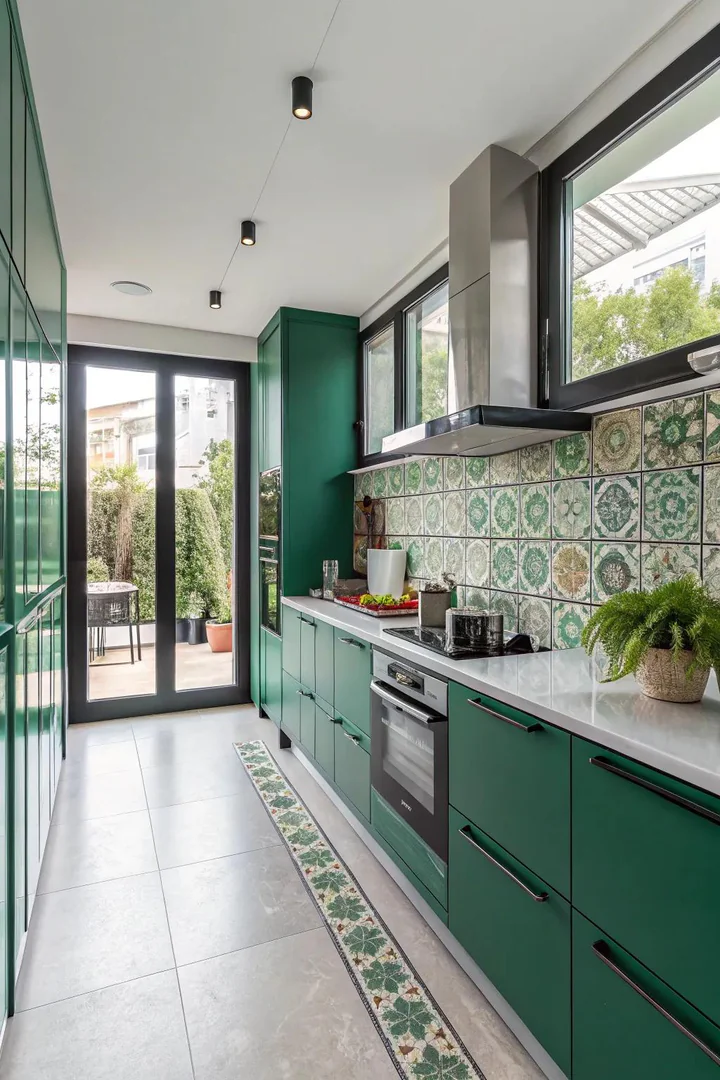
Painting a single wall in emerald (the wall behind the dining nook, the end wall of a galley, or the wall flanking the refrigerator) while keeping all cabinets and remaining walls white or gray introduces the color as a contained architectural statement. A single emerald wall costs less than $50 in paint and 3 hours of labor, making the approach the lowest-commitment way to test emerald green in a kitchen before committing to full cabinet painting.
An emerald accent wall behind a floating shelf or a wall-mounted utensil rail creates a functional display zone where the green serves as a backdrop. Pair the accent wall with emerald-toned accessories (a green ceramic vase, an emerald linen dish towel, a green glass pendant) distributed across the room so the accent wall connects to the wider kitchen rather than standing alone as an orphaned color block. An accent wall at the far end of a narrow kitchen draws the eye forward and makes the room feel deeper.
17. Emerald and Copper Hardware and Fixtures
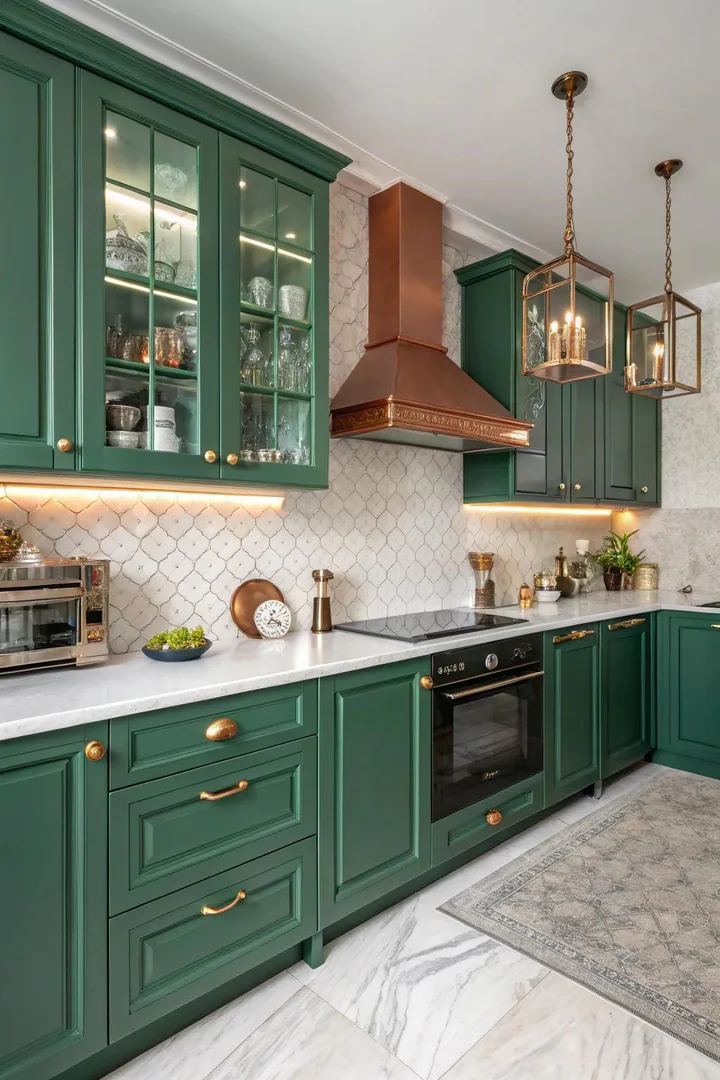
Pairing emerald cabinets with copper cup pulls from House of Antique Hardware ($15 each), a copper bridge faucet from Newport Brass Chesterfield ($600), and a copper pot rack from Enclume ($250) creates a green-and-copper palette that references the natural patina process where copper develops a green verdigris over decades of oxidation. The emerald-copper pair feels organic and historically grounded because the color combination occurs naturally on aged copper roofs and copper garden fixtures.
Unlacquered copper ages to a rosy brown within 6 months of kitchen use and eventually develops green patina spots at high-moisture contact points (around the faucet base, near the sink). Lacquered copper maintains its shiny salmon-pink tone indefinitely but requires relacquering if the coating chips. Copper pairs with emerald in all finish types: polished copper reads as glamorous, brushed copper reads as warm-casual, and aged patina copper reads as rustic or antique.
18. Classic Emerald and White Kitchen
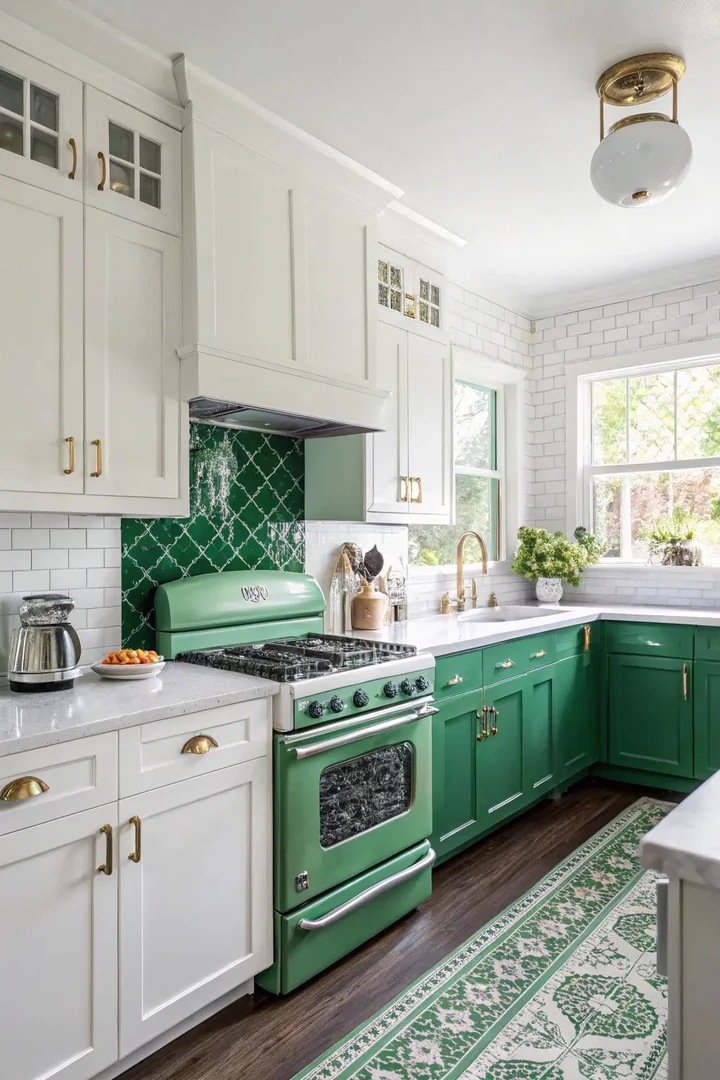
An all-emerald cabinet kitchen with white subway tile backsplash, white marble or quartz countertops, and white ceiling and trim creates the most classic version of the emerald kitchen, where the green dominates the lower half of the room and white dominates the upper half. A 3-by-6-inch white subway tile in a brick-lay pattern ($2 per square foot from Daltile) bridges the emerald cabinets and white ceiling with a simple, proven backsplash format.
White trim (baseboards, crown molding, window casings) painted in Benjamin Moore Simply White OC-117 frames the emerald cabinets and provides a crisp edge where the green meets the wall. Nickel or chrome hardware reads cleanly against both the emerald cabinets and the white countertop, while brass adds warmth. The classic emerald-and-white formula has proven resale appeal because the white elements (countertop, backsplash, walls, ceiling) occupy 60% to 70% of the visible surface area, keeping the overall kitchen reading as bright despite the dark cabinet color. Visit DIY kitchen ideas for budget-friendly cabinet painting approaches.
19. Emerald Gallery Wall with Bold Artwork
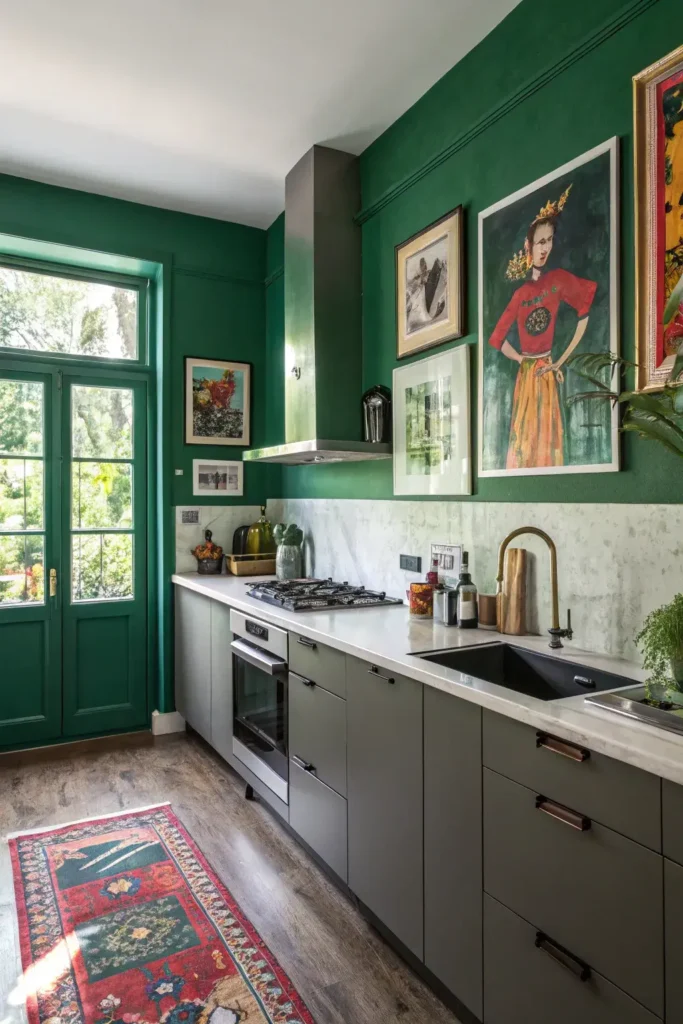
Hanging oversized framed artwork or a 3-to-5-piece gallery wall on an emerald-painted kitchen wall transforms the kitchen into a living space that blurs the boundary between cooking area and art gallery. Botanical prints, abstract paintings in complementary warm tones (gold, coral, cream), and vintage food illustration prints ($30 to $100 framed from Etsy or Minted) work against emerald because the dark green wall provides contrast that makes lighter artwork glow.
Use thin brass or black metal frames for a modern gallery feel, or ornate gold frames for a maximalist, collected look. Position art at eye level (center of the piece at 57 to 60 inches from the floor) and maintain consistent spacing (2 to 3 inches) between pieces in a multi-frame arrangement. A picture rail ($15 per 8-foot section from IKEA MOSSLANDA) allows artwork rotation without new nail holes. A single large-scale abstract (30 by 40 inches or larger) makes a stronger statement on an emerald wall than a cluster of small prints, which can read as cluttered against a bold backdrop. Browse more kitchen design guides at The Designers Company.
How to Paint Kitchen Cabinets Emerald Green
1. Select the Right Emerald Green Paint
Test 3 to 5 emerald green samples on a spare cabinet door or a 12-by-12-inch board and view them in your kitchen under morning daylight, afternoon sun, and evening LED lighting. Emerald greens with blue undertones (Benjamin Moore Manor Green 2047-20) read cooler, while emerald greens with yellow undertones (Sherwin-Williams Derbyshire SW 6741) read warmer. A paint with LRV 8 to 15 delivers the saturated jewel-tone emerald that most homeowners picture. LRV below 5 reads almost black in low-light kitchens.
2. Clean, Sand, and Prime Every Surface
Degrease all cabinet surfaces with Krud Kutter original cleaner ($8 per quart) to remove cooking residue that prevents paint adhesion. Sand every surface with 150-grit sandpaper to scuff the existing finish. Apply one coat of Zinsser BIN shellac-based primer ($25 per quart) to block tannin bleed from oak and prevent yellow discoloration under the dark green paint. Primer is especially important when covering a light-colored existing cabinet because any missed spot shows as a lighter patch under the saturated emerald topcoat.
3. Apply Two Coats with a Foam Roller and Brush
Use Benjamin Moore Advance ($55 per gallon) in satin or Sherwin-Williams Emerald Urethane Trim Enamel ($75 per gallon) in satin for the hardest, most durable emerald finish achievable with brush-and-roller application. Apply the first coat with a 4-inch high-density foam roller on flat surfaces and a Wooster Chinex FTP brush ($15) on panel details. Wait 16 to 24 hours between coats, sand lightly with 220-grit, remove dust with a tack cloth, and apply the second coat. The deep emerald pigment requires two full coats for even coverage.
Emerald Green Paint and Metal Pairing Comparison
| Paint Shade | Undertone | LRV | Best Metal Pairing | Best Countertop | Kitchen Style |
|---|---|---|---|---|---|
| BM Green Bay 2045-20 | Balanced | 10 | Brushed brass | White marble, white quartz | Traditional, transitional |
| SW Derbyshire SW 6741 | Warm (yellow) | 8 | Unlacquered brass, copper | Walnut butcher block | Craftsman, farmhouse |
| F&B Beverly No. 310 | Balanced | 11 | Polished brass, gold | Calacatta marble | Glam, maximalist |
| BM Forest Green 2047-10 | Cool (blue) | 5 | Matte black | Dark gray granite | Moody, dramatic |
| F&B Arsenic No. 214 | Cool (blue) | 7 | Satin nickel, chrome | Gray quartz, soapstone | Modern, contemporary |
| BM Manor Green 2047-20 | Cool (blue) | 8 | Polished chrome | White quartz, concrete | Scandinavian, minimalist |
Frequently Asked Questions
Does emerald green work in a small kitchen?
Emerald green works in small kitchens when confined to one surface: the island, the lower cabinets (with white uppers), or a single accent wall. A full emerald cabinet wrap in a kitchen under 100 square feet with limited natural light can read as dark and enclosed. A two-tone approach (emerald lowers, white uppers) or a single emerald accent wall provides the jewel-tone impact without shrinking the perceived room size. Semi-gloss or high-gloss finish reflects light and brightens the green surface in smaller spaces.
What countertop material pairs best with emerald green cabinets?
White marble (Carrara, Calacatta) and white quartz (Caesarstone Pure White, Cambria Brittanicca) provide the strongest contrast and the most popular pairing. Walnut and white oak butcher block adds warmth and an organic quality. Gray soapstone and dark granite extend the deep-tone palette for moody, dramatic kitchens. Verde Alpi green marble creates a tonal green-on-green layering. Avoid matching the countertop green to the cabinet green exactly, which flattens the kitchen. A contrast of at least 3 shades between the two green surfaces creates enough separation for the eye.
Is emerald green a trend or a timeless color?
Emerald green has appeared in kitchen design continuously since the Arts and Crafts movement of the 1890s, the Art Deco period of the 1920s, and the mid-century period of the 1950s and 1960s. Green cabinets appeared on the NKBA’s top-10 cabinet color list every year from 2019 through 2024. Emerald’s gemstone association and botanical resonance give the color a cross-decade appeal that trend-dependent colors (millennial pink, ultra violet) lack. Homeowners planning to sell within 2 years should pair emerald with white to broaden buyer appeal.
What wall color works with emerald green cabinets?
White walls (Benjamin Moore Chantilly Lace, Sherwin-Williams Extra White) provide the safest, brightest backdrop. Warm white walls (Benjamin Moore White Dove OC-17) soften the contrast and add warmth. Light gray walls (Sherwin-Williams Repose Gray SW 7015) create a muted, sophisticated background. Blush pink walls (Farrow & Ball Setting Plaster) add a complementary botanical accent. Avoid medium green or teal walls, which compete with the emerald cabinets and create a monochromatic overload without enough contrast to distinguish the two surfaces.
Can you use emerald green in a rental kitchen without painting cabinets?
Peel-and-stick contact paper in emerald green from d-c-fix ($15 per 17-by-78-inch roll) wraps cabinet doors and drawer fronts without permanent modification. Emerald green removable wallpaper on one wall ($40 per roll from Tempaper) adds the color as an accent. Emerald bar stools, pendant shades, dish towels, and ceramic accessories inject the green tone through furnishings that leave with the renter. All three approaches reverse cleanly without affecting the security deposit or requiring landlord approval.