
Grey Kitchen Cabinet Ideas: 14 Elegant Trends Designers Love Right Now
Grey kitchen cabinet ideas span cool blue-grays like Benjamin Moore Hale Navy HC-154 and Sherwin-Williams Web Gray SW 7075 to warm greige tones like Farrow & Ball Pavilion Gray No. 242 and Benjamin Moore Revere Pewter HC-172. Grey cabinets occupy the neutral zone between white and black, pairing with marble, butcher block, concrete, and quartz countertops without the maintenance concerns of all-white paint or the visual weight of all-dark stain. Below are 14 grey cabinet approaches organized by shade, finish, hardware, and kitchen style, followed by a painting guide, a comparison table, and FAQs on paint selection, finish types, and resale value.
1. Modern Flat-Panel Grey Cabinets with Minimal Hardware
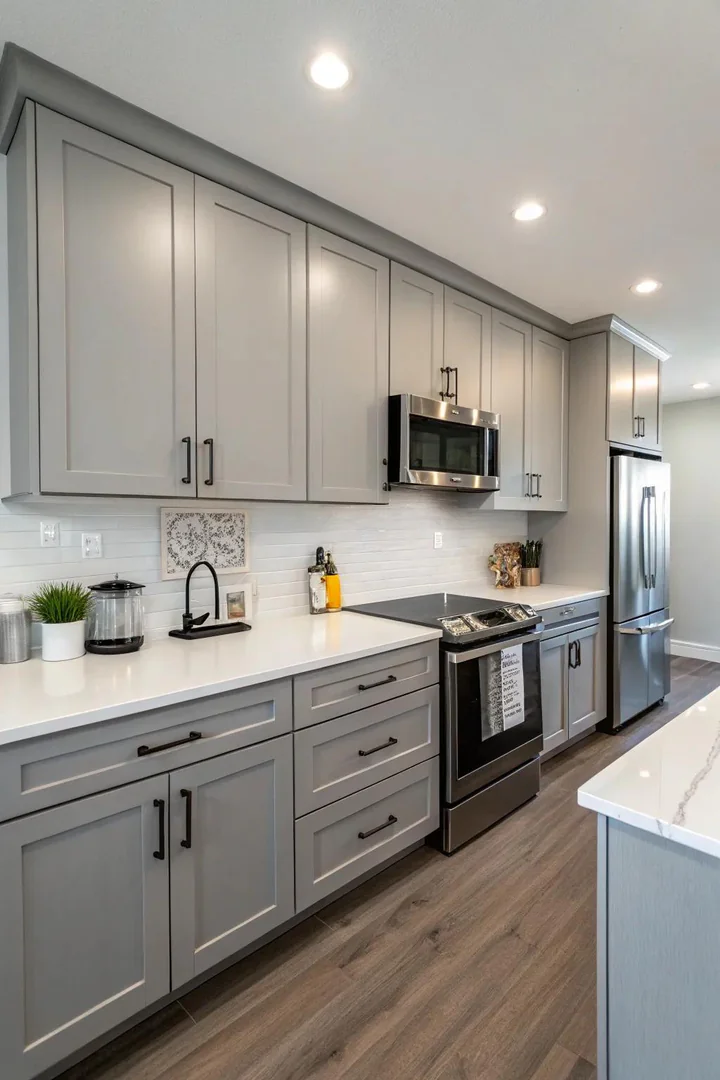
A flat-panel (slab-front) cabinet painted in Sherwin-Williams Gauntlet Gray SW 7019 or Benjamin Moore Kendall Charcoal HC-166 strips the cabinet door to a single flat plane that relies on color and material rather than molding for its design. Flat-panel grey cabinets suit modern, contemporary, and Scandinavian kitchens where clean lines and minimal ornamentation define the style. Integrated j-pull handles routed into the top edge of the door or push-to-open latches from Blum Tip-On ($5 per unit) eliminate visible hardware entirely.
A medium-dark grey (LRV 20 to 35) on flat-panel doors reads substantial without absorbing all available light. Pair with white quartz countertops from Caesarstone Pure White 1141 ($60 per square foot) for a two-tone palette where the countertop provides brightness and the cabinets provide depth. Matte or eggshell paint finishes hide surface imperfections better than semi-gloss on flat-panel doors because there are no raised profiles to cast shadows that distract from sheen irregularities.
2. Open-Layout Grey Kitchen with Glass Partition
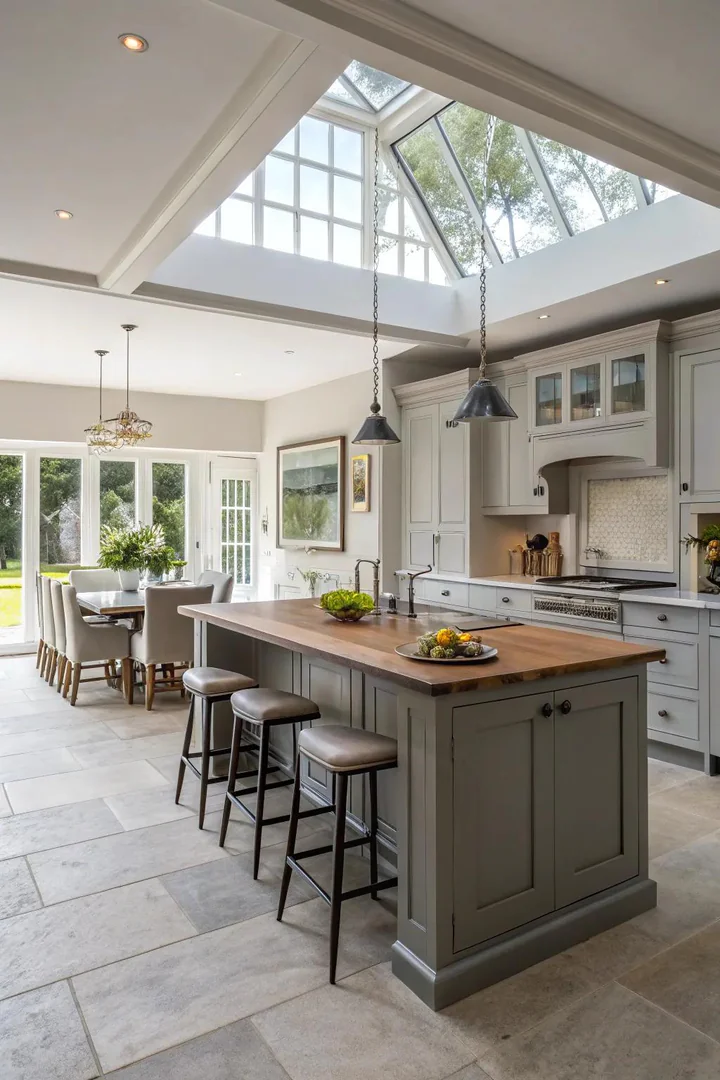
Grey cabinets in an open-plan kitchen that flows into a dining or living area benefit from a steel-and-glass partition or a half-wall peninsula that defines the cooking zone without closing off sight lines. Farrow & Ball Lamp Room Gray No. 88 or Benjamin Moore Chelsea Gray HC-168 on the cabinets creates a mid-tone grey that reads as a warm neutral from the living area side, anchoring the kitchen as a distinct zone within the open floor plan.
An open-layout grey kitchen needs consistent flooring across both zones (kitchen and living) to maintain visual flow. Wide-plank white oak or luxury vinyl plank in a warm greige tone connects the grey cabinets to the adjacent room without introducing a threshold strip. A waterfall-edge grey quartz island positioned at the boundary between kitchen and living area serves as both a visual divider and a functional seating bar that faces the living room.
3. Grey Cabinets with Unexpected Color Accents
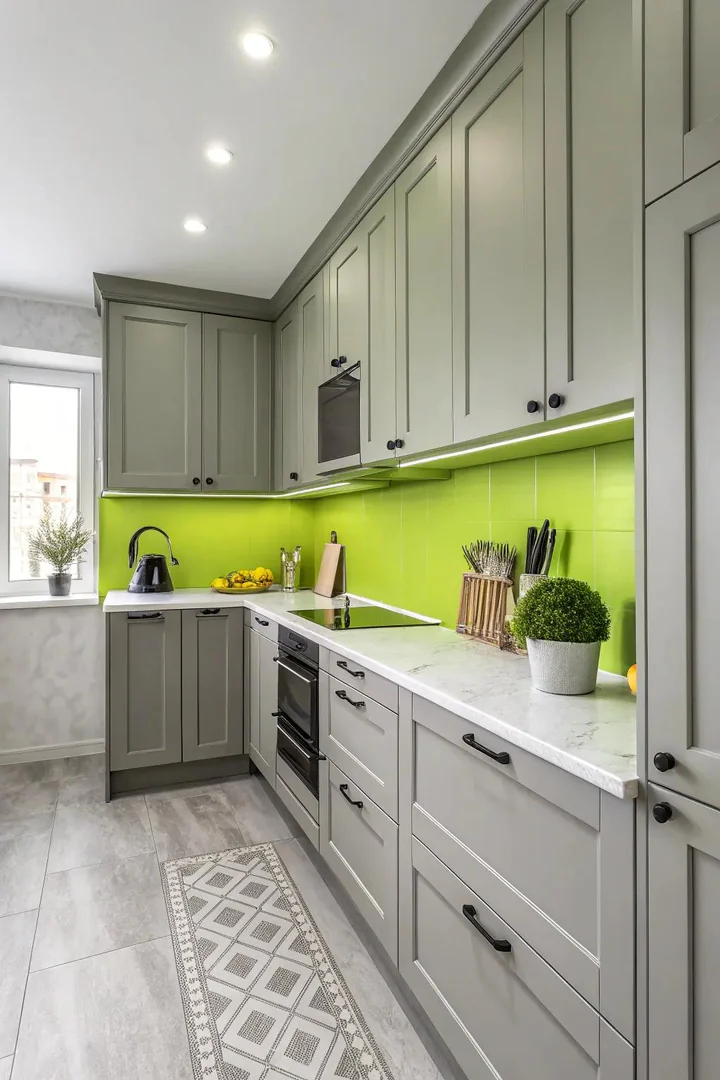
Painting the island or a single bank of lower cabinets in an accent color while keeping the perimeter cabinets grey creates a two-tone kitchen where the accent draws the eye without overwhelming the neutral palette. Farrow & Ball Hague Blue No. 30 (deep navy), Benjamin Moore Salamander 2050-10 (forest green), or Sherwin-Williams Cavern Clay SW 7701 (terracotta) pair with medium grey perimeters because grey absorbs and complements saturated hues without competing.
Limit the accent color to 20% to 30% of the total cabinet surface area (typically one island or one lower run) so the grey remains the dominant tone. Coordinate the accent cabinet hardware with the perimeter grey hardware in the same metal finish (brushed brass, matte black, or satin nickel) to unify the two colors through a shared metallic thread. A grey kitchen with a navy island and brass hardware references a classic British library palette translated into a kitchen context.
4. Tonal Grey Gradient from Light Uppers to Dark Lowers
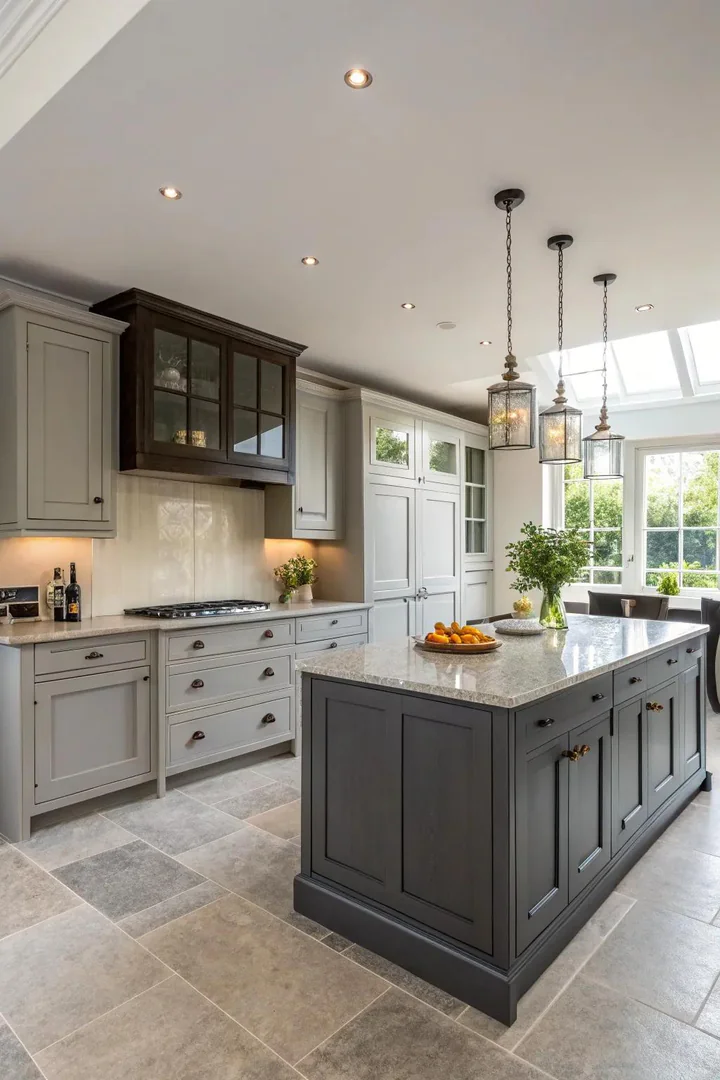
Painting upper cabinets in Benjamin Moore Stonington Gray HC-170 (light, LRV 59) and lower cabinets in Benjamin Moore Wrought Iron 2124-10 (near-black, LRV 6) creates a tonal gradient that grounds the kitchen visually: heavy at the base, airy at eye level. The two greys share a neutral undertone (neither blue nor green) so they read as the same color at different intensities rather than two unrelated paints.
A tonal gradient works best when the countertop bridges the two shades. A mid-grey quartz or marble countertop sits between the light uppers and dark lowers, connecting the transition. White countertops create a sharp break between the dark lowers and the light uppers, which some designers prefer for stronger definition. A charcoal countertop extends the dark lower zone upward and pushes the tonal break to the backsplash-to-upper-cabinet junction instead. Explore countertop options that complement grey cabinets at white kitchen gray countertops ideas.
5. Grey Cabinets with Integrated Appliance Panels
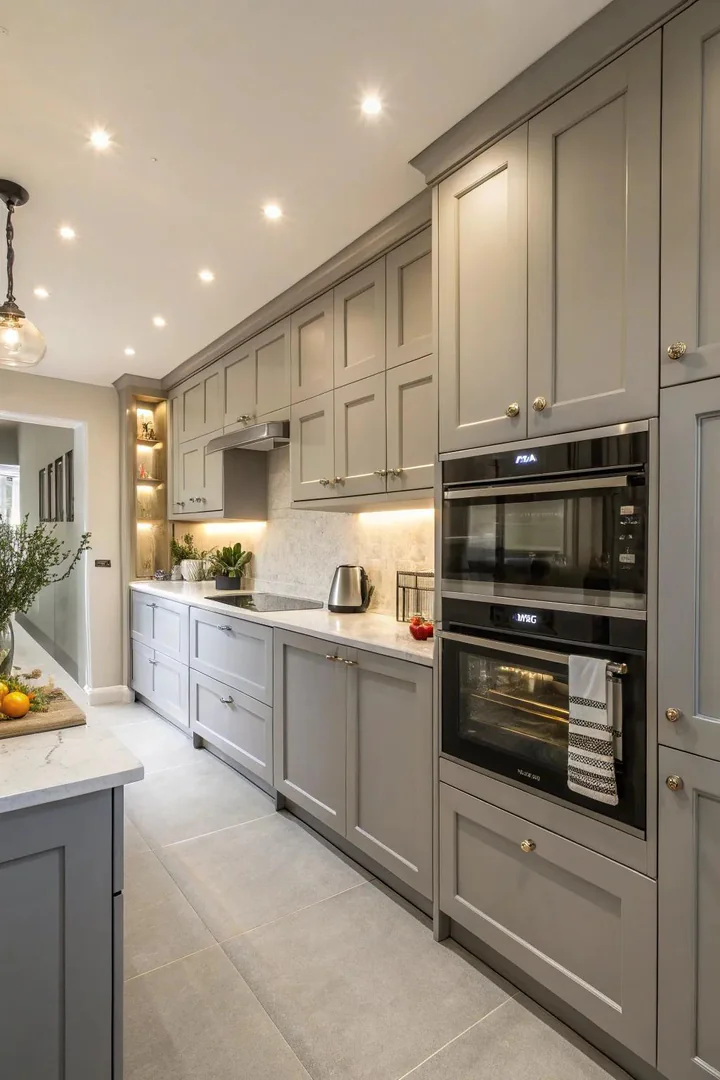
A panel-ready refrigerator from Bosch Benchmark ($4,800) or Thermador Freedom T36BT925NS ($5,200) accepts a custom grey cabinet panel that makes the 36-inch-wide appliance disappear into the grey cabinet wall. Panel-ready dishwashers, freezer drawers, and wine columns carry the same grey surface across every door and drawer front in the room, producing an unbroken grey facade from floor to ceiling.
Ordering appliance panels from the same cabinet shop that supplies the kitchen doors guarantees color, grain (for wood), and finish match. A panel-ready kitchen costs $2,000 to $4,000 more in appliances than a standard stainless-steel suite, but the visual payoff is a kitchen that reads as a single piece of built-in furniture. The only exposed appliance in a fully integrated grey kitchen is typically the range, which provides a deliberate contrast point in stainless steel or matte black.
6. Dark Charcoal Grey Cabinets with White Marble
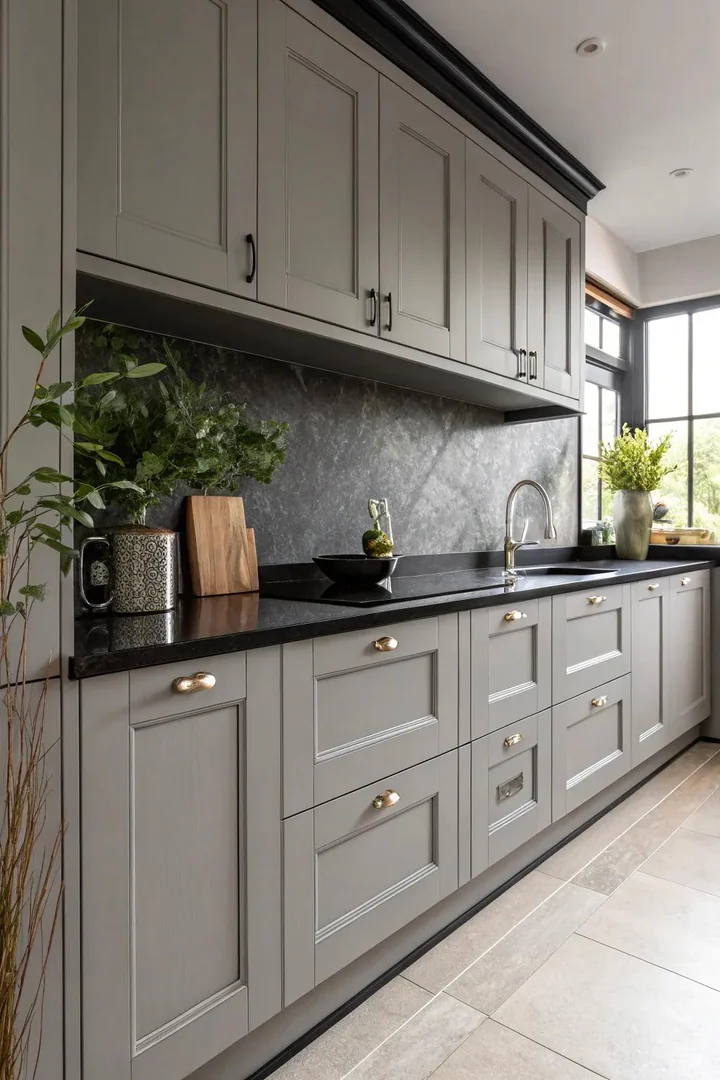
A dark charcoal grey like Benjamin Moore Iron Mountain 2134-30 (LRV 14) or Sherwin-Williams Peppercorn SW 7674 (LRV 10) paired with a Calacatta marble countertop ($80 to $120 per square foot) creates the highest-contrast version of a grey kitchen. Dark cabinets absorb light and recede visually, making the white marble countertop and backsplash glow by contrast. A kitchen with 8-foot or higher ceilings and south-facing windows handles dark charcoal without feeling cave-like.
Balance dark lower cabinets with lighter upper cabinets, open shelving, or no upper cabinets at all to prevent the room from closing in. Under-cabinet LED lighting in 3000K warm white washes the countertop and backsplash with light, creating a bright working zone between the dark upper and lower cabinet planes. Brass or gold hardware from Emtek Select ($12 per pull) provides warm contrast against dark grey paint and prevents the hardware from disappearing into the cabinet surface the way black hardware would.
7. Under-Cabinet and In-Cabinet LED Lighting
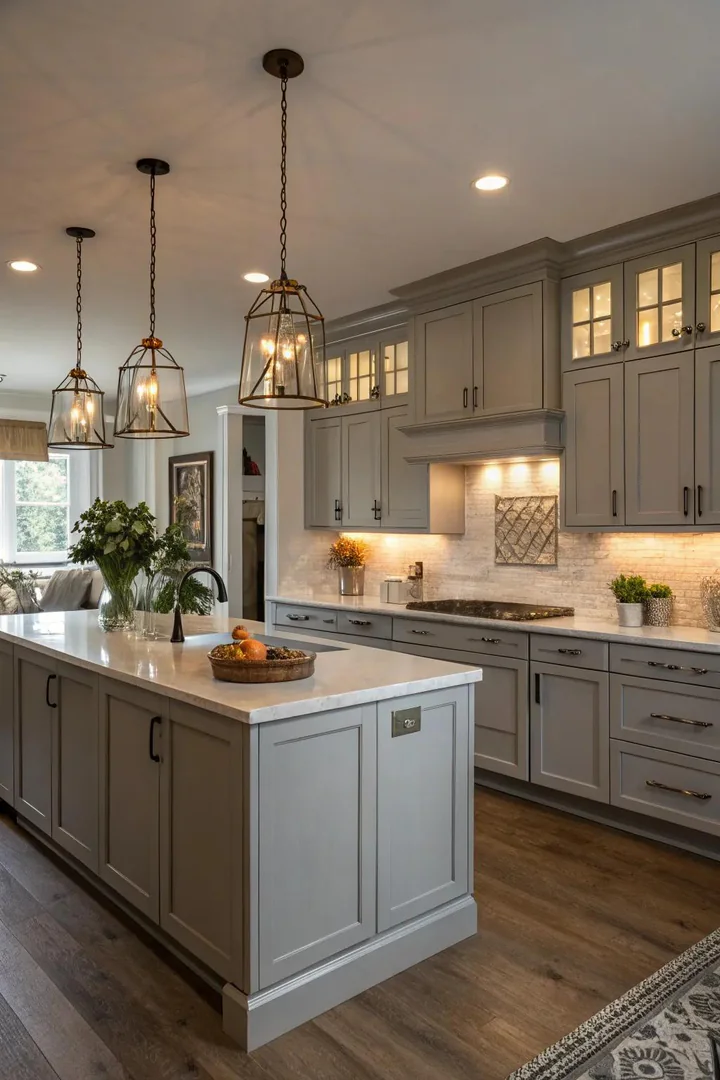
Grey cabinets absorb 40% to 70% more light than white cabinets (depending on LRV), making supplemental lighting a design requirement rather than an optional upgrade. Under-cabinet LED strip lights from WAC Lighting InvisiLED ($50 per 2-foot section) or Philips Hue LightStrip ($80 for a 6-foot strip with smart dimming) illuminate the countertop work zone with even, shadow-free light that the overhead ceiling fixture cannot provide at that angle.
In-cabinet LED puck lights from GE Enbrighten ($15 for a 3-pack) inside glass-front upper cabinets turn displayed glassware and ceramics into backlit art. A 2700K to 3000K color temperature brings out warm undertones in grey paint (greige, taupe) and prevents the grey from reading blue or institutional. Dimmable LED strips on a wall switch or smart plug allow the lighting intensity to shift from full task brightness during cooking to ambient glow during dinner. Browse more ways to pair lighting and storage in grey kitchens at kitchen storage ideas.
8. High-Gloss Lacquered Grey Cabinets
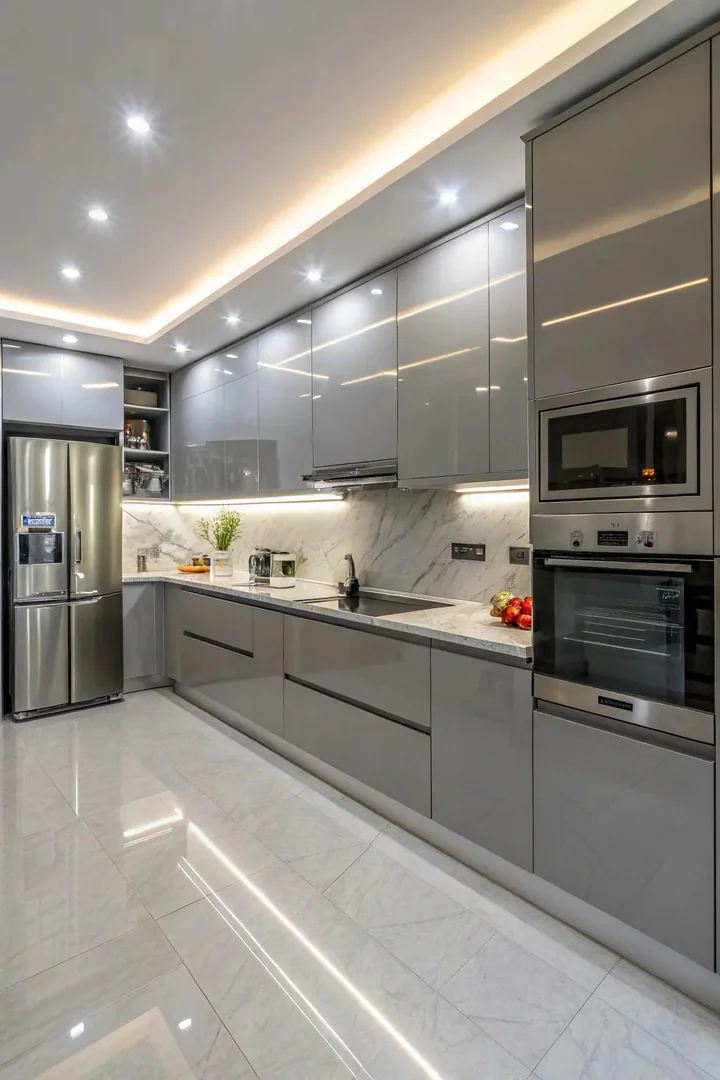
A high-gloss lacquer finish on grey cabinets from IKEA RINGHULT ($75 per door) or a custom spray-lacquer finish ($150 to $250 per linear foot) reflects light like a mirror, making a medium grey cabinet read brighter and more spacious than the same grey in matte. High-gloss grey suits modern, Art Deco, and European-contemporary kitchens where the reflective surface becomes part of the lighting strategy. The lacquered surface bounces under-cabinet and pendant light across the room, amplifying the effect of every fixture.
High-gloss finishes show fingerprints, water spots, and surface scratches more visibly than matte or satin finishes. A microfiber cloth and a spray of diluted white vinegar remove fingerprints without streaking. Grey-green or grey-blue high-gloss lacquer (like Farrow & Ball Pigeon No. 25 in full gloss) adds color depth that a neutral grey gloss lacks. Pair high-gloss grey cabinets with matte countertops (honed marble, leathered granite) to create a reflective-versus-matte contrast that gives each surface its own role.
9. Two-Tone Grey and White Cabinet Mix
Painting lower cabinets grey and upper cabinets white is the most popular two-tone kitchen formula because the heavier color sits at the base (grounding the room) and the lighter color sits at eye level (opening the space). Sherwin-Williams Dorian Gray SW 7017 on the lowers with Pure White SW 7005 on the uppers creates a warm mid-tone pairing. Benjamin Moore Pike’s Peak Gray 2127-50 on the lowers with Chantilly Lace OC-65 on the uppers creates a cooler, crisper split.
The countertop color should relate to both the grey lowers and the white uppers. A white or light-veined grey quartz sits on top of the grey lowers and below the white uppers, serving as a neutral bridge. A butcher-block countertop in walnut or white oak introduces a warm wood tone that softens the paint-to-paint transition. Two-tone kitchens need consistent hardware across both cabinet colors to unify the design. One metal finish (brushed brass, matte black, or satin nickel) on every door and drawer keeps the two-tone reading as one kitchen, not two rooms.
10. Grey Cabinets Styled with Ceramic and Copper Decor
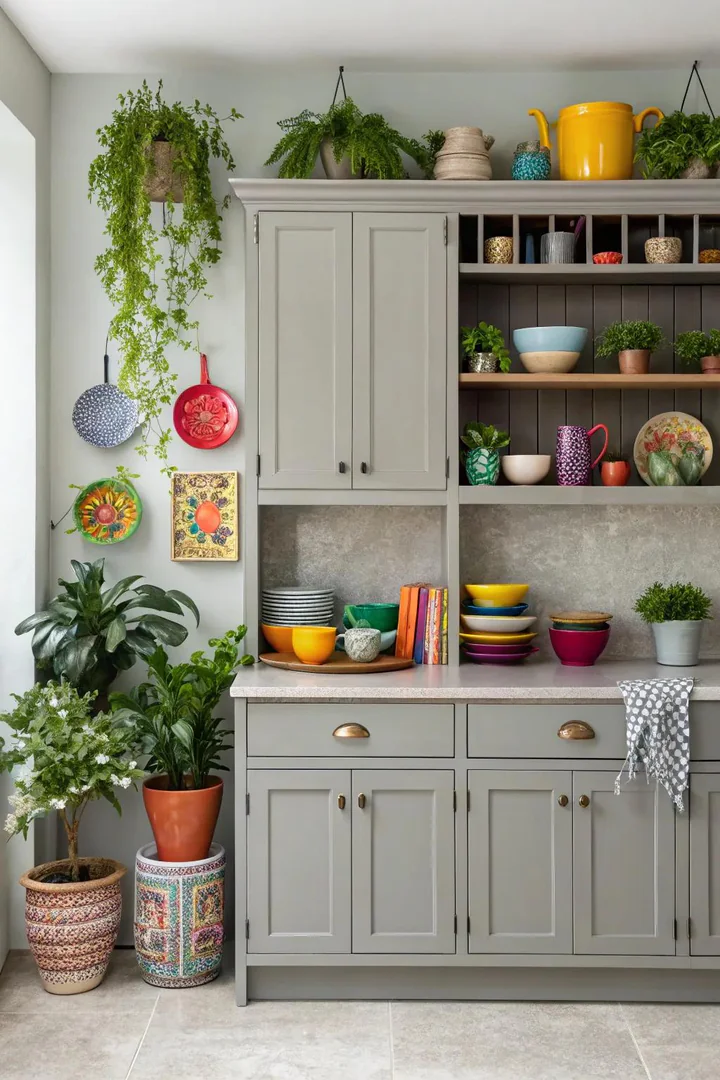
Grey cabinets serve as a neutral backdrop that amplifies decorative objects placed on countertops, open shelves, and windowsills. Handmade ceramic vases from East Fork Pottery ($50 to $120) in sage, rust, or cream, copper canisters from Williams Sonoma ($40 per set), and live herb pots in terracotta add warm, organic textures that prevent a grey kitchen from feeling flat or monotone.
Group decor in odd numbers (3 or 5 objects per display zone) and vary the heights within each group. A tall copper canister, a medium ceramic bowl, and a short potted herb create a triangular composition that the eye moves through naturally. Limit decor colors to 2 or 3 (warm metallics, greens, and one earthy tone) to maintain the restrained palette that grey cabinets establish. Avoid cluttering every surface: one styled vignette on the counter, one on the open shelf, and one on the windowsill fills the room without crowding it.
11. Grey Island with Built-In Bar Seating
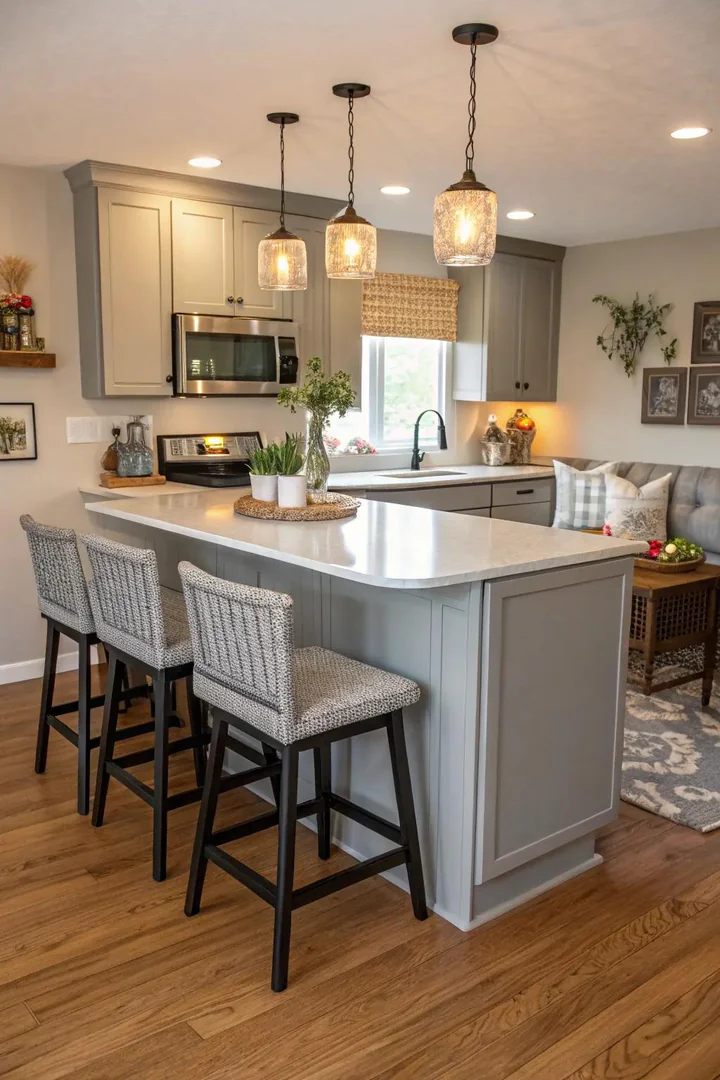
A grey-painted island with a 12-to-15-inch countertop overhang on one side accommodates 26-inch counter-height stools from Article Esse ($199 each) or West Elm Slope ($249 each) for casual dining and morning coffee seating. The island’s grey paint can match the perimeter cabinets for a unified look or shift one shade darker for subtle definition. A 96-inch-long island seats three adults comfortably with 24 inches of counter width per stool.
A waterfall-edge island wraps the grey countertop material down the island’s ends to the floor, turning the seating side into a solid stone panel. A paneled island base with Shaker-style grey cabinet doors on the non-seating sides provides closed storage for pots, platters, and small appliances. A combination island with drawers on the cooking side and open shelving on the seating side creates two distinct functional zones within the same grey structure. Browse ideas to maximize kitchen cabinet space for more island storage solutions.
12. Glass-Front Upper Cabinets in Painted Grey Frames
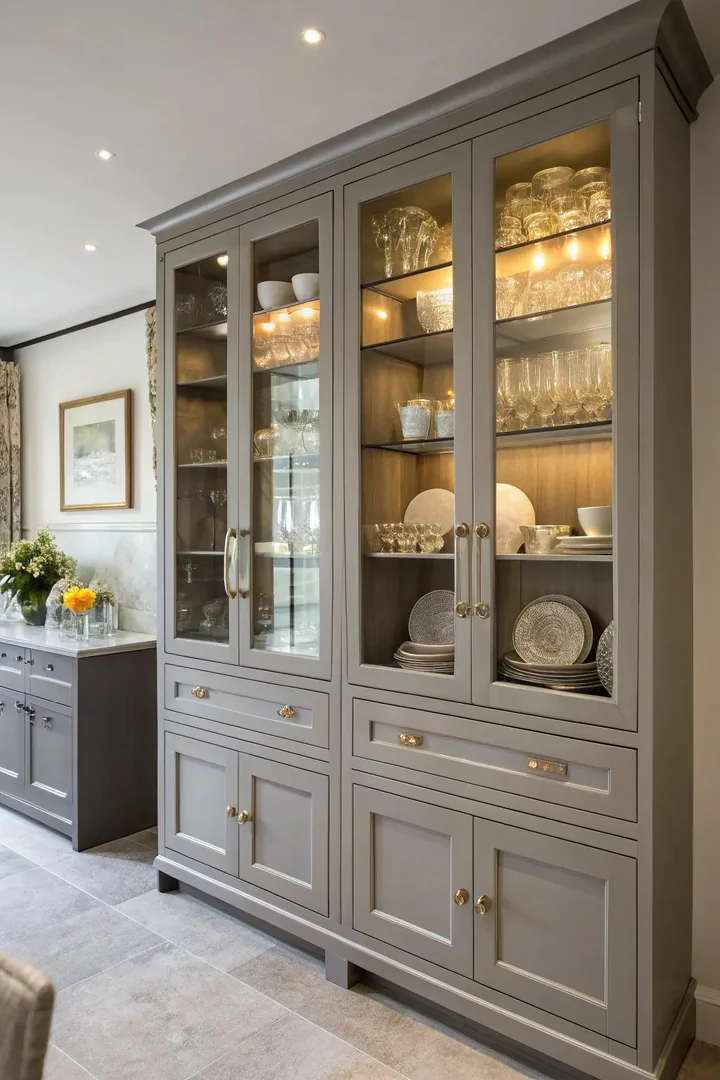
Replacing solid upper cabinet doors with glass-panel inserts in clear, seeded, or reeded glass turns grey cabinet frames into display cases for white dishware, crystal glassware, and curated ceramics. IKEA SEKTION/JUTIS glass doors ($50 per door) or custom glass-panel inserts from a local cabinet shop ($80 to $150 per door) maintain the grey frame while opening the center panel to view the interior contents.
Clear glass requires organized, curated cabinet contents because every item is visible. Seeded glass (with small embedded bubbles) and reeded glass (with vertical ribbing) obscure the contents slightly, allowing a less-than-perfect interior arrangement to still read as attractive from across the room. Interior cabinet lights (LED puck or strip) are strongly recommended behind glass doors because the glass reflects the kitchen outward rather than letting ambient light into the cabinet. Without interior lighting, glass-front cabinets appear as dark rectangles after sunset.
13. Vintage-Inspired Grey Cabinets with Beadboard Detail
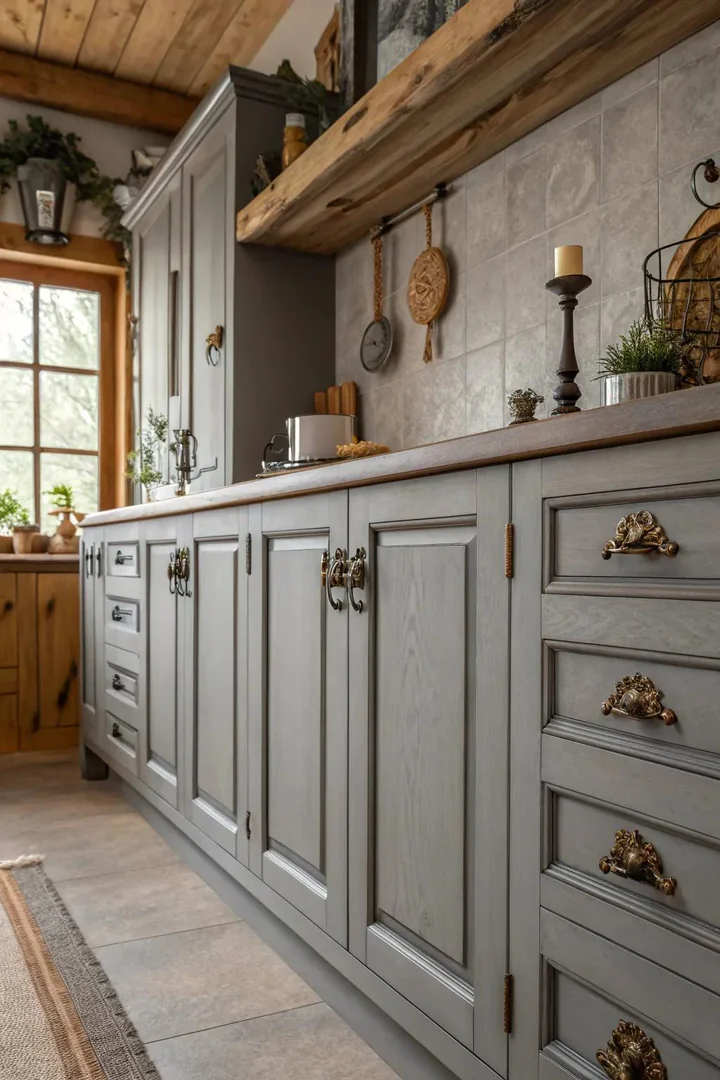
A beadboard-panel cabinet door painted in Farrow & Ball Mole’s Breath No. 276 (warm grey-brown) or Benjamin Moore Coventry Gray HC-169 (warm mid-grey) references late-1800s kitchen furniture where beadboard panels filled cabinet door frames as a decorative and structural element. The vertical grooves in beadboard create shadow lines that add texture and depth to a flat grey surface, giving the cabinets a handmade quality that slab and Shaker doors lack.
Beadboard-panel grey cabinets suit vintage, cottage, farmhouse, and Victorian-revival kitchens. Pair with unlacquered brass bin pulls from House of Antique Hardware ($15 each) and porcelain knobs with hand-painted floral motifs ($8 each) for period-accurate hardware. A soapstone countertop ($70 to $100 per square foot) in natural dark grey complements the vintage cabinet style because soapstone was the standard American farmhouse countertop from 1850 to 1920, predating granite and marble in residential kitchens.
14. Farmhouse Grey Shaker Cabinets with Apron-Front Sink
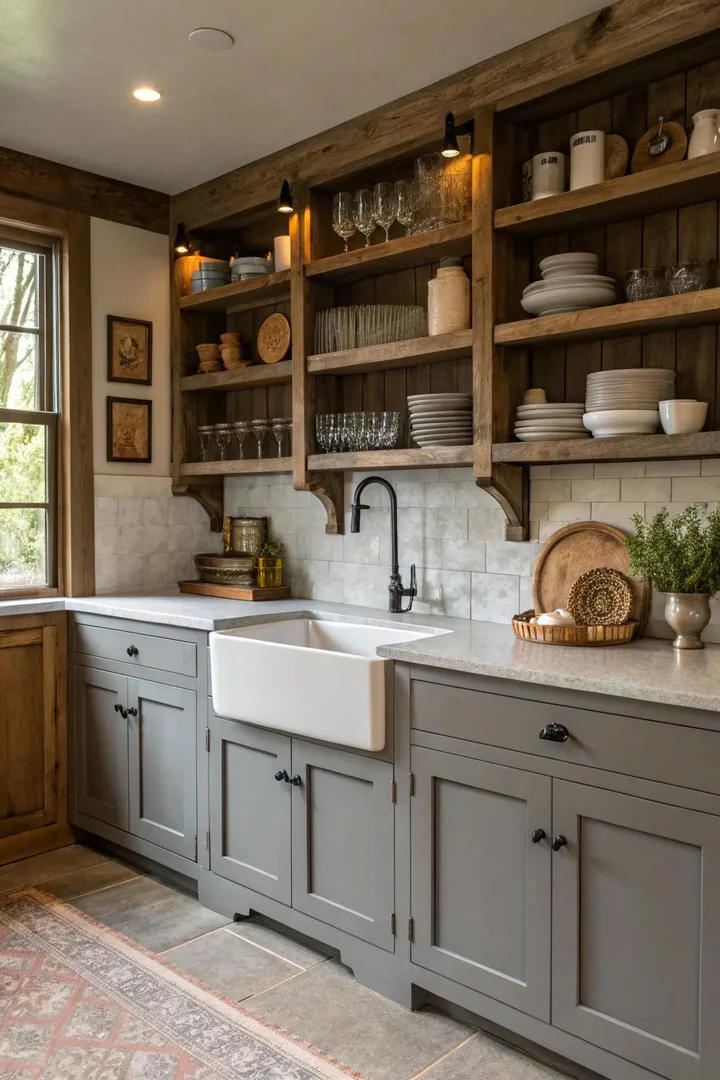
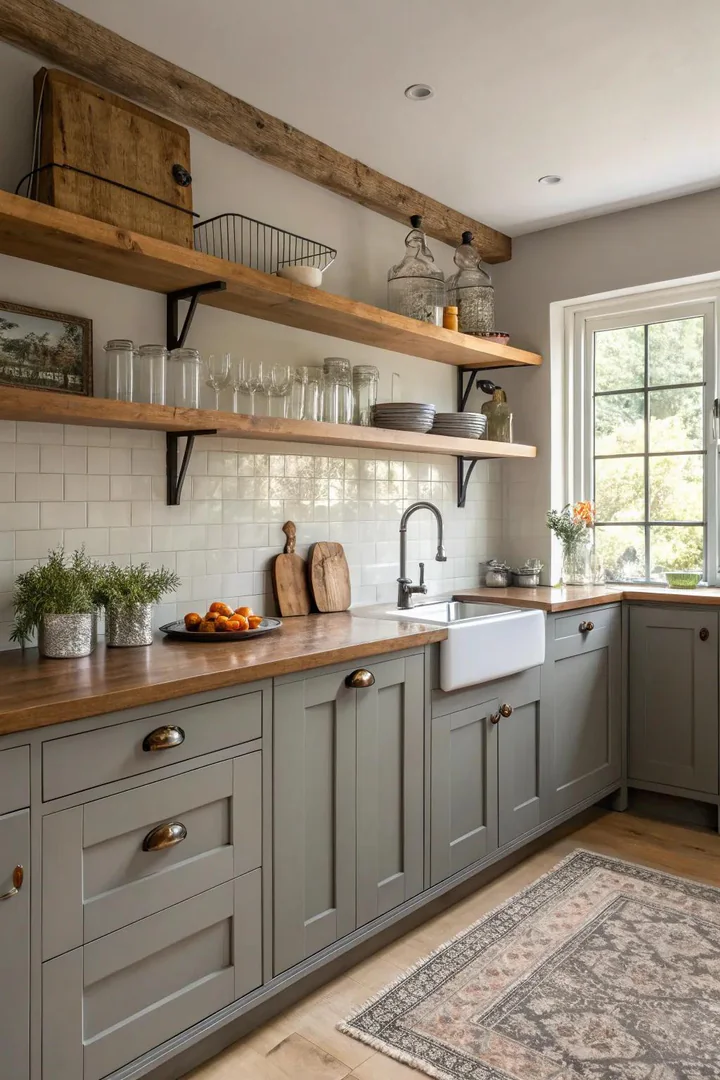
A grey Shaker cabinet painted in Sherwin-Williams Mindful Gray SW 7016 (warm greige, LRV 48) or Benjamin Moore Gray Owl OC-52 (cool light grey, LRV 65) paired with a 30-inch fireclay apron-front sink from DERADERA Fireclay ($400) or Kohler Whitehaven K-6489 ($1,100) defines the modern farmhouse kitchen. The apron sink’s exposed front panel breaks the cabinet line and creates a visual focal point at the sink zone that a standard undermount cannot produce.
Farmhouse grey cabinets pair with butcher-block countertops in white oak or maple ($40 to $60 per square foot) for a warm wood-and-paint palette, or with honed white marble ($60 to $80 per square foot) for a more polished farmhouse look. Matte black hardware from Rejuvenation Massey pulls ($10 each) and a matte black bridge faucet from Delta Broderick ($350) provide the iron-like hardware accents that reference agricultural and forge-made kitchen tools. Open wood shelving, a vintage-style pendant light from Schoolhouse Electric ($200), and a shiplap-paneled range hood wall complete the farmhouse material story. See more ways to pair grey cabinets with backsplash and accent colors at emerald green kitchen design ideas, and visit The Designers Company for the full kitchen design library.
How to Paint Kitchen Cabinets Grey
1. Remove Doors, Drawers, and Hardware
Label each door and drawer with a numbered piece of painter’s tape and mark the corresponding cabinet box with the same number so every piece returns to its original location. Remove hinges, pulls, and knobs and store them in a labeled zip-lock bag per door. A cordless drill with a #2 Phillips bit speeds removal. Photograph the hinge placement on each door before removing so you can reinstall at the exact screw holes without measuring.
2. Clean, Sand, and Prime All Surfaces
Wipe every surface with Krud Kutter original cleaner ($8 per quart) to dissolve kitchen grease that paint cannot bond to. Sand all surfaces with 150-grit sandpaper or a 3M sanding sponge to scuff the existing finish and create mechanical tooth for the primer. Apply one coat of Zinsser BIN shellac-based primer ($25 per quart) or KILZ Adhesion primer ($20 per quart) to all surfaces, including edges and the inside of the face frame. Shellac-based primer blocks tannin bleed from oak and prevents yellowing under grey paint.
3. Apply Two Coats of Grey Cabinet Paint
Use a 4-inch Wooster Chinex FTP brush ($15) for panel details and a 4-inch high-density foam roller ($5 for a 2-pack) for flat faces. Benjamin Moore Advance ($55 per gallon) in satin finish or Sherwin-Williams Emerald Urethane Trim Enamel ($75 per gallon) in satin provide the hardest, most durable cabinet paint finishes available in a brush-and-roller application. Apply the first coat, wait 16 to 24 hours for full cure, sand lightly with 220-grit, remove dust with a tack cloth, and apply the second coat. Two thin coats produce a smoother, harder finish than one thick coat.
4. Reinstall Hardware and Doors
Wait 72 hours after the second coat before handling the doors to avoid fingerprints in soft paint. Reinstall hinges first (the tape numbers match doors to cabinet boxes), then hang the doors and adjust the hinge screws for even gaps. Install new hardware if upgrading from knobs to pulls (fill old knob holes with wood filler, sand, and touch up with matching paint). A full kitchen with 20 doors and 10 drawers requires 3 to 5 days from start to finish, including cure time between coats.
Grey Cabinet Paint and Finish Comparison
| Paint Brand/Line | Price per Gallon | Finish Options | Dry Time Between Coats | Durability Rating | Best Grey Shades |
|---|---|---|---|---|---|
| Benjamin Moore Advance | $55 | Matte, satin, semi-gloss | 16 hours | Excellent (alkyd hybrid) | Chelsea Gray, Kendall Charcoal |
| Sherwin-Williams Emerald Urethane | $75 | Satin, semi-gloss | 16 hours | Excellent (urethane) | Dorian Gray, Gauntlet Gray |
| Farrow & Ball Modern Eggshell | $110 | Eggshell only | 4 hours (water-based) | Good | Pavilion Gray, Mole’s Breath |
| PPG Breakthrough | $50 | Satin, semi-gloss | 4 hours | Very good (acrylic-alkyd) | Gray Flannel, Pewter Mug |
| IKEA RINGHULT (pre-finished) | $75 per door | High-gloss | N/A (factory finish) | Good (foil wrap) | Grey (single shade) |
Frequently Asked Questions
What undertone should grey kitchen cabinets have?
Match the grey undertone to the room’s fixed elements (flooring, countertop, window light). North-facing kitchens with cool daylight benefit from warm grey (greige, taupe undertone) to prevent the grey from reading cold. South-facing kitchens with warm daylight handle cool grey (blue or green undertone) because the warm sunlight balances the cool paint. Hold a pure white paint chip next to the grey sample: a warm grey will look slightly brown or yellow compared to the white, and a cool grey will look slightly blue or green.
Do grey kitchen cabinets affect resale value?
Grey cabinets rank as the second most popular cabinet color (after white) in the National Kitchen & Bath Association’s 2024 design trend survey, and real estate agents report that grey kitchens photograph well in listing images. A neutral mid-tone grey (LRV 40 to 55) appeals to the widest range of buyers. Very dark charcoal or very cool blue-grey can polarize buyers, so homeowners planning to sell within 2 years should choose a safe mid-range grey like Sherwin-Williams Mindful Gray or Benjamin Moore Revere Pewter.
What hardware finish pairs best with grey cabinets?
Brushed brass and champagne bronze add warmth to grey cabinets and create a high-end look that grey-and-chrome or grey-and-nickel cannot match. Matte black hardware provides strong contrast on light grey cabinets and blends subtly into dark grey cabinets. Satin nickel and polished chrome work with cool-undertone greys (blue-grey, green-grey) because all three metals carry a silver tone. Avoid mixing more than two metal finishes per kitchen to prevent the hardware from reading chaotic.
Is it better to paint or buy pre-finished grey cabinets?
Pre-finished factory cabinets from IKEA, KraftMaid, or a semi-custom manufacturer deliver a harder, more uniform finish than on-site painting because factory spray booths apply lacquer or catalyzed varnish in controlled humidity and temperature. On-site painting costs $3,000 to $7,000 for a 20-door kitchen (labor plus materials) and allows any custom grey shade. Pre-finished cabinets limit the color selection to the manufacturer’s palette but eliminate the 3-to-5-day painting disruption. Spray-painting existing cabinets off-site (doors removed and taken to a spray shop) offers a middle ground: custom color with a factory-quality spray finish, typically $4,000 to $8,000 for a full kitchen.
What countertop material pairs best with grey cabinets?
White marble and white quartz provide the strongest contrast and the most classic pairing with grey cabinets. Butcher-block wood countertops (walnut, white oak) add warmth to cool grey cabinets. Concrete countertops extend the grey tone from cabinet to counter for a monochromatic industrial look. Black granite or soapstone creates a dramatic dark-on-grey pairing that works in kitchens with high ceilings and ample natural light. Avoid matching the countertop grey to the cabinet grey exactly, which flattens the kitchen. A 3-shade difference between cabinet and counter creates enough contrast for the eye to distinguish the two surfaces.