
Lighting Over Kitchen Sink Windows: 14 Stunning Ideas That Transform
Lighting over kitchen sink windows serves two purposes at once — it supplements the natural daylight that pours through the window during the day, and it replaces that daylight entirely after sunset when the window becomes a dark mirror. Most kitchen sink windows sit above the counter between upper cabinets, which means the standard overhead recessed lights installed in the ceiling are positioned behind the person standing at the sink, casting their shadow directly onto the dishes, the cutting board, and the drain area where visibility matters most.
The 14 lighting ideas below solve that shadow problem with fixtures specifically chosen for the above-the-sink position — under-cabinet strips, wall sconces flanking the window frame, pendants hung in front of the glass, flush mounts for low ceilings, and geometric cage pendants that add style without blocking the view through the window.
1. Lighting Below Cabinets
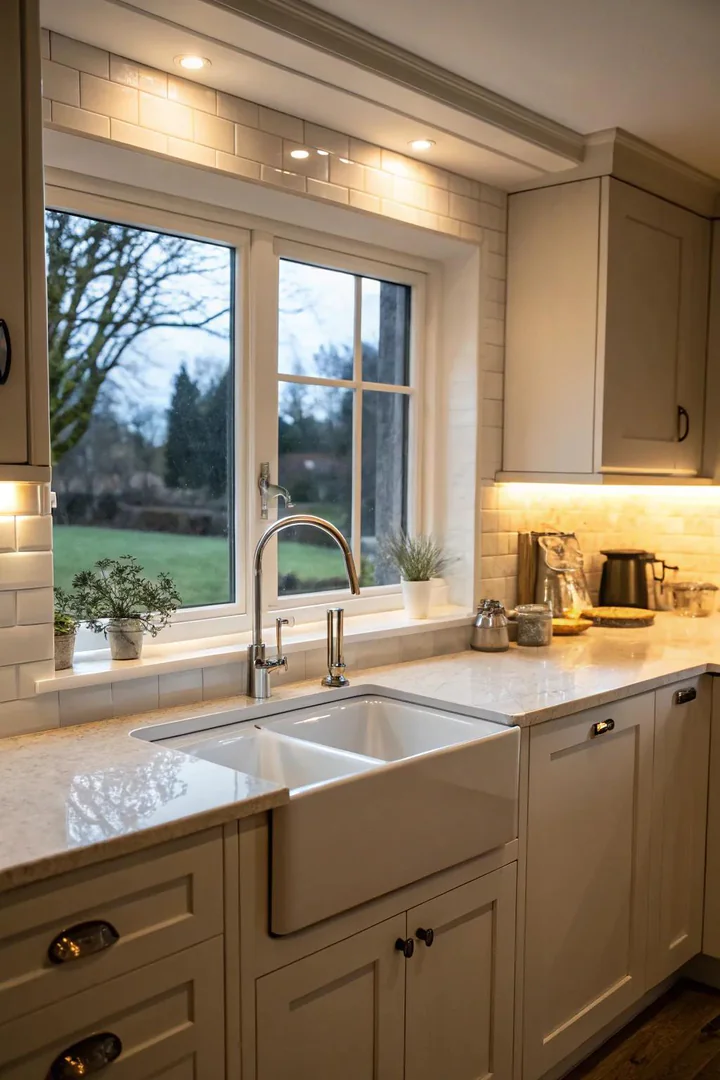
Under-cabinet lights mount to the bottom face of the upper cabinets flanking the sink window and direct light downward onto the countertop and sink basin, eliminating the shadow that overhead ceiling fixtures create behind the person standing at the sink. Because the light source sits only 18 to 24 inches above the counter surface (compared to 48 to 60 inches for a ceiling-mounted fixture), under-cabinet lights produce brighter, more focused illumination exactly where dishwashing and food prep happen.
LED puck lights (individual round fixtures 2.5 to 3 inches in diameter, surface-mounted or recessed into the cabinet bottom) and LED light bars (continuous strips 12 to 24 inches long from brands like GE, WAC Lighting, or Kichler) are the two standard formats. Puck lights create pools of focused light — install three to four across the width of the sink area, spaced 8 to 10 inches apart. Light bars create even, continuous illumination with no gaps — install one bar per cabinet that flanks the window. Choose a color temperature of 2700K to 3000K for a warm, flattering glow, or 4000K for a brighter, more clinical task light. Hardwired installations look cleanest; plug-in or battery-powered options work in rentals.
2. Light Strips with LED Technology
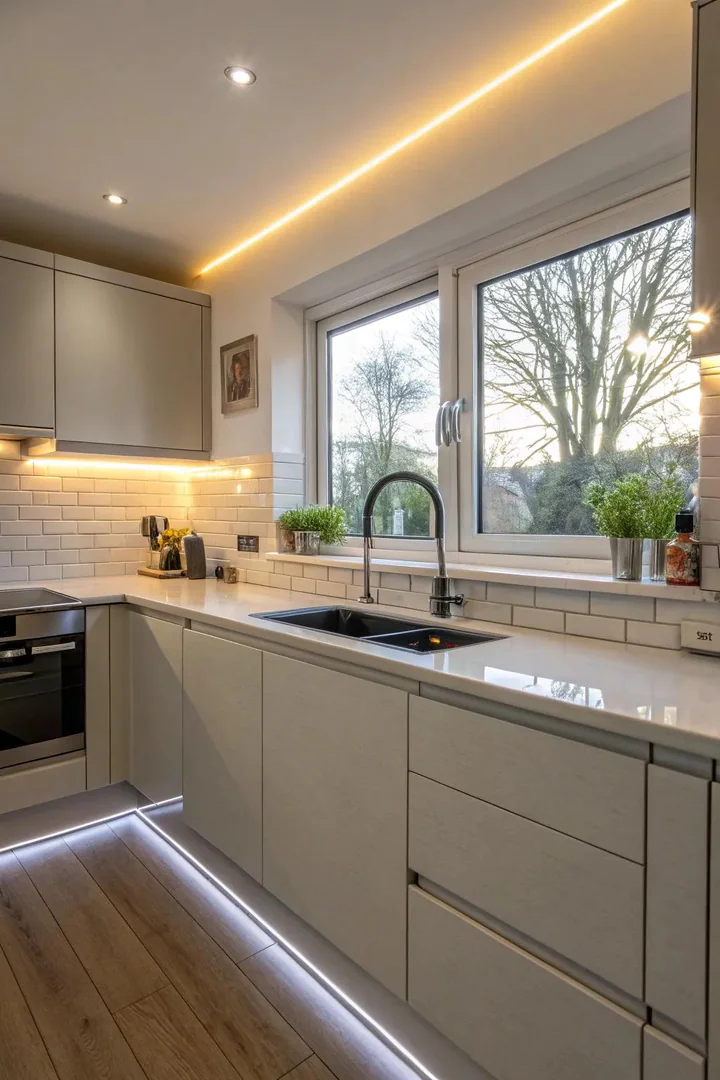
LED strip lights (also called LED tape lights) are thin, flexible strips of surface-mounted LEDs on an adhesive-backed ribbon that can be cut to custom lengths and adhered to any surface — the underside of a cabinet, the inside of a window frame, along the top of a backsplash, or inside an aluminum channel mounted to the wall. Their slim profile (typically 10mm wide and 3mm thick) makes them nearly invisible once installed, so the light appears to come from the architecture itself rather than from a visible fixture.
For kitchen sink window lighting, install LED strips in an aluminum channel with a frosted diffuser lens (from HitLights, Philips Hue, or Muzata) to prevent visible LED dots and create smooth, even light. Mount the channel to the underside of the upper cabinets on both sides of the window, or run a strip along the inside perimeter of the window frame for a backlit-window effect that glows at night. High-CRI strips (CRI 90+) render food colors accurately — important at a prep sink. Dimmable strips connected to a dimmer switch or smart-home controller (Philips Hue, Lutron Caseta) let you adjust brightness from bright task light during dishwashing to a low ambient glow during evening entertaining.
3. Wall-mounted Light Fixtures
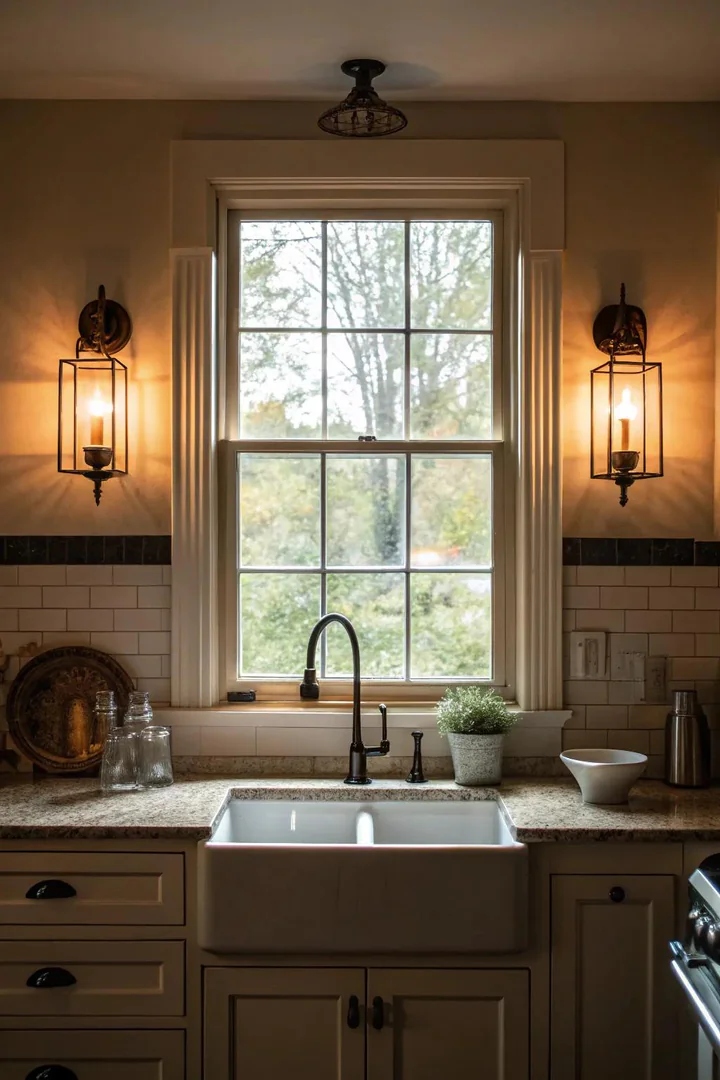
Wall sconces mounted on either side of the kitchen sink window frame light the sink area from the sides, creating balanced, shadow-free illumination similar to how bathroom sconces flank a vanity mirror. This side-lighting approach avoids the front-to-back shadow problem of overhead fixtures and adds a decorative, architectural element to the sink wall that elevates the kitchen’s overall design.
Mount one sconce on each side of the window frame, centered vertically on the window or positioned at the upper third of the window for downward-directed light. Choose sconces with upward, downward, or both-direction light output depending on the effect you want: downlights focus task illumination on the counter; uplights create ambient glow on the ceiling; bi-directional sconces provide both. Visual Comfort, Schoolhouse Electric, and Cedar & Moss all produce kitchen-appropriate wall sconces in finishes (brass, matte black, polished nickel) that coordinate with faucet and cabinet hardware. Size the sconces to the window — a 24-to-30-inch-tall window pairs with 8-to-12-inch-tall sconces; a larger window can handle 14-to-18-inch sconces.
4. Flush-Mounted Lighting
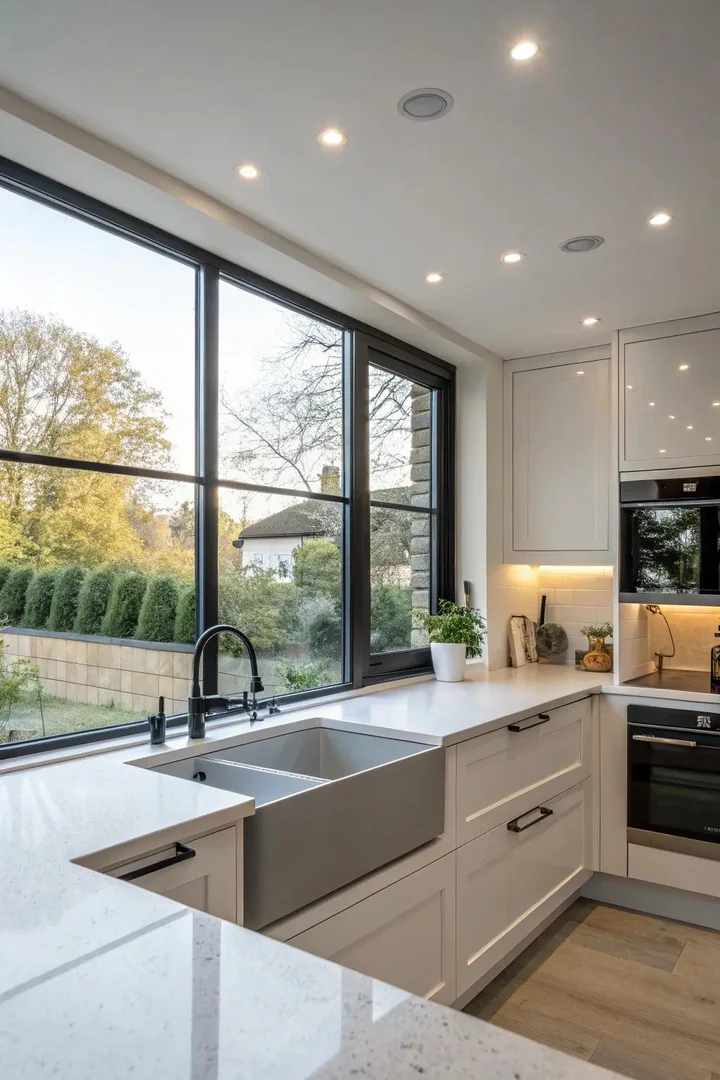
Recessed lights (also called can lights or downlights) install flush with the ceiling surface, producing a clean, minimal appearance with no visible fixture protruding into the room. For the kitchen sink window area, recessed lights positioned directly above the sink — rather than behind the cook — eliminate shadows and provide bright, focused task illumination without blocking the view through the window or competing visually with the window itself.
Install one or two 4-inch recessed LED fixtures (from Halo, Juno, or WAC Lighting) centered above the sink, spaced 24 inches apart if using two. Aim adjustable-trim recessed lights (also called eyeball trims or gimbal trims) directly at the sink basin to concentrate light where it matters most. Choose IC-rated (insulation-contact) fixtures if the ceiling above contains insulation. Pair recessed lights on a separate switch from the kitchen’s general overhead lights so you can turn on only the sink lights for dishwashing without lighting the entire kitchen. A dimmer switch adds flexibility for adjusting brightness between bright task mode and a softer ambient mode.
5. Multilayered Illumination
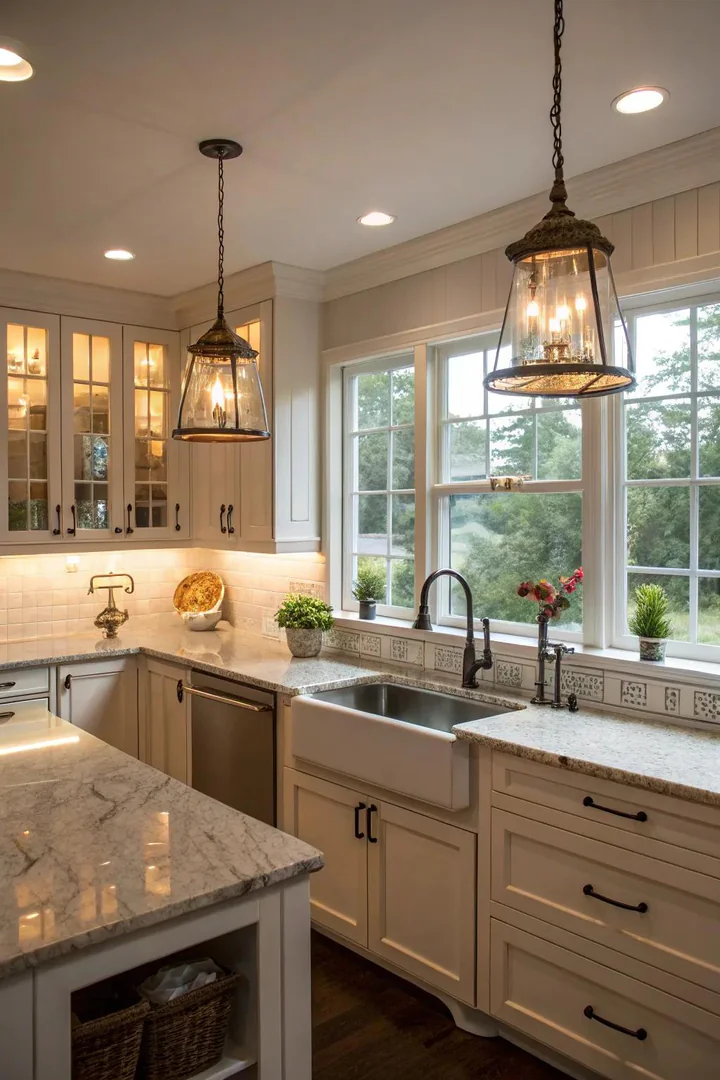
Layered lighting combines two or three types of light at the sink window — task lighting (under-cabinet LEDs or recessed downlights aimed at the sink), ambient lighting (a pendant or flush mount for general room illumination), and accent lighting (LED strips inside the window frame or along the backsplash) — so each layer can be controlled independently for different activities and times of day. A single fixture provides one light level; a layered system provides dozens of combinations.
The three-layer approach works as follows: hardwired under-cabinet LED bars on one switch provide bright task light for dishwashing and food prep. A pendant or semi-flush mount on a dimmer provides adjustable ambient light. An LED strip mounted inside the window frame on a third switch provides a decorative accent glow that makes the window visible from outside and creates a soft backlight inside. Each layer on its own dimmer (Lutron Caseta or Lutron Maestro dimmers are the most reliable residential options) gives you full control — bright task light for morning dishes, dim ambient light for evening cooking, accent-only for a nightlight effect.
6. Improvement of Natural Lighting
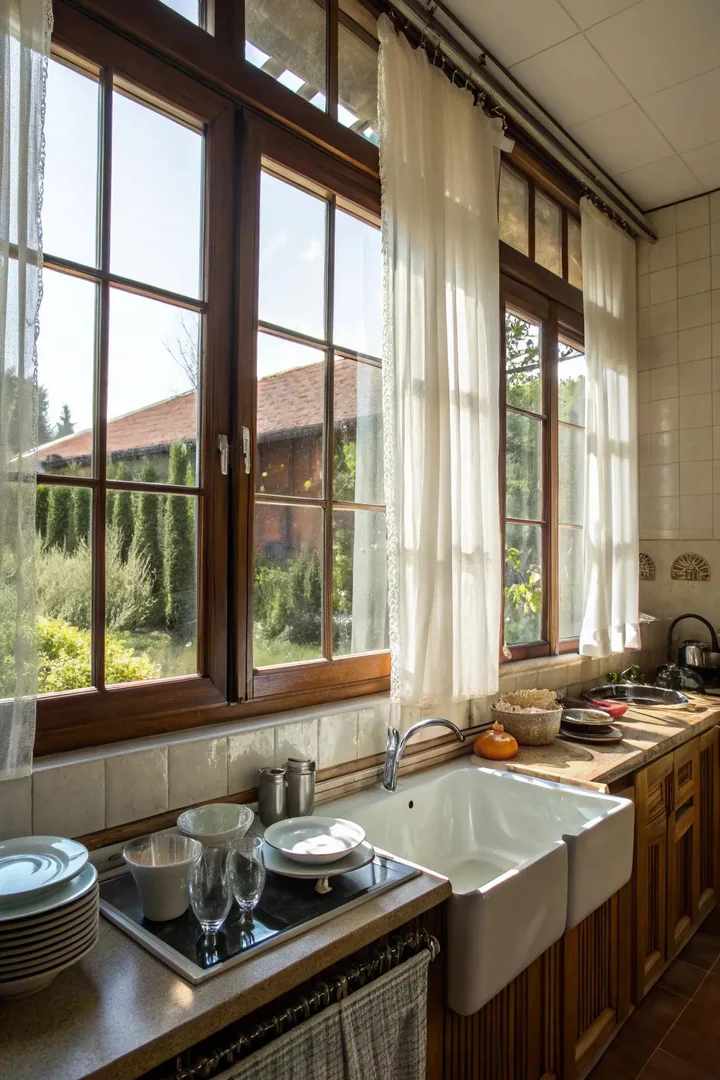
Maximizing the natural light that enters through the kitchen sink window reduces dependence on electric fixtures during the day and creates a brighter, more pleasant dishwashing and cooking experience. Natural light at the sink makes food colors look accurate, reduces eye strain during long prep sessions, and provides the vitamin-D-producing ultraviolet exposure that artificial light cannot replicate.
Start with the window treatment: replace heavy curtains or solid blinds with a sheer Roman shade (from The Shade Store or Smith & Noble) or a top-down/bottom-up cellular shade (from Hunter Douglas or Bali) that lets light through while maintaining privacy. Remove anything mounted above the window that blocks light — a rarely-used soffit, a decorative valance, or a shelf across the window top. If the window frame is dark wood, paint it white or a light color to reflect more light into the room. Install a light-colored backsplash (white subway tile, light marble, or glossy ceramic) between the window and the counter — glossy surfaces reflect up to 80% of incoming light compared to 30-40% for matte surfaces. For more on how kitchen color choices affect perceived brightness, see our dedicated guide.
7. Pendant Lights in Drum Style
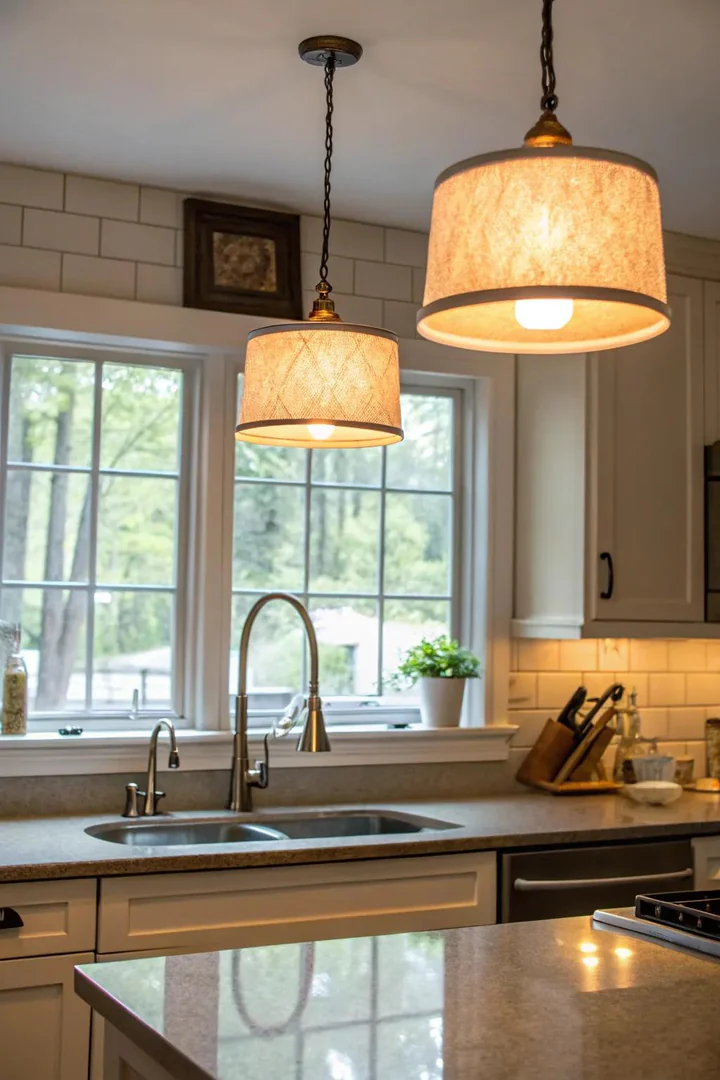
A drum pendant — a cylindrical shade (fabric, linen, metal, or frosted glass) that wraps around the bulb in a clean, geometric form — provides soft, diffused light in every direction while serving as a bold visual anchor above the kitchen sink window. The drum shape reads as a sculptural object that frames the window from above and gives the sink area a finished, designed look that bare bulbs and recessed cans cannot match.
Hang a single drum pendant centered on the window, 30 to 36 inches above the countertop and 6 to 10 inches in front of the window glass so the pendant does not press against the window frame. Choose a drum size proportional to the window width: a 10-to-14-inch-diameter drum works with windows up to 36 inches wide; a 16-to-20-inch drum suits larger windows. Fabric drum shades (from Rejuvenation, West Elm, or Pottery Barn) in linen or cotton create the softest, most diffused light. Metal drum pendants (from Hudson Valley Lighting or Arteriors) in brass, copper, or matte black create a more defined, modern statement. White or light-colored drum shades blend with the ceiling; dark drum shades create contrast and draw the eye.
8. Half-Flush Mounts
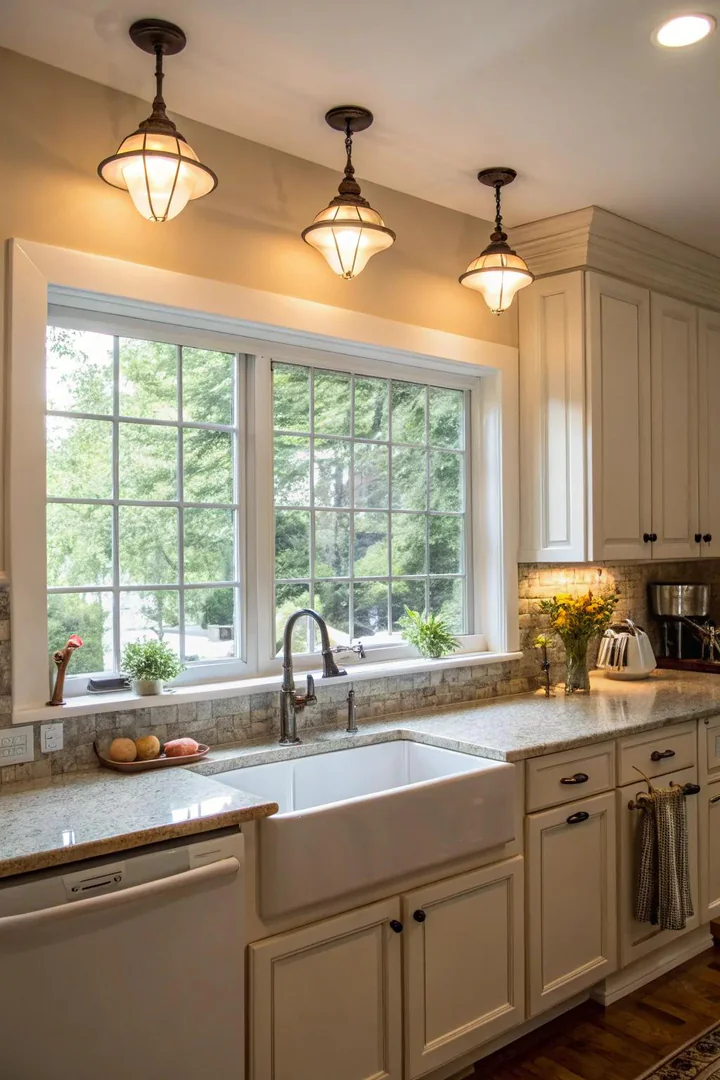
A semi-flush mount (also called a close-to-ceiling pendant) hangs 4 to 12 inches below the ceiling on a short stem or chain, splitting the difference between a flush mount that sits flat against the ceiling and a pendant that hangs 18+ inches down. For kitchens with 8-foot ceilings — where a full pendant would hang too low and block the view through the window — a semi-flush mount provides the decorative presence of a pendant while maintaining adequate headroom.
Semi-flush mounts are available in every style: a frosted-glass dome on a brass stem (traditional), a caged metal frame around a visible Edison bulb (industrial), a faceted crystal bowl on a chrome stem (glamorous), or a simple opal-glass globe on a black rod (modern). Brands like Visual Comfort (high-end), Schoolhouse Electric (mid-range modern), and Hampton Bay (budget-friendly) all produce semi-flush mounts sized for the kitchen sink area. Position the semi-flush mount centered on the window, directly above where you stand at the sink. The fixture should hang low enough to light the sink effectively (24 to 30 inches above the counter) but high enough to avoid blocking the window view from a standing position (minimum 72 inches from floor to bottom of fixture).
9. Metal Pendant with Geometric Frame
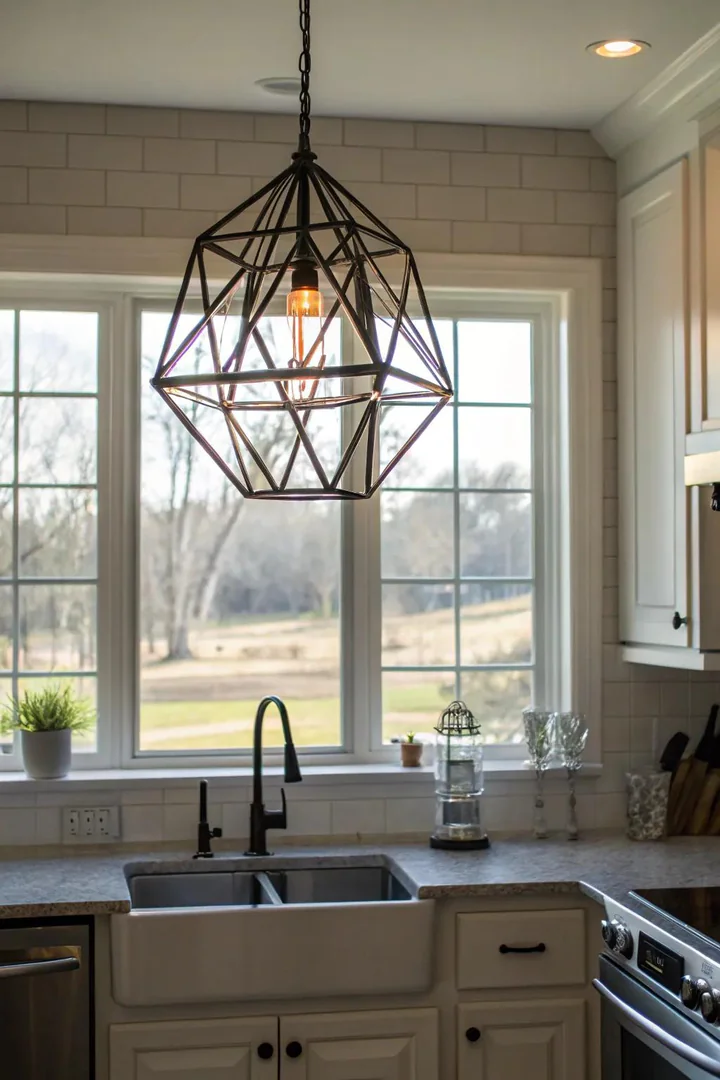
A geometric metal frame pendant — an open cage in a hexagonal, cuboid, teardrop, or polyhedron shape made of thin metal rods — provides architectural interest and a visible bulb without blocking the view through the kitchen sink window. Because the shade is an open wire frame rather than a solid surface, you can see through the pendant to the window behind it, making it the best pendant option for kitchens where preserving the window view is a priority.
Geometric pendants work as both task lighting (the exposed bulb directs light downward to the sink) and decorative objects (the geometric shadow pattern cast on the ceiling and walls adds visual interest, especially at night). Choose a matte black frame for contrast against a white ceiling, a brass or gold frame for warmth, or a polished nickel frame for a modern, reflective finish. Brands like Kichler (Flagship and Carvell lines), Sea Gull Lighting, and Capital Lighting produce geometric cage pendants in sizes from 8 to 18 inches. Hang the pendant centered on the window with an exposed vintage-style Edison bulb (warm 2200K amber) or a modern globe bulb (3000K) depending on the kitchen’s style. For more kitchen lighting options beyond the sink area, see our full guide.
10. Low Ceiling Flush Mount Lighting
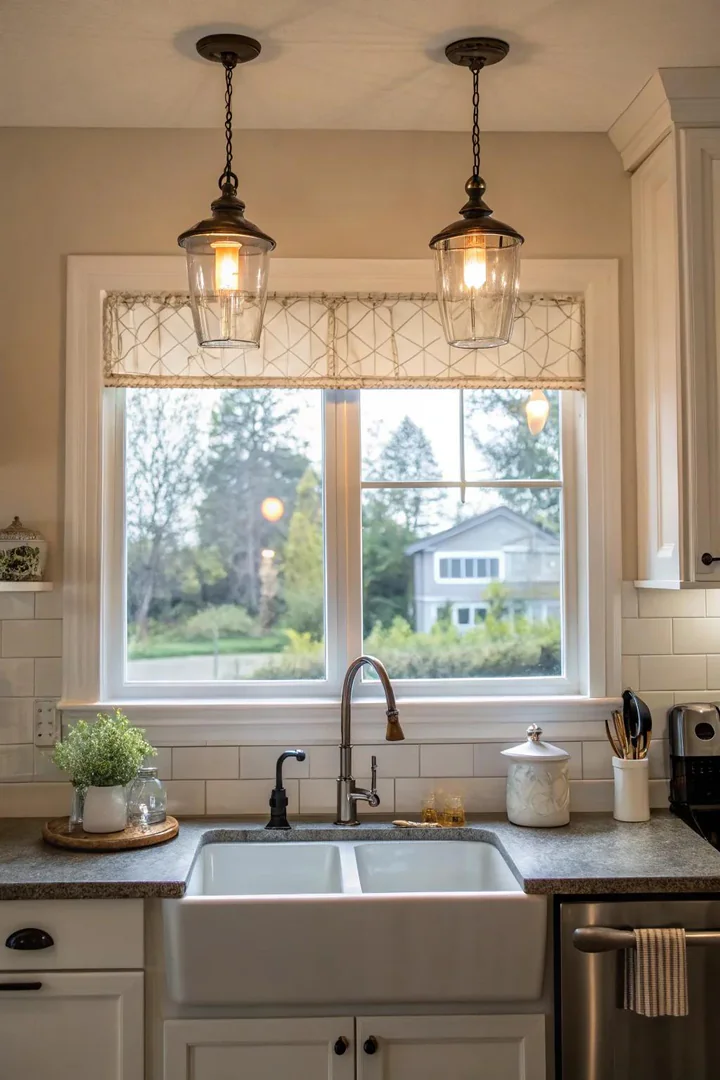
Flush mount ceiling lights sit directly against the ceiling surface with no visible gap, stem, or chain, making them the lowest-profile option for kitchens with ceilings below 8 feet where any pendant or semi-flush mount would hang uncomfortably low. A flush mount above the kitchen sink window provides task light without reducing headroom, blocking the window, or creating a collision hazard for tall users.
Modern flush mounts have moved far beyond the basic frosted-glass dome. Rejuvenation’s Satellite flush mount (a brass ring around a frosted globe), Schoolhouse Electric’s Meridian (a clean opal-glass disc), and Cedar & Moss’s Alto (a cone-shaped shade pressed flat to the ceiling) all provide attractive, design-forward flush-mount options that work above a kitchen sink window. Choose a flush mount with a 10-to-14-inch diameter for a standard-width sink and window — larger fixtures look out of scale above a single window. Position the flush mount centered on the window, directly above the sink faucet, so the light falls straight down onto the basin and countertop.
11. Lighting Choices for Islands
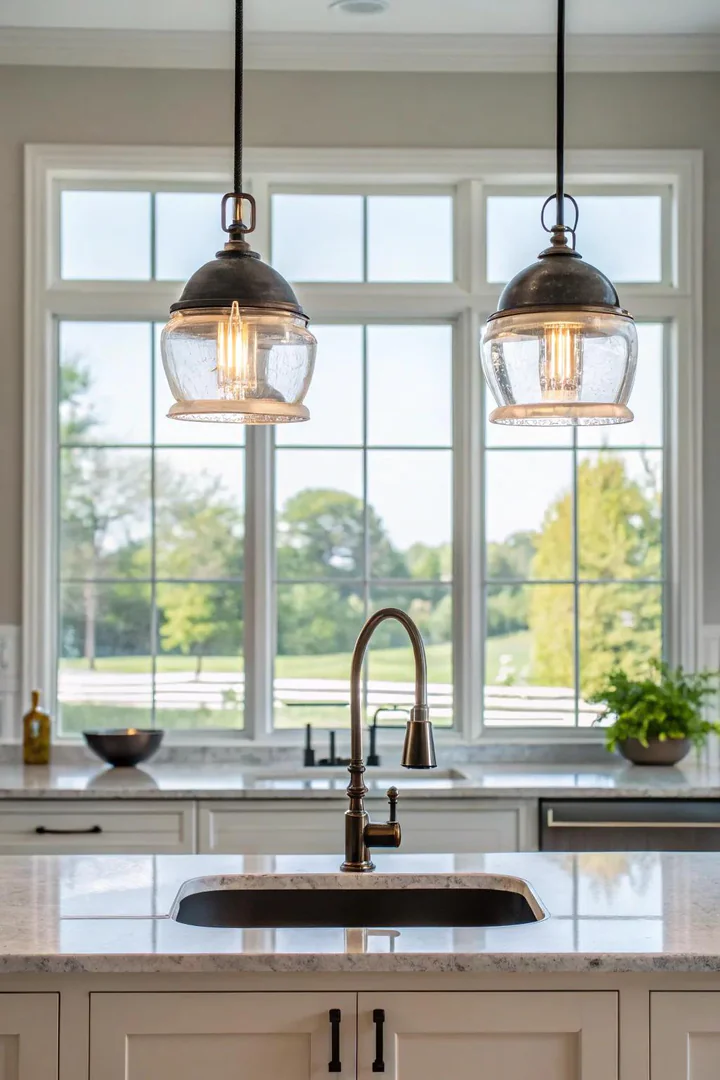
When the kitchen sink is installed in an island rather than against a wall, the lighting approach changes completely — there are no upper cabinets to mount under-cabinet lights, no wall for sconces, and the window is across the room rather than directly above the sink. Island sink lighting relies entirely on ceiling-mounted fixtures: pendants hung in a row above the island, a linear chandelier spanning the island’s length, or a track-light system aimed downward at the sink area.
Hang two to three pendants in a line above the island, centered over the countertop, with 24 to 30 inches of space between pendant centers. Position the pendant closest to the sink directly above the basin for focused task lighting. Use pendants with downward-directed light (opaque top, open bottom) for maximum illumination on the sink surface. A linear suspension light (a single fixture with multiple bulbs on one horizontal bar, from brands like Tech Lighting, Hubbardton Forge, or Kuzco Lighting) is a streamlined alternative that eliminates the need to align individual pendants. Hang all island fixtures 30 to 36 inches above the countertop for proper task illumination without blocking sight lines across the kitchen.
12. Dark Hanging Lights
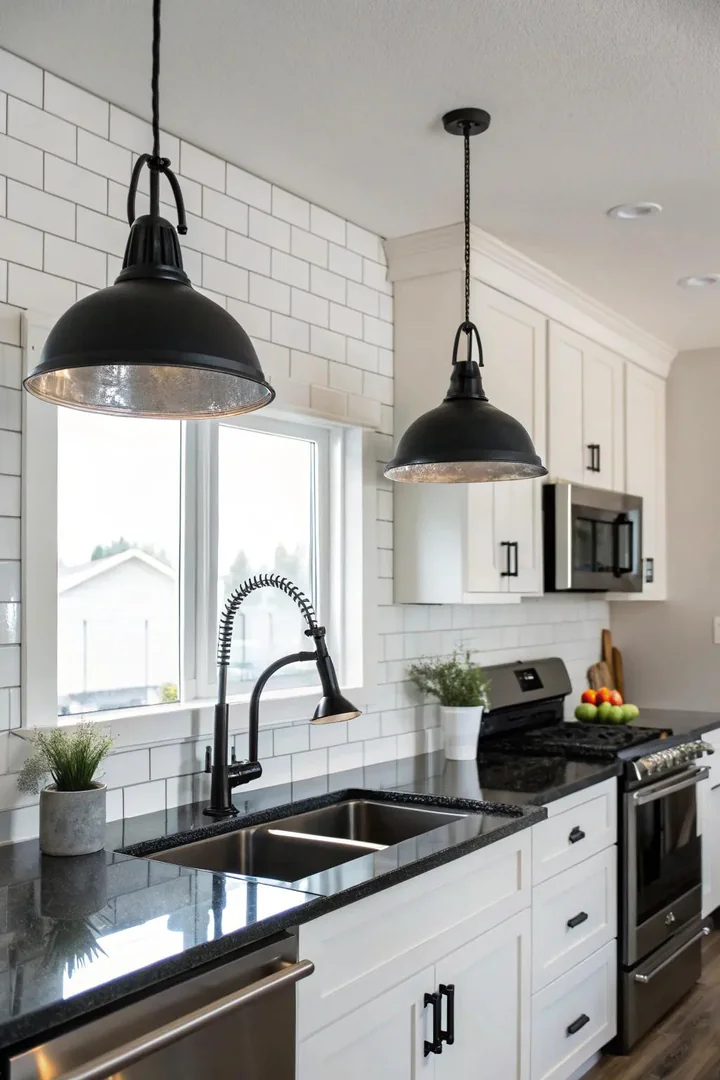
Black pendant lights create high-contrast drama against a white or light-colored ceiling and window frame, turning the sink lighting from a purely functional fixture into a bold design statement. The black finish reads as deliberate and graphic — a visual exclamation point that draws the eye to the sink area and anchors the kitchen’s design composition. Black pendants pair particularly well with black faucets, black cabinet hardware, and black window frames for a coordinated, modern look.
Matte black is the most popular black pendant finish because it absorbs light without creating distracting reflections on the pendant surface. Brands like Rejuvenation (the Baltimore pendant), West Elm (the Sculptural Glass Globe in black), and Schoolhouse Electric (the Carson pendant in matte black) all produce matte black pendants sized for above-the-sink installation. If the kitchen has an all-white palette, a single black pendant provides the only contrast needed — resist adding additional black accessories that dilute the impact. If the kitchen already has black elements (black faucet, black cabinet pulls, black range), the black pendant ties those elements together into a cohesive dark-hardware story. For advice on coordinating kitchen cabinet colors with dark fixture finishes, see our guide.
13. Relaxed Sophistication with Matching Pendants
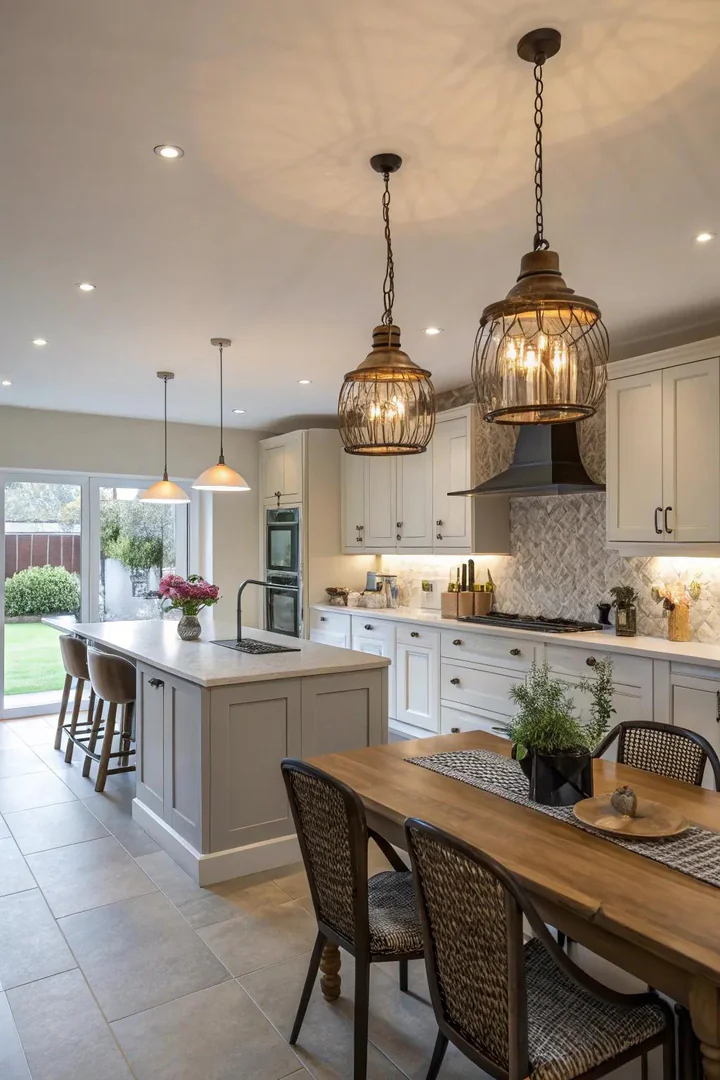
Hanging two or three matching pendants above and in front of the kitchen sink window creates a cohesive, polished look that reads as casual and approachable rather than formal. The repetition of the same pendant shape and finish produces visual rhythm — the eye moves from one pendant to the next in a satisfying, predictable pattern that makes the sink wall feel designed and intentional without appearing stiff or overdone.
The key to making matched pendants look casual rather than institutional is choosing the right scale and spacing. Two pendants flanking the window (one on each side) create a symmetrical, balanced composition. Three pendants in a row (one centered on the window, one on each side) create a more dramatic, restaurant-inspired look. Hang each pendant at the same height (30 to 36 inches above the counter) and space them evenly across the window’s width. Choose pendants with an organic or hand-finished quality — mouth-blown glass (from Niche Modern or West Elm), hammered metal (from Arteriors or Currey & Company), or natural fiber (rattan or woven seagrass from Serena & Lily) — to keep the matched set from looking mass-produced.
14. Gemstone-inspired Transitional Pendants
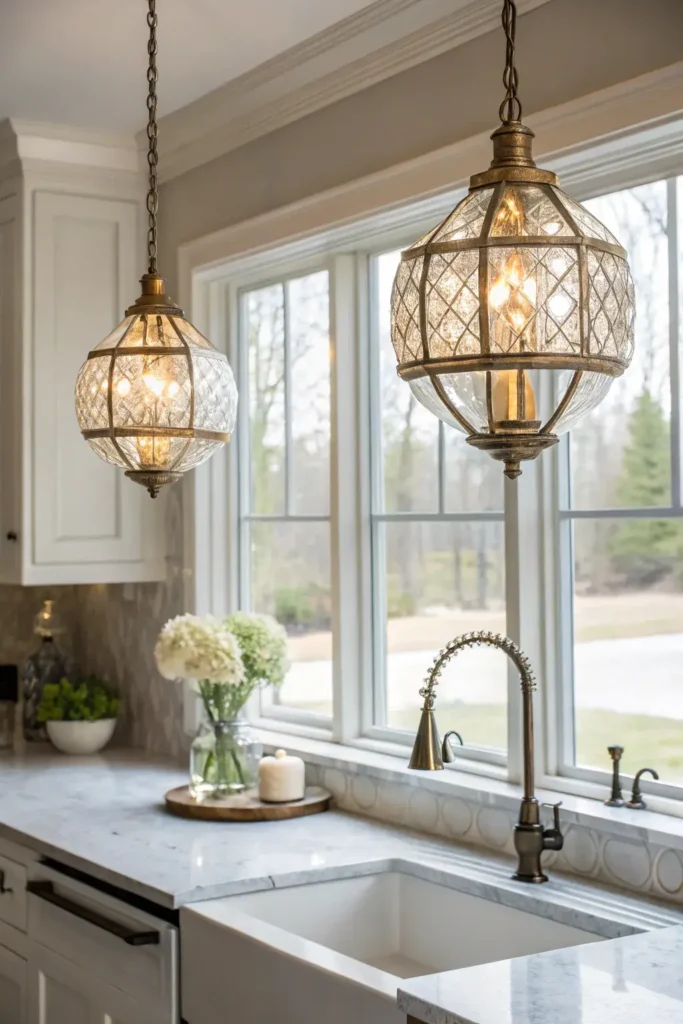
Gemstone-inspired pendants — faceted glass or crystal shades cut to resemble geometric crystals, prisms, or polished stones — create sparkle, refraction, and light play above the kitchen sink that no other pendant style can match. The faceted surfaces catch both natural daylight (during the day) and the bulb’s own light (at night), breaking the light into scattered patterns on the walls, ceiling, and counter that shift as you move around the kitchen.
Transitional gem-style pendants bridge the gap between traditional crystal chandeliers (too formal for most kitchens) and modern minimalist pendants (too plain for kitchens that want some sparkle). Brands like Elk Home (the Faceted series), Uttermost, and Crystorama produce gem-inspired pendants in clear, smoked, and tinted glass that work in transitional kitchens — those that blend traditional and contemporary elements. Hang a single gem pendant centered on the sink window for a subtle jewel-like accent, or a pair of smaller gem pendants flanking the window for balanced sparkle. Clear glass transmits the most light; smoked or tinted glass creates a moodier, more atmospheric effect. Choose a pendant with a metal accent (brass, gold, or polished chrome) at the canopy and socket to coordinate with your faucet finish.
How to Choose Lighting Over a Kitchen Sink Window
Matching the Fixture to Your Ceiling Height
Ceiling height determines which fixture categories work over your sink window. Standard 8-foot ceilings require flush mounts or semi-flush mounts — pendants hung from an 8-foot ceiling typically hang below eye level, blocking the window and creating a collision hazard. Ceilings 9 feet and above accommodate full-length pendants hung 30 to 36 inches above the countertop with adequate headroom. Vaulted or cathedral ceilings offer the most flexibility — long-cord pendants, chandeliers, and oversized fixtures all work when the ceiling provides 10+ feet of vertical space.
Coordinating Finishes with Hardware
Match the light fixture’s metal finish to the most visible metal in the kitchen — the faucet. If the faucet is brushed nickel, choose a pendant or flush mount with a brushed nickel canopy and accent. If the faucet is matte black, choose a black fixture. If the faucet is brass or gold-toned, choose a brass fixture. Matching the fixture to the faucet creates an immediate visual connection between the two most prominent elements at the sink. Cabinet hardware (pulls and knobs) is the second-most visible metal — coordinating all three (faucet, fixture, hardware) creates a fully unified kitchen. For help selecting kitchen bay window treatments and fixture pairings, see our guide.
Planning for Electrical Requirements
Determine the existing electrical junction box location above the sink before shopping for fixtures. If the box is centered on the window, any centered fixture (pendant, flush mount, or semi-flush mount) installs directly. If the box is offset from the window center, use a swag-style pendant with a hook that repositions the pendant over the window, or hire an electrician to move the junction box ($150-300 for a box relocation). Adding a new junction box for wall sconces requires running new wire through the wall and patching drywall — budget $200-400 per sconce location. All kitchen sink lighting should be on a GFCI-protected circuit (required by code for fixtures within 6 feet of a water source).
Kitchen Sink Window Lighting Options Comparison
| Fixture Type | Best Ceiling Height | View Blockage | Cost Range |
|---|---|---|---|
| Under-cabinet LED bars | Any | None | $30-150 |
| LED strip lights | Any | None | $20-80 |
| Wall sconces (pair) | Any | None | $100-600 |
| Recessed downlights | Any (needs ceiling cavity) | None | $50-200 |
| Flush mount | 8 ft and under | Minimal | $60-400 |
| Semi-flush mount | 8-9 ft | Low | $80-500 |
| Pendant (solid shade) | 9+ ft | Moderate | $80-600 |
| Geometric cage pendant | 9+ ft | Low (see-through) | $60-400 |
Common Kitchen Sink Window Lighting Mistakes
Hanging a pendant too low. A pendant hung below 72 inches from the floor blocks the window view and creates a collision hazard for anyone taller than 5 feet 10 inches. Measure from the floor to the bottom of the fixture — not from the ceiling — and ensure at least 72 inches of clearance. In kitchens with 8-foot ceilings, this often means a flush mount or semi-flush mount is the only pendant-style option that works.
Choosing a fixture that blocks the window. A large solid-shade pendant (16+ inches in diameter with an opaque shade) positioned directly in front of the window blocks daylight and eliminates the outdoor view that makes sink windows valuable. If you want a pendant, choose an open-frame geometric cage, a glass pendant, or a small-diameter fixture (10-12 inches) that does not cover more than 30% of the window area.
Using the wrong color temperature. Cool-white bulbs (5000K-6500K) create a harsh, clinical look over the kitchen sink — fine for a laboratory but unflattering in a home kitchen. Warm-white bulbs (2700K-3000K) produce a more inviting, natural-looking light. If you need bright task light for dishwashing, use 3000K on a dimmer rather than jumping to a higher color temperature.
Placing recessed lights behind you. Recessed ceiling lights installed behind where you stand at the sink cast your shadow directly onto the basin. Position recessed lights in front of or directly above where you stand — between your body and the window — so the light falls onto the sink rather than being blocked by your head and shoulders. Visit The Designers Company for more kitchen lighting guides and fixture recommendations.
Frequently Asked Questions
Can I hang a pendant light in front of a kitchen window?
Yes — pendant lights are commonly hung in front of kitchen sink windows, centered on the window and positioned 6 to 10 inches in front of the glass. Choose a pendant with a see-through design (geometric cage, clear glass, or open frame) to maintain the view, or a small-diameter solid pendant (under 12 inches) that blocks only a small portion of the window. Hang the pendant high enough (72+ inches from the floor) to avoid collision and keep the window view partially unobstructed.
What is the best lighting for a kitchen with no upper cabinets above the sink?
When there are no upper cabinets flanking the sink window, under-cabinet lights are not an option. Use a pendant, semi-flush mount, or flush mount hung from the ceiling above the sink instead. Wall sconces mounted on either side of the window frame also work well in this configuration and add a decorative element to the open wall space. Recessed ceiling lights positioned directly above the sink provide the most minimal option.
How many lights do I need over a kitchen sink?
One fixture is sufficient for most single-bowl and double-bowl kitchen sinks. A single pendant or flush mount centered on the sink provides adequate task lighting for a standard 30-to-36-inch-wide sink. For extra-wide sinks (42+ inches) or for a more dramatic look, two smaller pendants or a pair of wall sconces provide broader, more even coverage. Layering one overhead fixture with under-cabinet LED strips gives the most complete lighting.
Do I need a special bulb for above-the-sink lighting?
No special bulb is required, but choose one rated for damp locations if the fixture is within 3 feet of the faucet (UL damp-rated fixtures handle moisture from steam and splashing). For bulb type, LED bulbs are the best choice — they produce less heat than halogen or incandescent (important above a sink where steam rises), last 15,000-25,000 hours, and are available in every color temperature. Choose a CRI of 90+ for accurate color rendering of food and dishes.
What is the best color temperature for kitchen sink lighting?
Warm white (2700K-3000K) is the best all-around color temperature for residential kitchen sink lighting. It produces a comfortable, flattering light that makes skin tones, food, and kitchen surfaces look natural. For kitchens that need brighter task light (heavy food prep, detailed dishwashing), 3500K provides a neutral white that is brighter without feeling clinical. Avoid anything above 4000K for home kitchens — it reads as institutional.
Can I install lighting over a kitchen sink window without an electrician?
Plug-in pendants, battery-powered puck lights, adhesive LED strip lights, and rechargeable sconces can all be installed without any electrical work or professional help. Hardwired fixtures (permanently wired into a junction box) require either an existing junction box in the correct position or new wiring — the latter requires a licensed electrician in most jurisdictions. If a junction box already exists above the sink, a homeowner comfortable with turning off the breaker and following manufacturer instructions can install a hardwired fixture, but local building codes may require a permit and inspection for any new electrical work.
Conclusion
The right light above a kitchen sink window eliminates the shadow problem that standard ceiling fixtures create, brightens the area where you spend the most time standing in the kitchen, and turns a functional sink wall into a designed focal point. Whether you choose under-cabinet LEDs for invisible task light, wall sconces for architectural elegance, a drum pendant for a bold visual statement, or a geometric cage pendant that preserves the window view, the fixture should solve the shadow first and look good second.
Start by measuring your ceiling height (8-foot ceilings need flush or semi-flush mounts; 9+ feet can handle pendants), match the fixture finish to your faucet for instant coordination, and install every sink light on a dimmer so you can shift from bright dishwashing light to soft evening ambiance with a single adjustment. The goal is a kitchen sink that is just as pleasant to stand at in the dark of a winter evening as it is in the bright light of a summer morning.