
Red Kitchen Tile Ideas: 17 Bold Designs That Steal the Show
Red kitchen tile ideas use ceramic, porcelain, glass, terracotta, and natural stone tiles in shades of red — from pale terra cotta and rustic brick to deep burgundy, cherry, crimson, and ruby — on backsplashes, floors, accent walls, and island faces to bring warmth, energy, and bold color into the kitchen. Red is one of the most emotionally charged colors in interior design: it stimulates appetite, raises perceived warmth, and commands attention in a way that neutral tiles cannot.
The 17 red kitchen tile ideas below cover brick-style tiles, burgundy glass accents, classic subway tiles, penny rounds, arabesque patterns, geometric feature walls, fish scale tiles, herringbone layouts, Moroccan mosaics, Mediterranean island tiles, linear ceramics, Spanish-style tiles, vintage hexagons, terracotta floors, two-color combinations, diamond arrangements, and checkerboard floors. Each idea includes specific tile products, layout patterns, grout colors, and pairing guidance for using red tile confidently in any kitchen style.
1. Tiles in Red Brick Design

Red brick-style tiles — thin porcelain or ceramic tiles that replicate the size, color, and texture of real clay bricks — deliver the warm, rustic, industrial character of an exposed brick wall without the structural weight, mortar mess, and moisture permeability of actual bricks. Brick-look tiles are lighter, flatter, more uniform in thickness, and easier to clean than real brick, making them a practical backsplash and accent wall material in kitchens where genuine brick would be impractical.
Choose brick-look tiles in a running bond (offset) pattern with a warm gray or tan grout to closely replicate a traditional brick wall. Products like the Bricktown series from Daltile, the Brickstone line from MSI, and the Old Mill Thin Brick veneer offer realistic textures with a slight tumbled edge and color variation across each tile. Standard brick tile size is approximately 2.5×8 inches (matching real brick face dimensions). Pair red brick tiles with white or cream cabinets for a classic farmhouse or industrial loft feel, or with dark green or navy cabinets for an English pub or bistro atmosphere.
2. Burgundy Glass Tile Highlight
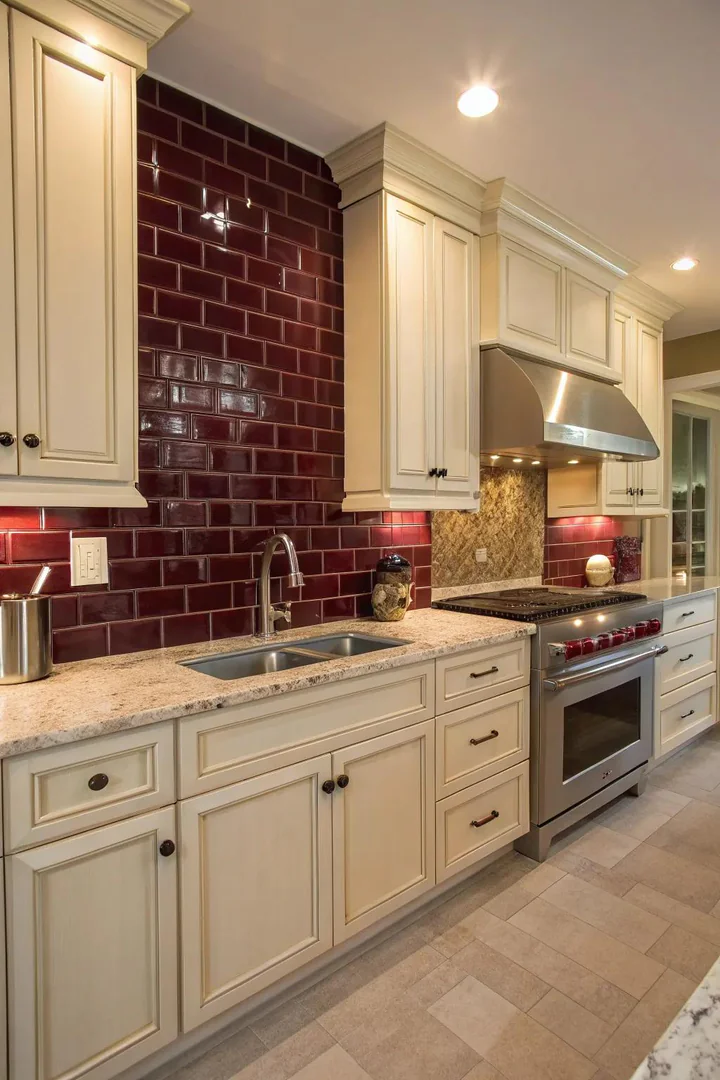
Burgundy glass tiles — translucent or opaque glass tiles in deep wine, plum, or maroon tones — catch and reflect kitchen lighting to create a jewel-like, luminous backsplash that glows with depth and color intensity that opaque ceramic tiles cannot match. The glass surface is completely non-porous, stain-proof, and easy to clean, making burgundy glass tiles both a practical and a visually striking backsplash material.
Use burgundy glass tiles as a full backsplash (from counter to upper cabinets) for maximum color impact, or as a single accent row or border strip within a neutral tile field for a controlled pop of color. Glass subway tiles (3×6 or 4×12 inches) from Giorbello, Modwalls, or Ivy Hill Tile come in rich burgundy shades with a glossy or matte finish. Glass mosaic tiles (1×1 or 2×2 inches on mesh sheets) from Elida Ceramica or Jeffrey Court provide a more textured, small-scale look. Pair burgundy glass tiles with white or light gray grout for crisp definition between tiles, or with a matching dark burgundy grout for a seamless, monochromatic surface. For more glass backsplash inspiration, see our glass backsplash kitchen ideas guide.
3. Traditional Red Subway Tiles
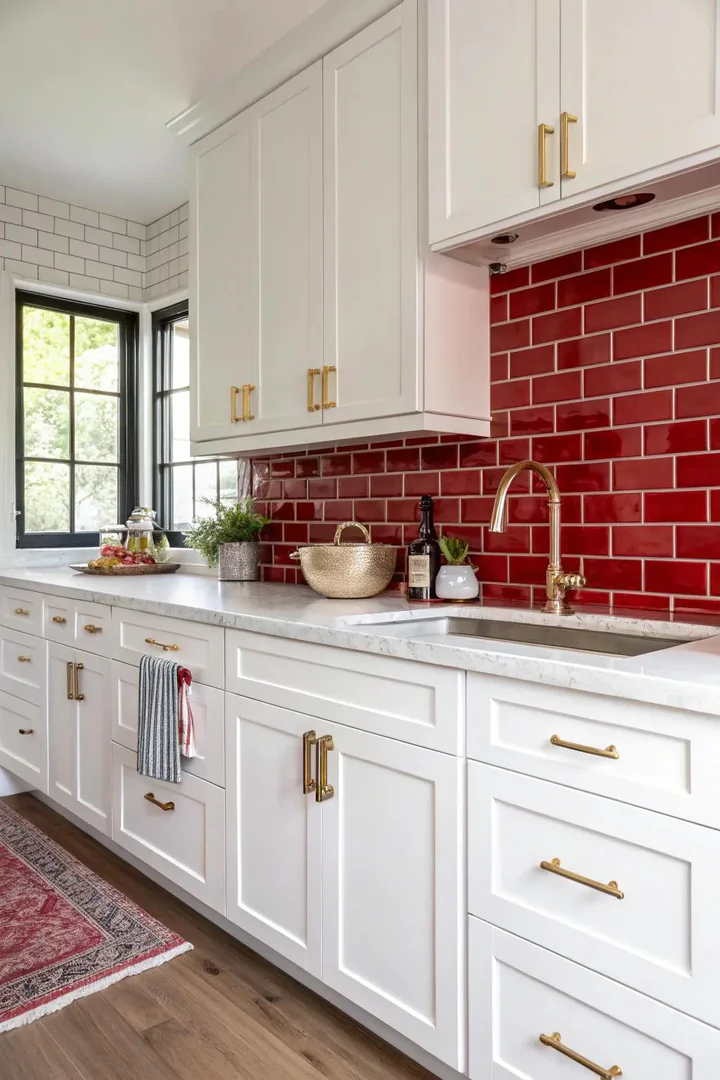
Red subway tiles — standard 3×6-inch rectangular ceramic or porcelain tiles in a glossy or matte red glaze, installed in a horizontal running bond (offset) pattern — deliver the clean lines and timeless silhouette of the classic subway tile in a bold, warm color that breaks from the expected white or gray. The subway tile format is familiar and universally appealing, which makes red subway tiles an approachable way to introduce red into a kitchen without an exotic or overly adventurous tile shape.
Glossy red subway tiles (from Daltile Rittenhouse Square, American Olean, or Fireclay Tile in shades like “Cherry Red,” “Tomato,” or “Chili Pepper”) reflect light and create a bright, energetic backsplash with visible depth and color variation across each tile. Matte red subway tiles provide a softer, more muted red that reads as sophisticated rather than bold. Install with white grout for a clean, high-contrast grid pattern, or with dark gray or charcoal grout for a more dramatic, modern look. Pair red subway tiles with white Shaker cabinets for a retro diner or mid-century feel, or with dark wood cabinets for a warm, traditional kitchen.
4. Crimson Coin Circular Tiles
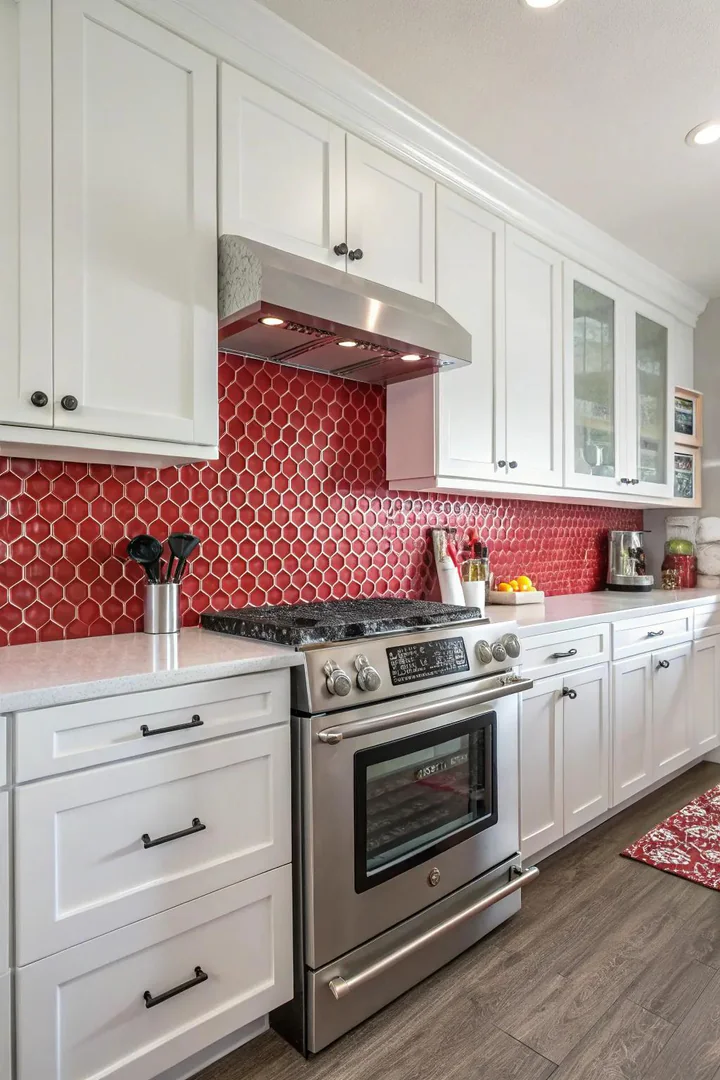
Scarlet penny round tiles — small (3/4-inch to 1-inch diameter) circular porcelain or ceramic tiles mounted on mesh sheets — create a densely textured, dot-pattern surface that is playful, retro, and visually distinct from any rectangular tile format. The small, round shape means more grout lines per square foot, which creates a busy, mosaic-like pattern that works as a bold accent even in a small area like a backsplash behind the stove or a niche behind open shelving.
Red penny rounds come in glossy, matte, and unglazed finishes from suppliers like Merola Tile (Hudson Penny Round), Bedrosians, and ModDotz. The dense grout grid is a defining feature of penny rounds — choose a contrasting white or light gray grout to emphasize each individual circle, or a matching red grout to create a more uniform, monochromatic field of color. Because penny rounds have a high grout-to-tile ratio, seal the grout with a penetrating grout sealer (from TileLab, Aqua Mix, or Custom Building Products) to prevent staining in the kitchen’s grease-and-splash environment.
5. Masterpiece of Red Arabesque Tiles
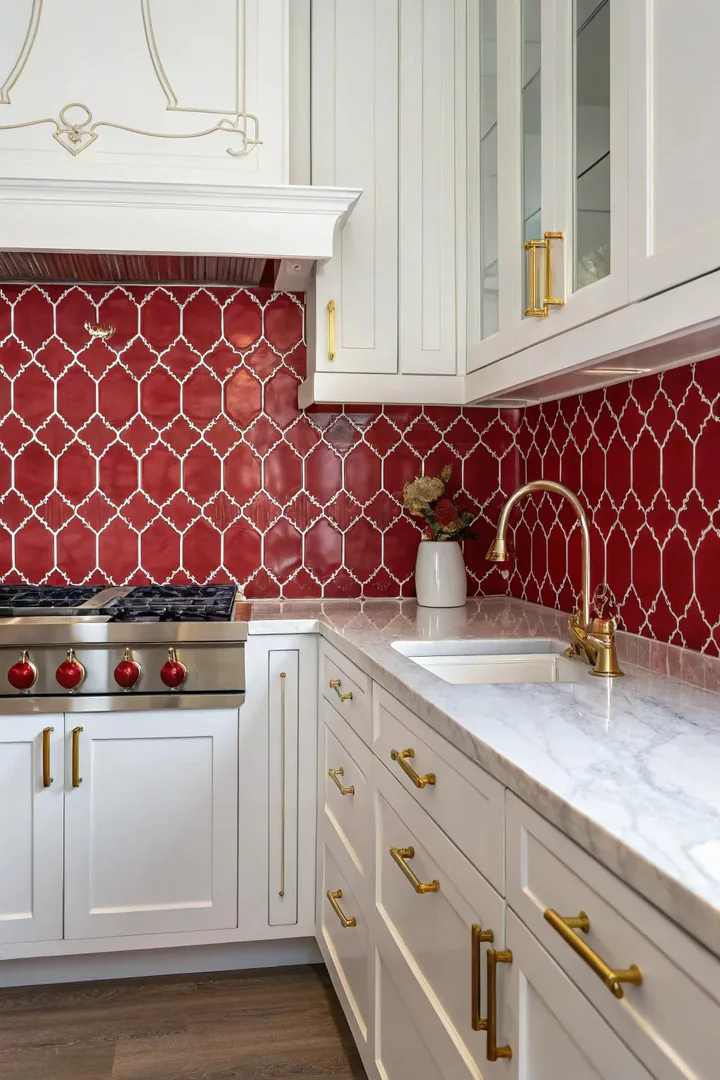
Red arabesque tiles — lantern-shaped or ogee-shaped tiles with a distinctive pointed, elongated silhouette inspired by Islamic and Moorish geometric art — create an ornate, pattern-rich backsplash that is dramatically different from any rectangular or square tile format. The arabesque shape interlocks to form a continuous, flowing pattern that is both intricate and rhythmic, giving the backsplash a handcrafted, artisan quality that mass-produced rectangular tiles lack.
Arabesque tiles in red are available in ceramic, porcelain, and glass from Merola Tile (Lantern series), Bedrosians (Costa Allegra), and Ivy Hill Tile. The interlocking pattern means each tile fits into the next like a puzzle piece, with thin, curving grout lines that follow the organic shape. Use a contrasting light grout (white or ivory) to define each individual arabesque shape, or a matching red grout for a more unified, textile-like surface. Pair red arabesque tiles with natural wood shelving, brass fixtures, and warm-toned countertops (butcher block, travertine, or warm-veined quartzite) for a Mediterranean or Middle Eastern-inspired kitchen.
6. Feature Wall with Geometric Red Tiles
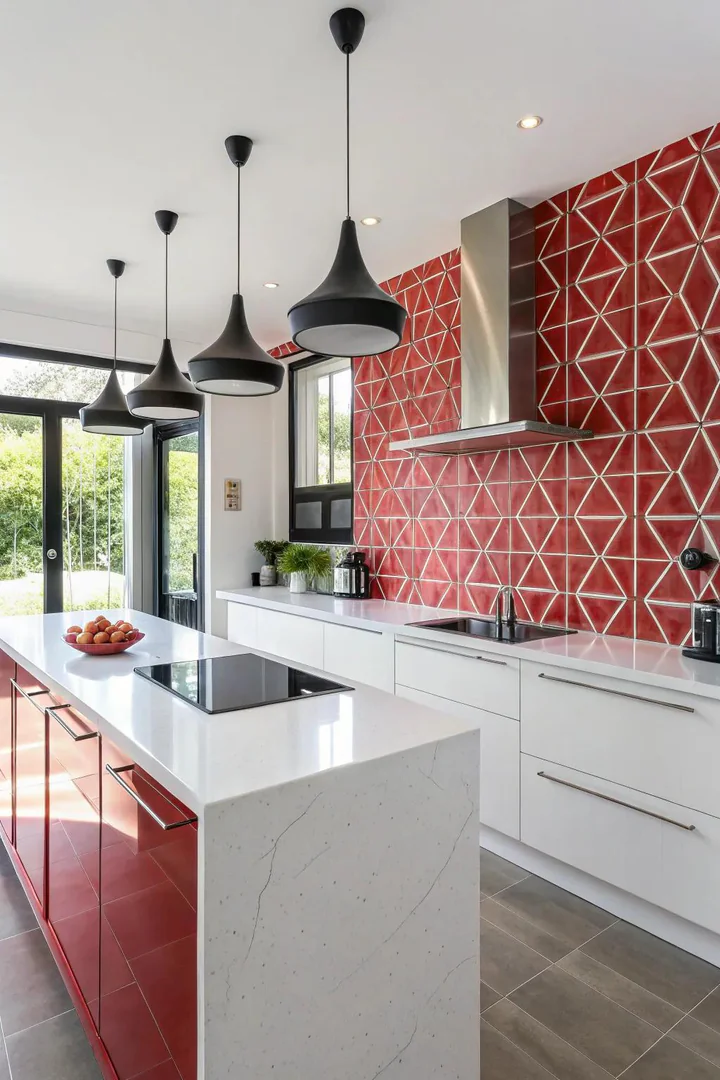
A geometric red tile feature wall — an entire wall surface (from counter to ceiling, or floor to ceiling) covered in red tiles arranged in a bold geometric pattern (diamond, chevron, pinwheel, basket weave, or a custom repeating motif) — creates a massive, wall-scale graphic that becomes the dominant design element in the kitchen. A feature wall is the most impactful way to use red tile because it commits fully to the color rather than using it as a small accent.
Choose a tile shape that creates a geometric pattern through its arrangement: square tiles rotated 45 degrees create a diamond grid; rectangular tiles arranged in alternating vertical and horizontal pairs create a basket weave; triangular tiles arranged point-to-point create a zigzag. Cement tiles (from Cement Tile Shop, Villa Lagoon Tile, or Granada Tile) with pre-printed geometric patterns in red and white, red and black, or red and cream deliver complex geometric designs in a single tile. Install the feature wall on the wall most visible from the main entry or the dining area so the bold red pattern commands attention from the room’s primary viewpoint.
7. Red Fish Scale Tiles
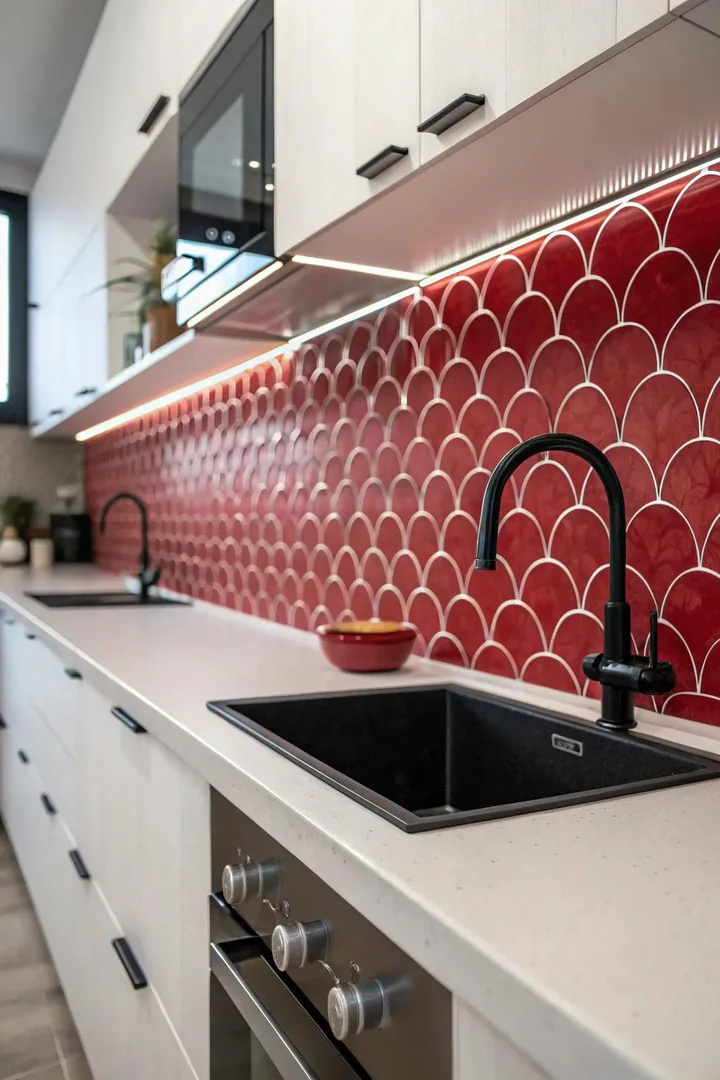
Fish scale tiles (also called scallop tiles or fan tiles) — semi-circular or fan-shaped tiles that overlap in staggered rows like the scales of a fish — create an organic, wave-like pattern on the backsplash that is feminine, decorative, and visually dynamic in a way that no straight-edged tile can replicate. In crimson red, fish scale tiles produce a surface that recalls lacquerware, Japanese fans, or Art Deco theater interiors.
Fish scale tiles are available in ceramic and porcelain from Merola Tile (Conchella Fan), Bedrosians (Mélange series), and specialty tile shops. Each tile is approximately 3 to 4 inches wide with a curved bottom edge that nests into the row below. Install with the rounded edge pointing downward (like actual fish scales) for the most organic, flowing look, or with the rounded edge pointing upward for a fan or sunrise pattern. Use a matching red grout for a smooth, unified surface, or a contrasting white grout to outline each individual scallop shape.
8. Crimson Red Herringbone Design
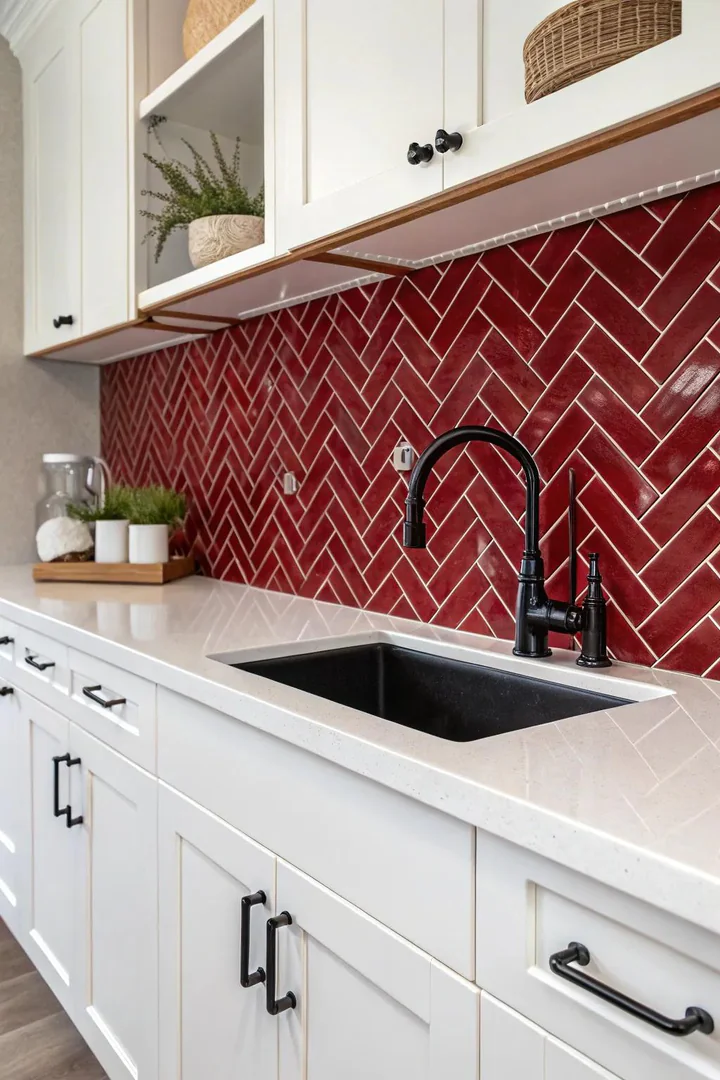
A ruby red herringbone pattern — standard rectangular tiles (typically 2×6, 2×8, or 3×6 inches) arranged in interlocking V-shapes at 45-degree or 90-degree angles — adds directional movement, visual energy, and a sense of craftsmanship to a red tile backsplash that a simple horizontal running bond cannot achieve. The herringbone pattern has been a staple of fine flooring and wall treatment for centuries, and in red, it creates a surface that is both classic and attention-grabbing.
The 45-degree herringbone (tiles angled at 45 degrees to the countertop line) creates a more dramatic, active pattern with strong diagonal lines. The 90-degree herringbone (tiles set with the V-shapes pointing straight up) creates a more structured, chevron-like pattern. Choose tiles with a handmade or zellige-style glaze (uneven, rippled, slightly varied in tone) from Clé Tile, Fireclay Tile, or Made a Mano for a textured, artisan herringbone with depth and color variation across each tile. Machine-made, uniform-glaze tiles from Daltile or American Olean produce a cleaner, more precise herringbone pattern.
9. Red Mosaic with Moroccan Influence
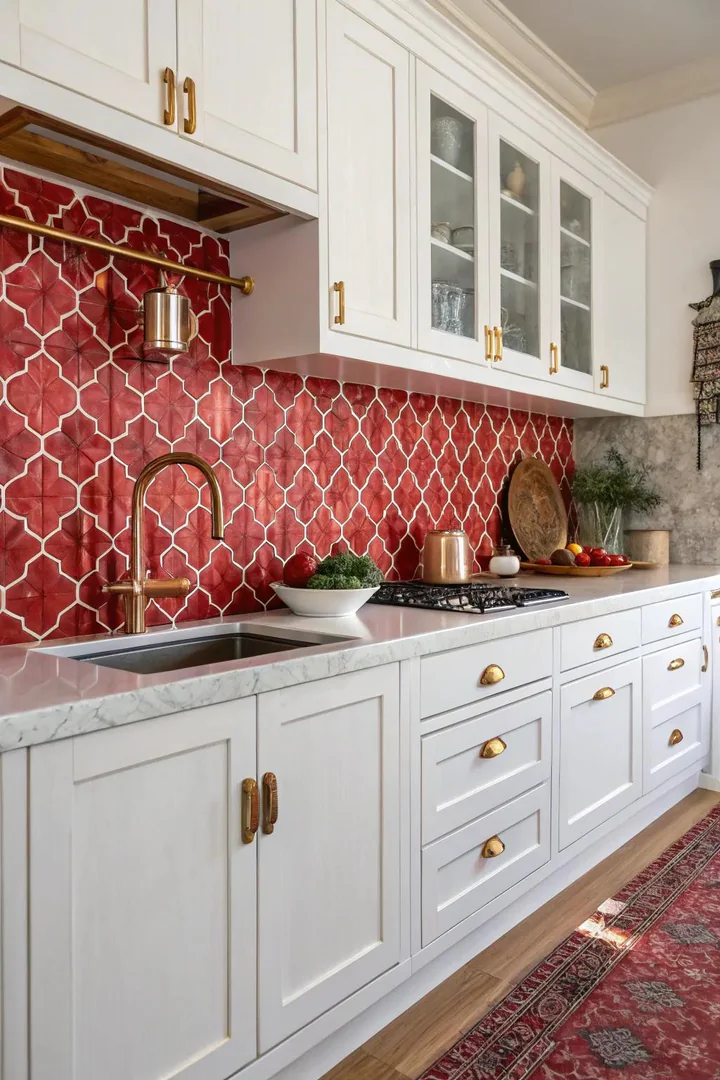
Moroccan-inspired red mosaic tiles — small, hand-cut tiles (zellige) or patterned cement tiles in traditional North African geometric and floral motifs featuring red as a dominant color — bring the centuries-old tile-making tradition of Fez, Marrakech, and the Mediterranean coast into the kitchen. Moroccan tile patterns are characterized by intricate, repeating geometric stars, rosettes, and interlocking polygons that create a carpet-like surface of extraordinary complexity and color richness.
Authentic Moroccan zellige tiles (small, hand-cut glazed terracotta squares, approximately 2×2 inches) from Mosaic House, Clé Tile, or Popham Design come in rich, slightly irregular red glazes that reflect light unevenly, creating the shimmering, textured surface that defines zellige craftsmanship. Cement tiles with pre-printed Moroccan star and geometric patterns (from Cement Tile Shop, Villa Lagoon Tile, or Riad Tile) deliver complex patterns at a lower cost per square foot than hand-cut zellige. Pair Moroccan red tiles with brass hardware, dark wood, and warm stone countertops for an authentic North African or Mediterranean kitchen atmosphere.
10. Island with Mediterranean Red Tiles
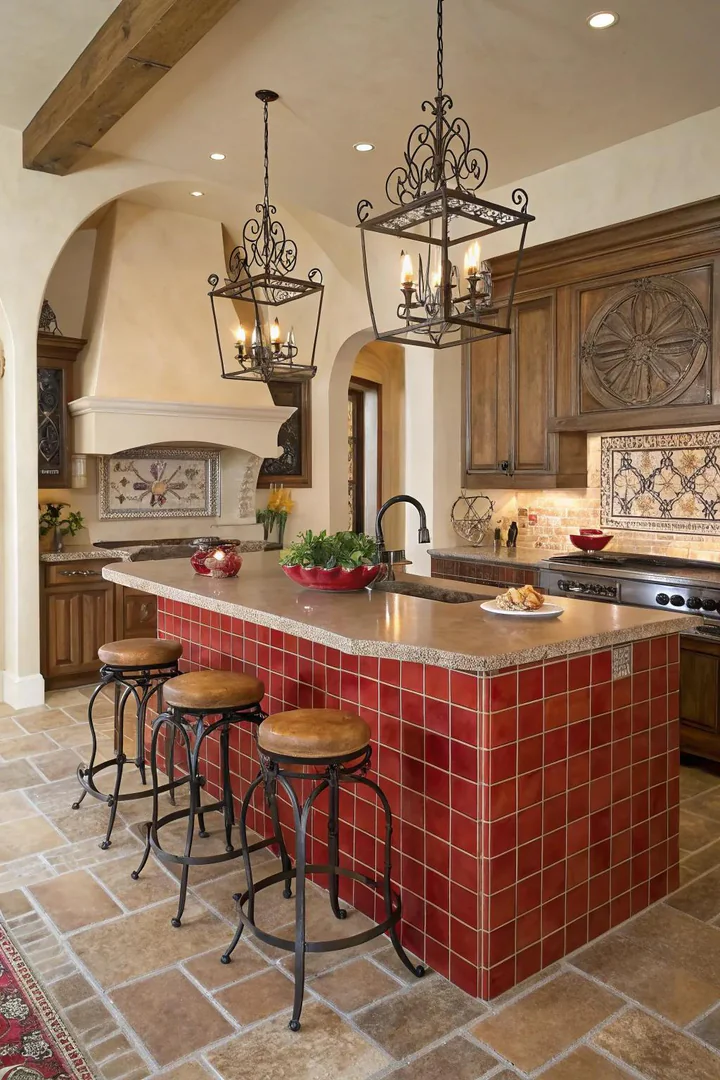
Cladding the front face or sides of a kitchen island with Mediterranean-style red tiles — hand-painted Talavera tiles, Majolica tiles, Portuguese azulejo-inspired tiles, or Italian-style encaustic cement tiles — turns the island into a colorful, tiled furniture piece that anchors the kitchen with Old World Mediterranean character. Tiling the island face is an unexpected application (most islands are finished with painted wood, stone, or plain panels) that creates a visual surprise and a strong design statement.
Talavera-style tiles (hand-painted ceramic tiles from Mexico, available from Mexican Tile Designs, Tierra y Fuego, or Latin Accents) come in red, yellow, blue, and white combinations with floral and geometric motifs. Italian-style encaustic cement tiles (from Cement Tile Shop or De Ferranti) in red and white or red and cream geometric patterns provide a European tile aesthetic. Install the tiles directly on the island’s front panel using thin-set mortar, with a bullnose or Schluter metal edge trim at the top where the tile meets the countertop overhang. For coordinating island tile color with cabinet paint shades, see our kitchen color ideas page.
11. Modern Red Linear Ceramic Tiles
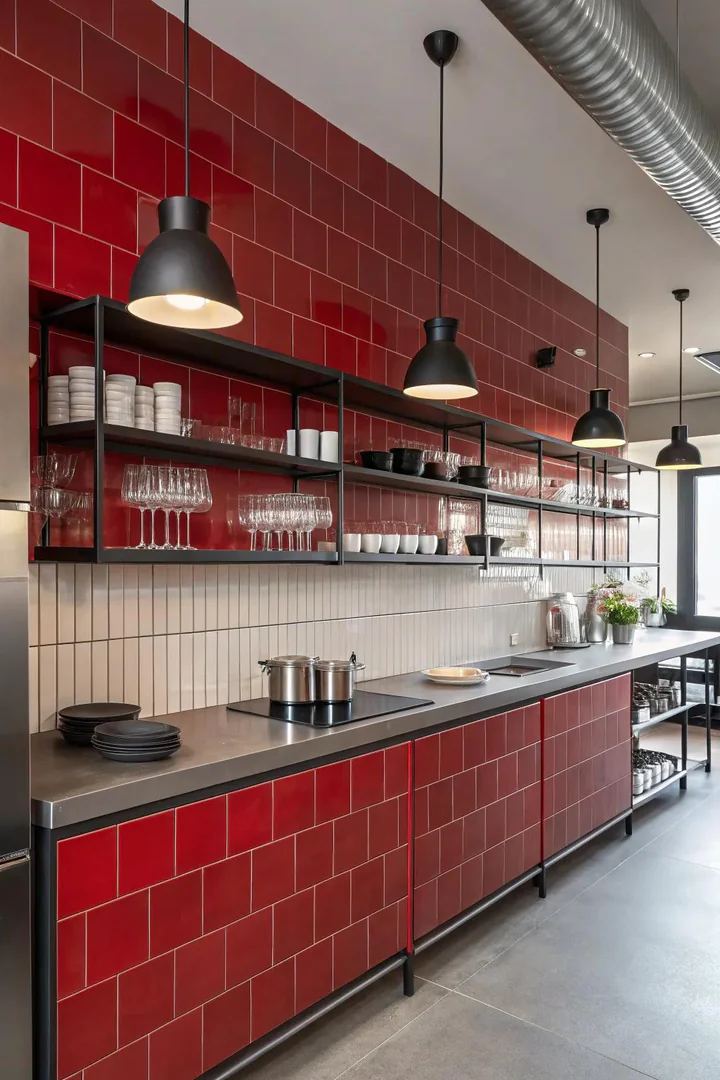
Red linear tiles — long, narrow rectangular tiles (typically 1×6, 1×12, 2×8, or 2×12 inches) installed in stacked horizontal or vertical rows — create a clean, modern, striped pattern that emphasizes horizontal or vertical lines and gives the red color a sleek, contemporary presentation. Linear tiles suit modern and mid-century modern kitchens where the design language favors long, low, horizontal proportions and clean, unbroken lines.
Horizontal stack bond (tiles aligned in straight, unoffset horizontal rows) creates a calm, orderly, modern pattern that elongates the backsplash wall. Vertical stack bond (tiles set straight up and down in unoffset columns) draws the eye upward and makes the ceiling feel taller. Red linear tiles in a glossy glaze from Soho Studio, Daltile, or MSI in shades like “Glossy Crimson” or “Cherry Red” catch kitchen lighting along their elongated surface, creating visible light reflections that move across the backsplash as you move through the kitchen.
12. Red Tiles in Spanish Style
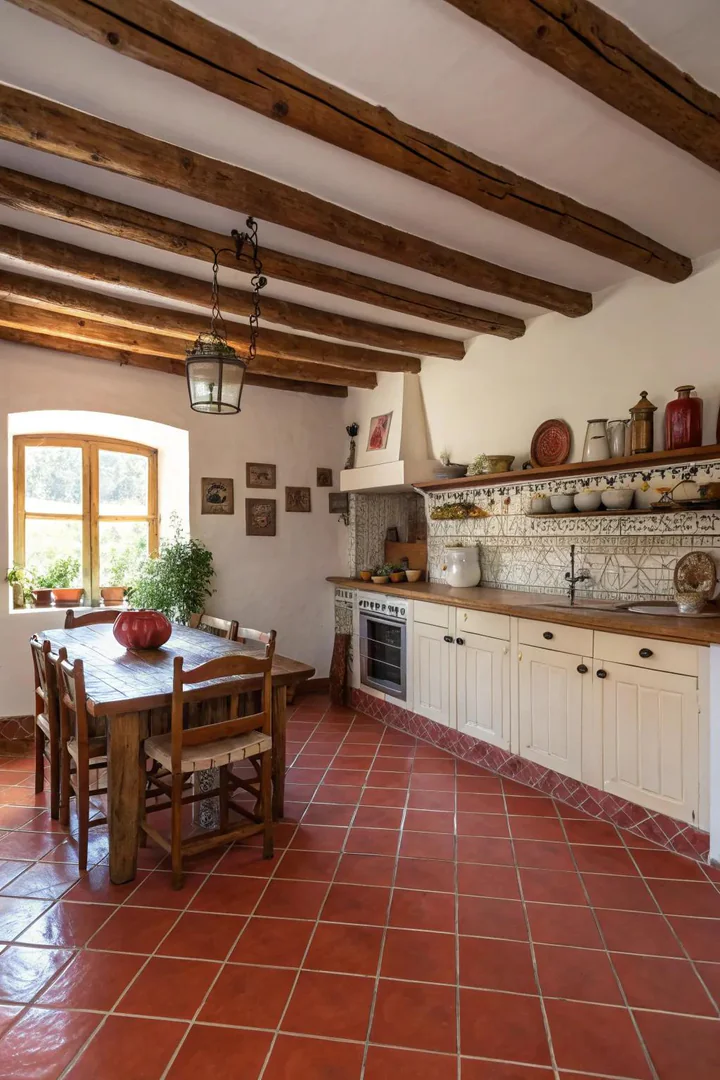
Spanish-style red tiles — hand-painted ceramic tiles (Cuerda Seca technique) or encaustic cement tiles featuring the bold, warm color palettes and geometric or floral patterns of traditional Andalusian, Catalan, and Moorish tile design — bring the sun-drenched warmth and centuries-old artisan tradition of the Spanish kitchen into your own home. Spanish tile patterns typically combine red with cobalt blue, golden yellow, forest green, and cream in symmetric, repeating motifs derived from Islamic geometric art.
Source Spanish-style tiles from Avente Tile (custom encaustic cement tiles in Spanish patterns), Fireclay Tile (handmade glazed tiles in warm reds), or directly from Spanish tile manufacturers like Porcelanosa, Gayafores, or Equipe. Spanish colonial and Mediterranean kitchens pair Spanish red tiles with wrought iron hardware, dark-stained wood beams, terracotta floors, and rough plaster or stucco walls for an authentic regional aesthetic. Use the patterned tiles on the backsplash behind the stove as a decorative focal panel (a “tile rug”) framed by plain border tiles on each side.
13. Retro Red Hexagonal Tiles
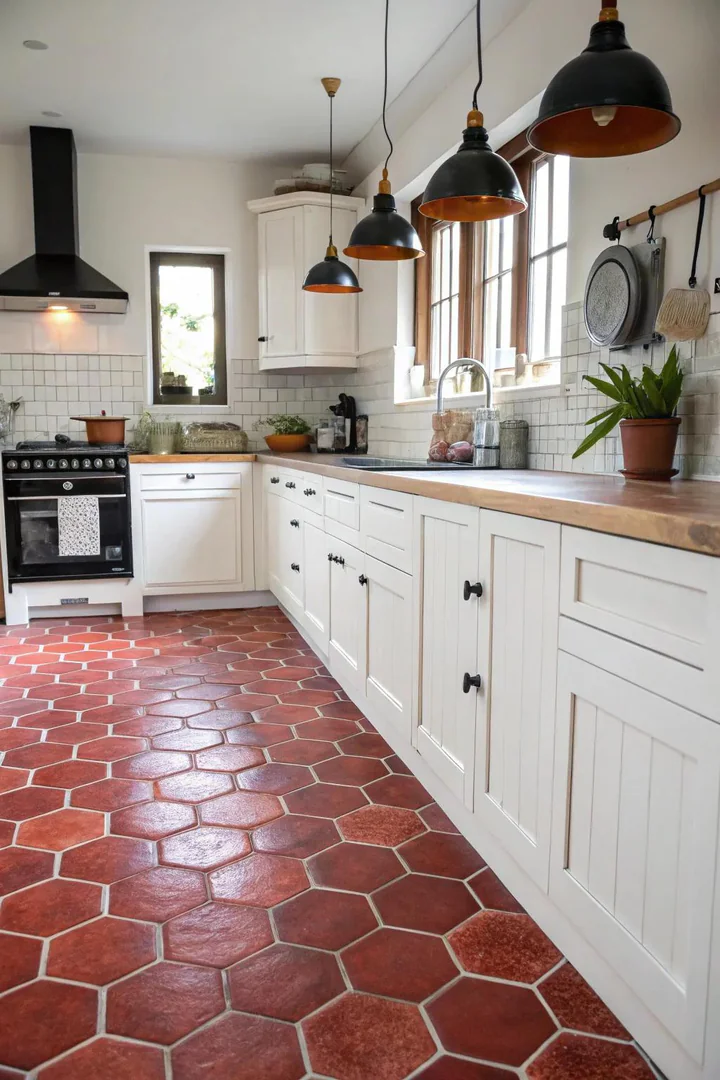
Vintage-style red hexagon tiles — six-sided tiles in 1-inch, 2-inch, or large-format (6-to-8-inch) sizes — create a honeycomb-like pattern on floors or backsplashes that is distinctly retro, reminiscent of early 20th-century kitchens, bathrooms, and commercial spaces. Hexagon tiles are inherently eye-catching because the six-sided geometry breaks the expected grid of squares and rectangles, and in red, the hexagonal pattern becomes a bold, geometric design feature.
Small hexagons (1-inch or 2-inch, on mesh sheets) from American Olean, Merola Tile, or Daltile create a dense, mosaic-like surface that works best on floors and smaller backsplash areas. Large hexagons (6 to 8 inches) from Bedrosians or Equipe work as statement floors or full-wall backsplashes with fewer grout lines and a more contemporary, graphic look. Mix red hexagons with white, black, or gray hexagons to create patterns — a red hex border surrounding a white hex center, or a random scatter of red hexes within a field of white, creates visual interest without overwhelming the kitchen with solid red.
14. Terracotta Floors in Rustic Red
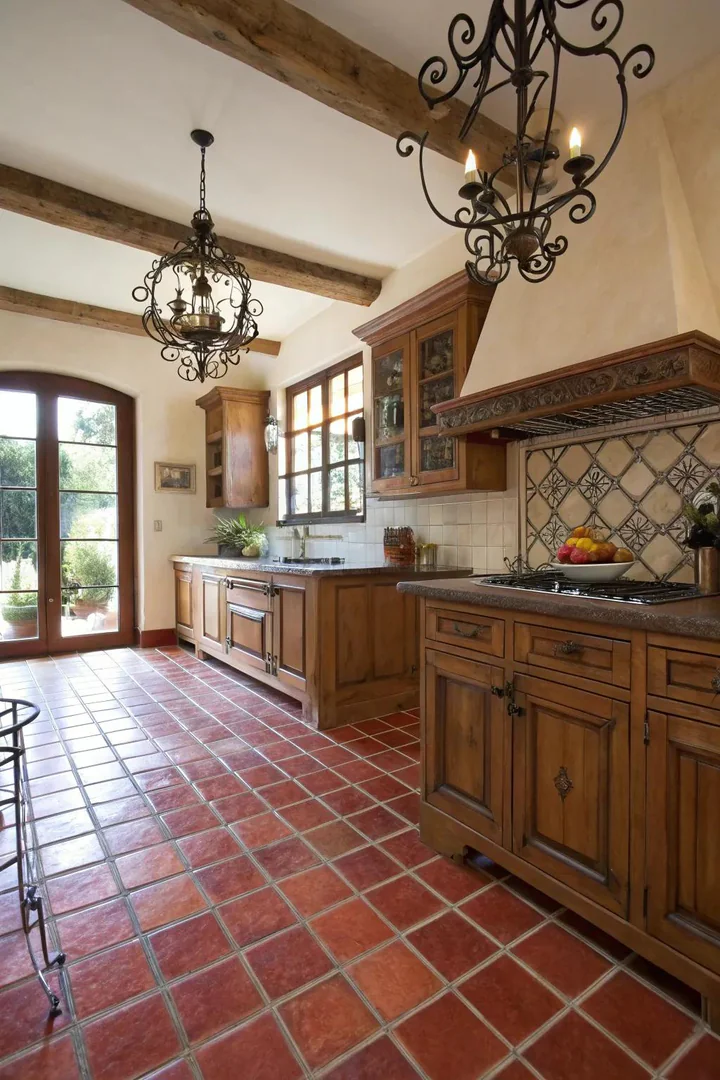
Rustic terracotta floor tiles — handmade or machine-made fired clay tiles in natural, unglazed red-orange and red-brown tones — bring the warmth, earthiness, and old-world character of a Tuscan, Provencal, or Spanish colonial kitchen floor into the home. Terracotta is one of the oldest tile materials in the world, and its warm red-orange color, handmade texture, and matte, unglazed surface create a floor that feels grounded, authentic, and deeply connected to the earth.
Authentic handmade terracotta tiles (from Saltillo Tile (Mexican Saltillo), Cotto d’Este (Italian), or Terre d’Antan (French)) have irregular edges, slight size variations, and visible texture marks from the forming process — these imperfections are the appeal, giving the floor a handcrafted, one-of-a-kind quality. Machine-made terracotta-look porcelain tiles (from Marazzi, Florida Tile, or Emser) replicate the color and texture of real terracotta with the durability, consistency, and low-maintenance performance of porcelain. Seal natural terracotta with a penetrating terracotta sealer (from StoneTech, Miracle Sealants, or Aqua Mix) to protect against staining from spills and cooking grease.
15. Combinations of Two-Color Tiles
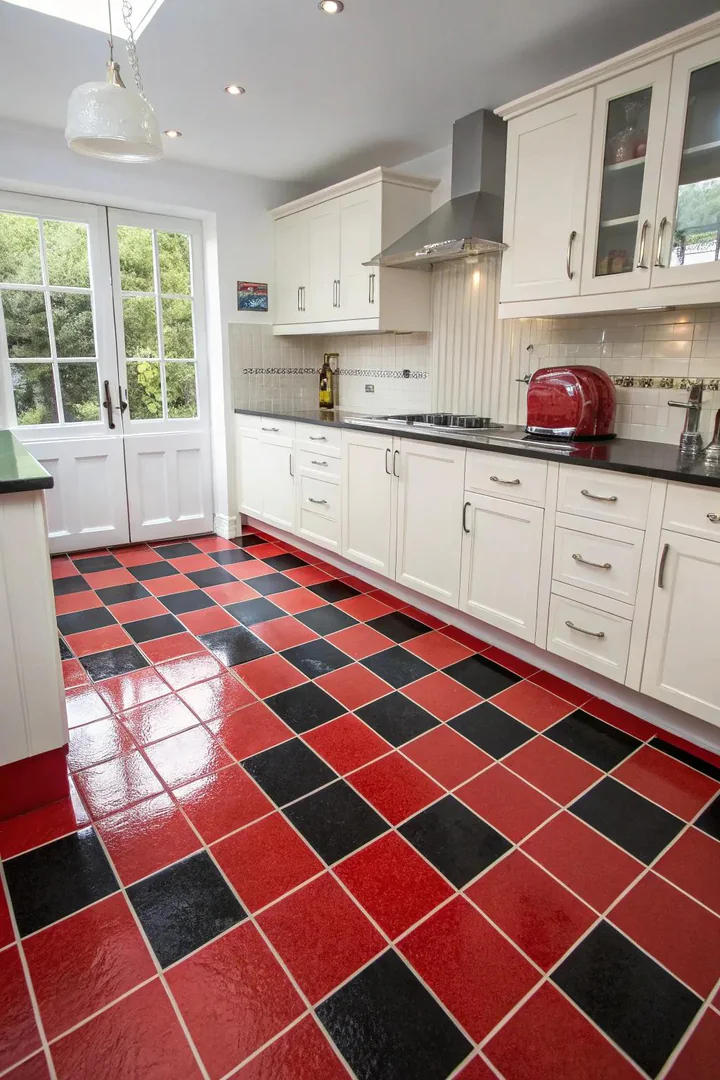
A two-color tile combination — red tiles paired with a single contrasting color (white, black, cream, gray, or gold) in an alternating, bordered, or zoned pattern — creates a graphic, high-contrast surface that is more dynamic than a solid red field but more controlled and cohesive than a multi-color mosaic. Two-color tile patterns have the visual impact of wallpaper or textile design while maintaining the durability and cleanability of tile.
Classic two-color combinations with red: red and white (bright, clean, retro diner), red and black (dramatic, bold, formal), red and cream (warm, Mediterranean, soft), red and gray (modern, balanced, neutral-grounded), and red and gold or yellow (warm, festive, Spanish colonial). Arrange the two colors in alternating rows, a checkerboard pattern, a border-and-field pattern (solid red center with a contrasting border row), or a gradient (dark red transitioning to light cream across the backsplash). Use tiles from the same manufacturer and product line to ensure the two colors have matching sizes, thicknesses, and surface finishes. For coordinating two-color tile schemes with cabinet finishes, visit our kitchen cabinet color ideas page.
16. Arrangement of Red Diamond Tiles
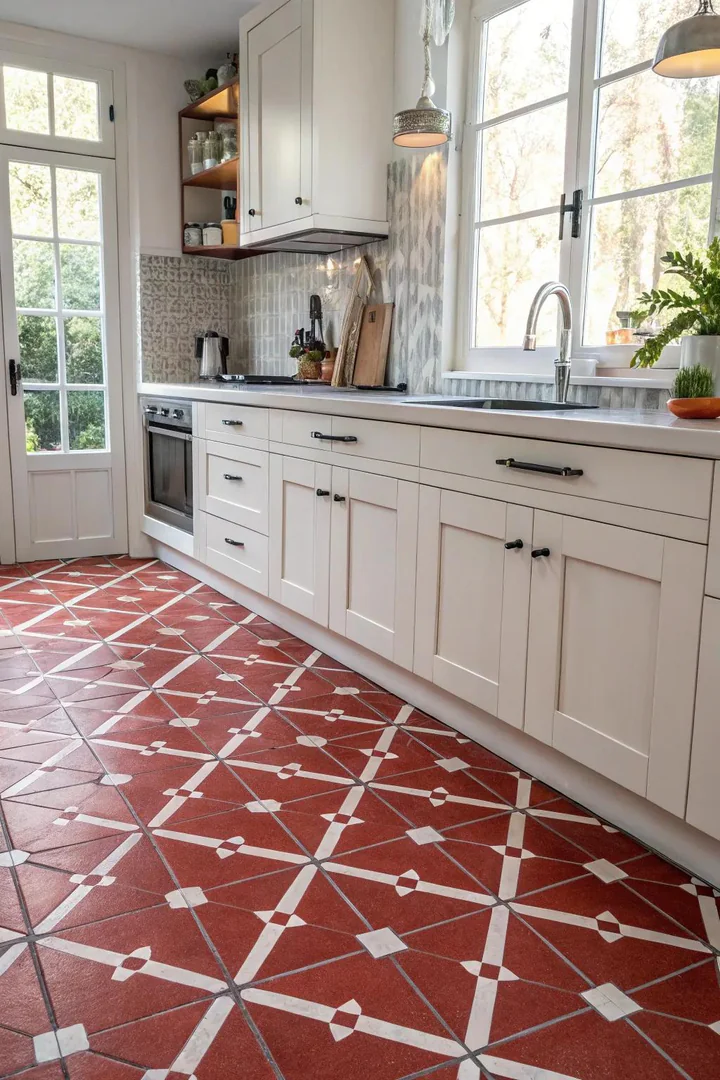
A red diamond tile arrangement — square tiles rotated 45 degrees (set on point) to create a diagonal diamond grid — changes the visual orientation of the backsplash or floor from horizontal and vertical to diagonal, adding movement, dimension, and a more formal, elevated feel to the red tile installation. The diagonal pattern makes the tiled surface appear larger and more complex than the same tiles set in a standard square grid.
Any square tile (4×4, 6×6, or 8×8 inches) can be installed in a diamond pattern by rotating it 45 degrees. The edges along the countertop, ceiling, and wall ends require half-tiles cut diagonally, which increases material waste by approximately 10-15% — order accordingly. Red square tiles with a glossy glaze from Daltile (Color Wheel), Merola Tile, or MSI in 4×4-inch or 6×6-inch sizes are the most common choice for diamond patterns. Set the diamond field with thin grout lines (1/16 inch) and white grout for a crisp, geometric effect, or with wider grout lines (1/8 inch) and a warm gray grout for a softer, more traditional look.
17. Red and White Checkerboard Flooring
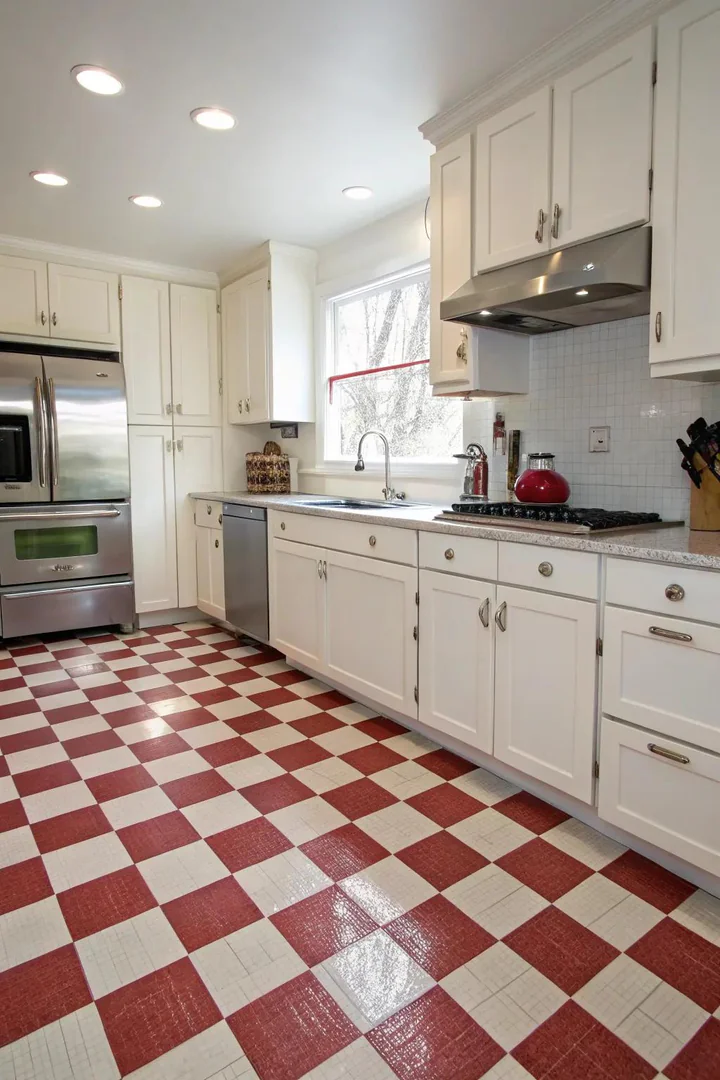
A red and white checkerboard floor — alternating red and white square tiles in a straight or diagonal grid — is one of the most iconic, immediately recognizable tile patterns in kitchen design, evoking 1950s diners, French bistros, European bakeries, and classic American kitchens of the mid-20th century. The bold two-color contrast creates a high-energy, graphic floor that gives the kitchen instant personality and period character.
Use 12×12-inch or 8×8-inch porcelain or ceramic floor tiles in matched red and white from the same product line (Daltile Color Wheel, American Olean, or Merola Tile) to ensure identical thickness, calibration, and surface finish. Install in a straight grid (tiles aligned with the walls) for a classic checkerboard, or rotate the grid 45 degrees for a diamond checkerboard that adds visual movement. The grout color should be neutral (light gray) to avoid competing with the two-tile pattern. Pair the red and white checkerboard floor with white cabinets and a simple white subway tile backsplash — the floor should be the star, and the surrounding surfaces should support rather than compete. Visit The Designers Company for more kitchen tile and design ideas.
How to Choose Red Kitchen Tiles
Selecting the Right Red Shade
Red is not one color — it spans from pale pink-tinged terra cotta and dusty rose through warm brick and tomato to bright cherry and crimson to deep burgundy, wine, and oxblood. The right shade depends on the kitchen’s existing palette and mood. Warm reds (brick, terracotta, tomato) suit farmhouse, rustic, Mediterranean, and traditional kitchens with warm wood and earthy tones. Cool reds (cherry, crimson, ruby) suit modern, contemporary, and mid-century kitchens with clean lines and crisp contrasts. Deep reds (burgundy, wine, oxblood) suit formal, traditional, and moody kitchens with dark cabinets, marble countertops, and rich textures. Order samples of 3 to 5 red shades and hold them against your cabinets, countertop, and floor in your kitchen’s actual lighting before committing.
Choosing the Right Grout Color
Grout color has as much impact on the final look as the tile color itself. White grout with red tiles creates maximum contrast, defines each individual tile shape, and gives the installation a clean, graphic quality. Dark gray or charcoal grout with red tiles reduces contrast, creates a more unified surface, and hides staining better. Matching red grout (color-matched to the tile) creates a near-seamless, monochromatic surface where the tile shape is visible only by texture, not by color. Avoid pure black grout with bright reds — the combination can look harsh and industrial. Always test grout color by applying a sample swatch alongside the actual tile before grouting the entire installation.
Deciding Between Wall Tiles and Floor Tiles
Wall tiles (backsplash, accent wall) and floor tiles have different performance requirements. Floor tiles must be rated for floor use (rated at least PEI 3 for residential kitchen floors), have a slip-resistant surface (coefficient of friction of 0.42 or higher), and withstand foot traffic, dropped objects, and dragged furniture. Wall tiles have no load or slip-resistance requirements, so they can be thinner, smoother, glossier, and made from a wider range of materials (glass, hand-painted ceramic, delicate encaustic). Do not install wall-rated tiles on floors — they will crack under foot traffic and become dangerously slippery when wet.
Red Kitchen Tile Options Comparison
| Tile Type | Cost per Sq Ft | Best Application | Maintenance |
|---|---|---|---|
| Ceramic subway | $2-8 | Backsplash | Low — wipe clean |
| Glass mosaic/subway | $8-25 | Backsplash, accent | Low — non-porous |
| Porcelain brick-look | $3-10 | Backsplash, accent wall | Low |
| Zellige (handmade) | $15-35 | Backsplash, accent | Medium — seal periodically |
| Cement/encaustic | $8-18 | Floor, backsplash, island | Medium — seal required |
| Natural terracotta | $5-15 | Floor | High — seal and reseal |
| Porcelain (floor-rated) | $3-12 | Floor, wall, any | Low — nearly maintenance-free |
Common Red Kitchen Tile Mistakes to Avoid
Using too much red in a small kitchen. Red is a high-energy, visually dominant color that advances toward the viewer and makes surfaces feel closer. Covering every wall and the floor in red tile in a small kitchen makes the room feel smaller, warmer, and more enclosed than it already is. In small kitchens, limit red tile to a single surface — the backsplash or the floor, not both — and keep the remaining surfaces neutral (white, cream, gray) to balance the visual weight of the red.
Pairing red tiles with the wrong grout color. Pure white grout with large-format red tiles creates a harsh, grid-like contrast that draws attention to the grout lines rather than the tile. Conversely, pure black grout with bright red tiles creates an aggressive, jarring combination. Test grout samples alongside your actual tile in your kitchen’s lighting before grouting. Warm gray, beige, and taupe grouts typically work better with red tiles than pure white or pure black.
Ignoring the red tile’s interaction with kitchen lighting. Red tiles look dramatically different under warm (2700K), neutral (3500K), and cool (5000K) lighting. Warm lighting intensifies red and makes it appear richer and deeper; cool lighting dulls red and can give it a brownish or purplish cast. Before committing to a red tile, view samples in your kitchen under the actual lighting conditions you will use daily — not just under the bright fluorescent lights at the tile showroom. For more on kitchen lighting and how it affects wall and backsplash colors, browse our kitchen decor ideas gallery.
Frequently Asked Questions
What cabinet colors go with red kitchen tiles?
White cabinets are the safest and most popular pairing with red tiles — the white provides a clean, neutral backdrop that lets the red tile stand out without competition. Cream and off-white cabinets work similarly but with a warmer, softer contrast. Dark wood cabinets (walnut, espresso, dark oak) create a rich, warm, traditional combination. Gray cabinets (light gray or charcoal) provide a modern, balanced backdrop for red tiles. Black cabinets create a bold, dramatic combination best suited for large kitchens with plenty of natural light. Avoid pairing red tiles with orange-toned or yellow-toned cabinets — the warm colors compete rather than complement.
Are red tiles hard to maintain?
No harder than any other color tile. Glazed ceramic, porcelain, and glass tiles in red require the same maintenance as white or neutral tiles — regular wiping with a damp cloth and mild cleanser, periodic grout cleaning, and grout resealing every 1 to 2 years. Unglazed tiles (natural terracotta, unfinished cement) require more maintenance regardless of color — they must be sealed initially and resealed every 1 to 3 years to prevent staining. Red tiles do not fade under normal kitchen lighting conditions; only prolonged direct UV exposure (from a skylight directly above the backsplash) can fade some ceramic glazes over many years.
Can I mix different red tile shapes in one kitchen?
Yes, but keep the red shade consistent across all shapes to maintain visual cohesion. A red subway tile backsplash paired with a red hexagon floor tile works well if both tiles are the same shade of red (or very close). Mixing different red shades (bright cherry backsplash with dark burgundy floor) creates a disjointed, uncoordinated look unless the two reds are clearly intentional and visually separated by neutral surfaces between them.
What countertop materials pair best with red tiles?
White marble or white quartz (Calacatta, Carrara, or pure white) provide the cleanest contrast with red tiles and keep the kitchen feeling bright. Dark granite or soapstone (black, charcoal, or dark green) create a rich, grounded base that supports the red tiles above. Butcher block and natural wood countertops add warmth and organic texture that complement the earthy character of brick-style and terracotta red tiles. Avoid red or orange-toned countertops (red granite, copper) — too much red across multiple surfaces overwhelms the kitchen.
How do I make red tiles work in a modern kitchen?
Choose sleek, uniform tile shapes (linear tiles, large-format squares, or clean subway tiles) rather than rustic, handmade, or ornate shapes. Use thin grout lines (1/16 inch) and a matching or dark grout to minimize the grout grid. Select a matte or satin finish rather than a heavily textured or hand-glazed finish. Pair the red tiles with flat-panel cabinets (no ornate molding or raised panels), quartz countertops, and minimalist hardware. The combination of a modern tile format with a bold red color creates a contemporary kitchen that has personality without looking traditional or dated.
Is red tile a good choice for resale value?
Red tile is a personal, bold design choice that appeals strongly to some buyers and not at all to others — it is not a safe, neutral choice for maximizing broad buyer appeal. If you plan to sell the home within 2 to 3 years, consider using red tile only in easily replaceable locations (a small backsplash, an accent strip) rather than on floors or large walls that are expensive to retile. If you plan to stay long-term, choose the red tile you love — your enjoyment of the kitchen matters more than hypothetical future buyers’ preferences.
Conclusion
Red kitchen tiles — from rustic terracotta and weathered brick to glossy subway tiles and hand-painted Moroccan zellige — bring a warmth, energy, and visual boldness to the kitchen that no neutral tile can replicate. The 17 ideas above demonstrate that red works in every tile shape, every installation pattern, and every kitchen style, from farmhouse to contemporary to Mediterranean, when the shade, the format, and the surrounding design elements are chosen with care.
Start with a sample. Order 3 to 5 red tile samples in different shades and finishes, hold them against your cabinets and countertops in your kitchen’s actual lighting, and test grout colors alongside each tile before committing. Red is bold, and bold choices reward careful planning — the right red tile in the right shade with the right grout on the right surface will give your kitchen a character and personality that neutral tiles simply cannot provide.