
Kitchen Decor Ideas: 23 Gorgeous Ways That Refresh Your Home Fast
Kitchen decor ideas matter because the kitchen is the most-used room in most homes — it is where meals are prepared, where families gather in the morning, where guests congregate during parties, and where homework gets done at the counter. A well-decorated kitchen does not just look good in photographs; it makes daily cooking and eating more pleasant by surrounding you with colors, textures, and objects that you chose deliberately rather than inherited from the previous owner or left over from a quick renovation.
The 23 kitchen decor ideas below cover every category of decoration — from backsplash tile and lighting to wall art and rugs — and each one names specific products, brands, and materials so you can source the exact look rather than guessing. Whether your kitchen is brand new or twenty years old, these ideas work as targeted upgrades that refresh the room without a full renovation.
1. Introduce Color with Backsplash Tiles
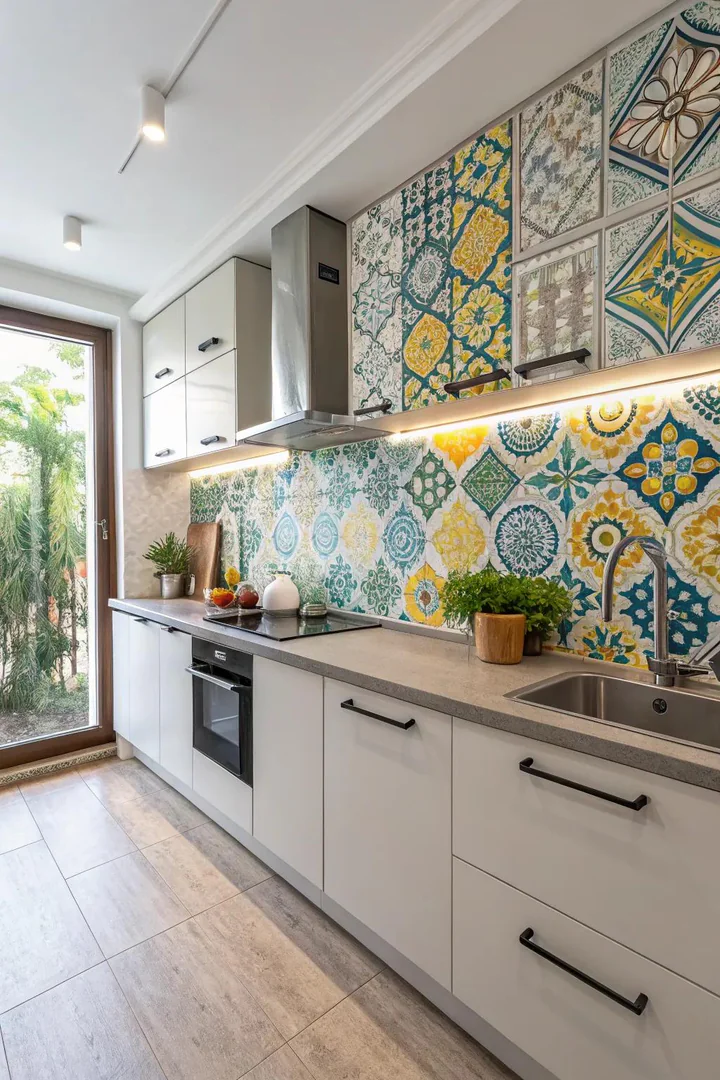
A backsplash is the single most impactful decorating decision in a kitchen because it occupies the vertical surface between the countertop and upper cabinets — the eye-level zone you face every time you cook. Replacing a plain painted wall with patterned tile, handmade zellige, or colorful ceramic immediately changes the kitchen’s personality. Fireclay Tile, Heath Ceramics, and Clé Tile all produce handmade backsplash tiles in dozens of colors and shapes — from classic 3×6 subway in glossy white to diamond-shaped zellige in Mediterranean blue.
For maximum color impact, choose a tile color that contrasts with your cabinets and countertops rather than matching them. White cabinets with a green zellige backsplash, grey cabinets with a terracotta herringbone tile, or navy cabinets with a white marble mosaic all create visual energy. If you prefer a subtler approach, choose a tile in the same color family as your cabinets but in a different finish — matte blue cabinets with glossy blue subway tile, for example, creates texture variation without color contrast. For more on choosing glass backsplash options, our dedicated guide covers every material and layout.
2. Add Open Shelving
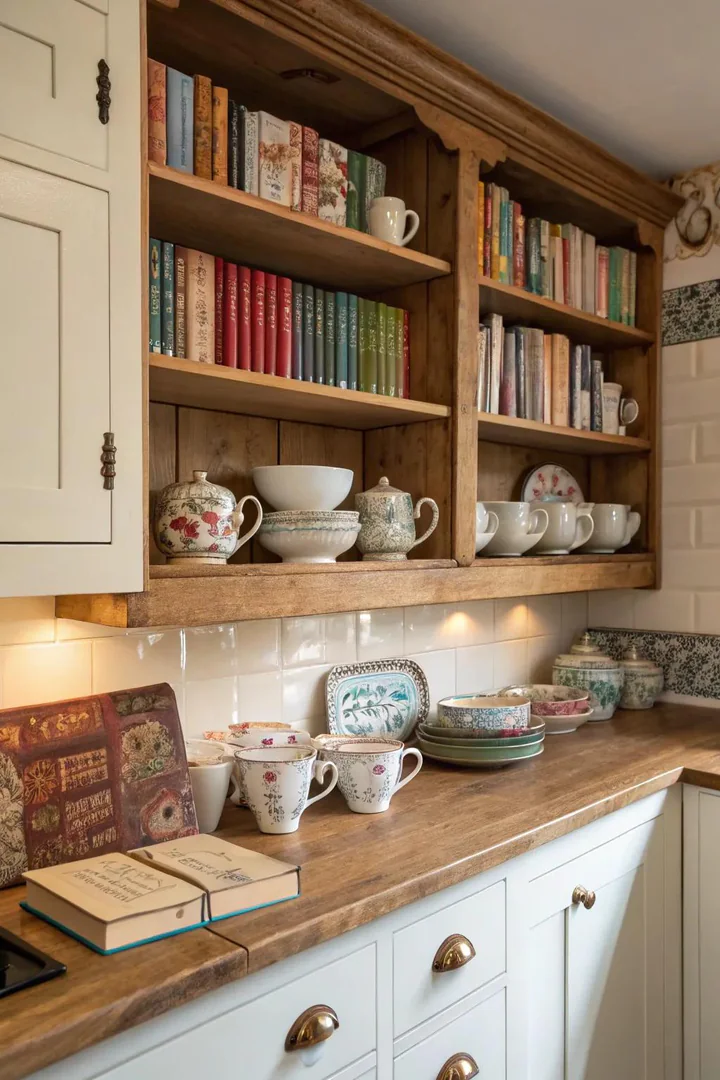
Open shelving replaces one or more sections of upper cabinets with floating shelves or bracket-mounted shelves that display dishes, glasses, cookbooks, and decorative objects rather than hiding them behind closed doors. The visual effect is dramatic — open shelves make a kitchen feel larger, airier, and more personal because you can see the objects on display and the wall behind them. White oak floating shelves (from companies like Shelfology or custom-cut from a local millwork shop) are the most popular material, but pipe-bracket shelves, brass-bracket marble shelves, and reclaimed wood planks each create a different aesthetic.
The key to successful open shelving is editing: display only the items that look good together and store everything else in lower cabinets or a pantry. A curated shelf with six matching white bowls, a few cookbooks stood upright, and a small potted herb looks designed. A shelf crowded with mismatched mugs, spice bottles, and cereal boxes looks like an overstuffed cabinet without a door. Arrange objects in groups of three, vary the height within each group, and leave breathing room between groups.
3. Adopt Natural Hues
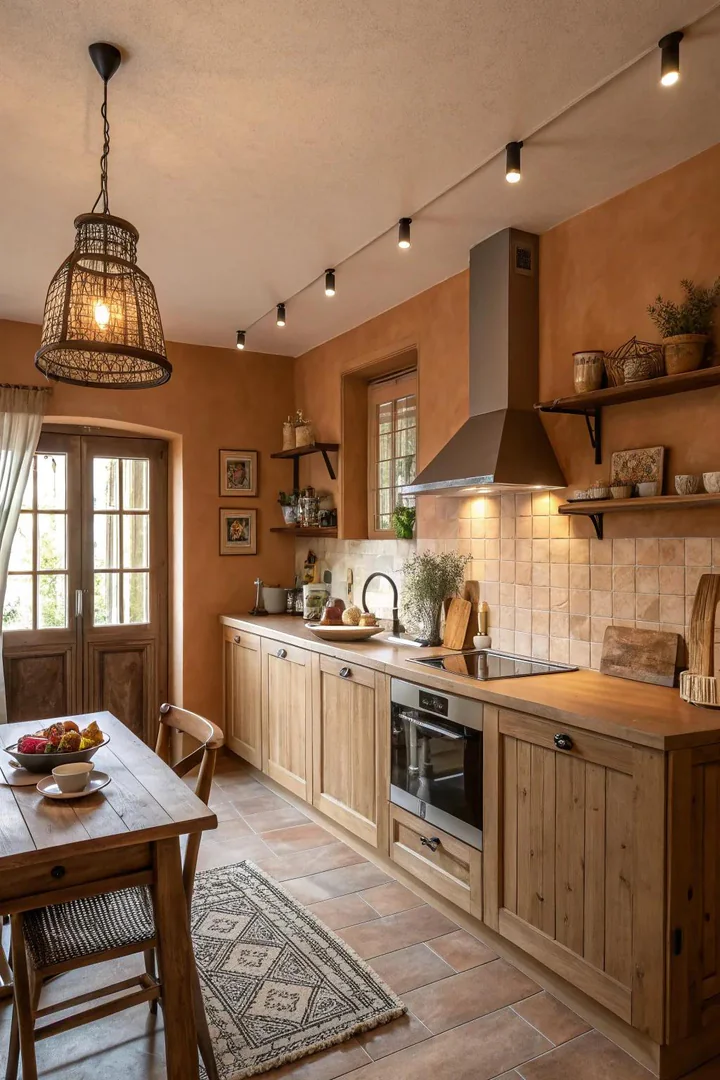
Earthy tones — terracotta, warm beige, olive green, clay, rust, and sand — create a kitchen palette that references natural materials and feels grounded, warm, and timeless. Unlike trend-driven colors that cycle in and out of fashion, earth tones are permanently appealing because they connect the kitchen to the natural world: the color of dried clay, fresh herbs, aged wood, and sun-warmed stone.
Introduce earthy tones through paint (Benjamin Moore’s Alexandria Beige, HC-77, or Sherwin-Williams’ Urbane Bronze, SW 7048 for cabinets or an accent wall), through natural materials (terracotta floor tile, soapstone countertops, walnut butcher block, linen curtains), and through accessories (handmade ceramic canisters from East Fork Pottery, woven baskets, olive-wood cutting boards). The earthy palette works in every kitchen style — rustic, farmhouse, Mediterranean, Scandinavian, and contemporary — because it is a material palette rather than a style palette. For more on choosing warm tones, our grey and beige kitchen ideas guide covers balancing warm and cool neutrals.
4. Set Up Pendant Lighting
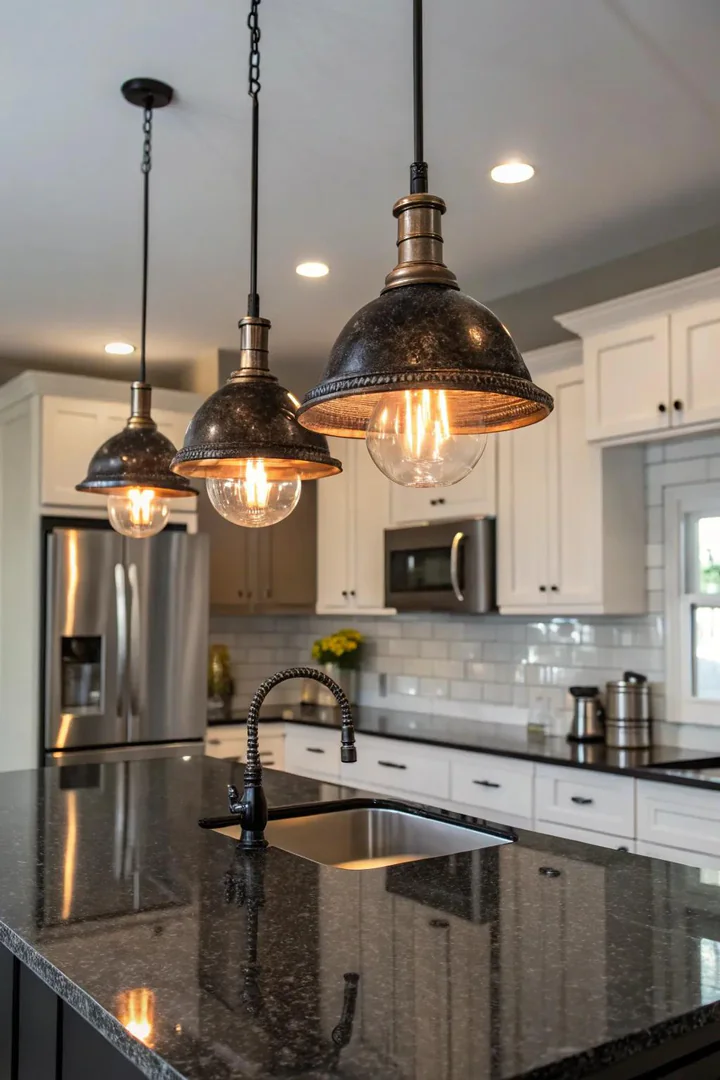
Pendant lights hung above an island or peninsula serve two purposes: they provide task lighting directly where you prep food and serve meals, and they act as decorative objects that establish the kitchen’s style. A pendant light is one of the few kitchen elements that functions simultaneously as lighting, furniture, and art — the shape, material, and finish of the pendant shade communicate the kitchen’s design direction at a glance.
Hang pendants 30 to 36 inches above the countertop surface and space them 24 to 30 inches apart for even light distribution. For a three-pendant arrangement over a standard 8-foot island, position one pendant at center and the other two 24 inches to each side. Schoolhouse Electric, Rejuvenation, Cedar & Moss, and West Elm all produce well-designed pendant lights in every style — from industrial enamel shades to handblown glass globes to woven rattan domes. Match the pendant finish to your cabinet hardware for a coordinated look. For more ideas, see our kitchen lighting guide covering pendant, recessed, and under-cabinet options.
5. Add a Rug for Warmth and Texture
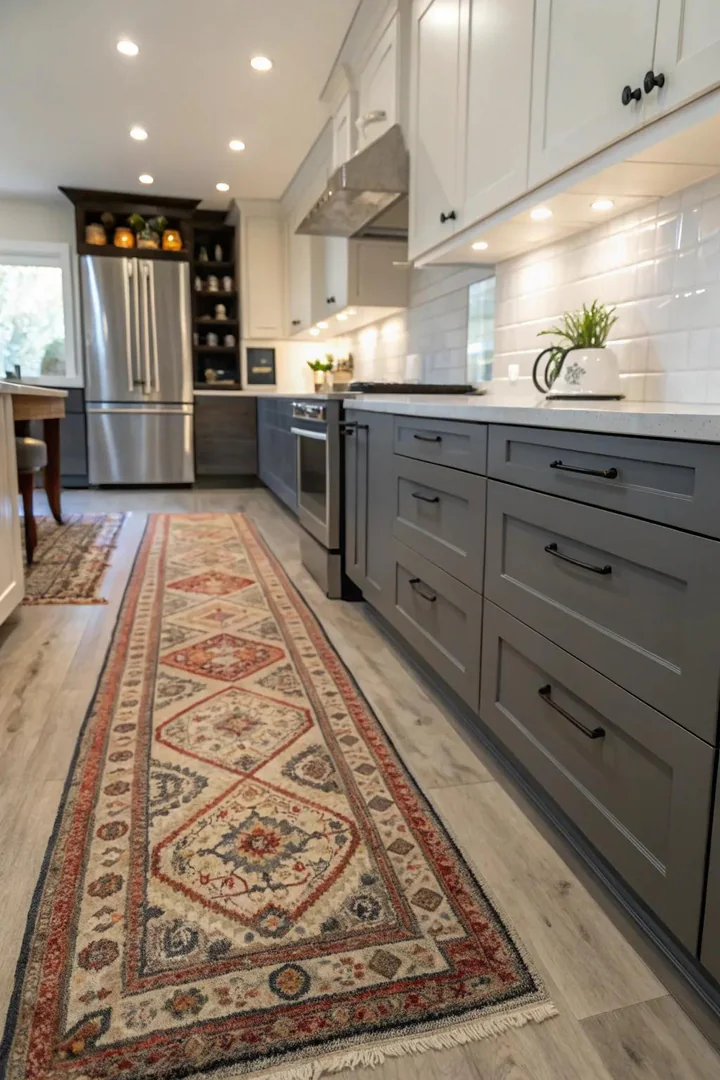
A kitchen rug — a runner in front of the sink, a small area rug in front of the stove, or a runner along the galley — adds color, pattern, and cushioned comfort underfoot in a room that is typically all hard surfaces. Standing on tile, stone, or hardwood for long cooking sessions is fatiguing; a rug absorbs impact and warms the floor visually and physically.
Choose a flat-weave, low-pile, or indoor-outdoor rug that can be machine-washed or hosed off — kitchen rugs collect food drips, flour dust, and foot traffic. Ruggable makes machine-washable kitchen runners in hundreds of patterns. Dash & Albert’s indoor-outdoor collection (made from recycled PET) resists stains and dries quickly. A 2.5×8-foot runner in front of the sink and a 2×3-foot mat in front of the stove are the two most functional placements. Choose a rug pattern with enough color and visual noise to hide minor stains — solid-color rugs in light shades show every spill.
6. Showcase Art for a Unique Touch
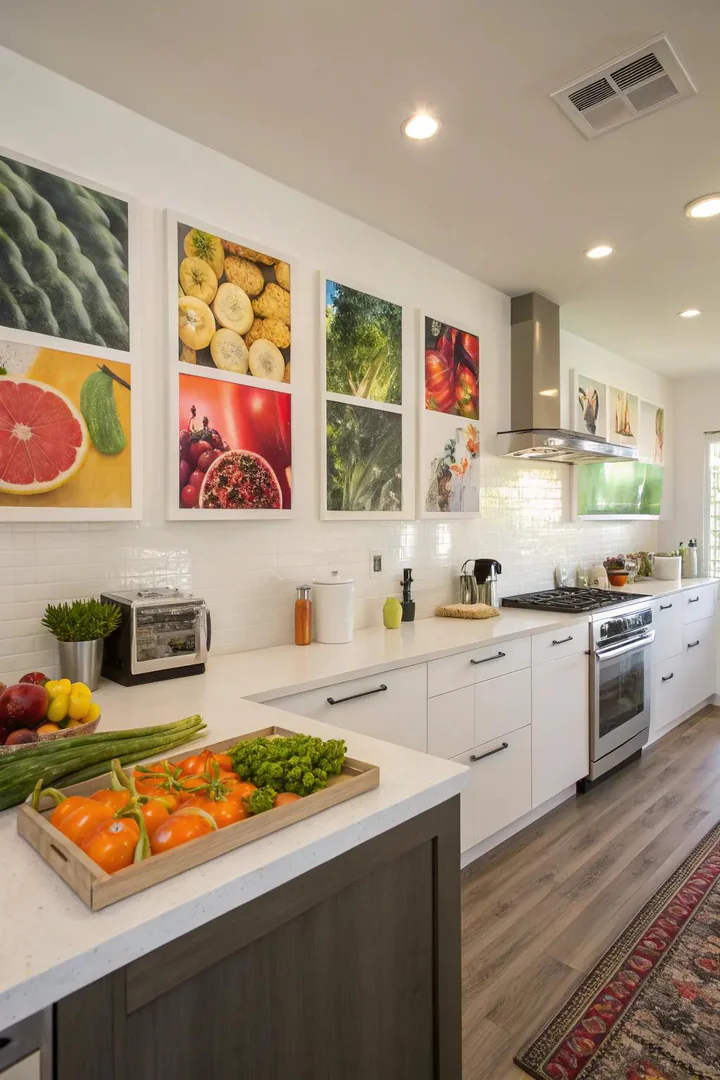
Hanging art in the kitchen — framed prints, original paintings, photography, or textile art — treats the kitchen as a living space worthy of decoration rather than a purely functional room. Art personalizes the kitchen in a way that expensive appliances and premium countertops cannot: a vintage botanical print, a photograph from a family trip, or a piece from a local artist tells a story that no countertop can.
Hang art on walls that are not directly adjacent to the stove or sink, where grease splatter and steam could damage the work. The wall above a breakfast nook, the wall at the end of a galley kitchen, and the side of a refrigerator enclosure are all protected locations for kitchen art. Use frames with glass or acrylic glazing to protect the art from humidity and grease particles. Framebridge and Simply Framed offer custom framing with protective glazing that resists kitchen conditions. Lean smaller pieces on an open shelf or a plate rail for an effortless, gallery-style display.
7. Combine and Contrast Textures
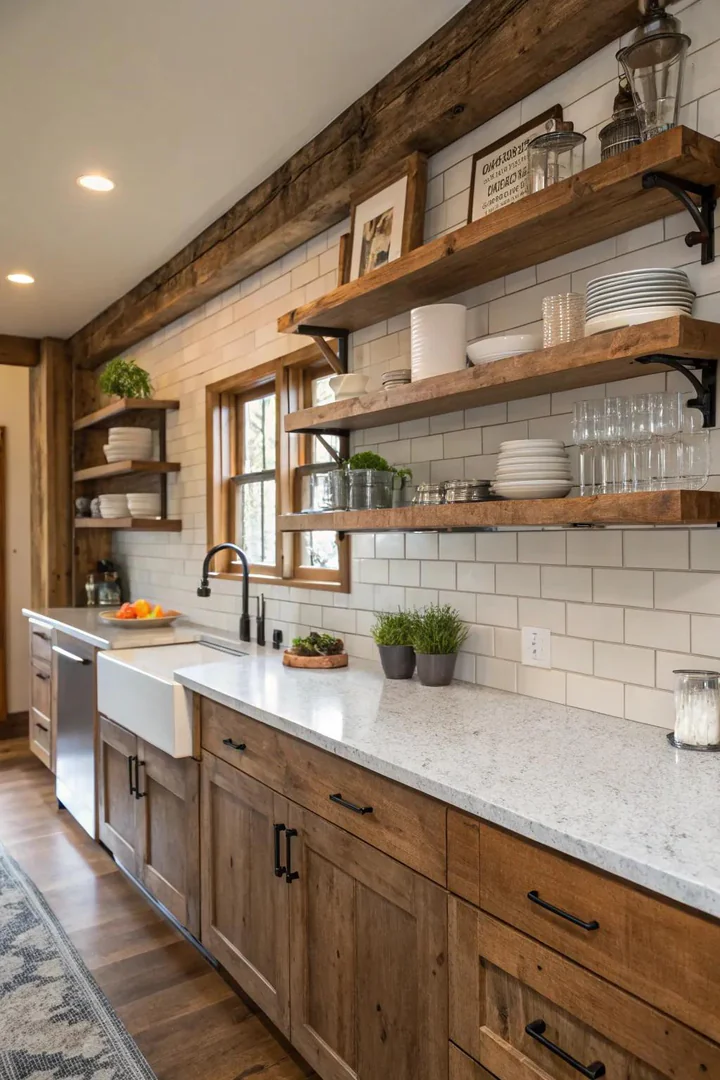
Texture mixing — combining smooth, rough, glossy, matte, woven, and brushed surfaces in the same kitchen — adds visual richness and depth that a single-texture kitchen cannot achieve. A kitchen with polished marble countertops, matte-painted cabinets, a rough brick backsplash, a woven pendant light, and a hammered copper sink creates a sensory experience that is far more interesting than a kitchen where every surface is the same sheen and material.
Balance texture contrast so the kitchen feels layered rather than chaotic: pair one or two rough/organic textures (reclaimed wood, exposed brick, woven fibers) with one or two smooth/polished textures (marble, lacquer, stainless steel) and one or two matte textures (painted cabinets, soapstone, linen). The rough textures add warmth and character, the smooth textures add refinement and light reflection, and the matte textures provide visual rest between the extremes. Aim for at least three distinct textures visible in any single sightline.
8. Incorporate Vintage Treasures for Unique Charm
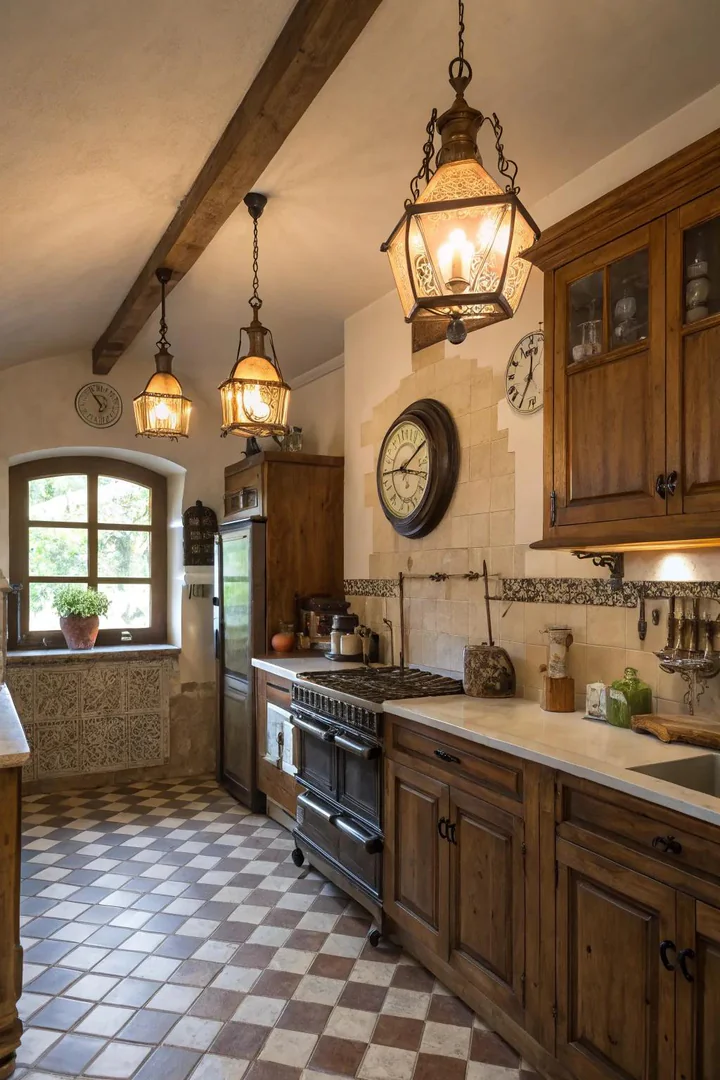
Vintage objects — a 1950s Chambers stove, an antique bread box, a set of French copper pots, a reclaimed apothecary cabinet, or a collection of Depression-era glass jars — give a kitchen the patina and personality that new objects cannot replicate. Each vintage piece carries its own history, its own wear patterns, and its own aesthetic that is impossible to reproduce with new manufacturing.
Source vintage kitchen items from local antique shops, estate sales, Chairish, 1stDibs, and Etsy’s vintage section. The best vintage pieces for kitchen display are those that are both decorative and functional: a copper colander hung on the wall, a vintage enamelware bowl holding fruit, an antique scale displaying lemons, or a set of vintage ceramic canisters storing flour and sugar. Limit vintage items to two or three per kitchen to keep the look curated rather than cluttered — a few well-placed antiques among modern elements create character, while an entire kitchen of mismatched vintage pieces creates visual confusion.
9. Establish a Coffee Bar
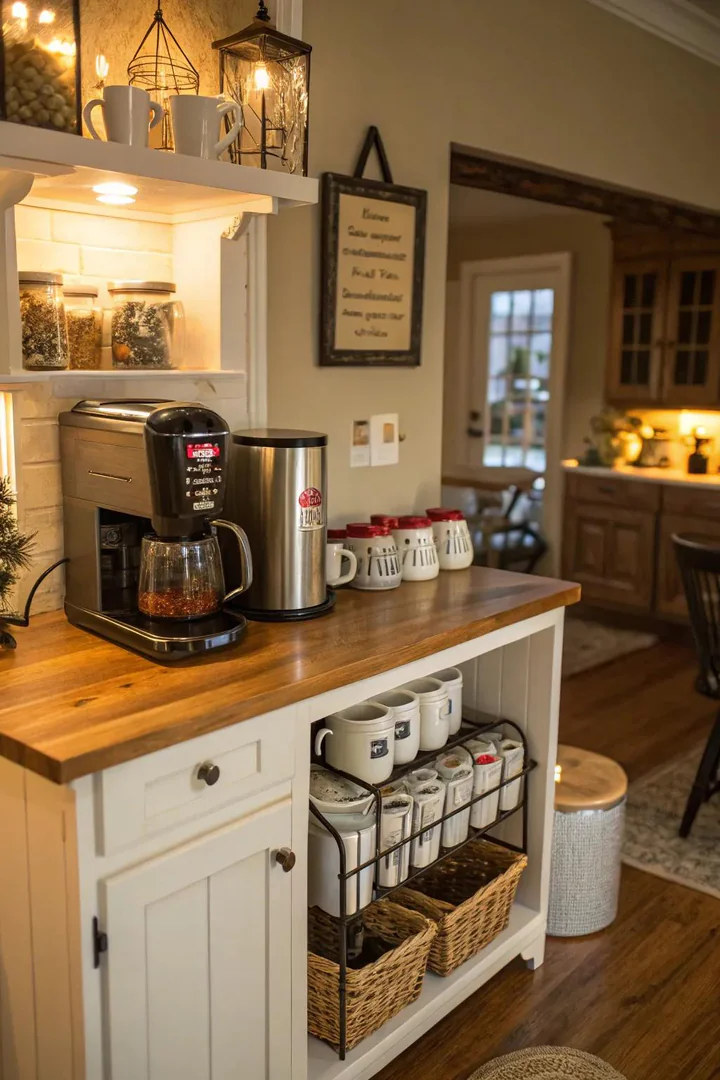
A dedicated coffee station — a countertop zone or a built-in niche that houses the coffee maker, grinder, mugs, and supplies — serves both a decorative and organizational function. Instead of scattering coffee equipment across the counter among the toaster and cutting boards, a coffee station groups everything in one styled vignette that looks intentional and keeps the morning routine efficient.
Set up the coffee station in a corner of the counter or inside a pantry cabinet with its own outlet. Place the coffee machine (Breville, Technivorm Moccamaster, or a manual pour-over setup like Chemex or Hario V60) on a small tray or cutting board to define the zone. Store mugs on hooks beneath an upper cabinet or on a small shelf above the machine. Add a ceramic canister for beans, a small sugar bowl, and a spoon rest. The tray or cutting board creates a visual boundary that separates the coffee station from the rest of the counter — it reads as a self-contained moment rather than another appliance on the counter.
10. Add Indoor Plants
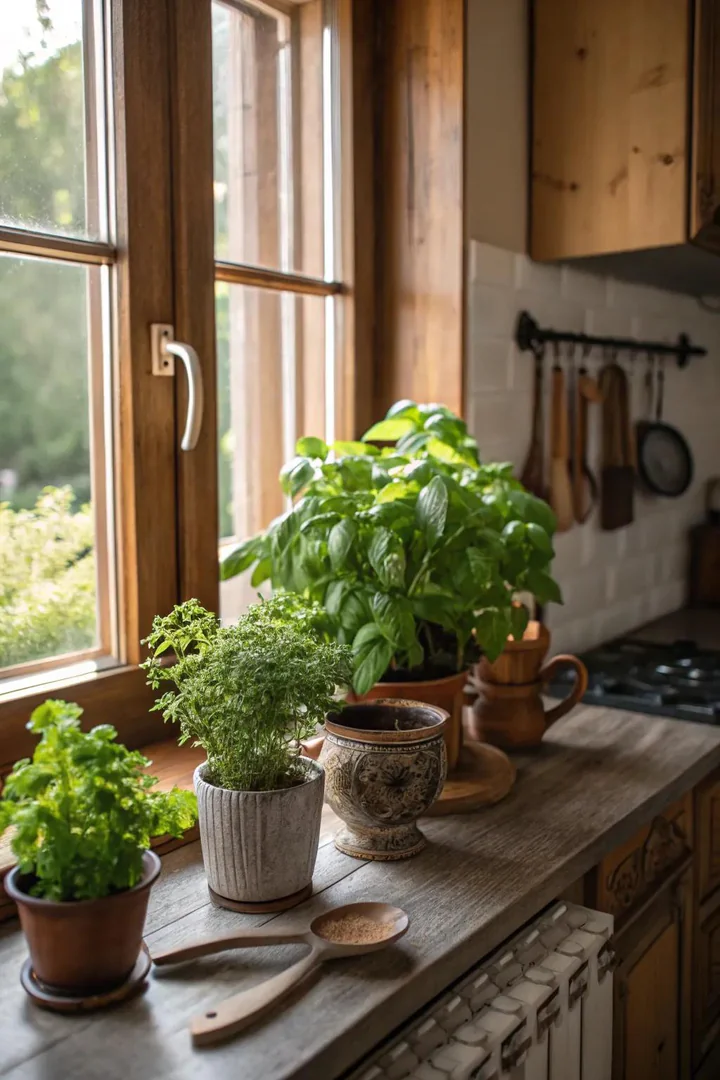
Indoor plants bring a kitchen to life in a way that no other decorating element can — they add color, organic shape, movement (as leaves shift in air currents), and the psychological warmth of living things in a room dominated by hard, manufactured surfaces. A pothos trailing from the top of a cabinet, a small herb garden on the windowsill, or a fiddle-leaf fig in the corner softens the kitchen’s edges and connects the room to nature.
Choose plants that tolerate the kitchen’s conditions: humidity from cooking, temperature swings from the stove and oven, and potentially low light. Pothos, philodendron, snake plant, and ZZ plant all thrive in kitchen conditions with minimal care. For the windowsill, grow culinary herbs — basil, rosemary, thyme, mint, and cilantro — in small terra cotta pots from a local nursery. The herbs serve a dual purpose: they look beautiful and provide fresh ingredients within arm’s reach. Place plants on the windowsill, on top of upper cabinets, on open shelves, or in hanging planters from the ceiling — each location creates a different decorative effect.
11. Set Up Statement Fixtures
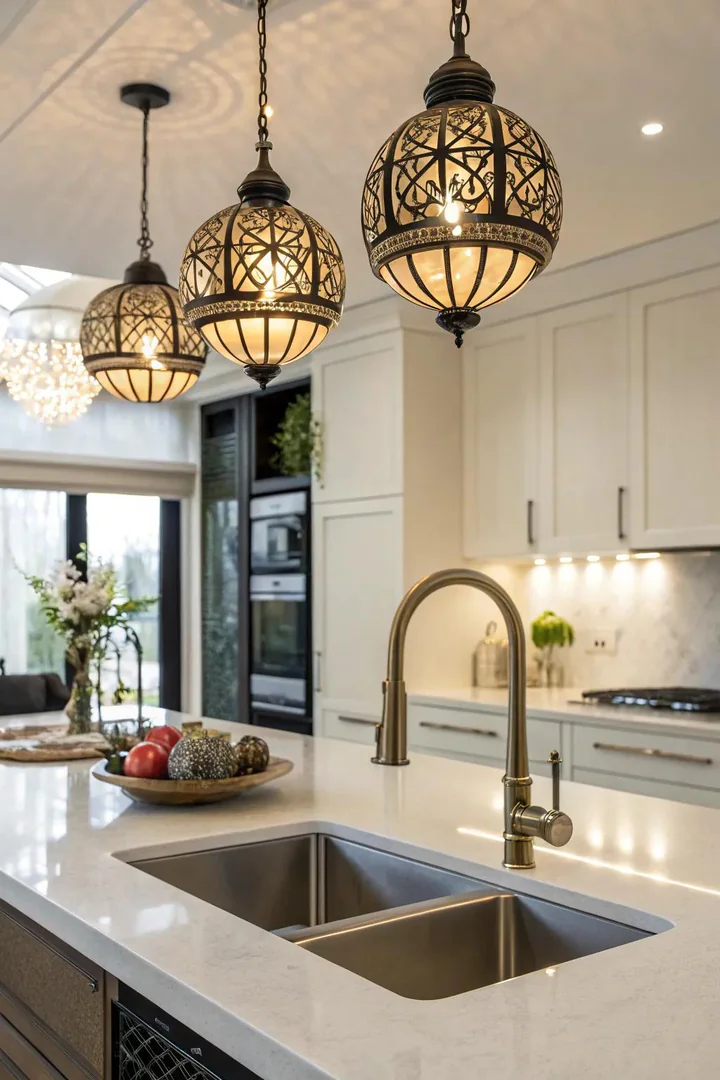
A statement fixture — an oversized pendant light, a sculptural chandelier, a dramatic pot rack, or a bold range hood — gives the kitchen a single commanding focal point that anchors the room’s design and draws the eye. Where pendant lights provide balanced task lighting, a statement fixture provides presence: it says “this is the center of the room, and the design was planned around this piece.”
Choose one statement fixture per kitchen — two competing statements cancel each other out. An oversized woven rattan pendant (Serena & Lily’s Headlands Pendant or a vintage Vietnamese bamboo shade) works in coastal and bohemian kitchens. A linear brass chandelier (Visual Comfort’s Darlana or Restoration Hardware’s Harlow Crystal) works in traditional and transitional kitchens. A matte black industrial pendant cluster works in modern and loft-style kitchens. Scale the fixture to the island or table it hangs above — the fixture width should be approximately two-thirds the width of the surface below it.
12. Try Out Wallpaper
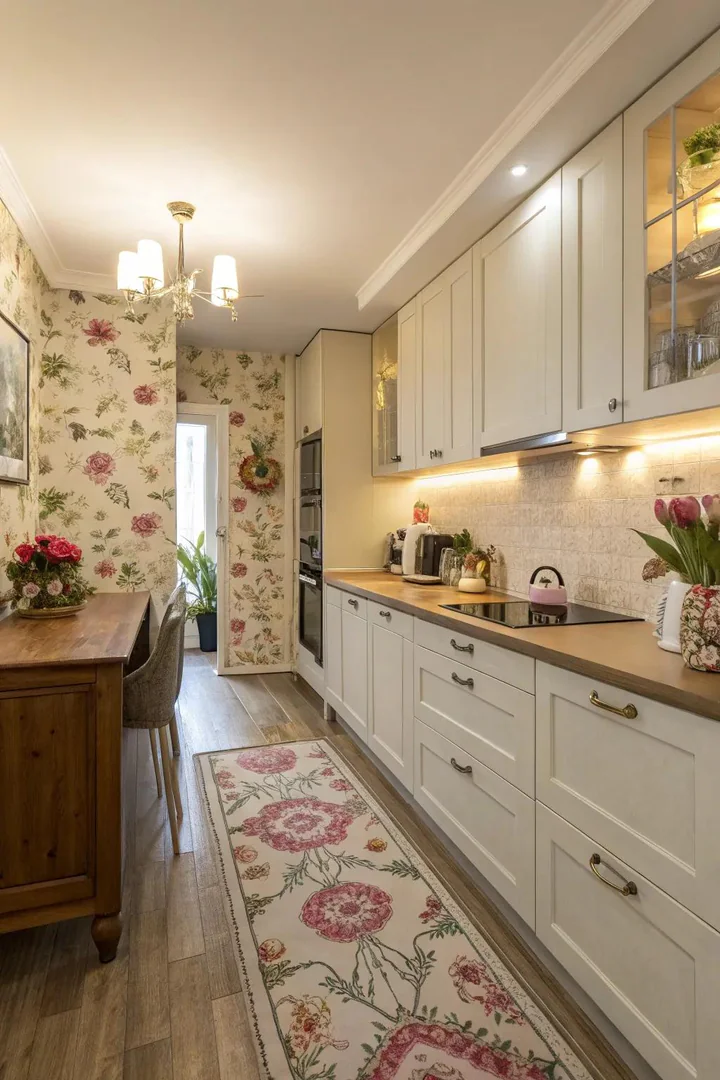
Wallpaper in the kitchen introduces pattern, color, and visual complexity that paint alone cannot provide. A botanical print, a geometric motif, a toile pattern, or a textured grasscloth transforms a blank kitchen wall into a design statement. Modern vinyl-coated and peel-and-stick wallpapers (from brands like Chasing Paper, Tempaper, and Spoonflower) are moisture-resistant, wipeable, and removable — making them practical for kitchen use and rental-friendly.
Apply wallpaper to a single accent wall (the wall without cabinets, the breakfast nook wall, or the wall behind open shelving) rather than all four walls — a fully wallpapered kitchen can feel overwhelming. Choose a wallpaper pattern that complements the kitchen’s existing colors: a blue-and-white botanical for a kitchen with white cabinets, a warm geometric for a kitchen with wood tones, or a black-and-white toile for a kitchen with grey cabinets. Keep the backsplash area tiled (not wallpapered) for durability behind the stove and sink.
13. Make Use of Under-Cabinet Lighting
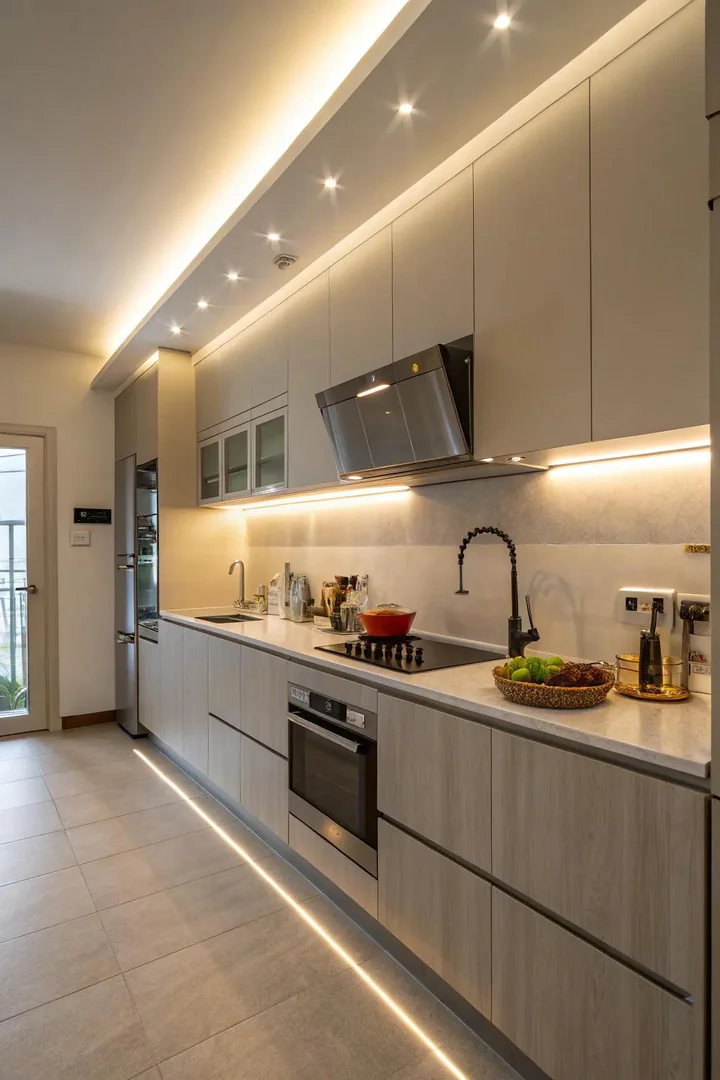
Under-cabinet lighting — LED strip lights or puck lights mounted to the underside of upper cabinets — provides direct task lighting on the countertop work surface and creates a warm ambient glow that makes the kitchen feel inviting in the evening. Overhead recessed lights cast shadows on the countertop when you stand at the counter; under-cabinet lights eliminate those shadows by illuminating the work surface from directly above.
LED strip lights (WAC Lighting’s InvisiLED, GE’s Premium LED Bars, or Philips Hue light strips for smart-home integration) mount with adhesive backing or screw-in clips along the front underside of the upper cabinets. Choose warm white (2700K-3000K) for a cozy, residential feel or neutral white (3500K-4000K) for better color accuracy when prepping food. Wire-in models provide the cleanest installation with no visible cords; plug-in models (like the Brilliant Evolution LED bars) install in minutes without an electrician.
14. Create a Chalkboard Wall
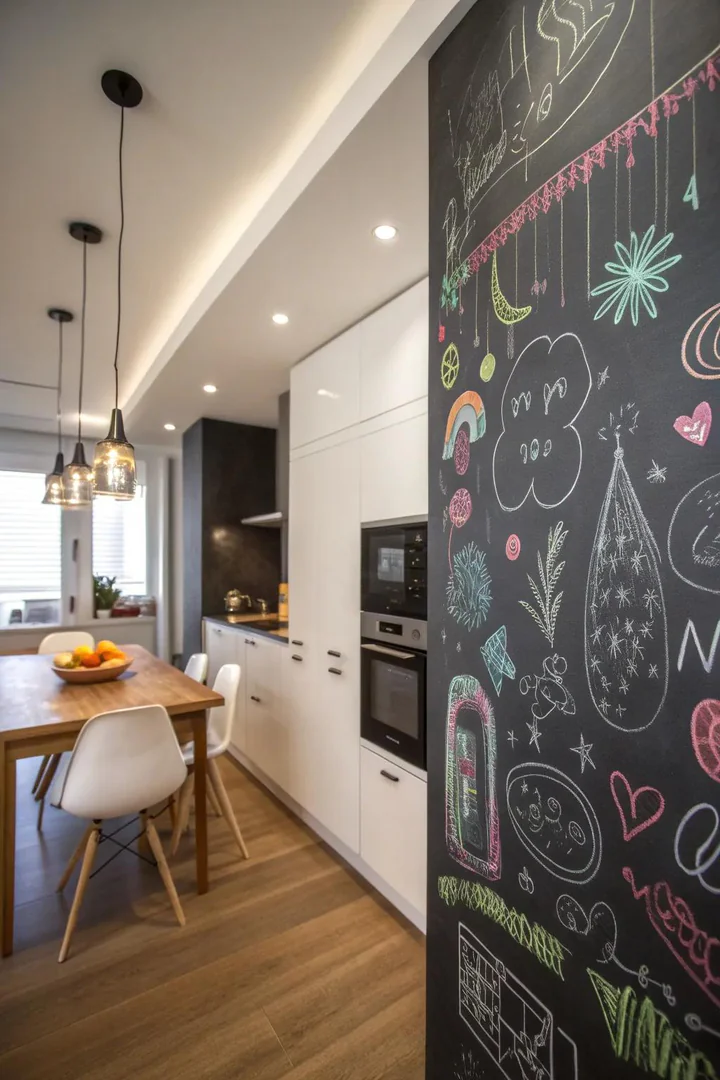
A chalkboard wall — created by painting a wall section with chalkboard paint (Rust-Oleum or Benjamin Moore’s chalkboard finish) or applying a chalkboard-finish adhesive panel — turns a kitchen wall into a writable surface for grocery lists, weekly meal plans, recipe notes, kids’ drawings, and decorative chalk lettering. The dark surface also functions as an accent wall that anchors the room visually.
Paint the chalkboard surface on a small, defined area — the inside of a pantry door, a section of wall between cabinets, or a framed rectangle rather than an entire wall. An entire chalkboard wall can look unfinished unless it is consistently decorated with quality chalk lettering. Use liquid chalk markers (from Versachalk or Chalkola) rather than stick chalk for cleaner, more legible writing that does not smudge as easily. Condition the chalkboard surface before first use by rubbing the side of a piece of chalk across the entire surface and then wiping it off — this prevents “ghosting” (permanent marks from the first writing).
15. Embrace Minimalist Sophistication
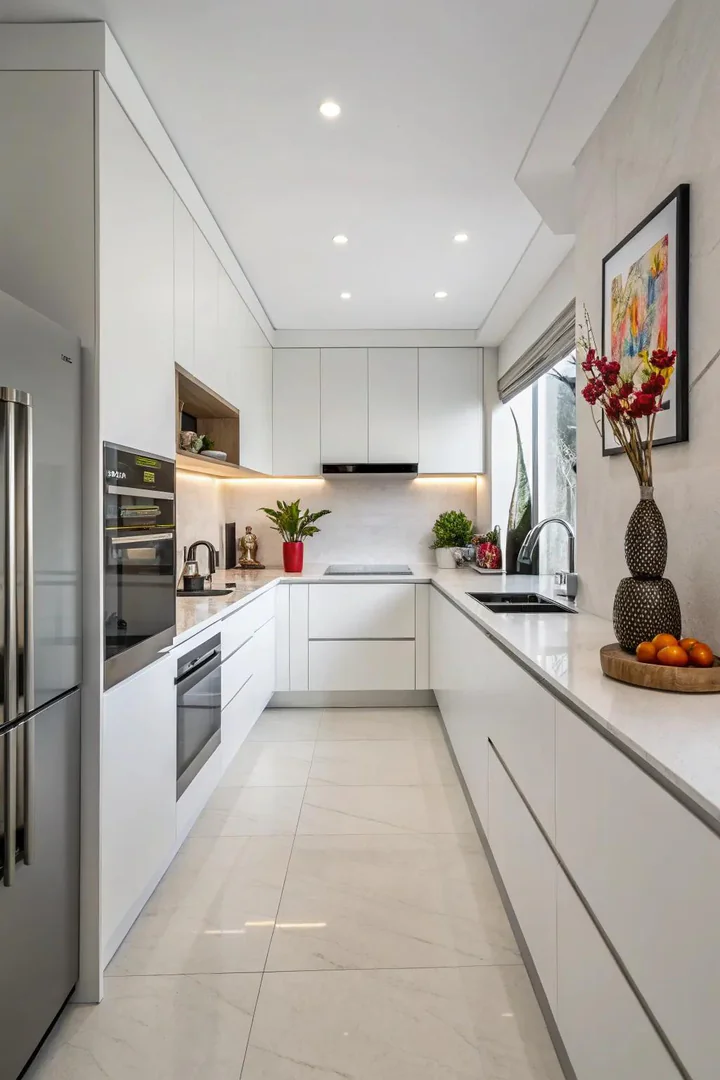
Minimalist kitchen decor strips the room down to essential elements — clean surfaces, hidden storage, neutral colors, and a few carefully chosen objects — so the architecture and materials speak rather than the accessories. The minimalist kitchen is decorated through restraint: the beauty comes from the quality of the countertop material, the precision of the cabinet joints, the color of the paint, and the shape of a single ceramic vase on an otherwise empty counter.
Achieve minimalist decor by removing countertop clutter (store appliances in cabinets or a pantry, keep only one or two objects on the counter), choosing handle-less cabinets (push-to-open or integrated edge pulls), and limiting the color palette to two or three neutrals (white, warm grey, and natural wood, or white, black, and concrete). The decorative objects in a minimalist kitchen must earn their place — a handmade ceramic bowl from Hasami Porcelain, a single branch in a glass vase, or a stack of three cookbooks with attractive spines. Nothing sits on the counter by accident.
16. Incorporate Personal Elements with Decorations
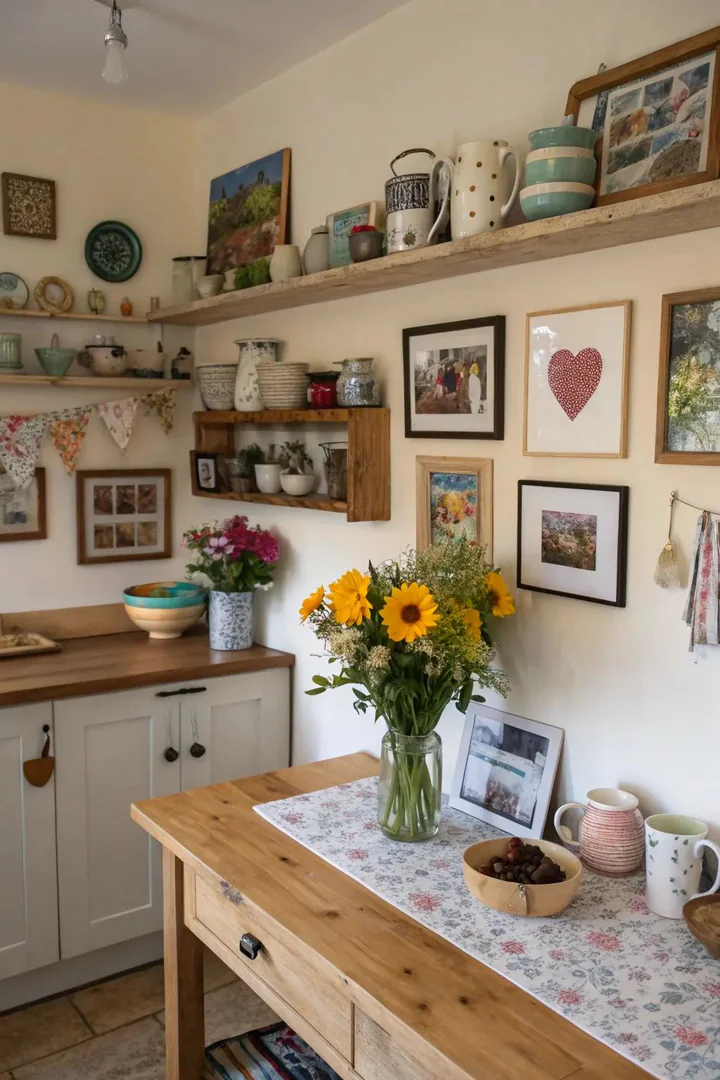
Personal decor — family photos in the breakfast nook, a collection of ceramic pieces from your travels, a grandmother’s recipe card framed on the wall, a child’s drawing displayed on a magnetic board — makes the kitchen yours rather than a showroom. Personal items distinguish a lived-in kitchen from a staged kitchen, and they create conversation starters when guests visit.
Display personal items in designated zones rather than scattering them across every surface: a small gallery arrangement on one wall, a curated shelf of collected ceramics, or a magnetic board near the fridge for rotating family photos and notes. Keep personal displays edited — five family photos in matching frames look intentional; fifteen photos in mismatched frames on every wall surface look disorganized. Rotate personal displays seasonally (swap in holiday cards in December, vacation photos in summer) to keep the kitchen feeling fresh.
17. Merge Contemporary and Rustic Designs
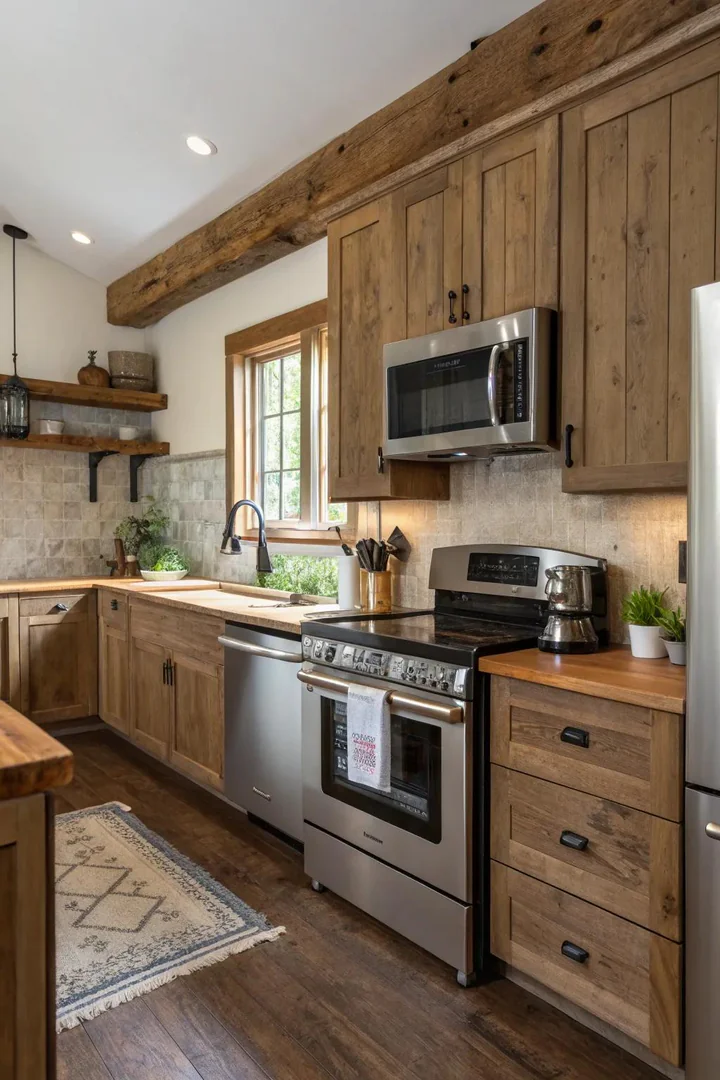
The modern-rustic kitchen combines clean contemporary lines (flat-panel cabinets, integrated appliances, thin-edge countertops) with raw natural materials (reclaimed wood beams, hand-scraped floors, stone accent walls, woven baskets) to create a style that feels both current and rooted. The modern elements prevent the kitchen from looking like a log cabin; the rustic elements prevent it from looking cold and sterile.
Balance is the key: start with a modern framework (clean-lined cabinets in a solid color, a simple countertop) and add rustic elements as accents — a reclaimed wood floating shelf, a rough-hewn live-edge bar top on the island, a hand-thrown ceramic fruit bowl, or a wrought-iron pot rack. Brands like Lostine, Schoolhouse Electric, and West Elm’s organic collections bridge the modern-rustic divide with products designed to work in both contexts. Keep the rustic elements natural and unfinished (exposed wood grain, visible stone texture, woven fibers) to provide honest contrast against the refined modern surfaces.
18. Try Out Striking Accent Colors
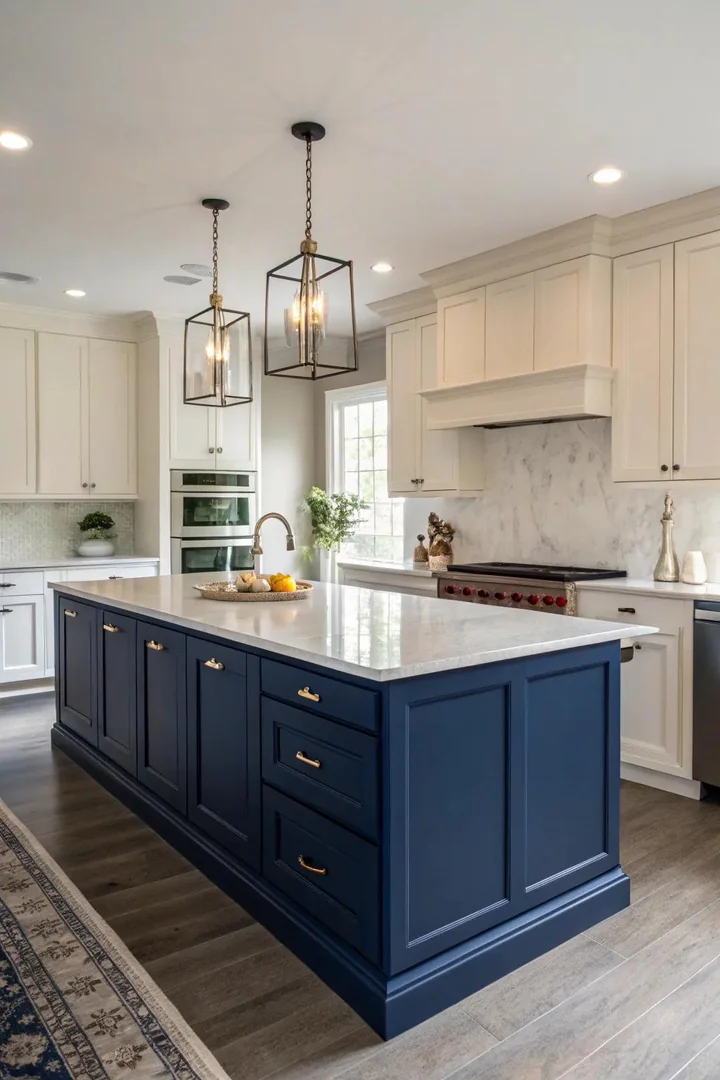
Bold accent colors — a red range, a yellow door, a green island, a teal backsplash, or an orange pendant light — inject energy and personality into a neutral kitchen without requiring a full color commitment. The accent-color approach works on the 80/20 principle: 80 percent of the kitchen stays neutral (white, grey, black, wood) while 20 percent provides a concentrated dose of color that defines the room’s personality.
Choose one accent color and repeat it in two or three locations: a cobalt blue island echoed in blue ceramic canisters and a blue dish towel, or a forest green range echoed in green glass cabinet knobs and a green runner. The repetition makes the accent color look planned rather than random. Avoid introducing multiple bold colors — a red range with a yellow island and a blue backsplash creates a clashing palette. For more ideas on choosing kitchen colors, our dedicated guide covers accent, two-tone, and full-color strategies.
19. Integrate Various Metal Finishes
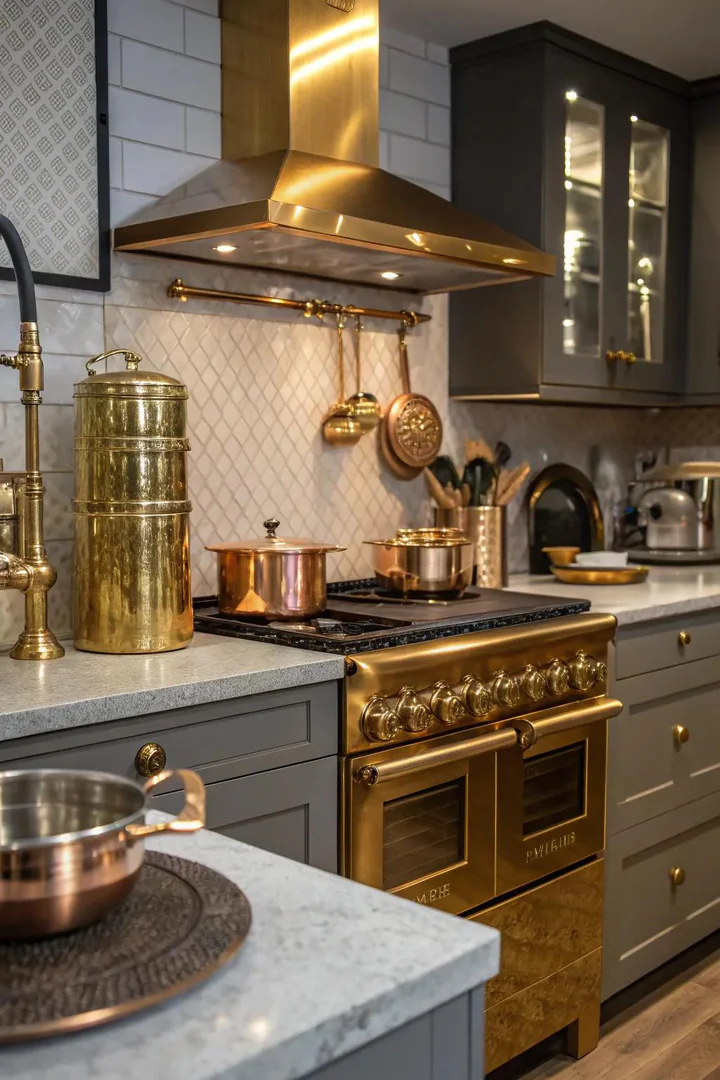
Mixing metal finishes — brass hardware with a polished nickel faucet, a matte black range with chrome pendant lights, or a copper range hood with brushed gold cabinet pulls — adds visual depth and prevents the kitchen from looking like everything was ordered from a single catalog on the same day. Mixed metals suggest that the kitchen was assembled over time with thoughtful individual selections rather than chosen as a package.
The rule of successful metal mixing is to limit the palette to two or three metals and distribute each one across at least two locations: brass on the hardware and the light fixture, matte black on the faucet and the range, chrome on the cabinet hinges and the pot rack. Avoid random metal distribution where every fixture is a different finish — the mixed metals should still feel coordinated. Group metals by temperature: warm metals (brass, gold, copper) mix well together, cool metals (chrome, nickel, stainless) mix well together, and one warm metal paired with one cool metal creates a balanced contrast.
20. Design a Gallery Wall
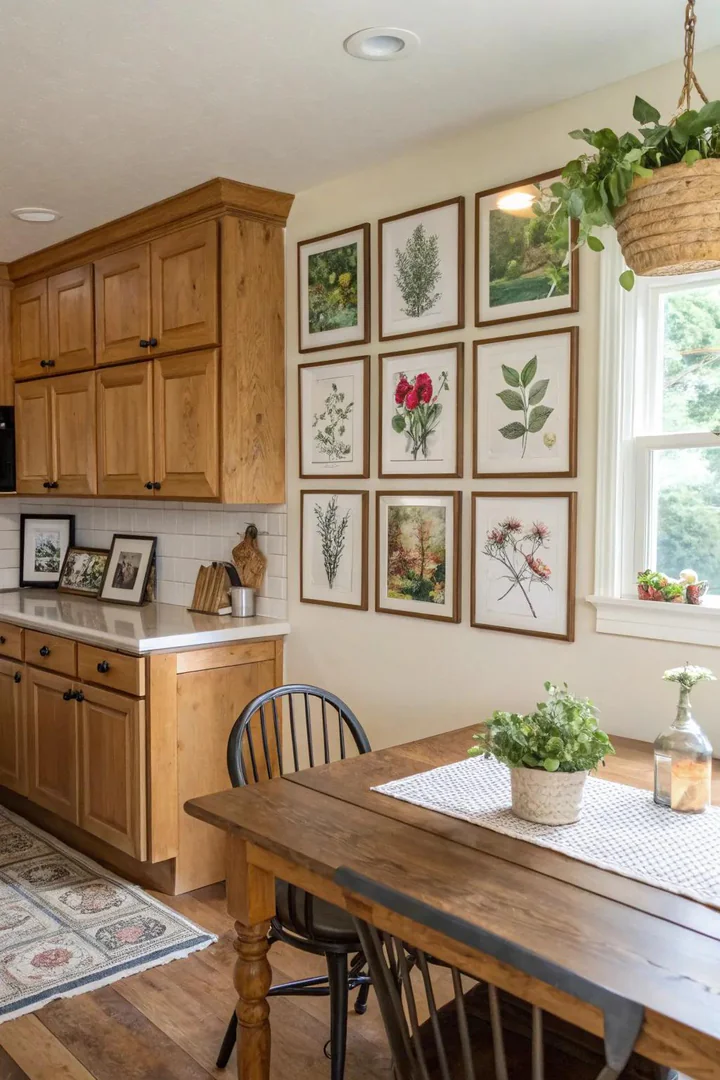
A gallery wall — a curated arrangement of framed prints, photographs, and objects grouped together on a single wall — creates a museum-quality focal point in the kitchen dining area or breakfast nook. Unlike a single piece of art that makes a quiet statement, a gallery wall commands attention through the collective impact of multiple pieces arranged in a deliberate composition.
Plan the gallery wall layout on the floor before hammering any nails — arrange all the frames on the floor in front of the target wall, adjust spacing and positions, and photograph the final arrangement as a reference. Maintain 2 to 3 inches of consistent spacing between all frames. Use matching frame styles (all black, all white, all natural wood) for a cohesive look, or mix frame styles for an eclectic gallery feel. Include a mix of sizes — two or three large pieces anchoring the arrangement, several medium pieces filling the middle ground, and a few small pieces filling gaps. Minted, Society6, and Juniper Print Shop all offer affordable art prints sized specifically for gallery wall arrangements.
21. Create a Breakfast Nook
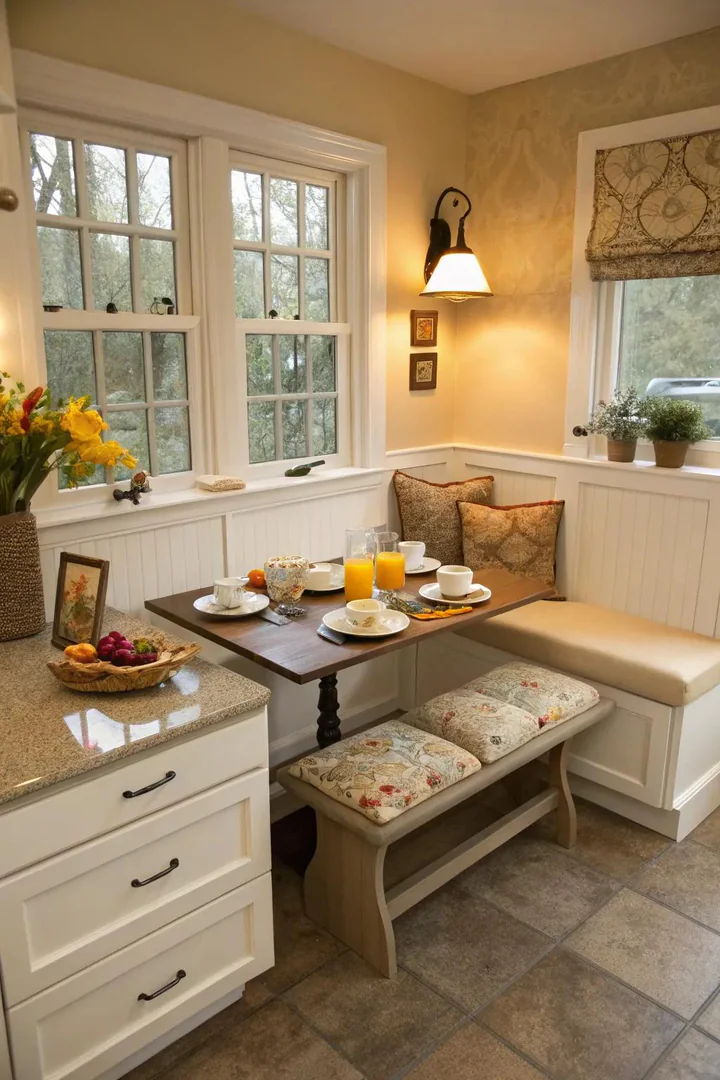
A breakfast nook — a built-in banquette or a small table-and-chairs arrangement tucked into a kitchen corner, bay window, or alcove — creates an intimate dining zone within the kitchen that is more casual and inviting than a formal dining room. Breakfast nooks use space efficiently (a corner banquette with storage beneath the seats can fit four people in the footprint of a two-person table) and create a cozy, enclosed feeling that is psychologically warm.
Build the nook around the kitchen’s best feature: a window with a view, a corner with natural light, or an alcove created by a bump-out in the wall. A built-in banquette (custom-built by a carpenter or from IKEA’s KALLAX units topped with a cushion and legs) provides seating with hidden storage for table linens, seasonal items, or children’s craft supplies. Add a round or oval pedestal table (Article, CB2, or vintage) that fits the nook’s dimensions, upholster the banquette cushion in a durable, wipeable fabric (Sunbrella or Crypton), and hang a pendant light or sconce above the table to define the nook as its own zone.
22. Install Curtains for a Gentle Feel
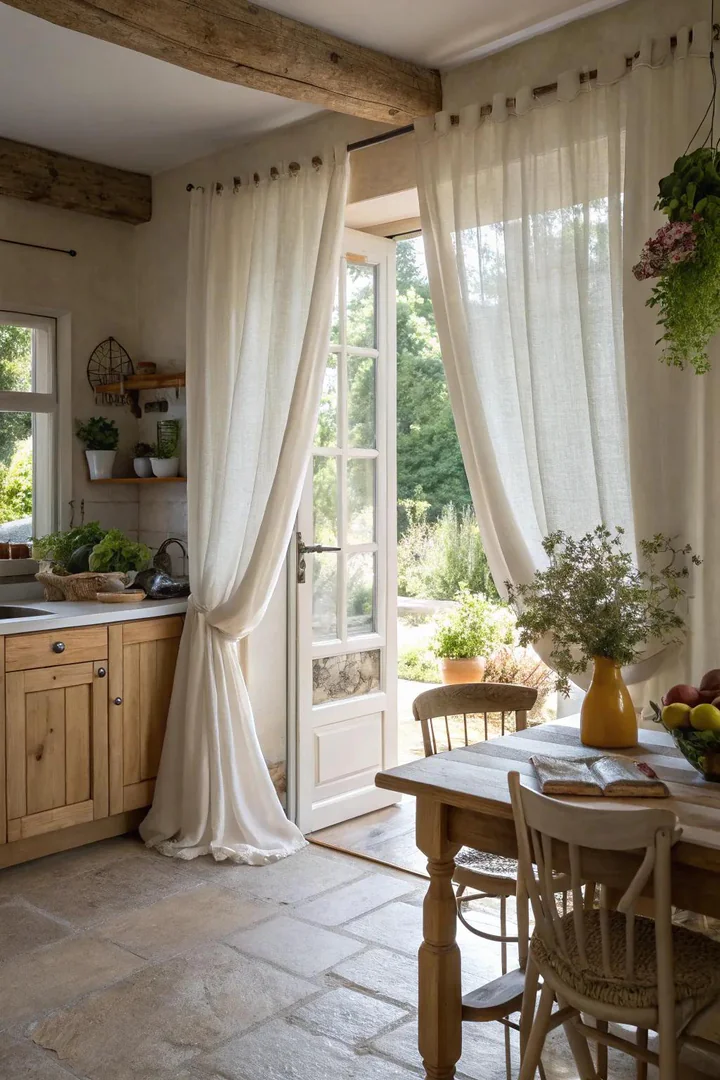
Kitchen curtains add softness, color, and fabric texture to a room full of hard surfaces — tile, stone, metal, and glass. A linen café curtain on the lower half of a kitchen window, a full-length sheer panel flanking a sink window, or a Roman shade in a patterned fabric introduces the warmth and movement of fabric that balances the kitchen’s hard edges. For window seating ideas that pair well with curtains, our kitchen bay window guide covers nook and window-seat configurations.
Choose machine-washable fabrics for kitchen curtains — linen, cotton, and cotton-linen blends wash easily and dry wrinkle-free with minimal ironing. Avoid silk, velvet, and dry-clean-only fabrics that will absorb cooking odors and grease without easy cleaning. Café curtains (covering only the lower half of the window) are the most practical kitchen curtain style because they provide privacy at counter height while allowing full natural light through the upper half of the window. Pottery Barn, IKEA, and Linen Tales all produce kitchen-friendly curtains in neutral and patterned fabrics.
23. Design a Feature Wall Using Paint
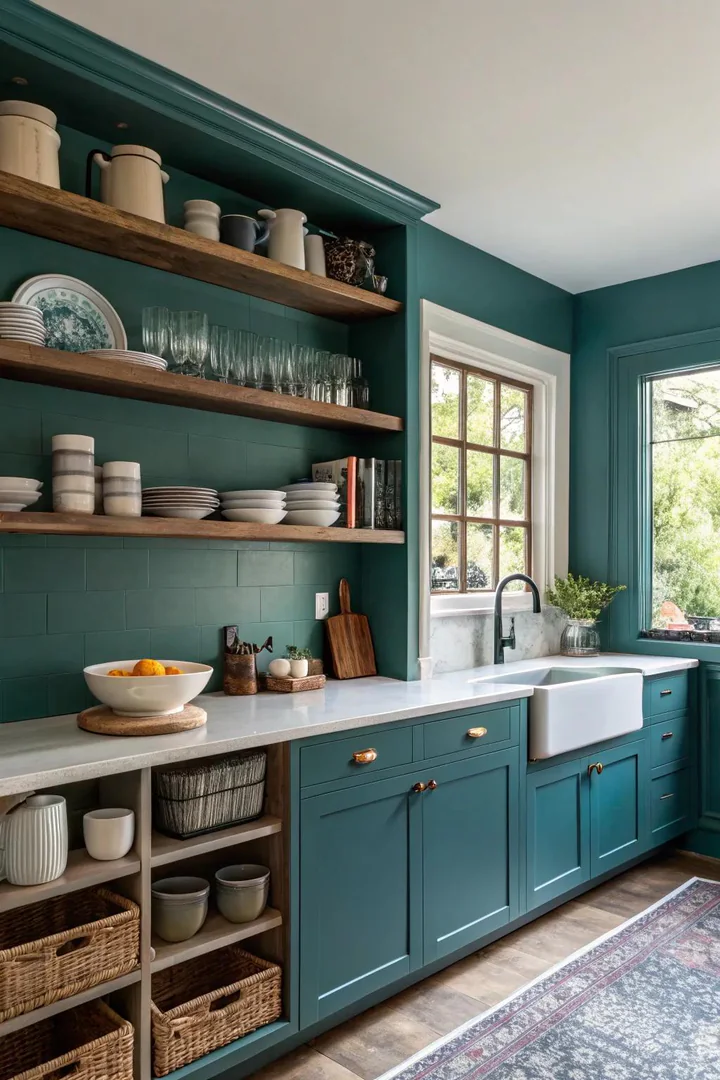
A painted feature wall — one wall in a bold or contrasting color while the other three walls remain neutral — adds color and drama to the kitchen with minimal effort and cost. Paint is the most affordable and most reversible way to introduce color into a kitchen: a gallon of premium paint costs $40-80, application takes one afternoon, and if you do not like the result, you can repaint the next weekend.
Choose the wall that has the fewest cabinets and the most visibility — the wall facing the kitchen entry, the wall behind a breakfast nook, or the back wall of an open-concept kitchen that is visible from the living room. Paint the feature wall in a color that contrasts with the cabinet color: dark green (Benjamin Moore’s Forest Green, 2047-10) behind white cabinets, deep terracotta (Sherwin-Williams’ Cavern Clay, SW 7701) behind light grey cabinets, or rich navy (Farrow & Ball’s Hague Blue, No. 30) behind warm wood cabinets. Use a satin or eggshell finish for kitchen walls — both are washable and resist moisture better than flat paint.
Kitchen Decor Planning Guide
Setting a Decor Budget
Kitchen decor does not have to cost thousands of dollars — the highest-impact changes (paint, plants, a rug, art, and under-cabinet lighting) can be completed for under $500 total. Prioritize the changes that address your kitchen’s biggest weakness: if the lighting is flat and unflattering, start with under-cabinet LEDs and a pendant light. If the kitchen looks generic and builder-grade, start with art, plants, and personal objects. If the kitchen lacks color, start with a painted feature wall or a colorful backsplash tile.
Choosing a Decor Style
Pick one style direction and commit to it across all decorating decisions — a kitchen that mixes farmhouse curtains, industrial pendant lights, and coastal art looks disjointed. Identify your style by looking at kitchens you have saved or bookmarked: if they share warm wood, linen, and natural materials, your style is farmhouse or organic modern. If they share clean lines, matte black, and minimal objects, your style is contemporary. If they share bold colors, mixed patterns, and collected objects, your style is eclectic or bohemian.
Maintaining a Decorated Kitchen
Kitchen decor requires maintenance that living room or bedroom decor does not — kitchens produce grease, steam, and food splatter that settle on decorative objects. Clean open-shelf displays monthly (wipe ceramic pieces, dust books, wash glass containers). Wash kitchen rugs biweekly. Wipe art frames and pendant light shades monthly. Water plants weekly and trim dead leaves. Rotate seasonal decor (swap out heavy winter textiles for lighter summer fabrics) to keep the kitchen feeling fresh and current.
Kitchen Decor Ideas by Budget
| Decor Change | Estimated Cost | Difficulty | Impact |
|---|---|---|---|
| Indoor plants | $20-80 | Easy | Medium |
| Kitchen rug or runner | $40-200 | Easy | Medium |
| Under-cabinet LED lighting | $30-150 | Easy | High |
| Painted feature wall | $40-80 | Easy | High |
| Wall art or gallery wall | $50-300 | Easy | High |
| Open shelving (1-2 shelves) | $50-200 | Medium | High |
| Pendant light replacement | $100-500 | Medium | High |
| Backsplash tile | $300-1500 | Hard | Very high |
Common Kitchen Decorating Mistakes to Avoid
Cluttering the countertops. Every item on the counter competes for attention and makes the kitchen look smaller and less organized. Keep only daily-use items on the counter (coffee maker, knife block, dish soap) and store everything else in cabinets, drawers, or a pantry. A clear counter reads as clean and spacious regardless of the kitchen’s actual size.
Ignoring the lighting layers. A kitchen with only one type of lighting (recessed cans in the ceiling) looks flat and clinical. Layer three types: ambient (recessed or flush-mount ceiling lights), task (under-cabinet LEDs and pendant lights over the island), and accent (in-cabinet lights, a sconce near the breakfast nook). The three layers create depth and atmosphere that a single lighting type cannot.
Choosing style over function. Every decorative element in the kitchen must coexist with cooking activity — grease, steam, heat, water, and food splatter. Open shelves next to the stove will collect grease film. A delicate wallpaper behind the sink will peel from moisture. A light-colored rug in the cooking zone will stain immediately. Place decorative elements in protected zones and choose durable, washable materials.
Mixing too many styles. A farmhouse wood shelf, an industrial pendant light, a coastal blue backsplash, and mid-century modern bar stools in the same kitchen creates visual confusion. Choose one primary style and one secondary accent — farmhouse with modern touches, industrial with warm wood accents, or coastal with traditional hardware.
Frequently Asked Questions
What is the easiest kitchen decor upgrade?
Indoor plants, a kitchen rug, and under-cabinet lighting are the three easiest upgrades because they require no tools, no installation, and no permanent changes. You can complete all three in a single afternoon for under $200. Plants add life and color, the rug adds warmth and pattern, and the under-cabinet lighting adds atmosphere and task illumination.
How do I decorate a rental kitchen?
Focus on removable and non-permanent elements: peel-and-stick backsplash tile (from Tic Tac Tiles or Smart Tiles), adhesive under-cabinet LED strips, a machine-washable runner rug, removable wallpaper on one wall, plants on the windowsill, and art on the walls using Command strips. All of these can be removed without damage when you move out. Avoid making holes in the backsplash or permanently altering any surfaces.
How often should I update kitchen decor?
Refresh small decorative elements (seasonal items, dish towels, fruit bowls, fresh flowers) every season. Update medium-impact elements (art arrangement, rug, curtains, shelf styling) every one to two years. Larger decorative investments (backsplash tile, pendant lights, open shelving) should last five to ten years before they feel dated. Following current trends in small, inexpensive items (towels, canisters, plants) and choosing timeless pieces for expensive items (tile, fixtures, furniture) keeps the kitchen feeling current without constant renovation.
What colors make a kitchen look bigger?
White, light grey, pale blue, and soft sage green make kitchens look larger because light colors reflect more light and create less visual weight than dark colors. Paint the walls and ceiling the same light color to blur the boundaries between surfaces and make the room feel more open. Use a light-colored countertop and backsplash to continue the bright palette. Dark accent colors on one wall or the island add depth without shrinking the perceived room size.
Can kitchen decor improve home value?
Yes — kitchens are the highest-return rooms for decorating investment. Buyers respond to kitchens that feel finished, warm, and well-lit. Under-cabinet lighting, a quality backsplash, pendant lights, and a styled breakfast nook all increase perceived value without the cost of a full kitchen remodel. Stage the kitchen with fresh flowers, a bowl of fruit, clean towels, and clear countertops to make the best impression during showings. Visit The Designers Company for more home design guides, decor inspiration, and remodeling ideas.
What kitchen decor trends are popular right now?
Warm neutrals (terracotta, olive, warm beige) replacing cool greys, natural materials (stone, wood, ceramic) replacing manufactured surfaces, open shelving replacing upper cabinets, warm metals (brass, unlacquered brass, aged gold) replacing chrome and nickel, and textured surfaces (fluted glass, reeded wood, ribbed ceramics) replacing smooth flat surfaces. These trends reflect a broader shift toward organic warmth and tactile materials in kitchen design.
Conclusion
Kitchen decor is the fastest and most affordable way to change how your kitchen looks and feels without a full renovation — a few strategic additions (better lighting, a rug, plants, art, and edited surfaces) can make a builder-grade kitchen feel custom and a dated kitchen feel current. Start with the changes that address your kitchen’s most obvious weakness and build from there.
The most important rule of kitchen decorating is editing: every object on display should be there because you chose it deliberately, not because it landed there and stayed. A kitchen with five intentionally placed decorative elements looks better than a kitchen with twenty random objects accumulated over time. Start with a clear counter, add one element at a time, and stop when the kitchen feels finished rather than full.