
White Kitchen Countertop Ideas: 19 Stunning Styles to Elevate Now
White kitchen countertop ideas cover every material category from natural stone (marble, quartzite, granite, soapstone, limestone, onyx) to engineered surfaces (quartz, solid surface, sintered stone, Corian) to budget-friendly options (laminate, concrete, butcher block, recycled glass, resin, porcelain). A white countertop brightens the kitchen by reflecting 80% to 95% of overhead and under-cabinet light, pairs with every cabinet color from white-on-white to navy, forest green, and matte black, and suits every design style from modern minimalist to farmhouse traditional. Below are 19 white countertop materials with specific product names, slab costs per square foot, maintenance requirements, and durability ratings, followed by a how-to selection guide, a comparison table, and FAQs on staining, sealing, and cost per linear foot.
1. Classic White Marble

Carrara marble ($40 to $100 per square foot installed) from Tuscany, Italy, features a white-to-light-gray base with soft gray veining that ranges from subtle wisps to bold, flowing lines depending on the slab. A standard kitchen counter (30 to 50 square feet) costs $1,200 to $5,000 in Carrara marble installed. Marble reads as the most traditional, timeless white countertop material because the stone has been used in European kitchens and baths for over 2,000 years.
Marble is softer than granite and quartz (3 to 5 on the Mohs hardness scale versus 6 to 7 for granite), which means acidic liquids (lemon juice, tomato sauce, red wine, vinegar) can etch the polished surface within minutes if not wiped immediately. Seal marble countertops with Tenax Hydrex Impregnating Sealer ($15 per quart) every 6 to 12 months to prevent staining. A honed (matte) finish hides etching and watermarks better than a polished (glossy) finish, making honed Carrara the preferred choice for high-use kitchen prep areas.
2. Engineered Quartz
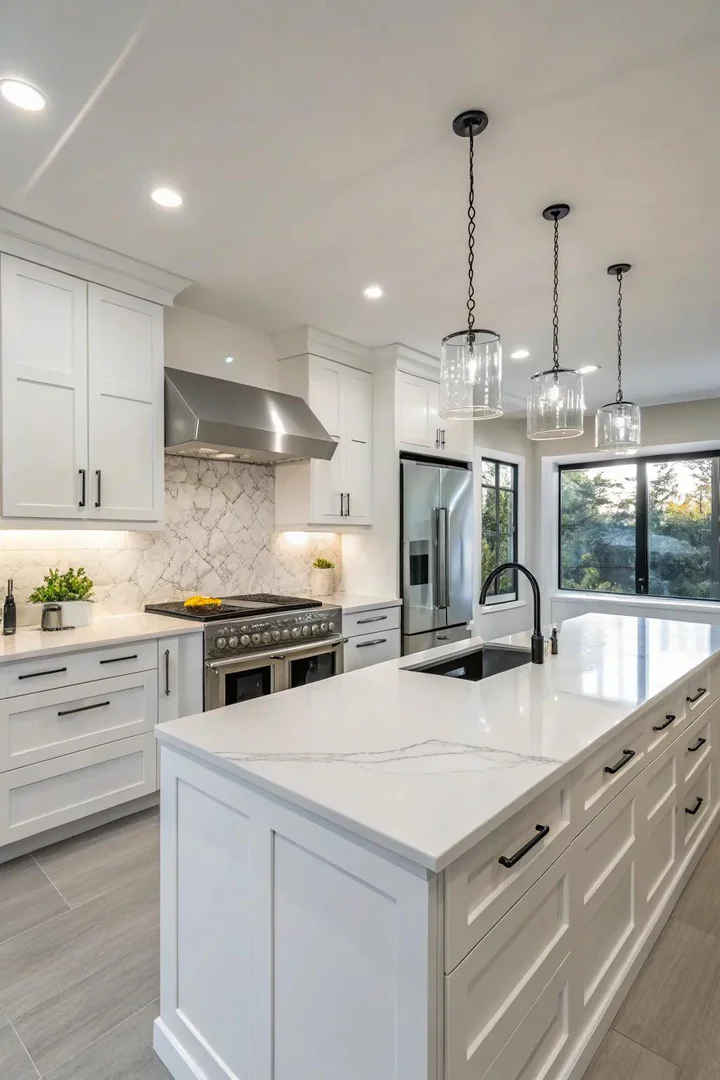
White engineered quartz from Cambria Brittanicca ($70 to $100 per square foot installed), Silestone Calacatta Gold ($55 to $80 per square foot), or Caesarstone Statuario Nuvo ($60 to $90 per square foot) combines 90% to 94% ground natural quartz with 6% to 10% polymer resin binder and pigments to create a non-porous, stain-resistant, maintenance-free surface that mimics the veining of natural marble without the etching vulnerability.
Engineered quartz requires no sealing, resists stains from coffee, wine, and tomato sauce, and scores 7 on the Mohs hardness scale (harder than marble and most granite). A full kitchen installation (30 to 50 square feet) costs $1,650 to $5,000. Quartz cannot withstand direct heat above 300 degrees Fahrenheit: hot pots and pans placed directly on the surface can crack or discolor the resin binder. Always use trivets or hot pads. Quartz is manufactured in controlled factory conditions, so color and pattern consistency from slab to slab is tighter than natural stone, where every slab is unique.
3. Budget-Friendly Laminate
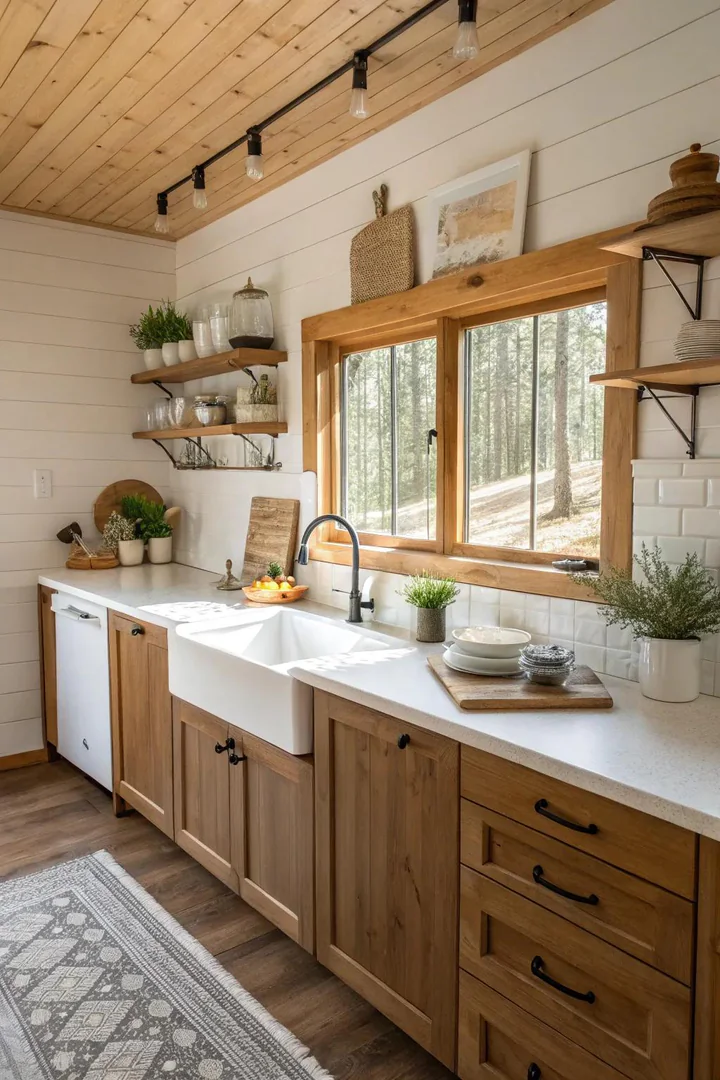
White laminate countertops from Formica ($10 to $25 per square foot installed) or Wilsonart ($12 to $28 per square foot) provide a white marble or white quartz look at 20% to 30% of the cost of natural or engineered stone. Formica 180fx Calacatta Marble ($15 to $20 per square foot) prints a full-resolution photograph of a Calacatta marble slab onto a high-pressure laminate sheet, creating a convincingly realistic marble appearance from normal viewing distances.
A full laminate counter installation (30 to 50 square feet) costs $300 to $1,400, making laminate the most affordable white countertop material. Laminate resists stains and moisture but can be scratched by knives (always use a cutting board) and damaged by hot pots placed directly on the surface (heat above 275 degrees Fahrenheit can blister the laminate layer). A post-formed edge (curved front edge with no visible seam) costs less than a square-edge or waterfall laminate but reads as a more dated, builder-grade profile. A square-edge laminate with a matching color-through edge band ($5 to $10 more per linear foot) looks more modern and closer to the slab-style edge of natural stone.
4. Poured Concrete
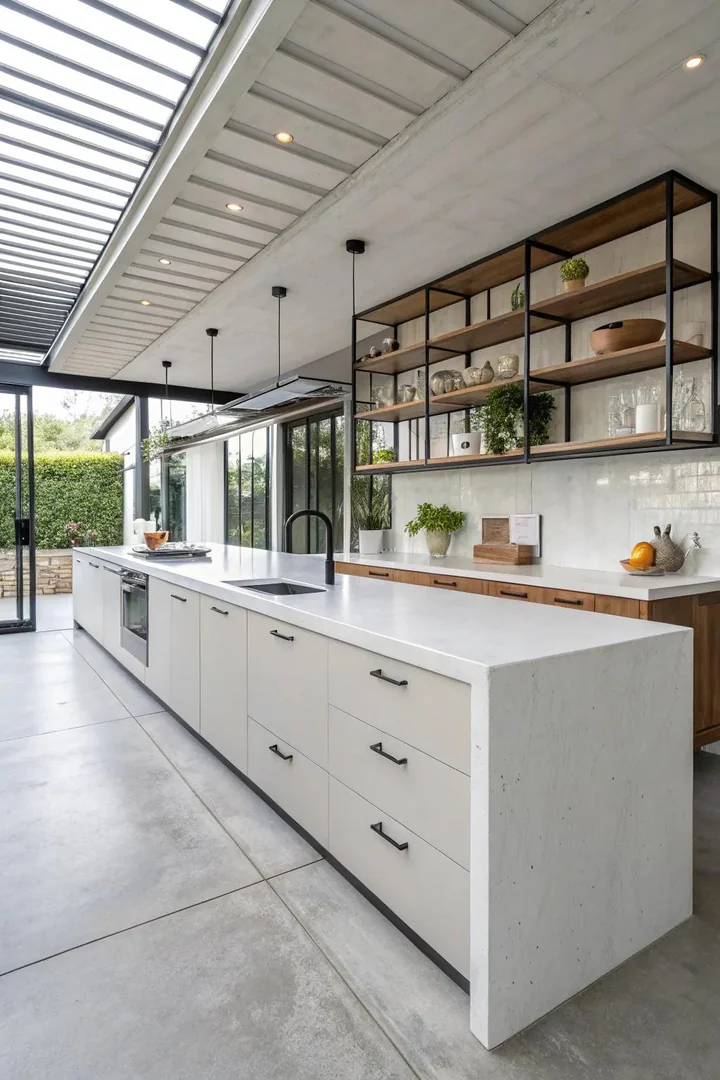
White concrete countertops ($65 to $135 per square foot installed by a professional, or $5 to $15 per square foot DIY using Quikrete Countertop Mix, $15 per 80-pound bag) deliver an industrial, artisan aesthetic with subtle surface texture, gentle color variation, and a matte or satin finish. White concrete is achieved by using white Portland cement (instead of standard gray) mixed with fine white sand and a white pigment additive. A Buddy Rhodes Bone White pigment pack ($20) or white titanium dioxide powder ($10 per pound from concrete supply stores) tints the mix to a clean white.
Concrete countertops are cast in a mold (built from melamine-coated MDF, $20 per 4-by-8-foot sheet) and cured for 5 to 7 days before demolding, polishing, and sealing. Seal white concrete with Cheng Concrete Sealer ($25 per quart) or food-safe beeswax and mineral oil blend ($15) to prevent staining. Concrete is porous and will absorb liquids (coffee, wine, cooking oil) within minutes if unsealed. Re-seal every 1 to 3 years depending on use. Concrete countertops can develop hairline cracks over time (a characteristic of the material, not a defect), especially over spans longer than 8 feet without support.
5. Porcelain Slab
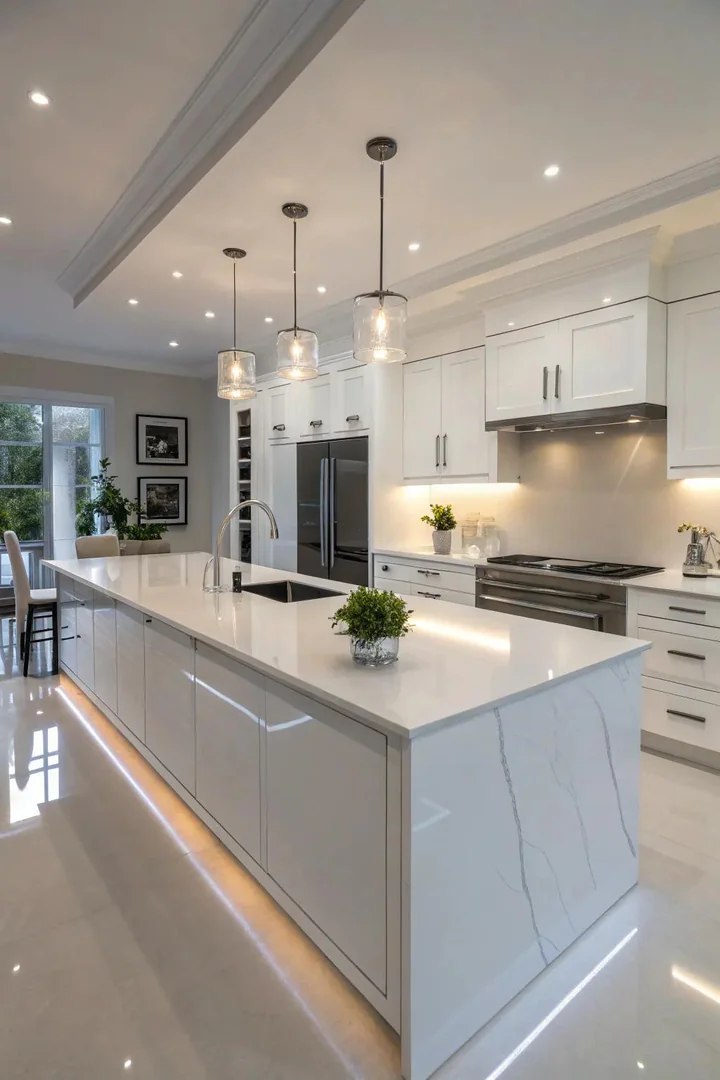
White porcelain slab countertops from Dekton by Cosentino ($55 to $100 per square foot installed) or Neolith ($60 to $110 per square foot) are ultra-thin (6mm to 12mm thick) sintered surfaces made from a blend of clite, feldspar, silica, and mineral oxides fired at 2,200 degrees Fahrenheit. The firing process creates a surface that is scratch-resistant (6 to 7 Mohs), heat-resistant (withstands direct contact with hot pots up to 600 degrees Fahrenheit), stain-proof (zero porosity), and UV-stable (does not yellow in sunlight).
Porcelain slabs come in large formats (up to 126 by 60 inches) that cover most kitchen counters with zero or minimal seams. Neolith Estatuario ($70 to $100 per square foot) mimics Statuario marble with bold gray veining on a bright white base. Porcelain requires no sealing, no re-polishing, and no special maintenance beyond wiping with a damp cloth. The ultra-thin profile (as thin as 6mm / 1/4 inch) requires a plywood or MDF substrate for structural support; the slab itself does not span unsupported gaps wider than 12 inches.
6. Natural Quartzite
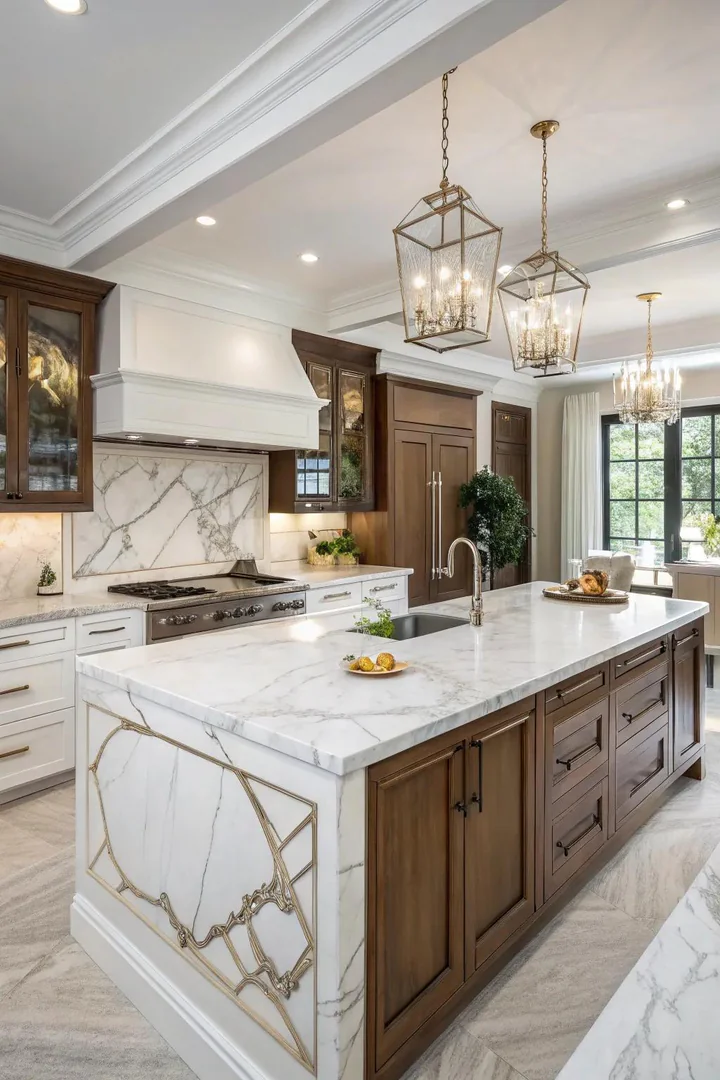
White quartzite (not to be confused with engineered quartz) is a natural metamorphic stone formed when sandstone is subjected to extreme heat and pressure deep within the earth’s crust. White Macaubas quartzite ($60 to $120 per square foot installed) and Taj Mahal quartzite ($70 to $130 per square foot) feature a white-to-cream base with soft gold, gray, or taupe veining. Quartzite scores 7 on the Mohs hardness scale, making the surface harder than marble, harder than granite, and comparable to engineered quartz in scratch resistance.
Quartzite resists etching from acidic foods (lemon, vinegar, tomato) far better than marble because the silica-based mineral composition is chemically inert to household acids. Seal quartzite annually with StoneTech BulletProof Sealer ($30 per quart) to prevent oil and liquid absorption through the stone’s natural micro-pores. A quartzite countertop looks like marble but performs closer to granite, making quartzite the preferred natural-stone choice for cooks who want the marble aesthetic without the marble maintenance. Browse related kitchen remodel planning at kitchen ergonomics and layout planning.
7. Recycled Glass
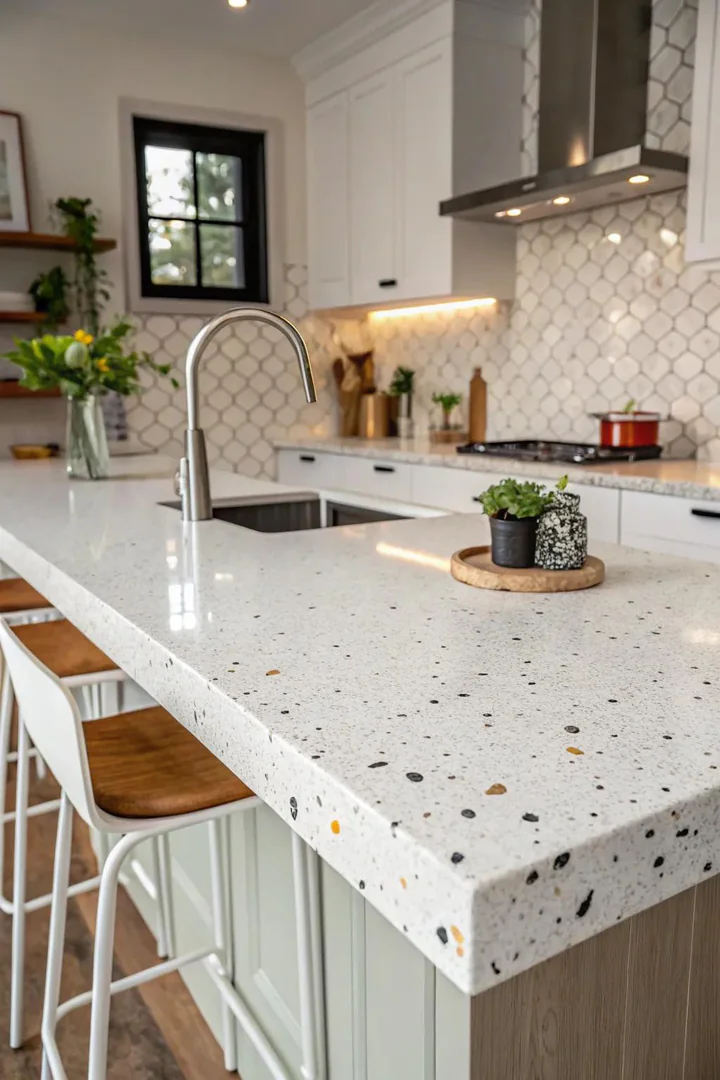
Recycled glass countertops from Vetrazzo ($80 to $150 per square foot installed) or IceStone ($65 to $100 per square foot) embed crushed recycled glass (from bottles, windshields, and architectural glass) in a cement or resin binder to create a speckled, terrazzo-like surface. A white recycled glass countertop uses clear and white glass chips in a white cement binder, producing a luminous, light-catching surface that sparkles under kitchen lighting.
Recycled glass countertops contain 75% to 100% post-consumer recycled materials, making them one of the most environmentally responsible countertop choices. Vetrazzo Palladian Gray ($90 to $130 per square foot) uses clear, white, and pale gray glass in a white cement matrix. Seal cement-based recycled glass countertops every 12 months with a penetrating stone sealer to prevent staining. Resin-based recycled glass countertops (like IceStone) are non-porous and require no sealing. Recycled glass is heat-resistant (cement-based versions withstand temperatures up to 400 degrees Fahrenheit) and scratch-resistant (glass chips score 5.5 on the Mohs scale).
8. Sintered Stone
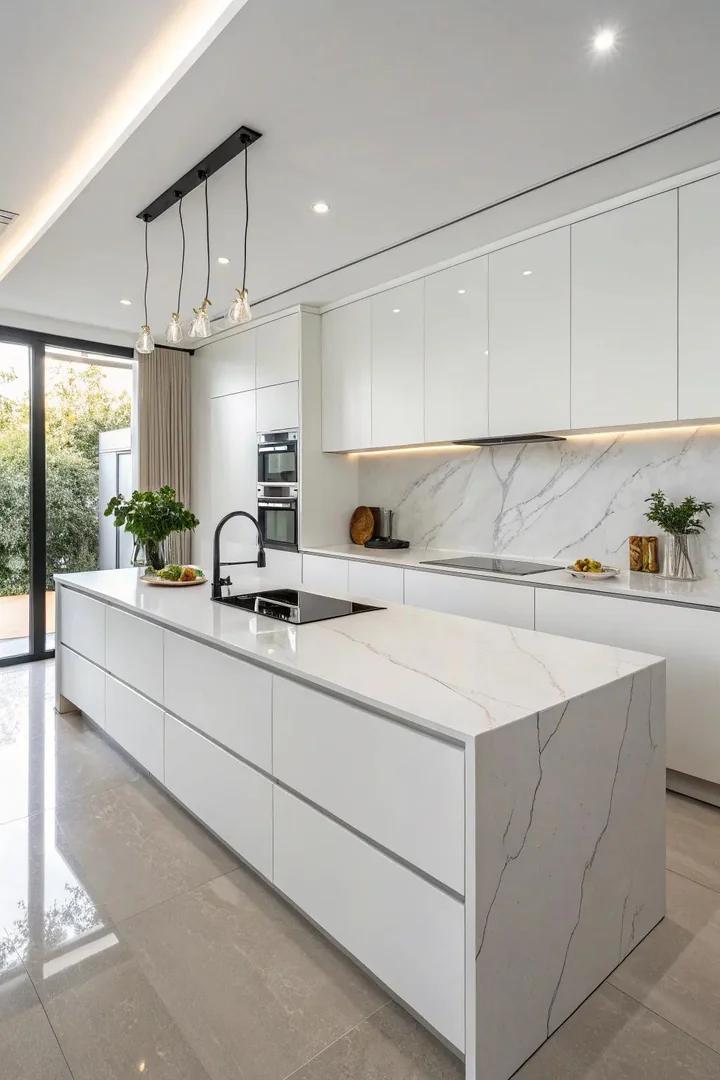
Sintered stone from Lapitec ($70 to $120 per square foot installed) or Laminam ($60 to $100 per square foot) is manufactured by compressing natural minerals (silica, feldspar, quartz, clay) at extreme pressure (400 bar) and firing at 2,200 degrees Fahrenheit to fuse the particles into a solid, non-porous slab without resin or adhesive binders. Sintered stone bridges the gap between natural stone (authentic mineral composition) and engineered surfaces (consistent color, zero porosity, no maintenance).
A white sintered stone slab in a Statuario or Calacatta marble pattern delivers the veining and visual depth of natural marble with the stain, scratch, heat, and UV resistance of porcelain. Sintered stone slabs are available in thicknesses from 6mm (ultraslim for cladding) to 20mm (standard countertop thickness) and in slab sizes up to 126 by 60 inches. The material withstands direct flame, thermal shock (hot to cold transitions), and knife cuts without damage, making sintered stone one of the most durable white countertop options on the market.
9. Resin Composite
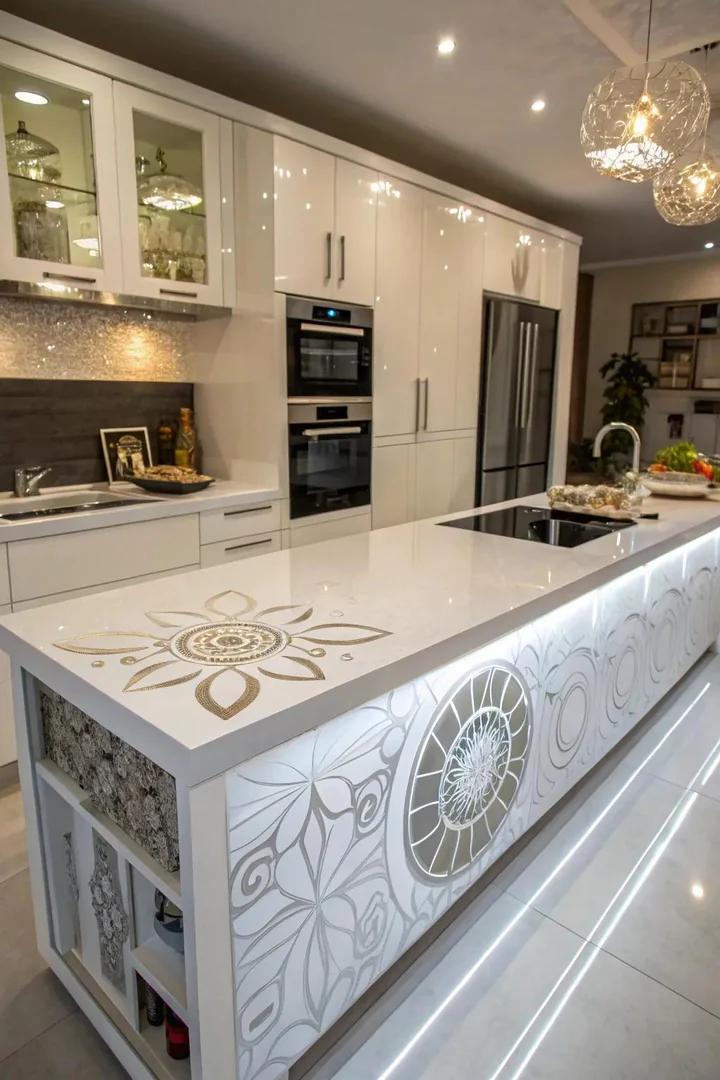
White resin countertops from Swanstone ($20 to $40 per square foot installed) or custom-cast epoxy resin pours ($30 to $80 per square foot for materials, DIY) create a smooth, non-porous, joint-free white surface that can be molded to any shape, including integrated sinks, curved edges, and waterfall side panels. A Swanstone solid-surface countertop in white ($20 to $35 per square foot) is a factory-made alternative to Corian with similar properties at a lower price point.
Custom epoxy resin countertops use a 2-part epoxy system ($100 to $200 per gallon kit from Stone Coat Countertops or TotalBoat) poured over an existing countertop substrate (plywood, MDF, or old laminate). White pigment ($10 to $15 per bottle) mixed into the epoxy creates a solid white surface; adding gray or gold metallic powder ($8 per jar) creates a marble-vein effect. Epoxy resin cures in 24 to 72 hours, is food-safe when fully cured, and produces a high-gloss finish that reflects light like polished marble. Resin countertops are heat-sensitive (direct contact above 200 degrees Fahrenheit can soften the surface), so trivets are mandatory.
10. Calacatta Marble
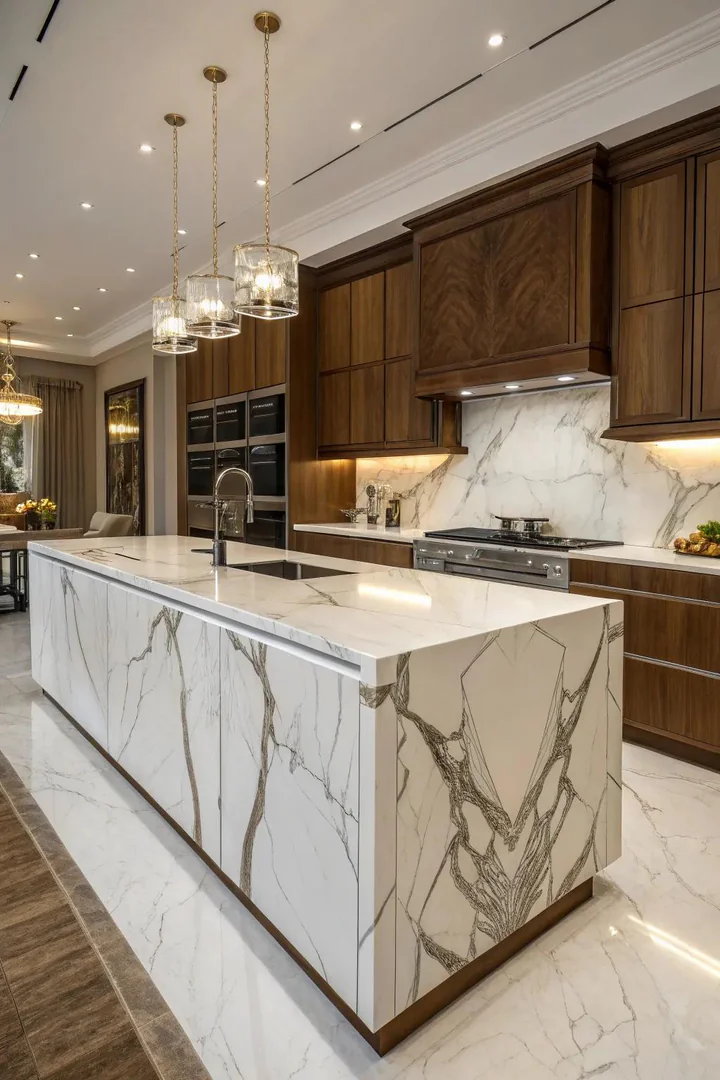
Calacatta marble ($100 to $250 per square foot installed) is quarried exclusively from the Apuan Alps near Carrara, Italy, and commands a premium over Carrara marble because of its brighter white base, bolder gold-and-gray veining, and rarer supply. A standard kitchen installation (30 to 50 square feet) costs $3,000 to $12,500 in Calacatta marble, making the material a luxury-tier choice reserved for high-end kitchens and statement islands.
Calacatta’s veining patterns fall into named subcategories: Calacatta Borghini (wide, dramatic gold-gray veins on a pure white base), Calacatta Vagli (tight, feathery gray veins), and Calacatta Oro (gold-dominant veining). Each subcategory varies in price depending on slab availability and vein intensity. Like all marble, Calacatta etches from acidic contact, stains from unsealed oil or wine spills, and requires sealing every 6 to 12 months. A leathered finish (brushed, slightly textured surface) on Calacatta hides etching and fingerprints better than a polished finish and adds a tactile, organic quality to the stone.
11. Solid Surface (Corian)
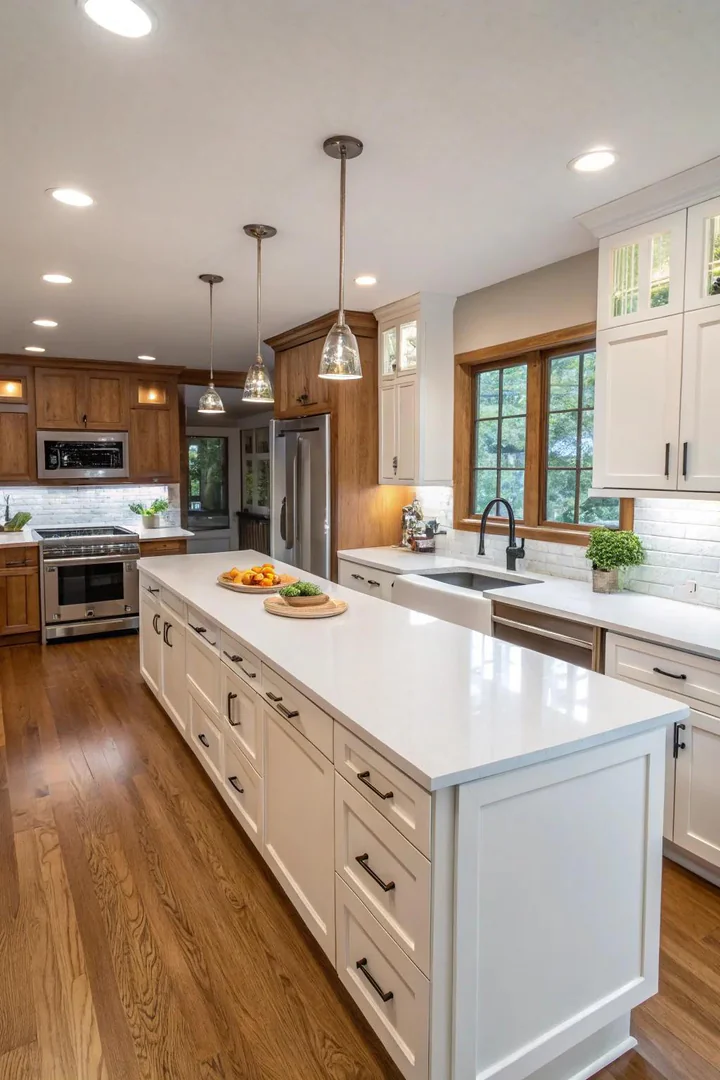
Corian Glacier White ($40 to $80 per square foot installed) is a solid-surface countertop made from acrylic polymer and natural minerals by DuPont (now part of Corian Design). Solid surface is non-porous, repairable (scratches and burns can be sanded out with 400-grit sandpaper and buffed to restore the original finish), and joint-free (sections are joined with color-matched adhesive that cures invisibly, creating a continuous surface with no visible joints).
Corian integrates a flush undermount sink bowl (Corian 850 Integral Sink, $200 to $400) into the countertop surface, eliminating the seam between sink and counter where bacteria and mold accumulate. A Corian countertop with an integrated sink reads as a single, monolithic white surface from edge to edge. Solid surface is softer than quartz and stone (2 to 3 Mohs), which means knife cuts leave marks (always use a cutting board) and coarse cookware can scratch the surface. Hot pots above 325 degrees Fahrenheit can scorch the acrylic surface, so trivets are required.
12. White Butcher Block
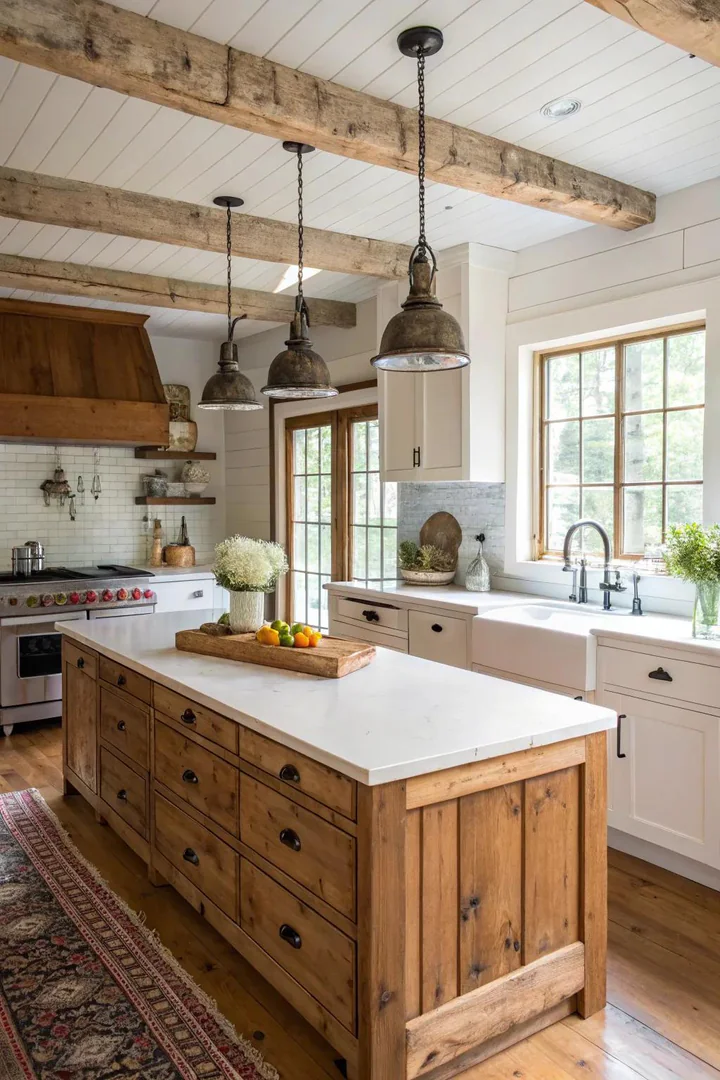
A white-washed or bleached butcher-block countertop delivers the warmth and texture of natural wood in a white-toned palette. Start with a light-colored wood species: maple ($25 to $40 per square foot from Boos or IKEA KARLBY), birch ($20 to $35 per square foot), or white oak ($30 to $50 per square foot). Apply a white pickling stain (Minwax White Wash Pickling Stain, $12 per quart) or a liming wax (Briwax Liming Wax, $15 per tin) that fills the wood grain with white pigment while allowing the natural grain pattern to show through.
Seal the white-washed surface with Waterlox Original Tung Oil Finish ($30 per quart, 3 coats) for waterproofing and food-safe protection. A white-washed butcher block pairs with white cabinets for a tone-on-tone Scandinavian look or with dark cabinets (navy, charcoal, forest green) for a high-contrast pairing. Re-oil the surface every 3 to 6 months with food-grade mineral oil ($8 per bottle) to maintain the finish and prevent drying. Butcher block is the only countertop material that doubles as a cutting surface (on end-grain blocks), though white-washed finishes show knife marks more visibly than natural unstained wood.
13. Tempered Glass
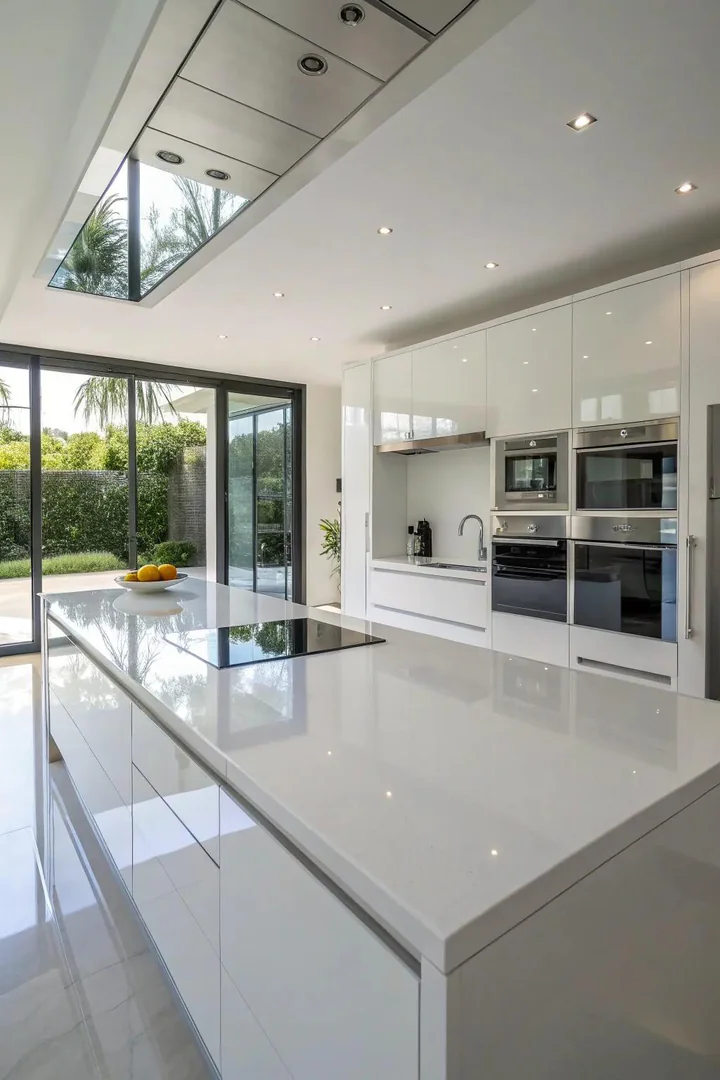
A white back-painted tempered glass countertop ($50 to $100 per square foot from ThinkGlass or a local glass fabricator) uses a sheet of 1/2-inch or 3/4-inch tempered glass with a white opaque coating applied to the underside, creating a glossy, reflective white surface that is non-porous, stain-proof, heat-resistant (tempered glass withstands temperatures up to 470 degrees Fahrenheit), and scratch-resistant (5.5 Mohs). Glass countertops reflect 90% to 95% of incident light, making the surface the brightest-reading white countertop option available.
Glass countertops are custom-fabricated to exact measurements with cutouts for sinks, faucets, and cooktops. A full kitchen installation (30 to 50 square feet) costs $1,500 to $5,000. Glass edges can be polished flat, beveled, or rounded. The high reflectivity of glass shows fingerprints, water spots, and dust more readily than matte surfaces; plan for daily wiping with a glass cleaner and microfiber cloth. Glass countertops suit ultra-modern, minimalist, and high-gloss kitchen designs where the mirror-like surface contributes to the overall bright, clean aesthetic.
14. White Granite
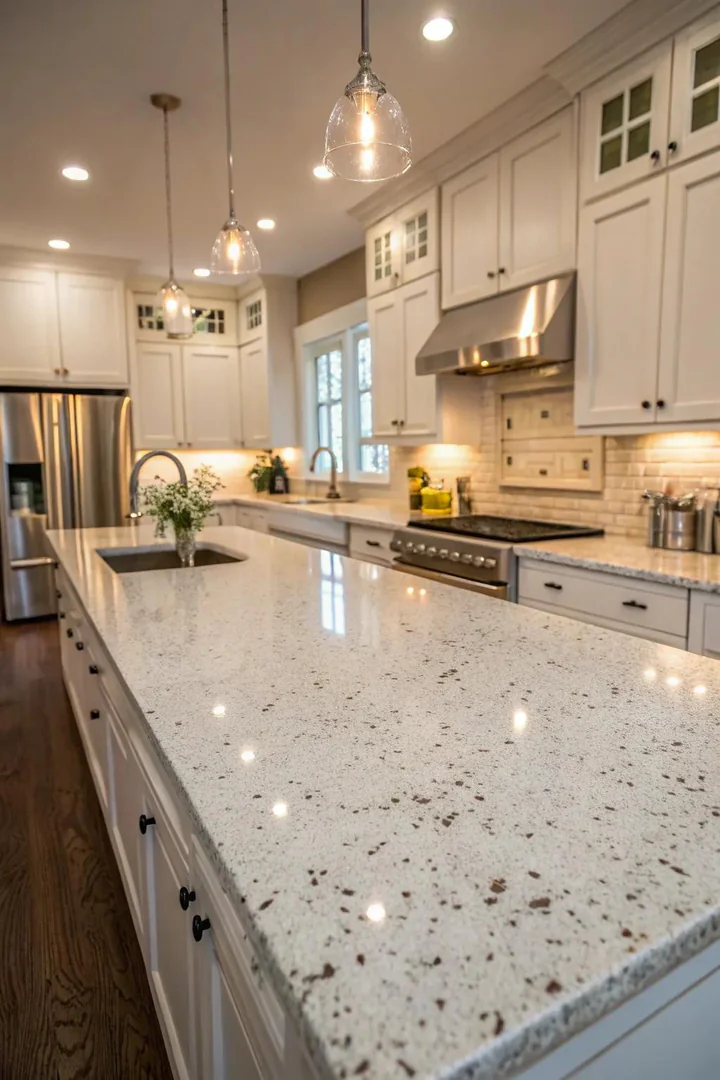
White granite from Colonial White ($35 to $60 per square foot installed), White Ice ($40 to $70 per square foot), or Bianco Romano ($45 to $75 per square foot) provides a natural white countertop with mineral flecks, crystals, and subtle veining that creates visual texture and depth. Granite scores 6 to 7 on the Mohs hardness scale, resists scratches from kitchen knives, and withstands direct heat from hot pots without scorching or cracking.
White granite requires annual sealing with Tenax Hydrex or StoneTech BulletProof Sealer ($15 to $30 per quart) to prevent oil and liquid absorption through the stone’s natural micro-pores. Sealed white granite resists stains from coffee, red wine, and cooking oil for 12 to 18 months between re-applications. A standard kitchen installation (30 to 50 square feet) costs $1,050 to $3,750 in white granite. Granite is quarried in full slabs (typically 110 by 60 inches), and each slab has a unique pattern, so selecting the specific slab at the stone yard (rather than choosing from a sample chip) ensures the veining and crystal pattern matches expectations. See more countertop pairing strategies at simple outdoor kitchen ideas.
15. Bold-Veined White Stone
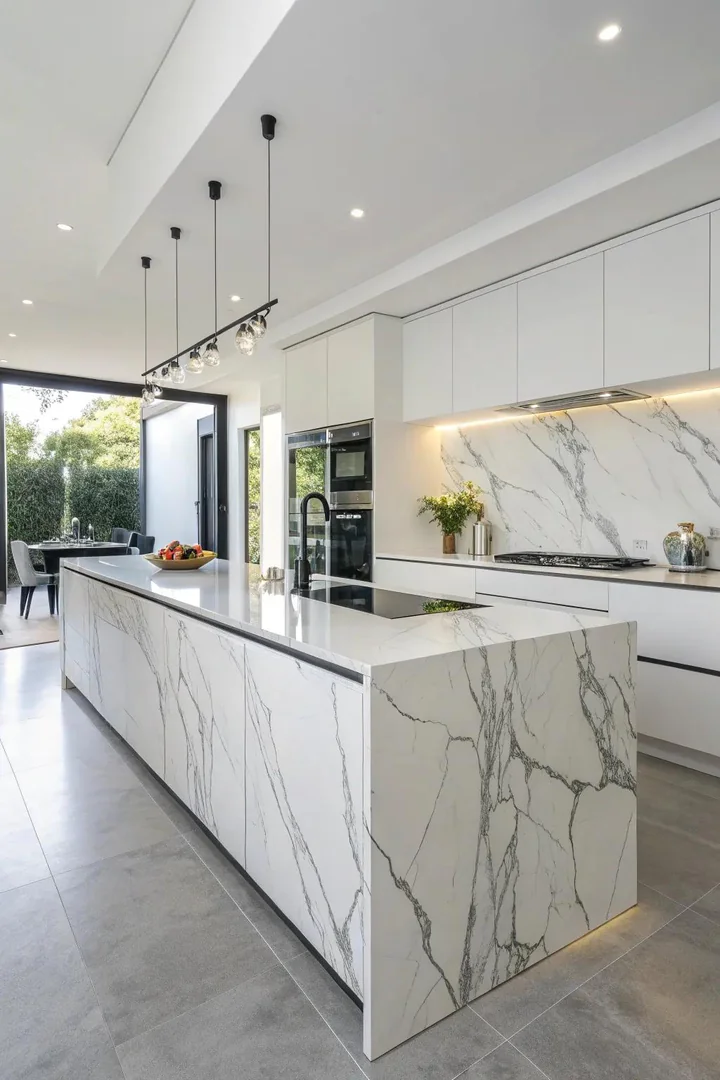
A white countertop with dramatic, bold veining (wide, high-contrast gray, gold, or black veins on a bright white base) serves as the kitchen’s primary visual focal point. Calacatta Viola marble ($150 to $300 per square foot) features purple-gray veins on a warm white base. Paonazzo marble ($120 to $250 per square foot) displays wide, sweeping purple and gray veins. Cambria Brittanicca Warm engineered quartz ($70 to $100 per square foot) delivers bold gray veining on a warm white base without the etching risk of natural marble.
A bold-veined slab works best on a large, uninterrupted surface (an island, a long countertop run, or a waterfall edge) where the veining can flow across the surface without being broken by seams, sink cutouts, or cooktop interruptions. Book-matching (placing two adjacent slabs from the same block mirror-image to each other) creates a symmetrical butterfly pattern at the seam line, turning the countertop into a piece of functional art. Bold veining reads best against simple, solid-color cabinetry (flat-panel white, navy, or charcoal cabinets) that does not compete with the stone’s pattern for visual attention.
16. Textured Limestone
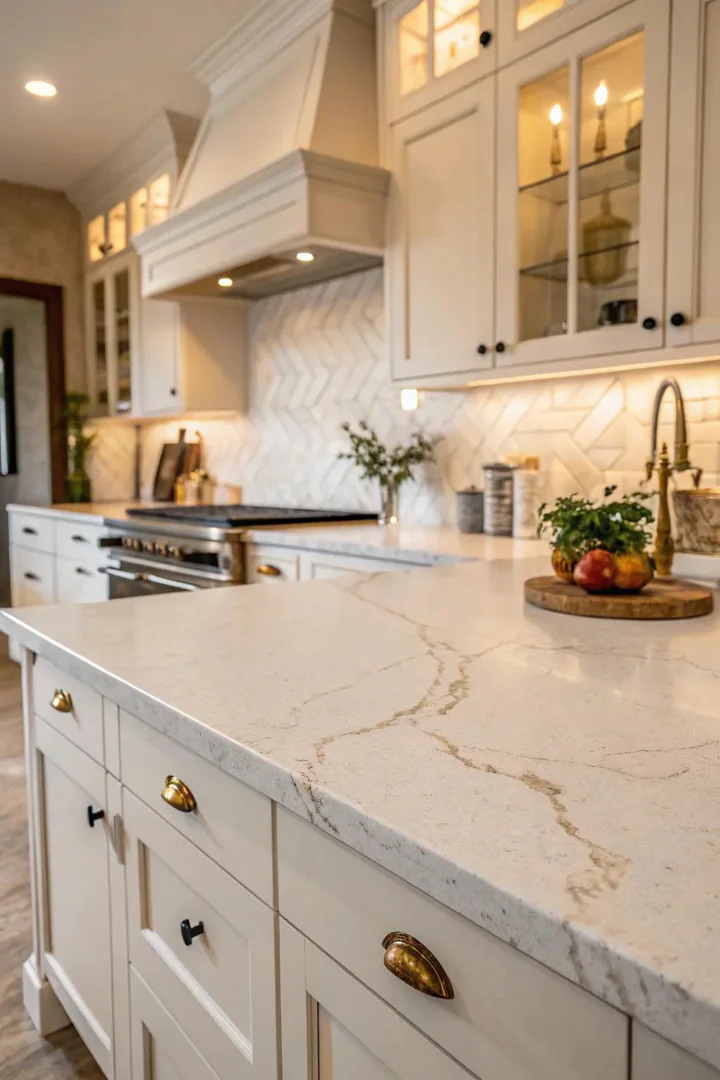
White limestone countertops from Jura Beige/White ($40 to $80 per square foot installed) or Crema Marfil ($35 to $70 per square foot) provide a soft, warm white surface with a matte, chalky texture and fossil inclusions that create subtle organic patterns. Limestone is a sedimentary stone composed primarily of calcium carbonate, the same mineral as marble, but limestone has not undergone the metamorphic crystallization that gives marble its polished shine. The result is a softer, more textured, more rustic surface that pairs with farmhouse, Mediterranean, and French country kitchen styles.
Limestone scores 3 on the Mohs hardness scale (softer than marble), making the surface vulnerable to scratches from coarse cookware and etching from acidic liquids. A honed or tumbled finish (matte, slightly rough) is the standard for limestone countertops; a polished finish is possible but shows scratches and etching more visibly. Seal limestone countertops every 6 months with Miracle Sealants 511 Impregnator ($20 per pint) to prevent staining. Limestone’s softness and porosity make the material better suited for low-use areas (a baking station, a butler’s pantry, an island display) than for the primary prep zone where knives, acids, and heavy use concentrate.
17. White Onyx
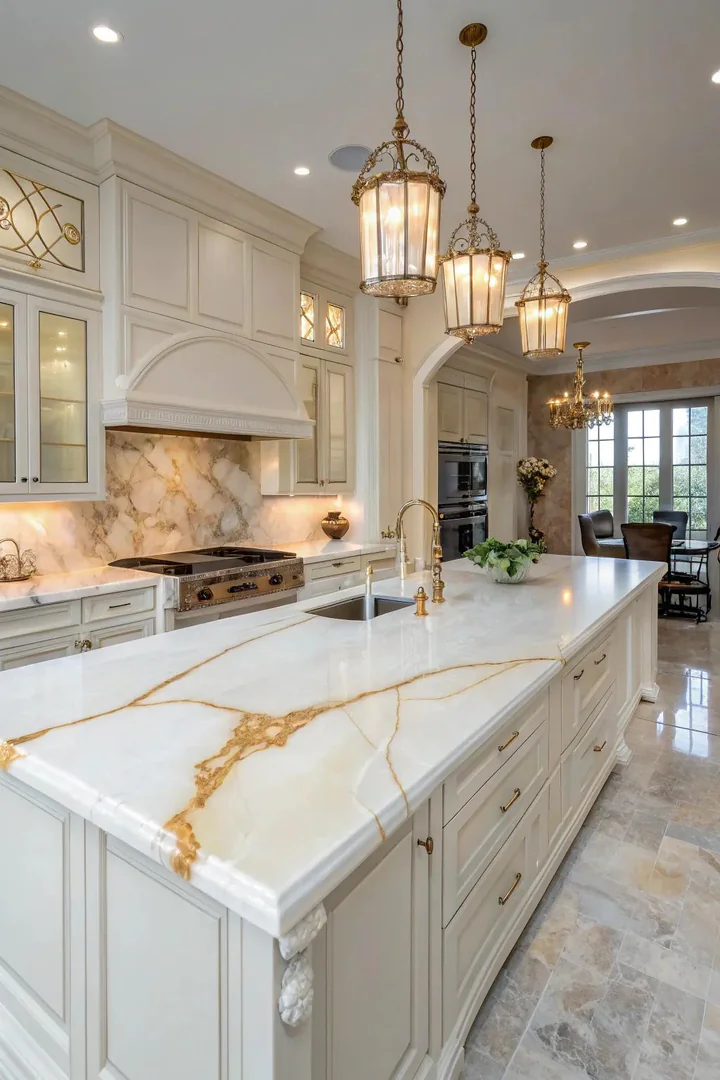
White onyx ($100 to $250 per square foot installed) is a translucent, banded calcite stone with a luminous, glass-like quality that allows light to pass through the slab when backlit. A backlit white onyx island ($3,000 to $12,500 for a 30-to-50-square-foot installation plus $200 to $500 for LED backlighting panels) glows from within, creating a lantern-like focal point that no other countertop material can replicate.
Onyx is the softest and most fragile countertop stone (2.5 to 3 Mohs), making the material unsuitable for heavy-use prep zones where knife cuts, dropped pots, and acidic spills occur daily. Reserve white onyx for a statement island, a bar top, a butler’s pantry counter, or a display surface where the stone’s translucency and beauty are appreciated without the wear and tear of primary kitchen prep. Seal onyx every 3 to 6 months and treat the surface with extreme care: no cutting, no acidic foods, no hot pots, no heavy impact. Onyx is a showpiece material, not a workhorse surface.
18. White Soapstone
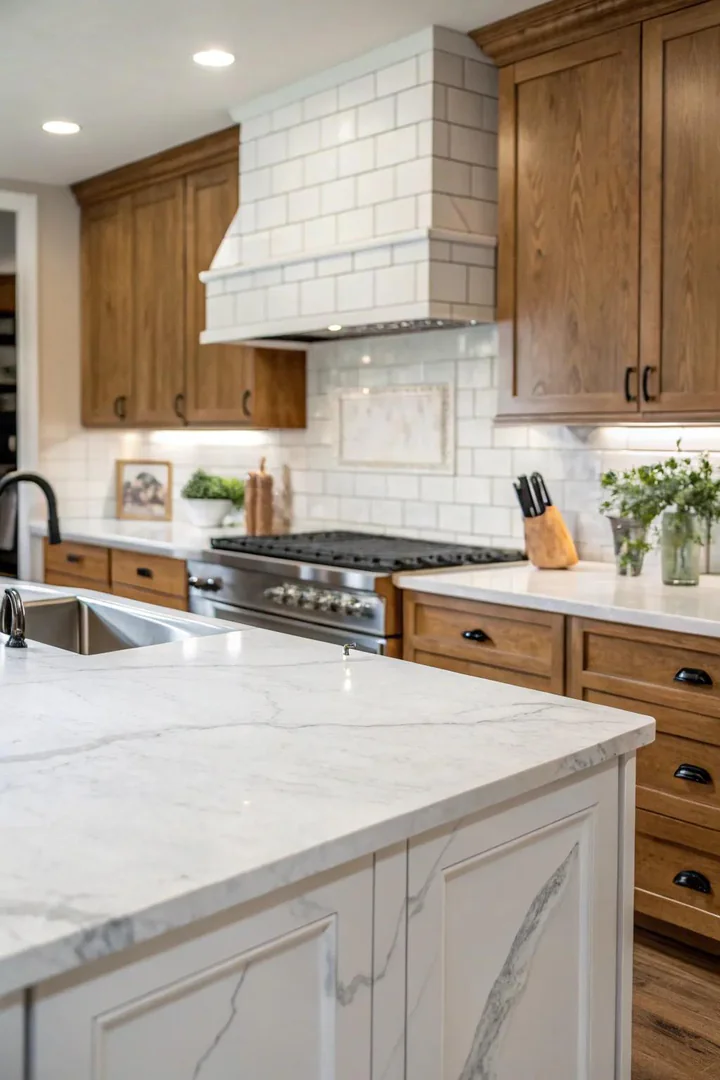
White soapstone ($70 to $120 per square foot installed) from Brazilian or Finnish quarries features a white-to-light-gray base with a smooth, matte, talc-like texture. Soapstone is composed primarily of talc (which gives the stone its smooth, soapy feel) and is naturally non-porous, meaning the stone does not require sealing to resist liquid absorption and staining. Soapstone is also chemically inert: acids, bases, and solvents do not etch or damage the surface, making soapstone the most chemical-resistant natural countertop stone. See how white surfaces pair with lighting strategies at windowless kitchen ideas.
Soapstone darkens naturally over time (from white-gray to charcoal-gray) as the surface oxidizes. Applying mineral oil ($8 per bottle) accelerates and evens the darkening process; leaving the stone untreated allows a slower, more varied patina to develop. A cook who prefers a permanently light-colored soapstone surface should apply a wax sealant that slows oxidation and maintains the lighter tone. Soapstone scores 1 to 2 on the Mohs scale (very soft), so knife cuts leave visible marks and sharp impacts can chip edges. The softness is also a benefit: soapstone absorbs thermal shock (hot pots directly from the stove) without cracking, unlike quartz, glass, and laminate.
19. Corian Solid Surface
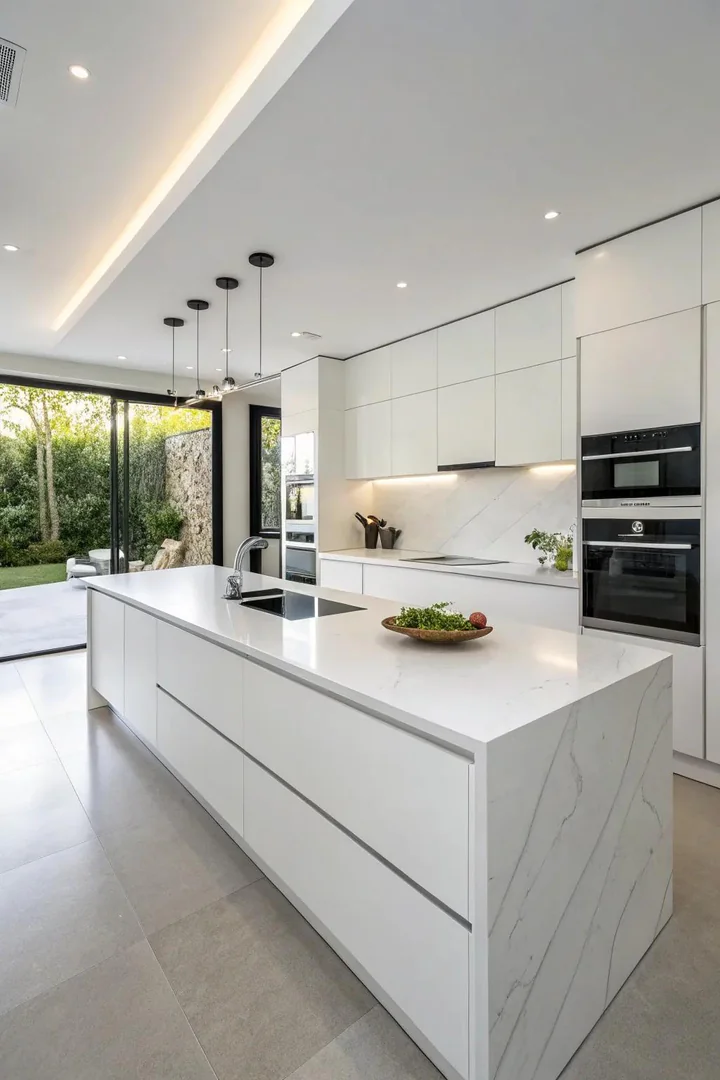
Corian Designer White ($40 to $80 per square foot installed) delivers a uniform, joint-free, bright white surface with no veining, no flecks, and no variation. A Corian countertop reads as a single continuous plane from edge to edge because joints are bonded with color-matched Corian adhesive that cures to an invisible seam. The result is a monolithic white surface that wraps from countertop to backsplash to integrated sink without a single visible break.
Corian is thermoformable: the material can be heated and bent into curved shapes, waterfall edges, and continuous backsplash coves that other rigid materials (stone, quartz, porcelain) cannot achieve without separate pieces and visible joints. A Corian countertop with a continuous coved backsplash (the counter curves upward 4 to 6 inches at the rear edge in a smooth radius) eliminates the grout line between countertop and backsplash tile where moisture, mold, and food debris accumulate. Scratches and burns on Corian are repaired by sanding with 400-grit sandpaper and buffing with a Scotch-Brite pad; the material’s color runs through its entire thickness, so sanding removes damage without revealing a different layer beneath. Visit The Designers Company for the full white countertop and kitchen design library.
How to Choose the Right White Countertop Material
1. Identify Your Primary Use Pattern
Determine whether the counter serves as a heavy-use prep surface (daily cutting, chopping, kneading, hot pot placement), a low-use display or serving surface (island bar, butler’s pantry, coffee station), or a mixed-use surface (prep on one section, display on another). Heavy-use prep zones need hard, heat-resistant, non-porous materials (quartz, quartzite, granite, porcelain, sintered stone). Low-use display zones can accommodate softer, more delicate materials (marble, onyx, limestone, soapstone) where beauty matters more than durability.
2. Set a Per-Square-Foot Budget
Measure the total counter area in square feet (length times depth for each section, then sum all sections). Multiply by the per-square-foot cost of each material under consideration. A 40-square-foot kitchen at $15 per square foot (laminate) costs $600 installed. The same kitchen at $80 per square foot (quartz) costs $3,200 installed. At $150 per square foot (Calacatta marble) the cost reaches $6,000 installed. Knowing the total installed price for each material at the actual kitchen dimensions prevents budget surprises after fabrication begins.
3. Match Material to Kitchen Style
Modern minimalist kitchens pair with quartz, Corian, porcelain, or glass (clean lines, zero texture, uniform color). Farmhouse and French country kitchens pair with marble, soapstone, butcher block, or limestone (natural texture, age-developed patina, organic imperfections). Transitional kitchens pair with quartzite or granite (natural stone character with modern durability). Match the countertop material to the cabinet style, hardware finish, and backsplash material for a cohesive design story. Explore layout strategies that pair with white countertops at ideas for remodeling a small kitchen.
White Countertop Material Comparison
| Material | Cost/sq ft | Hardness (Mohs) | Sealing | Heat Safe |
|---|---|---|---|---|
| Carrara marble | $40–$100 | 3–5 | Every 6–12 mo | Yes |
| Engineered quartz | $55–$100 | 7 | Never | No (>300°F risk) |
| Laminate | $10–$25 | N/A | Never | No (>275°F risk) |
| Quartzite | $60–$130 | 7 | Annually | Yes |
| White granite | $35–$75 | 6–7 | Annually | Yes |
| Porcelain slab | $55–$110 | 6–7 | Never | Yes (600°F+) |
| Corian solid surface | $40–$80 | 2–3 | Never | No (>325°F risk) |
| Soapstone | $70–$120 | 1–2 | Optional (oil) | Yes |
Frequently Asked Questions
Do white countertops stain easily?
Staining depends on the material, not the color. Non-porous white surfaces (quartz, porcelain, Corian, laminate, glass) resist stains completely because liquid cannot penetrate the surface. Porous white surfaces (marble, granite, quartzite, limestone, concrete, soapstone) absorb liquids through micro-pores and can stain if the surface is unsealed or if spills sit for extended periods. A properly sealed white marble countertop resists coffee and wine stains for 12 to 18 months between re-sealings; an unsealed white marble can stain within 5 to 10 minutes of contact.
What is the most durable white countertop?
Porcelain slab (Dekton, Neolith) and natural quartzite rank as the most durable white countertop materials. Both score 6 to 7 on the Mohs hardness scale, resist heat (porcelain withstands 600+ degrees Fahrenheit, quartzite withstands direct heat from all cookware), and resist scratching from kitchen knives. Porcelain adds zero porosity (no sealing required) and UV stability (no yellowing near windows). Quartzite adds natural stone beauty and uniqueness (every slab is one of a kind). Engineered quartz is a close third but loses points for heat sensitivity above 300 degrees Fahrenheit.
How much does a white quartz countertop cost?
White engineered quartz costs $55 to $100 per square foot installed, including the slab, fabrication (cutting, polishing edges, sink cutout), and installation. A standard kitchen (30 to 50 square feet of counter surface) costs $1,650 to $5,000 fully installed. Premium white quartz brands (Cambria Brittanicca, $80 to $100 per square foot) cost more than mid-range brands (Silestone, Caesarstone, $55 to $80 per square foot). Fabrication adds $10 to $20 per square foot on top of the slab material cost; complex edge profiles (ogee, bullnose, waterfall) add $15 to $30 per linear foot.
Can you put hot pots on white marble countertops?
Marble is heat-resistant and will not scorch, crack, or discolor from hot pot contact (marble withstands temperatures well above 500 degrees Fahrenheit). However, rapid temperature changes (a frozen pot from the freezer placed directly onto a warm marble surface) can cause thermal shock cracking in rare cases. The greater risk with marble is etching: steam condensation under a hot pot can leave a ring-shaped etch mark on polished marble. Use a trivet or hot pad on marble countertops to prevent both thermal shock and condensation etching.
What white countertop looks most like marble but is easier to maintain?
White engineered quartz with a marble-veined pattern (Cambria Brittanicca, Silestone Calacatta Gold, Caesarstone Statuario Nuvo) delivers the closest visual match to natural marble without the etching, staining, and sealing requirements. Quartz requires no sealing, resists all household stains, and maintains its polished finish indefinitely without re-polishing. A second option is white quartzite (White Macaubas, Taj Mahal), which provides the natural stone character and heat resistance that quartz lacks while resisting acid etching far better than marble.