
Ideas for Kitchen Windows Over Sink: 17 Brilliant Ways to Upgrade
Ideas for kitchen windows over sink cover treatments, accessories, and architectural upgrades that turn the most-used window in the house into a design feature. The kitchen window above the sink sits at eye level during dishwashing, food prep, and hand-washing, making the view, the light quality, and the window treatment visible for 30 to 90 minutes of daily use. Below are 17 window treatments and styling approaches with brand names, installed costs, and light-control specifics, followed by a how-to guide for installing a window shelf, a comparison table, and FAQs on moisture resistance, privacy, and rental-friendly options.
1. Roman Shade
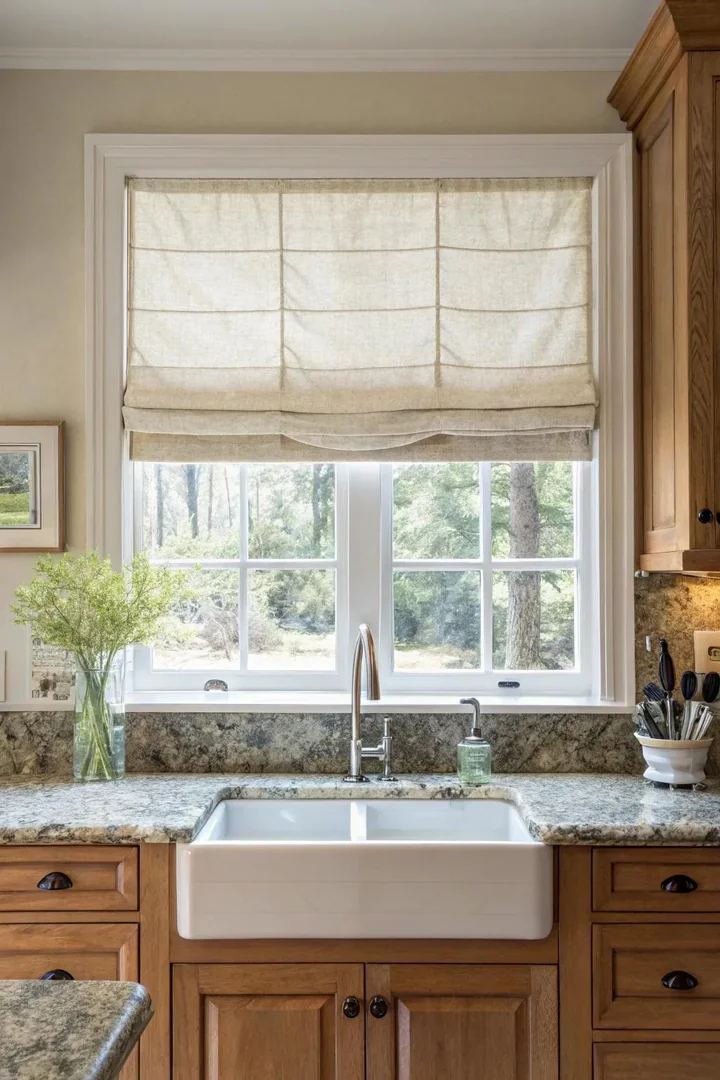
A flat-fold Roman shade from The Shade Store ($250 to $600 per window, custom-sized) or a cordless Roman shade from Levolor ($50 to $120 per window from Lowe’s) adds fabric softness and pattern above the sink while folding flat against the window frame when raised. Flat-fold Roman shades stack into neat horizontal pleats at the top of the window, occupying only 4 to 6 inches of glass when fully raised. Choose a moisture-resistant fabric (polyester blend, outdoor-grade Sunbrella, or faux linen) for above-sink placement where steam and splashing are constant.
An inside-mounted Roman shade (installed inside the window frame) produces a clean, built-in appearance. An outside-mounted shade (installed on the wall above the window frame) covers the frame entirely and makes the window appear taller. A bold geometric or botanical print fabric on the Roman shade adds color and pattern that a roller shade or blind cannot deliver. Line the shade with blackout fabric if the kitchen window faces east or west where direct morning or afternoon sun creates glare on the countertop.
2. Black Roller Blinds
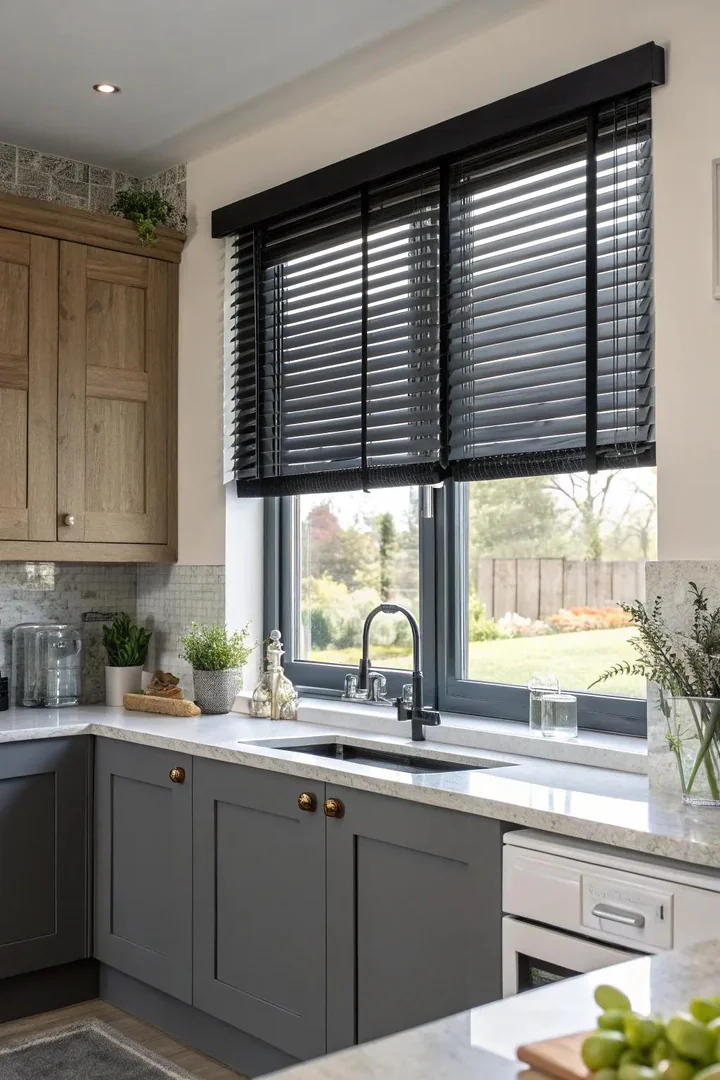
Black roller blinds from IKEA FYRTUR ($130 for a motorized blackout roller, up to 48 inches wide) or Lutron Serena ($300 to $500 for a motorized sheer or blackout roller) create a modern, graphic frame around the kitchen window. A black shade against white window trim produces a high-contrast frame that reads as architectural rather than decorative. Motorized rollers operated by a wall switch, remote, or smartphone app keep hands-free operation available while the cook’s hands are wet or greasy.
A solar shade in charcoal (5% openness factor) reduces glare while preserving the view; a blackout roller in matte black blocks all light for kitchens that face directly into a neighbor’s window. Rolling the shade up fully conceals the fabric inside a slim cassette head rail mounted at the top of the window, leaving the window completely unobstructed. A black roller shade paired with matte black cabinet hardware and a black faucet produces a coordinated metal-and-textile palette that ties the window treatment into the kitchen’s hardware story.
3. Linen Curtain Panel
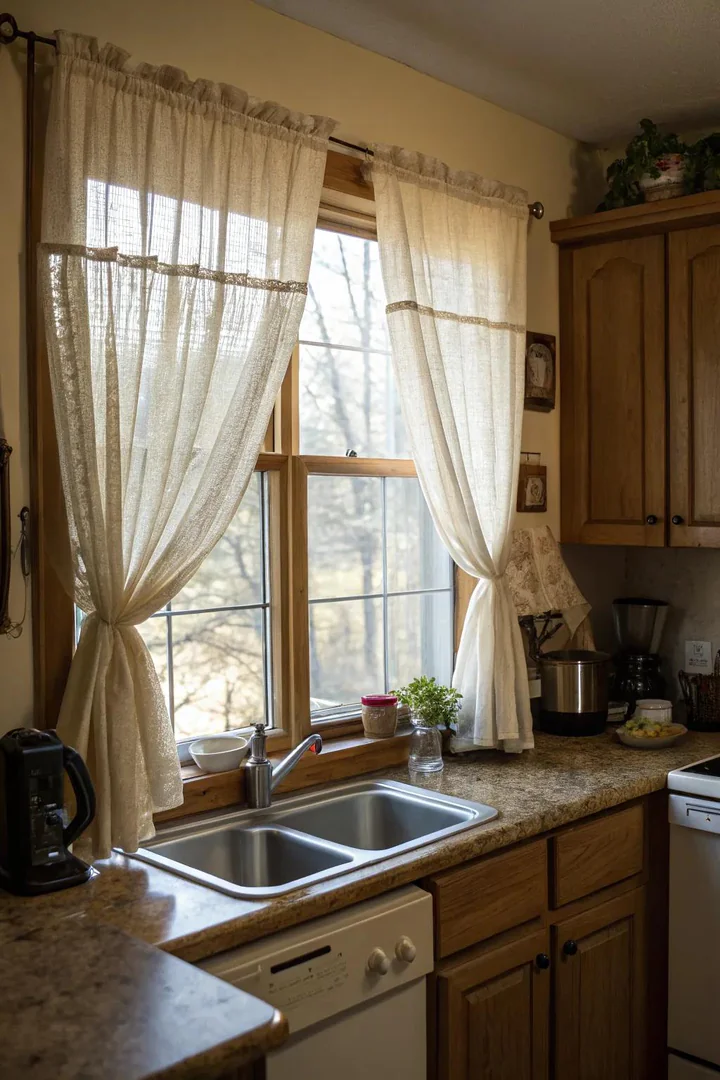
A single linen curtain panel in white, oatmeal, or flax from Pottery Barn Belgian Flax Linen ($80 to $130 per panel) or IKEA AINA ($20 per panel) hung from a brass or matte-black tension rod ($10 from Target) filters light without blocking the view. Linen’s loose, textured weave diffuses sunlight into a soft glow rather than casting harsh shadows. A cafe-style half curtain (covering only the bottom half of the window) provides privacy at sink height while leaving the upper glass open for daylight and sky view.
Hang the curtain rod 4 to 6 inches above the window frame to make the window appear taller. Let the curtain panels puddle 1 to 2 inches on the windowsill for a relaxed, European-linen look, or hem precisely to the sill for a tailored finish. Linen wrinkles naturally and does not require ironing after washing, which suits a kitchen where steam and cooking moisture contact the fabric daily. Machine-wash linen panels in cold water and tumble-dry on low; the fabric softens and becomes more supple with each wash cycle.
4. Floating Window Shelf
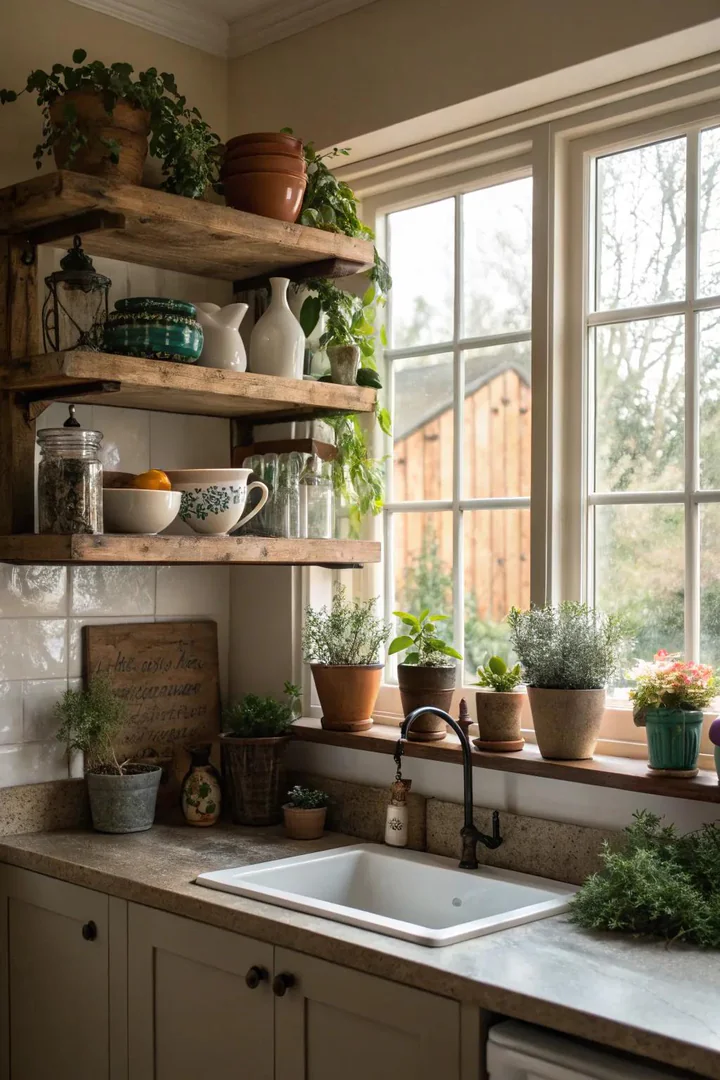
Mounting a floating shelf across the middle of the kitchen window (supported by L-brackets anchored into the window trim) creates a display surface for small potted herbs, propagation vases, and decorative objects while preserving the view above and below the shelf. A 3/4-inch-thick white oak or walnut board ($8 to $15 per linear foot from a lumber yard) cut to the window’s interior width, sanded, and sealed with Minwax Polycrylic ($15 per quart) produces a simple, natural shelf.
A 4-inch-deep shelf holds small 3-inch pots, glass propagation vases, and slim decorative objects without blocking the view. A 6-inch-deep shelf accommodates 4-inch herb pots and wider objects but reduces the visible glass area. Mount the shelf at the vertical midpoint of the window so equal amounts of glass appear above and below. Use brass shelf brackets ($12 for a pair from Rejuvenation) for a warm metal accent or black steel brackets ($8 for a pair from Home Depot) for a modern, industrial look.
5. Woven Natural Shade
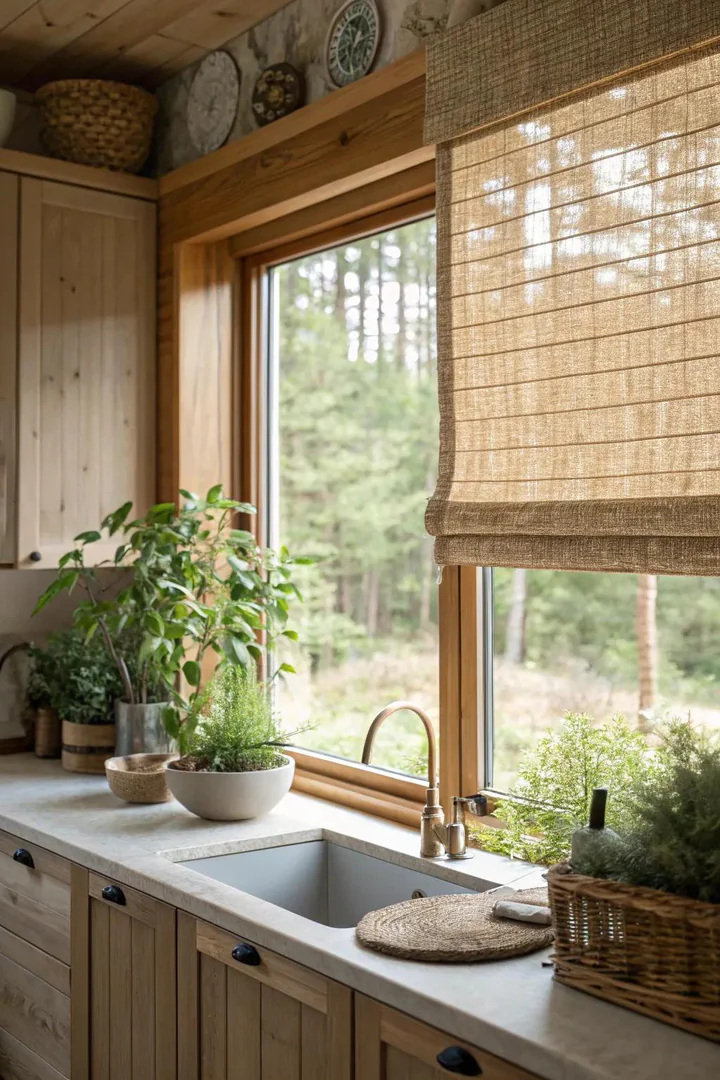
A woven bamboo, jute, or rattan shade from The Shade Store ($200 to $400 per window) or Blinds.com Bali Natural Woven Shade ($80 to $200 per window) adds organic texture and warm earth tones above the sink. Woven shades filter light through their natural fiber weave, creating a dappled, sun-through-leaves effect on the countertop. The tonal variation in natural fibers (light tan, golden straw, warm brown) adds warmth that synthetic materials cannot replicate.
Lining the woven shade with a privacy liner ($30 add-on from most manufacturers) blocks the sightline from outside without changing the shade’s exterior appearance. An unlined woven shade provides light filtering and texture but limited privacy after dark when interior lighting silhouettes the occupants. Choose a moisture-resistant species (bamboo, which naturally resists humidity and mold) over cotton or jute for above-sink placement. A woven shade suits farmhouse, coastal, bohemian, and organic-modern kitchen styles where natural materials define the palette.
6. Tile-Framed Window Surround
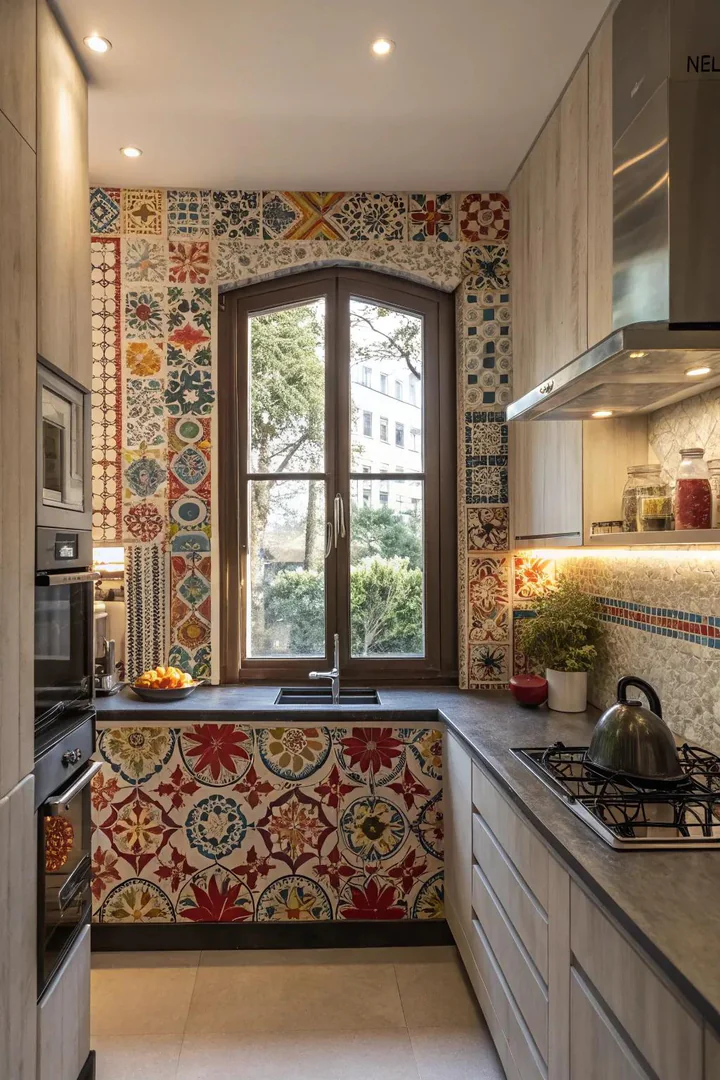
Running the backsplash tile up and around the window frame (covering the drywall returns and the area between the upper cabinets and the window trim) creates a tile-framed window that reads as a built-in architectural feature. A 3-by-6-inch subway tile in white or cream, a zellige tile in seafoam or terracotta from Clé Tile ($15 to $30 per square foot), or a patterned cement tile from Granada Tile ($12 to $25 per square foot) wrapping the window opening adds texture, color, and craft to the sink area.
Waterproof the window returns with a liquid membrane (RedGard, $20 per quart) before tiling to prevent moisture from migrating into the wall cavity behind the tile. Use bullnose or pencil-liner trim tiles at the window’s inner edges for a clean, finished corner. A tiled window surround costs $200 to $500 in tile and supplies for a standard 36-by-48-inch kitchen window. The tiled frame elevates the window from a standard drywall opening to a custom architectural detail that ties the backsplash and window together.
7. Vintage Pendant or Lantern
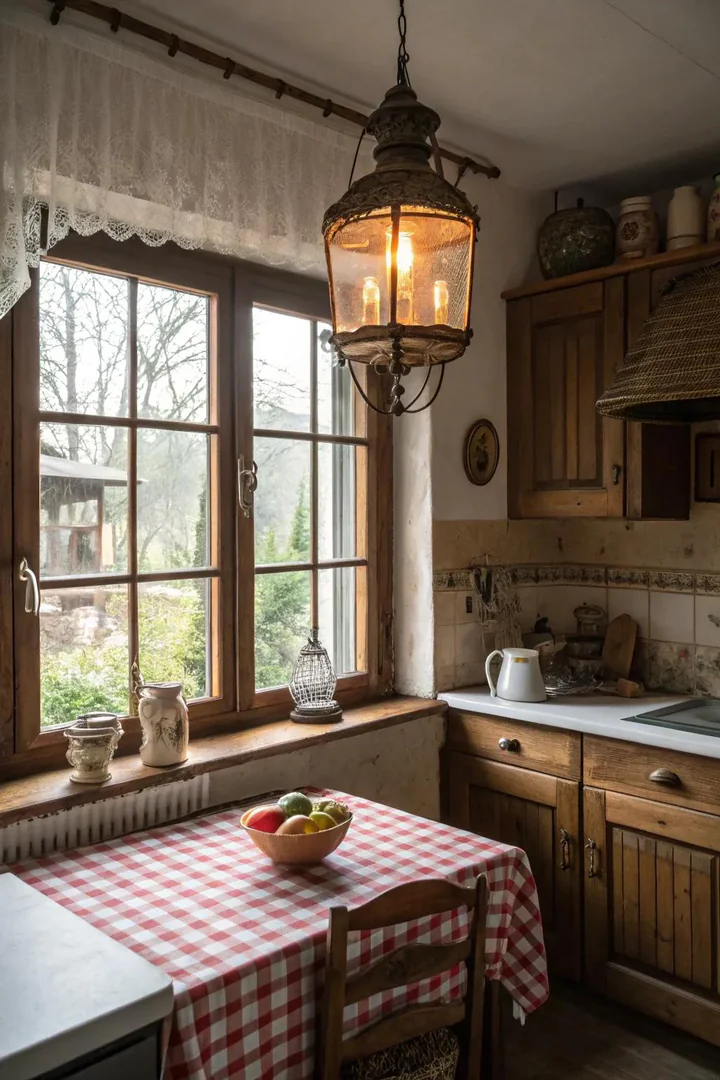
Hanging a vintage-style pendant or lantern centered in front of the kitchen window (6 to 12 inches above the faucet) creates a focal light fixture framed by the window behind. Visual Comfort Darlana Lantern ($600 for a small lantern in aged iron), Schoolhouse Electric Carson pendant ($200 in brass), or Pottery Barn Flynn Recycled Glass pendant ($150 in clear glass) produce warm, overhead task lighting at the sink while the window provides backlighting during daytime.
A pendant hung directly in front of a window can block part of the view. Choose a pendant with an open or transparent body (clear glass, wire cage, open lantern frame) that allows the view through and behind the fixture. A solid-shade pendant (opaque metal, fabric drum) blocks the view completely and should be hung to the side of the window or above the window frame rather than centered in front of the glass. Browse kitchen ideas with gold hardware for coordinating brass pendant finishes with cabinet pulls and faucets.
8. Reclaimed Wood Window Frame
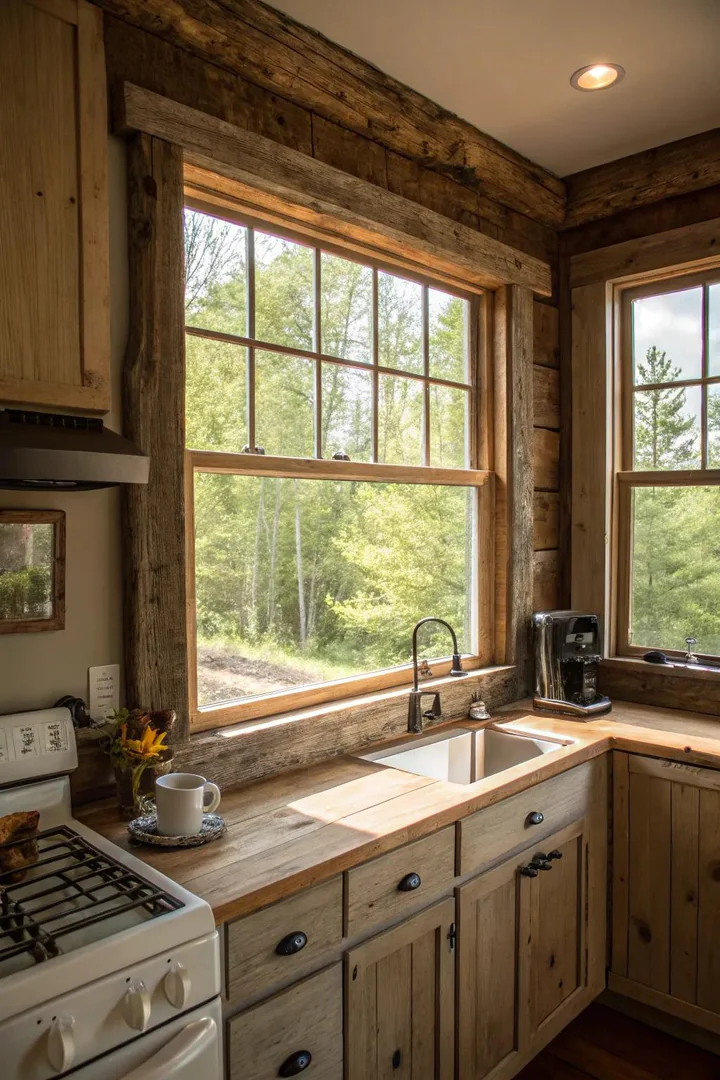
Replacing standard white-painted window trim with reclaimed barn wood ($10 to $30 per linear foot from a salvage yard) or rough-sawn cedar ($5 to $10 per linear foot from a lumber mill) adds aged grain, nail holes, and natural patina that frames the window like a picture frame. A 4-inch-wide reclaimed wood casing board around a standard 36-by-48-inch window requires approximately 14 linear feet of material ($70 to $210 in reclaimed wood or $35 to $70 in rough-sawn cedar).
Sand the reclaimed wood lightly with 220-grit to remove splinters, then seal with Waterlox Original Tung Oil ($35 per quart) for water resistance without a plastic-like sheen. Attach the wood casing to the existing window frame with finish nails and construction adhesive. A reclaimed wood window frame suits rustic, farmhouse, cabin, and organic-modern kitchens where raw materials and visible age define the design language. Pair the wood frame with a woven natural shade or a simple linen curtain to reinforce the organic palette.
9. Plantation Shutters
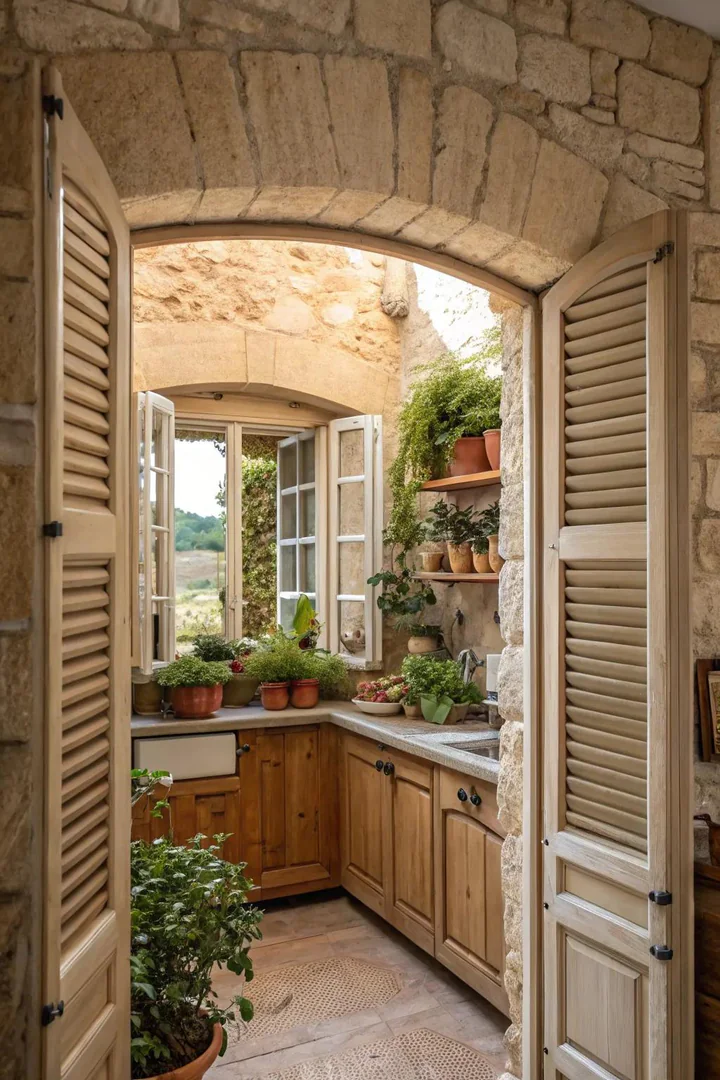
Plantation shutters with 3.5-inch or 4.5-inch louvers from Hunter Douglas NewStyle ($300 to $600 per window installed) or Blinds.com Faux Wood Shutters ($120 to $250 per window) provide adjustable light control, privacy, and a clean architectural appearance. Faux-wood (PVC composite) shutters resist moisture, warping, and peeling better than real wood in the high-humidity environment above a kitchen sink. Tilt the louvers open for full daylight, angle downward for privacy while admitting overhead light, or close flat for complete light blockage.
A cafe-style shutter installation (covering only the lower half of the window, leaving the upper glass exposed) provides sink-level privacy while admitting daylight and sky views through the unshuttered upper glass. Full-height shutters with a mid-rail (a horizontal divider at the midpoint) allow independent louver adjustment of the upper and lower halves: open the top louvers for light, close the bottom louvers for privacy. Plantation shutters increase a home’s appraised value because appraisers classify them as a permanent fixture, not a window treatment.
10. Semi-Sheer Roller Shade
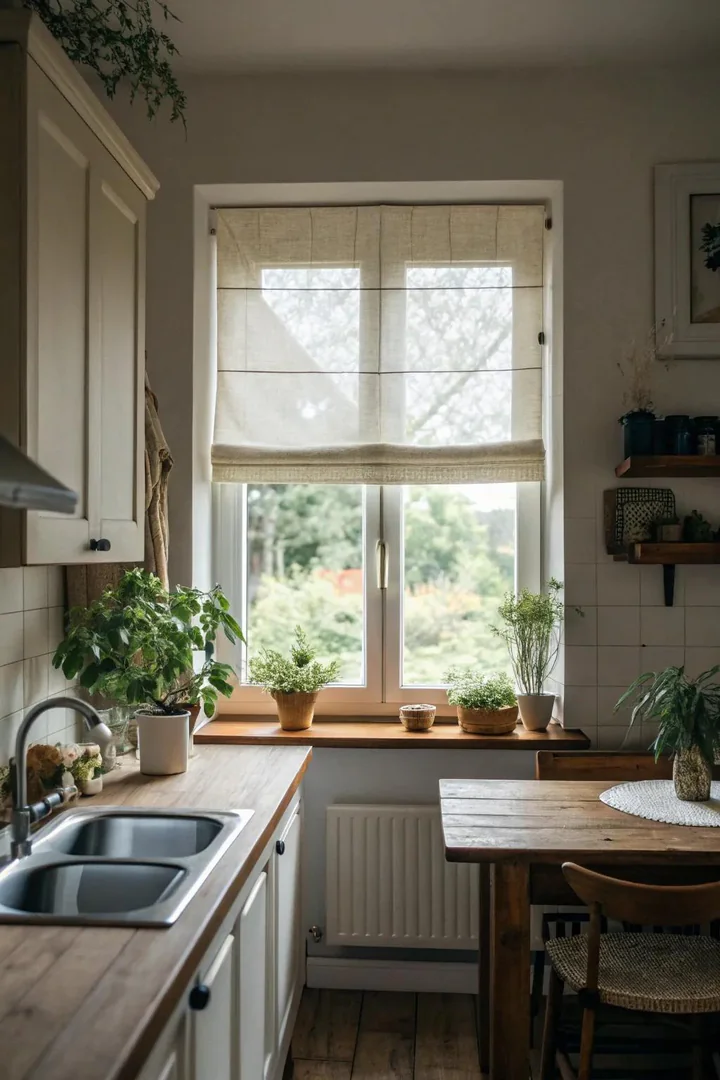
A semi-sheer solar shade (3% to 5% openness factor) from The Shade Store ($200 to $400 per window) or Bali Solar Shades from Blinds.com ($80 to $180 per window) reduces glare and UV rays while preserving the outdoor view. A 3% openness factor blocks 97% of UV light and reduces visible light by approximately 90%, maintaining the view of trees, sky, and yard while eliminating harsh direct sun on the countertop and faucet.
Solar shades in light colors (white, ivory, linen) reflect heat and glare away from the kitchen, keeping the sink zone cooler during afternoon sun. Dark-colored solar shades (charcoal, bronze, black) reduce glare more aggressively but absorb heat and reduce the outward view clarity. Roll the shade up fully into a slim cassette headrail for an unobstructed window during cloudy days and evenings. A solar shade is a practical, low-profile alternative to curtains and blinds for kitchens where the view is the primary design feature and the treatment’s role is sun management rather than decoration.
11. Picture Window Upgrade
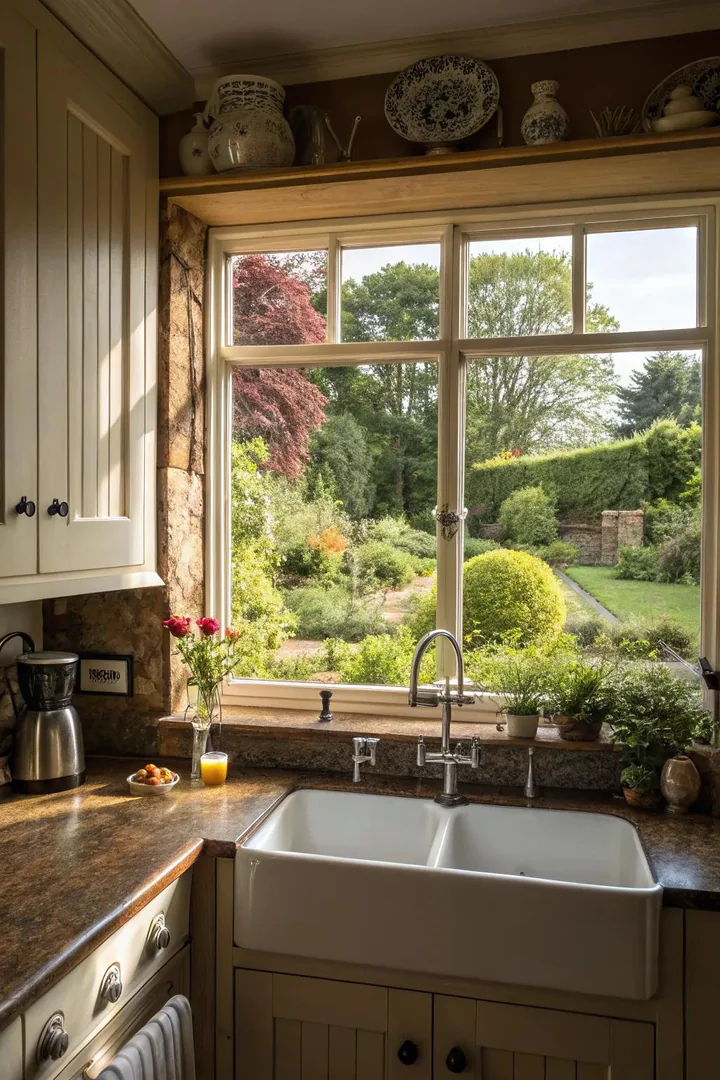
Replacing a standard 36-by-48-inch window with a picture window (a fixed, non-opening pane measuring 48-by-60 inches or larger) floods the sink zone with daylight and frames the yard, garden, or landscape as a living painting. A Marvin Signature Ultimate Picture Window ($800 to $2,000 depending on size and glass type) or Andersen 400 Series Fixed Window ($400 to $1,200) in a black or bronze exterior frame creates a gallery-style opening.
A picture window does not open, which means the kitchen loses the ventilation that an operable window provides. Compensate with a range hood that vents to the exterior (not a recirculating hood) and, if needed, an operable awning or casement window flanking the picture window. A fixed picture window eliminates the hardware, tracks, and mullions of an operable window, producing the largest uninterrupted glass area and the clearest view. The absence of moving parts also eliminates the maintenance and air-leakage issues associated with operable window mechanisms.
12. Brass Hardware Accents Around the Window
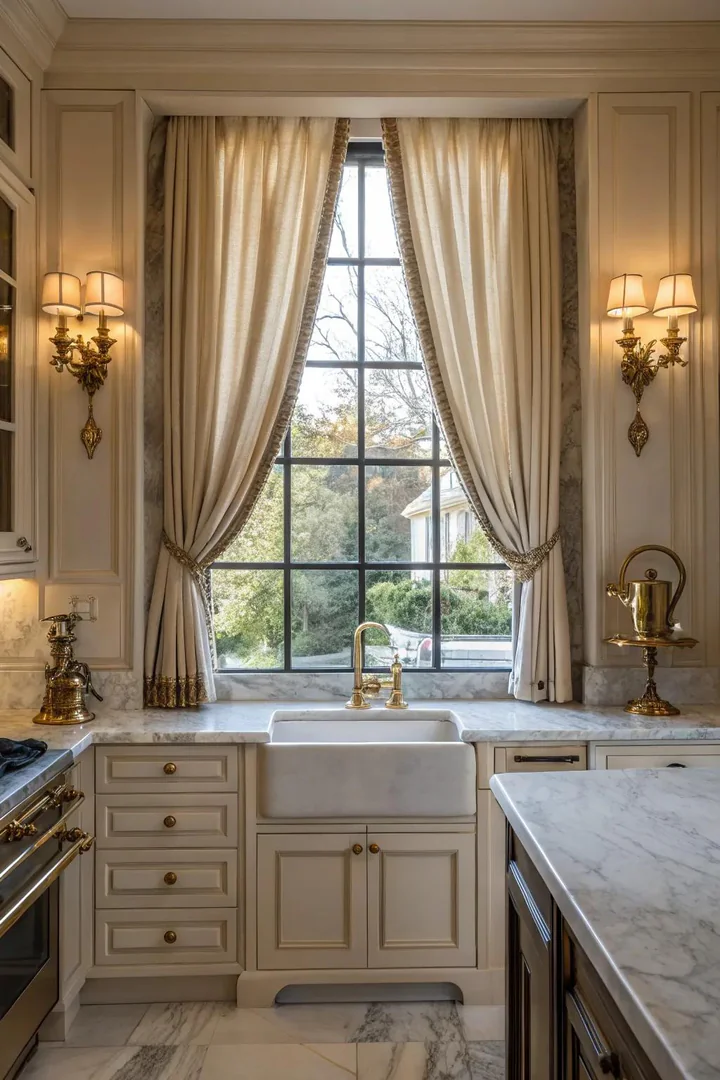
Coordinating brass window hardware (cremone bolts, sash lifts, sash locks) with brass cabinet pulls, a brass faucet, and brass pendant lighting creates a unified warm-metal palette in the sink zone. Emtek Brass Cremone Bolt ($200 to $350 per set), Rejuvenation Massey Sash Lock ($45 in unlacquered brass), and a Kohler Purist faucet in Brushed Moderne Brass ($450) produce a coordinated brass language from the window to the countertop to the cabinet doors.
Unlacquered brass develops a natural patina (darkening and tarnishing) over months that gives each hardware piece an aged, lived-in character. Lacquered brass maintains a consistent shine indefinitely but looks uniformly new. Mixing lacquered and unlacquered brass in the same room creates a mismatched appearance as the unlacquered pieces darken and the lacquered pieces remain bright. Choose one finish type for all brass elements. A brass-accented sink window zone suits traditional, transitional, and modern-classic kitchen styles where warm metallics anchor the material palette.
13. Transom Window Addition
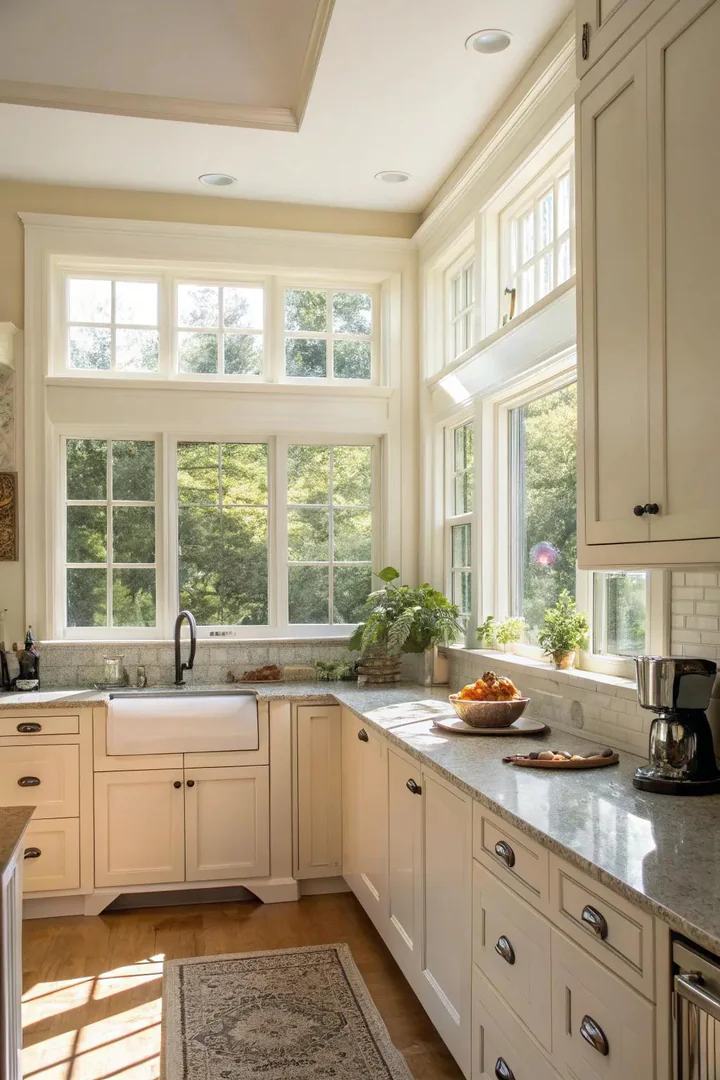
Adding a transom window (a horizontal window above the main window, separated by a mullion or header) increases the total glass area by 25% to 40% and brings clerestory-level daylight into the kitchen that the main window alone cannot reach. A transom window above a 36-by-48-inch main window adds a 36-by-12-inch or 36-by-18-inch glass panel that admits high-angle morning and afternoon sun while the main window handles the direct view and ventilation.
A fixed (non-opening) transom costs $200 to $600 installed when added during a window replacement or kitchen remodel. Retrofitting a transom into an existing wall requires cutting the header, reframing the opening, and patching the exterior siding, which adds $500 to $1,500 in carpentry. A transom suits kitchens with 9-foot or higher ceilings where the additional glass height reaches toward the ceiling plane, visually connecting the window wall to the ceiling and making the room feel taller. A transom in a kitchen with standard 8-foot ceilings may feel crowded against the upper cabinets or crown molding. Explore more architectural ideas at kitchen remodel ideas.
14. Potted Flowers on the Sill
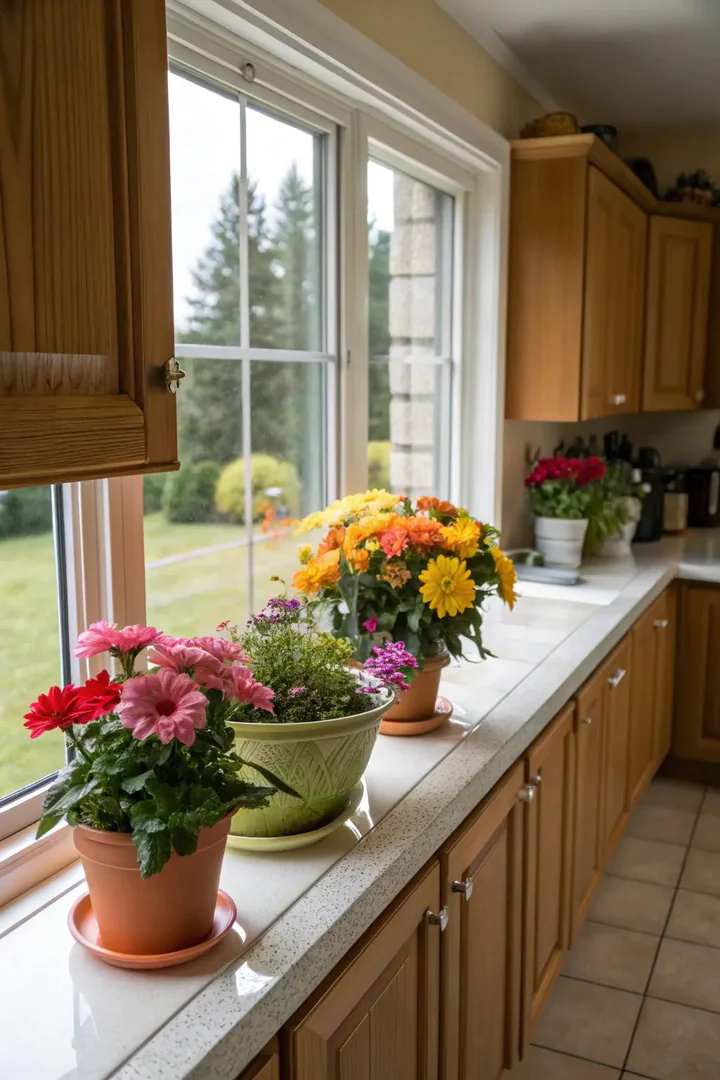
Grouping 3 to 5 small potted plants (African violets, mini orchids, pothos cuttings in water, or flowering kalanchoe) on the windowsill above the sink adds living color, fragrance, and greenery to the most-viewed window in the kitchen. A 4-inch African violet ($5 from a garden center) blooms year-round in the indirect light of an east- or north-facing window. A mini Phalaenopsis orchid ($15 from Trader Joe’s) flowers for 2 to 3 months per bloom cycle and re-blooms with minimal care (water with 3 ice cubes weekly).
Choose plants that tolerate the kitchen’s humidity, temperature fluctuations, and occasional splashing. Succulents (which prefer dry, bright conditions) struggle above a sink where steam and splash create consistently high humidity. Tropical foliage plants (pothos, philodendron, peace lily) thrive in the warm, humid microclimate above a kitchen sink. Place a waterproof tray or saucer under each pot to protect the windowsill from water damage. Rotate plants 90 degrees weekly so all sides receive equal light and the plant grows evenly rather than leaning toward the window.
15. Styled Windowsill Display
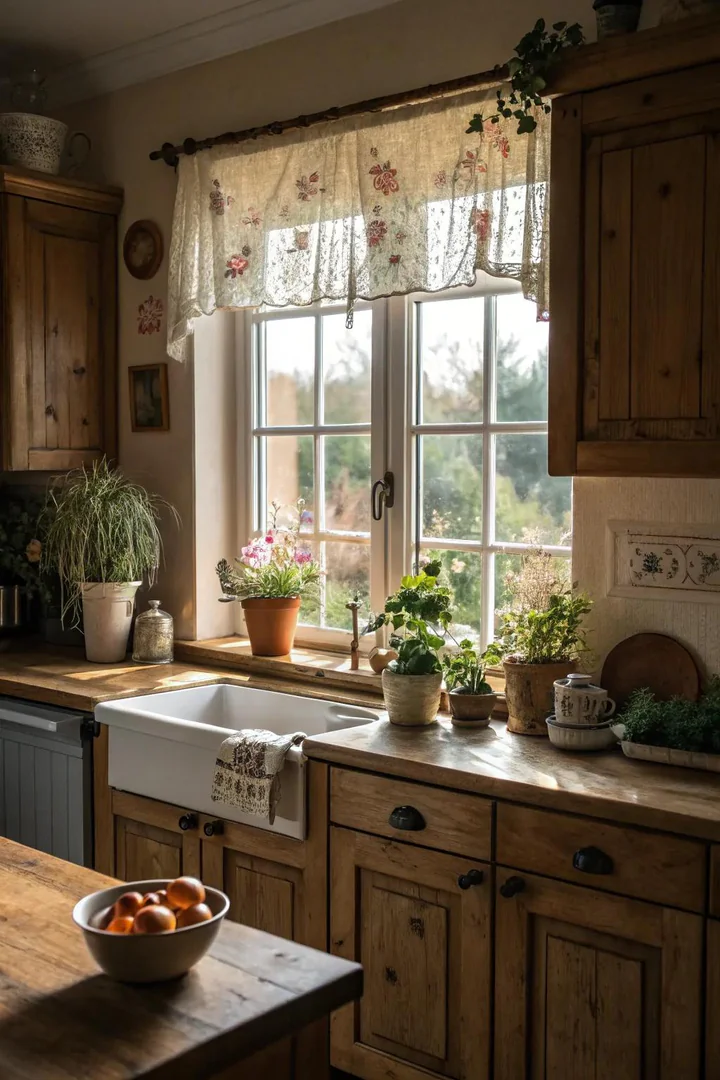
Arranging a curated collection of 3 to 5 objects on the windowsill (a ceramic soap dish, a small potted succulent, a brass candle holder, a glass propagation vase with a cutting, a decorative bottle) creates a styled vignette that personalizes the sink zone. Group objects at varying heights: one tall (8 to 10 inches), one medium (4 to 6 inches), one low (2 to 3 inches) for visual rhythm. A triangle composition (tallest object off-center, flanked by shorter pieces) reads as intentional rather than cluttered.
Choose objects that tolerate water splashing and humidity: ceramic, glass, brass, stone, and sealed wood. Avoid paper, untreated wood, fabric, and electronics on the sink windowsill. A hand-thrown pottery vase ($20 to $40 from a local potter) with a single stem (eucalyptus, olive branch, dried lavender) adds height and organic texture without the maintenance of a living plant. Rotate the display seasonally: fresh flowers in spring and summer, dried branches and amber glass in fall, pine sprigs and candles in winter.
16. Black-and-White Color Scheme
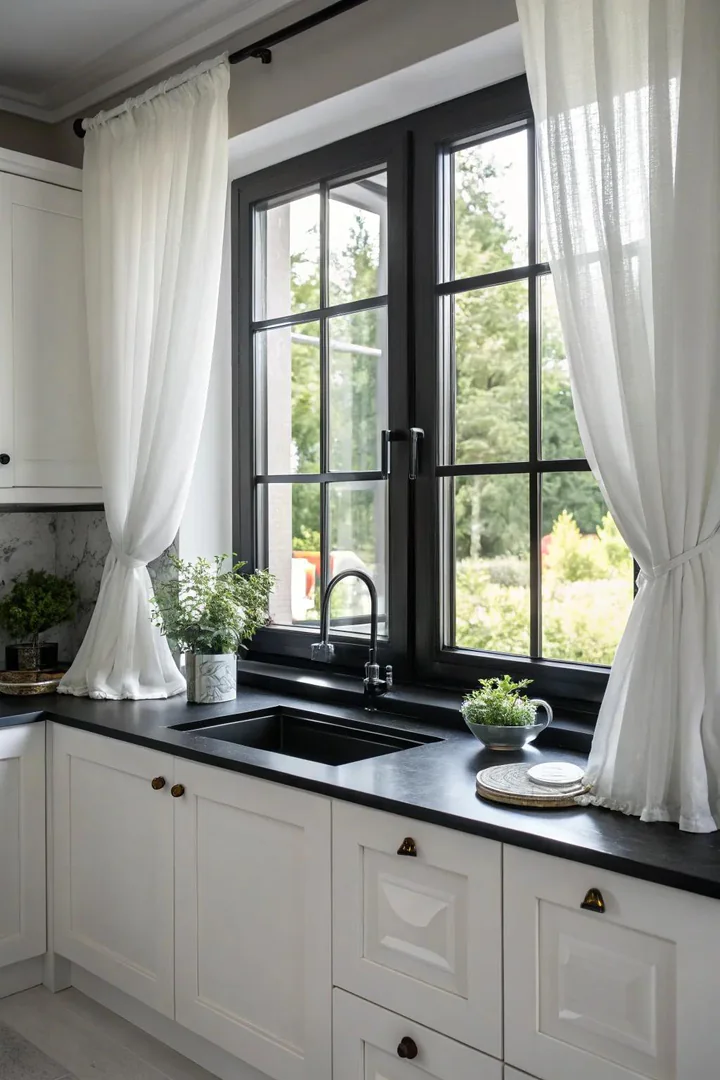
Painting the window trim, frame, and mullions matte black against white walls and white cabinets creates a graphic, high-contrast frame around the sink window. Benjamin Moore Black HC-190 or Sherwin-Williams Tricorn Black SW 6258 on the window trim produces a crisp, gallery-style border. A black window frame paired with a black faucet (Delta Trinsic in Matte Black, $300), black pendant light, and black cabinet hardware creates a coordinated dark-metal accent palette that punctuates an otherwise white kitchen.
Black window trim photographs dramatically and suits modern, Scandinavian, industrial, and contemporary farmhouse kitchen styles. Paint only the interior window trim (casing, sill, stops); leave the exterior frame in its original color or match the exterior house trim. A semi-gloss or satin paint finish on the trim resists moisture and wipes clean more readily than a flat finish. Black trim requires 2 coats of Benjamin Moore Advance ($55 per gallon) over a primer coat for full coverage and a smooth, durable finish on millwork. Browse more color coordination at peninsula design ideas.
17. Under-Window LED Accent Lighting
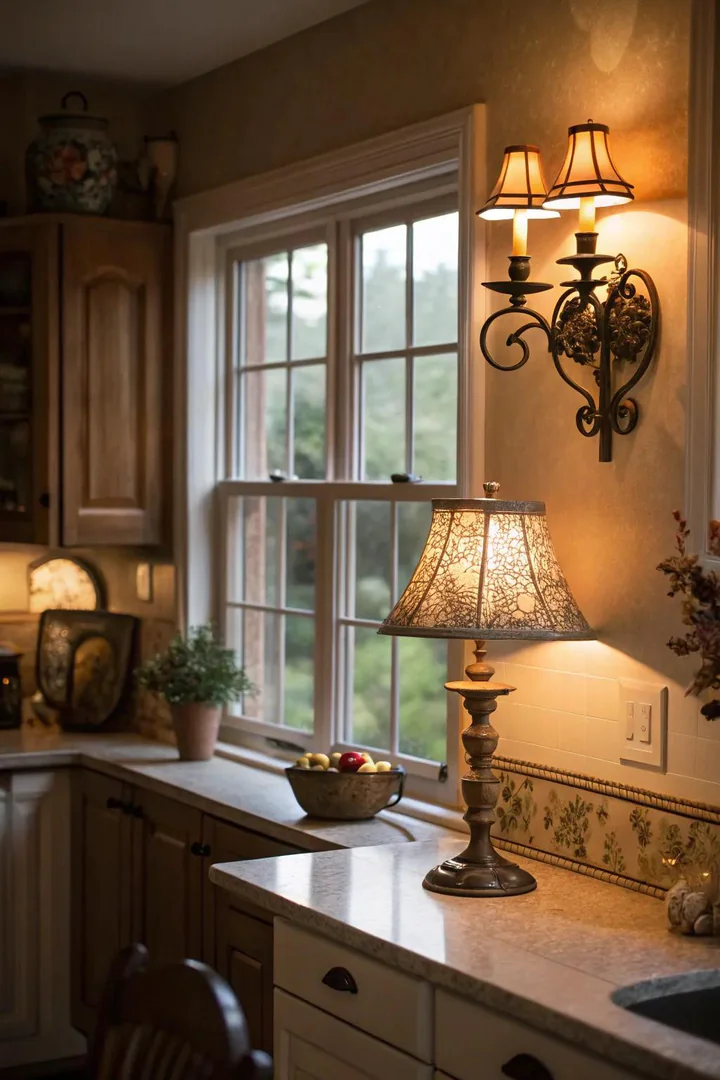
Mounting a peel-and-stick LED strip on the underside of the window sill (facing downward toward the backsplash) or along the bottom edge of the window frame creates a soft backlight that outlines the window after sunset. Philips Hue LightStrip Plus ($80 for a 6-foot strip with smart dimming and color control) or HitLights Warm White LED Strip ($15 for a 16-foot roll) in 2700K to 3000K warm white produces a cozy amber glow that replaces the lost daylight after dark.
LED strip lighting under the window sill serves as nightlight-level ambient illumination for late-night water-glass runs without switching on the overhead kitchen lights. A dimmer or smart switch ($30 for a Lutron Caseta dimmer) adjusts the LED brightness from full task light to a faint glow. Position the LED strip toward the back of the sill (closest to the glass) to wash light down the backsplash tile without visible glare from the seating or cooking zone. A window outlined in warm LED light becomes the kitchen’s evening focal point, replacing the daytime view with a warm-light accent. Visit The Designers Company for the full kitchen window and design library.
How to Install a Floating Window Shelf
1. Measure the Window Interior Width
Measure the interior width of the window opening (between the side casings) at the point where the shelf will sit. Subtract 1/4 inch from the measurement to allow clearance on each side for the shelf to slide in without binding. A standard 36-inch window interior produces a shelf approximately 35.5 inches long. Cut a 3/4-inch-thick hardwood board (white oak, walnut, or maple) to this length using a miter saw or circular saw with a straightedge guide.
2. Sand, Stain, and Seal the Shelf
Sand the board with 120-grit, then 220-grit sandpaper for a smooth surface. Apply a wood stain (Minwax Early American for warm brown, Minwax Ebony for dark contrast, or leave unstained for a natural look) and let the stain dry for 24 hours. Seal with 2 coats of Minwax Polycrylic in matte or satin finish, sanding lightly with 320-grit between coats. Polycrylic provides water resistance without the amber yellowing that oil-based polyurethane produces on light-colored wood.
3. Mount the Brackets and Shelf
Mark the bracket positions on the window casing or wall (one bracket 3 inches from each end for a 36-inch shelf). Pre-drill pilot holes to prevent the casing from splitting. Screw the brackets into the casing with 1.5-inch wood screws. Level the shelf across both brackets using a torpedo level. Place the shelf on the brackets and secure from below with short screws through the bracket holes into the shelf bottom. A properly installed floating shelf holds 15 to 25 pounds (6 to 10 small potted herbs and decorative objects).
Kitchen Window Treatment Comparison
| Treatment | Cost per Window | Light Control | Privacy | Moisture Safe | Rental Friendly |
|---|---|---|---|---|---|
| Roman shade | $50–$600 | Good | Full when lowered | Polyester/Sunbrella only | Yes (tension rod) |
| Black roller blind | $80–$500 | Excellent | Full when lowered | Yes | Yes (inside mount) |
| Linen curtain | $20–$130 | Moderate | Moderate | Machine washable | Yes (tension rod) |
| Woven natural shade | $80–$400 | Moderate | Low (unlined) | Bamboo only | Yes (inside mount) |
| Plantation shutters | $120–$600 | Excellent | Full when closed | Faux wood only | No (permanent) |
| Solar shade | $80–$400 | Good (UV block) | Moderate | Yes | Yes (inside mount) |
| No treatment | $0 | None | None | N/A | Yes |
Frequently Asked Questions
What is the best window treatment for above a kitchen sink?
A faux-wood plantation shutter in PVC composite resists moisture, steam, and grease splatter without warping, peeling, or staining, making the shutter the most durable above-sink window treatment. For a softer look, a Roman shade in moisture-resistant polyester fabric or outdoor-grade Sunbrella provides fabric softness with water resistance. Avoid natural silk, cotton, and untreated linen directly above a sink where steam and splashing create sustained moisture contact.
How do you add privacy to a kitchen window over the sink without blocking light?
Applying a frosted window film ($8 to $15 per roll from Home Depot, brands include Gila and Artscape) to the lower half of the glass obscures the view into the kitchen while admitting full diffused daylight through the frosted pane. A cafe-style curtain or half-height plantation shutter covering only the bottom half of the window provides adjustable privacy at sink level with unobstructed daylight above. A 3% solar shade reduces interior visibility from outside during daytime while preserving the interior view outward.
Can you put a window shelf above a kitchen sink without drilling?
A tension rod shelf system (two tension rods spanning the window opening with an acrylic or wood plank resting across them) creates a no-drill window shelf that holds lightweight objects (small pots, propagation vases, candles) up to 10 pounds total. Command strip shelf brackets ($6 per pair, rated for 3 to 5 pounds per bracket) mount to the window casing with adhesive strips and support a lightweight shelf without holes. Remove both options cleanly on move-out day for full deposit recovery.
What plants grow best on a kitchen windowsill over the sink?
Pothos, philodendron, peace lily, African violet, herbs (basil, mint, parsley, cilantro), and mini orchids thrive in the warm, humid, partially-lit conditions above a kitchen sink. South- and west-facing windows receive enough direct light for herbs and succulents. North- and east-facing windows suit shade-tolerant tropicals (pothos, peace lily, ZZ plant). Avoid cacti and desert succulents above the sink because the constant humidity from dishwashing promotes root rot in plants adapted to arid conditions.
How much does it cost to replace a kitchen window over the sink?
Replacing a standard 36-by-48-inch kitchen window costs $300 to $1,500 for the window unit plus $200 to $500 for professional installation. A vinyl double-hung window from Pella 250 Series ($300 to $500) or Andersen 100 Series ($250 to $400) is the most common replacement. Upgrading to a larger picture window, adding a transom, or switching from a double-hung to a casement window increases costs by $500 to $2,000 due to reframing and exterior siding modifications. Visit kitchen countertop ideas for materials that complement your sink window zone.