
Dark Beige Kitchen Cabinet Ideas: 21 Elegant Designs to Inspire
Dark beige kitchen cabinets sit between standard beige and brown on the color wheel, pulling warmth from amber, clay, and mushroom undertones while staying lighter than mocha or chocolate finishes. Paint colors like Benjamin Moore Alexandria Beige (HC-77), Sherwin-Williams Latte (SW 6108), and Farrow & Ball Jitney (No. 293) all land in the dark beige family and produce cabinets that feel grounded without absorbing light the way charcoal or espresso stains do. Below are 21 design approaches covering wood pairings, metal accents, countertop combinations, backsplash choices, and lighting strategies, followed by a step-by-step painting guide, a comparison table, and FAQs on undertones, sheen levels, and coordinating wall colors.
1. Dark Beige Cabinets with Warm Walnut Floating Shelves
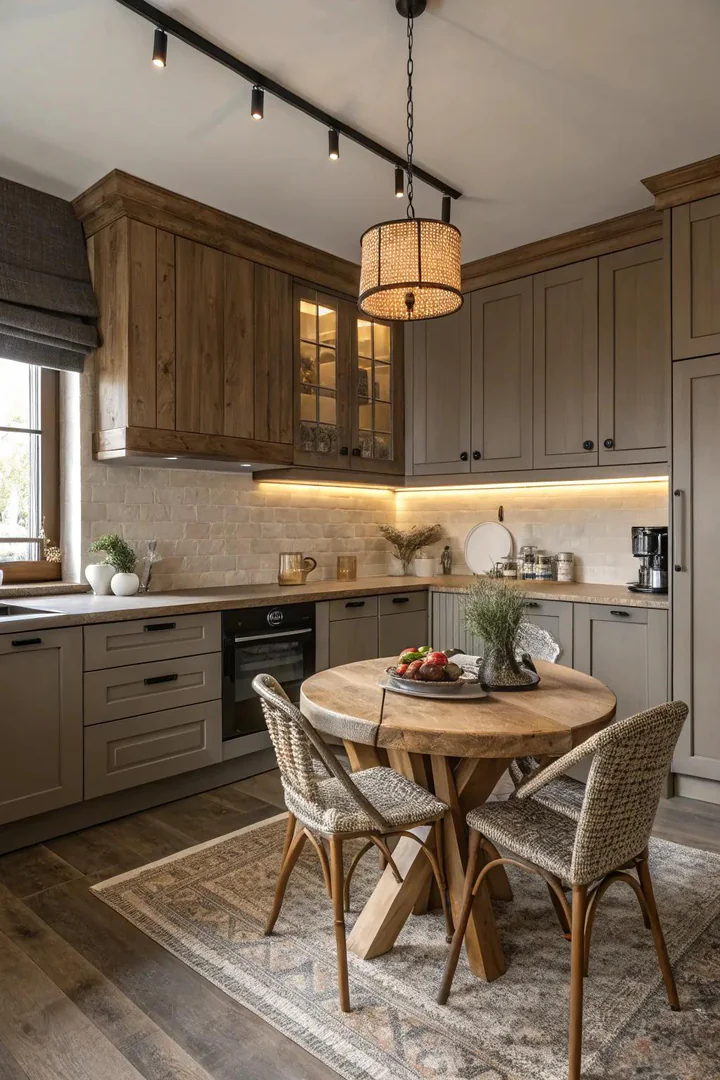
Mounting solid walnut floating shelves above a dark beige cabinet run introduces a richer wood tone that reads as a deliberate tonal step rather than a mismatch. Walnut grain ranges from honey to deep chocolate, and the darkest sections pick up the brown undertone in the beige paint. Shelves in 10-inch depth and 36-inch length from Shelfology or Ultra Shelf hold everyday plates, mugs, and spice jars without blocking sightlines in the upper wall zone.
White oak or natural maple shelving creates a lighter wood contrast that keeps the kitchen airy, while walnut creates depth. Floating shelf brackets rated for 50+ pounds per shelf ensure the wood does not sag under stacked dishes. A trio of shelves spaced 12 inches apart vertically replaces four upper cabinet boxes and opens the wall for a more relaxed, collected look that farmhouse and transitional kitchens favor.
2. Brushed Brass Cabinet Pulls on Dark Beige Shaker Doors
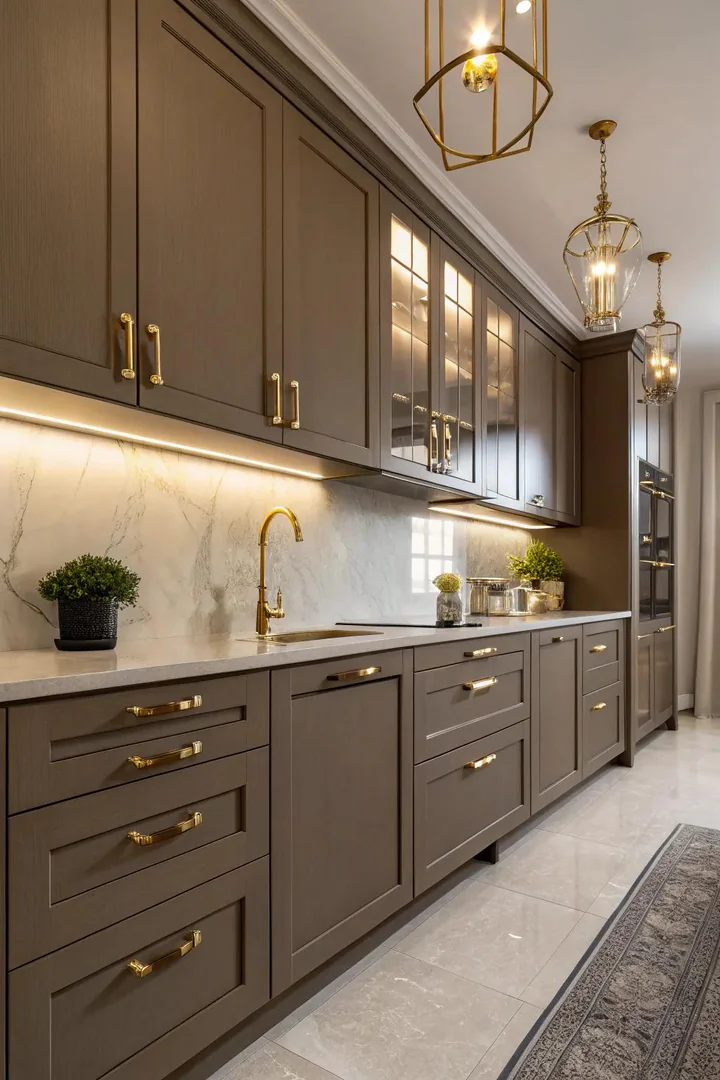
Brushed brass bar pulls from Amerock Mulholland or Top Knobs Aspen II add a warm metallic layer that amplifies the golden undertone already present in dark beige paint. Brass reads warmer than nickel or chrome, making the cabinet face feel rich rather than flat. A 128 mm center-to-center pull suits standard Shaker drawer fronts, and matching brass round knobs top each upper door.
Extending the brass into the faucet, pendant light shades, and range hood trim creates a cohesive metallic thread across the room. Unlacquered brass develops a patina over 6 to 12 months, darkening to an antique gold that pairs naturally with the muted warmth of dark beige. Lacquered satin brass stays uniform longer and requires only a damp-cloth wipe. Readers exploring metal and cabinet pairings can also browse our guide to blue kitchen cabinets with gold hardware for a bolder color-and-metal combination.
3. Smoke-Gray Subway Tile Backsplash Behind Dark Beige Cabinets
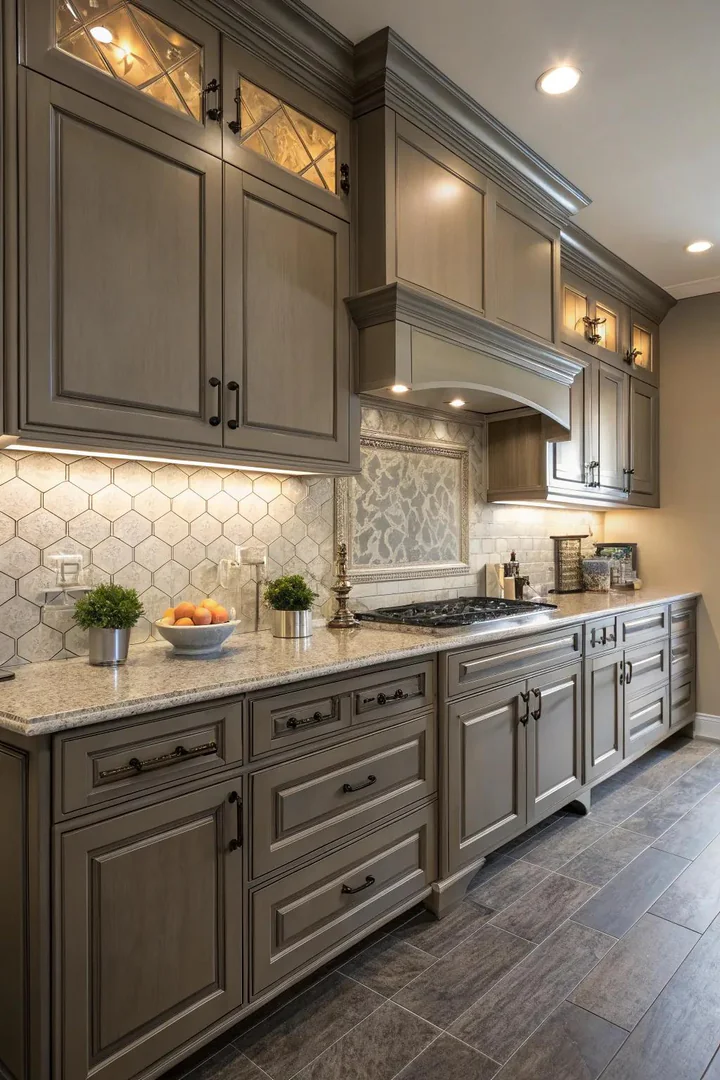
A 3-by-6-inch smoke-gray ceramic subway tile from Daltile Rittenhouse Square or Bedrosians Cloe introduces a cool counterpoint to the warm cabinet face. Gray and beige sit on opposite temperature sides of the neutral spectrum, so placing them next to each other creates visual tension that keeps the kitchen from reading as one-note. A mid-gray with a slight blue undertone pulls the design toward contemporary, while a warm greige tile bridges the gap between the two tones.
Running the tile in a stacked vertical pattern rather than the standard offset brick pattern gives the backsplash a modern edge without changing the tile itself. Light gray grout lines at 1/16-inch spacing keep the wall clean and minimize the grout-maintenance burden. A glossy glaze on the tile bounces under-cabinet LED light back into the room, brightening the zone between counter and upper cabinets.
4. Sculptural Pendant Lights Above a Dark Beige Kitchen Island
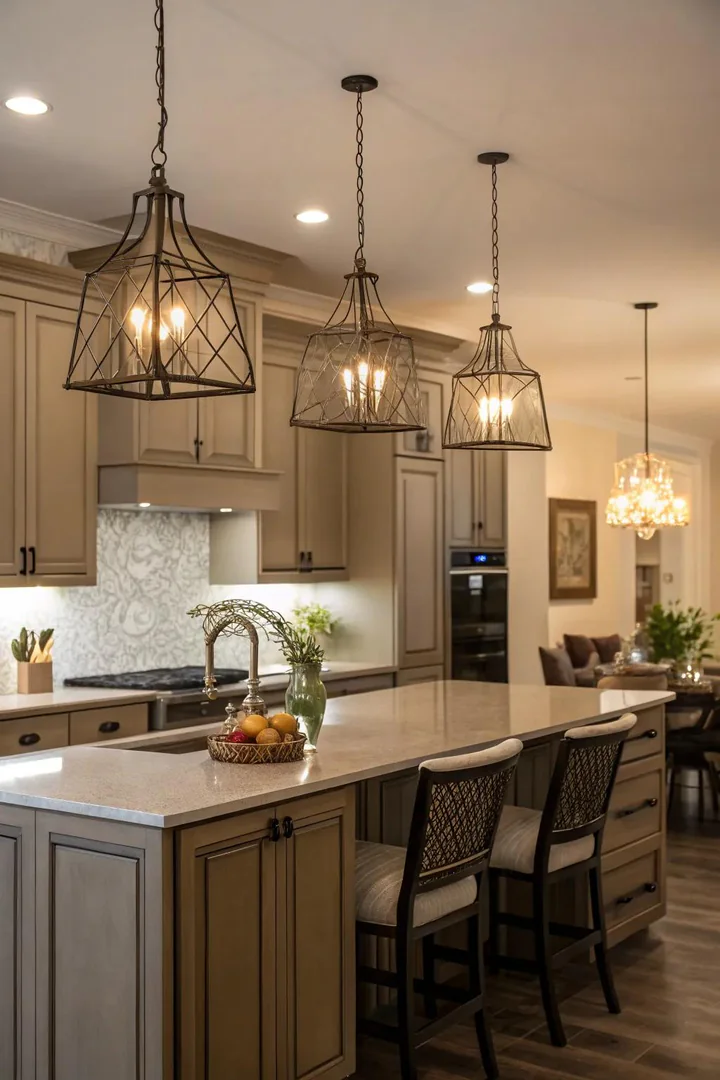
Two or three sculptural pendant lights in brushed brass or matte black from Visual Comfort Kelly Wearstler Utopia or West Elm Sculptural Glass Globe hang 30 to 34 inches above a dark beige island counter, putting the fixture at eye level and casting warm pools of light on the work surface. Pendant shapes with open bottoms or glass shades distribute task light downward while sending ambient glow sideways.
Warm-white LED bulbs in the 2700K to 3000K range complement the warm undertone of dark beige better than daylight (5000K) bulbs, which wash out warm colors and make beige look grayish. Dimmer switches on the pendant circuit let the homeowner shift from full task brightness during meal prep to low ambient glow during evening entertaining. Sculptural fixtures act as decorative objects above the island, giving the kitchen a gallery-quality focal point without wall art.
5. Dark Beige Cabinets Contrasted with Matte Black Range and Hood
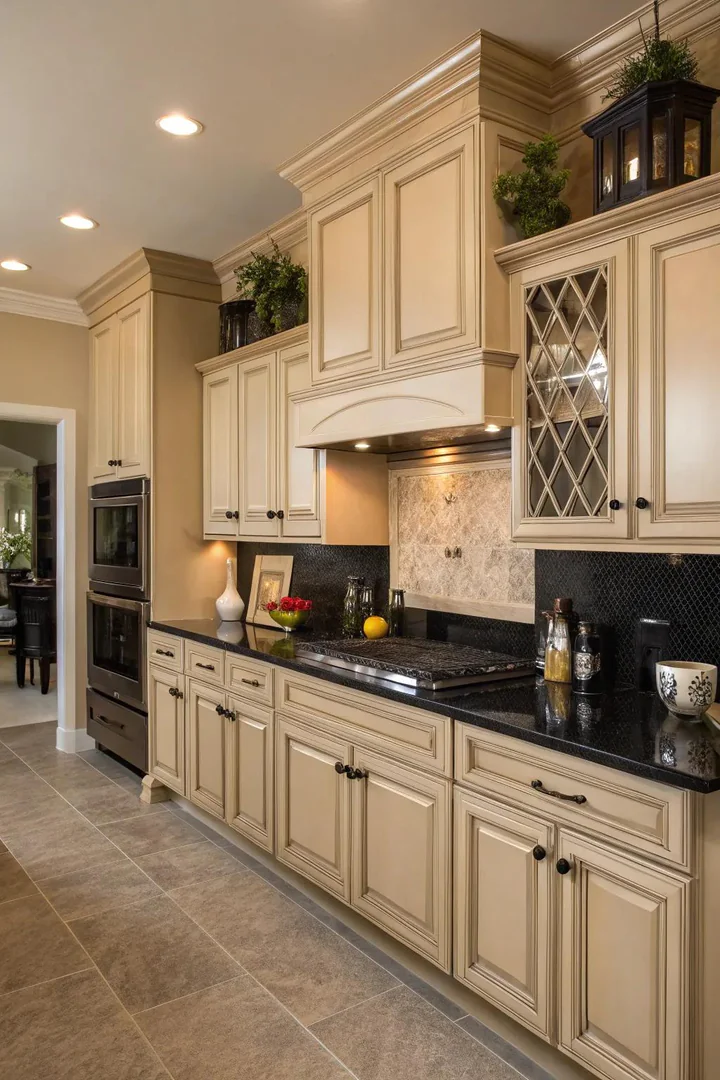
A matte black freestanding range from DERA, SMEG Portofino, or GE Café flanked by dark beige cabinets sets up a high-contrast anchor in the cooking zone. Matte black reads as a solid, grounding presence without the reflective distraction of stainless steel. A matching matte black range hood or a custom wood hood painted in the same dark beige extends the cabinet color upward and frames the black range between two beige walls.
Black drawer pulls, cabinet hinges, and open-shelf brackets echo the range finish across the room in small doses. Limiting black to hardware and one major appliance prevents the kitchen from tipping dark; the beige cabinetry still covers 70% or more of the visible surface area, keeping the overall palette warm. A honed black granite or Dekton Kelya countertop ties the range and the counter plane together if the homeowner wants maximum contrast.
6. Calacatta Marble Countertops on Dark Beige Base Cabinets
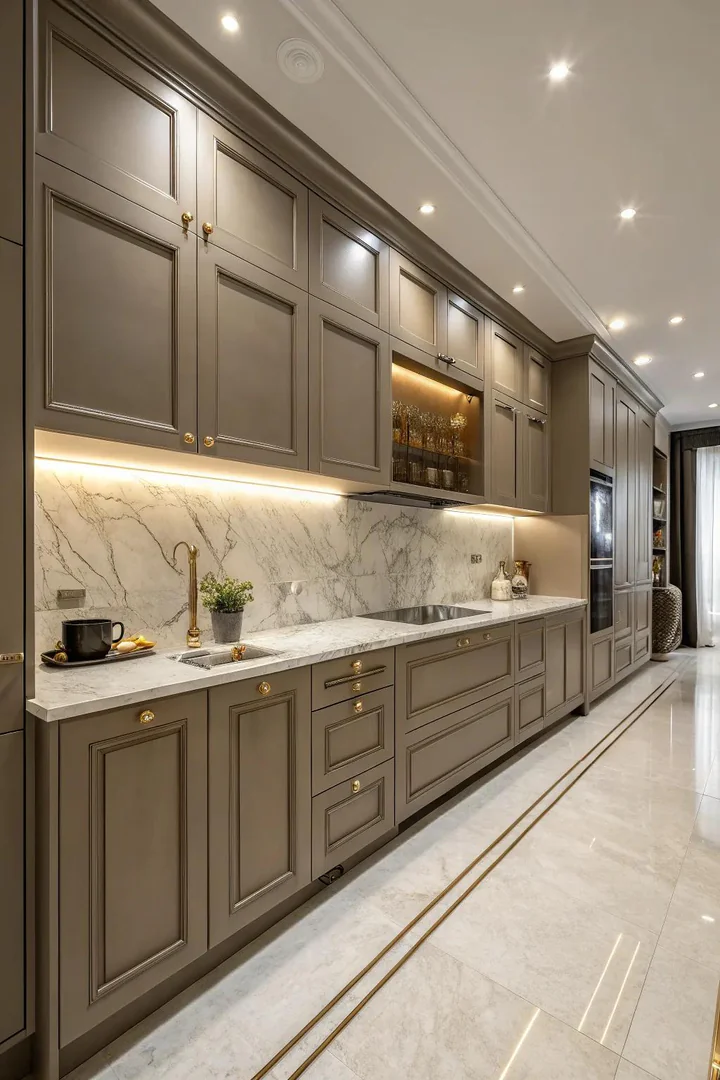
A 3 cm Calacatta Borghini marble slab with gold-and-gray veining on a warm white base bridges the beige cabinet tone and any brass hardware in a single geological pattern. Polished marble reflects pendant light and under-cabinet LEDs, brightening the work surface and countering the muted warmth of the cabinet below. A full-height marble backsplash behind the range eliminates tile grout and creates one unbroken stone surface from counter to upper cabinets.
Marble requires sealing once or twice a year with an impregnating sealer like Tenax Hydrex to resist oil and acid stains from lemon juice, tomato sauce, and red wine. Quartz alternatives like Caesarstone Calacatta Nuvo (5131) or Cambria Brittanicca replicate the marble look at zero porosity for homeowners who want the pattern without the maintenance. Dark beige cabinets sit well under white-veined marble because the contrast stays soft and warm rather than stark.
7. Rift-Cut White Oak Cabinets Stained to a Dark Beige Tone
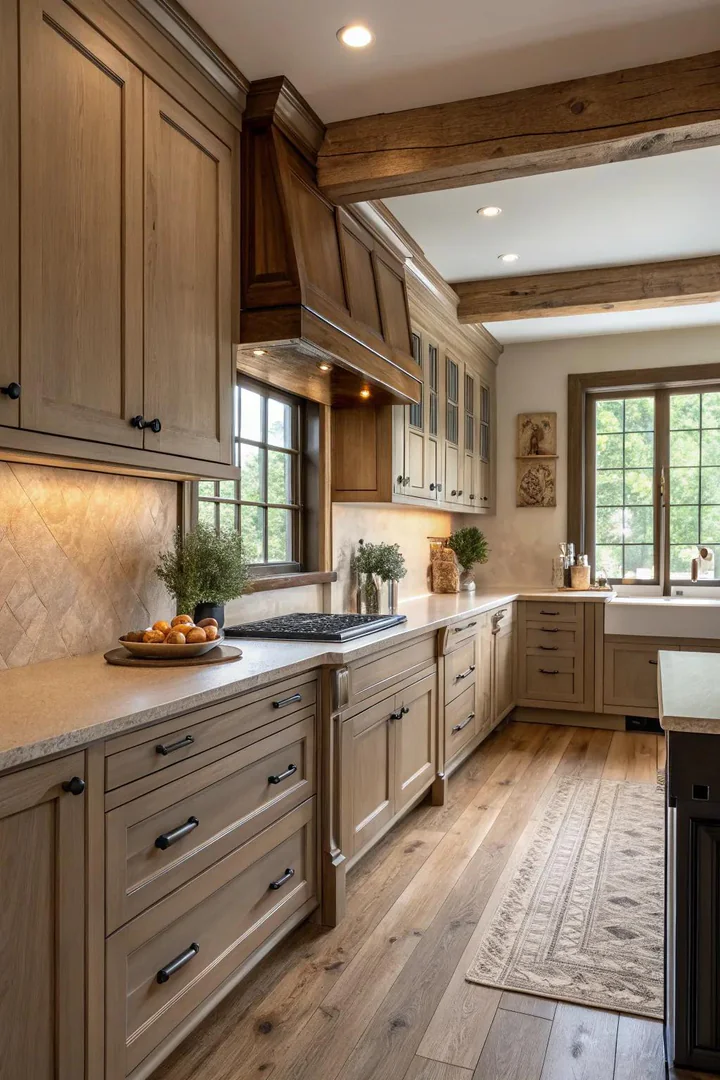
Rift-cut white oak cabinet doors stained in a dark beige custom mix (two parts Rubio Monocoat Smoke to one part Rubio Cotton White) show the oak’s tight linear grain while landing in a warm sandy-brown tone. Rift-cut grain runs in parallel lines without the cathedral arches of plain-sawn oak, giving the cabinet face a contemporary, uniform texture. White oak accepts stain evenly because the pores are tight and consistent.
A clear matte topcoat from Osmo Polyx-Oil protects the stained surface from water rings and cooking grease without adding sheen. Stained-wood dark beige reads differently from painted dark beige because the grain shows through, adding visual depth that solid paint cannot replicate. Pair stained oak cabinets with a concrete or honed limestone countertop for a natural-material kitchen where every surface carries texture.
8. Custom Range Hood Painted to Match Dark Beige Cabinetry
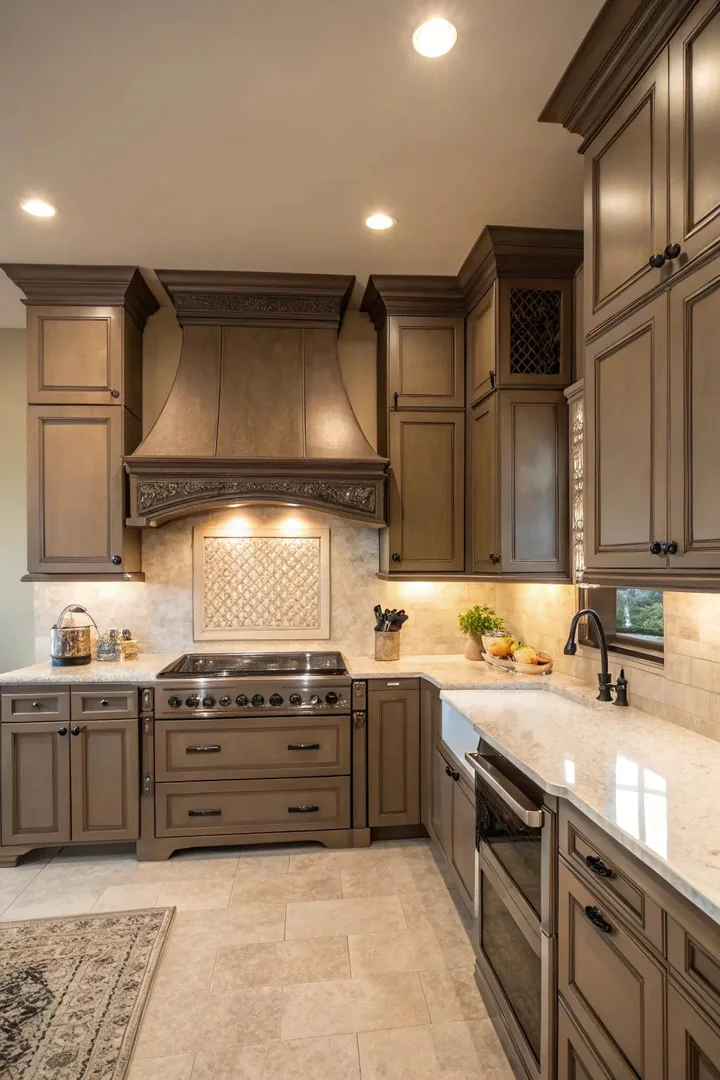
A tapered or arched wood range hood from CopperSmith or ProLine Range Hoods (wood insert) painted in the same dark beige as the cabinets turns the ventilation unit into a sculptural focal point. Matching the hood and cabinet color makes the hood disappear into the cabinet wall rather than interrupting the run with stainless steel. Trim details like a crown molding cap, corbel brackets, or a paneled front panel add dimension to the single-color surface.
A hood insert from Zephyr Tornado (AK9234AS) or Broan Elite fits inside the custom wood surround and provides 600 to 900 CFM extraction for a 30-inch or 36-inch range. Paint the hood in the same sheen as the cabinets (satin or semi-gloss) so the two surfaces reflect light identically. A single brass or iron strap across the hood front at the midpoint breaks up the large painted surface and connects to the brass hardware on the surrounding doors.
9. Dark Beige Lowers with Cream or Off-White Upper Cabinets
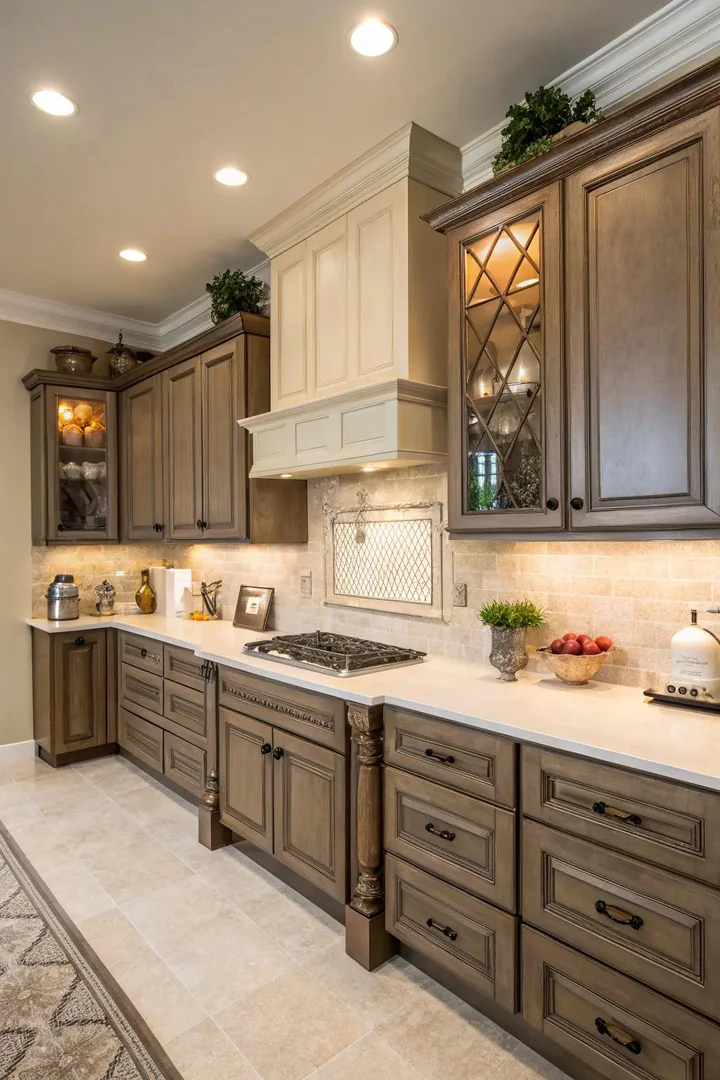
Painting upper cabinets in Benjamin Moore White Dove (OC-17) or Sherwin-Williams Alabaster (SW 7008) while keeping lowers in dark beige creates a two-tone layout that grounds the base and opens the upper wall. White Dove carries a warm yellow undertone that harmonizes with beige rather than fighting it, unlike blue-white paints (Chantilly Lace, Simply White) that can make beige look muddy by comparison.
A two-tone split works best when the countertop sits between the two colors in value: white marble, light gray quartz, or butcher-block walnut. The counter becomes a visual divider, and the eye reads the kitchen in three horizontal bands (dark base, medium counter, light upper). A matching dark beige island below cream uppers anchors the center of the room and ties the lower-cabinet color across the floor plan.
10. Bookmatched Veined Marble Backsplash with Dark Beige Cabinets
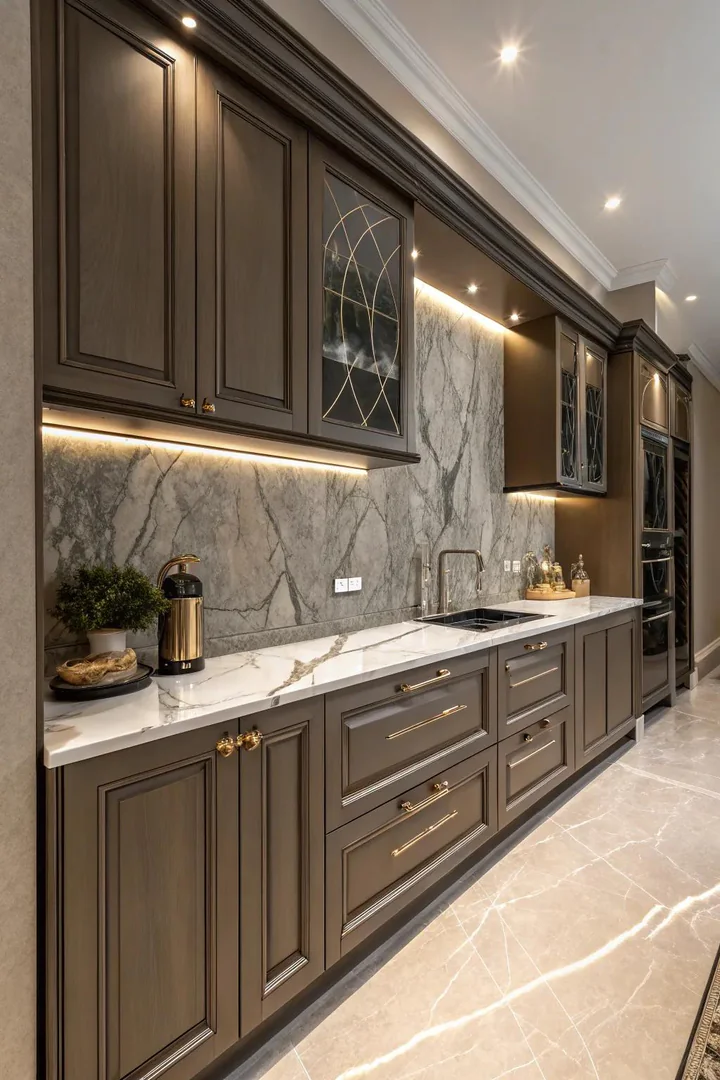
A bookmatched Calacatta Viola marble slab backsplash, where two adjacent slabs mirror each other’s veining, produces a butterfly pattern that commands attention behind a dark beige cabinet run. Bookmatching requires two sequential slabs from the same marble block, cut and polished on opposite faces, and installed symmetrically around a center axis. The result is a one-of-a-kind geological art piece that no tile installation can replicate.
Pair the bookmatched backsplash with a simple, solid-color countertop (honed white Thassos marble or white quartz) so the veining pattern stands alone as the statement surface. Dark beige cabinets frame the slab without competing because their muted warmth acts as a neutral border. Bookmatched marble backsplash slabs cost $80 to $200 per square foot installed, compared to $15 to $30 for subway tile, but the visual impact justifies the premium in a kitchen designed to hold its value at resale.
11. Flat-Panel Slab Doors in Dark Beige for a Minimalist Kitchen
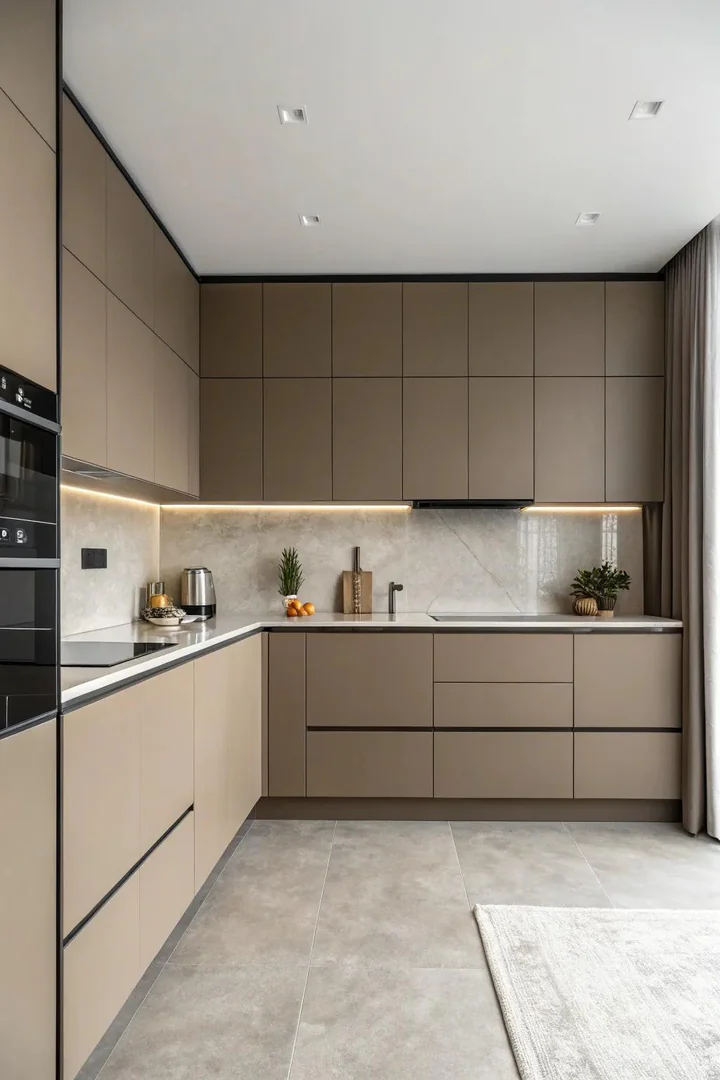
Flat slab-front doors in dark beige strip away the frame-and-panel detail of Shaker profiles for a clean, contemporary silhouette. IKEA Voxtorp (in a custom-sprayed dark beige over the stock surface) or custom slab doors from Semihandmade fit standard IKEA and custom face-frame boxes. Slab doors cost less per unit than Shaker because the manufacturing skips cope-and-stick joinery, saving $15 to $30 per door at most cabinet shops.
Edge pulls or integrated J-pulls along the top edge of each door eliminate protruding hardware and keep the surface unbroken. Hafele Profile Handle in matte gold or matte black installs behind the door edge, invisible from the front. A handleless kitchen in dark beige reads as warm Scandinavian modern, especially when paired with white oak flooring, a white quartz waterfall island, and matte-finish appliance panels. Browse more kitchen design guides at The Designers Company for product sources, paint picks, and layout advice across every style.
12. Matte Black Knobs and T-Bar Pulls on Dark Beige Doors
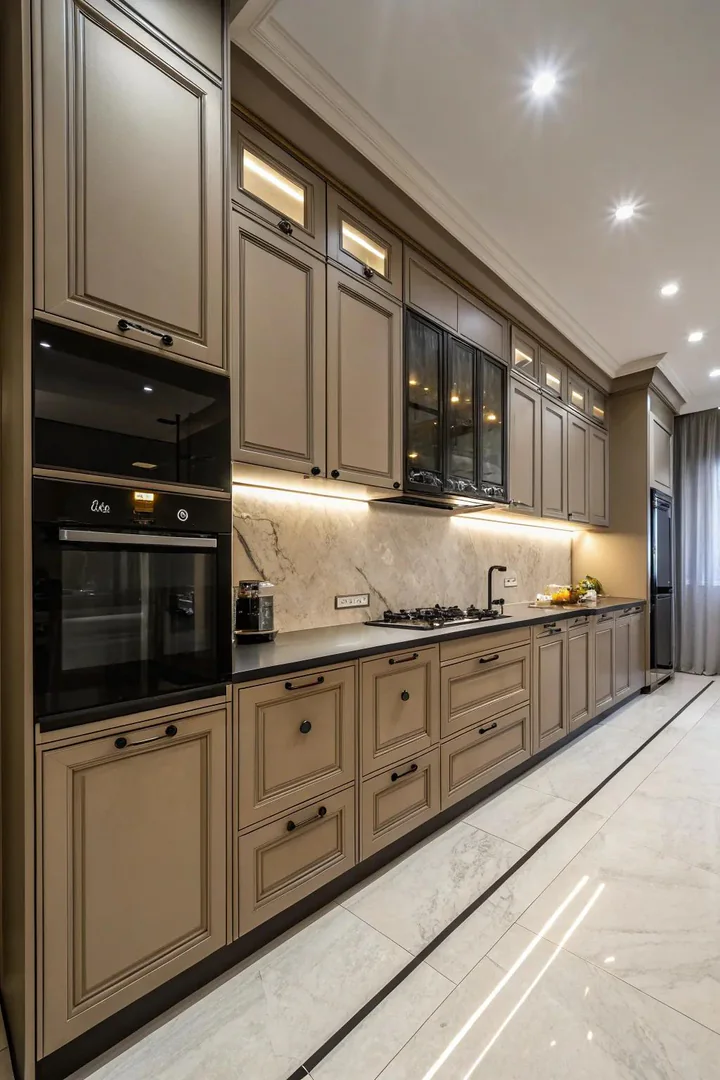
Matte black round knobs from Cosmas 5305FB ($3 each) and matching T-bar pulls from Goldenwarm ($5 each) deliver high contrast against dark beige at the lowest hardware price point. Black hardware sharpens the cabinet face by creating defined points of visual weight on every door and drawer. A knob-on-doors, pull-on-drawers split maintains consistency while varying the hardware shape by function.
Matte black resists fingerprints better than polished chrome or satin nickel because the flat finish diffuses light rather than reflecting it. Match the black hardware to the faucet and range hood trim for a coordinated metal layer, or mix black hardware with brass light fixtures for an intentional two-metal scheme. Dark beige and black work across farmhouse, transitional, industrial, and Scandinavian styles, making the pairing one of the safest choices for homeowners who may change decorative accessories over time without repainting cabinets.
13. Floor-to-Ceiling Dark Beige Pantry Cabinets with Symmetrical Flanking
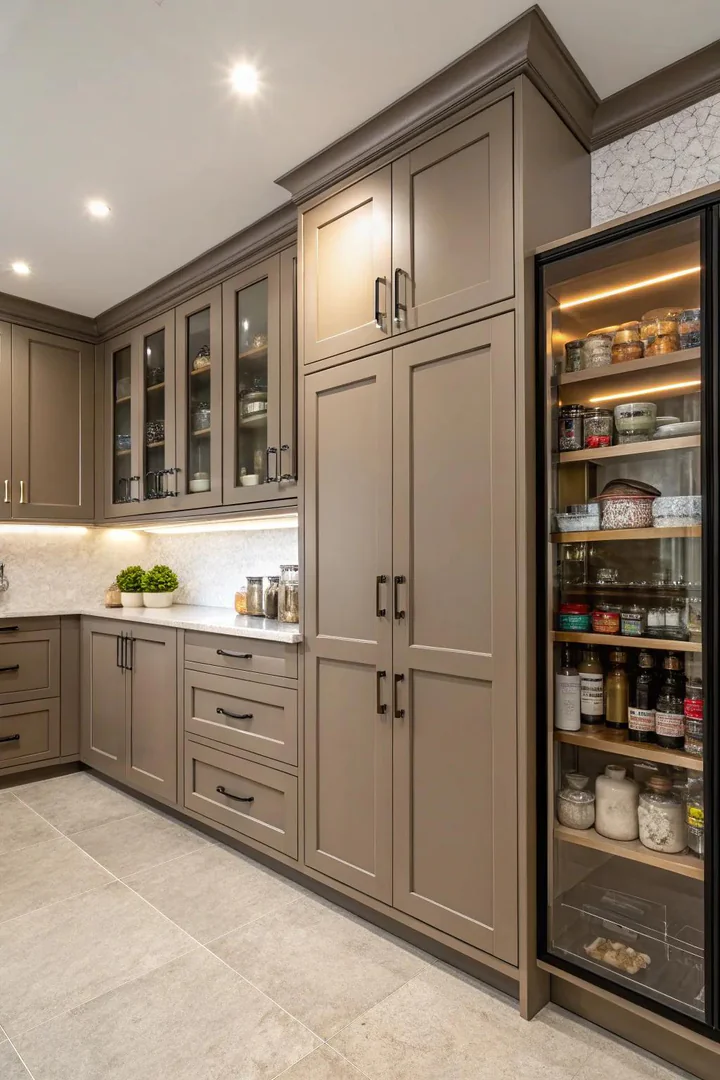
Tall 96-inch pantry cabinets in dark beige flanking a centered range or refrigerator create a formal, balanced composition that anchors the main wall. Pull-out pantry shelves from Rev-A-Shelf inside each tall box maximize the 24-inch-deep interior by bringing canned goods, dry staples, and small appliances to the front. Full-extension, soft-close drawer slides rated for 100 pounds keep heavy loads moving smoothly.
Crown molding in the same dark beige closes the gap between the cabinet top and the ceiling, giving the run a built-in furniture look. Symmetrical pantry stacks read as intentional architecture rather than added cabinetry, raising the perceived quality of the kitchen at appraisal. Pair with a warm LED strip inside each pantry box (activated by a door-contact switch) so the homeowner can see every shelf without a flashlight. Discover more yellow, grey, and white kitchen ideas for alternative warm-neutral cabinet palettes that share the same grounding effect.
14. Blue-Gray Island Paired with Dark Beige Perimeter Cabinets
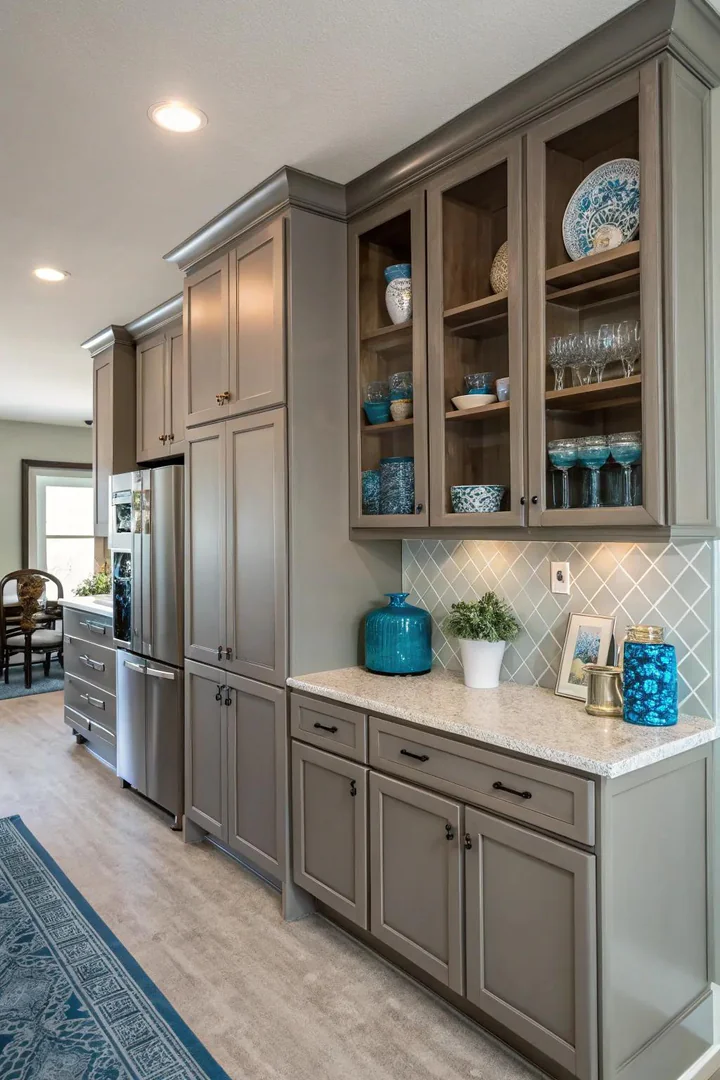
Painting the island in Benjamin Moore Boothbay Gray (HC-165) or Sherwin-Williams Uncertain Gray (SW 6234) while keeping perimeter cabinets in dark beige introduces a cool accent that prevents the kitchen from reading as all-warm. Blue-gray sits opposite beige on the color temperature scale, so the two colors create a balanced tension that neither one achieves alone. The island becomes a distinct zone, and the perimeter stays warm and enveloping.
A white marble or quartz countertop on both the island and perimeter ties the two cabinet colors together through a shared horizontal surface. Blue-gray islands pair well with matte brass or aged bronze hardware, bridging the warm beige and cool gray without committing fully to either temperature. A two-color kitchen photographs well from every angle, which helps at resale when listing photos drive buyer interest.
15. Warm LED Under-Cabinet and In-Cabinet Lighting for Dark Beige Kitchens
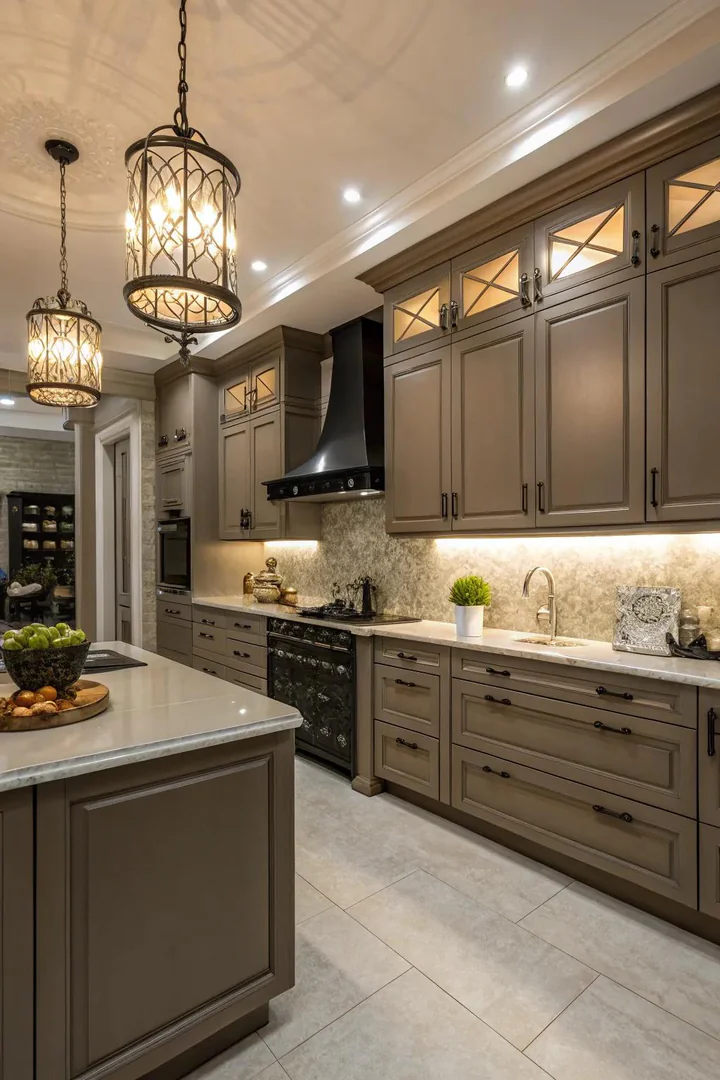
Warm-white LED strip lighting (2700K) mounted under upper cabinets washes the countertop and backsplash with a glow that amplifies the warm undertone of dark beige paint. WAC Lighting InvisiLED or HitLights UL-listed LED strip in a silicone channel sits flush against the cabinet bottom and hides behind a 1/2-inch trim strip so the light source stays invisible from standing height.
In-cabinet LED puck lights inside glass-front uppers turn displayed dishes and glassware into a decorative feature. A dimmer switch or smart controller (Lutron Caseta) lets the homeowner dial the under-cabinet light from full brightness during meal prep to a low nightlight glow during evening hours. Warm 2700K LEDs suit dark beige better than cool 4000K or 5000K strips, which shift the beige toward gray and wash out the paint’s golden base.
16. Dark Beige Cabinets with Calacatta Marble and Brass Faucet
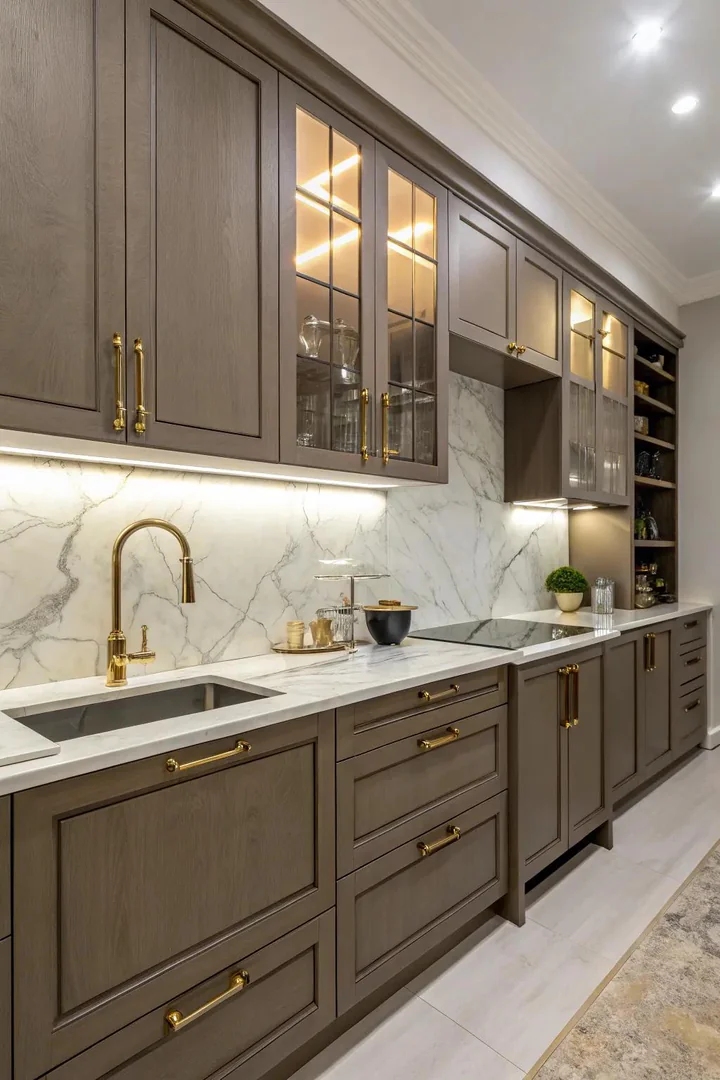
Pairing a Calacatta Gold marble countertop with a Kohler Purist bridge faucet in Moderne Brushed Gold above dark beige cabinets creates a three-material story: stone, metal, and paint. The marble’s gold veining connects to the faucet finish, while the warm white base connects to the backsplash. Brass soap dispensers, cabinet pulls, and a pot-filler faucet in the same brushed-gold finish complete the metallic layer.
Marble with gold veining reads warmer than marble with gray-only veining (Carrara, Statuario), making it a closer tonal match for dark beige cabinets. A 4-inch marble backsplash behind the sink continues the countertop material upward without committing to a full-height slab. Dark beige, marble, and brass together produce a kitchen that looks edited and intentional, landing in the transitional-to-traditional zone that real estate agents describe as “timeless.” Homeowners shopping for housewarming gift ideas for the kitchen often choose brass utensil holders and marble pastry boards that fit right into a palette like this one.
17. Putty-Shade Dark Beige Cabinets in an Open-Plan Kitchen
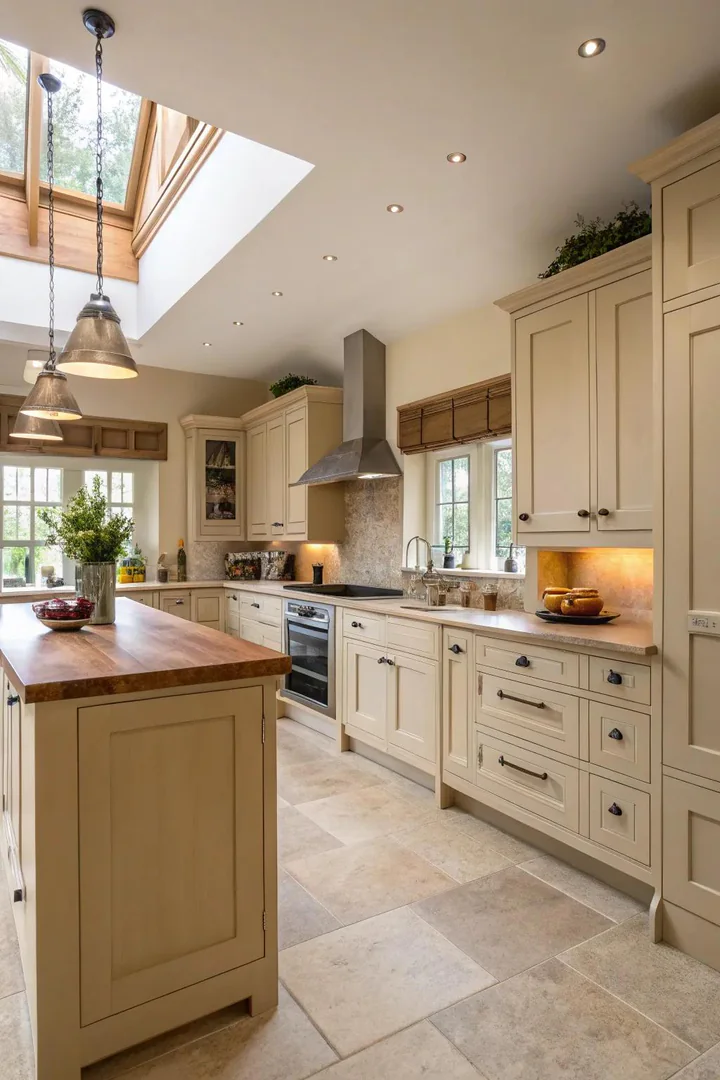
A putty shade like Farrow & Ball Jitney (No. 293) or Benjamin Moore Lenox Tan (HC-44) sits at the darker, earthier end of the beige spectrum and reads as a soft clay. In an open-plan kitchen that flows into a living room, putty beige bridges the two zones because the color works equally well as a cabinet finish and a living-room accent wall. The single color thread connects cooking and living without a hard visual break at the transition point.
Open-plan kitchens benefit from muted cabinet tones because the cabinetry is visible from seating areas 15 to 20 feet away. Bold or saturated cabinet colors dominate the living room sightline, while putty beige recedes into the background and lets furniture, art, and textiles carry the personality. Pair putty cabinets with wide-plank white oak floors in a natural matte finish for a warm, low-contrast foundation that supports any decorating direction the homeowner chooses later.
18. Warm Minimalist Dark Beige Kitchen with Concealed Appliances
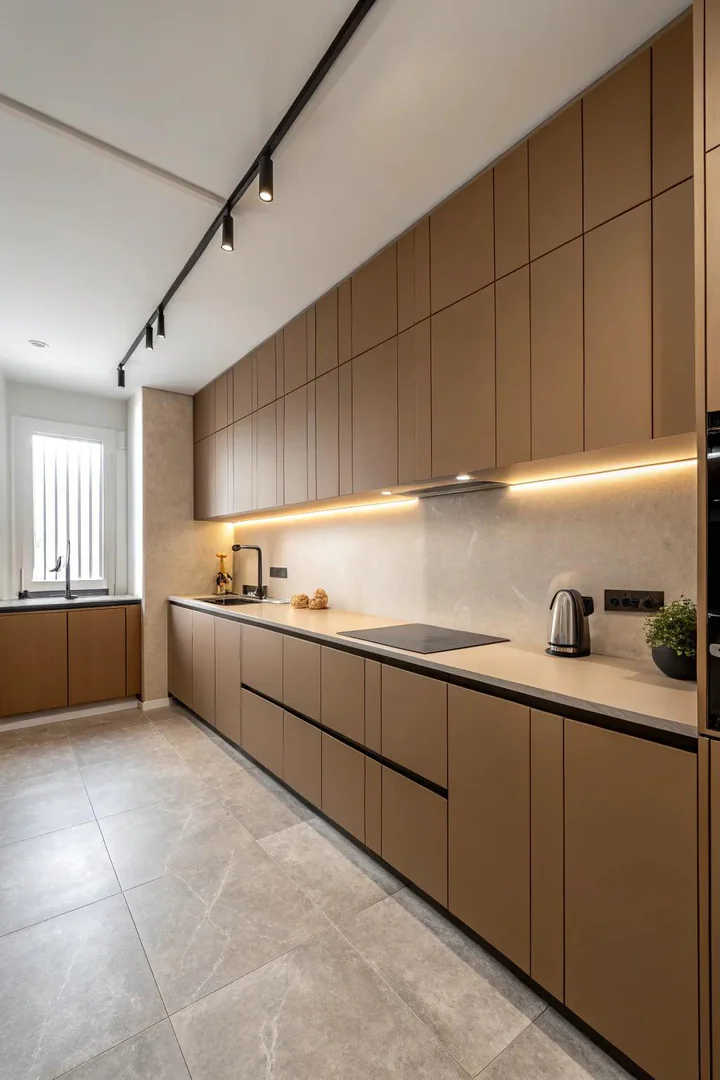
Integrating the refrigerator, dishwasher, and microwave behind dark beige panel-ready fronts creates a kitchen where every visible surface reads as cabinetry. Panel-ready models from Bosch 800 Series, Fisher & Paykel, and Miele accept custom door panels that match the surrounding cabinet depth and color. The result is a continuous wall of dark beige with no stainless-steel interruptions.
Touch-latch or push-to-open mechanisms replace visible handles on the appliance panels, reinforcing the handleless minimalist aesthetic. A single material palette (dark beige paint, white quartz, brushed brass) keeps the visual noise low. Warm minimalism differs from cold minimalism in material choice: matte paint instead of high-gloss lacquer, brushed metal instead of polished chrome, and natural wood accents instead of acrylic. The approach produces a kitchen that feels calm and lived-in rather than sterile.
19. Dark Beige Cabinets Coordinated with Greige Wall Paint
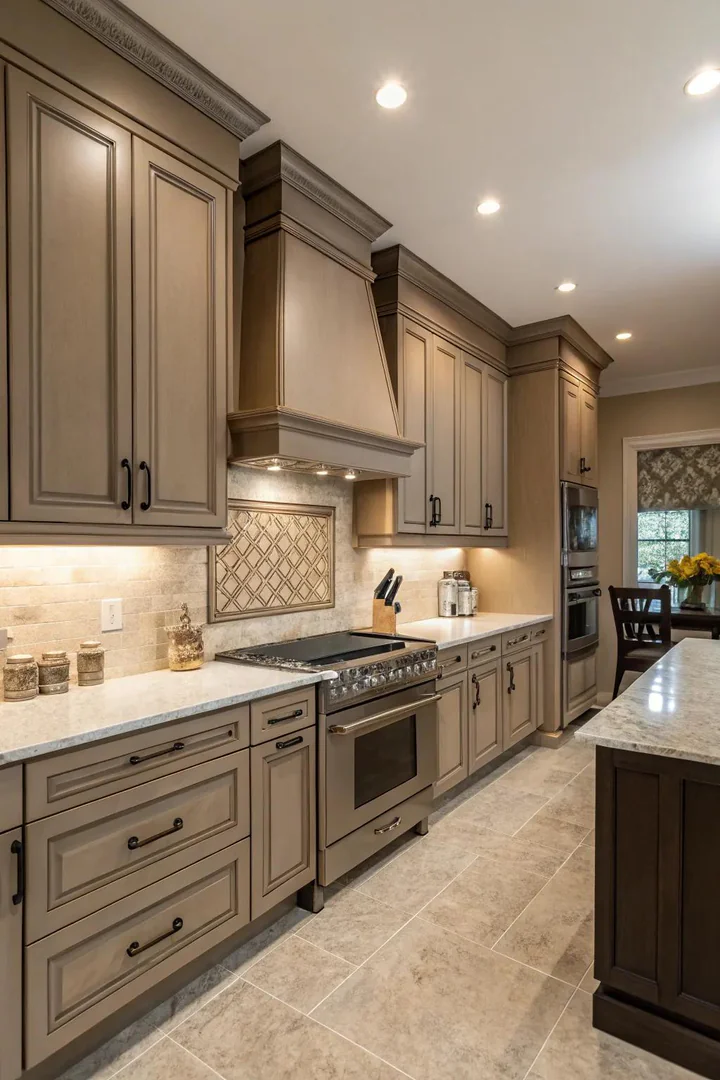
Painting the kitchen walls in a greige (gray-beige hybrid) one or two shades lighter than the cabinets wraps the room in a tonal envelope that feels cohesive without going monochrome. Benjamin Moore Edgecomb Gray (HC-173) on the walls beside Alexandria Beige (HC-77) cabinets reads as the same color family at different depths. The lighter wall recedes, making the cabinet face the focal surface.
Greige walls work in kitchens with limited natural light because the warm undertone prevents the gray from reading cold or institutional. White ceiling paint in Benjamin Moore Chantilly Lace (OC-65) provides a clean overhead plane that brightens the room without competing with the warm walls and cabinets. A greige-and-beige scheme creates a flexible backdrop for colorful art, patterned textiles, and seasonal decorating changes that pop against the neutral base.
20. Statement Brass Chandelier Above a Dark Beige Island
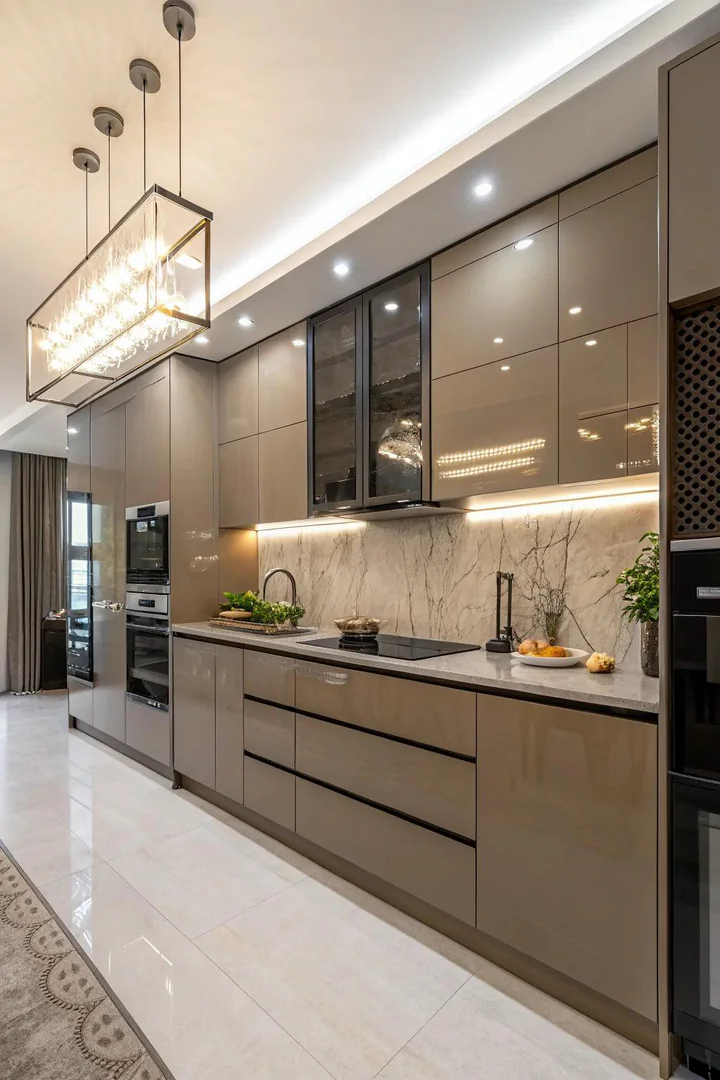
A multi-arm brass chandelier from Visual Comfort Ian K. Fowler Calvados or Arteriors Haskell hung 30 to 34 inches above a dark beige island counter introduces a decorative focal point that bridges the hardware and the ceiling plane. Chandeliers with exposed bulbs or small glass globes distribute light across a wider area than single-shade pendants, covering a 6- to 8-foot island without dark spots at the ends.
Brass chandeliers in aged or antique finishes carry a warmer, more textured tone than polished brass, matching the quiet warmth of dark beige cabinets. Pair the chandelier with matching brass cabinet pulls, a brass pot-filler, and brass-rimmed glass upper-cabinet inserts for a layered metallic story that runs from counter to ceiling. A statement light fixture justifies its cost because the eye travels upward in a kitchen, and the fixture is the first thing guests notice when entering the room.
21. Full-Slab Quartzite Backsplash with Dark Beige Perimeter Cabinets
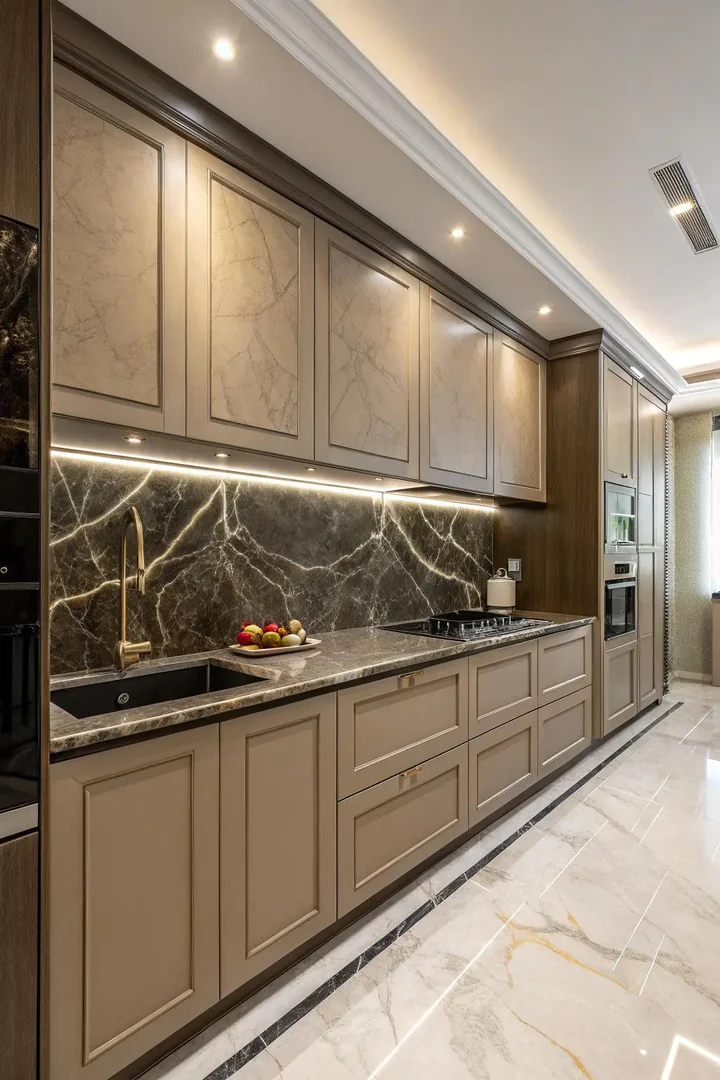
A full-height Taj Mahal quartzite slab running from counter to upper cabinets behind the range creates a golden-veined stone surface that mirrors the warm undertone of the dark beige paint. Quartzite is a natural metamorphic stone harder than marble (7 on the Mohs scale vs. marble’s 3), resisting scratches and etching that marble would absorb. A polished finish bounces light, while a honed or leathered finish adds texture and reduces glare.
Quartzite slabs cost $70 to $150 per square foot installed, depending on the variety. Perla Venata quartzite offers softer veining for a quieter look, while Cristallo quartzite delivers a dramatic, high-contrast pattern. Dark beige cabinets frame the stone slab like a gallery border, letting the geological pattern command the wall. A matching quartzite countertop in the same stone wraps the cooking zone in a continuous surface from counter to ceiling. Homeowners setting up a dining area alongside a kitchen like this can browse our guide to kitchen utensil holder ideas for countertop organization that keeps cooking tools within reach of the range.
How to Paint Kitchen Cabinets in a Dark Beige Finish
1. Remove Doors, Drawers, and Hardware
Label every door and drawer with a numbered piece of painter’s tape so each piece returns to its original opening after painting. Remove hinges, pulls, and knobs and store them in labeled zip-top bags. Cleaning and painting with the doors flat on sawhorses produces a smoother finish than spraying doors in place, where gravity causes drips and paint sags on vertical surfaces.
2. Clean and Sand Every Surface
Wipe all cabinet boxes, doors, and drawer fronts with Krud Kutter or a TSP substitute to remove cooking grease, food residue, and fingerprints that prevent paint adhesion. Sand every surface with 120-grit sandpaper or a sanding sponge to roughen the existing finish, then vacuum dust and wipe with a tack cloth. Skipping the degreasing step is the number-one cause of paint peeling within the first year on kitchen cabinets.
3. Apply a Bonding Primer Coat
Roll and brush one coat of Zinsser BIN Shellac-Based Primer or KILZ Adhesion Primer over every surface. Shellac-based primers block bleed-through from wood tannins and adhere to glossy factory finishes, melamine, and thermofoil without sanding to bare wood. Allow the primer to dry for 45 to 60 minutes (shellac) or 2 hours (latex adhesion primer) before light sanding with 220-grit to smooth any grain raise or roller texture.
4. Apply Two Coats of Dark Beige Cabinet Paint
Use Benjamin Moore Advance (alkyd-hybrid, self-leveling, low-VOC) or Sherwin-Williams Emerald Urethane Trim Enamel in the chosen dark beige color. Apply the first coat with a 4-inch Purdy White Dove roller on flat surfaces and a 2-inch angled Purdy brush on panel edges and inside corners. Allow 16 to 24 hours of cure time between coats for Advance, or 4 hours for Emerald. A second coat builds opacity, durability, and an even sheen.
5. Reinstall Doors and Hardware After Full Cure
Wait a minimum of 3 days (Advance) or 7 days (Emerald Urethane) before reinstalling doors and hardware, even though the paint feels dry to the touch within hours. Full chemical cure hardens the paint film to its rated durability, and closing doors against frames before cure creates permanent impressions and sticking. Place small felt bumper pads on every door and drawer corner to cushion contact and prevent paint-to-paint adhesion at hinge points.
Dark Beige Cabinet Paint Comparison
| Paint Color | Brand | Undertone | LRV | Best Countertop Pairing | Best Hardware Finish |
|---|---|---|---|---|---|
| Alexandria Beige (HC-77) | Benjamin Moore | Warm golden | 43 | White marble, white quartz | Brushed brass, antique gold |
| Latte (SW 6108) | Sherwin-Williams | Warm amber | 37 | Honed soapstone, dark walnut | Oil-rubbed bronze, matte black |
| Jitney (No. 293) | Farrow & Ball | Earthy clay | 44 | Limestone, light concrete | Unlacquered brass, aged bronze |
| Lenox Tan (HC-44) | Benjamin Moore | Warm putty | 38 | Butcher block, warm quartz | Satin brass, warm pewter |
| Accessible Beige (SW 7036) | Sherwin-Williams | Greige (warm neutral) | 46 | Gray quartz, Carrara marble | Polished nickel, brushed gold |
| London Fog (1541) | Benjamin Moore | Cool beige, slight gray | 40 | White quartz, Taj Mahal quartzite | Matte black, satin nickel |
| Shiitake (SW 9173) | Sherwin-Williams | Mushroom, earthy | 32 | Honed marble, concrete | Aged brass, matte black |
Frequently Asked Questions
What paint sheen works best on dark beige kitchen cabinets?
Satin and semi-gloss finishes work best because both reflect enough light to look polished while hiding minor brush marks and roller texture. Satin (25% to 35% sheen) reads slightly softer and suits farmhouse and transitional kitchens. Semi-gloss (35% to 50% sheen) wipes clean more easily and resists grease buildup around the stove zone. Matte and eggshell finishes show every fingerprint and scuff mark on a cabinet surface that gets daily hand contact, so avoid both for kitchen cabinetry.
Does dark beige make a small kitchen look smaller?
Dark beige absorbs less light than espresso, charcoal, or navy, so the effect on perceived room size is mild. A small kitchen with one window can handle dark beige on the lower cabinets if the upper cabinets stay white or cream, the countertop is light-colored, and warm under-cabinet lighting washes the backsplash. A fully dark beige floor-to-ceiling kitchen in a room under 80 square feet may feel heavy, so breaking the color with open shelving or glass-front uppers prevents the walls from closing in.
What wall colors coordinate with dark beige kitchen cabinets?
Greige tones one to two shades lighter than the cabinet color (like Benjamin Moore Edgecomb Gray or Sherwin-Williams Agreeable Gray) create a tonal envelope that feels warm and cohesive. White walls in a warm white (White Dove, Alabaster) brighten the room and let the cabinets stand as the color statement. Avoid cool blues, stark bright whites, or gray-greens as wall colors because they clash with the warm amber or clay undertone in dark beige paint.
Can dark beige cabinets work with stainless steel appliances?
Stainless steel sits in the cool-neutral zone, and dark beige sits in the warm-neutral zone. The temperature contrast works well when the rest of the room reinforces warmth: brass hardware, warm pendant lights, walnut accents, and a white-veined marble countertop. Avoid a fully cool palette (chrome hardware, gray backsplash, concrete counter) around stainless appliances with dark beige cabinets, because the beige reads out of place when every other surface runs cool.
How long does a professional dark beige cabinet paint job last?
A professional cabinet paint job using alkyd-hybrid (Benjamin Moore Advance) or waterborne urethane (Sherwin-Williams Emerald) paint over a bonding primer lasts 8 to 12 years before the finish shows wear in high-traffic zones: drawer faces near the stove, lower cabinet doors near the dishwasher, and pantry pull-outs. Touch-up kits from the same paint batch (stored in a sealed glass jar) handle nicks and scratches in between full repaints.
What is the difference between beige and dark beige in cabinet paint?
Standard beige paints carry a Light Reflectance Value (LRV) of 55 to 70 and read as warm off-whites or sandy creams. Dark beige paints sit at LRV 30 to 45, pulling deeper into the amber, clay, putty, or mushroom range. The darker LRV means the paint absorbs more light and reads as a definite color rather than a variation of white. Dark beige cabinets ground a room the way medium-gray or sage-green cabinets do, while standard beige acts more like a warm neutral backdrop.
Should upper and lower cabinets both be dark beige, or just one zone?
Full dark beige on both upper and lower cabinets works in kitchens with 9-foot or taller ceilings and at least one large window. A two-tone split (dark beige lowers, white or cream uppers) suits standard 8-foot-ceiling kitchens because the lighter upper zone prevents the room from feeling low and enclosed. An island-only dark beige approach introduces the color as an accent without committing the full perimeter, and repainting a single island costs a fraction of a full kitchen job.