
Marble Floor Kitchen Ideas: 23 Stunning Designs to Transform
Marble floor kitchen ideas cover tile sizes from 2-by-2-inch mosaics to 24-by-48-inch large-format slabs, colors from Carrara white to Nero Marquina black, and finishes from polished mirror-shine to honed matte and tumbled antique. Marble flooring in a kitchen costs $10 to $50 per square foot for the tile and $8 to $15 per square foot for professional installation (including subfloor preparation, thinset, grout, and sealer), totaling $18 to $65 per square foot installed for a 150-square-foot kitchen floor ($2,700 to $9,750 total). Below are 23 marble floor styles with specific tile names, costs, and design pairings, followed by a how-to sealing guide, a comparison table, and FAQs on maintenance, slip resistance, and durability.
1. Classic White Carrara Marble
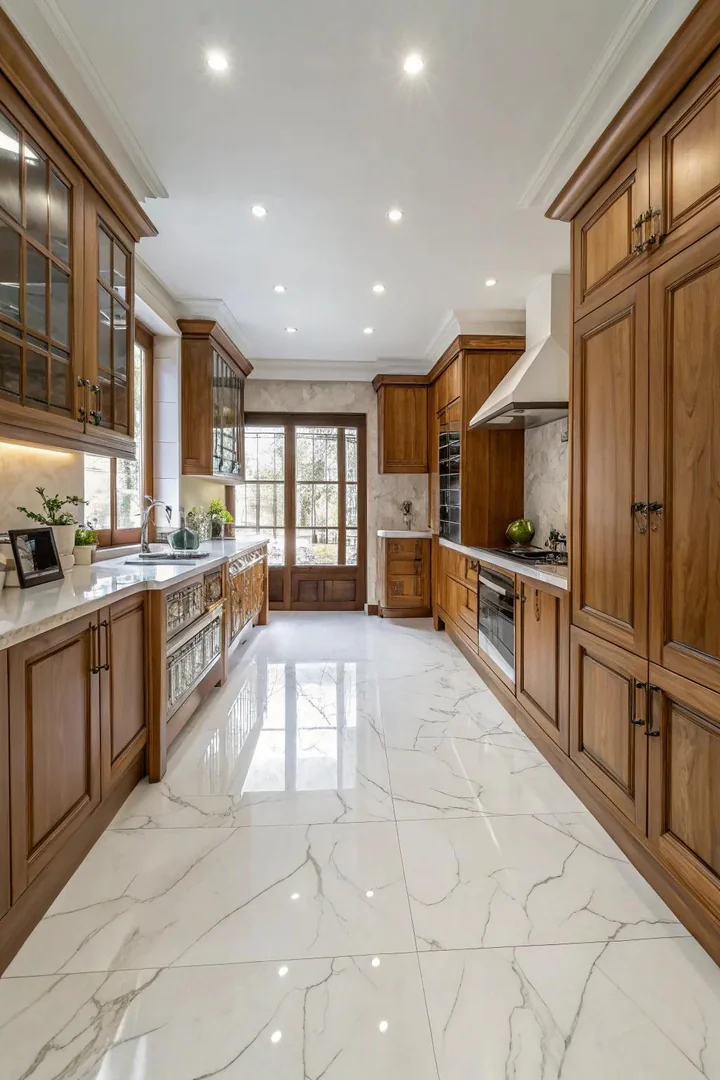
Carrara marble (quarried in Carrara, Tuscany, Italy) produces a white-to-light-gray base with subtle gray veining and costs $10 to $30 per square foot for 12-by-12-inch or 12-by-24-inch honed tiles from suppliers like Daltile, MSI, or Tile Bar. Carrara’s soft, uniform veining creates a calm, cohesive floor pattern that works as a neutral background for colorful cabinets, bold backsplashes, and statement lighting.
Honed (matte) Carrara marble provides better slip resistance than polished Carrara in a kitchen where water splashes and cooking spills occur regularly. Sealing Carrara marble every 6 to 12 months with a penetrating sealer (Tenax Proseal, $30 per quart, or StoneTech BulletProof, $40 per quart) protects the porous surface from oil, wine, and tomato-sauce stains. Carrara marble suits traditional, transitional, Scandinavian, and modern farmhouse kitchens where a light, airy floor anchors the room.
2. Bold Black Marble
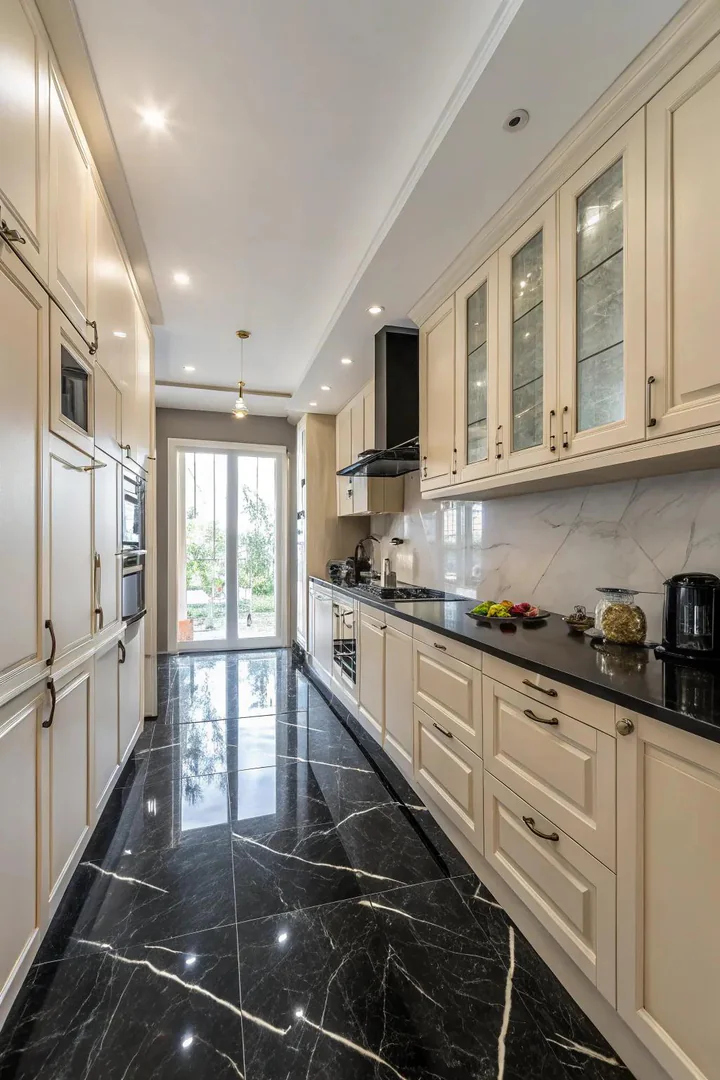
Nero Marquina marble (quarried in Spain) produces a jet-black base with bright white veining and costs $15 to $40 per square foot. Black Marquina 12-by-24-inch polished tiles from MSI ($18 per square foot) or Daltile Marble Collection ($22 per square foot) create a dramatic, high-contrast floor that anchors white or light-colored cabinets above. Black marble floors require consistent cleaning because dust, water spots, and footprints show more readily on dark polished surfaces than on lighter stones.
A black marble floor paired with white cabinets and brass hardware produces a tuxedo palette (black-and-white with warm gold accents) that reads as formal and gallery-like. A black marble floor paired with dark cabinets (charcoal, navy, forest green) creates a moody, enveloping space that suits evening entertaining and dramatic kitchen designs. Polish the black marble to a high gloss for maximum light reflection and drama, or hone the surface for a matte, understated black that absorbs rather than reflects overhead lighting.
3. Gray Marble for Modern Minimalism
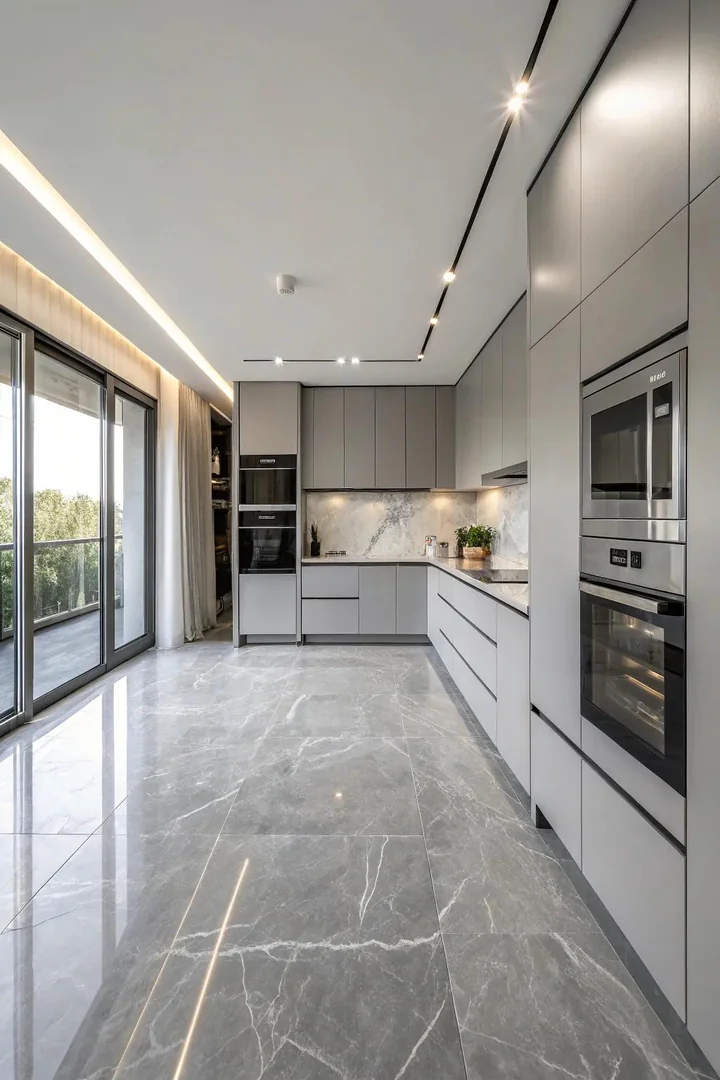
Bardiglio Gray marble (from Carrara, Italy) produces a medium-gray base with darker gray veining and costs $12 to $35 per square foot. Gray marble functions as a neutral floor color that splits the difference between white Carrara’s brightness and black Nero Marquina’s darkness. Gray marble coordinates with virtually any cabinet color (white, navy, green, charcoal, natural wood) because gray is the most versatile neutral in interior design.
Large-format gray marble tiles (18-by-18-inch or 24-by-24-inch) reduce grout lines and produce a more continuous, slab-like appearance than smaller 12-by-12-inch tiles. Fewer grout lines also mean less grout maintenance and less opportunity for grout staining and mildew in the kitchen’s high-moisture environment. Gray marble in a honed finish paired with flat-panel white cabinets and stainless-steel appliances creates a modern, gallery-quality kitchen with a subdued material palette.
4. Patterned Polished Marble
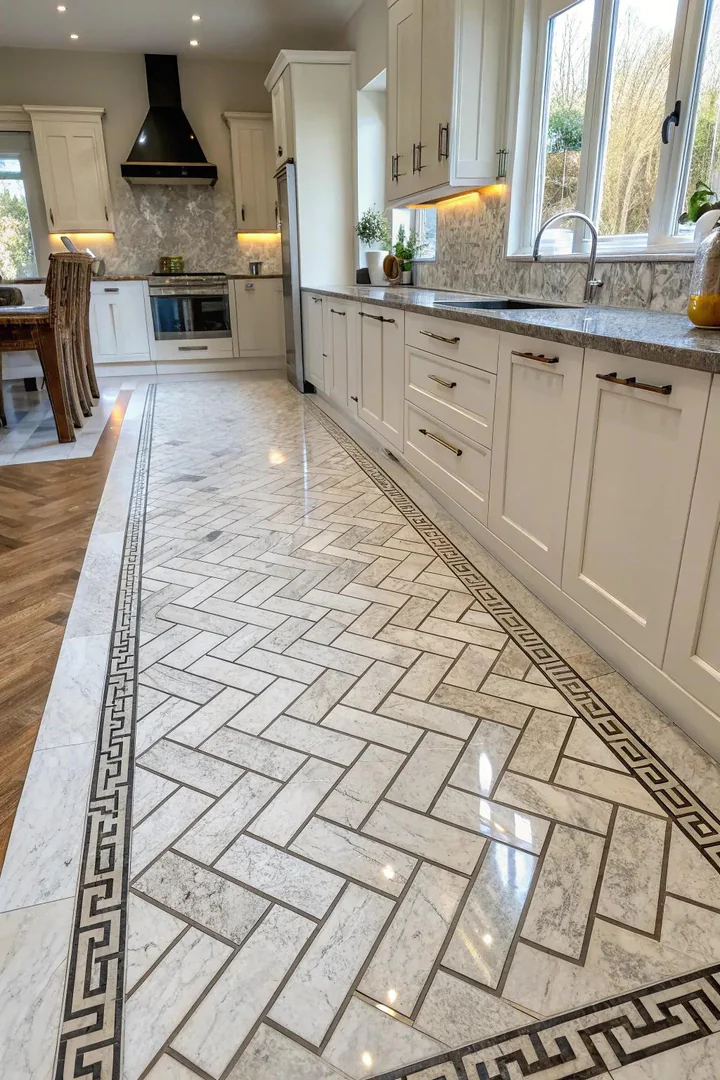
A patterned marble floor combines two or more marble colors cut into geometric shapes (checkerboard, herringbone, basketweave, pinwheel, or custom inlay) to produce a decorative floor surface. A classic black-and-white checkerboard pattern using 12-by-12-inch Carrara White and Nero Marquina tiles ($15 to $30 per square foot for both colors) creates a timeless pattern that references European palaces, Parisian bistros, and Art Deco apartment buildings.
Patterned marble floors cost 20% to 40% more in labor than a single-color installation because the installer must cut, fit, and align multiple tile shapes and maintain the pattern across the entire floor. A herringbone pattern with 3-by-12-inch marble planks produces a zigzag direction that makes a narrow kitchen appear wider when the pattern runs perpendicular to the long wall. A basketweave pattern alternates pairs of rectangular tiles in perpendicular orientation, creating a woven textile effect on the floor.
5. Picket Marble Mosaic
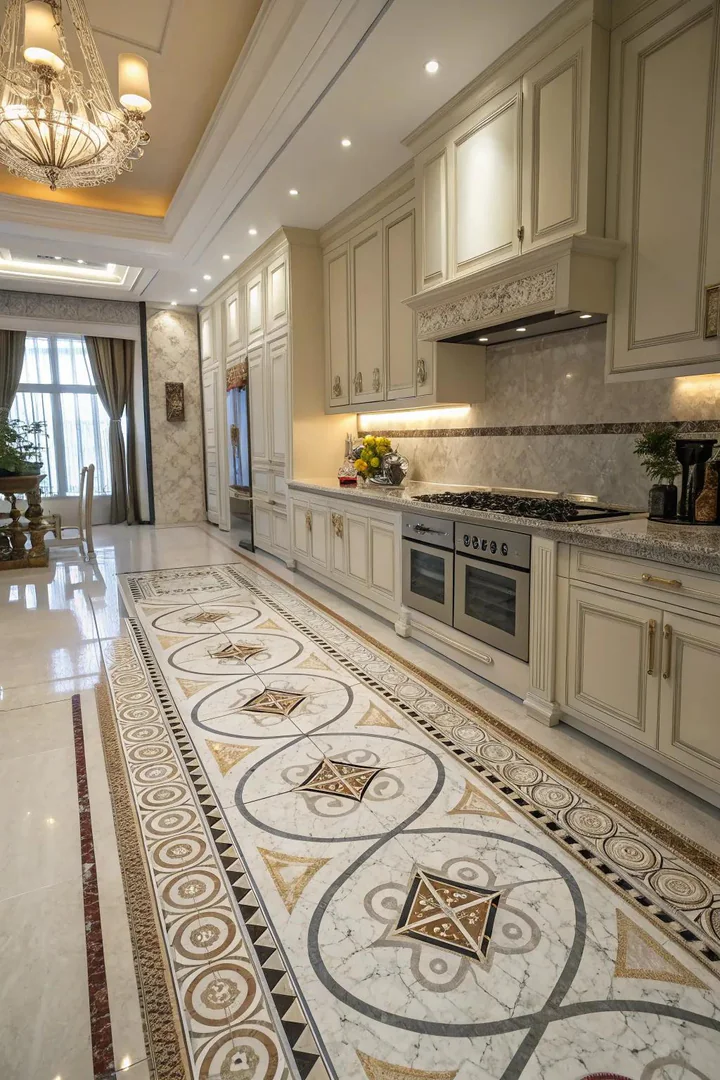
A picket mosaic (elongated hexagon or elongated diamond shapes, 2 to 4 inches long) on a mesh-backed sheet produces a small-scale geometric pattern with a high percentage of grout lines, creating a texture-rich floor surface. Carrara picket mosaic on mesh from Tile Bar ($15 to $25 per square foot) or Jeffrey Court ($12 to $20 per square foot) installs like a standard mosaic tile: spread thinset, press the mesh sheet into the adhesive, and grout.
Picket mosaics suit smaller kitchens and kitchen zones (a niche, a butler’s pantry, an entryway from the kitchen to the dining room) where the small-scale pattern adds visual interest without overwhelming the room. A single mesh-backed mosaic sheet covers approximately 1 square foot, meaning a 150-square-foot kitchen floor requires 150+ sheets. The high grout-to-tile ratio (20% to 30% grout surface) requires a grout sealer application after grouting to prevent staining in the grout lines.
6. Honed Marble with Rustic Patina
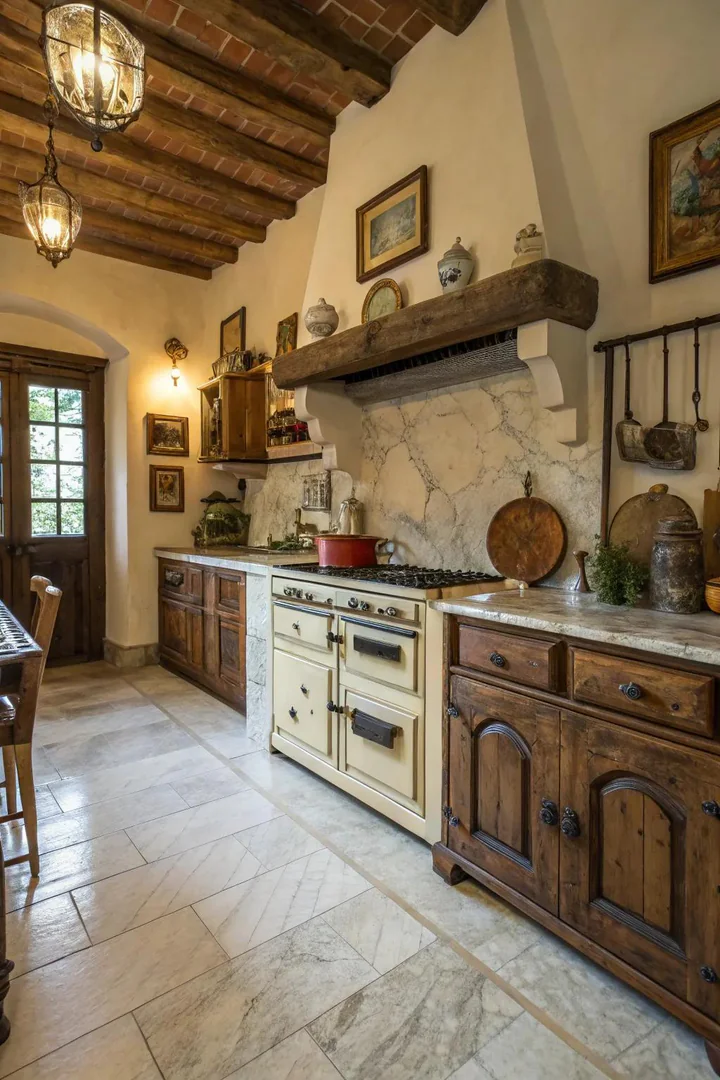
Tumbled marble tiles (edges softened and surfaces distressed in a rotating drum) produce an aged, antique appearance that suits farmhouse, Mediterranean, and Old World kitchen styles. Tumbled Botticino marble ($8 to $18 per square foot from MSI) in warm beige-cream and tumbled Noce travertine-style marble ($7 to $15 per square foot) deliver a naturally worn look straight from the factory. Tumbled tile edges are rounded and irregular, producing wider grout joints (1/4 to 3/8 inch) that reinforce the rustic aesthetic.
A tumbled marble floor’s matte, slightly textured surface provides better slip resistance than polished marble, making the finish practical for kitchens where water, oil, and food debris reach the floor regularly. The distressed surface also camouflages future wear, scratches, and etch marks better than polished marble because the tumbled texture already incorporates surface variation. Pair tumbled marble floors with exposed wood ceiling beams, wrought-iron light fixtures, and terra-cotta pottery for a Tuscan or French country kitchen atmosphere.
7. Warm-Toned Marble with Fluted Trim
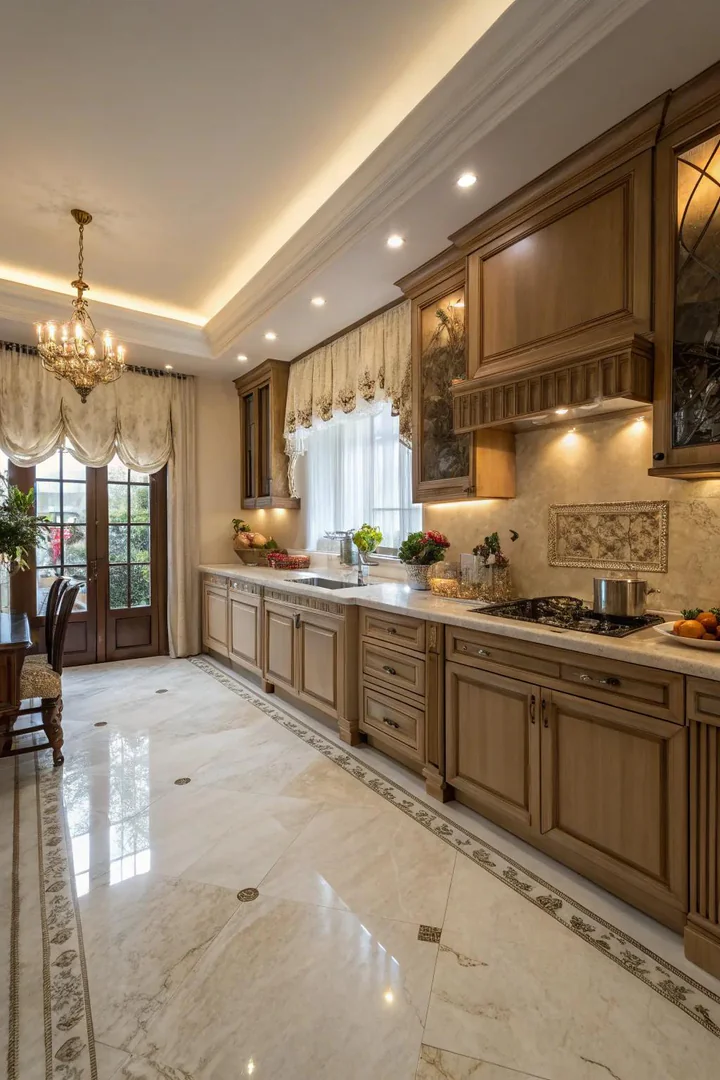
Warm-toned marbles like Crema Marfil ($10 to $25 per square foot, quarried in Spain), Botticino ($12 to $28 per square foot, quarried in Italy), and Honey Onyx ($30 to $60 per square foot) carry beige, cream, gold, and amber undertones that warm a kitchen’s palette from the ground up. A fluted marble trim (a pencil liner or chair-rail profile, $5 to $12 per linear foot) installed at the baseboard or as a transition strip between the marble floor and an adjacent room’s flooring adds a carved architectural detail.
Warm-toned marble floors coordinate naturally with warm cabinet colors (cream, butter yellow, sage green, terracotta) and warm metals (brass, gold, copper). A warm marble floor under cool-toned cabinets (white, gray, blue) creates a temperature contrast where the floor warms the room and the cabinets cool the upper half. A fluted trim profile adds a hand-carved, custom-millwork detail that flat-edged tiles cannot provide, elevating the floor’s perceived quality and craftsmanship.
8. Bosphorus Skyline Marble
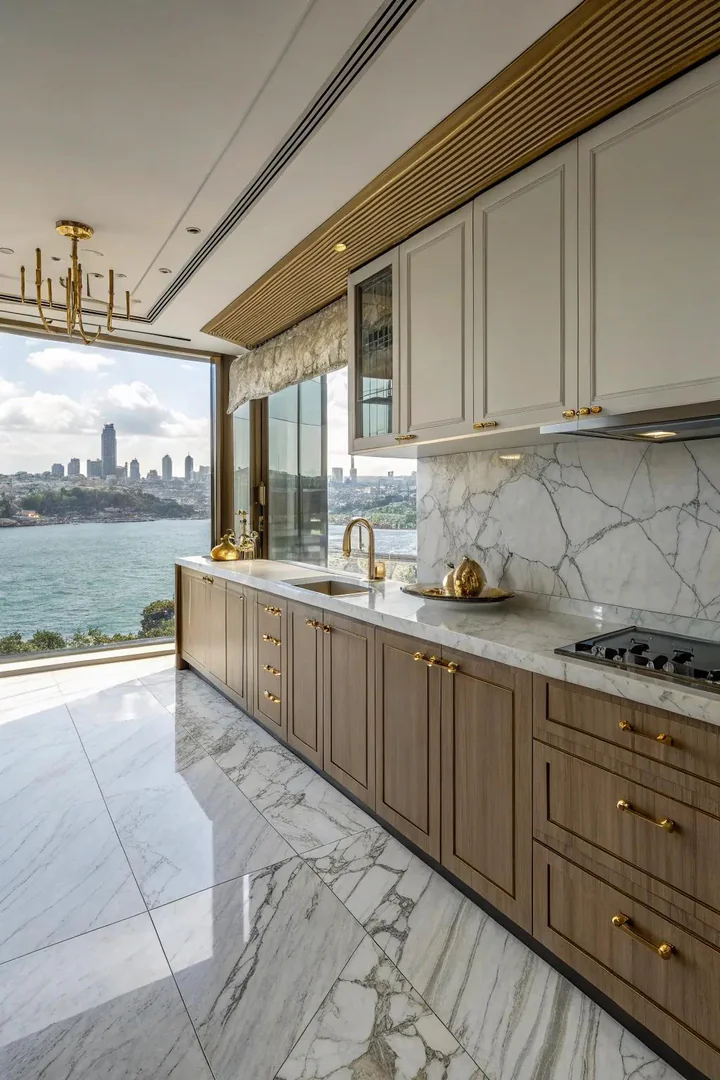
Bosphorus marble (quarried in Turkey) produces a dark gray-brown base with dramatic silver-white veining that sweeps across the surface like lightning or river tributaries. Bosphorus honed tiles ($15 to $35 per square foot from MSI or Daltile) deliver a dark, moody floor with high visual movement. The dramatic vein pattern means every tile carries a unique design, producing a one-of-a-kind floor composition that cannot be replicated.
Bosphorus marble’s dark base hides kitchen floor stains (cooking oil, coffee, wine) better than white or light-gray marbles because the dark surface absorbs minor discoloration into its natural color variation. Large-format tiles (18-by-18-inch or 24-by-24-inch) allow the dramatic vein patterns to display fully; small tiles (6-by-6-inch or 4-by-4-inch) fragment the veining and lose the sweeping geological pattern. Pair Bosphorus marble with warm wood cabinets, brass hardware, and cream countertops for a warm contrast against the dark floor.
9. Hexagonal Marble Tiles
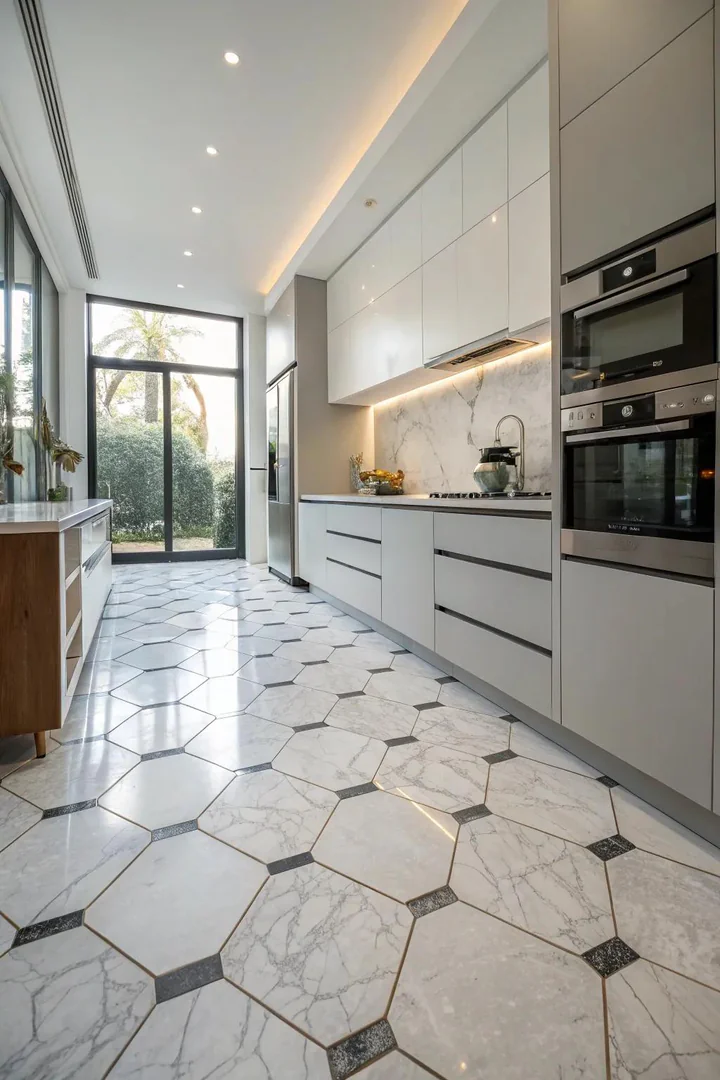
Hexagonal marble tiles in 4-inch, 6-inch, or 8-inch sizes from Daltile Marble Hex ($12 to $25 per square foot) or Tile Bar Carrara Hex ($14 to $22 per square foot) produce a honeycomb floor pattern that references Victorian-era bathrooms and vintage apothecaries. A single-color marble hex floor (all Carrara white or all Bardiglio gray) creates a subtle geometric texture. A two-color hex floor (alternating white and black hexagons) produces a bolder, more graphic pattern.
Hexagonal tiles require more cuts and fitting at the room’s edges than rectangular tiles because the tessellated hex pattern does not align cleanly with straight walls. Budget 10% to 15% extra tile for edge waste on a hex floor. Small hexagons (2 to 3 inches) on mesh-backed sheets install quickly but produce a very high grout-to-tile ratio. Large hexagons (8 to 10 inches) reduce grout lines and display more of each tile’s marble veining. A hex marble floor suits transitional, farmhouse, vintage-inspired, and eclectic kitchen styles. See more floor and counter pairings at kitchen remodel ideas.
10. Gold-Veined Marble
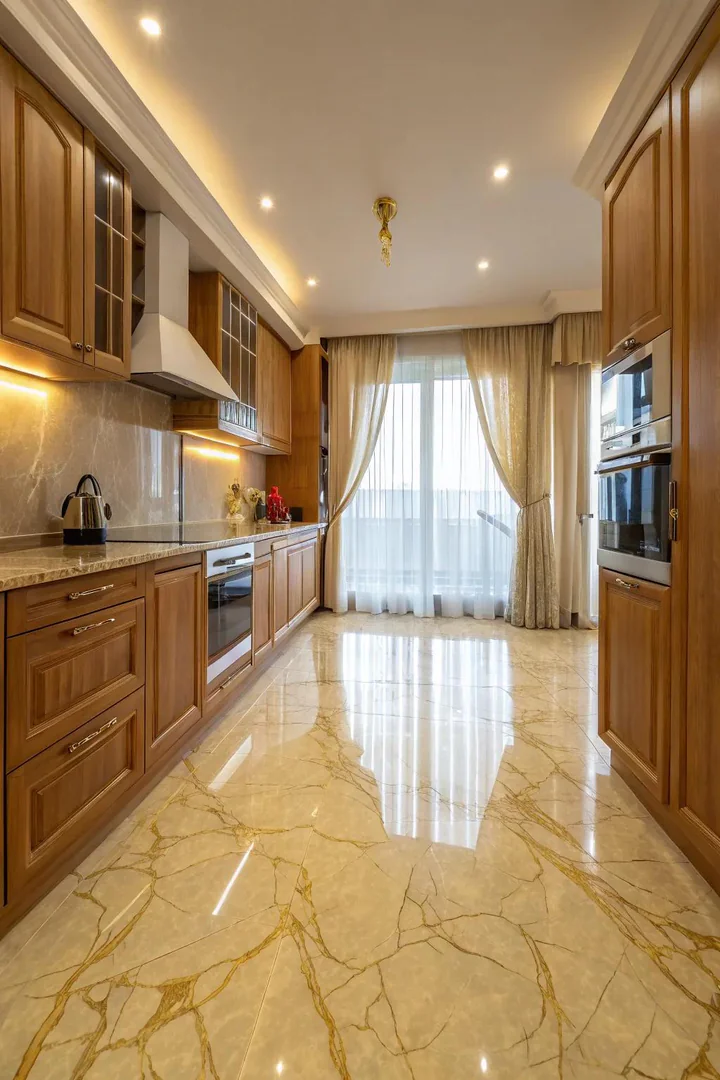
Calacatta Gold marble ($30 to $80 per square foot) carries warm gold-and-amber veining on a bright white base, producing a floor that glows with warm undertones under natural and artificial light. Golden Spider marble ($15 to $30 per square foot from MSI) delivers cream-and-gold veining on a warm white background at a lower price point. Gold-veined marble pairs naturally with brass and gold hardware because the metal and stone share the same warm-amber color family.
Gold-veined marble floors suit kitchens with a warm, luxurious palette: cream cabinets, brass pulls, warm wood shelving, and amber-toned pendant lighting. A gold-veined marble floor under a white kitchen with gold hardware creates a cohesive warm-metal-and-stone story from floor to cabinet face. Polished Calacatta Gold reflects overhead lighting and amplifies the gold veining’s warmth; honed Calacatta Gold softens the effect for a more understated warmth.
11. Calacatta Marble Statement Floor
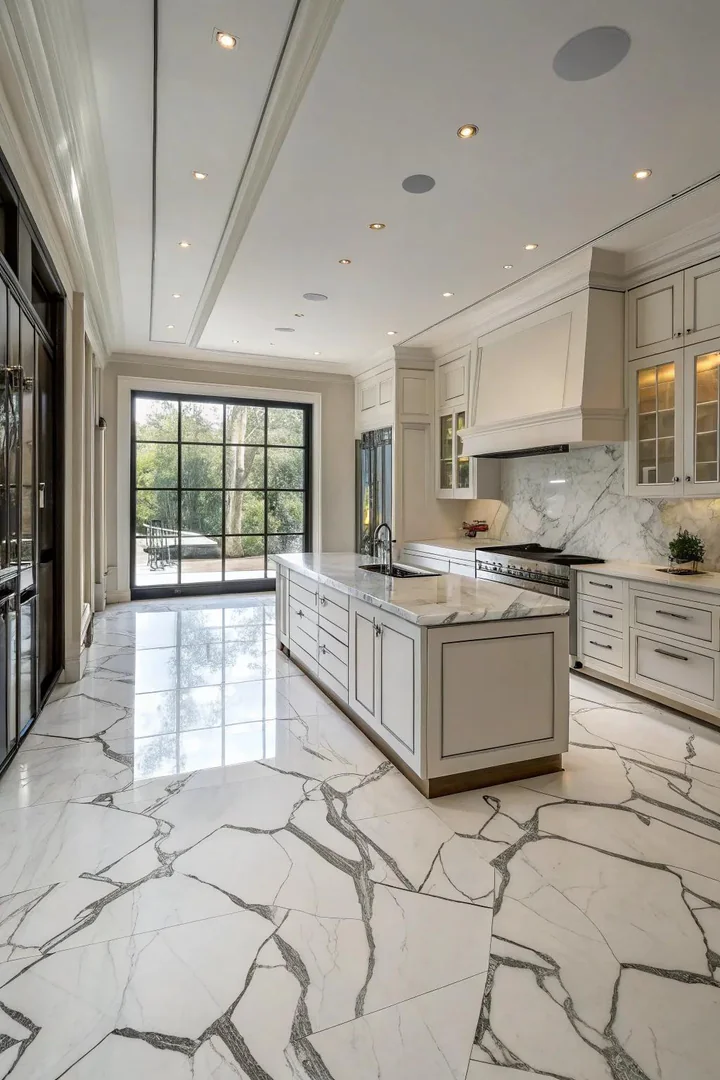
Calacatta marble (from Carrara, Italy) carries bolder, thicker, more dramatic gray-and-gold veining than Carrara marble, making Calacatta the higher-contrast, higher-impact choice for a statement floor. Calacatta costs $30 to $80 per square foot compared to Carrara’s $10 to $30, reflecting Calacatta’s relative rarity and dramatic vein character. A Calacatta floor paired with a matching Calacatta backsplash and countertop creates a floor-to-ceiling stone envelope that reads as a single continuous material.
Book-matching Calacatta tiles (mirroring adjacent tiles so the vein pattern reflects across the grout line) produces a symmetrical, butterfly-wing effect on the floor. Book-matching requires purchasing sequential tiles from the same slab and increases the fabrication cost because the installer must lay tiles in a specific order. A random layout (tiles placed without vein matching) costs less and produces a more natural, quarry-style appearance. Both approaches work; book-matching suits formal kitchens and random layouts suit casual kitchens.
12. Chevron Marble Layout
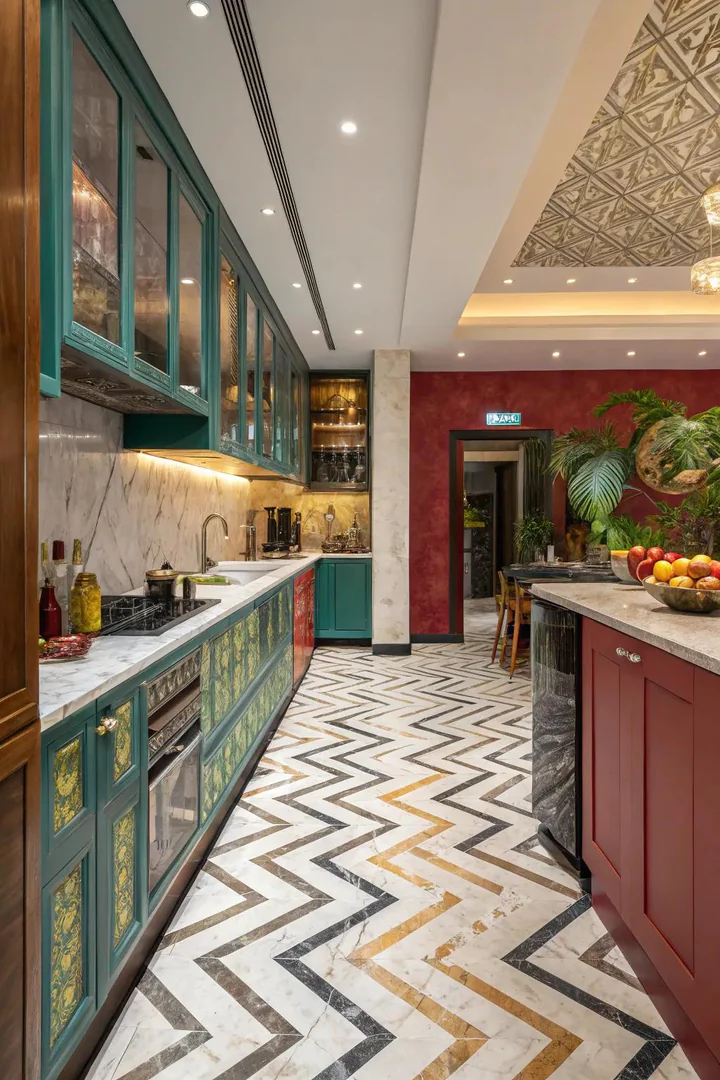
A chevron marble floor uses marble planks cut at 45-degree angles on both ends, producing a continuous zigzag pattern with each plank meeting the next at a sharp point. Carrara chevron tiles from Tile Bar ($18 to $30 per square foot) or MSI ($15 to $25 per square foot) on mesh-backed sheets simplify the installation by pre-arranging the angled planks. A chevron pattern adds directional movement to the floor, drawing the eye along the zigzag line toward the kitchen’s focal point (the range, the island, or the window).
Chevron differs from herringbone: chevron planks meet at a point (angled cuts on both ends), while herringbone planks meet at a 90-degree stagger (square-cut ends butting against the side of the adjacent plank). Chevron reads as more formal and contemporary than herringbone. Both patterns require more cuts and produce more waste than a straight-lay installation (budget 15% to 20% extra tile). A chevron marble floor suits modern, Art Deco, Parisian, and contemporary transitional kitchen styles.
13. Concrete-Look Marble
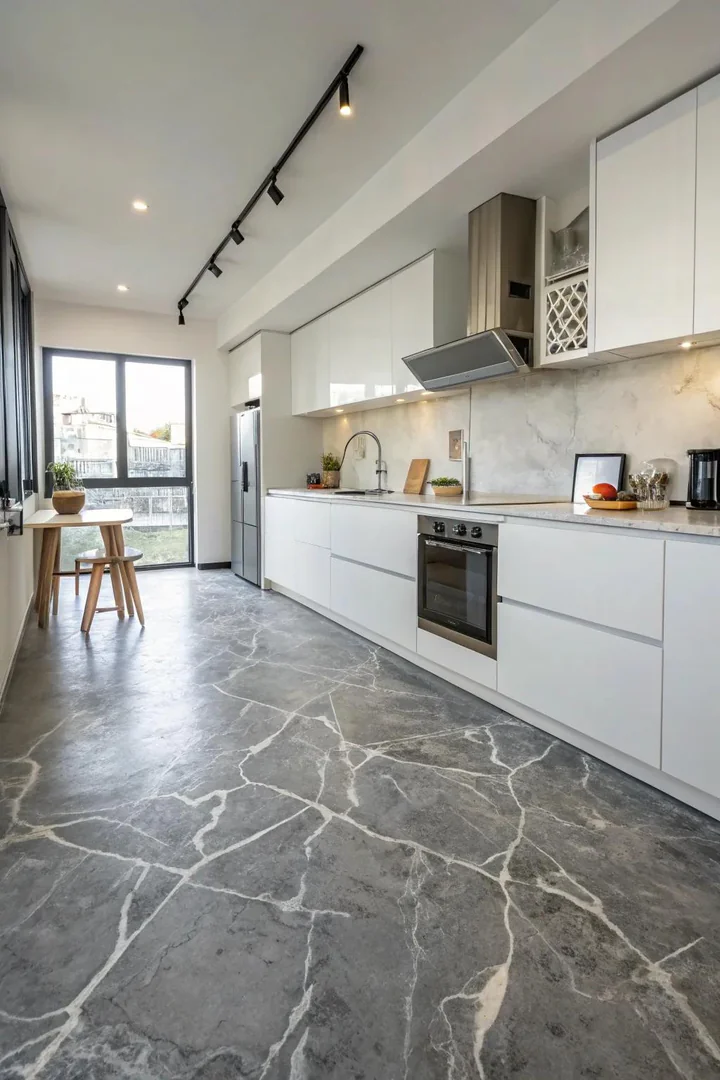
Some marble varieties produce a muted, low-contrast surface that reads as polished concrete rather than traditional veined marble. Blue de Savoie marble ($20 to $40 per square foot) in a honed finish carries a soft blue-gray tone with minimal veining. Pietra Gray marble ($15 to $35 per square foot from MSI) delivers a uniform dark gray surface with subtle, tonal veining. Both varieties produce floors that feel industrial and modern while retaining marble’s natural depth and material authenticity.
Concrete-look marble offers the aesthetic of polished concrete without concrete’s curing time (28 days), cracking tendency, and ongoing sealing demands. A honed finish on these low-contrast marbles eliminates the reflective sheen associated with traditional marble, further reinforcing the concrete impression. Pair concrete-look marble floors with minimalist flat-panel cabinets, stainless-steel appliances, and industrial pendant lighting for a loft-style kitchen. A concrete-look marble floor costs 30% to 50% more than actual polished concrete but arrives as ready-to-install tiles without the on-site pouring and curing process.
14. Brushed and Chiseled Marble
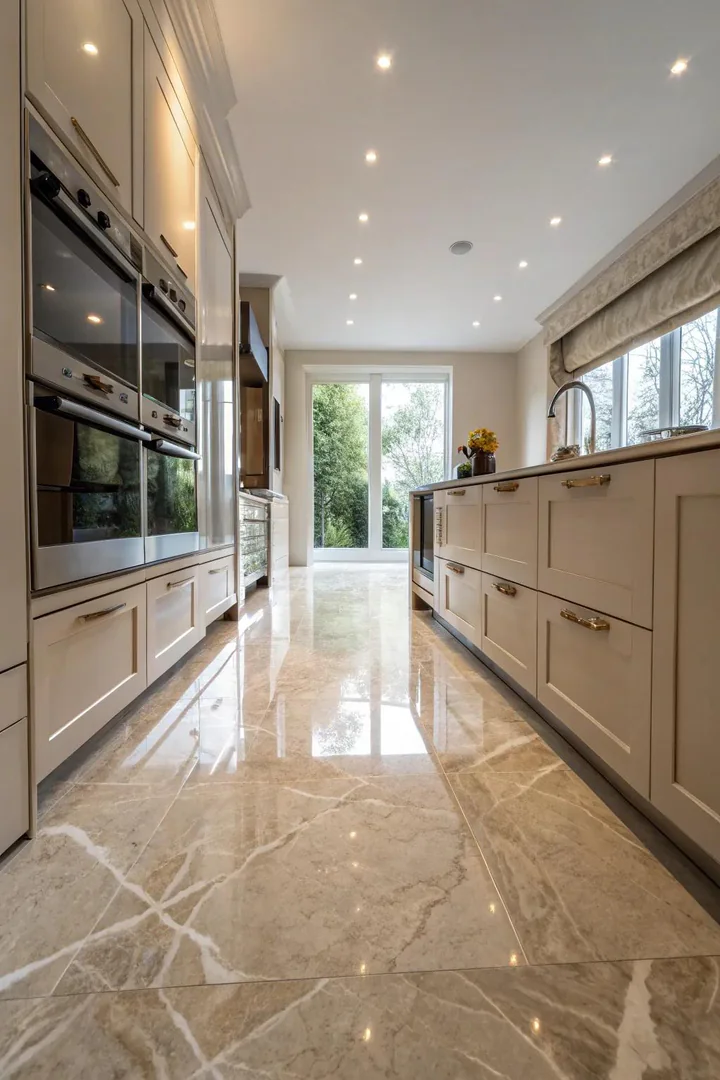
Brushed marble (wire-brushed to create a slightly textured, antiqued surface) and chiseled-edge marble (edges hand-chipped to produce an irregular, stone-cut border) create a floor that looks centuries old. Brushed Carrara marble from MSI ($12 to $25 per square foot) produces a softer, more weathered appearance than honed Carrara. Chiseled edges replace the sharp, factory-cut tile edges with an irregular, hand-hewn profile that resembles stone quarried and laid by hand.
Brushed-and-chiseled marble suits Mediterranean, Tuscan, French provincial, and rustic farmhouse kitchens. The textured surface provides excellent slip resistance (better than polished or honed) because the wire-brushed grooves create micro-traction on the tile face. Wider grout joints (1/4 to 3/8 inch) accommodate the chiseled edge’s irregularity and reinforce the old-world aesthetic. Use a sanded grout in a warm beige or gray tone to complement the antique character.
15. Snow White Marble Mosaic
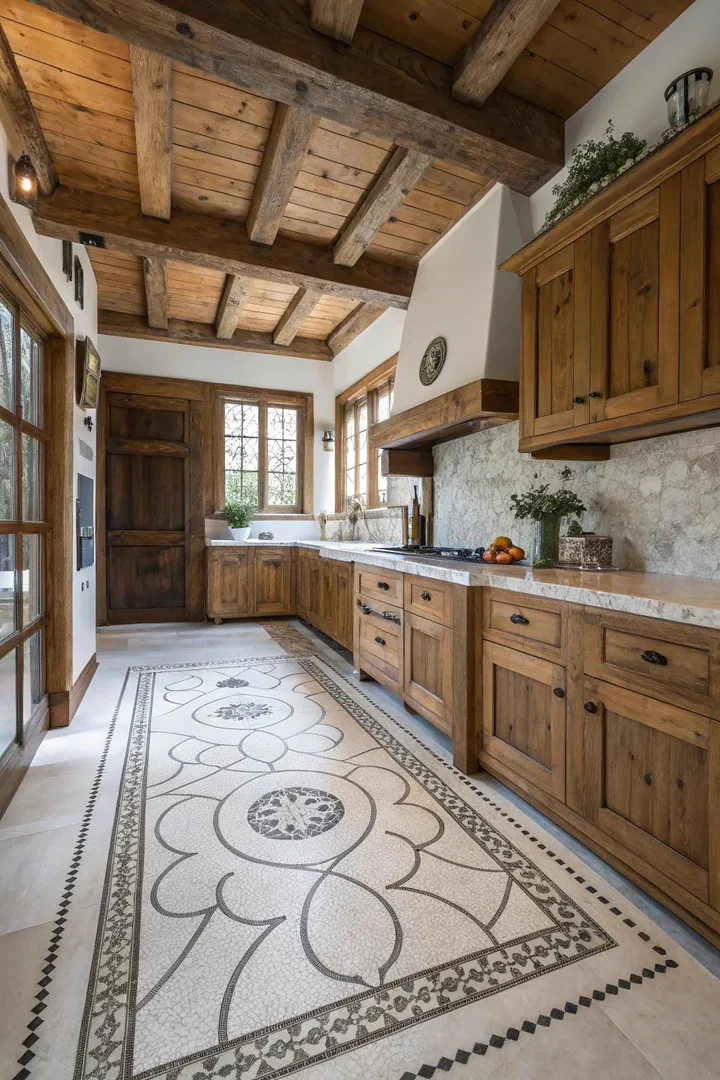
Thassos White marble (quarried in Greece) produces the whitest marble available, with minimal veining and a crystalline, sugar-like grain structure. Thassos White 2-by-2-inch mosaic on mesh from Tile Bar ($20 to $35 per square foot) creates a bright white grid floor with a high grout-to-tile ratio. The mosaic format suits small kitchens and kitchen zones where a small-scale pattern adds texture without overwhelming the limited floor area.
Thassos White marble reflects light more than any other marble color, making the floor a secondary light source that bounces natural and artificial light back into the room. A bright white marble floor under white cabinets creates a luminous, all-white kitchen envelope. Pair the white floor with a single warm accent material (butcher-block countertop, brass hardware, natural wood shelving) to prevent the all-white space from reading as clinical or sterile. Seal Thassos White every 6 months because the pure-white surface shows stains more visibly than veined or tonal marbles.
16. Bianco Carrara Vintage Pattern
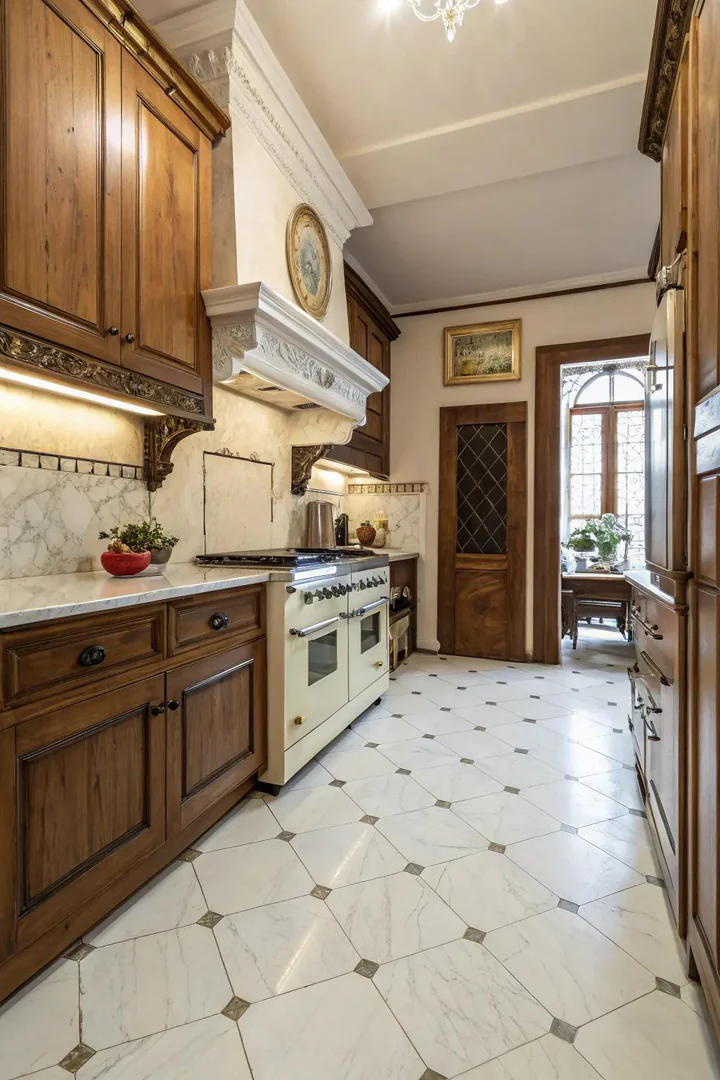
Bianco Carrara (a specific Carrara grade with a brighter white base and more defined gray veining than standard Carrara) costs $12 to $30 per square foot and is the most widely available white marble tile in North America. A Bianco Carrara floor in a basketweave pattern (two rectangular tiles paired with a small square accent tile in alternating orientation) produces a vintage, early-20th-century floor pattern. Black dot accents (small 1-by-1-inch Nero Marquina squares at the basketweave intersections) add graphic contrast to the white field.
Basketweave, pinwheel, and Versailles patterns reference historic European and American floor designs from the 1880s to 1940s, making these layouts appropriate for period-correct renovations in older homes. A basketweave Bianco Carrara floor with a border row of contrasting marble (a dark gray or black 2-inch strip framing the room’s perimeter) elevates the installation from a standard tile floor to a custom inlay floor. Pattern floors cost 25% to 50% more in labor due to the cutting and fitting required.
17. Iris Black Polished Marble
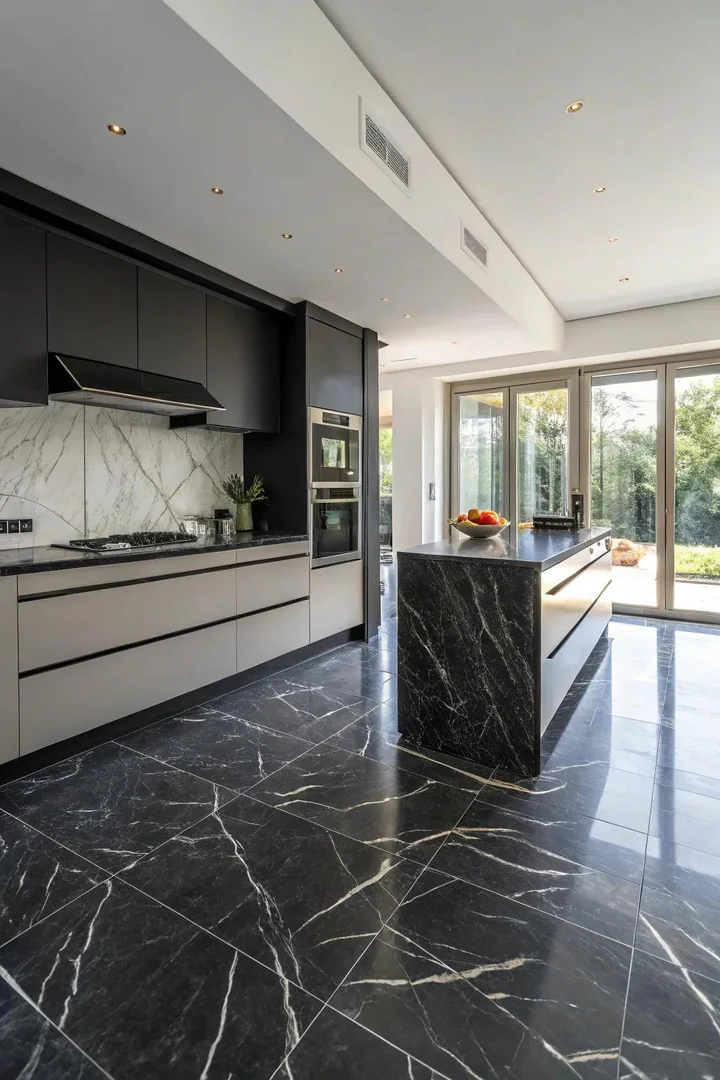
Iris Black marble (from Turkey) produces a deep black base with fine silver-white veining and occasional brown undertones. Polished Iris Black tiles ($15 to $30 per square foot from MSI) deliver a mirror-reflective dark surface that doubles as a secondary ceiling reflection on the floor plane. The fine, web-like veining of Iris Black differs from Nero Marquina’s bold, sweeping veins, creating a more intricate, jewel-like pattern at close range.
A polished black marble floor amplifies the reflected light from pendant fixtures and under-cabinet LEDs, creating a sense of depth and sparkle in the kitchen’s lower zone. Black marble floors in narrow galley kitchens can make the space feel smaller by absorbing light at floor level. Compensate with strong overhead lighting, light-colored cabinets, and reflective countertop materials (polished quartz, glass, stainless steel) that bounce light across the room above the dark floor plane.
18. Waterjet Marble Inlay
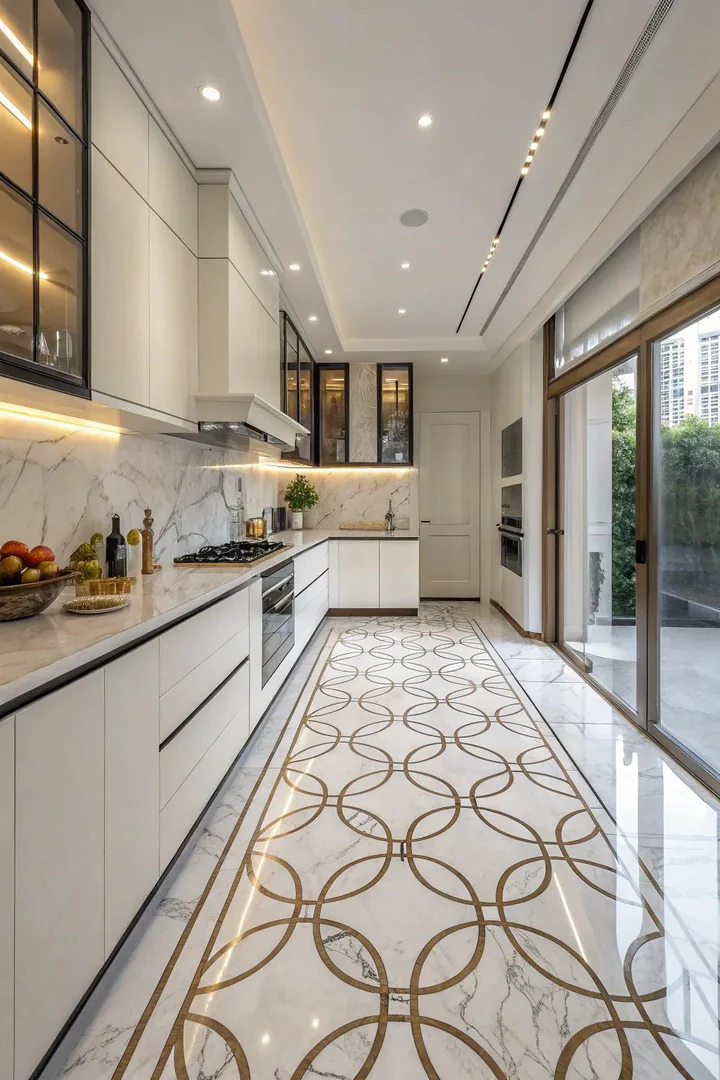
A waterjet marble inlay uses computer-controlled water-cutting machines to precision-cut marble, metal, and stone into complex curved, interlocking, and mosaic patterns that hand-cutting cannot achieve. Waterjet medallions and waterjet border strips from Marble Systems ($30 to $100+ per square foot) create floor centerpieces, borders, and all-over patterns with sub-millimeter joint precision. A waterjet marble floor combines 3 to 5 marble colors and sometimes brass, copper, or mother-of-pearl inlays.
Waterjet floors suit formal kitchens, entryway transitions from the foyer into the kitchen, and kitchen floor medallions centered under the island or chandelier. A waterjet floor medallion (a decorative circular or square inlay, 24 to 48 inches across) surrounded by a plain marble field creates a focal point on the floor without covering the entire surface in complex pattern. Waterjet installation requires a specialist tile setter experienced with tight-tolerance inlay work because the pre-cut pieces fit together like puzzle pieces with minimal grout lines.
19. Silver Shadow Marble
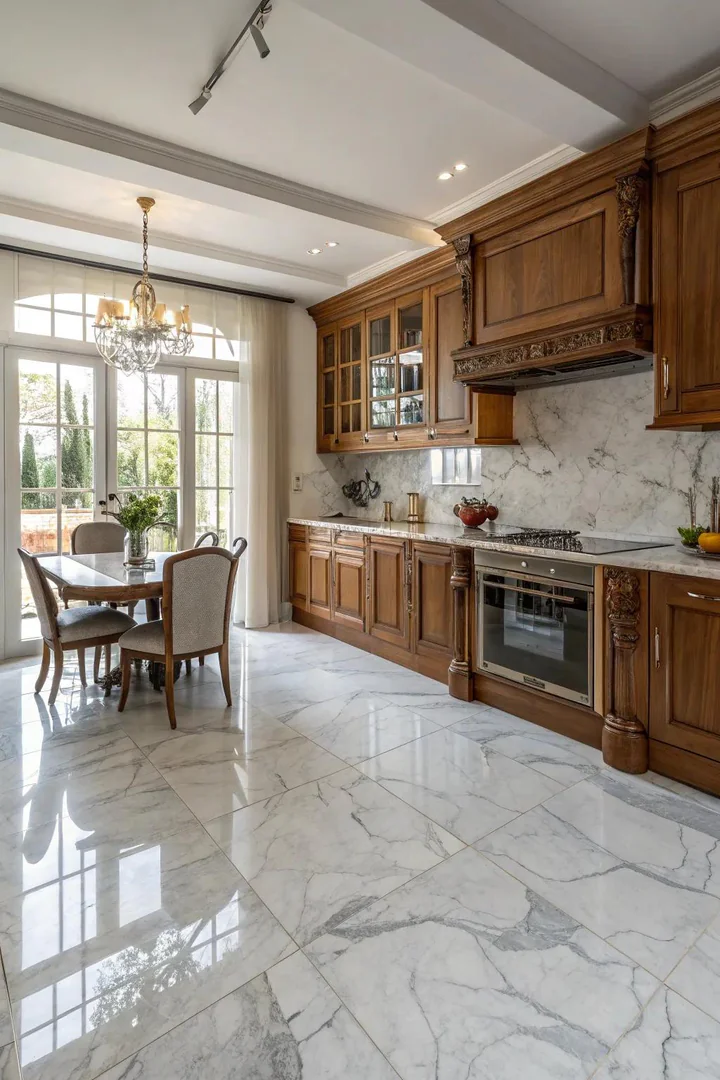
Silver Shadow marble (from Turkey) carries a medium-gray base with silver, white, and charcoal veining in horizontal, linear striations that resemble wood grain or sedimentary rock layers. Silver Shadow honed tiles ($10 to $22 per square foot from MSI) produce a textured, directional floor pattern that adds horizontal movement to the kitchen. Laying the tiles so the linear striations run parallel to the kitchen’s longest wall emphasizes the room’s length and makes a narrow kitchen appear more expansive.
Silver Shadow’s mid-tone gray hides everyday kitchen floor dirt, dust, and minor stains better than white or black marbles because the mottled gray surface absorbs minor surface variation into its natural color range. The linear grain pattern gives Silver Shadow a modern, understated character that suits contemporary, minimalist, and Scandinavian kitchen styles. A Silver Shadow marble floor paired with white flat-panel cabinets and a concrete-look quartz countertop creates a cool, neutral material palette rooted in gray tones.
20. Skyline Honed Marble
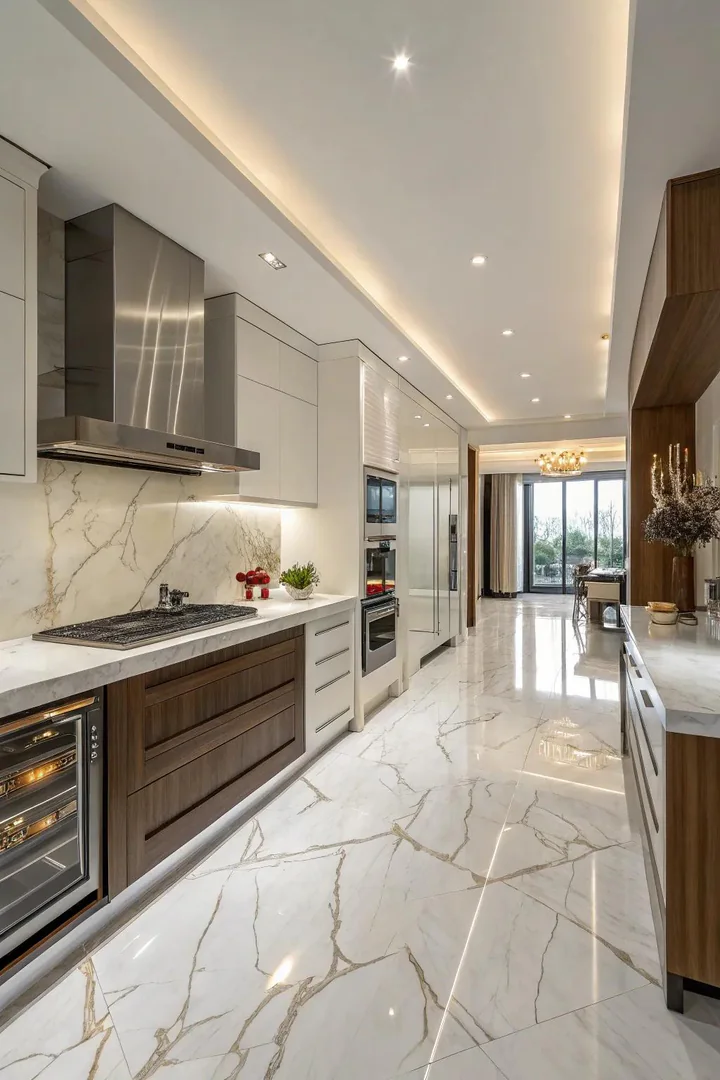
Skyline marble (from Turkey) produces a warm gray base with cream and golden-brown veining that carries more warmth than the silver-toned Gray marbles (Bardiglio, Silver Shadow). Skyline honed tiles ($12 to $28 per square foot from MSI) bridge the gap between cool gray marbles and warm beige marbles, making Skyline a versatile neutral floor that works with both warm and cool cabinet palettes.
Skyline marble’s warm gray tone coordinates with both brass (warm metal) and chrome (cool metal) hardware without clashing, giving the homeowner freedom to change hardware finishes in the future without worrying about the floor’s color temperature. A Skyline marble floor in a herringbone pattern adds both warmth and directional texture to the kitchen. Lay the herringbone pattern at a 45-degree angle to the room’s longest wall for the most striking visual movement across the floor surface.
21. Geometric Marble Tiles
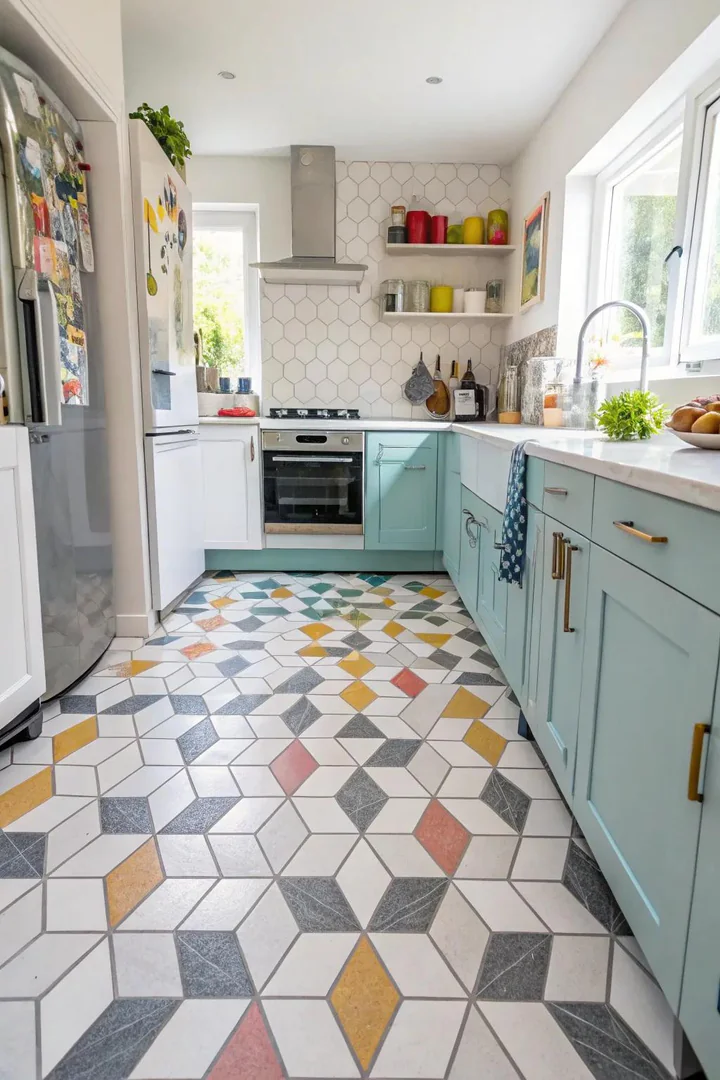
Geometric marble tiles in arabesque, lantern, fan, scallop, or star-and-cross shapes from Tile Bar, Daltile, or Jeffrey Court ($15 to $35 per square foot on mesh-backed sheets) create ornamental floor patterns rooted in Moorish, Moroccan, and Mediterranean tile traditions. An arabesque marble tile (a rounded, pointed shape inspired by Arabic calligraphy curves) in Carrara white produces a soft, organic pattern that contrasts with the straight lines of rectangular marble tiles.
Geometric marble tiles add personality to small kitchen zones: the area in front of the stove, the floor under a breakfast nook, or a transition strip between the kitchen and the adjacent dining room. Using geometric marble tiles as a border or accent strip within a field of plain rectangular marble tiles adds decorative detail without covering the entire floor in complex pattern. A full-floor geometric marble installation suits eclectic, bohemian, Mediterranean, and maximalist kitchen designs where pattern on the floor competes with pattern on the backsplash and textiles. Explore more kitchen style ideas at kitchen organization ideas.
22. Snow White Honed Marble
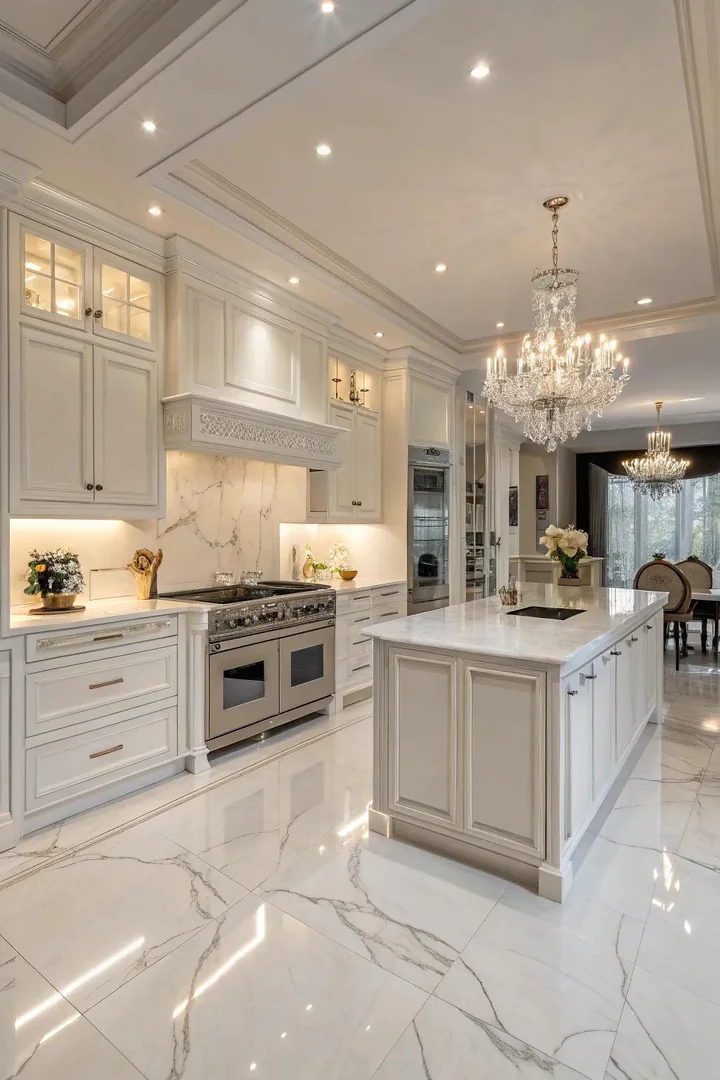
Snow White marble (from Turkey and Greece) in a honed finish produces a matte, chalky-white surface that absorbs light rather than reflecting a mirror-shine like polished Thassos White. Snow White honed tiles ($12 to $25 per square foot from MSI) deliver a soft, flat white that reads as contemporary and understated. A honed finish on white marble eliminates the formal, polished-ballroom quality of glossy white marble, replacing the sheen with a casual, lived-in matte surface.
Snow White honed marble shows etch marks (dull spots from acidic contact) less visibly than polished white marble because the already-matte surface lacks the reflective sheen that makes etching visible. For kitchens where acidic spills (lemon juice, tomato sauce, vinegar) are frequent, honed white marble provides the white-marble look with better tolerance for everyday cooking chemistry. A Snow White honed floor paired with warm wood island tops and mobile home kitchen remodel ideas shows that marble works in every kitchen scale.
23. Black and Gold Art Deco Marble
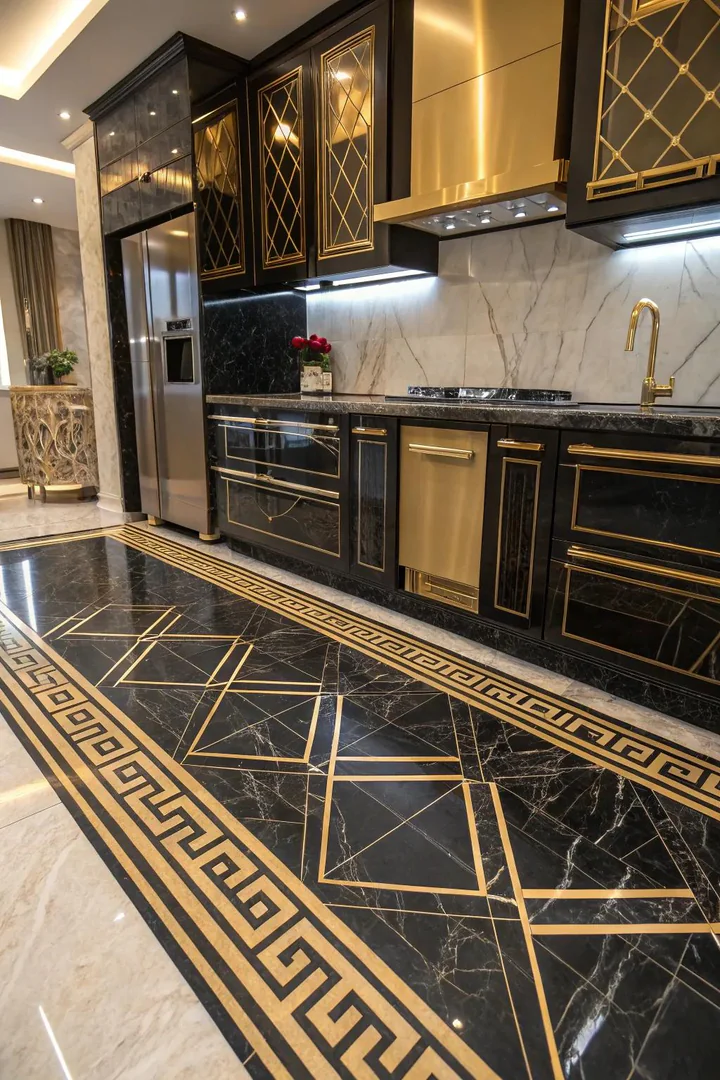
An Art Deco marble floor combines Nero Marquina (black), Calacatta Gold (white with gold veining), and brass inlay strips ($20 to $40 per linear foot for thin brass divider strips) in geometric patterns (fan shapes, sunburst lines, stepped borders) inspired by 1920s and 1930s American and French design. A black-and-gold Art Deco floor costs $40 to $100+ per square foot due to the multi-material combination and precision cutting required.
Art Deco marble floors suit formal kitchens, large open-plan kitchen-dining rooms, and homes with existing Art Deco architectural details (arched doorways, fluted columns, geometric molding profiles). A simpler Art Deco-inspired approach: a black marble floor with a thin brass inlay strip forming a geometric border around the room’s perimeter ($500 to $1,500 in brass strips and installation). The brass inlay catches overhead light and creates a warm-metal frame around the dark marble field. Visit The Designers Company for the full marble floor and kitchen design library.
How to Seal and Maintain a Marble Kitchen Floor
1. Apply a Penetrating Sealer Before First Use
Seal the marble floor immediately after grouting and before any foot traffic, cooking, or furniture placement. Apply a penetrating (impregnating) sealer like Tenax Proseal ($30 per quart) or StoneTech BulletProof ($40 per quart) with a clean microfiber applicator pad, working in 3-by-3-foot sections. Allow the sealer to penetrate for 15 to 20 minutes, then wipe off the excess with a clean, dry microfiber cloth. A penetrating sealer fills the marble’s microscopic pores without altering the surface sheen.
2. Re-Seal Every 6 to 12 Months
Test the seal annually by placing a few drops of water on the marble surface. Sealed marble beads water on the surface; unsealed marble absorbs water within 5 minutes, darkening the stone. Re-seal when the water absorption test fails. Light-colored marbles (Carrara, Thassos, Calacatta) require more frequent sealing (every 6 months) than dark marbles (Nero Marquina, Bosphorus) because stains show more visibly on light surfaces.
3. Clean Daily with pH-Neutral Stone Cleaner
Mop the marble floor daily with a pH-neutral stone cleaner (StoneTech Stone and Tile Cleaner, $10 per quart, diluted per label instructions) and a microfiber mop. Acidic cleaners (vinegar, lemon, most bathroom cleaners) etch marble on contact. Alkaline cleaners (ammonia, bleach) dull the polished finish. A pH-neutral cleaner (pH 7) cleans without chemical damage. Wipe spills immediately, especially wine, coffee, tomato sauce, and citrus juice, to prevent staining and etching.
Marble Floor Finish and Color Comparison
| Marble Type | Color | Cost/sq ft | Best Finish | Slip Resistance | Stain Visibility |
|---|---|---|---|---|---|
| Carrara | White/light gray | $10–$30 | Honed | Good | High |
| Calacatta | White/gold veining | $30–$80 | Polished or honed | Moderate | High |
| Nero Marquina | Black/white veining | $15–$40 | Polished | Low | Low |
| Bardiglio | Medium gray | $12–$35 | Honed | Good | Moderate |
| Thassos White | Pure white | $20–$35 | Polished or honed | Low (polished) | Very high |
| Crema Marfil | Warm beige | $10–$25 | Polished | Moderate | Low |
| Silver Shadow | Mid gray/linear | $10–$22 | Honed | Good | Low |
| Bosphorus | Dark gray-brown | $15–$35 | Honed | Good | Low |
Frequently Asked Questions
Is marble flooring a good choice for kitchens?
Marble flooring works well in kitchens when sealed properly and maintained with pH-neutral cleaners. Marble is softer than granite, porcelain, and ceramic (Mohs 3 versus Mohs 6 to 7), making the surface more susceptible to scratching, etching, and staining than harder alternatives. Homeowners who accept marble’s natural aging (patina, etch marks, minor staining) as part of the material’s character find marble floors rewarding. Homeowners who prefer a zero-maintenance, always-pristine floor should consider porcelain tile or quartz-composite flooring instead.
Does marble flooring increase home value?
Marble flooring in a kitchen adds perceived luxury and can increase home value in mid-to-high-end markets ($400,000+ homes). Real estate appraisers recognize marble as a premium flooring material that signals quality construction and design investment. A full marble kitchen floor ($3,000 to $10,000 installed) typically recovers 60% to 80% of its cost at resale in luxury markets. Budget and mid-range home markets may not recover the full installation cost because buyers at lower price points may view marble as high-maintenance rather than luxurious.
How do you prevent marble kitchen floors from being slippery?
Choose a honed, tumbled, or brushed finish rather than a polished finish. Honed marble provides 40% to 60% more slip resistance than polished marble because the matte surface creates more micro-friction with shoe soles. Adding a washable kitchen runner rug in front of the sink and stove (where water and oil splashes are most frequent) reduces slip risk in the two highest-traffic zones. Applying an anti-slip treatment ($25 to $50 per application from Stone Care International) to polished marble increases the coefficient of friction without changing the tile’s appearance.
What grout color works best with white marble floors?
A light gray grout (Mapei Keracolor U in “Frost” or Laticrete Permacolor Select in “Silver Shadow”) produces the most visually cohesive result with white marble because the grout color approximates the marble’s natural gray veining. Bright white grout matches the marble’s base color but shows dirt and staining more quickly. Dark gray or charcoal grout creates a graphic contrast that outlines each tile, producing a geometric grid effect. Choose unsanded grout for joints under 1/8 inch and sanded grout for joints 1/8 inch and wider.
How often should a marble kitchen floor be professionally cleaned?
Professional marble floor cleaning and re-sealing ($2 to $5 per square foot, or $300 to $750 for a 150-square-foot kitchen) once per year maintains the marble’s surface protection and removes embedded dirt that daily mopping cannot reach. A professional marble polishing service (diamond pad honing to restore gloss on etched or dulled surfaces) costs $3 to $8 per square foot and is needed every 3 to 5 years depending on traffic and wear. Between professional visits, daily pH-neutral mopping and immediate spill cleanup maintain the marble’s appearance.