Kitchen Cabinet Ideas: 15 Stunning Designs to Transform Your Space
Kitchen cabinet ideas shape everything about how a kitchen looks, feels, and functions — cabinets cover roughly 40 percent of the visible wall space in a typical kitchen, making them the single largest design element in the room. The cabinet style, color, material, finish, and hardware you choose determine whether the kitchen reads as traditional, modern, transitional, farmhouse, industrial, or minimalist, and they dictate how efficiently you store, access, and organize everything from plates to appliances.
The 15 kitchen cabinet ideas below span bold color choices, mixed styles, earthy tones, open shelving, glass fronts, handleless designs, two-tone combinations, textured doors, high-gloss finishes, reclaimed wood, statement hardware, floating cabinets, integrated lighting, Shaker profiles, and built-in coffee stations. Each idea includes specific product recommendations, material options, finish details, and installation considerations to help you choose and execute the right cabinet approach for your kitchen’s size, layout, and design direction.
1. Welcome Vibrant Cabinets
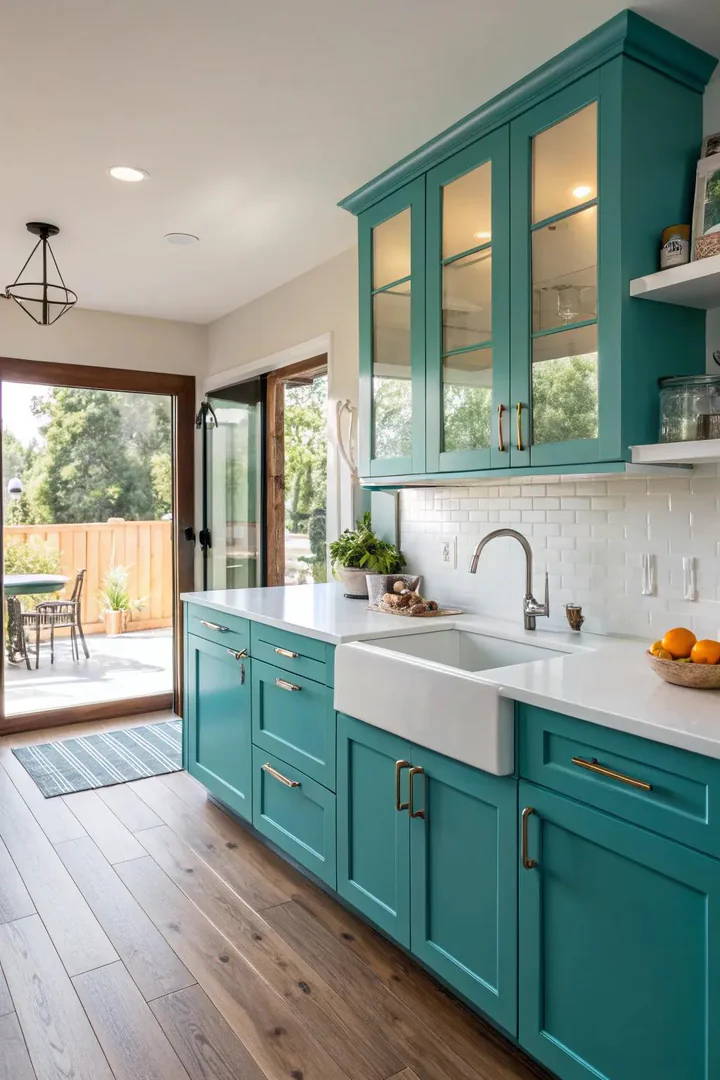
Bold, saturated cabinet colors — deep teal, emerald green, navy blue, burnt orange, or sunshine yellow — turn kitchen cabinetry from a neutral backdrop into the room’s primary design statement. Colored cabinets work best when the rest of the kitchen stays relatively subdued: white or light gray countertops, neutral backsplash tile, and simple hardware let the cabinet color take center stage without visual competition.
For the strongest results, choose a paint with a semi-gloss or satin finish (Benjamin Moore Advance, Sherwin-Williams Emerald Urethane Trim Enamel, or Farrow & Ball Estate Eggshell) for durability and easy cleaning. Popular bold cabinet colors include Hague Blue (Farrow & Ball No. 30), Hunter Green (Benjamin Moore 2041-10), Rookwood Sash Green (Sherwin-Williams SW 2810), and Gentleman’s Gray (Benjamin Moore 2062-20). If painting the entire kitchen feels too intense, start with the island or the lower cabinets only and pair them with white or cream uppers — this gives you the color impact with a built-in visual break. For more ideas on pairing cabinet colors with your kitchen’s overall palette, see our kitchen cabinet color ideas guide.
2. Combine and Blend Cabinet Designs
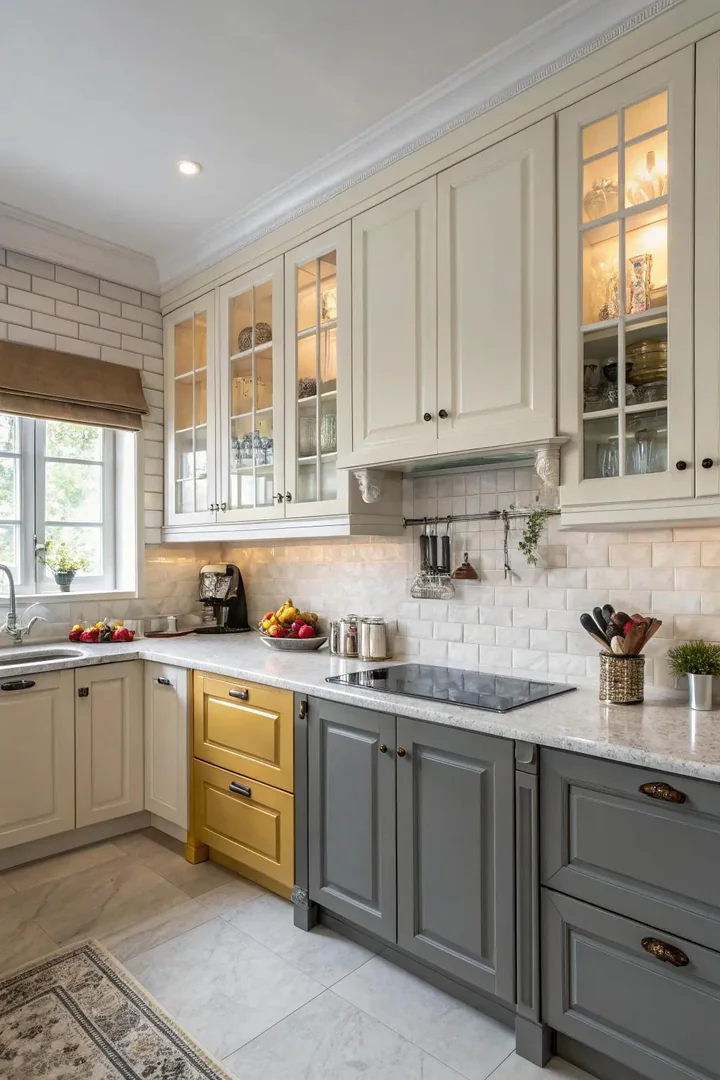
Mixing cabinet styles — Shaker-front lower cabinets with flat-panel uppers, a beadboard island paired with slab-door perimeter cabinets, or raised-panel base units with open shelving above — creates visual depth and architectural interest that a single uniform cabinet style cannot achieve. The key to a successful mix is maintaining one unifying element (shared color, shared hardware, or shared material) so the different styles feel intentional rather than mismatched.
Start with a dominant style for 60 to 70 percent of the cabinetry (typically the perimeter) and introduce the contrasting style on the island, the pantry wall, or the upper cabinets. For example, flat-panel walnut base cabinets (from IKEA’s Voxtorp line, Semihandmade, or a custom cabinet shop) paired with white Shaker uppers (from CliqStudios, Cabinets To Go, or KraftMaid) creates a warm-meets-classic combination. Keep hardware consistent across both styles — matching pulls or knobs (from Rejuvenation, Schoolhouse, or Emtek) tie the different door profiles together into a single cohesive kitchen.
3. Select Natural Colors
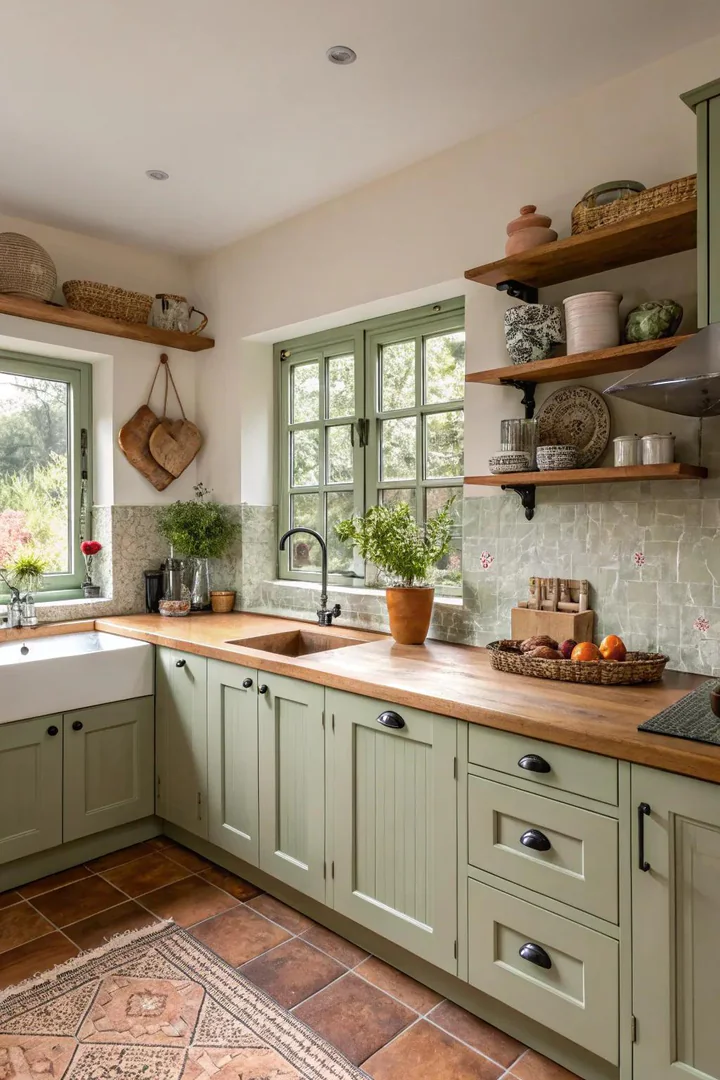
Earthy cabinet tones — sage green, warm terracotta, olive, mushroom, putty, clay, and warm taupe — ground the kitchen in a natural, calming palette that pairs well with wood countertops, stone surfaces, and organic textures. These colors draw from the natural world (soil, stone, dried herbs, tree bark) and produce kitchens that feel warm, quiet, and connected to the outdoors without being dark or heavy.
Sage green is the most popular earthy cabinet color in current kitchen design, with strong options from Benjamin Moore (Sage Mountain 1488, Cushing Green HC-125), Sherwin-Williams (Evergreen Fog SW 9130, Clary Sage SW 6178), and Farrow & Ball (Vert De Terre No. 234). Terracotta tones (Benjamin Moore Baked Clay 035, Sherwin-Williams Cavern Clay SW 7701) bring warmth to kitchens with white countertops and black hardware. Pair earthy cabinets with brass or unlacquered brass hardware (from Schoolhouse, Rejuvenation, or CB2) and natural stone or butcher block countertops for a grounded, organic aesthetic.
4. Choose Open Shelving
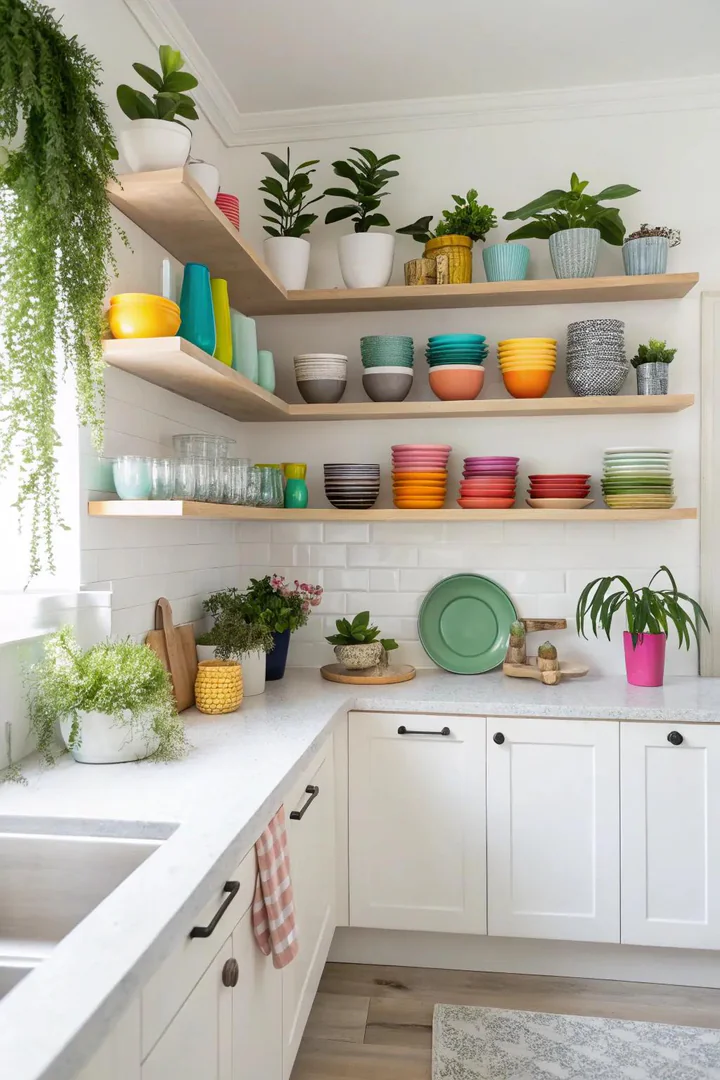
Replacing some or all upper cabinets with open shelving — floating wood shelves on concealed brackets, industrial pipe shelving, or simple wood planks on wrought iron brackets — opens up the kitchen visually, makes the ceiling feel higher, and turns everyday dishes, glassware, and cookbooks into decorative display elements. Open shelving works best in kitchens where the homeowner has enough lower cabinet and pantry storage to compensate for the reduced upper storage volume.
For a clean, modern look, use floating shelves (solid walnut, white oak, or maple, 10 to 12 inches deep, on concealed heavy-duty brackets from Shelfology, Ultra Shelf, or Federal Brace). For rustic or industrial kitchens, use reclaimed wood planks on black steel brackets (from D. Lawless Hardware, Cascade Iron Co., or custom metalwork). Limit open shelving to 2 or 3 shelves per wall section and keep them styled with a curated mix of daily-use items (plates, bowls, mugs) and a few decorative objects (a plant, a ceramic vase, a cookbook) with breathing room between groupings. Avoid overcrowding — the visual benefit of open shelving disappears the moment every inch is filled.
5. Add Cabinets with Glass Fronts
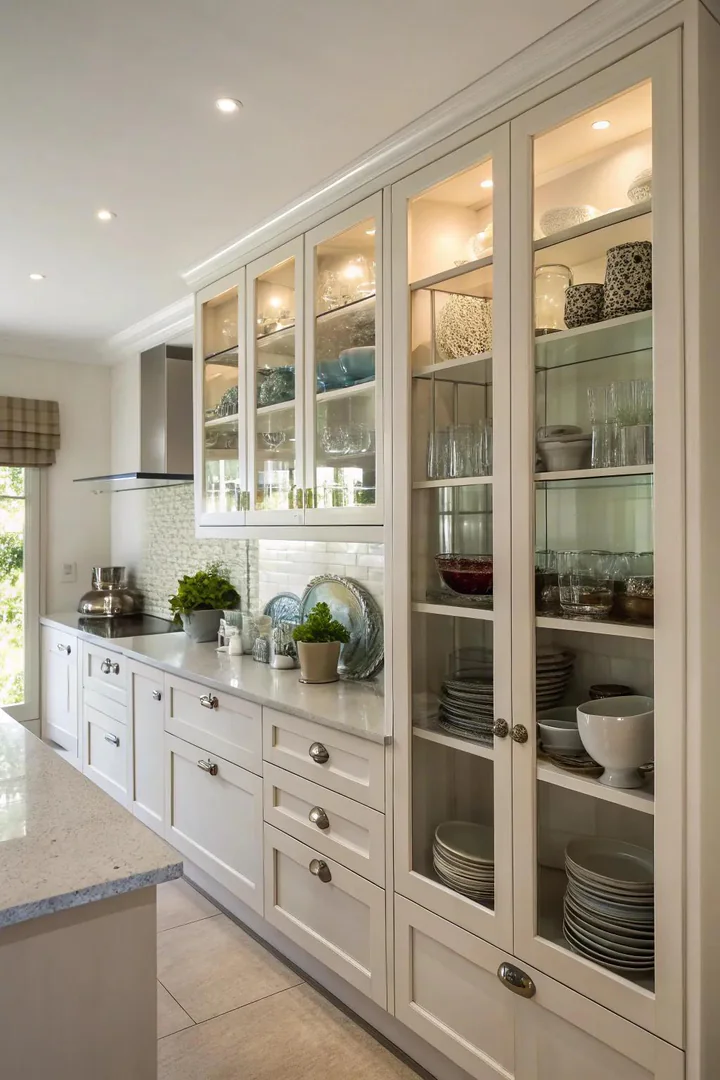
Glass-front cabinets — clear glass, seeded glass, fluted glass, or leaded glass panels set into wood or metal cabinet door frames — provide the enclosed, dust-free storage of traditional cabinets with the visual openness and display quality of open shelving. Glass fronts break up long runs of solid cabinetry, add light and depth, and create a natural place to display attractive dishware, glassware, and collections.
Clear glass works best when the cabinet contents are attractive and well-organized — matching dish sets, wine glasses, or a curated collection of pottery. Seeded glass (handblown glass with small air bubbles) and fluted glass (vertically ribbed) obscure the contents enough to hide everyday clutter while still allowing light to pass through. Source glass door inserts from your cabinet manufacturer (most semi-custom and custom lines like KraftMaid, Thomasville, and Medallion offer glass-front options) or retrofit existing cabinets by ordering replacement glass doors from Cabinet Door World, Fast Cabinet Doors, or a local glass shop.
6. Embrace Minimalism with Handle-Free Cabinets
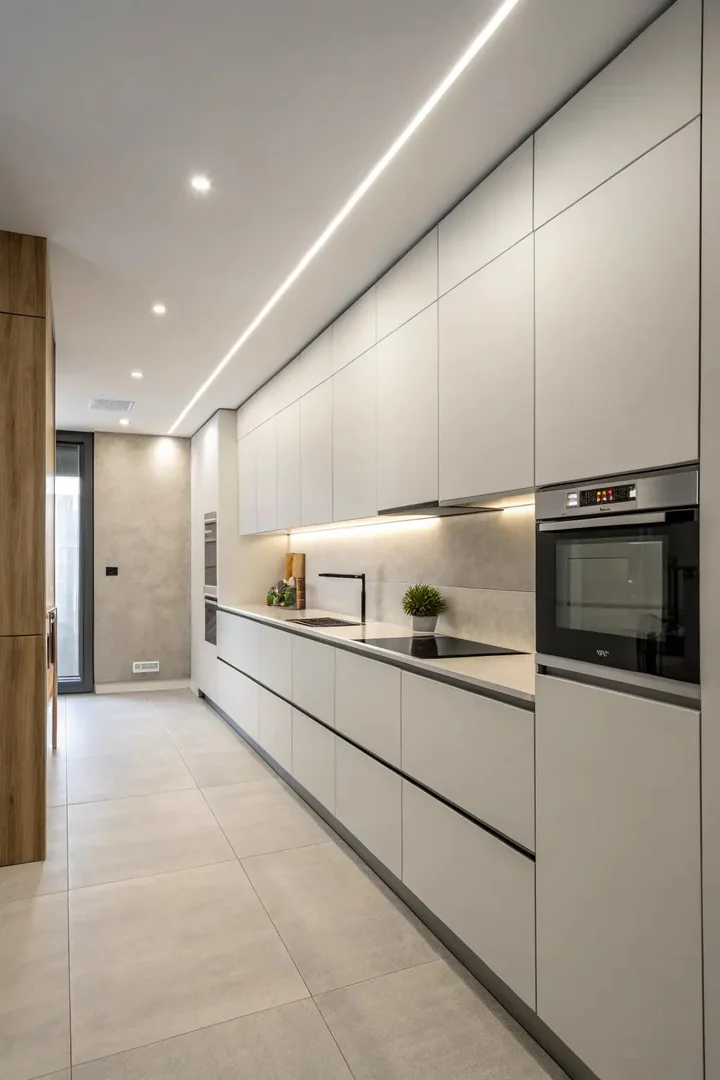
Handleless cabinets — opened by push-to-open (tip-on) mechanisms, integrated J-pull or finger-pull channels routed into the door edge, or recessed grip profiles milled into the top or bottom of the door — produce the cleanest, most minimalist cabinet fronts possible. Without visible handles, knobs, or pulls, the cabinetry reads as a continuous wall of color or material, making the kitchen feel larger, quieter, and more architecturally precise.
The three main handleless systems are push-to-open (Blum Tip-On or Hettich Push-to-Open), J-pull (a routed groove in the top edge of the door or bottom edge of upper doors), and integrated rail (a horizontal channel or lip between the door and the cabinet box). IKEA’s Voxtorp and Ringhult lines offer affordable push-to-open options. For semi-custom and custom kitchens, Italian-designed brands like Snaidero, Pedini, and Valcucine specialize in handleless systems. Handleless cabinets work best with slab (flat-panel) doors in matte or soft-touch finishes (matte lacquer, laminate, or wood veneer) that emphasize the clean, unbroken surface.
7. Present Two-Tone Cabinets
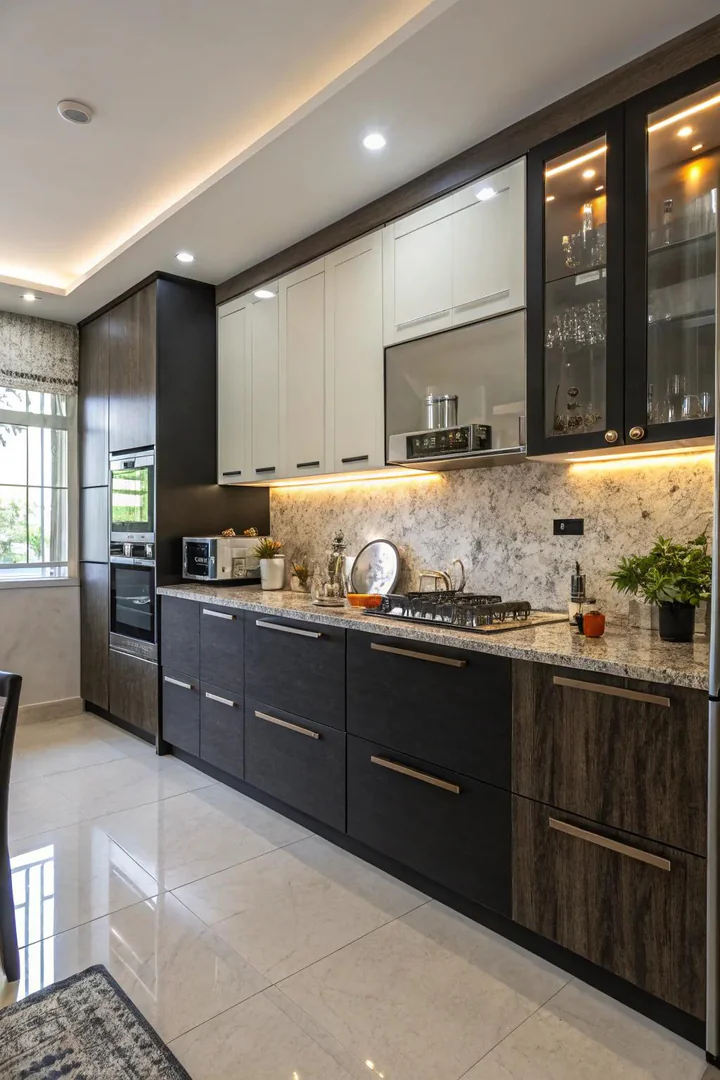
Two-tone cabinets — using two different colors or finishes on the upper and lower cabinets, on the perimeter versus the island, or on the base versus the wall units — create visual depth, define zones within the kitchen, and let you incorporate a bold or dark color without committing to it on every surface. The standard two-tone approach is lighter uppers with darker or colored lowers, which keeps the upper zone airy and bright while grounding the lower zone with weight and warmth.
Popular two-tone combinations include white uppers with navy blue lowers (Benjamin Moore Hale Navy HC-154), white uppers with natural wood lowers (rift-cut white oak or walnut), and pale gray uppers with charcoal or black lowers (Sherwin-Williams Iron Ore SW 7069). The island is another natural place to introduce the second tone — a stained wood or painted island in a contrasting color stands out as a furniture-like piece against the perimeter cabinetry. Use the same hardware finish across both tones (brushed brass, matte black, or polished nickel from Emtek, Top Knobs, or Amerock) to unify the two-tone scheme.
8. Incorporate Textured Cabinet Doors
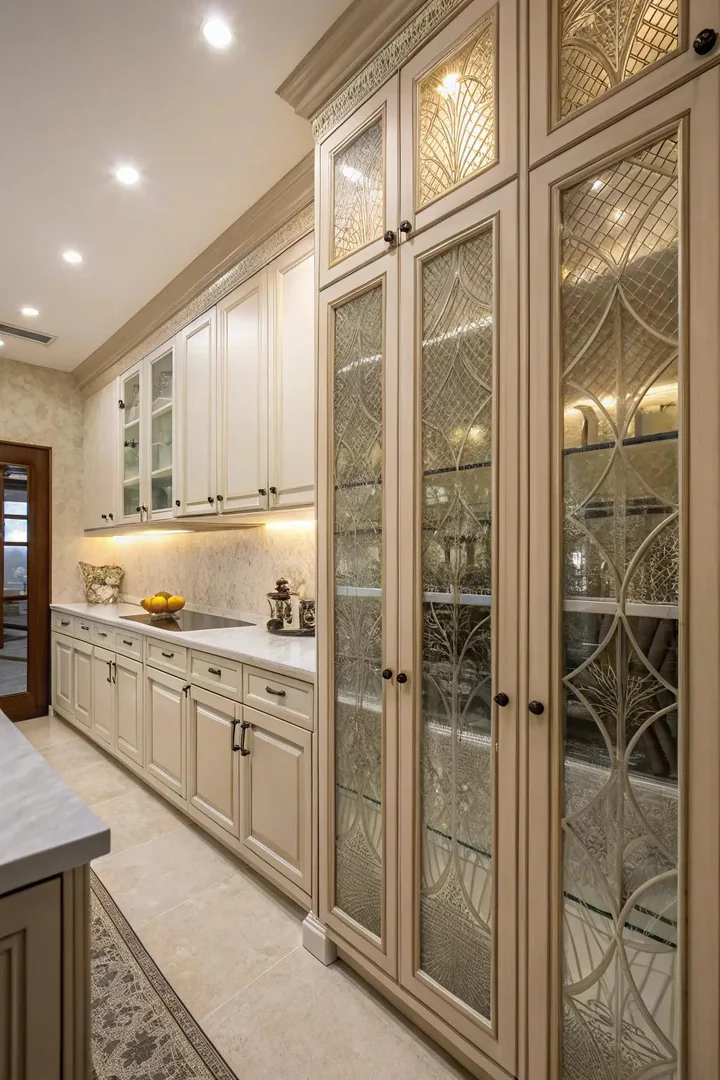
Textured cabinet doors — fluted (vertically grooved) panels, reeded (closely spaced rounded ridges) panels, cane-front inserts, beadboard, tongue-and-groove, or wire mesh — add a tactile, three-dimensional quality to cabinet surfaces that flat-panel and Shaker doors cannot provide. Textured doors catch light differently depending on the viewing angle, creating shadow lines and depth that make the kitchen feel richer and more layered.
Fluted and reeded doors are the most popular textured options in current kitchen design. Fluting (wide, shallow grooves, typically 1/2 inch to 1 inch apart) gives a refined, architectural look that works in both modern and transitional kitchens. Reeding (narrower, rounded ridges, typically 1/4 inch apart) produces a finer, more detailed texture. Source fluted door panels from Semihandmade (which makes doors compatible with IKEA cabinet boxes), Nieu Cabinet Doors, or a custom cabinet shop. Cane-front doors (woven rattan or cane set into a wood frame) add a natural, coastal, or boho texture — order cane door inserts from Cabinet Door World or source pre-made cane doors from Etsy sellers.
9. Emphasize with Glossy High-Finish Surfaces
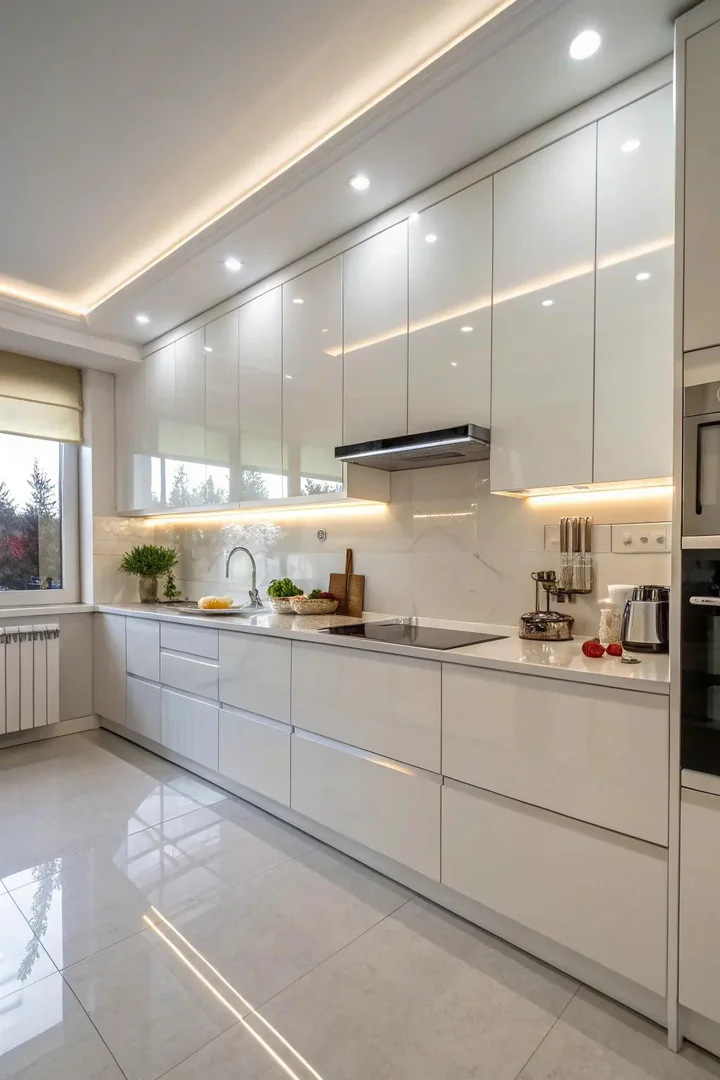
High-gloss cabinet finishes — mirror-like lacquer, acrylic, thermofoil, or high-sheen polyurethane — reflect light across the kitchen, making small spaces feel larger, dark kitchens feel brighter, and every surface look polished and precise. High-gloss finishes are the hallmark of contemporary European kitchen design (Italian, German, and Scandinavian kitchens use gloss extensively) and they pair naturally with stainless steel appliances, quartz countertops, and minimalist hardware.
White high-gloss cabinets are the most popular choice (IKEA Ringhult, Nobilia Flash, or custom lacquer), but high-gloss finishes also look striking in deep colors — gloss navy, gloss black, gloss emerald, or gloss burgundy. The trade-off with high-gloss is maintenance: fingerprints, smudges, and dust show immediately on reflective surfaces, so daily wiping with a microfiber cloth is necessary. Matte and soft-matte finishes (satin lacquer, brushed laminate, or super matte thermofoil like Fenix NTM) provide a modern look without the fingerprint visibility. For broader kitchen design inspiration that complements glossy cabinetry, explore our kitchen decor ideas collection.
10. Incorporate Reclaimed Wood for a Rustic Feel
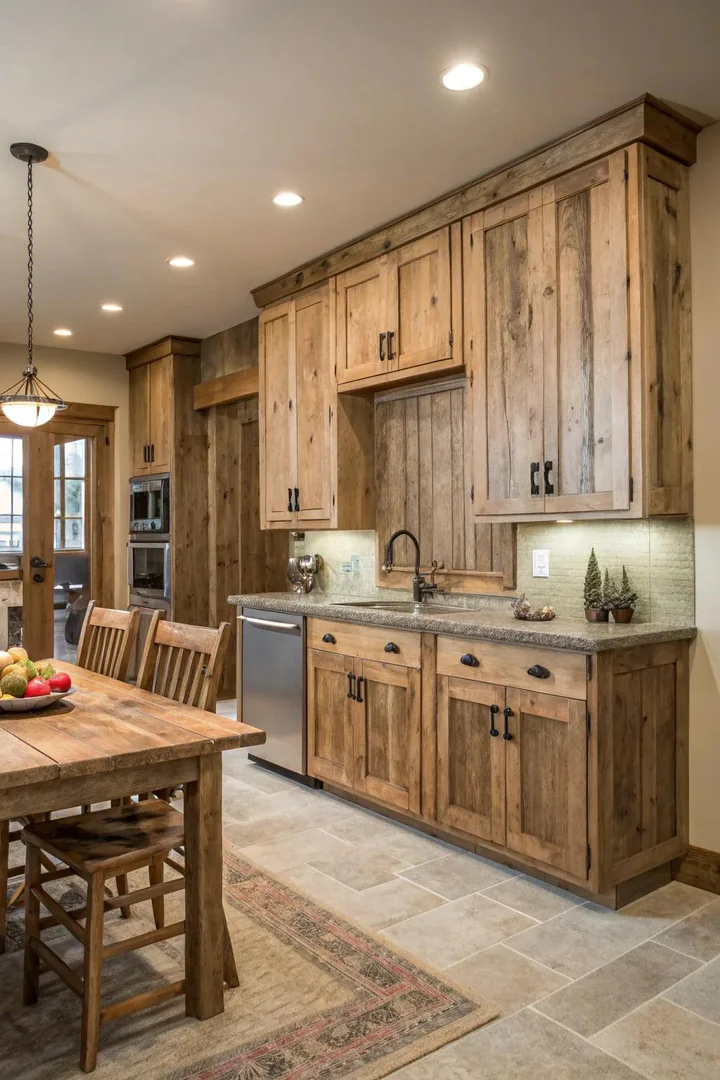
Reclaimed wood cabinets — built from salvaged barn boards, antique timber, old-growth lumber from demolished buildings, or weathered dock planks — bring the patina, grain character, nail holes, and natural aging of old wood into the kitchen. Reclaimed wood has grain patterns, coloring, and surface texture that new lumber cannot replicate, and each piece carries visible history (old nail holes, saw marks, weathering, paint remnants) that gives the kitchen authentic age and character.
Source reclaimed lumber from architectural salvage yards (Olde Good Things, Rebuilding Exchange, Black’s Farmwood), reclaimed wood dealers (Reclaimed DesignWorks, Terramai, Pioneer Millworks), or local demolition companies. Common reclaimed species include white oak, chestnut (highly prized but scarce), heart pine, Douglas fir, and elm. Use reclaimed wood for cabinet door fronts, drawer fronts, open shelving, or a feature island — full reclaimed-wood kitchens can feel visually heavy, so mixing reclaimed elements with painted or smooth-finished cabinets keeps the kitchen balanced. For farmhouse cabinet approaches that pair well with reclaimed wood, see our farmhouse kitchen cabinet ideas guide.
11. Try Out Striking Hardware
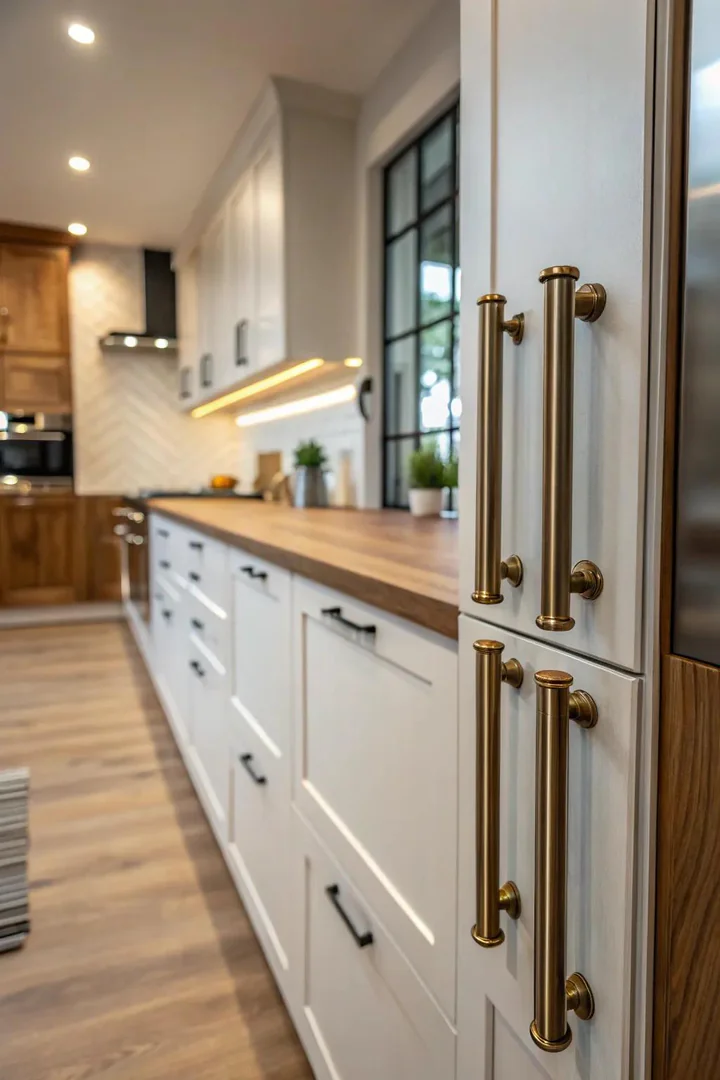
Statement hardware — oversized brass bar pulls, hand-forged iron ring pulls, sculptural knobs in unlacquered bronze, leather-wrapped pulls, or geometric handles in brushed gold — is the fastest, most affordable, and most reversible way to change the look of existing kitchen cabinets. Swapping out standard 3-inch or 4-inch pulls for 8-inch or 12-inch bar pulls in a contrasting finish can make the same cabinets look like an entirely different kitchen in a single afternoon.
For modern kitchens, oversized matte black bar pulls (from Top Knobs, Emtek, or Goldenwarm on Amazon) in 8- to 12-inch lengths create strong horizontal lines across slab or Shaker doors. For traditional and transitional kitchens, unlacquered brass knobs and bin pulls (from Rejuvenation, Nostalgic Warehouse, or House of Antique Hardware) develop a natural patina over time. Leather-wrapped pulls (from Turnstyle Designs or Walnut Studiolo) add warmth and a Scandinavian-inspired softness. Match the hardware finish to the kitchen’s other metal finishes — faucet, light fixtures, and appliance handles — for a cohesive metalwork palette.
12. Experiment with Floating Cabinets
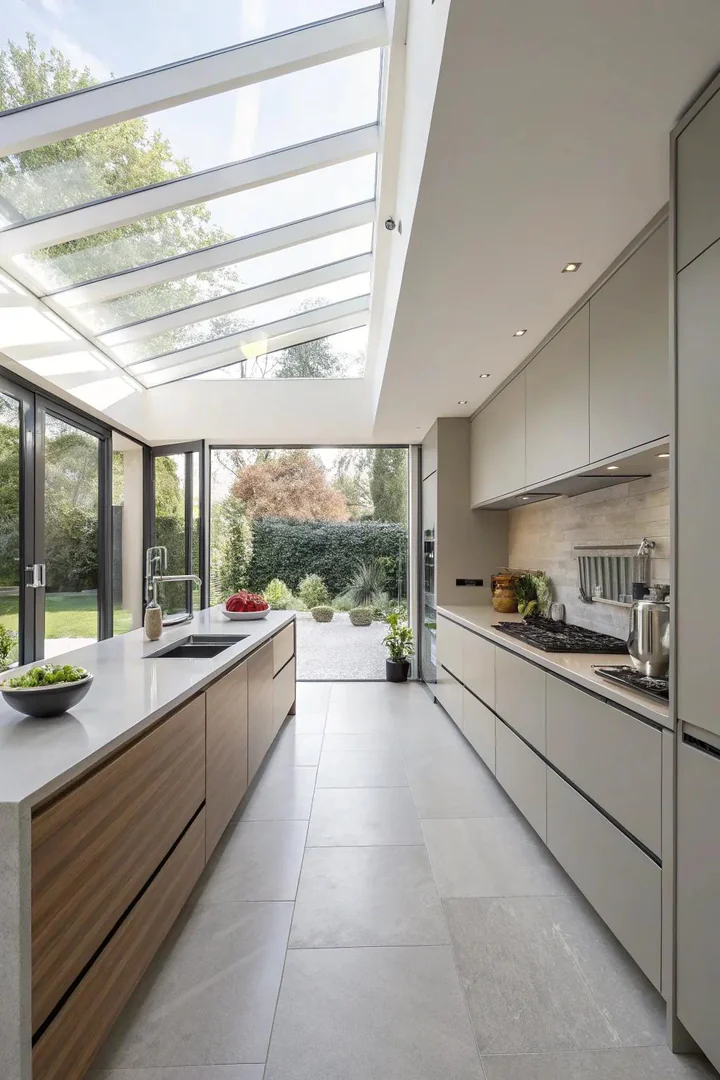
Floating (wall-mounted) base cabinets — lower cabinets suspended off the floor on a concealed rail system, leaving a visible gap between the cabinet bottom and the floor — create a light, airy, almost gravity-defying aesthetic that makes the kitchen feel larger and easier to clean. The open floor space beneath floating cabinets allows continuous flooring to run uninterrupted across the room and makes mopping and vacuuming effortless.
Floating base cabinets require a concealed mounting rail system (a steel rail anchored into wall studs, with the cabinet box hooking onto the rail) strong enough to support the cabinet weight plus contents — typically rated for 200 to 400 pounds per linear foot. IKEA’s Metod/Sektion system supports wall-mounted base cabinets natively. For custom kitchens, French cleat systems or heavy-duty rail systems (from Hafele or Blum) provide the mounting infrastructure. The gap between cabinet and floor is typically 4 to 8 inches — enough to be visually impactful without making the cabinets feel uncomfortably high. Add LED strip lighting under the cabinets to illuminate the floor gap and create a floating glow effect.
13. Integrate Lighting Inside Cabinets
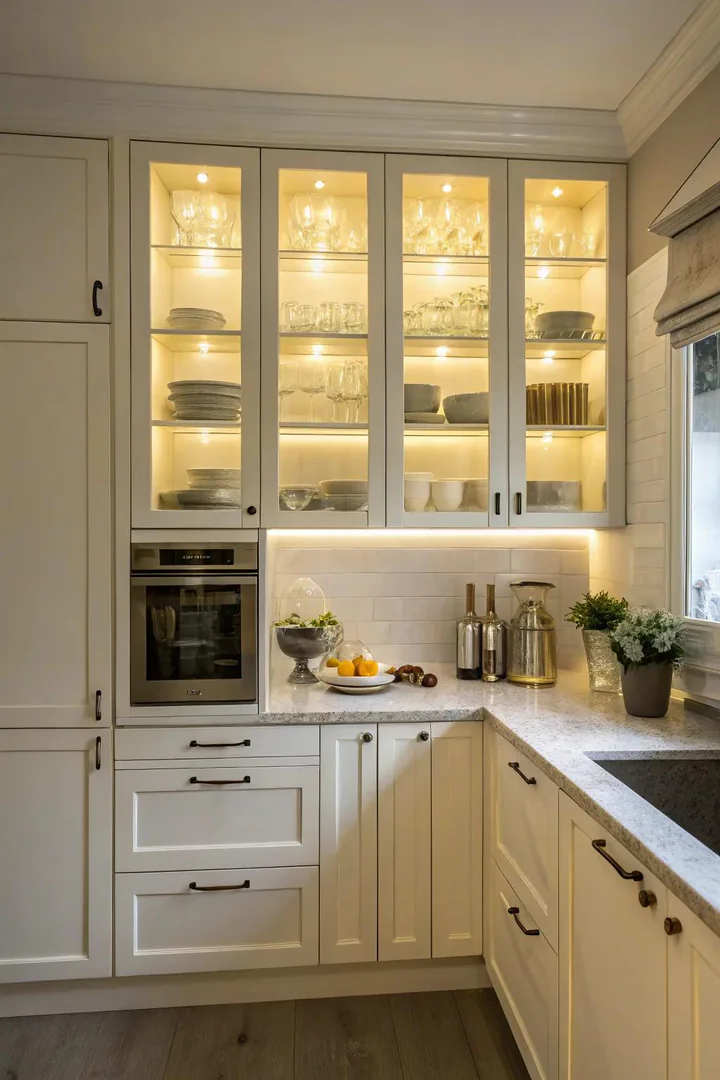
Integrated cabinet lighting — LED strips inside glass-front cabinets, puck lights on interior shelves, under-cabinet LED bars illuminating the countertop, and in-drawer LED strips that activate when the drawer opens — adds functional task light, ambient warmth, and display illumination that makes the kitchen feel layered and inviting at every hour of the day. Lighting inside and around cabinets turns the cabinetry itself into a light source, reducing the kitchen’s dependence on overhead ceiling fixtures.
Under-cabinet lighting is the highest-impact cabinet lighting upgrade: LED light bars (from WAC Lighting, Kichler, or GE) mounted to the underside of upper cabinets cast direct, shadow-free light onto the countertop work surface. In-cabinet lighting for glass-front cabinets uses slim LED strips (from Philips Hue, HitLights, or Inspired LED) mounted along the top interior edge, powered by a small transformer hidden inside the cabinet. In-drawer LED strips (from Hafele’s Loox system or Rev-A-Shelf) activate automatically via a door/drawer sensor switch when the drawer opens. For more on coordinating cabinet lighting with the overall kitchen lighting scheme, browse our kitchen lighting ideas guide.
14. Choose Minimalist Shaker Design
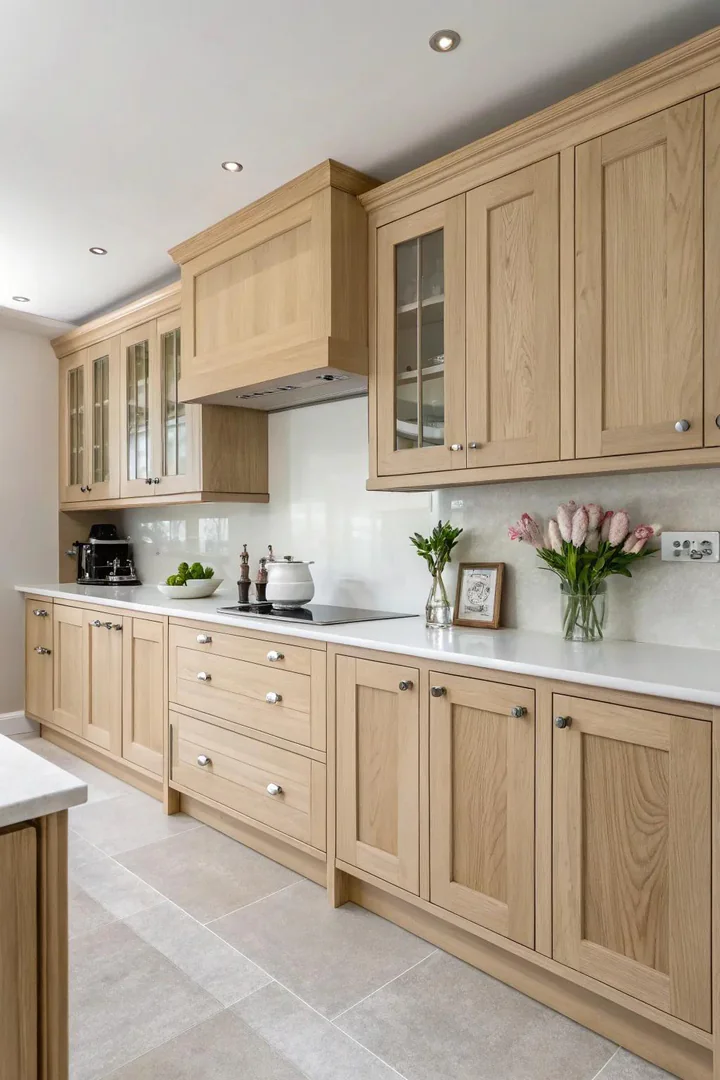
Shaker cabinets — a five-piece door construction with a flat center panel and a simple, square-profiled frame, based on the furniture of the Shaker religious communities of the 18th and 19th centuries — are the single most popular cabinet door style in American kitchens and the safest long-term design choice for resale value and visual versatility. Shaker doors work in traditional, transitional, modern, farmhouse, and coastal kitchens depending on the color, hardware, and countertop they are paired with.
For the most refined Shaker look, choose doors with a thin, flat rail-and-stile frame (1.5 to 2 inches wide) and a recessed flat center panel — no beading, no chamfer, no profile detail. Paint in white (Benjamin Moore Chantilly Lace OC-65 or Simply White OC-17), warm gray (Revere Pewter HC-172 or Edgecomb Gray HC-173), or a soft color (Pale Oak OC-20, Wickham Gray HC-171). Source Shaker doors from semi-custom cabinet lines (KraftMaid, Diamond, Thomasville at Home Depot) or from aftermarket door makers (Semihandmade, Nieu, Kokeena) that make Shaker fronts compatible with IKEA Sektion cabinet boxes.
15. Incorporate An Inbuilt Coffee Station
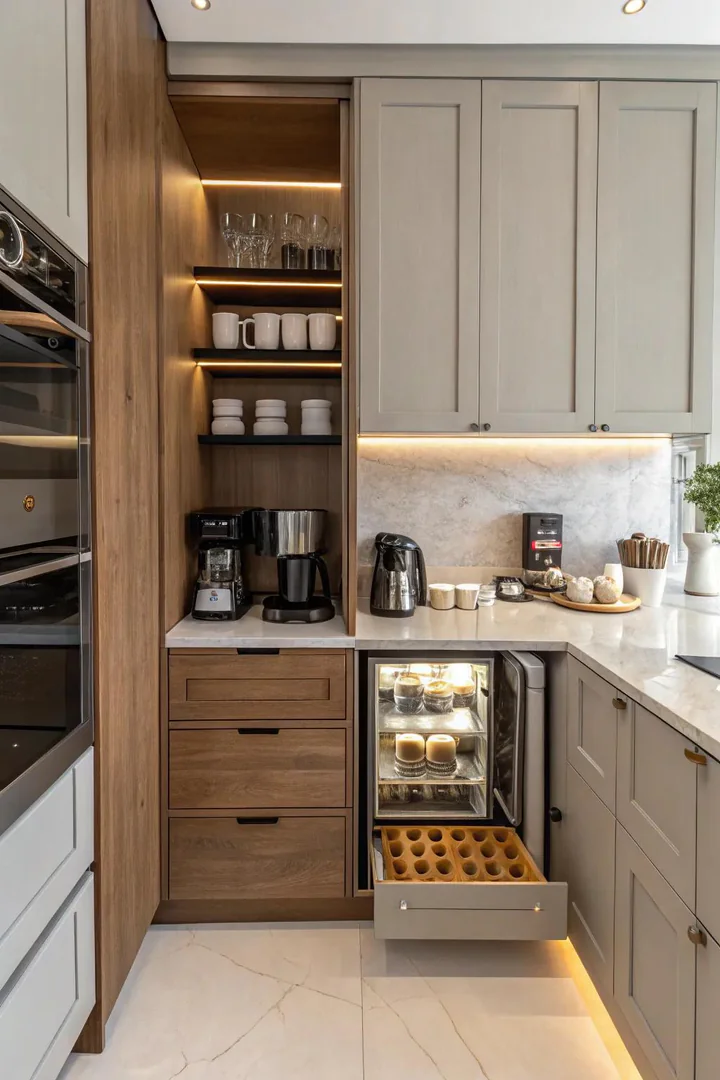
A built-in coffee station — a dedicated cabinet alcove or appliance garage that houses an espresso machine, drip coffee maker, or built-in coffee system along with mugs, beans, grinder, filters, and syrups in a single organized zone — keeps the coffee-making workflow contained and the main countertops clear. The coffee station can be an open niche in the cabinetry, a pocket-door appliance garage (doors that slide back into the cabinet sides when open), or a pull-out shelf behind a retractable cabinet door.
Plan the coffee station with a dedicated 15-amp electrical outlet (for the espresso machine) at the back of the alcove, a small section of waterproof countertop or tile backsplash for drips and spills, and storage organized by frequency of use: daily items (mugs, coffee, machine) at eye level, weekly items (specialty beans, syrups, spare filters) on upper shelves, and rarely used items (backup equipment, holiday mugs) in lower drawers. A built-in cup warming drawer (from Miele, Thermador, or JennAir) positioned beneath the espresso machine adds a luxury hotel-quality touch. Visit The Designers Company for more kitchen renovation and cabinet inspiration.
How to Choose the Right Kitchen Cabinets
Setting Your Budget and Priorities
Kitchen cabinets account for 30 to 50 percent of a total kitchen renovation budget, making them the single largest line item. Stock cabinets (from IKEA, Home Depot’s Hampton Bay, or Lowe’s Diamond Now) range from $60 to $200 per linear foot. Semi-custom cabinets (KraftMaid, Thomasville, CliqStudios) range from $150 to $650 per linear foot. Custom cabinets (built to your exact specifications by a local cabinet maker or brands like Plain & Fancy, Crystal Cabinet Works, or Wood-Mode) range from $500 to $1,200+ per linear foot. Determine your total cabinet budget before choosing styles, finishes, and features — the budget dictates whether you are shopping stock, semi-custom, or custom.
Matching Style to Your Kitchen’s Architecture
The cabinet style should complement the kitchen’s architecture and the home’s overall design language. Shaker and raised-panel doors suit traditional, colonial, and craftsman homes. Flat-panel (slab) doors suit modern, mid-century, and contemporary homes. Beadboard and inset doors suit farmhouse and cottage homes. Two-tone and mixed-material cabinets suit transitional and eclectic spaces. Study the home’s existing trim profiles, door styles, and molding details — the cabinet doors should feel like they belong in the same vocabulary, not like they were imported from a different architectural era.
Evaluating Material and Construction Quality
The cabinet box construction — the material and joinery of the box itself, not the door — determines how long the cabinets will last. Plywood boxes (3/4-inch birch or maple plywood) are stronger, more moisture-resistant, and more durable than particleboard or MDF boxes. Dovetail or dowel-joined drawer boxes last longer than stapled or glue-joined boxes. Full-extension, soft-close drawer slides (from Blum Tandem, Grass Nova Pro, or Hettich Actro) and soft-close hinges (Blum Blumotion, Hettich Sensys) are worth the upgrade on every cabinet — they protect the cabinet box from slamming impact and make every drawer and door feel solid and well-made.
Kitchen Cabinet Style Comparison
| Cabinet Style | Best For | Price Range | Maintenance |
|---|---|---|---|
| Shaker | All kitchen styles | $$ — $$$ | Low — simple profile is easy to clean |
| Flat-panel (slab) | Modern, minimalist | $$ — $$$$ | Medium — fingerprints show on smooth surfaces |
| Glass-front | Display and visual openness | $$$ — $$$$ | Medium — interior must stay organized |
| Two-tone | Adding depth and contrast | $$ — $$$$ | Low — same as single-color |
| Handleless | Ultra-modern, European | $$$ — $$$$ | Low — no hardware to clean around |
| High-gloss | Small or dark kitchens | $$$ — $$$$ | High — fingerprints visible constantly |
| Reclaimed wood | Rustic, farmhouse | $$$ — $$$$ | Medium — periodic oiling and sealing |
| Open shelving | Airy, display-focused | $ — $$ | High — dust and grease exposure |
Common Kitchen Cabinet Mistakes to Avoid
Choosing style over storage function. The most common cabinet mistake is selecting a door style, color, and finish without first mapping the storage requirements for your specific kitchen. Before choosing aesthetics, inventory every item that needs to be stored in the cabinets — pots, pans, baking sheets, small appliances, dishes, glasses, dry goods, cleaning supplies, spices, and recycling/trash — and ensure the cabinet layout provides a dedicated, accessible location for each category. A beautiful kitchen with insufficient or poorly organized storage becomes frustrating within weeks.
Installing upper cabinets too low or too high. Standard upper cabinet installation places the bottom of the cabinet 18 inches above the countertop, but this height should be adjusted based on the primary cook’s height and the backsplash design. Too low and the upper cabinets crowd the countertop work zone and make the kitchen feel cramped. Too high and the top shelf becomes unreachable without a step stool. Measure based on who uses the kitchen most.
Skipping soft-close hardware. Soft-close hinges and drawer slides cost $3 to $10 more per hinge/slide than standard hardware, but they eliminate cabinet slamming, reduce wear on the cabinet box, and make the kitchen feel dramatically more refined. Every kitchen built or renovated today should include soft-close hardware on every door and drawer — this is not a luxury feature, it is a standard-of-quality issue.
Ignoring lighting inside and under cabinets. Cabinets without under-cabinet lighting leave the countertop work surface in shadow (the cook’s body blocks the overhead ceiling light), making food prep harder and less safe. Under-cabinet LED lighting is inexpensive ($30 to $100 per linear foot) and can be installed during or after cabinet installation. Plan for it from the beginning so the wiring is concealed inside the cabinet rather than exposed on the underside.
Frequently Asked Questions
What is the most popular kitchen cabinet style right now?
Shaker-style cabinets remain the most popular kitchen cabinet style, accounting for roughly 60 percent of new kitchen installations in North America. Their clean, five-piece door construction works with every design direction — paint them white for a classic look, dark gray for modern, sage green for organic, or natural wood for Scandinavian. Flat-panel (slab) doors are the second most popular style, driven by the growth of European-influenced and minimalist kitchen design.
Should I choose painted or stained cabinets?
Painted cabinets (typically MDF or maple doors coated in lacquer, enamel, or high-quality latex) offer unlimited color options and a smooth, uniform finish. Stained cabinets (solid wood doors with a transparent or semi-transparent stain that shows the natural grain) offer warmth, natural character, and a connection to the wood species. Painted cabinets are better for modern, minimalist, and colorful kitchens. Stained cabinets are better for rustic, traditional, and warm-toned kitchens. Painted MDF is more stable than painted solid wood (MDF does not expand and contract with humidity changes, so paint does not crack at joints over time).
How long do kitchen cabinets last?
Well-built kitchen cabinets with plywood boxes, solid wood or MDF doors, and quality hardware (soft-close hinges and full-extension slides) last 20 to 30 years or longer with normal use. Stock cabinets with particleboard boxes and standard hardware typically last 10 to 15 years before the boxes begin to sag, swell from moisture exposure, or lose structural integrity at the fastener points. Refacing (replacing doors and drawer fronts while keeping the existing cabinet boxes) can extend the life of structurally sound boxes by another 10 to 15 years at roughly half the cost of full replacement.
Can I paint my existing cabinets instead of replacing them?
Yes, painting existing cabinets is a cost-effective alternative to full replacement — it typically costs $3,000 to $7,000 for a professional paint job on an average kitchen versus $15,000 to $40,000 for new semi-custom or custom cabinets. The process requires thorough preparation: remove all doors and hardware, clean with TSP (trisodium phosphate), sand or degloss all surfaces, apply a bonding primer (Zinsser BIN shellac primer or STIX bonding primer), and apply 2 coats of high-quality cabinet paint (Benjamin Moore Advance, Sherwin-Williams Emerald Urethane, or Fine Paints of Europe Hollandlac). Spray application produces a smoother, more professional finish than brush-and-roller.
What hardware finish should I choose for my cabinets?
Match the cabinet hardware finish to the kitchen’s existing metal tones — the faucet, light fixtures, and appliance handles should share the same metal family. Matte black hardware is the most versatile choice, working with white, gray, wood, and colored cabinets. Brushed brass and unlacquered brass suit warm-toned, traditional, and transitional kitchens. Polished nickel and chrome suit modern and contemporary kitchens with cool-toned palettes. Oil-rubbed bronze suits rustic, farmhouse, and traditional kitchens with warm wood and earth tones.
What is the best cabinet material for kitchens with high humidity?
Marine-grade plywood (exterior-grade plywood with waterproof adhesive between layers) and high-pressure laminate (HPL) doors are the most moisture-resistant cabinet materials for kitchens with high humidity, poor ventilation, or proximity to water sources. Avoid particleboard and standard MDF in high-humidity kitchens — both swell, warp, and degrade when exposed to moisture. If using MDF doors, choose moisture-resistant MDF (green-core MDF, labeled “MR MDF”) and ensure all edges and surfaces are fully sealed with paint or laminate to prevent moisture infiltration.
Conclusion
Kitchen cabinet ideas cover the full range of style, material, color, and construction choices that determine how your kitchen looks, works, and lasts. The 15 designs above — from bold color cabinets and two-tone schemes to Shaker profiles, handleless systems, and built-in coffee stations — provide specific, actionable options for kitchens of every size, budget, and design direction.
Start your cabinet selection by defining three things: your budget range (stock, semi-custom, or custom), your style direction (modern, traditional, transitional, or farmhouse), and your storage requirements (what needs to go where). With those three decisions made, the right door style, finish, and hardware will follow naturally. Choose quality box construction and soft-close hardware regardless of style — these structural choices determine whether the cabinets still feel solid and well-made in 15 years.