
Luxury Marble Kitchen Ideas: 17 Sophisticated Looks You’ll Adore Now
Marble has been the defining material of luxury kitchens for centuries, and its appeal has only grown stronger as homeowners look for surfaces that combine natural beauty with serious durability. No two marble slabs are identical — every vein, cloud, and color shift tells a geological story millions of years in the making, which means your kitchen countertop or island will always be one of a kind.
Choosing the right marble for your kitchen involves more than picking a pretty slab at the stone yard. You need to understand vein density, porosity ratings, finish options, and sealing schedules to keep the stone looking pristine under daily kitchen use. The wrong marble in a high-traffic cooking space can etch and stain within weeks, while the right selection — properly sealed and maintained — will age gracefully for decades.
Below you will find 17 luxury marble kitchen ideas spanning bold statement islands, subtle accent surfaces, and everything in between. Each one includes specific marble types, complementary materials, and care tips so you can bring the look home with confidence.
1. Striking Veins for a Theatrical Impact

Calacatta Borghini is the gold standard for bold veining — its thick, sweeping grey-and-gold veins running across a bright white base turn any island into a statement piece that commands attention from across the room. When selecting a slab with dramatic veining, ask your fabricator to do a dry layout so you can see exactly how the pattern falls across your island dimensions before committing to a cut. Book-matching two adjacent slabs creates a mirror-image butterfly pattern that amplifies the drama even further.
Pair heavily veined marble with flat-panel cabinetry in a quiet matte finish — think Benjamin Moore Hale Navy or Sherwin-Williams Iron Ore — so the stone takes center stage without competing with busy door profiles. Keep the backsplash simple, either a single matching slab carried up the wall or plain white subway tile, to avoid visual clutter. Seal bold-veined Calacatta with a penetrating impregnator like StoneTech BulletProof every twelve months, because the dense vein lines can trap liquids faster than the surrounding white field.
2. Discreet Marble in a Simple Environment
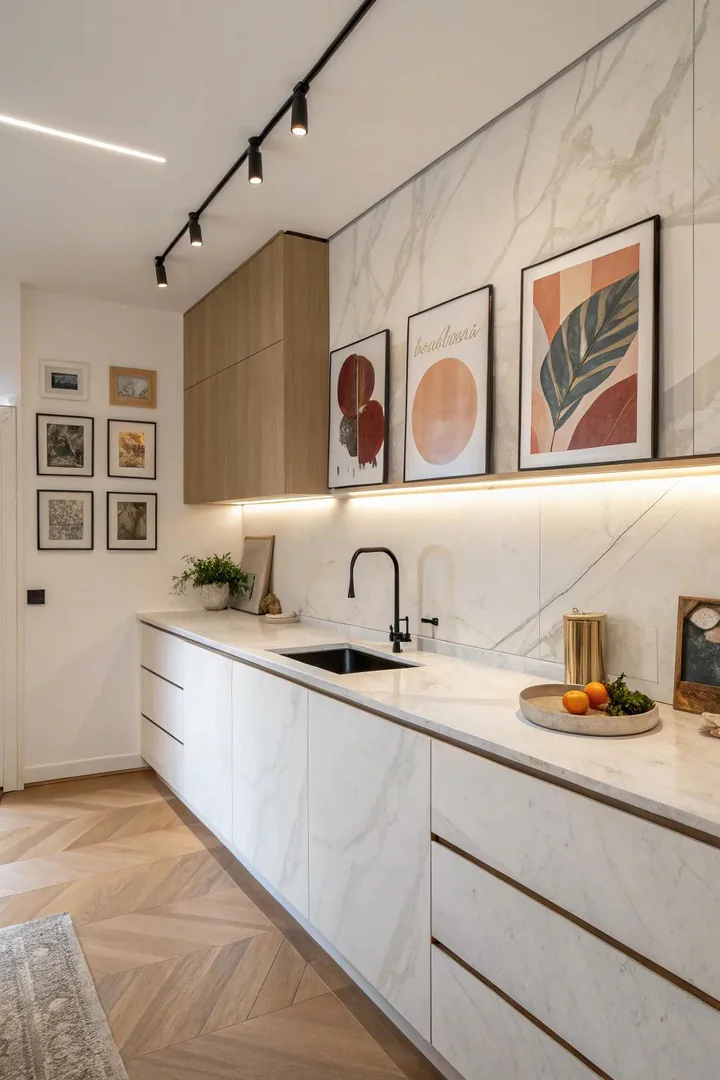
Not every marble kitchen needs to shout. Bianco Carrara with its fine, feathery grey veins on a soft white base delivers quiet elegance that lets the architecture do the talking. In a minimalist kitchen with handleless cabinets and recessed toe kicks, a Carrara countertop reads almost like a cloud — present but never dominating. This restraint works especially well in open-plan homes where the kitchen shares sightlines with the living and dining areas.
Choose a honed finish rather than polished for a minimalist setting. Honed Carrara has a matte, velvety texture that absorbs light instead of bouncing it, which keeps the space feeling calm rather than flashy. The trade-off is that honed surfaces show water marks more readily, so apply a quality sealer like Dry-Treat Stain-Proof Original twice a year. If you love the subtle marble look and want to explore how it pairs with warm neutrals, our grey and beige kitchen ideas guide covers palettes that complement low-contrast stone beautifully.
3. Enchanting Medium-Hued Wood and Marble
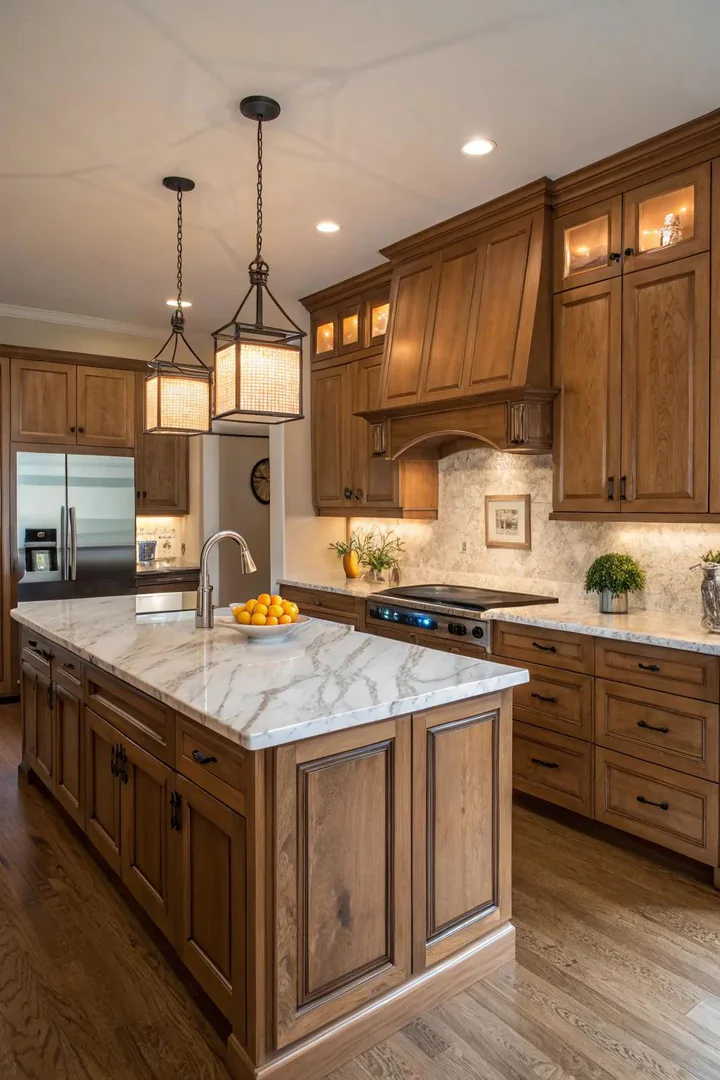
Medium-toned woods like white oak, walnut, and rift-sawn ash bring warmth that balances the cool surface temperature and visual crispness of marble. A white-oak island base topped with a Statuario marble slab creates a two-tone composition where neither material overwhelms the other — the honey tones of the wood anchor the marble’s brightness, and the marble’s veining adds visual interest that flat wood cannot match on its own.
For cabinetry, choose a stain that lands in the medium range on the Minwax color chart — Golden Oak, Provincial, or Special Walnut all pair well with white and grey marbles. Keep the grain direction consistent on all cabinet fronts for a clean, continuous look. Use matching wood floating shelves on one wall to tie the island wood into the rest of the kitchen, and display a few stoneware pieces or linen-wrapped cookbooks on those shelves to add texture without clutter. The warmth of wood makes the marble feel approachable rather than cold, which is exactly what you want in a room designed for cooking and gathering.
4. Elegant Under-Cabinet Lighting Solutions
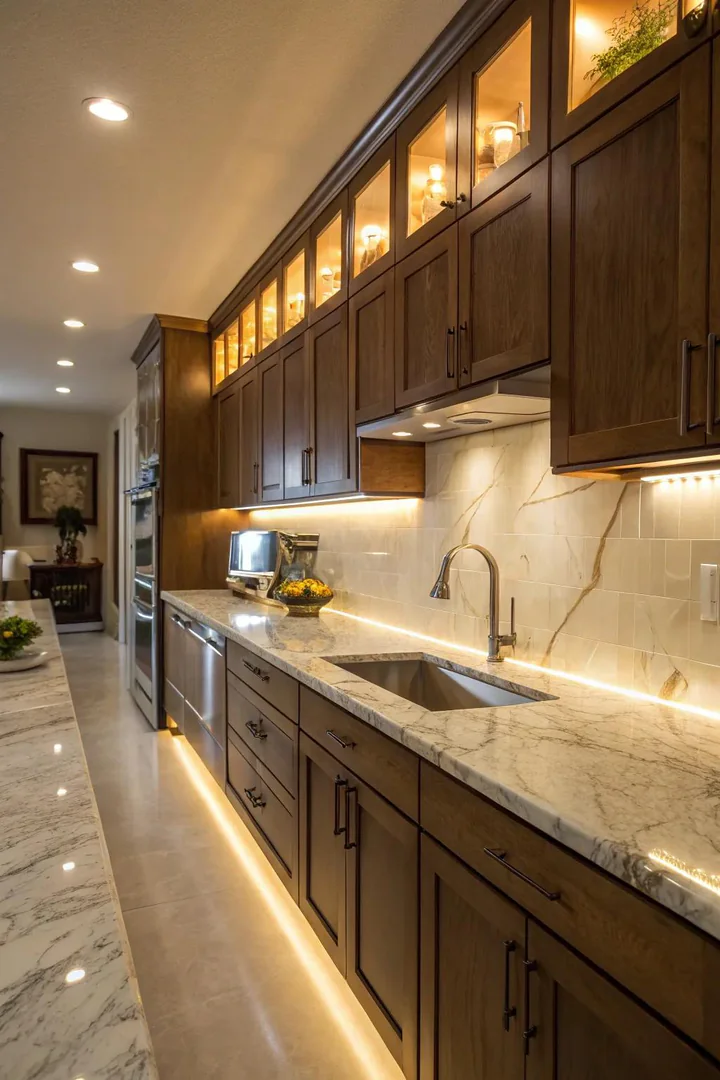
Under-cabinet LED strips at 3000K color temperature bring out the warm undertones in marble veining that overhead pot lights miss entirely. Mount the strips behind a flush aluminum channel with a frosted diffuser lens — WAC Lighting’s InvisiLED and Kichler’s 6T series both offer low-profile channels that disappear under the cabinet rail. Position the channel toward the front of the cabinet bottom, not against the wall, so the light washes down the face of the backsplash and pools on the countertop surface where you actually prep food.
Dimmable drivers let you dial the brightness from full task lighting during meal prep down to a soft glow for evening entertaining. A Lutron Caseta dimmer switch paired with an ELV driver gives smooth, flicker-free dimming from one-hundred-percent down to five percent. The low setting turns your marble backsplash into a glowing accent wall after dark, highlighting every vein and color shift in the stone. If your marble has gold or honey veining — common in Calacatta Macchia Vecchia — warm LED lighting at 2700K brings those gold tones forward even more dramatically.
5. Combining Marble and Light Wood
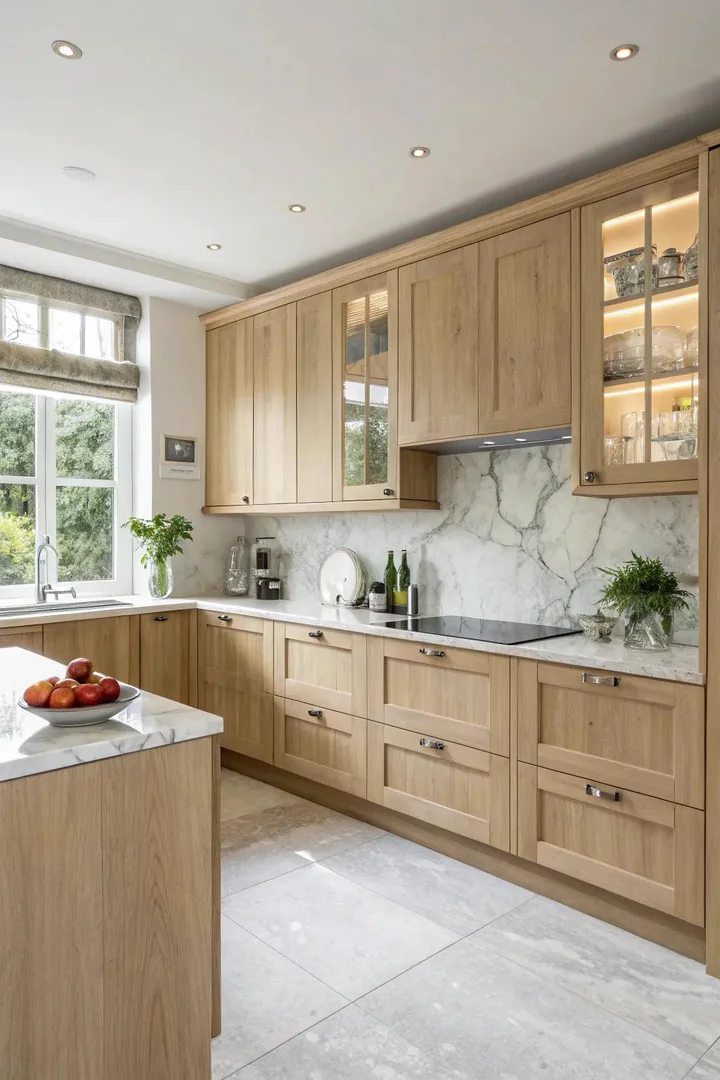
Light woods like maple, birch, and white-washed ash pair with marble to create kitchens that feel bright and airy even in rooms with limited natural light. Scandinavian-inspired kitchens use this combination frequently — a pale birch cabinet set against a Carrara or Danby marble countertop produces a room that reads as open and clean without feeling sterile. The key is choosing a marble with warm grey veining rather than blue-grey, which can clash with the yellow undertones in light woods.
Edge profiles on the marble matter more than you might think in a light-toned kitchen. A simple eased edge (just a slight rounded-over corner) keeps the modern, pared-back feel intact. Avoid ornate ogee or dupont profiles — they introduce visual weight that conflicts with the airy palette. For the floor, extend the light-wood theme with wide-plank engineered hardwood in a natural or matte finish, and let the marble countertop be the single contrasting material that draws the eye. This focused approach keeps the entire room feeling cohesive and intentional.
6. Bold Black and White Contrast
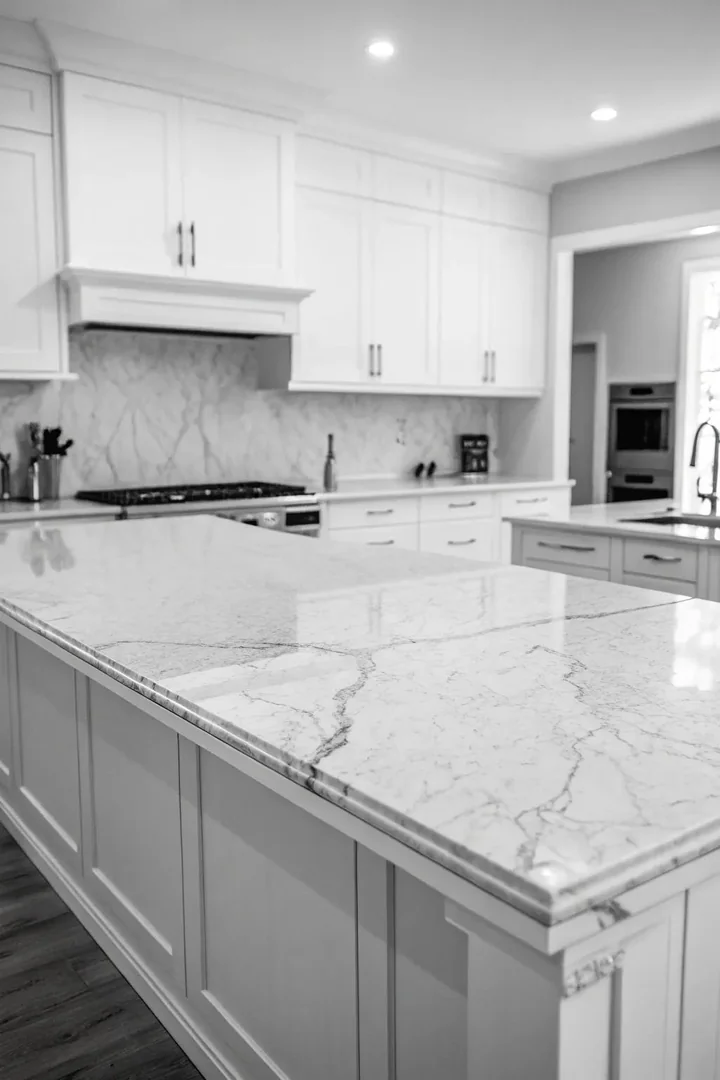
A black-and-white kitchen anchored by marble is a look that never goes out of fashion. Pair matte black cabinetry — Farrow & Ball’s Railings or Benjamin Moore’s Onyx — with a white Calacatta marble countertop for maximum contrast. The black absorbs light and recedes visually, which makes the white marble surface pop forward and become the undeniable star of the room. Brushed brass or satin gold hardware on the dark cabinets adds warmth that prevents the palette from feeling clinical.
For the backsplash, carry the marble up the wall between the upper and lower cabinets as a full-slab installation rather than using tile. A continuous slab of matching Calacatta eliminates grout lines and creates a seamless sweep of stone that reads as a single piece of art. If full-slab is outside the budget, large-format porcelain tiles like the SapienStone Calacatta series mimic the look at roughly one-third the cost. Visit The Designers Company for more high-contrast kitchen palette ideas and installation guides.
7. Industrial Edge with Grey Marble
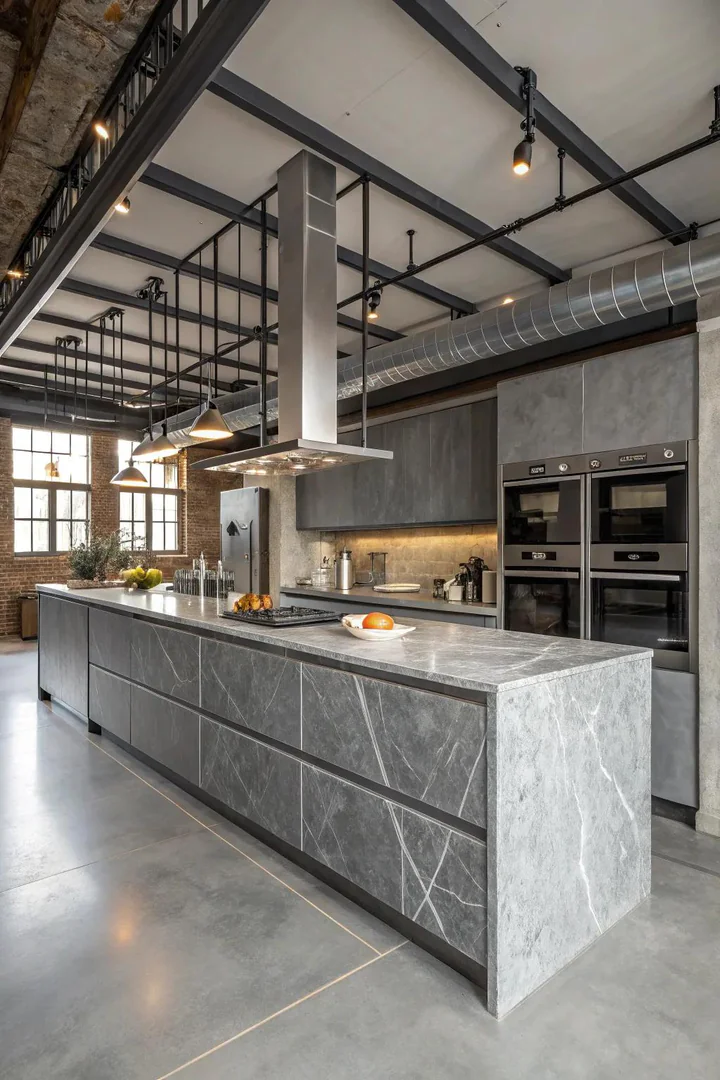
Grey marble varieties like Bardiglio, Pietra Grey, and Grey Saint Laurent bring an industrial toughness that white marbles cannot deliver. Their deep charcoal bases and stark white veining read as moody and masculine, pairing naturally with raw steel shelving, blackened iron pendant lights, and exposed concrete walls. Bardiglio in particular offers a mid-tone grey with soft, cloud-like veining that works as a bridge between warmer wood elements and cooler metal fixtures in a mixed-material kitchen.
Honed or leathered finishes suit grey marble in industrial settings better than high-gloss polish, which can make the surface look too refined for the raw aesthetic you are after. A leathered finish — where the surface is textured with a diamond brush — gives Pietra Grey a tactile, almost suede-like feel that hides fingerprints and minor scratches better than any other finish. Pair grey marble countertops with concrete-look floor tiles and black grout for a monochromatic industrial palette that still feels luxurious rather than unfinished.
8. Unique Touch with Curved Marble
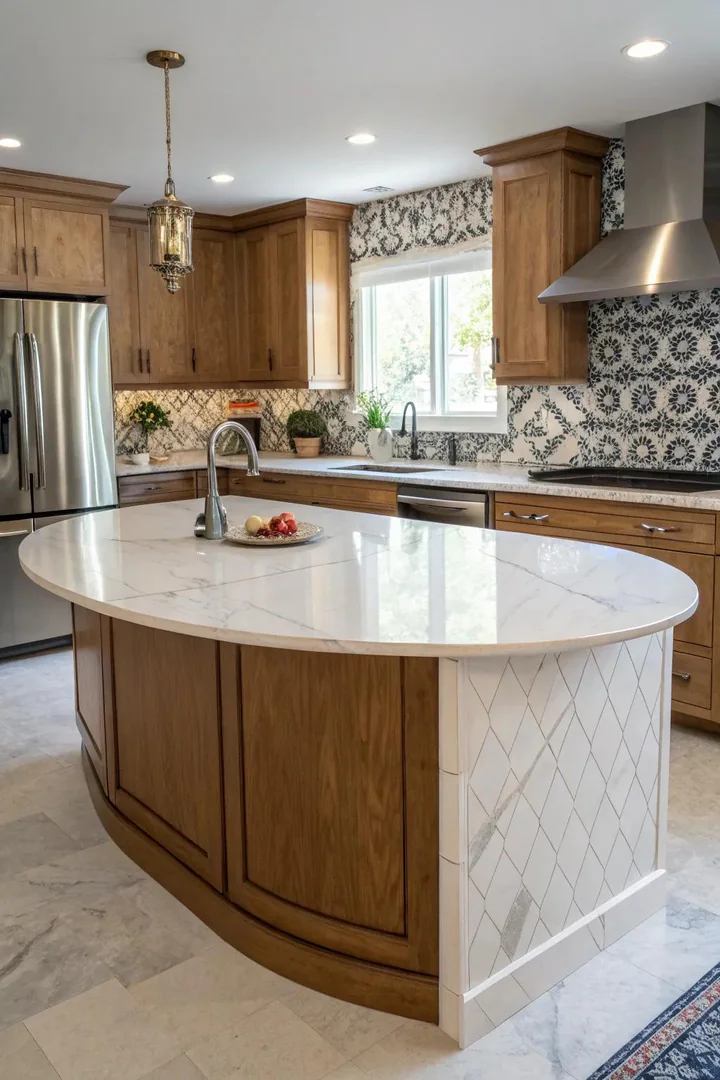
Curved marble edges on an island or a rounded waterfall end soften the angular geometry of a kitchen and add a sculptural quality that flat slabs lack. CNC-cut radius corners and rolled bullnose profiles are the two most common curved treatments — a CNC radius creates a smooth arc at the island’s corners, while a rolled bullnose rounds the entire front edge into a continuous half-circle. Both require a fabricator with five-axis CNC equipment; expect to pay a twenty-to-thirty-percent premium over standard straight-cut edges.
Calacatta Viola and Arabescato Corchia are particularly striking in curved applications because their swirling vein patterns follow the curve of the stone, creating a sense of motion that enhances the sculptural effect. Make sure the fabricator templates the curve on-site and dry-fits the slab before final polishing — curved pieces are extremely expensive to recut if the dimensions are off. Support the curved overhang with a concealed steel bracket rated for the slab’s weight, typically thirty to fifty pounds per square foot for two-centimeter-thick marble.
9. Open Kitchens Featuring Marble Islands
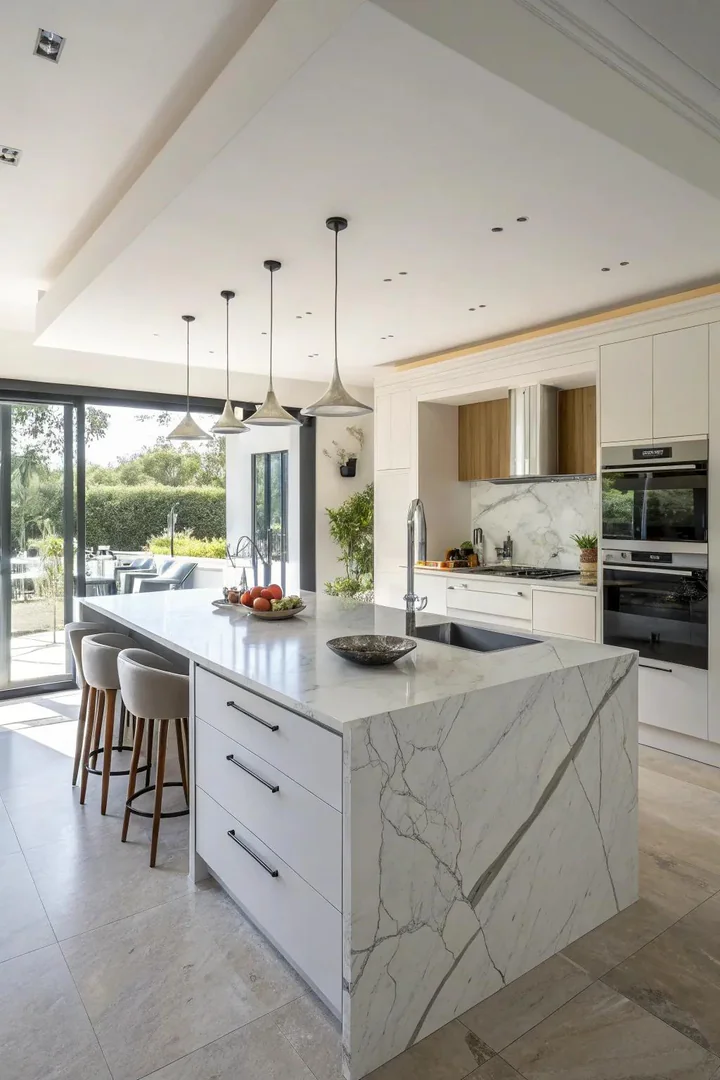
In an open-plan layout where the kitchen is visible from the living room and dining area, the island is the piece of furniture everyone sees first. A large marble island — eight feet long and four feet deep is the sweet spot for entertaining — gives you prep space, casual seating on one side, and a visual anchor that ties the kitchen to the rest of the home. Calacatta Gold with its warm golden veining pairs beautifully with the soft furnishings and area rugs you typically find in the adjoining living space.
Waterfall edges on one or both ends of the island, where the marble wraps down the sides to meet the floor, increase the stone’s visual impact and hide the island’s cabinetry structure from view. This technique doubles the slab footage you need, so budget accordingly — a waterfall island in Calacatta Gold runs between eight-thousand and fifteen-thousand dollars in fabricated material alone. If you are designing a full luxury modern kitchen, a marble waterfall island is the single biggest design element that signals high-end intent to anyone who walks through the door.
10. Thin Marble Islands Featuring Cooktops
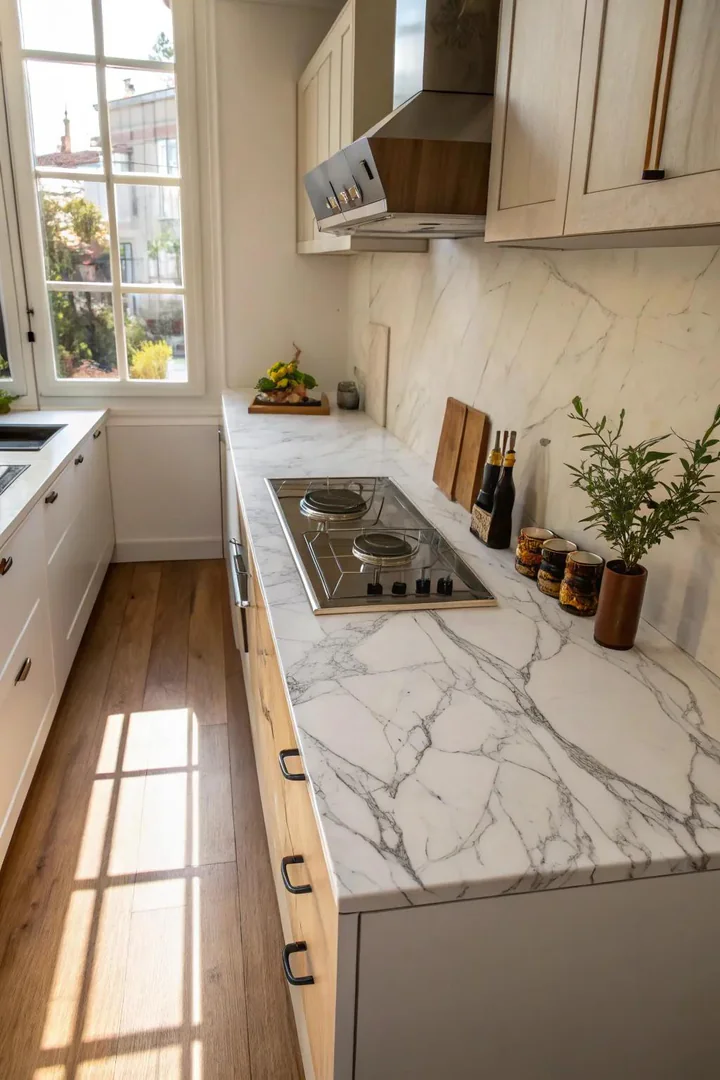
A narrow island measuring twenty-four to thirty inches deep can still accommodate a flush-mount induction cooktop while leaving enough marble surface for prep work on either side. The Bosch 500 Series and the Miele KM 6365 both come in thirty-inch widths that fit neatly into a narrow slab with two-inch margins on each side. Choose a two-centimeter-thick slab rather than three-centimeter for a sleek, low-profile edge that emphasizes the island’s slender proportions.
Heat resistance matters when marble sits next to a cooktop. While marble itself handles moderate heat, sudden temperature swings can cause thermal shock cracks along existing veins. Always use trivets or silicone heat pads between hot cookware and the marble surface, and keep the cooktop’s side ventilation outlets clear of any marble overhang. A matching marble backsplash strip behind the cooktop — four to six inches tall — protects the wall from splatter while visually extending the island’s material upward, making the whole cooking station feel integrated and considered.
11. Luxurious Ambiance with Dark Marble
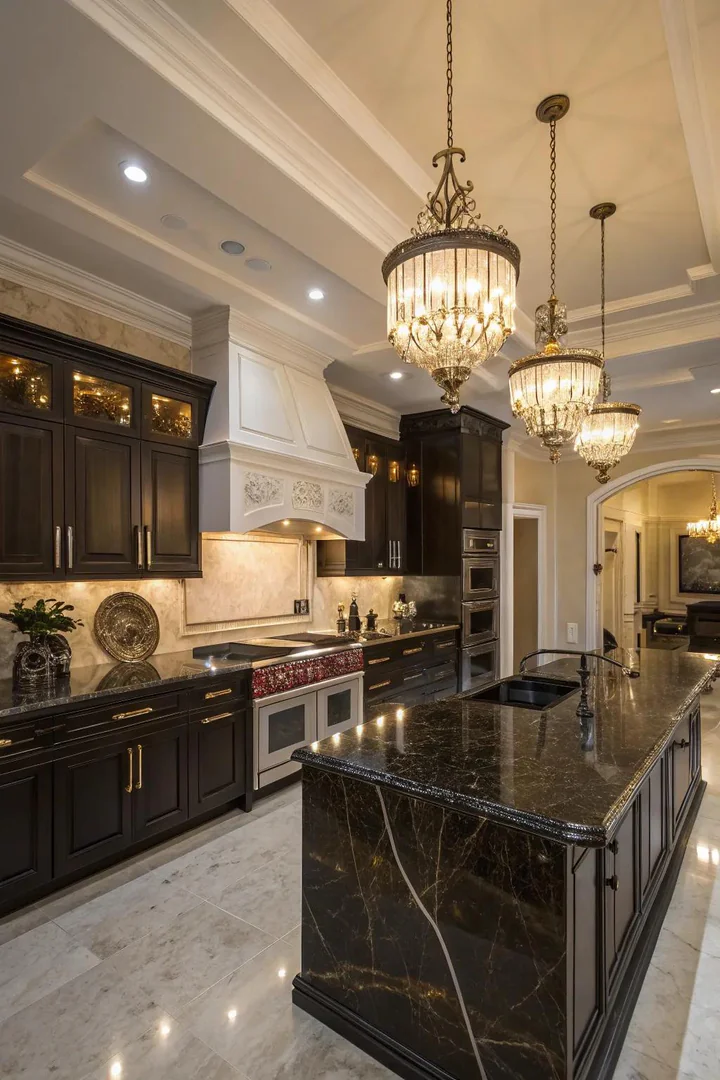
Nero Marquina from Spain and Black Marquina from China deliver jet-black bases with crisp white veining that creates a tuxedo effect on countertops and islands. These dark marbles work best in kitchens with high ceilings and generous natural light, because a black surface in a small, dim room will make the space feel closed in. Pair Nero Marquina with warm brass fixtures and light-toned wood flooring to offset the darkness and keep the room from feeling like a cave.
Dark marbles show dust, water spots, and fingerprints more visibly than white varieties, so maintenance is a daily consideration. Wipe surfaces with a microfiber cloth and a pH-neutral stone cleaner — StoneTech Stone & Tile Cleaner is a reliable everyday option — rather than all-purpose kitchen sprays, which often contain acids that etch marble. Polished dark marble also shows etching more than honed, so consider a leathered or antiqued finish if you cook frequently and want a surface that ages with character rather than showing every lemon juice splash.
12. Marble Featuring Built-in Storage
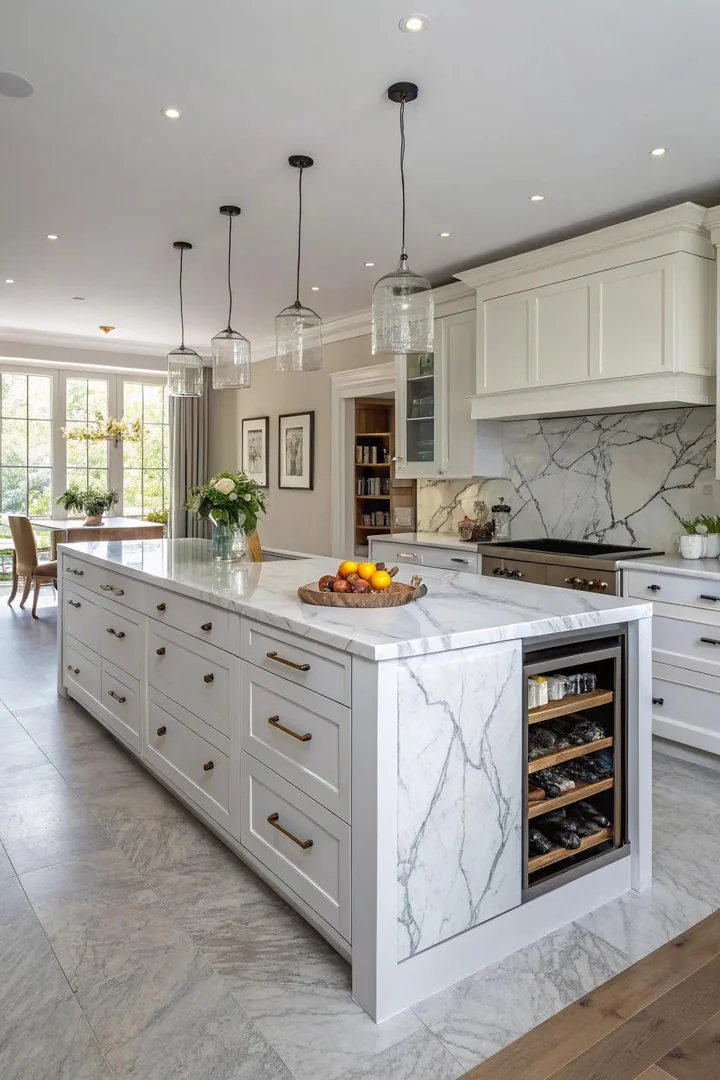
A marble-topped island with well-designed storage beneath it pulls double duty — the surface handles prep and serving, while the base houses everything from pots and pans to wine bottles and cutting boards. Deep drawers with full-extension Blum Tandembox slides are the most practical storage configuration beneath a heavy marble top because they let you access the full depth of the cabinet without bending and reaching. Plan for four to six drawers across the island’s length, with at least one extra-deep drawer for stockpots and Dutch ovens.
Open shelving on the seating side of the island creates display space for cookbooks, decorative bowls, and potted herbs without adding visual weight. Paint the interior of the open shelves the same color as the island base — or a single shade darker — so the objects on display become the focal point rather than the shelf structure. The contrast of raw, functional storage against the polished marble top gives the island a grounded, livable feel that makes guests comfortable pulling up a stool and staying awhile.
13. Experimenting with Marble Designs
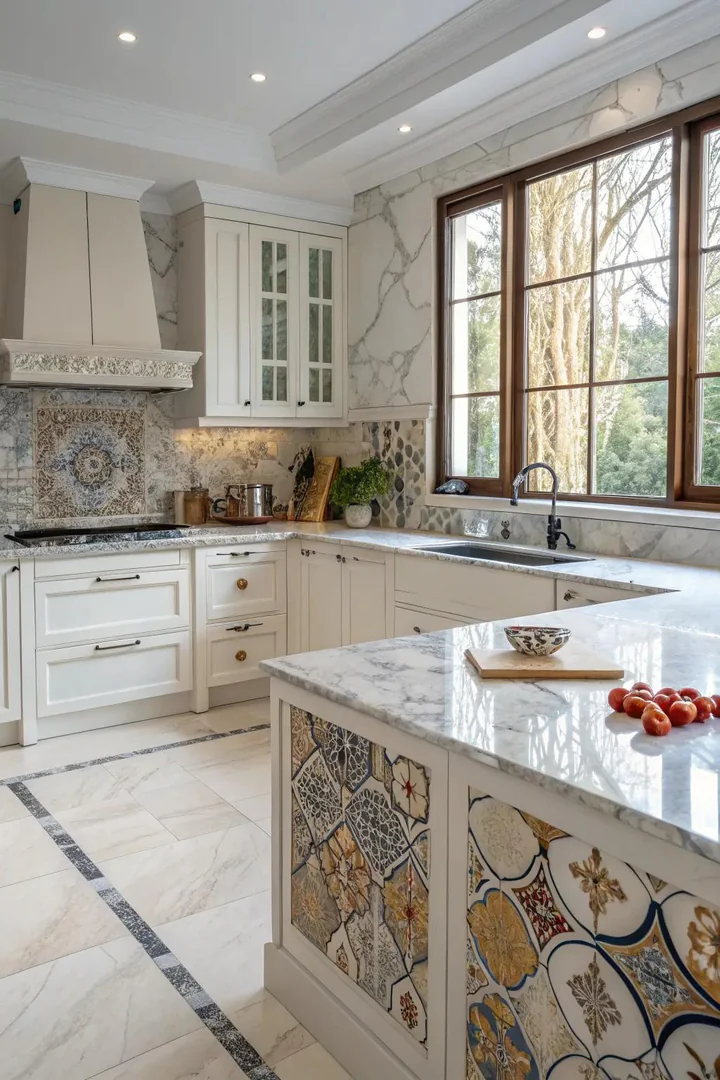
Mixing two or more marble types in the same kitchen creates visual contrast that a single stone cannot deliver on its own. Use a bold Calacatta with thick grey veins on the island and a quieter Carrara with fine, wispy veins on the perimeter countertops. The two stones share enough DNA — both are white-based Italian marbles — to look related, but the vein scale difference gives each surface its own identity and prevents the room from reading as monotone.
Another pattern-play technique is the vein-matched backsplash, where the fabricator cuts the backsplash slab from the same block as the countertop and aligns the veins so the pattern flows continuously from horizontal surface to vertical wall. This requires ordering extra slab footage and careful templating, but the result is a seamless sweep of stone that looks like it grew out of the counter. For kitchen color ideas that complement mixed-marble palettes, warm neutrals and muted earth tones tend to ground the stone without competing for attention.
14. Marble with Earthy Hues
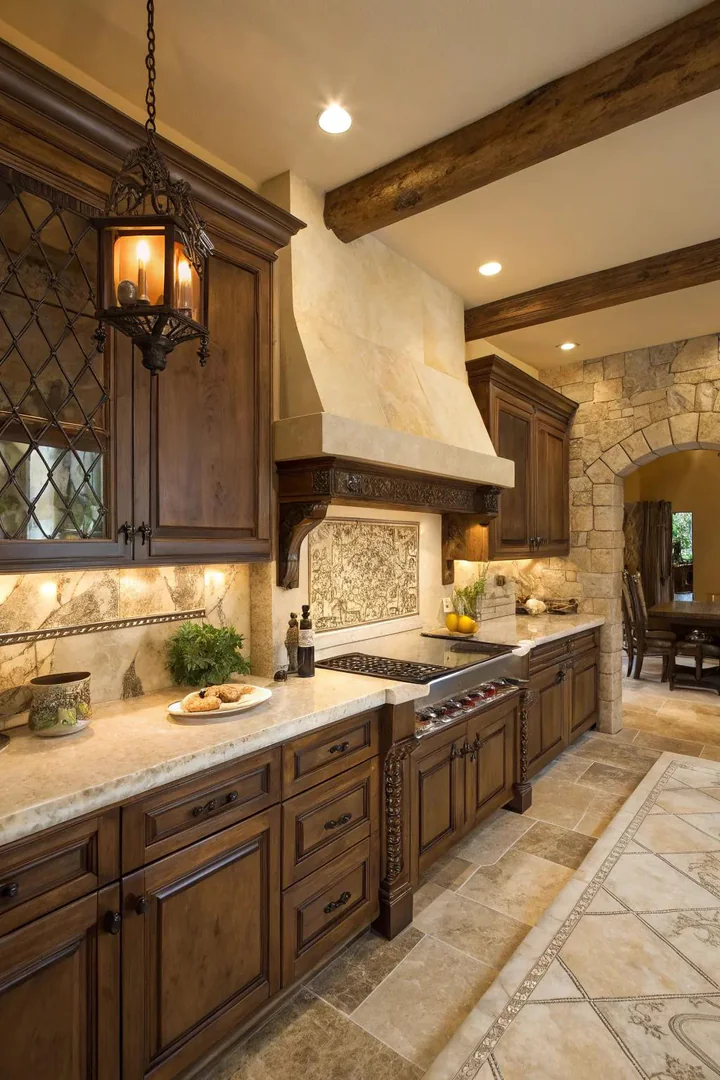
Earthy-toned marbles like Emperador Dark, Crema Marfil, and Breccia Oniciata bring warmth that white marbles struggle to match. Emperador Dark — quarried in southeastern Spain — features a deep chocolate-brown base with tan and gold veining that feels rich and inviting next to terracotta floor tiles and sage-green painted cabinets. Crema Marfil sits at the lighter end of the spectrum with a warm ivory base and faint caramel veining, making it a natural partner for cream and beige kitchen palettes.
When working with earthy marbles, keep metal finishes warm too — oil-rubbed bronze, antique brass, and copper hardware and faucets reinforce the organic color story. Cool chromes and polished nickels clash with brown-toned stone and create a visual disconnect. If you are drawn to the copper direction specifically, our white and copper kitchen ideas guide explores how warm metals pair with both light and dark stone surfaces. Use matte or honed finishes on earthy marble to enhance the natural, unpolished feel that makes these stones so appealing in the first place.
15. Marble and Dynamic Illumination
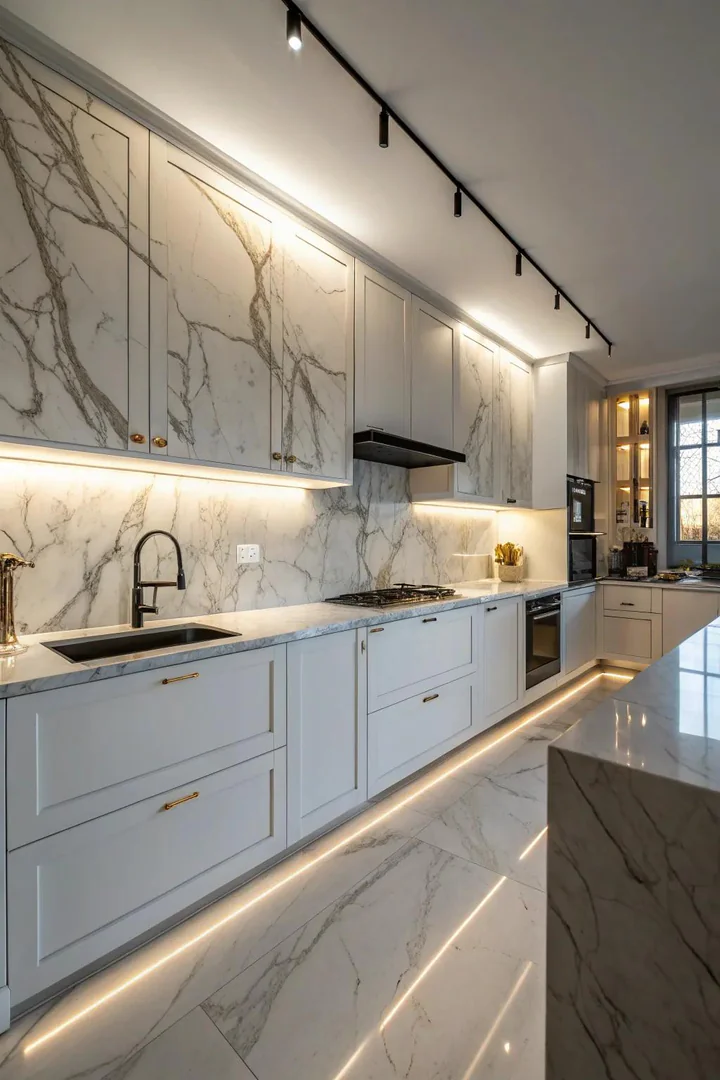
Marble changes its appearance dramatically depending on the light source hitting it. Under warm 2700K LEDs, the veins in Calacatta Gold glow with amber intensity. Under cool 4000K task lighting, the same veins shift toward silver-grey. Smart lighting systems from Lutron RadioRA or Philips Hue let you program multiple scenes — a bright task setting for cooking at 4000K, a warm ambient glow at 2700K for dinner parties — so you can control exactly how the marble reads at any time of day.
Pendant lights hung twenty-eight to thirty-four inches above a marble island cast focused pools of light that emphasize the stone’s surface texture. Choose pendants with open-bottom shades so the light hits the marble directly rather than diffusing into the room. The Rejuvenation Baltimore pendant and the Schoolhouse Electric Otis pendant both feature open bases with warm brass finishes that complement marble’s natural tones. Add recessed can lights on a separate dimmer circuit for general room fill, and you have a layered lighting plan that makes your marble look its absolute best at every hour.
16. Marble for an Everlasting Charm
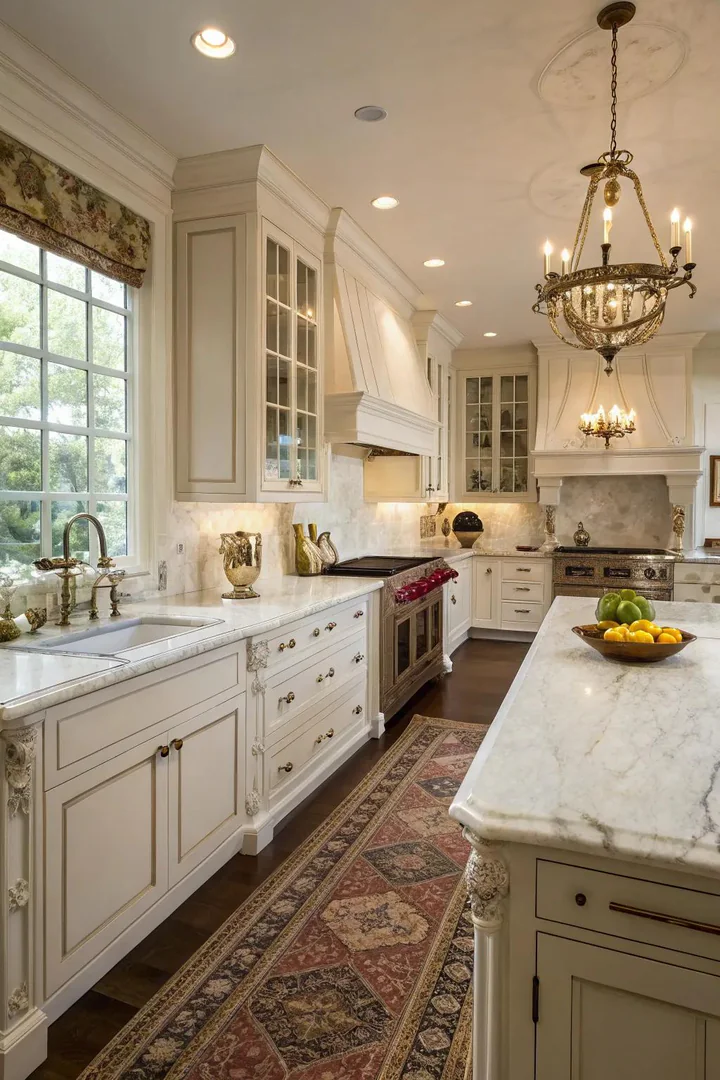
Marble’s ability to move between design eras without looking dated is one of its greatest strengths. A Carrara countertop installed in a 1920s brownstone kitchen looks just as at home as one in a 2025 new-construction modern farmhouse. This timelessness comes from the stone’s neutral color range — whites, greys, and soft golds — and its organic patterning, which never reads as trendy the way a bold-colored quartz or a heavily patterned laminate might in ten years.
To protect that timeless investment, commit to a simple care routine. Seal the marble twice a year with a penetrating impregnator, wipe spills within thirty seconds, and avoid placing acidic foods directly on the surface. Over time, a well-used marble countertop develops a soft patina of faint etch marks and hairline scratches that many homeowners describe as character rather than damage. If the patina bothers you, a professional stone restoration specialist can hone and re-polish the surface back to factory condition for a few hundred dollars — far less than replacing an entire countertop.
17. Custom Marble Patterns
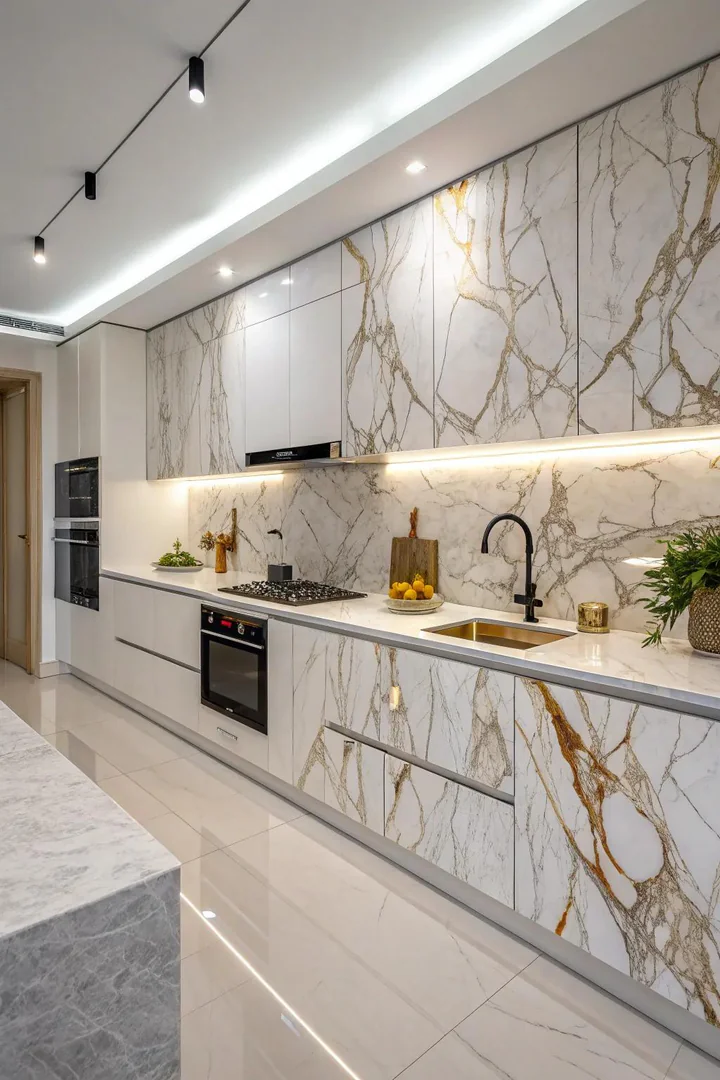
Waterjet-cut marble inlays let you embed geometric borders, medallions, or brand logos directly into a marble countertop or floor. A hexagonal Nero Marquina inlay set into a Carrara field creates a sharp graphic punch that reads as custom furniture rather than standard countertop material. Waterjet cutting uses a high-pressure abrasive stream that produces clean, precise edges on marble with no chipping, and the resulting pieces fit together with grout joints as thin as one-sixteenth of an inch.
For backsplashes, consider a chevron or herringbone pattern cut from contrasting marble strips — alternating Calacatta and Bardiglio strips in a herringbone layout produces a bold two-tone wall that looks like it belongs in a boutique hotel kitchen. Custom patterns require more slab footage due to cutting waste, so order twenty to twenty-five percent extra material. Work with a fabricator who specializes in inlay work and can show you a portfolio of completed projects, because precision cutting and tight joint tolerances make or break the final result.
How to Choose the Right Marble for Your Kitchen
Marble Types and Their Characteristics
Calacatta marbles feature bold, wide veining on a warm white base and cost between seventy-five and two-hundred-fifty dollars per square foot, making them the most expensive option. Carrara offers finer, more diffuse veining on a cooler white-grey base at forty to one-hundred dollars per square foot — it is the most widely available Italian marble and the default choice for traditional kitchens. Statuario sits between the two in both price and vein intensity, while domestic options like Vermont Danby deliver similar white-based looks at thirty to sixty dollars per square foot with shorter lead times.
Honed vs Polished Finish
Polished marble has a glossy, reflective surface that maximizes vein contrast and makes colors appear deeper. It shows etching from acidic foods more visibly than other finishes, so it works best in kitchens where the homeowner commits to wiping spills promptly. Honed marble has a matte, satin surface that hides minor etching and fingerprints but can appear slightly darker than the same stone in polished form. A third option — leathered — adds a textured, dimpled surface that masks wear extremely well and suits industrial or rustic kitchens.
Sealing and Maintenance
Apply a penetrating impregnating sealer — not a topical coating — immediately after installation and again every six to twelve months depending on use intensity. Tenax Proseal and Dry-Treat Stain-Proof are two professional-grade sealers that penetrate into the stone’s pores without changing its appearance. For daily cleaning, use a pH-neutral stone cleaner and a soft cloth. Avoid vinegar, lemon juice, bleach, and any cleaner with ammonia, all of which etch marble on contact. Place trivets under hot pans, use cutting boards rather than cutting directly on the stone, and wipe spills within thirty seconds to prevent staining.
Marble Kitchen Cost Guide
| Marble Type | Origin | Price Per Sq Ft | Best Used For |
|---|---|---|---|
| Carrara | Tuscany, Italy | $40 – $100 | Countertops, backsplashes, bathrooms |
| Calacatta Gold | Tuscany, Italy | $150 – $250+ | Statement islands, waterfall edges |
| Statuario | Tuscany, Italy | $100 – $200 | Full-slab backsplashes, feature walls |
| Nero Marquina | Basque Country, Spain | $50 – $120 | Accent surfaces, inlays, contrast islands |
| Emperador Dark | Alicante, Spain | $30 – $80 | Warm-toned countertops, flooring |
| Vermont Danby | Vermont, USA | $30 – $60 | Budget-friendly white marble alternative |
Common Marble Kitchen Mistakes to Avoid
Skipping the sealer. Unsealed marble stains within hours of contact with wine, coffee, or tomato sauce. Always seal before first use and reapply on schedule. A five-minute sealing job prevents hundreds of dollars in professional stain removal later.
Choosing polished for a busy family kitchen. Polished marble shows every etch mark from lemon juice, vinegar, and acidic sauces. If you cook daily with acidic ingredients, honed or leathered finishes are far more forgiving and still look beautiful.
Ignoring slab selection. Online photos of marble slabs rarely match the actual slab you receive. Visit the stone yard in person, view the exact slab under natural light, and mark which sections of the slab will face outward in your kitchen. The difference between a stunning installation and a disappointing one often comes down to slab selection.
Using generic cleaners. All-purpose kitchen sprays, glass cleaners, and anything containing citrus or vinegar will etch marble surfaces on contact. Invest in a pH-neutral stone cleaner and keep it in a dedicated spray bottle next to the sink so reaching for the wrong cleaner never happens.
Frequently Asked Questions
Is marble a good choice for kitchen countertops?
Marble is an excellent countertop material if you accept that it will develop a patina over time. It stays cool, which is ideal for baking and pastry work, and its natural beauty is unmatched by engineered alternatives. Regular sealing and prompt spill cleanup keep it looking great for decades. Many professional pastry chefs prefer marble precisely because the cool surface prevents butter from softening during dough work.
How often should I seal marble countertops?
Seal new marble immediately after installation. After that, reseal every six to twelve months depending on how heavily you use the kitchen. A quick water-drop test tells you when it is time: place a few drops of water on the surface and wait ten minutes. If the water absorbs and darkens the stone, the sealer has worn off and it is time to reapply.
What is the difference between Carrara and Calacatta marble?
Both come from the same quarrying region in Tuscany, Italy, but they look quite different. Carrara has a grey-blue base with fine, feathery veins and is more affordable and widely available. Calacatta has a warmer white base with bold, thick veins in grey and gold, commands a higher price, and is rarer. Carrara suits understated kitchens while Calacatta delivers a dramatic statement.
Can I put hot pans on marble?
Marble can handle moderate heat, but placing a screaming-hot cast iron pan directly on the surface risks thermal shock, which can crack the stone along existing vein lines. Always use a trivet or a silicone heat pad. Cork trivets from brands like Crate & Barrel and IKEA cost a few dollars each and prevent thousands of dollars in potential damage.
Does marble stain easily?
Unsealed marble stains readily from acidic and pigmented liquids — red wine, coffee, beet juice, and tomato sauce are the most common culprits. A properly sealed marble surface resists staining significantly, giving you time to wipe spills before they penetrate. If a stain does set, a poultice made from baking soda and distilled water left overnight usually pulls it out completely.
Is marble more expensive than quartz?
Mid-range marble like Carrara costs roughly the same as mid-range quartz, between forty and one-hundred dollars per square foot installed. High-end marbles like Calacatta Gold cost significantly more — one-hundred-fifty to two-hundred-fifty dollars per square foot — while premium quartz tops out around one-hundred-twenty dollars. The price gap is largest at the top end, but for many homeowners the natural beauty and unique veining of marble justifies the premium over an engineered surface.
Conclusion
Marble brings a level of natural beauty and sophistication to a kitchen that no engineered surface can fully replicate. Whether you choose a bold Calacatta island with sweeping gold veins or a quiet Carrara perimeter counter with soft grey striations, the stone you select becomes the defining character of the room for years to come.
Take the time to visit a stone yard, select your exact slab in person, and work with a fabricator who understands vein matching, edge profiles, and proper sealing protocols. With the right marble choice and a consistent maintenance routine, your kitchen will deliver the kind of effortless luxury that looks better with every passing year.