
Yellow Grey and White Kitchen Ideas: 19 Stunning Ways to Brighten
Yellow, grey, and white kitchens balance warm energy against cool restraint by assigning each color a specific role: yellow brings warmth through cabinets, accessories, or accent walls, grey grounds the room through countertops, flooring, or appliances, and white opens sightlines on walls, backsplash, or upper cabinets. Paint picks like Benjamin Moore Hawthorne Yellow (HC-4), Sherwin-Williams Repose Gray (SW 7015), and Benjamin Moore Simply White (OC-17) land the trio in a classic pairing that works across farmhouse, contemporary, and transitional styles. Below are 19 ways to distribute the three colors, followed by a step-by-step coordination guide, a color comparison table, and FAQs on undertones, balance ratios, and accent sourcing.
1. Sunny Yellow Shaker Cabinets with White Countertops and Grey Flooring
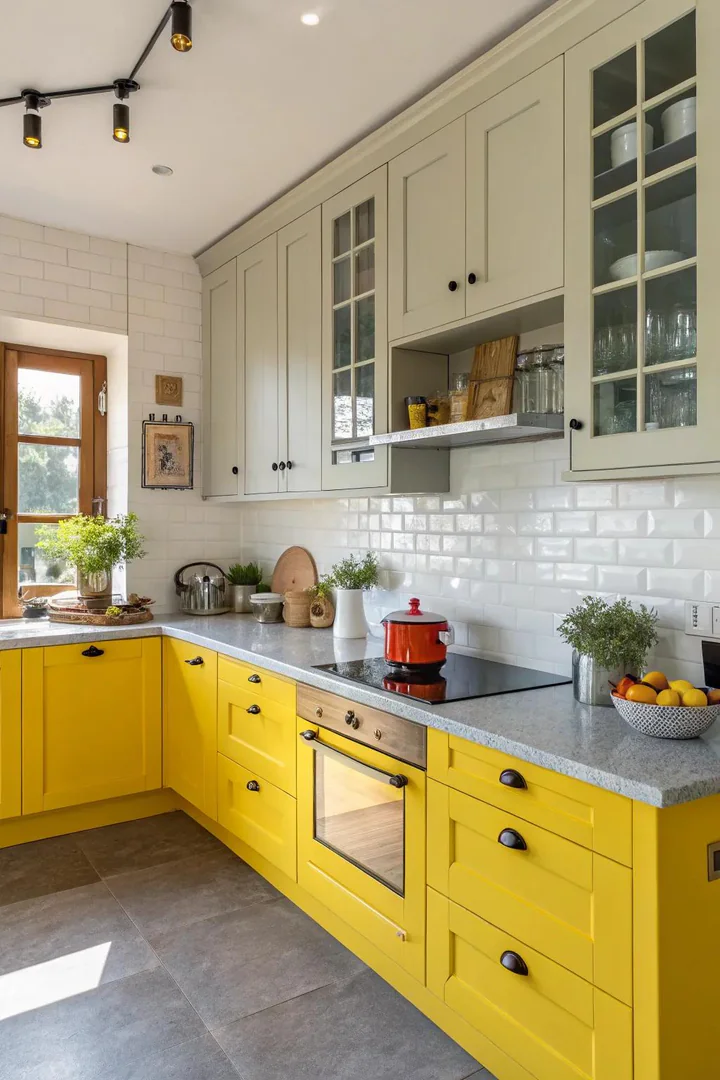
Full-coverage yellow cabinets in Benjamin Moore Hawthorne Yellow (HC-4) or Farrow & Ball Babouche (No. 223) turn the cabinetry into the room’s primary color statement. White quartz countertops from Caesarstone Pure White (1141) break up the yellow with a clean horizontal band, and grey porcelain floor tiles in a 24-by-24-inch format anchor the base without competing for attention.
Satin brass or brushed gold hardware pairs naturally with yellow because both colors share a warm undertone. A white subway tile backsplash keeps the wall zone bright and lets the yellow cabinets command the eye. Yellow cabinets work best in kitchens with at least one window because natural daylight reveals the paint’s depth, while artificial-only light can flatten the hue.
2. Grey Shaker Cabinets with Yellow Open Shelf Accessories
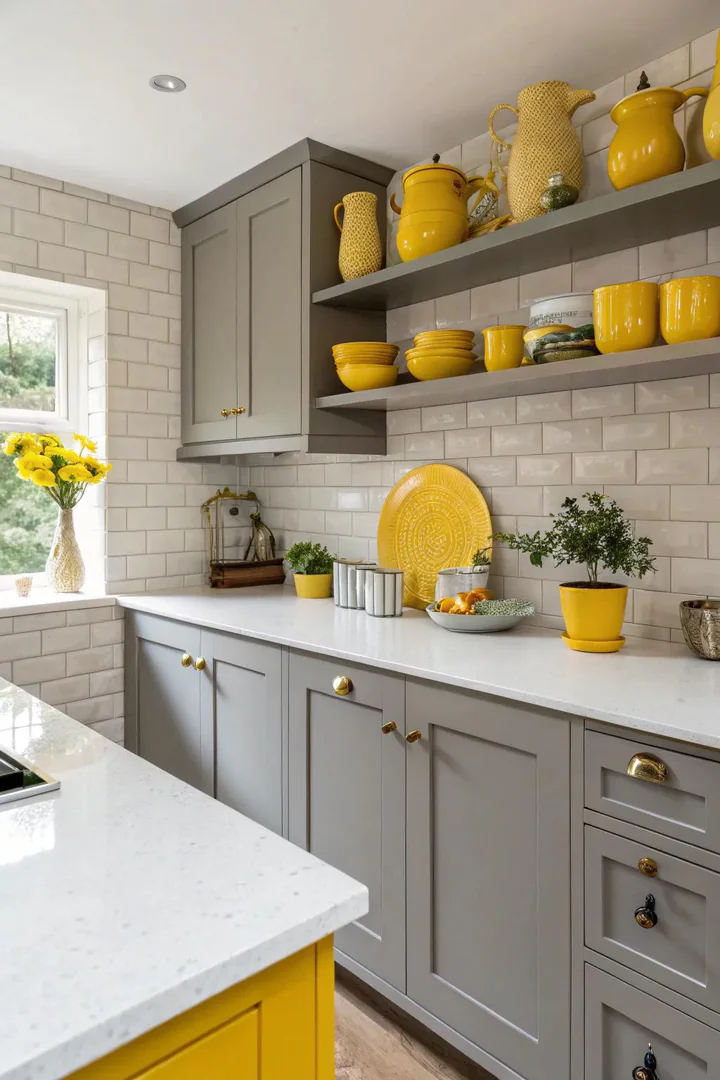
Painting cabinets in Sherwin-Williams Dorian Gray (SW 7017) and placing yellow ceramics, canisters, and cookbooks on open shelves above introduces color through accessories rather than paint. Yellow Le Creuset stoneware mugs ($18 each) and a yellow KitchenAid Artisan stand mixer ($350) add pops against the grey without requiring a repaint if the homeowner wants to change the accent later.
White walls and a white marble countertop fill the remaining surfaces with a neutral that bridges the grey and yellow. Swapping the yellow accessories for copper, sage green, or terracotta pieces changes the room’s personality in an afternoon. Removable accents give renters and budget-conscious homeowners the same three-color effect that a full cabinet paint job delivers.
3. White Walls with Yellow and Grey Accent Panels
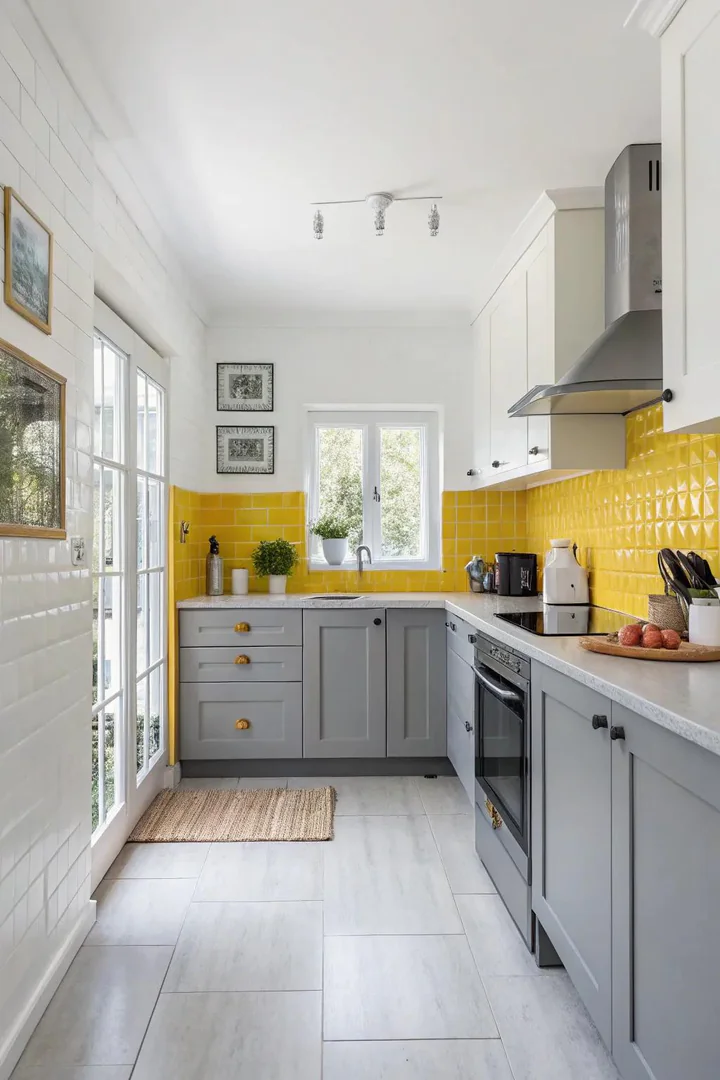
Painting one wall or a recessed niche in Benjamin Moore Lemon Chiffon (2024-60) while keeping the remaining walls in Benjamin Moore Decorator’s White (OC-149) places yellow as a targeted accent rather than a whole-room commitment. Grey open shelving, grey bar stools, or a grey range hood on the opposite side of the room creates a second accent that balances the warm yellow with a cooler tone.
A single accent wall behind the range or breakfast nook draws the eye to one focal zone and makes the kitchen feel intentionally designed rather than randomly colored. White cabinets on the accent wall stand out against the yellow backdrop, reversing the usual figure-ground relationship. Keep the accent wall free of heavy artwork or floating shelves so the color block reads as architecture, not decoration.
4. Yellow and Grey Patterned Cement Tile Backsplash
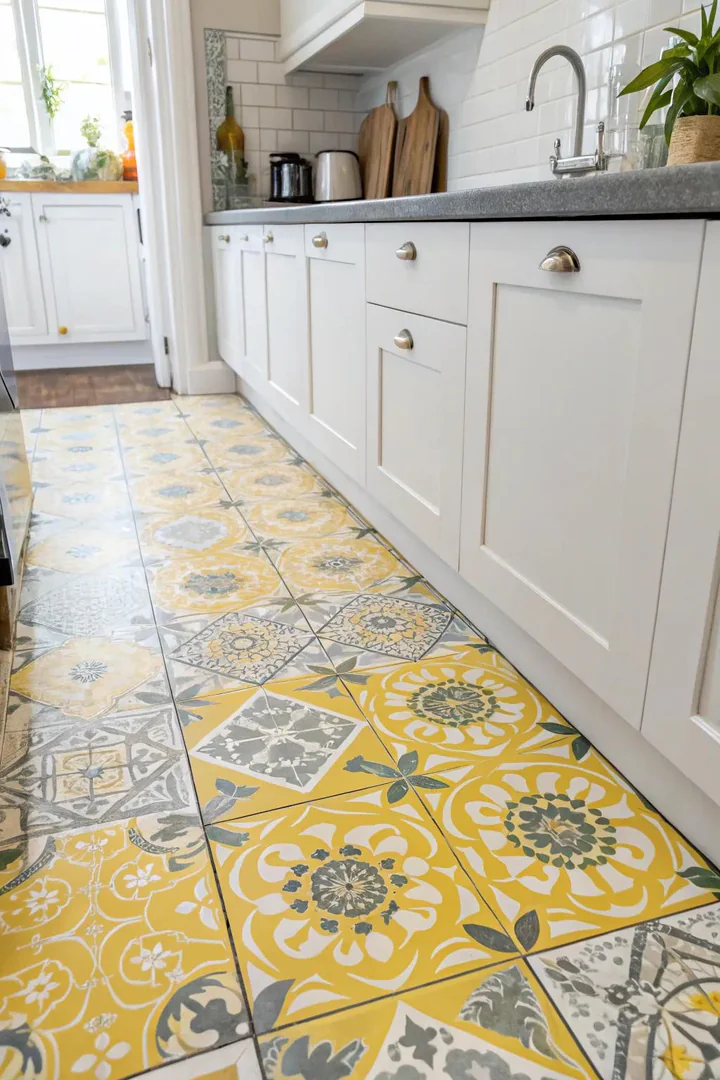
Encaustic cement tiles from Cement Tile Shop or Granada Tile in a yellow-and-grey geometric pattern deliver both accent colors in a single surface. Patterns like Moorish stars, quatrefoils, or diagonal stripes combine mustard yellow and warm charcoal grey on a white base, creating a backsplash that reads as a textile rather than a hard surface. Each 8-by-8-inch tile costs $8 to $15, and the installation runs $12 to $18 per square foot for labor.
Cement tiles require sealing with a penetrating sealer (Miracle Sealants 511 Impregnator) before grouting and again after installation to prevent staining. A white or light grey grout keeps the pattern crisp. Patterned tile backsplashes work as the room’s single decorative statement, so pair them with solid-color cabinets (white or grey) and a plain countertop to avoid visual competition.
5. Yellow-Painted Kitchen Island with Grey Upholstered Stools
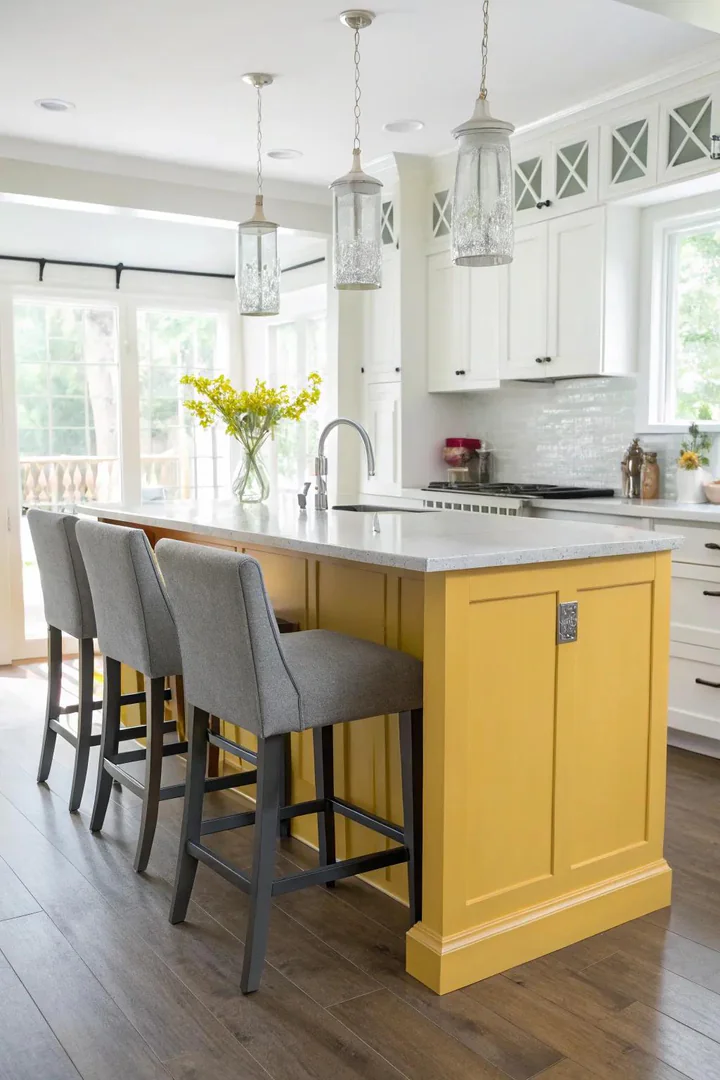
Painting only the island in Sherwin-Williams Bee (SW 6683) or Farrow & Ball India Yellow (No. 66) introduces yellow as a focal point without committing the full kitchen to color. Grey linen-upholstered counter stools from Article Sede ($200 each) or West Elm Slope ($250) pull up to the overhang and ground the warm island with a cool neutral seat. White perimeter cabinets keep the surrounding walls clean.
An island-only color strategy costs less in paint and labor because only 8 to 12 linear feet of cabinetry need refinishing. The island becomes a standalone furniture piece that the homeowner can repaint in a single weekend if the yellow feels too bold after a year. Brass pendant lights above the island connect to the warm yellow below, while the grey stools connect to any grey countertop or flooring in the perimeter zone.
6. Grey and Yellow Mosaic Tile Backsplash Behind White Cabinets
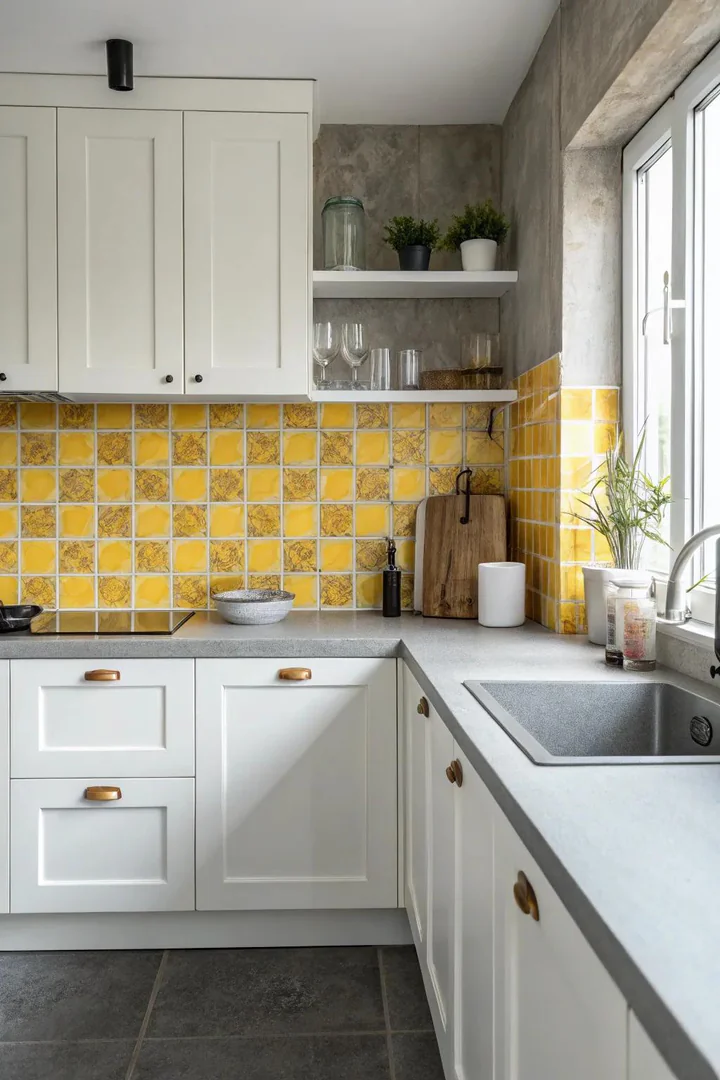
A glass mosaic blend in 1-by-1-inch tiles mixing pale yellow, warm grey, and clear glass from Lunada Bay Tile Tozen or Oceanside Glasstile scatters color across the backsplash in a confetti-like pattern. The small tile size creates a textured, shimmering wall that catches under-cabinet lighting and shifts tone as the viewing angle changes. White cabinets above and below frame the mosaic without competing.
Glass mosaic tiles resist moisture, staining, and heat behind the range, making them a practical backsplash choice as well as a decorative one. Pre-mounted mesh-backed sheets speed installation: each 12-by-12-inch sheet covers one square foot. A matching grey grout unifies the tile field, while white grout separates each tile for a busier, more detailed look. For more mosaic design approaches, see our collection of mosaic kitchen backsplash ideas covering marble, ceramic, and mixed-material blends.
7. White Cabinets with Yellow Interior Paint and Grey Hardware
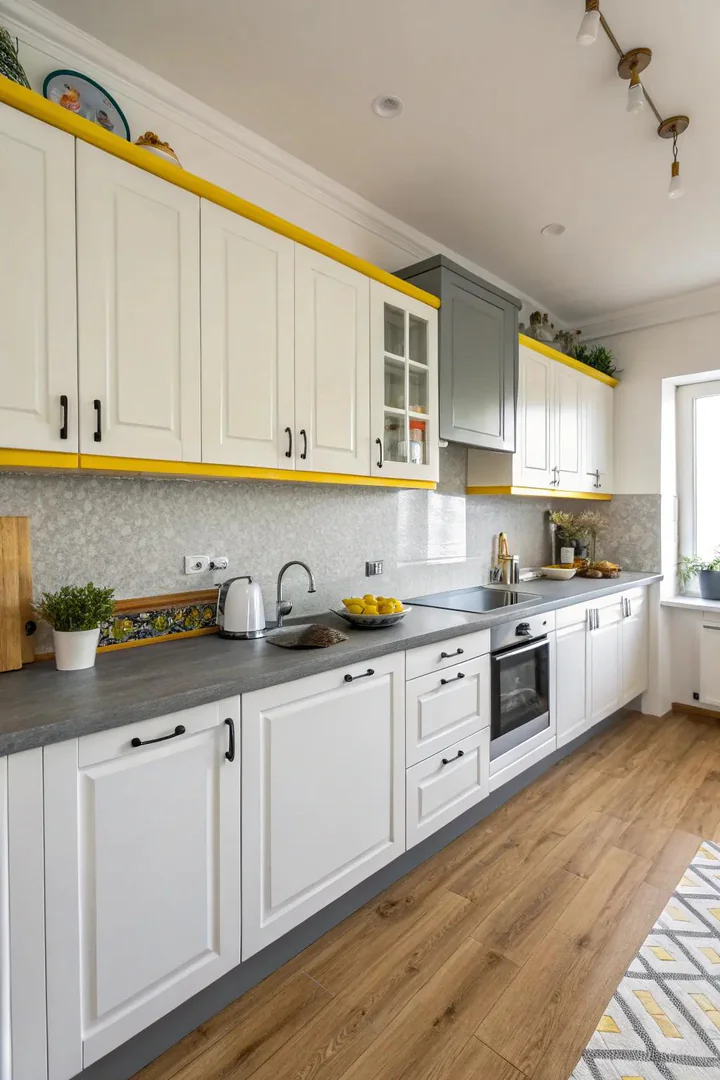
Painting the inside back panel of glass-front upper cabinets in a soft yellow like Benjamin Moore Lemon Ice (2024-50) creates a subtle color surprise visible through the glass doors. The yellow interior reflects off white dishes and glassware, casting a warm glow that reads differently from an accent wall. Matte grey round knobs from Amerock Blackrock ($3 each) on every door and drawer introduce the third color at the hardware layer.
Cabinet interiors require only 1 to 2 quarts of paint for a full kitchen, costing under $25 in materials. The homeowner can brush the interiors without removing doors, taping only the front frame edges. Grey hardware on white doors creates enough contrast to define each cabinet face, while the yellow interior adds a pop visible only when the glass-front doors catch light at the right angle.
8. Yellow Brass or Gold Pendant Lights Over a Grey-and-White Kitchen
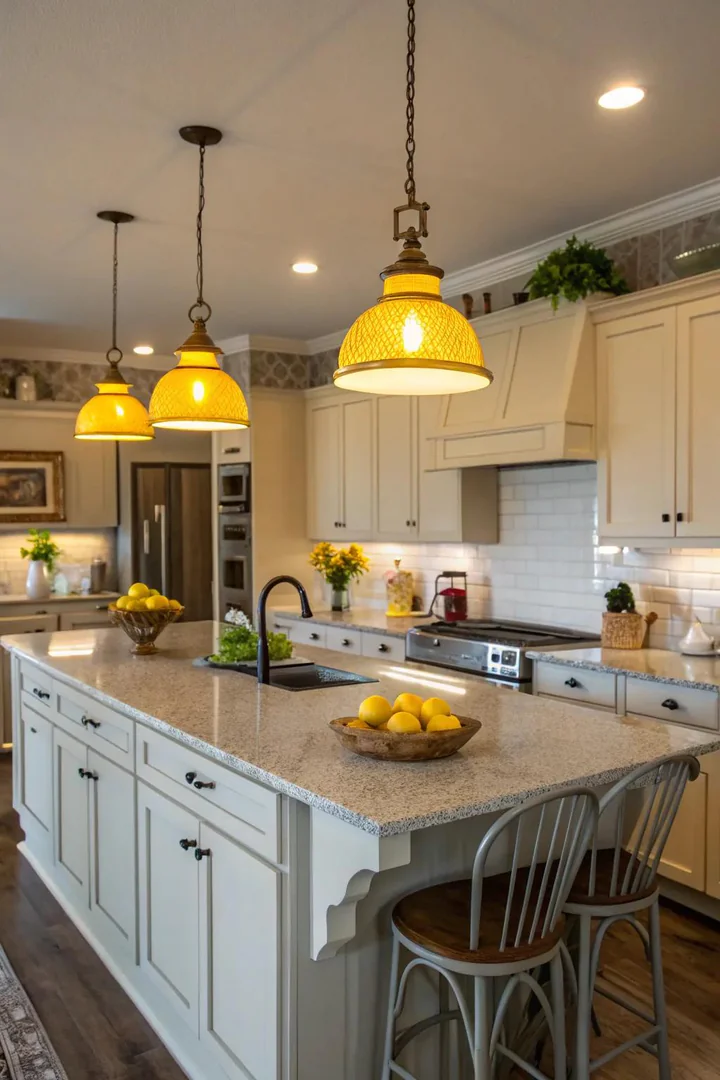
Three unlacquered brass dome pendants from Schoolhouse Electric Isaac ($250 each) or Rejuvenation Baltimore ($180) hang above a grey-and-white island and introduce yellow through a warm metallic rather than paint. Brass reads as a golden yellow under warm incandescent bulbs, and the pendants become the room’s accent color without requiring any painted yellow surface. Grey cabinets, white countertops, and white walls form the backdrop.
Matching the pendant finish to the faucet, cabinet pulls, and outlet-plate screws in brushed brass or satin gold creates a cohesive metallic thread. Using brass as the yellow layer works well for homeowners who prefer a neutral kitchen but want warmth beyond chrome and nickel. Pendant lights hang at eye level above the island, making the brass finish one of the first things a guest notices when entering the room.
9. Grey Appliances with Yellow Cabinet Accents
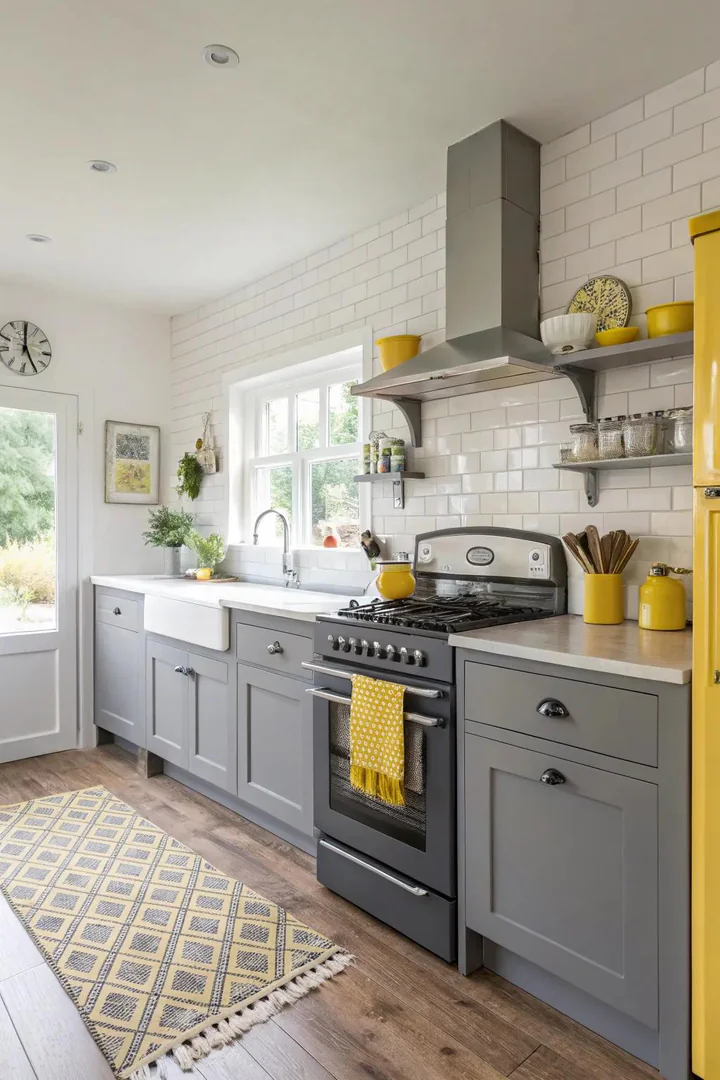
Slate-finish appliances from GE Profile or SamsungDERA in a matte grey read softer and warmer than stainless steel and coordinate directly with grey cabinetry or grey countertops. Yellow accent cabinets on the island or on a single open-shelf column break up the grey zone with a warm punctuation mark. White walls and white upper cabinets keep the kitchen bright above the grey appliance line.
Slate-grey appliances resist fingerprints and smudges better than polished stainless steel because the matte texture diffuses light rather than reflecting it. A slate refrigerator, range, and dishwasher panel match each other out of the box, unlike stainless pieces from mixed brands that can show different grey tones. Pairing yellow accents with grey appliances keeps the warm-cool tension visible at the appliance scale.
10. Yellow and Grey Open Shelving with White Brackets
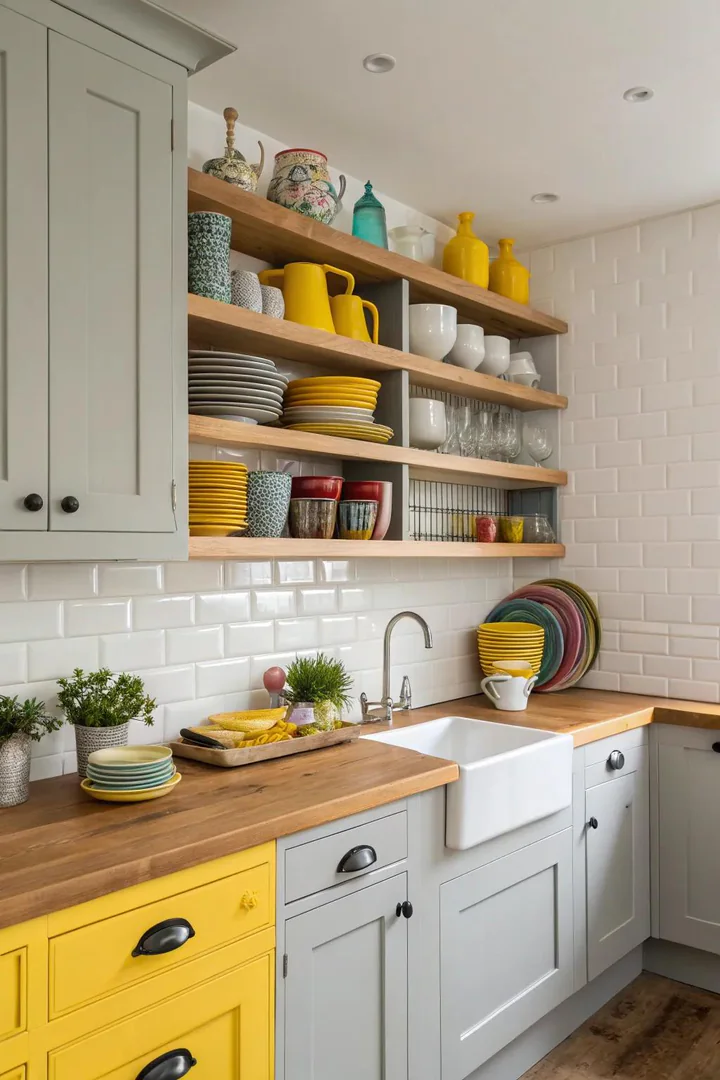
Installing floating shelves in grey-stained white oak on white powder-coated steel brackets and filling them with yellow bowls, yellow linen napkins, and grey stoneware plates layers all three colors in one vertical column. Shelfology Heavy-Duty brackets in white support 10-inch-deep shelves at 24-inch intervals, holding up to 75 pounds per bracket pair. The shelves replace two or four upper cabinet boxes and open the wall.
Styling the shelves follows a 60-30-10 ratio: 60% white and grey functional items (plates, mugs, jars), 30% yellow accent pieces (a ceramic vase, a cookbook with a yellow spine, a mustard-yellow canister), and 10% natural materials (a small potted herb, a wooden cutting board). Rotating the accent pieces seasonally keeps the shelf display fresh without a permanent change. Open shelving costs less than upper cabinets and installs in a single afternoon with a drill, level, and stud finder.
11. Yellow Accent Wall Behind Grey and White Cabinetry
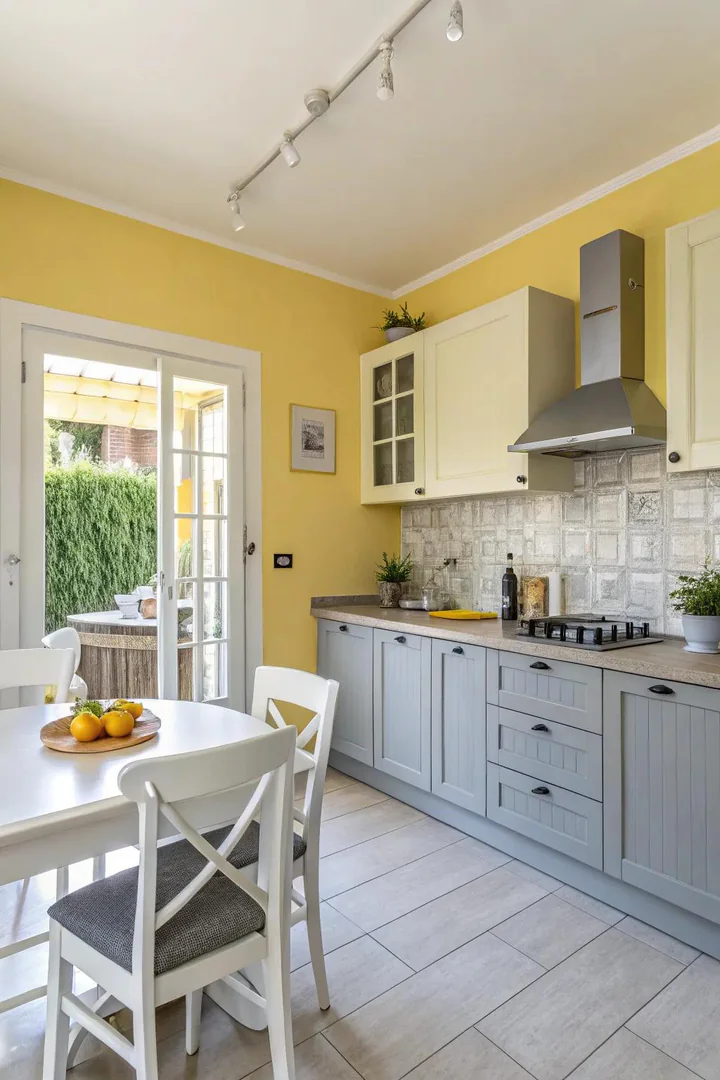
A full accent wall in Farrow & Ball Dayroom Yellow (No. 233) behind grey base cabinets and white upper cabinets wraps the cooking zone in warmth without painting the entire room. The yellow reads strongest behind open shelving or above a low backsplash where the wall surface shows. Grey quartz countertops bridge the base cabinets and the yellow wall, creating a layered transition.
A yellow accent wall works best on the range wall or the breakfast-nook wall, where a single sightline frames the color. Avoid painting two facing walls yellow because the color bounces between them and intensifies beyond the intended brightness. Pair the yellow wall with warm-white (2700K) recessed can lights or under-cabinet LEDs, since cool daylight bulbs (5000K) wash out yellow paint and make the wall look greenish under artificial light at night.
12. Grey Quartz Countertops with Yellow Accessories on White Cabinets
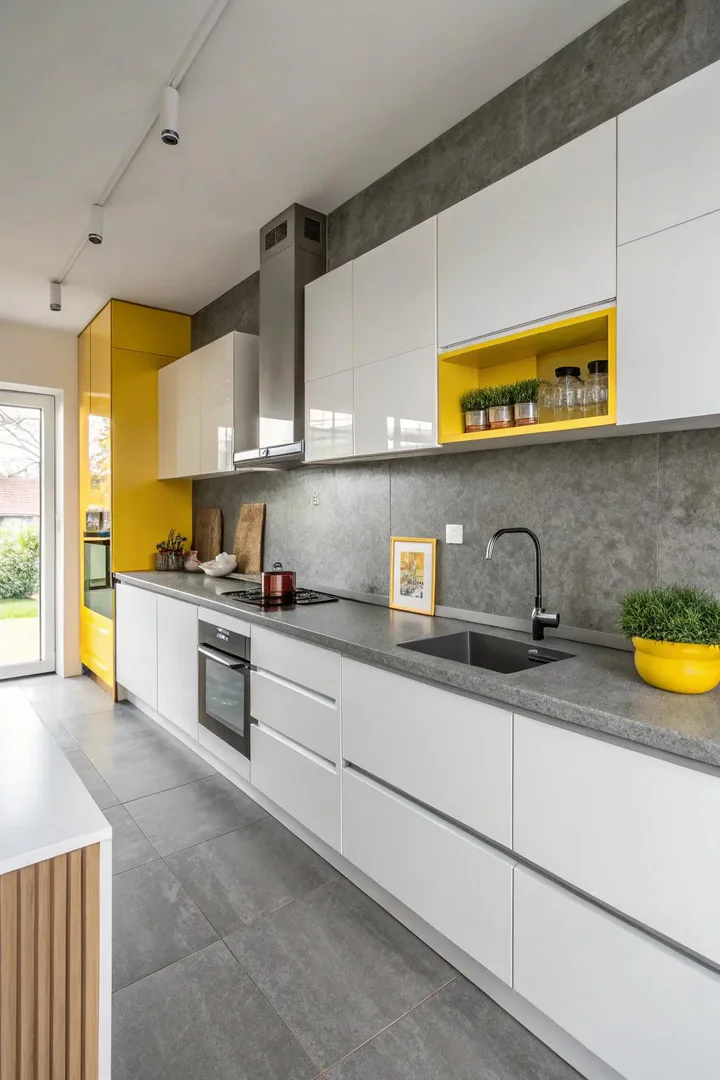
Caesarstone Rugged Concrete (4033) or Cambria Clyde grey quartz countertops over white Shaker cabinets set up a two-tone neutral base that lets yellow accessories command the accent layer. A yellow KitchenAid mixer, a set of yellow Le Creuset utensil crocks, and a yellow linen runner down the island deliver color without a single brushstroke of paint. Keep more kitchen tools organized with ideas from our guide to kitchen utensil holder ideas.
Grey quartz resists staining, scratching, and heat up to 400°F without sealing, making the surface a zero-maintenance alternative to marble or granite. A grey countertop on white cabinets produces a soft contrast that reads modern without going stark. Swapping the yellow accessories for teal, coral, or terracotta pieces changes the accent color in a weekend, giving the neutral base long-term flexibility.
13. White Subway Backsplash with Yellow and Grey Decorative Accessories
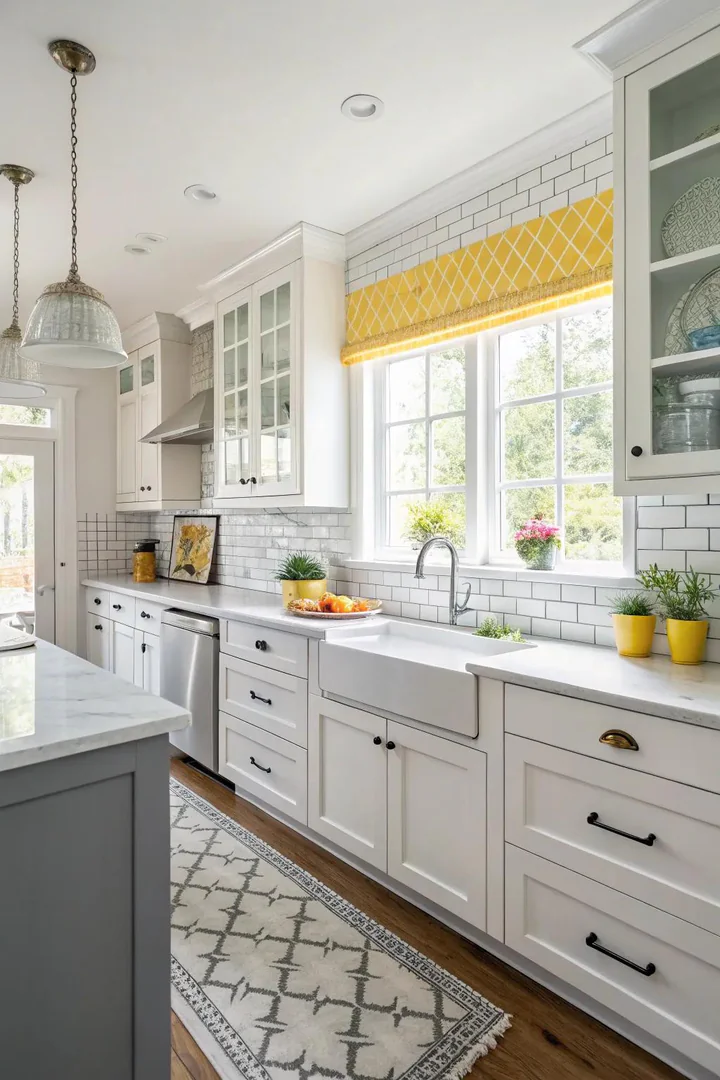
A 3-by-6-inch white glossy subway tile backsplash from Daltile Rittenhouse Square ($2 per square foot) provides a timeless backdrop that absorbs no visual attention, leaving the counter accessories and wall-mounted objects to carry the yellow and grey. A yellow ceramic soap dispenser, a grey marble paper-towel holder, and a yellow-framed herb print above the range introduce both accent colors at the decorative layer.
White subway tile in a running bond (offset brick) pattern has remained in production since the early 1900s, and the style appears in farmhouse, transitional, contemporary, and industrial kitchens without looking dated. Grey grout darkens the grid lines and adds graphic definition, while white grout creates a more uniform, quieter wall. Keeping the backsplash neutral and the accents colored lets the homeowner refresh the palette every few years without demolition.
14. Yellow and Grey Patterned Roman Shade or Cafe Curtain
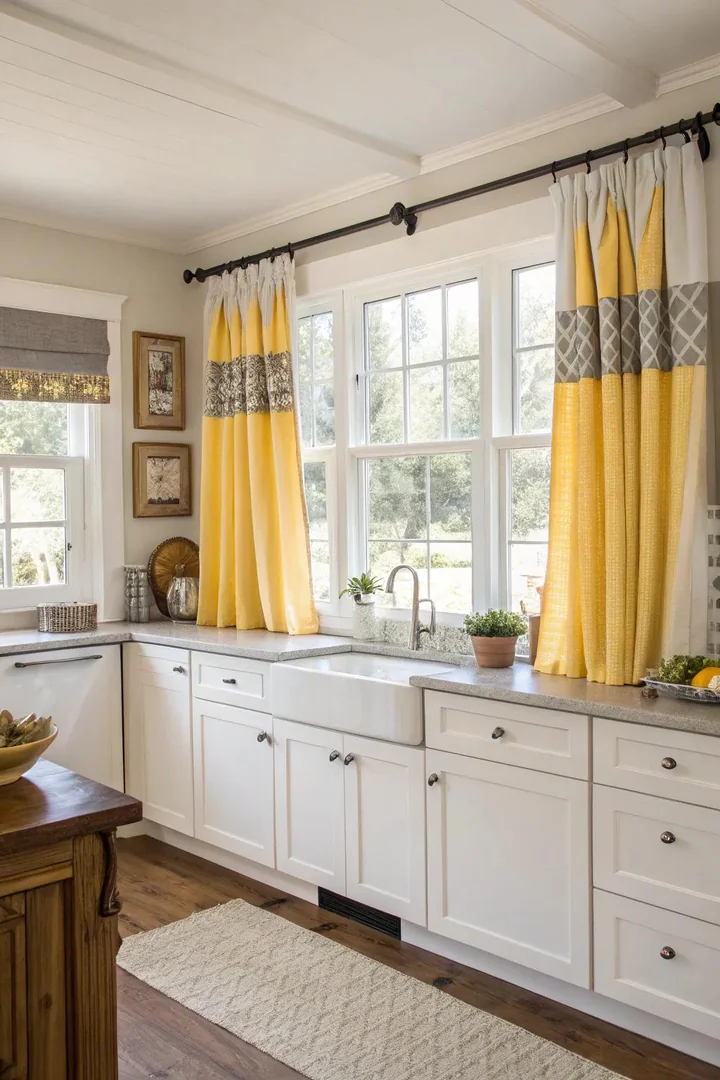
A Roman shade in a yellow-and-grey ikat, chevron, or floral print from Smith+Noble ($120 to $200 per window) or a cafe curtain in Spoonflower custom fabric ($25 per yard) brings both accent colors to the window without touching the cabinetry. The window treatment frames the natural-light source and softens the hard surfaces of countertops and tile that dominate the rest of the room.
A Roman shade mounted inside the window casing sits flush and does not interfere with the sink faucet or dish rack below. A cafe curtain covering only the lower half of the window provides privacy at counter level while letting full light enter above. Washable cotton or cotton-linen blend fabrics handle kitchen grease and moisture better than silk or velvet. Coordinating the shade fabric with a matching set of cloth napkins or a table runner extends the pattern into the dining zone.
15. Grey Island with Yellow Upholstered Bar Stools
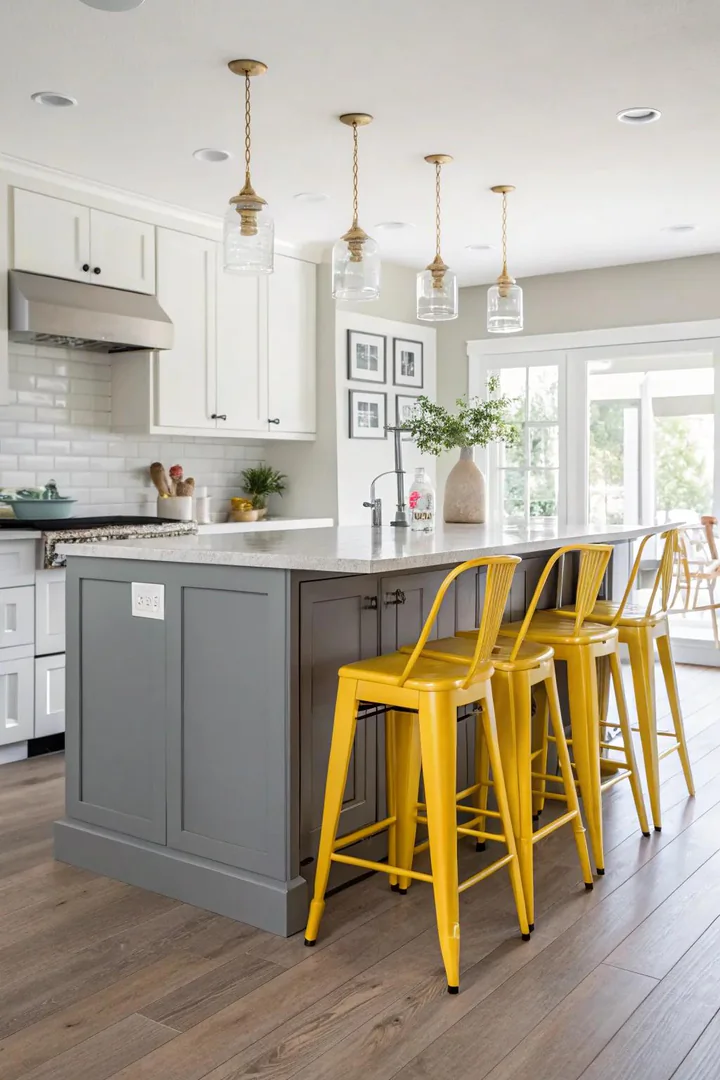
A grey-painted island in Benjamin Moore Pigeon Gray (2133-50) paired with yellow velvet or linen counter stools from Wayfair or CB2 ($150 to $300 each) creates a warm-cool pairing at the seating zone. Yellow upholstery pulls the eye to the island perimeter and adds a soft texture that contrasts with the hard surfaces of stone, tile, and painted wood.
Swivel stools with a 24-inch seat height fit standard 36-inch counters, while 30-inch stools suit 42-inch bar-height islands. Performance velvet or Crypton-coated linen resists stains from spills and food, making the fabric practical for kitchen seating. Three stools spaced 24 inches apart cover a 6-foot island overhang comfortably. Yellow stools deliver the accent color at a scale large enough to read from across an open-plan room.
16. Yellow and Grey Linen Tea Towels and Oven Mitts
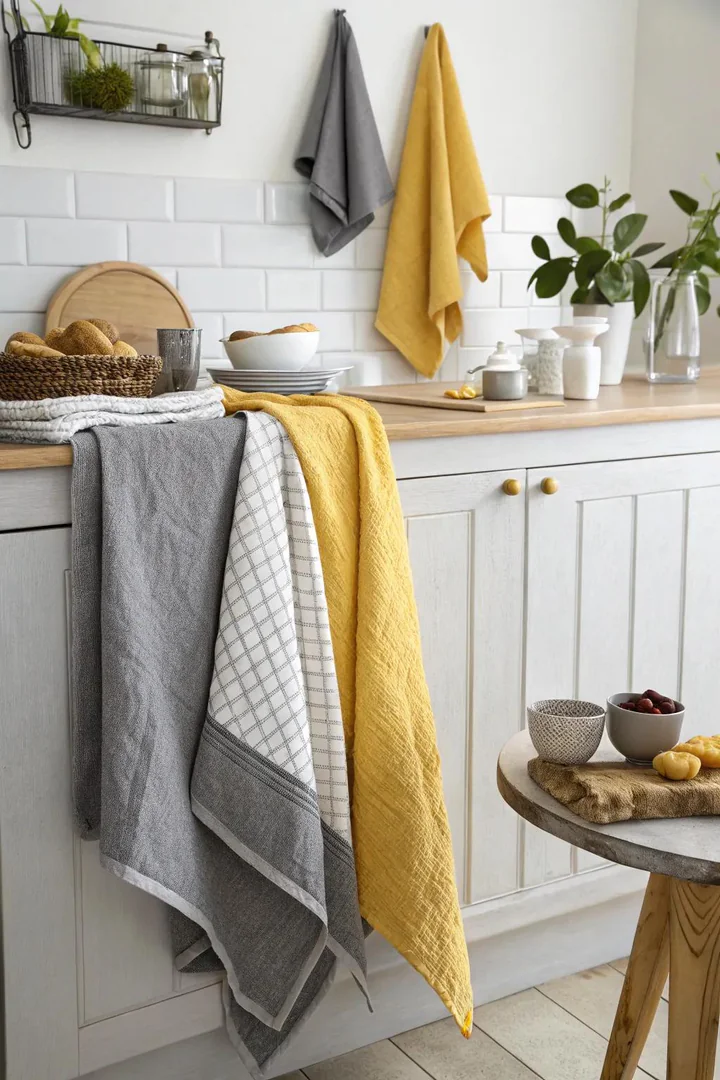
Hanging a pair of yellow linen tea towels from Coyuchi ($18 each) on the oven-door handle and setting grey linen oven mitts from Rough Linen ($30 per pair) beside the range introduces the color palette through soft goods that swap out in seconds. Cotton-linen blends absorb moisture quickly, resist odor buildup, and soften with every wash cycle.
Coordinating the towel and mitt colors with a yellow-and-grey striped apron creates a textile set that ties the three colors together at the cooking station. Textiles rank among the lowest-cost, lowest-commitment ways to test a color palette before investing in paint or tile. A full set of coordinated kitchen linens costs under $80 and arrives in two days from most online retailers. Explore more ways to organize countertop accessories at The Designers Company.
17. Yellow and Grey Framed Art Prints on White Kitchen Walls
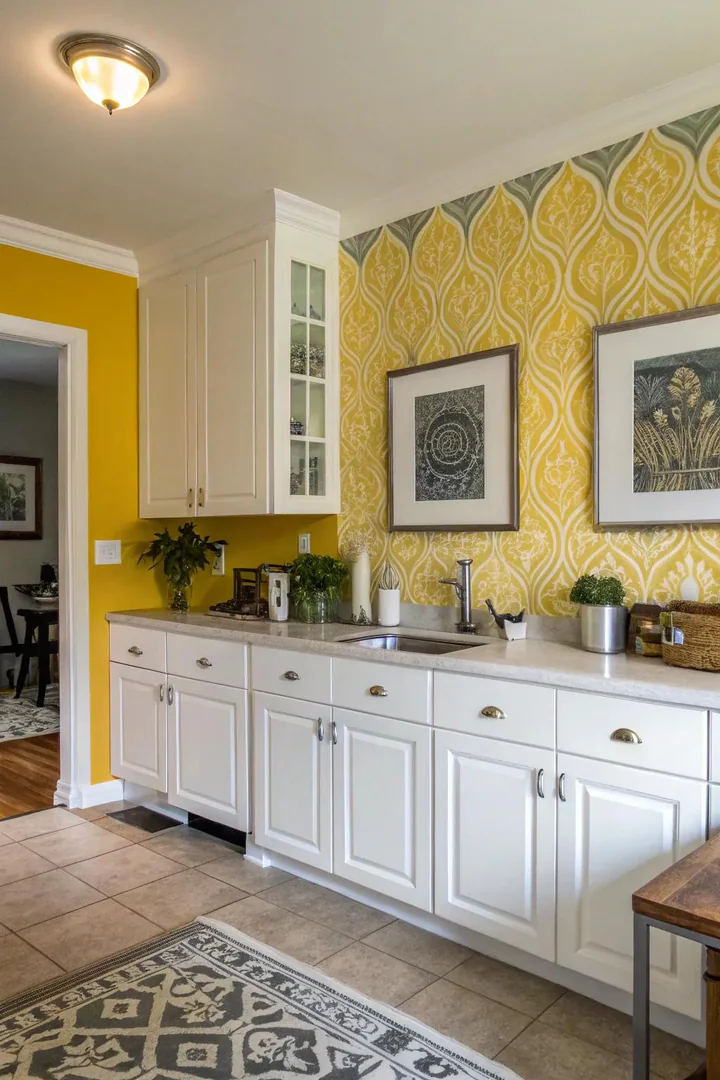
A pair of 11-by-14-inch framed prints from Minted or Juniper Print Shop in a yellow-and-grey abstract or botanical motif fills the blank wall above a breakfast nook or beside the refrigerator. Grey matting inside a white frame bridges the print to the wall color, and the yellow in the artwork echoes the accent pieces on the counter or shelves. Two prints hung side by side at 57 inches on center (gallery standard) create a mini gallery wall.
Kitchen wall art should use frames with glass or acrylic glazing to protect the print from cooking moisture and grease. Avoid hanging unframed canvas prints near the range because the exposed canvas absorbs airborne grease and yellows over time. Art prints cost $20 to $60 each and arrive ready to hang, making them one of the fastest accent changes in the kitchen.
18. Grey Porcelain Floor Tile with a Yellow Wool Runner
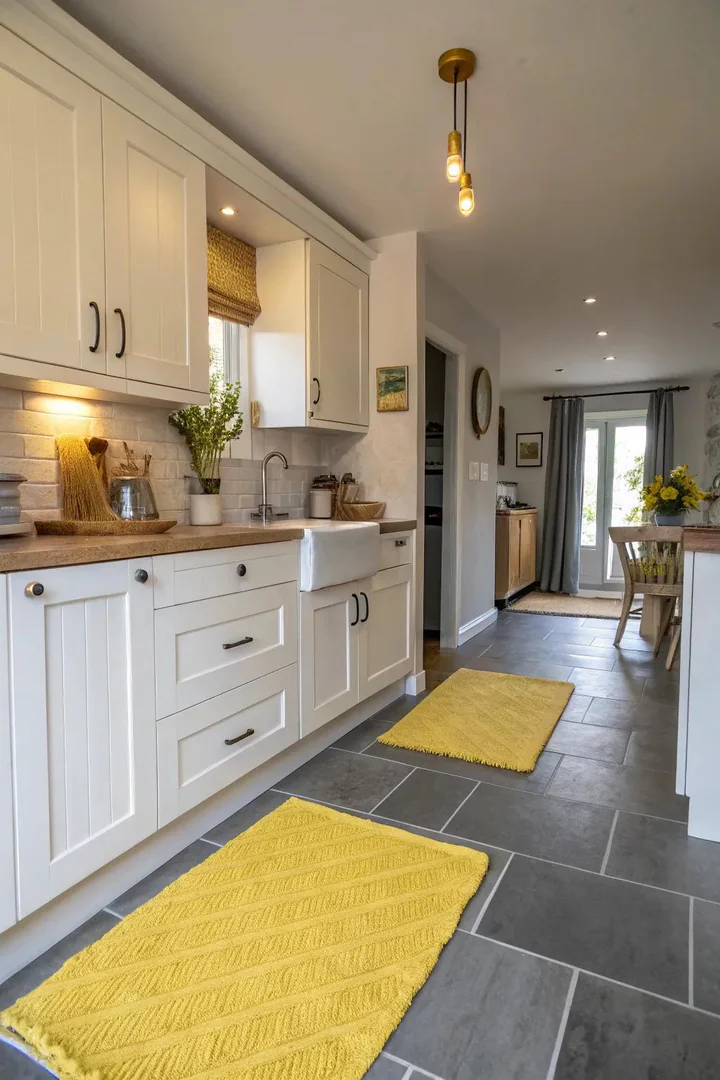
A 12-by-24-inch grey porcelain floor tile from Marazzi Color Body or Emser Borigni laid in a staggered brick pattern covers the kitchen floor in a low-maintenance, waterproof surface. A flat-weave yellow wool runner from Dash & Albert ($90 for a 2.5-by-8-foot size) or Ruggable ($100, machine-washable) lays in front of the sink and range, adding warmth and color underfoot. Homeowners considering neutral cabinet tones can also browse our guide to dark beige kitchen cabinet ideas for warm flooring and cabinet pairings.
Porcelain tile rated PEI 4 or higher withstands kitchen foot traffic, dropped utensils, and rolling chairs without chipping. A runner with a non-slip rubber backing or a separate rug pad prevents sliding on the smooth tile surface. Yellow runners soften the hard floor and provide cushioning during long cooking sessions. A machine-washable runner handles spills and stains without professional cleaning.
19. Yellow and Grey Kitchenware Collection on White Countertops
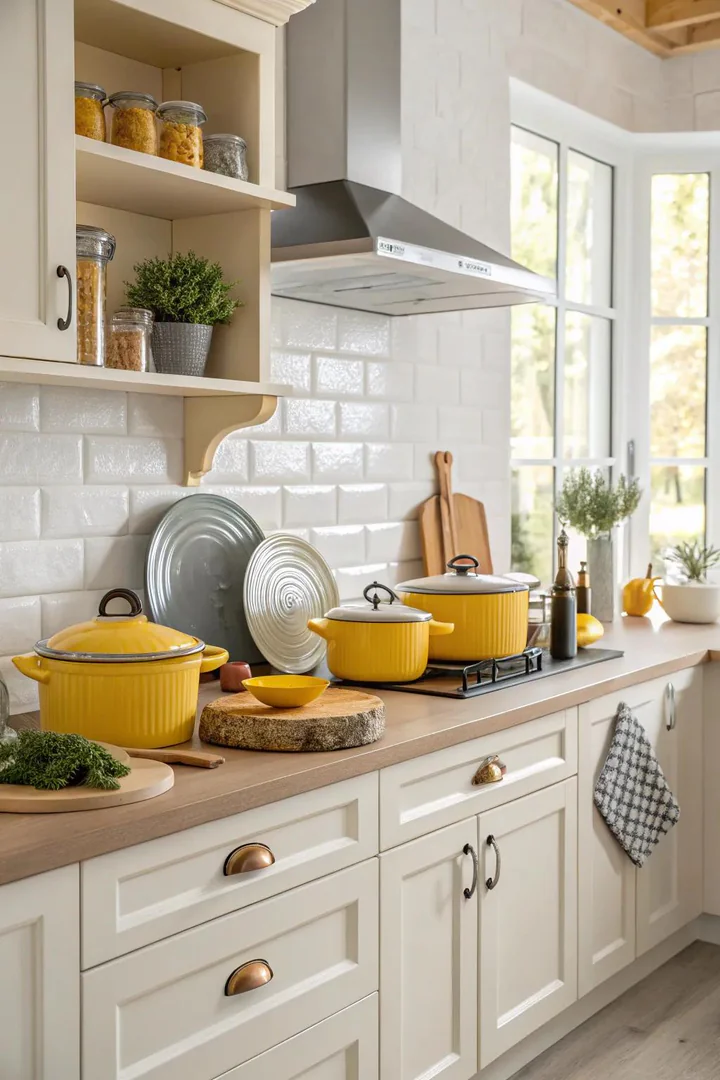
A curated counter display of yellow and grey kitchen tools turns everyday objects into a color palette: a yellow Le Creuset French oven ($350 for the 5.5-quart round), grey Staub ceramic baking dishes ($40 each), a yellow OXO Good Grips colander ($14), and a grey marble utensil crock ($25) line up on a white quartz countertop as a functional still life. Each piece pulls its weight in daily cooking while contributing to the room’s three-color story.
Keeping the display to 5 to 7 pieces avoids clutter and lets each item breathe. A tray or small cutting board under the grouping defines the display zone and makes it easy to slide everything aside for counter cleaning. Matching kitchenware colors to the room palette is a designer trick that costs nothing extra because the homeowner was buying these items anyway. Choosing yellow and grey versions instead of random colors turns a functional purchase into a decorative decision. Pair the collection with ideas from our guide to housewarming gift ideas for the kitchen for more curated countertop accessories.
How to Coordinate a Yellow, Grey, and White Kitchen Palette
1. Choose the Dominant Color for Cabinets and Walls
Assign white or grey as the dominant color (covering 60% of visible surfaces: cabinets, walls, ceiling) and reserve yellow for the accent role (10% to 20% of surfaces: island, accessories, textiles, art). White-dominant kitchens feel open and airy, while grey-dominant kitchens feel grounded and modern. Yellow as the dominant color works only in large kitchens with ample natural light, because floor-to-ceiling yellow in a small room reads overwhelming.
2. Test Undertones by Placing Swatches Side by Side
Order 4-inch paint samples in your chosen yellow, grey, and white and tape all three to the same cabinet door under the kitchen’s installed lighting. Yellow with a green undertone (like chartreuse) clashes with warm grey, while yellow with an orange undertone (like marigold) clashes with cool blue-grey. A true warm yellow (Hawthorne Yellow, India Yellow) and a true warm grey (Repose Gray, Dorian Gray) sit on the same temperature side and harmonize. View the samples at midday and again at 8 PM, because yellow shifts dramatically under warm versus cool light.
3. Distribute the Three Colors Across Different Material Layers
Place each color on a different material: paint on one, stone or tile on another, and fabric or metal on the third. Yellow paint on the island, grey quartz on the countertop, and white ceramic on the backsplash give each color a distinct texture. Layering colors across materials prevents the room from reading flat and adds depth that a single-material palette cannot achieve.
4. Add the Accent Color Last Through Swappable Items
Start with the dominant and secondary colors on permanent surfaces (cabinets, countertops, flooring, backsplash), then introduce yellow through bar stools, pendant lights, textiles, and kitchenware. Swappable accent items let the homeowner adjust the yellow intensity after living in the room for a few weeks. Removing or adding one yellow piece shifts the balance without a repaint or renovation.
Yellow, Grey, and White Kitchen Color Comparison
| Color Role | Paint / Material | Brand | Undertone | Best Application | Price |
|---|---|---|---|---|---|
| Yellow accent | Hawthorne Yellow (HC-4) | Benjamin Moore | Warm golden | Island, accent wall | $80–$90/gal |
| Yellow accent | India Yellow (No. 66) | Farrow & Ball | Warm ochre | Island, single cabinet run | $110–$120/gal |
| Grey dominant | Repose Gray (SW 7015) | Sherwin-Williams | Warm greige | Full cabinets, walls | $70–$80/gal |
| Grey dominant | Pigeon Gray (2133-50) | Benjamin Moore | Cool blue-grey | Island, lower cabinets | $80–$90/gal |
| Grey counter | Rugged Concrete (4033) | Caesarstone | Industrial warm grey | Countertops | $65–$85/sq ft |
| White dominant | Simply White (OC-17) | Benjamin Moore | Warm clean white | Walls, upper cabinets | $80–$90/gal |
| White backsplash | Rittenhouse Square subway | Daltile | Bright white gloss | Backsplash | $2/sq ft |
Frequently Asked Questions
What shade of yellow works best with grey kitchen cabinets?
Warm golden yellows like Benjamin Moore Hawthorne Yellow, Farrow & Ball Babouche, and Sherwin-Williams Bee pair best with warm greys (Repose Gray, Dorian Gray). Avoid neon or lemon yellows with a green undertone because the cool base clashes with warm grey. Mustard and ochre yellows work with both warm and cool greys because their earthy depth absorbs temperature differences between the two colors.
How much yellow should a grey-and-white kitchen have?
Follow the 60-30-10 rule: 60% white or grey (cabinets, walls, countertops), 30% the secondary neutral (the one you didn’t pick for 60%), and 10% yellow accents. A kitchen with 10% yellow delivers enough warmth to register without overwhelming the neutral base. Going above 20% yellow (a full island plus a full accent wall, for example) pushes the room toward a yellow-dominant palette that feels very different from a grey-and-white kitchen with yellow pops.
Can yellow, grey, and white work in a small kitchen?
A small kitchen handles the trio well when white covers the walls and upper cabinets, grey appears on the countertop or flooring, and yellow enters through two or three accessories (a canister, a towel set, a small print). Avoid a full yellow accent wall or yellow lower cabinets in a kitchen under 80 square feet because the saturated color absorbs light and makes the walls feel closer. Small-scale yellow accents deliver the same color story at a comfortable intensity.
Does yellow paint on kitchen cabinets lower resale value?
Yellow cabinets are a personal choice that some buyers love and others dislike, which makes the color a polarizing option at resale compared to white, grey, or navy. An island-only yellow or a removable accent approach (accessories, textiles, art) avoids the resale risk entirely. Full yellow perimeter cabinets in a muted shade (Hawthorne Yellow, India Yellow) photograph better in listing images than neon or primary yellow, which can look cartoonish on camera.
What metal finish pairs best with yellow, grey, and white?
Brushed brass and satin gold read as extensions of the yellow family and unify the warm accent layer. Matte black hardware works when the grey is the dominant cabinet color, adding graphic contrast. Polished chrome or satin nickel suits cool-grey kitchens where the yellow enters only through accessories. Mixing brass pendants with black hardware (warm overhead, cool at hand level) creates a layered metallic scheme that bridges the yellow and grey zones.