
Kitchen Ideas with Gold Hardware: 16 Luxe Designs to Inspire You
Kitchen ideas with gold hardware pair warm-toned metal pulls, knobs, hinges, and faucets with cabinet colors that range from classic white to deep navy and forest green. Gold hardware (available in brushed brass, satin gold, polished brass, champagne bronze, and antique brass finishes from manufacturers like Amerock, Top Knobs, Emtek, and Rejuvenation) costs $4 to $25 per pull and transforms the kitchen’s personality in a single afternoon with a screwdriver. Below are 16 cabinet-and-gold-hardware pairings with specific finish names, price points, and style recommendations, followed by a how-to installation guide, a comparison table of gold finishes, and FAQs on tarnishing, mixing metals, and matching gold hardware to appliances.
1. White Cabinets with Gold Pulls
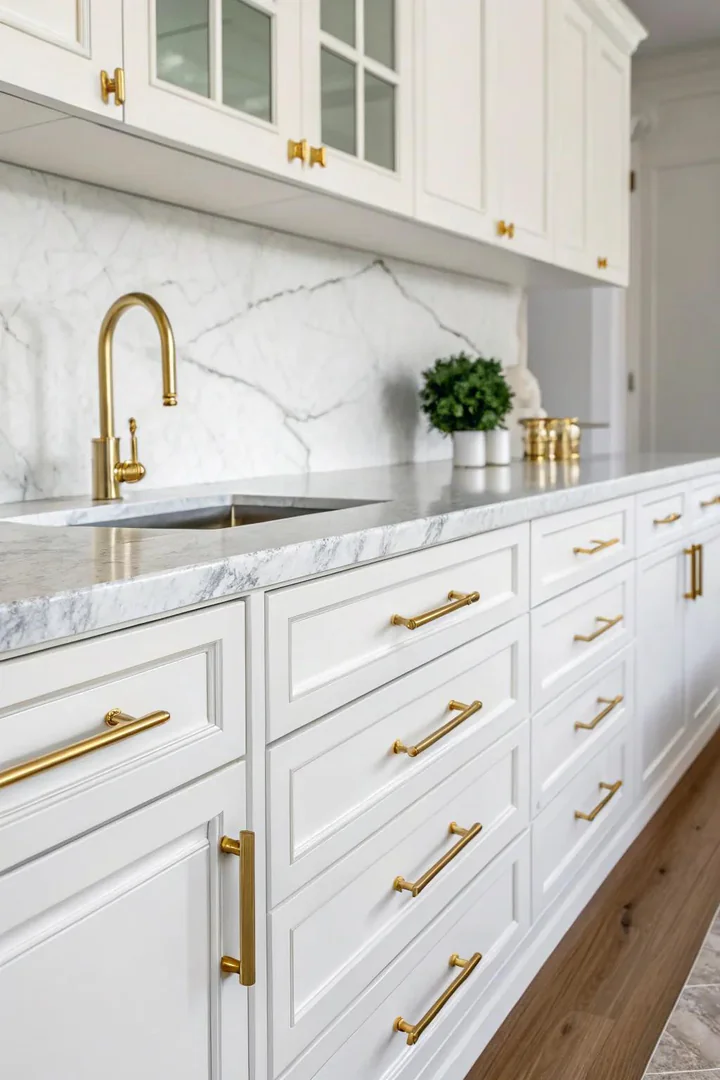
White shaker cabinets (in Benjamin Moore White Dove OC-17 or Sherwin-Williams Extra White SW 7006) with brushed brass bar pulls from Amerock Bar Pull in Golden Champagne ($6 each for 5-inch center-to-center) produce the most universally appealing kitchen color-and-metal combination. The warm gold tone softens the starkness of bright white cabinets, adding warmth without color. A 20-door kitchen with 10 drawers requires approximately 30 pulls ($180 total for Amerock bar pulls).
Match the pull length to the cabinet door and drawer size: 3-inch to 5-inch pulls on standard doors, 6-inch to 8-inch pulls on wide drawers, and 10-inch to 12-inch pulls on pantry or appliance-panel doors. Brushed brass (a matte, slightly textured gold finish) hides fingerprints better than polished brass (a mirror-reflective gold finish) in high-traffic kitchen use. White cabinets with gold hardware suit traditional, transitional, modern farmhouse, and contemporary kitchen styles because white-and-gold reads as both classic and current.
2. Black Cabinets with Gold Contrast
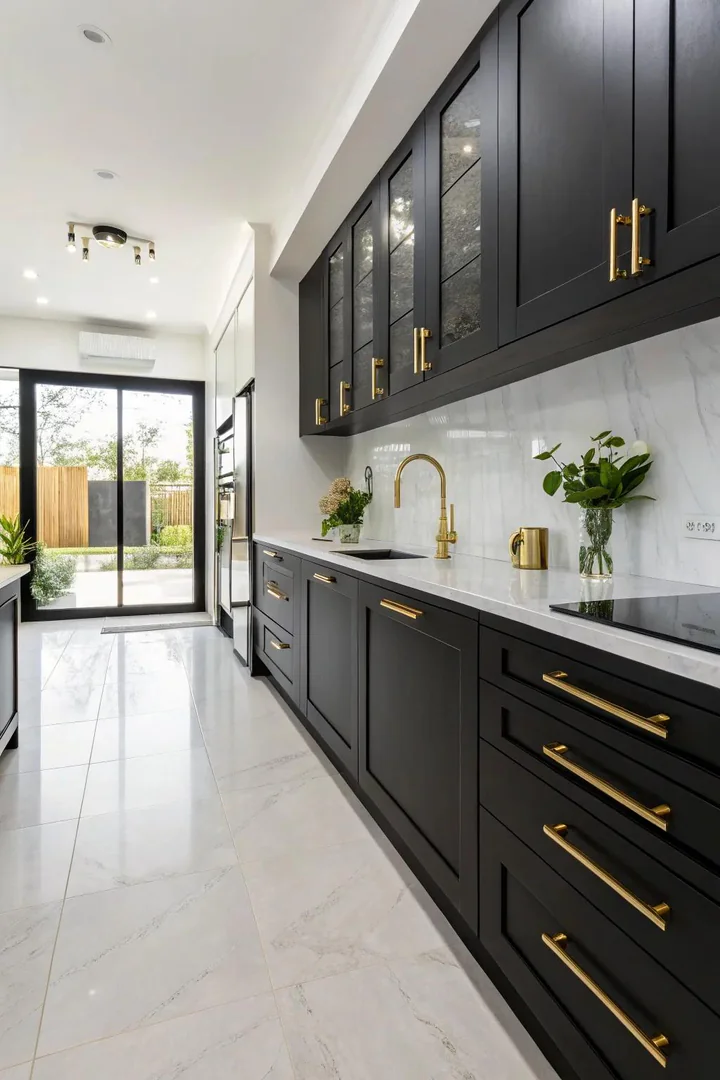
Matte black cabinets (in Benjamin Moore Onyx 2133-10 or Sherwin-Williams Tricorn Black SW 6258) with polished brass knobs from Emtek Norwich Knob in French Antique ($18 each) or satin brass cup pulls from Top Knobs Barrington Cup Pull in Honey Bronze ($15 each) produce a high-contrast, jewelry-like effect. Gold hardware on black cabinets reads as bold and glamorous because the metal catches light against the light-absorbing black paint.
Black-and-gold kitchens pair naturally with marble countertops (Calacatta or Carrara with gold veining), brass faucets, and warm wood floating shelves that break the darkness with natural grain. A black kitchen with gold hardware requires strong task lighting (under-cabinet LED strips, pendant lights over the island) because dark cabinets absorb light that reflective white cabinets would bounce back into the room. Gold hardware on black cabinets suits art deco, glam, modern, and contemporary kitchen styles.
3. Soft Gray Cabinets with Gold Accents
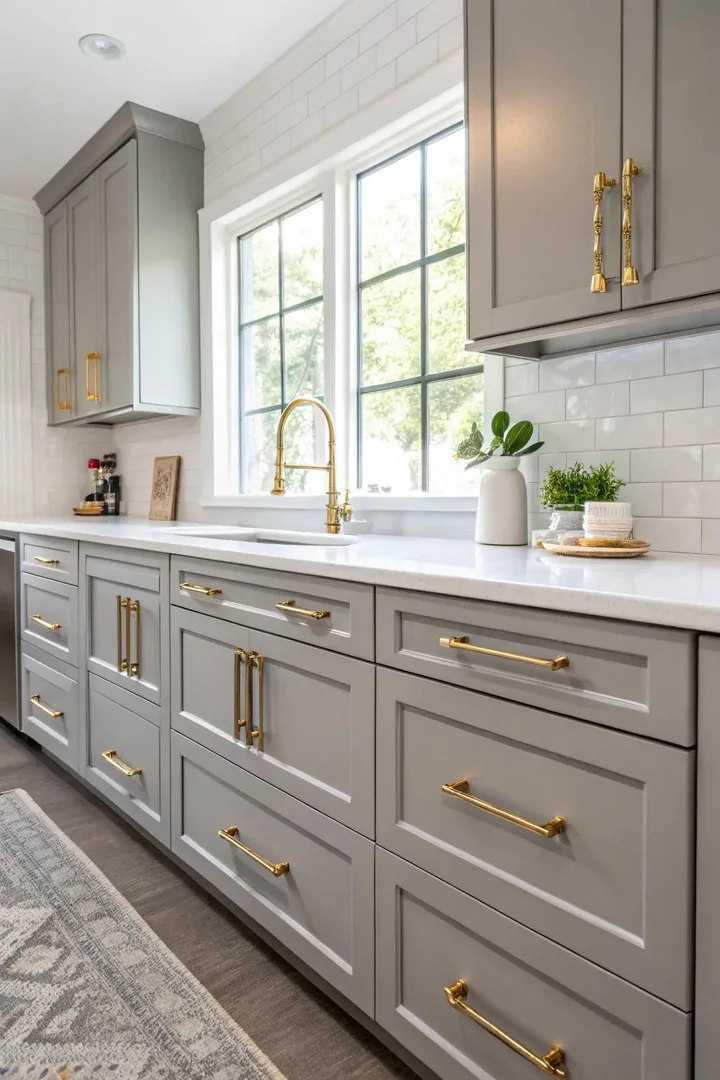
Light gray cabinets (in Benjamin Moore Revere Pewter HC-172, Sherwin-Williams Repose Gray SW 7015, or Farrow & Ball Pavilion Gray No. 242) with satin gold bar pulls create a sophisticated, neutral palette where the warm metal becomes the primary accent. Gray-and-gold avoids the starkness of white-and-gold while maintaining a neutral foundation that accommodates any countertop color, backsplash pattern, and wall paint.
Warm grays (with beige or taupe undertones, like Revere Pewter) pair best with warm gold finishes (brushed brass, champagne bronze). Cool grays (with blue or purple undertones, like Repose Gray) pair with brighter gold finishes (polished brass, satin gold) that contrast against the cool base. Test the gray paint sample and gold hardware together under the kitchen’s actual lighting before committing; fluorescent lighting makes warm grays read pink and cool grays read blue, shifting the perceived color match with the gold hardware.
4. Navy Blue Cabinets with Gold Hardware
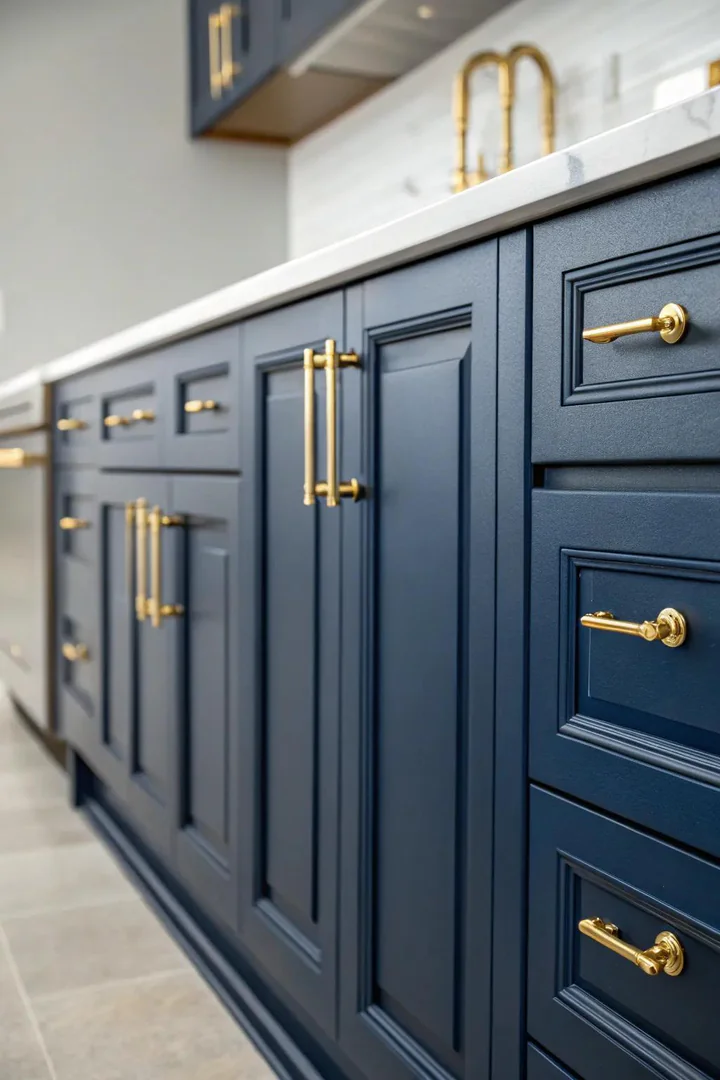
Benjamin Moore Hale Navy HC-155, Sherwin-Williams Naval SW 6244, or Farrow & Ball Stiffkey Blue No. 281 cabinets with brushed gold pulls from Rejuvenation Massey Pull in Aged Brass ($16 each) or Amerock Mulholland Pull in Brushed Gold ($8 each) produce a nautical-meets-traditional palette that real estate agents frequently cite as a buyer-attracting kitchen color scheme. Navy and gold share a deep, warm tone family that creates harmony rather than contrast.
Navy lower cabinets with white upper cabinets and gold hardware on both create a two-tone kitchen where the gold unifies the upper and lower cabinet colors. A white marble or quartz countertop between navy lowers and white uppers provides a bright horizontal band that separates the dark base from the light top. Navy-and-gold suits coastal, traditional, transitional, and preppy kitchen styles. A navy kitchen reads as formal enough for entertaining and warm enough for everyday family cooking. See how kitchen remodel ideas incorporate two-tone cabinet schemes.
5. Green Cabinets with Gold Pulls
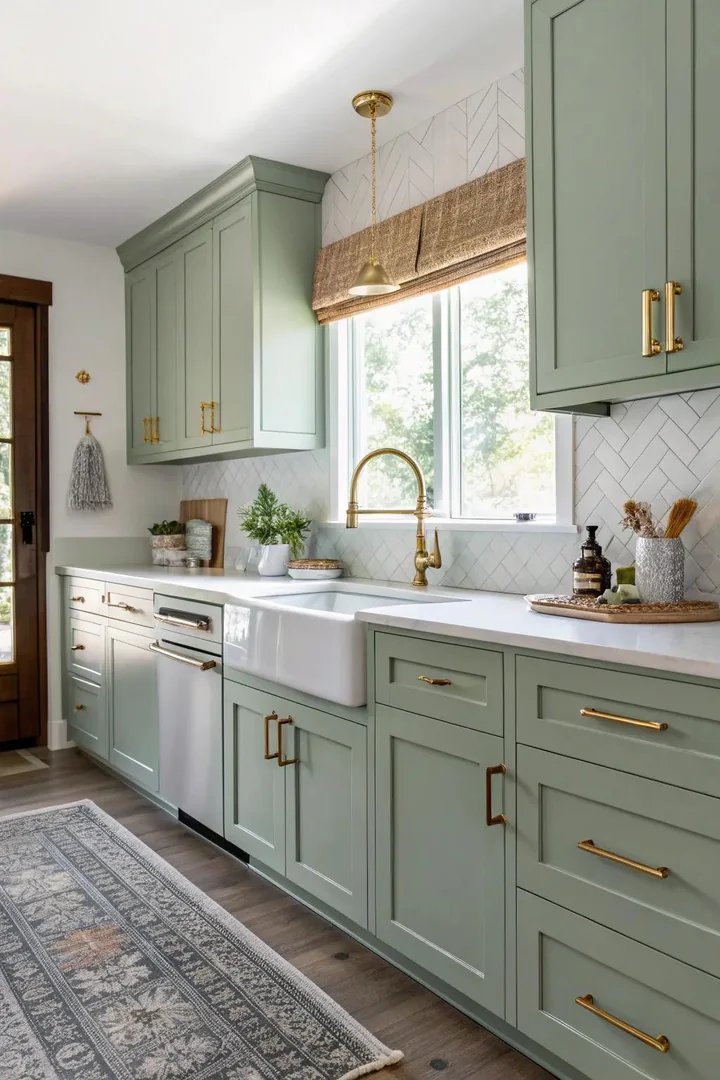
Forest green (Benjamin Moore Essex Green HC-188), sage green (Sherwin-Williams Evergreen Fog SW 9130), or hunter green (Farrow & Ball Studio Green No. 93) cabinets with antiqued brass pulls produce a nature-inspired palette where gold hardware mimics the warm tones of autumn sunlight on green foliage. Green and gold appear together throughout the natural world (golden wheat against green fields, brass leaves on a green branch), making the pairing instinctively harmonious.
Sage green (a muted, gray-green) creates a softer, more restrained mood than saturated forest green or hunter green. Sage with satin brass reads as Scandinavian-modern; deep green with antique brass reads as English country or library-study. A green kitchen with gold hardware, a butcher-block countertop, and terracotta floor tiles produces a warm, organic palette that references Italian farmhouse and English garden kitchen traditions. Gold hardware cost for a 20-door kitchen: $120 to $500 depending on brand and finish.
6. Mixed Metals with Gold as the Dominant Finish
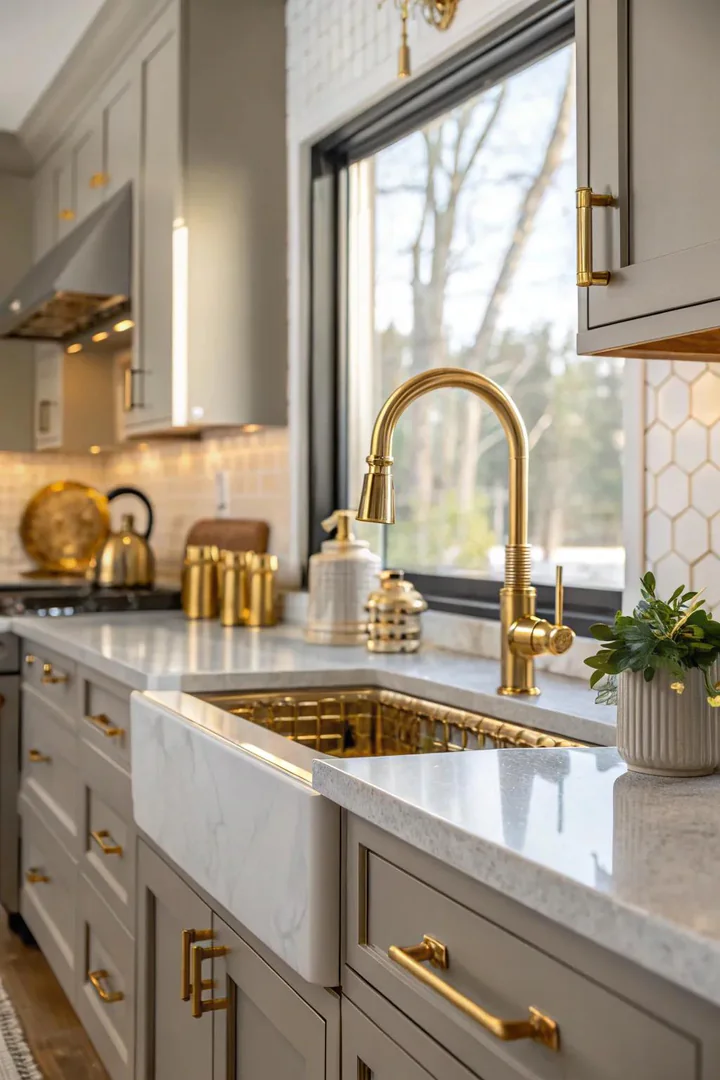
Mixing gold cabinet hardware with a secondary metal (stainless-steel appliances, a chrome pot rack, a matte-black range hood, or nickel light fixtures) adds depth and visual interest that a single-metal kitchen cannot achieve. The 70/30 rule guides metal mixing: 70% of the kitchen’s metal surfaces should be in the dominant finish (gold/brass) and 30% in the secondary finish (chrome, nickel, or black). Keeping 70% gold ensures the warm metal reads as intentional rather than accidental.
Gold hardware on the cabinets, a gold faucet, and gold pendant light fixtures establish the dominant metal. Stainless-steel appliances (refrigerator, range, dishwasher) serve as the secondary metal. A matte-black range hood or vent pipe introduces a third accent metal at the 10% level. Avoid mixing more than 3 metal finishes in one kitchen; 4+ metals create a chaotic, uncoordinated appearance. Test metal combinations by placing a hardware sample, a faucet finish card, and the appliance handle side by side before purchasing.
7. Vintage-Style Gold Hardware
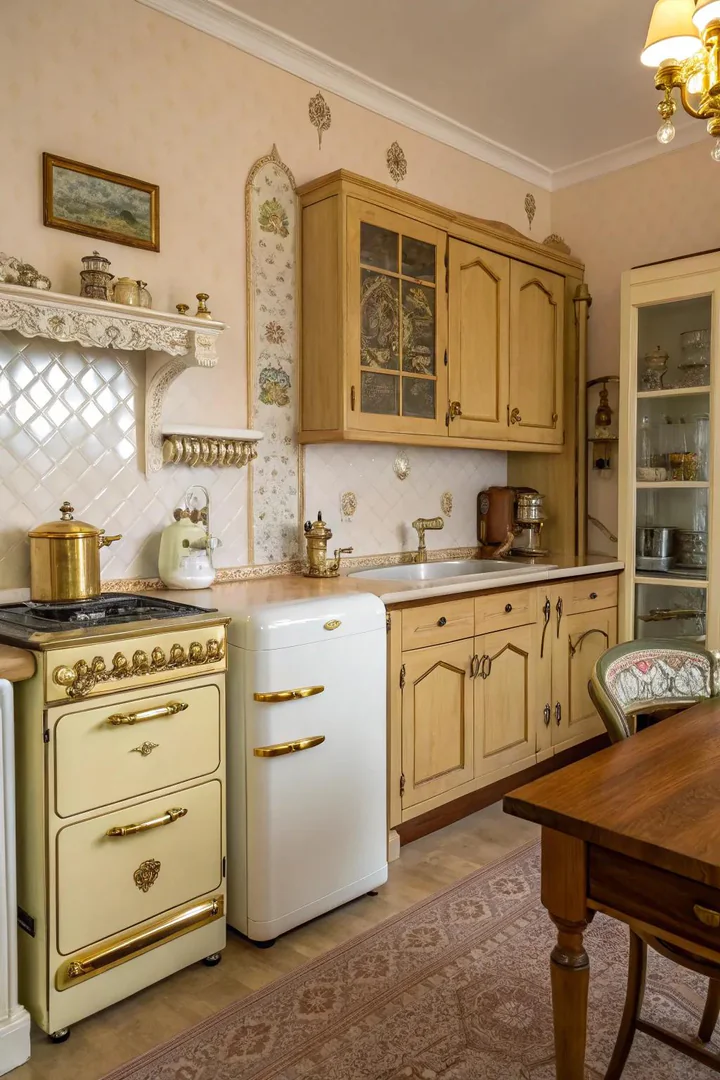
Unlacquered brass hardware from Schoolhouse Electric ($12 to $20 per pull) or Rejuvenation ($10 to $18 per pull) arrives in a bright, raw brass finish that develops a natural patina (darkening, tarnishing, and developing mottled tones) over months of handling. Unlacquered brass on kitchen cabinets produces the same aged character seen on antique door handles, nautical fittings, and heirloom furniture hardware. Each pull and knob patinas uniquely based on hand oils, moisture exposure, and frequency of use.
Accelerate the patina process by applying a thin coat of liver of sulfur solution ($10 from a jewelry supply store) to darken the brass immediately, then buffing the high points with steel wool to create an artificially aged two-tone finish. Slow the patina by applying Renaissance Wax ($15 per can) to the brass surface, which forms a protective barrier that delays tarnishing by 6 to 12 months. Unlacquered brass suits traditional, farmhouse, cottage, and eclectic kitchens where a lived-in, collected aesthetic defines the design direction.
8. Minimalist Gold Touch Points
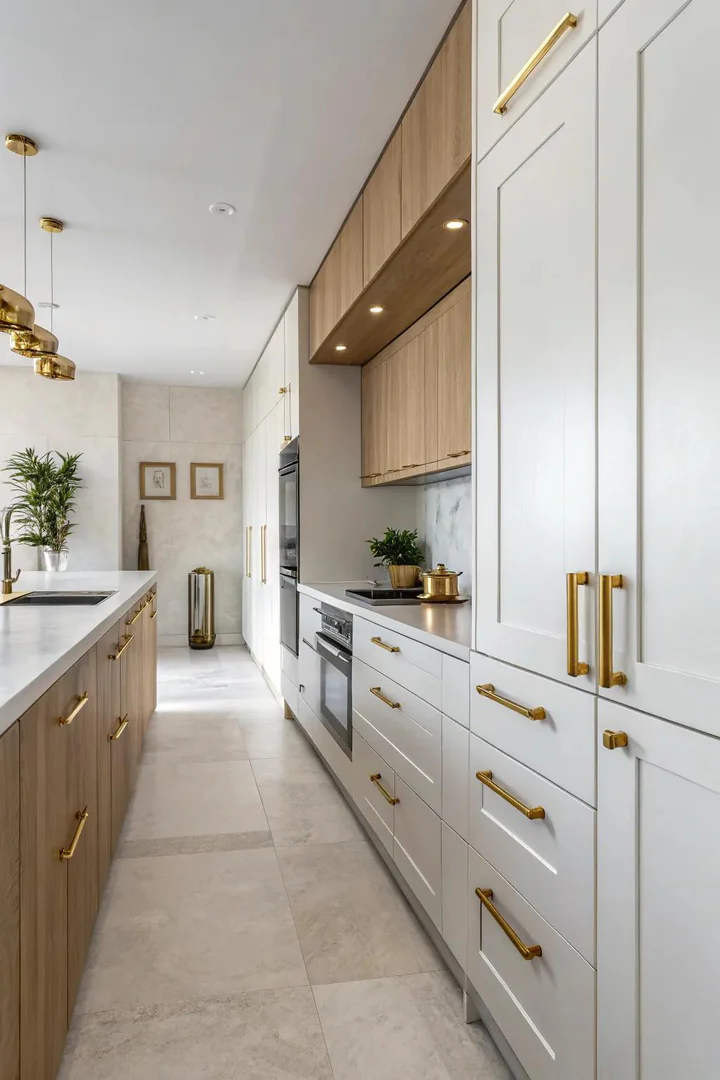
A minimalist kitchen with flat-panel or slab-front cabinets uses slim gold edge pulls (Top Knobs Mercer Tab Pull in Honey Bronze, $10 each, 2 inches long) or integrated finger pulls (a routed groove in the top edge of the door, with a thin brass strip inlaid into the groove) rather than protruding bar pulls. Slim edge pulls sit flush against the cabinet face, maintaining the flat, uninterrupted surface that defines minimalist kitchen design. The gold flash appears only at the touch point, registering as a warm accent rather than a decorative feature.
A minimalist kitchen might also achieve gold accents through a brass faucet, brass shelf brackets, or brass pendant lights rather than conspicuous cabinet hardware. The goal is strategic restraint: one or two gold elements in the room rather than 30 matching pulls. A handleless or push-to-open cabinet system eliminates visible hardware entirely, leaving only the faucet and lighting as the kitchen’s gold accent points. Minimalist gold suits contemporary, Japanese-inspired, and Scandinavian kitchen styles.
9. Gold Hardware on Open Shelving Brackets
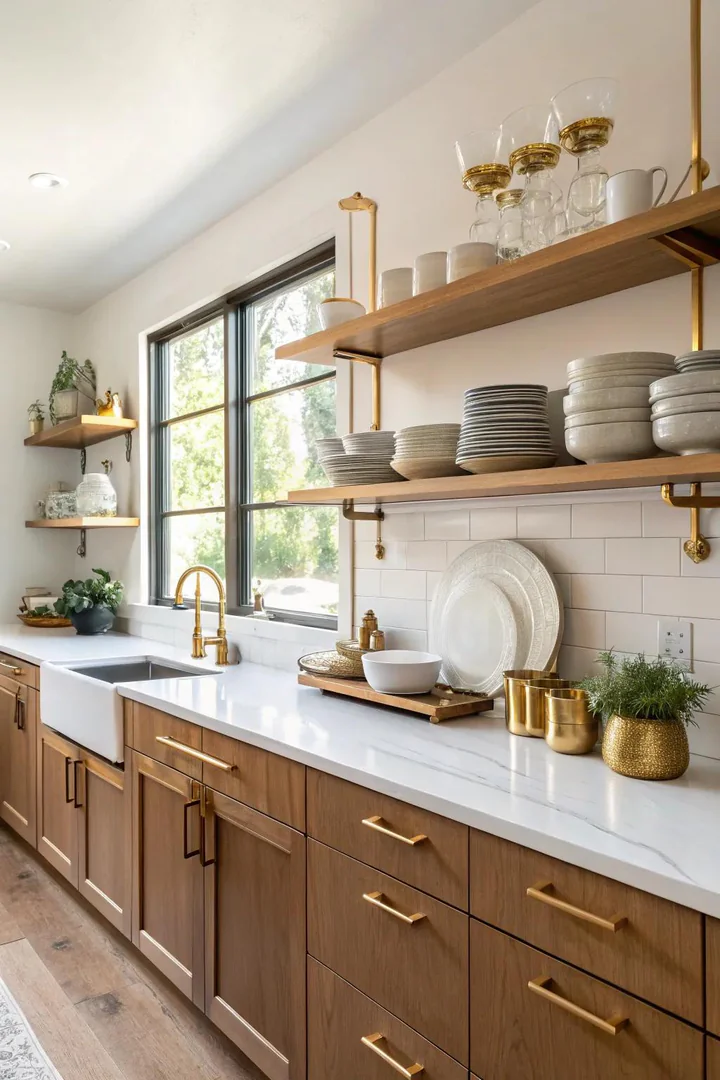
Brushed brass shelf brackets from Rejuvenation Staff Bracket in Aged Brass ($30 per bracket) or Anthropologie Hammered Brass Bracket ($28 per bracket) support floating open shelves while extending the gold hardware language from the cabinets to the walls. A wall with 2 open shelves on 4 brass brackets adds 4 visible brass elements to the room, reinforcing the gold palette without adding more cabinet pulls.
Match the bracket finish to the cabinet hardware finish (if the pulls are brushed brass, the brackets should be brushed brass, not polished brass or antique brass). A white oak shelf on brass brackets above a marble backsplash creates a layered material palette: stone, wood, and metal. Black walnut shelves on brass brackets produce a richer, warmer combination. Position the shelf height at 54 to 60 inches (bottom of the shelf) so the bracket profile is visible at eye level, where the brass finish catches natural and artificial light. Open shelving with gold brackets works especially well on peninsula layouts where the dining side faces the living area.
10. Farmhouse-Style Gold Hardware
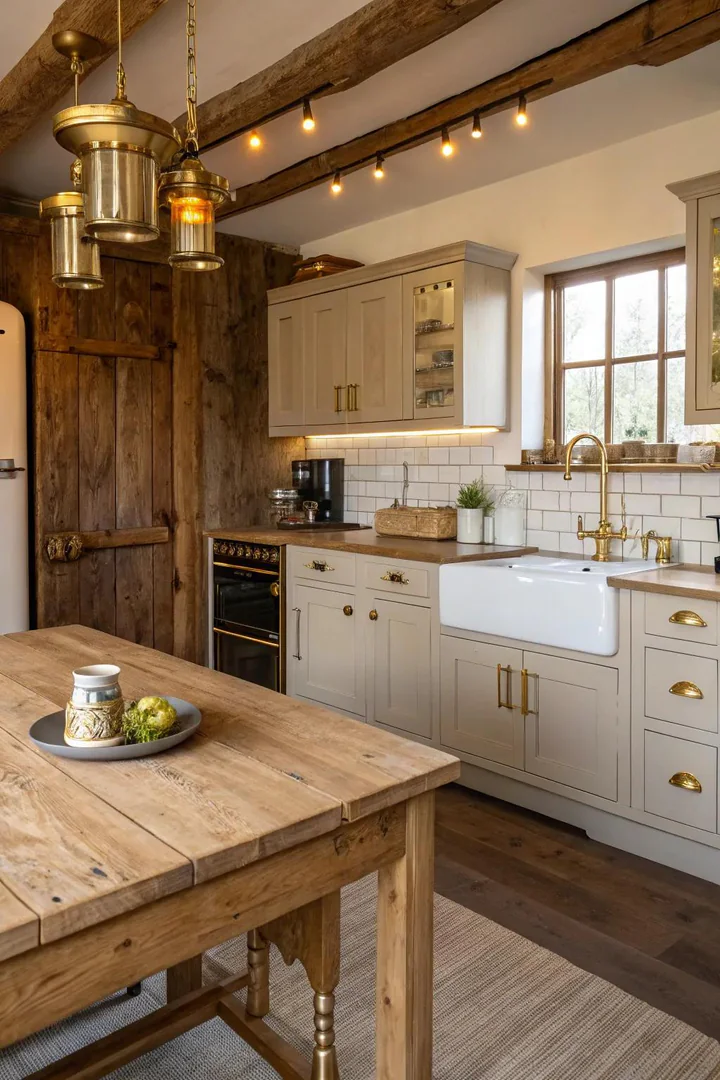
A farmhouse kitchen pairs cup pulls on drawers (Amerock Ashby Cup Pull in Golden Champagne, $8 each) and round knobs on doors (Emtek Brass Knob in French Antique, $12 each) for a traditional, collected look. Cup pulls (half-moon-shaped bin pulls) originated on 19th-century apothecary drawers and produce an authentic farmhouse-era silhouette. Mixing cup pulls on drawers with round knobs on doors adds variety that a uniform bar-pull installation lacks.
A farmhouse gold palette coordinates brass cup pulls, a brass bridge faucet (Kingston Brass Heritage KS7752, $180 in polished brass), brass bin-pull latches on pantry doors, and a brass pendant light over the farmhouse sink. White beadboard or shaker cabinets, a soapstone or butcher-block countertop, and a fireclay farmhouse sink complete the farmhouse material palette. Gold (rather than nickel or chrome) gives the farmhouse kitchen a warmer, more antique-inspired metal language than silver-toned alternatives.
11. Gold Light Fixtures Coordinated with Hardware
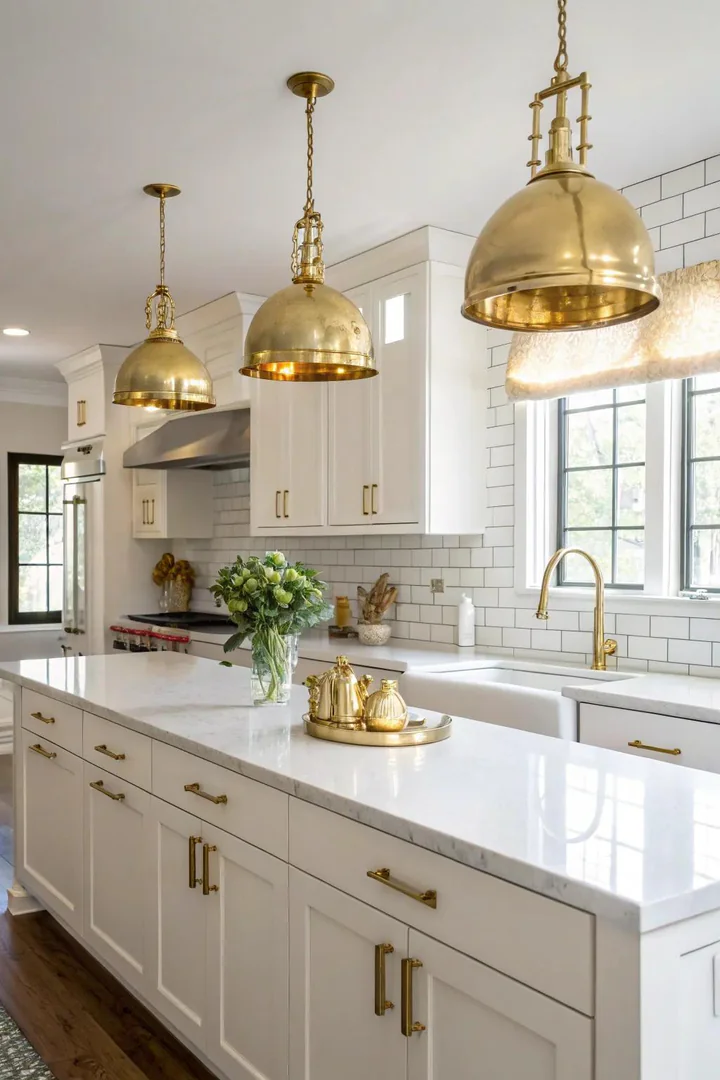
Matching the pendant light finish to the cabinet hardware finish creates a unified gold thread that runs from the countertop level (hardware) to the ceiling level (light fixtures). A brass pendant from Schoolhouse Electric Isaac in Natural Brass ($200) or West Elm Sculptural Glass Globe in Brass ($149) hung over the island or peninsula extends the gold accent vertically. Three matching pendants over an 8-foot island create a rhythmic gold line across the ceiling plane.
Recessed can lights with brass trim rings (Halo 6-inch trim in Satin Brass, $15 each) convert standard silver-trimmed recessed lights to gold-trimmed lights for $15 per fixture. A brass flush-mount ceiling light (Rejuvenation Eastmoreland in Aged Brass, $175) replaces a basic builder-grade flush mount and coordinates with the cabinet hardware below. Coordinating light and hardware finishes requires buying from the same finish family (brushed brass with brushed brass, not brushed brass with polished brass), though small variations between manufacturers are normal and acceptable.
12. Marble Countertop with Gold Hardware
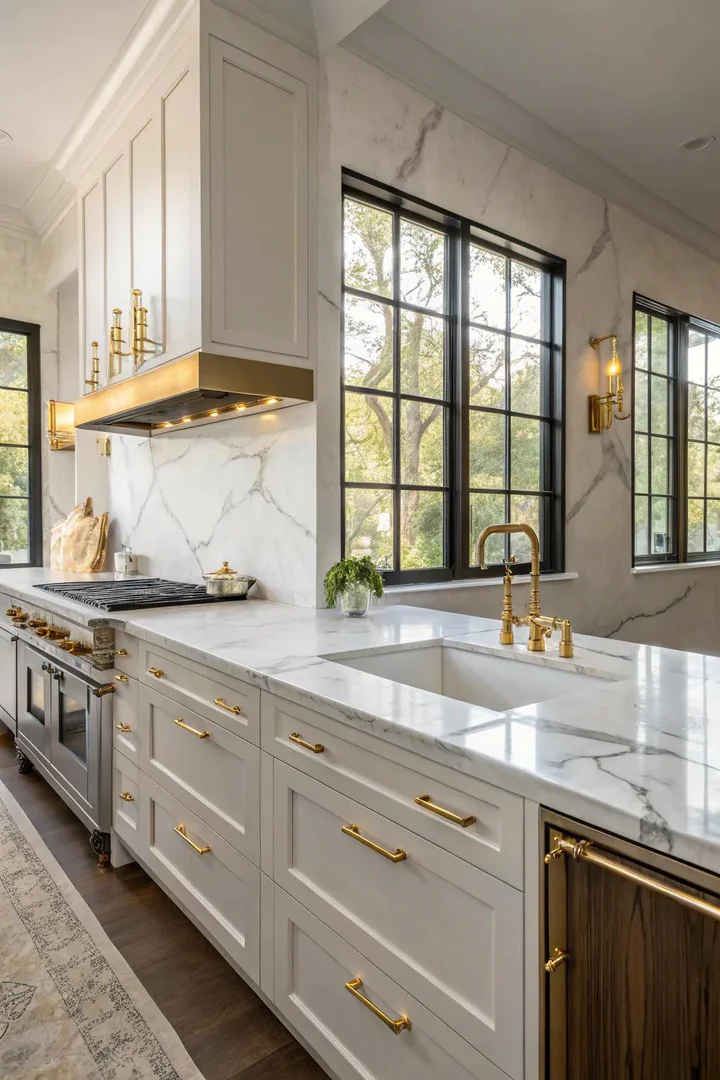
Gold hardware on cabinets below a Calacatta marble or Calacatta Gold quartz countertop creates a luxury-grade material palette where the gold veining in the stone echoes the gold finish on the pulls. Calacatta Gold marble ($100 to $200 per square foot installed) carries warm gold-and-amber veining on a white background that visually connects to brushed brass or satin gold hardware. Caesarstone Calacatta Nuvo 5131 ($70 to $90 per square foot) replicates the pattern in a zero-maintenance quartz slab.
A gold faucet centered on a marble countertop (especially a Kohler Purist in Brushed Moderne Brass at $450 or a Brizo Litze in Luxe Gold at $550) ties the hardware metal directly into the countertop zone. Marble’s cool white base temperature-balances the warm gold; the result reads as luxurious without feeling heavy. Gold hardware on marble suits traditional, transitional, and glam kitchen styles where material quality and craft define the design. Browse marble floor kitchen ideas for matching the countertop stone to the floor.
13. Glass Cabinet Doors with Gold Frames
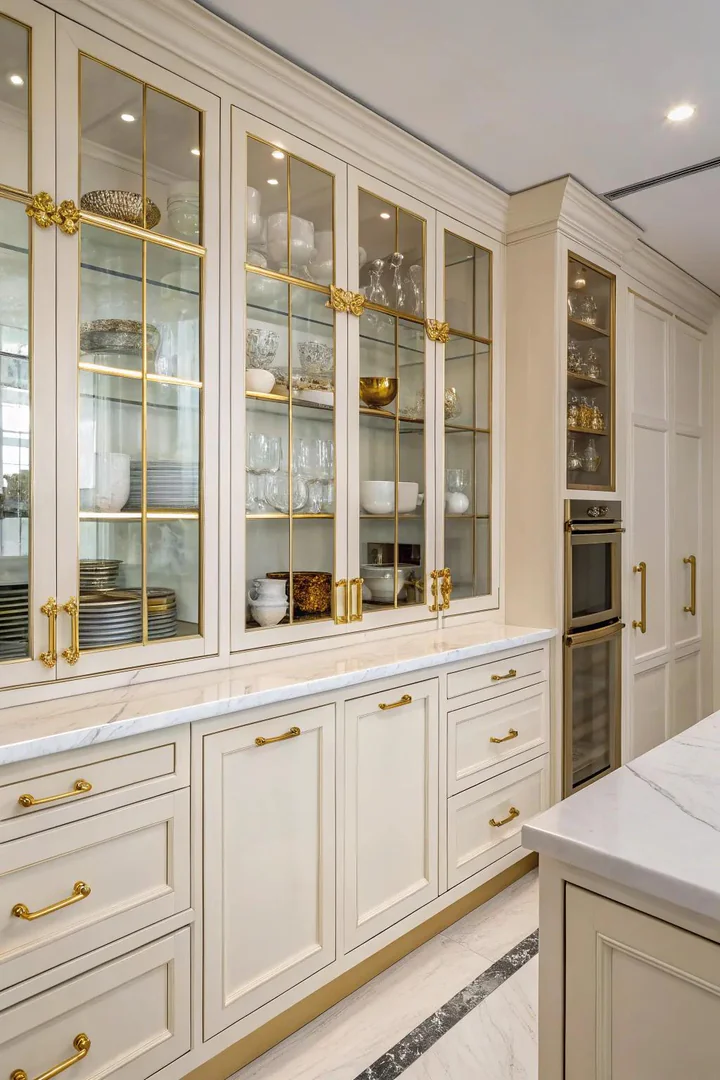
Glass-front upper cabinet doors with gold-finished hinges (Amerock Self-Closing Hinge in Golden Champagne, $5 per pair) and gold knobs (Top Knobs Aspen Round Knob in Light Bronze, $8 each) frame the glass panel in warm metal, turning the cabinet into a display case. The gold hinge and knob on each glass door provide 3 visible brass points per door (two hinges + one knob) that read as a unified gold frame around the glass.
LED puck lights ($8 each from GE) installed inside glass-front cabinets illuminate the interior contents and reflect off the gold hardware, amplifying the warm-metal glow. White dishware, clear glassware, and ceramic pieces displayed behind glass doors create a gallery-like presentation. Gold-framed glass cabinets suit traditional, transitional, and French country kitchen styles where displaying collected objects behind glass adds visual richness without clutter. Position glass-front cabinets flanking the range hood or sink window for a symmetrical composition.
14. Oversized Gold Statement Pulls
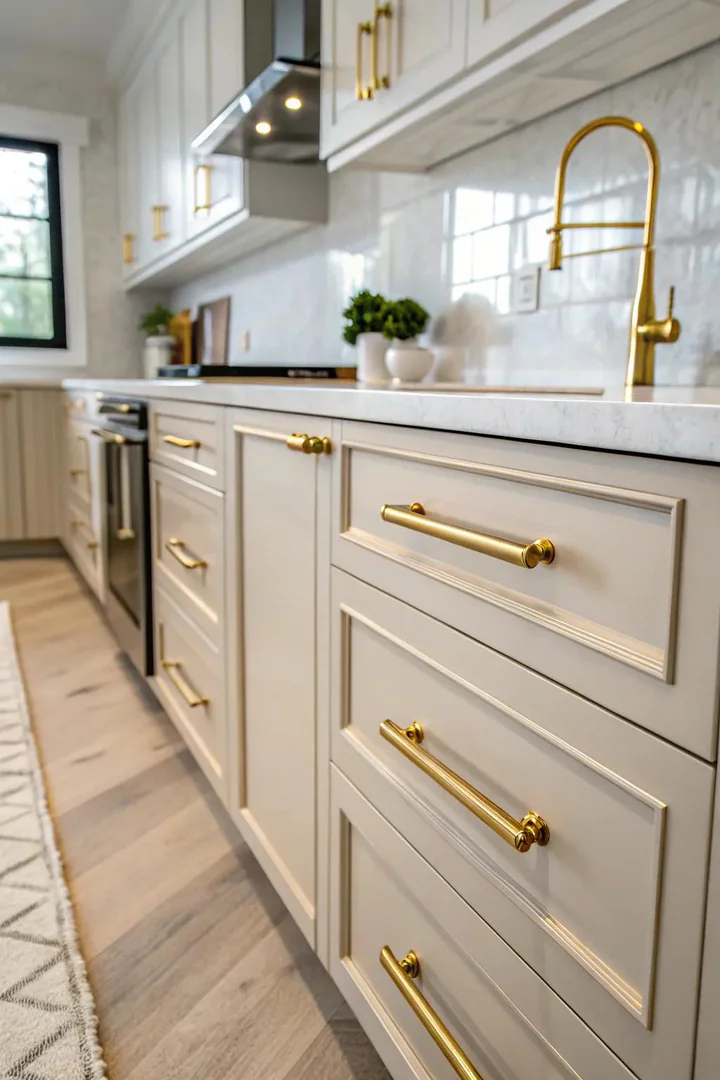
Oversized pulls (10 to 18 inches long) from Top Knobs Barrington Appliance Pull in Honey Bronze ($40 for a 12-inch pull) or Emtek Alexander Appliance Pull in Satin Brass ($55 for an 18-inch pull) on tall pantry doors, refrigerator panels, and full-height cabinet doors create a bold, furniture-grade look. A single oversized pull on a 24-by-84-inch pantry door reads as a design statement; standard 5-inch pulls on the same door read as afterthoughts.
Oversized pulls work best on tall, wide doors where the pull length proportionally matches the door size. A 12-inch pull suits a 36-inch-wide drawer or a 15-inch-wide pantry door. An 18-inch pull suits a 24-inch-wide or wider door. Mounting the oversized pull vertically on tall doors (centered at 36 to 42 inches from the floor) provides an ergonomic grip height. Mounting horizontally on wide drawers provides a two-handed grip for heavy drawers. Oversized gold pulls suit modern, contemporary, and glam kitchens where the hardware functions as the cabinet’s primary decorative element.
15. Textured Gold Finishes
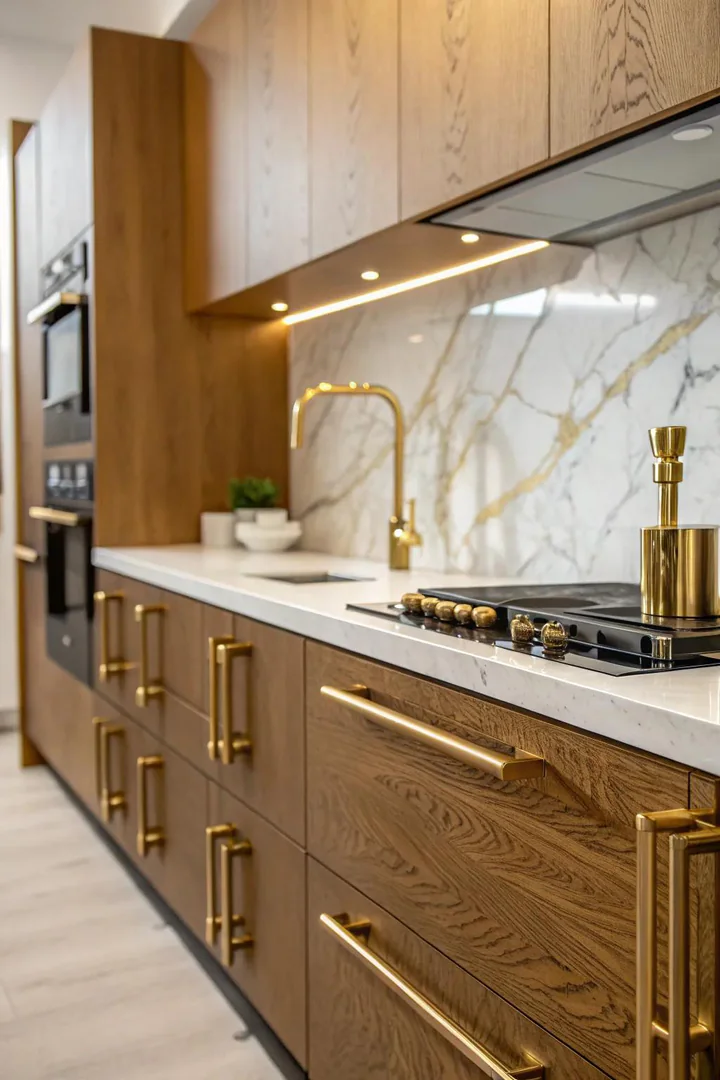
Hammered brass, knurled brass, and ribbed brass pulls from Anthropologie Hammered Drawer Pull ($14 each), Buster + Punch Knurled T-Bar in Brass ($35 each), or CB2 Fluted Brass Knob ($12 each) add a tactile dimension that smooth bar pulls cannot deliver. A hammered surface catches light at multiple angles, producing a glittering, faceted effect. A knurled surface (fine crosshatch grooves cut into the brass) provides a non-slip grip and an industrial-jewelry appearance.
Textured gold hardware becomes the kitchen’s primary decorative detail, reducing the need for additional accessories, art, or decorative objects. The pull itself tells a material story: hammered brass references artisan metalwork; knurled brass references precision machining and industrial tooling; ribbed (fluted) brass references Art Deco column detailing. Choose one texture type for all hardware in the kitchen; mixing hammered and knurled and ribbed in the same room creates competing textures that cancel each other’s impact.
16. Gold Hardware with Natural Wood Cabinets
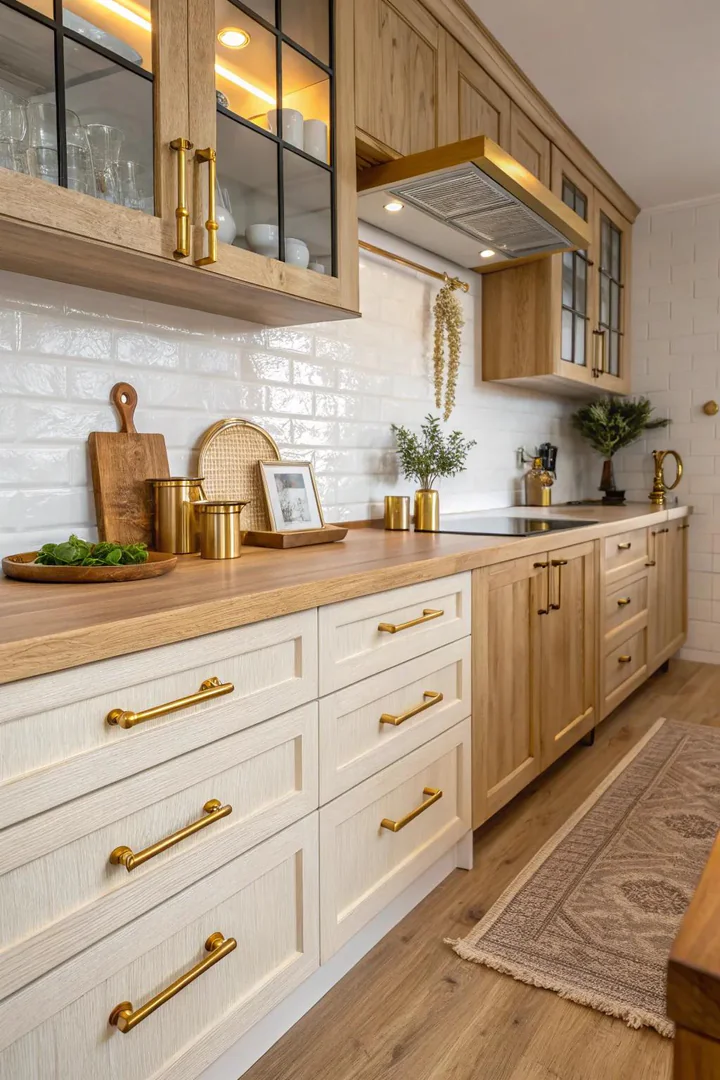
Natural wood cabinets in white oak (rift-cut, with a linear grain), walnut (dark chocolate-brown with warm purple undertones), or maple (honey-blonde with a fine, uniform grain) paired with satin brass pulls create an organic, warm palette where both the wood grain and the metal carry golden undertones. The brass hardware echoes the amber and honey tones naturally present in oak and maple grain, producing a tonal harmony that painted cabinets with gold hardware cannot replicate.
A clear-finished or natural-oil-finished wood cabinet (no paint, no opaque stain) lets the grain, knots, and color variation of the wood surface serve as the primary decorative element. Gold hardware on natural wood reads as jewelry on skin: a warm accent that complements rather than competes with the underlying surface. A natural wood kitchen with gold hardware, a white stone countertop, and warm-toned lighting produces a modern-organic style that balances raw materials with polished metal craft. Visit kitchen windows over sink for pairing brass window hardware with gold cabinet pulls, and explore the full design library at The Designers Company.
How to Install Gold Cabinet Hardware
1. Choose the Right Pull Size and Center-to-Center Measurement
Measure the existing hardware holes on each cabinet door and drawer. The center-to-center measurement (distance between the two screw holes on a bar pull) determines which replacement pulls fit without drilling new holes. Common center-to-center measurements: 3 inches, 3.75 inches, 5 inches, 6.25 inches, 7.5 inches, and 10 inches. Replacing knobs (single hole) with bar pulls (two holes) requires drilling one new hole per door and filling the old hole with wood filler and touch-up paint.
2. Use a Hardware Jig for Consistent Placement
A cabinet hardware template jig (True Position TP-1934, $25, or Liberty Align Right, $10) ensures every new hole drills at exactly the same position on each door and drawer. Clamp the jig to the door edge, align the drill guide to the desired position, and drill through the template hole with a 3/16-inch drill bit. Without a jig, even 1/8-inch variations between doors produce a visibly crooked hardware line across a bank of cabinets.
3. Install Pulls with Machine Screws from Inside the Door
Insert the machine screw (included with the pull) from inside the cabinet door, through the drilled hole, and into the threaded hole on the back of the pull. Hand-tighten, then give a quarter-turn with a screwdriver to snug the pull against the door face. Over-tightening pulls the screw head through the interior door surface or strips the threads. A rubber or plastic washer between the screw head and the interior door surface distributes pressure and prevents the screw from sinking into soft wood or MDF.
Gold Hardware Finish Comparison
| Finish | Appearance | Tarnish Behavior | Maintenance | Price Range | Best Style Match |
|---|---|---|---|---|---|
| Polished brass | Mirror-reflective gold | Tarnishes if unlacquered | Polish quarterly | $8–$25/pull | Traditional, glam |
| Brushed brass | Matte warm gold | Hides fingerprints | Wipe with cloth | $5–$20/pull | Transitional, modern |
| Satin gold | Soft sheen, warm | Lacquered, no tarnish | Wipe with cloth | $6–$18/pull | Contemporary |
| Champagne bronze | Warm gold-brown | Lacquered, no tarnish | Wipe with cloth | $5–$15/pull | Farmhouse, transitional |
| Antique brass | Darkened, aged gold | Pre-aged, stable | Minimal | $8–$22/pull | Vintage, farmhouse |
| Unlacquered brass | Raw, patinas over time | Patinas naturally | Optional wax/polish | $10–$25/pull | Traditional, cottage |
Frequently Asked Questions
Does gold cabinet hardware tarnish over time?
Lacquered gold hardware (brushed brass, satin gold, champagne bronze, antique brass from most manufacturers) is coated with a clear protective lacquer that prevents tarnishing indefinitely. Unlacquered brass hardware tarnishes naturally over weeks to months, developing a darker, mottled patina from hand oils and air exposure. Polished brass hardware from some manufacturers ships lacquered; check the product description. To remove tarnish from unlacquered brass, apply Bar Keepers Friend ($3) or a paste of lemon juice and baking soda, scrub gently, and rinse.
Can you mix gold hardware with stainless-steel appliances?
Gold hardware coordinates successfully with stainless-steel appliances when the gold appears on the cabinets, faucet, and light fixtures (the small, repeated elements) while stainless steel appears on the large appliance surfaces (refrigerator, range, dishwasher). The 70/30 rule (70% dominant metal, 30% secondary metal) guides the proportion. Gold cabinet hardware against stainless-steel appliances reads as intentional mixed metals, not mismatched, when the gold appears consistently across all cabinet doors and drawers.
What is the difference between brushed brass and champagne bronze?
Brushed brass carries a warm, yellow-gold tone with a matte, directionally brushed texture. Champagne bronze carries a slightly darker, more brown-gold tone that reads as warmer and more muted than brushed brass. Delta Champagne Bronze (the finish popularized by Delta faucets) sits between gold and bronze on the color spectrum. Champagne bronze coordinates more naturally with warm wood tones and earth-colored countertops; brushed brass coordinates more naturally with white, gray, and cool-toned cabinets.
How many gold pulls and knobs does a typical kitchen need?
A standard 20-door, 10-drawer kitchen requires 30 to 40 pieces of hardware: one pull or knob per door and one pull per drawer. Small drawers (under 18 inches wide) use one pull; wide drawers (18 to 36 inches) use two pulls spaced symmetrically. Budget $150 to $500 for a full kitchen hardware swap using mid-range pulls ($5 to $15 each). Premium and designer hardware ($20 to $40+ each) raises the total to $600 to $1,600. Hardware installation (removal of old, installation of new) takes 1 to 3 hours for a DIY homeowner.
What gold hardware finish is most popular for kitchens in 2025?
Brushed brass and champagne bronze remain the two most-specified gold finishes in kitchen design because both hide fingerprints, resist tarnishing (lacquered), and coordinate with the broadest range of cabinet colors and countertop materials. Satin gold and antique brass are rising alternatives for homeowners who want a softer or more aged appearance. Polished brass (the high-shine, mirror-reflective finish popular in the 1980s and 1990s) is returning in modern and Art Deco-inspired kitchens as a deliberately retro choice.