
French Country Kitchen Ideas: 19 Elegant Styles That Inspire
French country kitchen ideas blend the rustic warmth of rural Provence and the refined grace of Parisian interiors into a kitchen style defined by natural materials, soft colors, hand-finished surfaces, and collected antiques. A French country kitchen uses limestone or terracotta floors, hand-glazed or hand-painted cabinetry, open shelving with displayed pottery, copper and brass cookware hung from iron racks, and natural stone or butcher-block countertops to create a space that feels lived-in, welcoming, and layered over generations rather than assembled from a single showroom purchase. Below are 19 French country kitchen design elements with specific materials, products, colors, and placement strategies, followed by a how-to guide, a comparison table, and FAQs.
1. Contrasting Wood Tones

Mixing two or three wood tones (a dark walnut island with light oak perimeter cabinets, or a honey-pine ceiling beam against white-painted cabinetry) creates the layered, collected-over-time look that defines French country interiors. A single uniform wood tone reads as modern or builder-grade; mismatched wood tones read as inherited, organic, and European. Pair a dark-stained walnut island top (IKEA Karlby Walnut, $249 for 74 inches) with light-washed white-oak open shelving and medium-toned reclaimed-pine ceiling beams.
French country wood tones lean warm: honey, amber, walnut, cherry, and rustic pine rather than cool gray-washed or whitewashed woods (which read as coastal or Scandinavian). Sand and refinish existing oak cabinets with Minwax Golden Oak 210B stain ($9 per quart) for a warm honey tone, or leave the natural grain visible under a clear matte polyurethane ($14 per quart from General Finishes) for a raw, provincial finish.
2. Mixed Pattern Scales
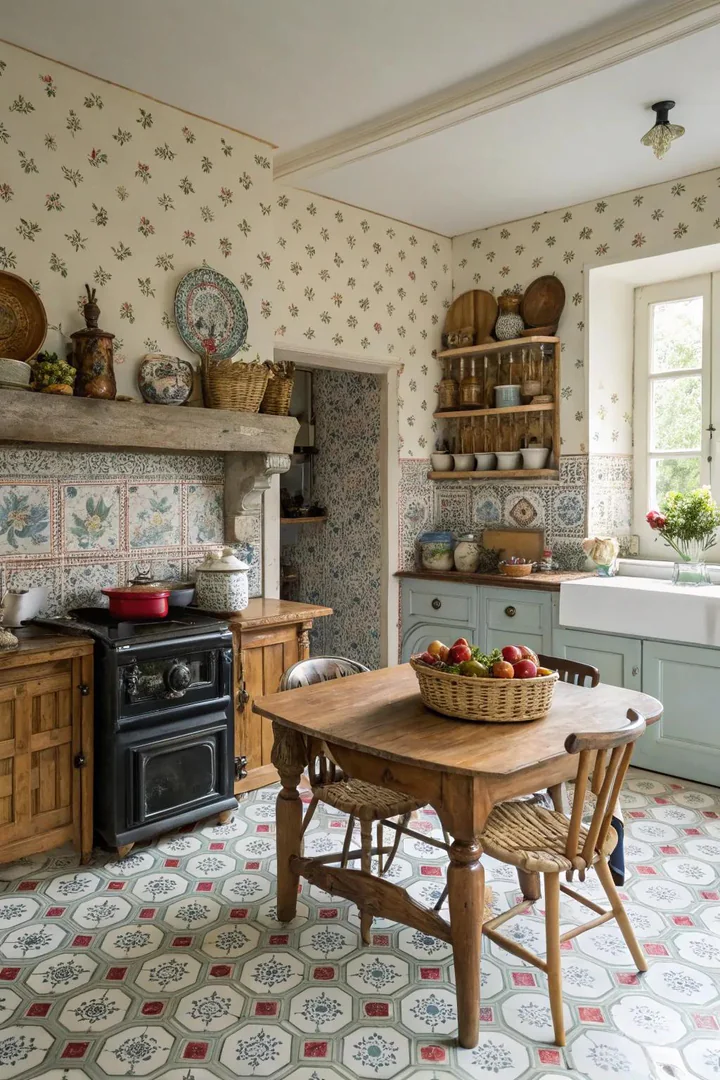
Combining a large-scale toile (a scenic print depicting pastoral, floral, or architectural scenes, traditionally printed in a single color on cream or white cotton) on curtains or chair cushions with a small-scale gingham check on napkins and a medium-scale floral on a table runner creates the layered pattern mix that French country interiors embrace. The mixing rule: vary the scale (one large, one medium, one small) and keep the color palette within 2 to 3 related hues (blue and cream, red and cream, or green and gold).
Source French country textiles from Pierre Deux (specialty French fabric store), Waverly (available at JoAnn Fabric, $15 to $30 per yard for toile and floral prints), or Schumacher ($40 to $80 per yard for designer-grade toile). A single toile curtain panel ($25 to $50 per panel from Target or Wayfair in blue-and-white or red-and-white) on the kitchen window paired with a gingham check seat cushion ($15 each from Pier 1 or Pottery Barn) establishes the French country pattern vocabulary without over-saturating the kitchen.
3. Natural Stone Floors
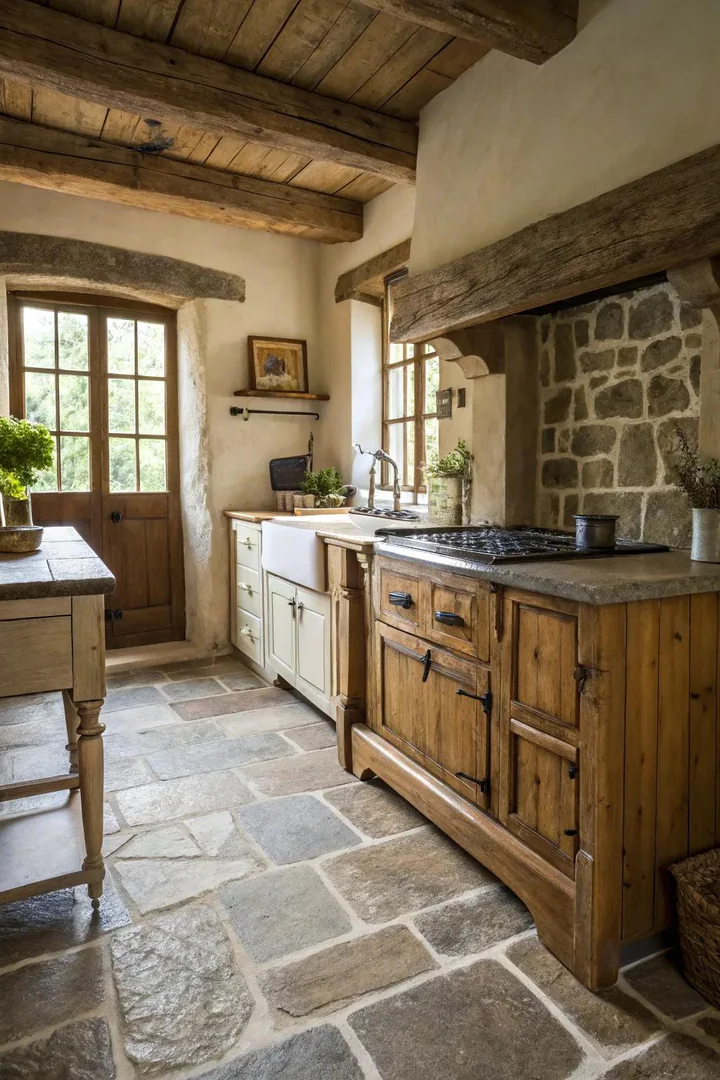
French limestone ($8 to $20 per square foot for honed Burgundy limestone, available from stone yards and specialty tile importers) or reclaimed terracotta tiles ($10 to $25 per square foot from antique-tile dealers like Chateau Domingue or Tabarka Studio) create the authentic French country floor that anchors the entire kitchen’s provincial character. Limestone in a tumbled or honed finish (not polished, which reads as Italian contemporary rather than French rustic) has a matte, chalky surface with natural fossil marks and color variation.
A terracotta floor (unglazed clay tiles in warm orange, brick-red, and brown tones, 6-by-6-inch or 8-by-8-inch squares, 12-by-12-inch squares, or hexagonal shapes) brings warmth underfoot and connects the kitchen to centuries of Mediterranean and French farmhouse tradition. Seal terracotta with a penetrating stone sealer (Miracle Sealants 511 Impregnator, $25 per quart) to prevent oil and wine stains from penetrating the porous clay surface.
4. Upholstered Seating
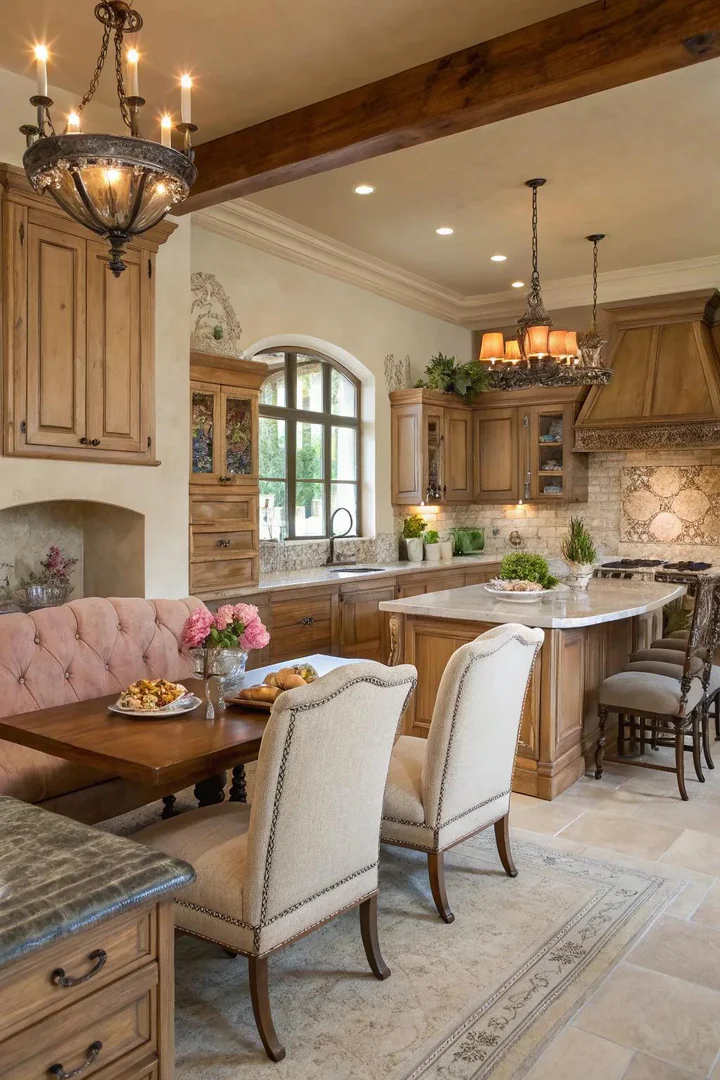
French country kitchens treat seating as furniture (upholstered dining chairs, cushioned window seats, tufted banquettes) rather than utilitarian perches (bare wood stools, metal bar chairs). A Louis XVI-style side chair ($150 to $400 each from Restoration Hardware, World Market, or French Heritage) with a carved wooden frame, cabriole legs, and a linen or cotton seat cushion brings dining-room formality into the kitchen eating area.
Reupholster existing kitchen chairs with French linen ($20 to $40 per yard from Joann or online linen retailers) in natural oatmeal, soft blue, faded rose, or sage green for an authentic French textile look. A window seat with a 4-inch foam cushion ($30 to $50 for a custom-cut foam pad from a craft store) covered in toile or ticking-stripe fabric turns a kitchen window nook into a French country reading corner. Upholstered seating softens the kitchen acoustically and visually, replacing hard surfaces with padded, fabric-covered shapes that absorb sound and add warmth.
5. Statement Range Hood
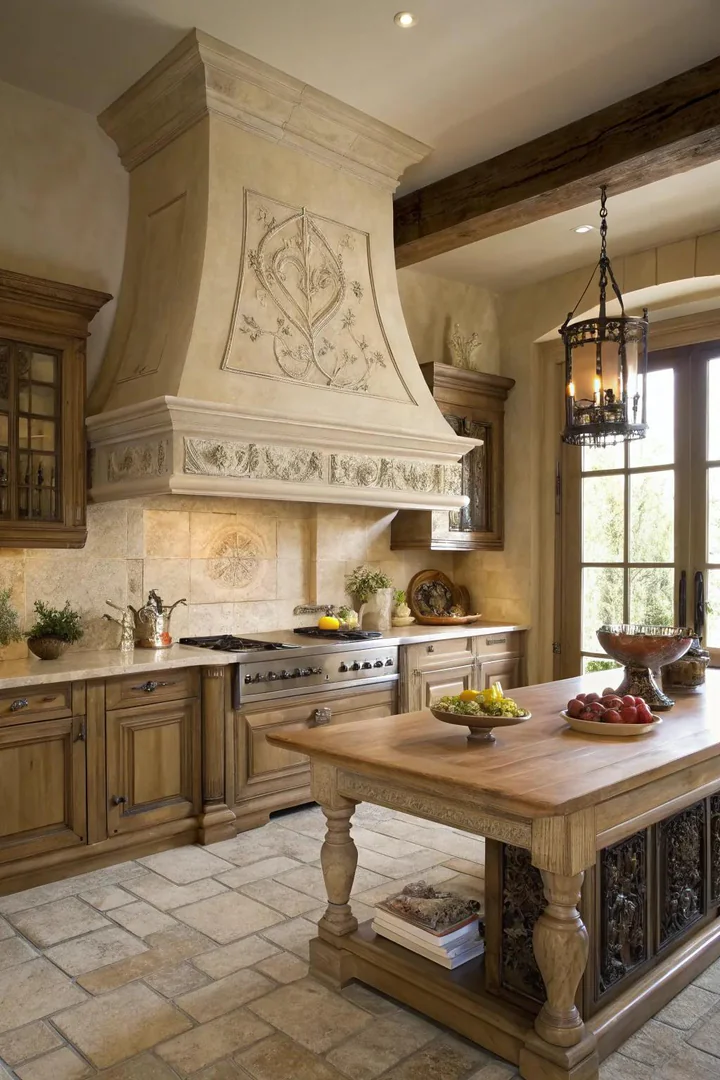
A plaster, stone, or carved-wood range hood that extends from the wall to the ceiling and curves outward in a bell, arch, or mantel shape replaces a standard stainless-steel hood with an architectural element that becomes the kitchen’s focal point. French country range hoods are typically finished in smooth plaster or Venetian stucco (Behr Venetian Plaster, $35 per gallon, applied with a steel trowel for a hand-finished texture) and painted white, cream, or a soft color that matches the wall.
A custom plaster hood shell ($800 to $2,500 from hood manufacturers like Francois & Co or CopperSmith) installs over a standard range hood insert (Broan Elite 36-inch, $300 to $500, 400 CFM) that provides the actual ventilation function. A DIY plaster hood built over a plywood frame and coated with joint compound and Venetian plaster costs $200 to $400 in materials. The curved, hand-plastered surface reads as Old World craftsmanship that stainless-steel appliance hoods cannot replicate.
6. Natural Wood Open Shelving
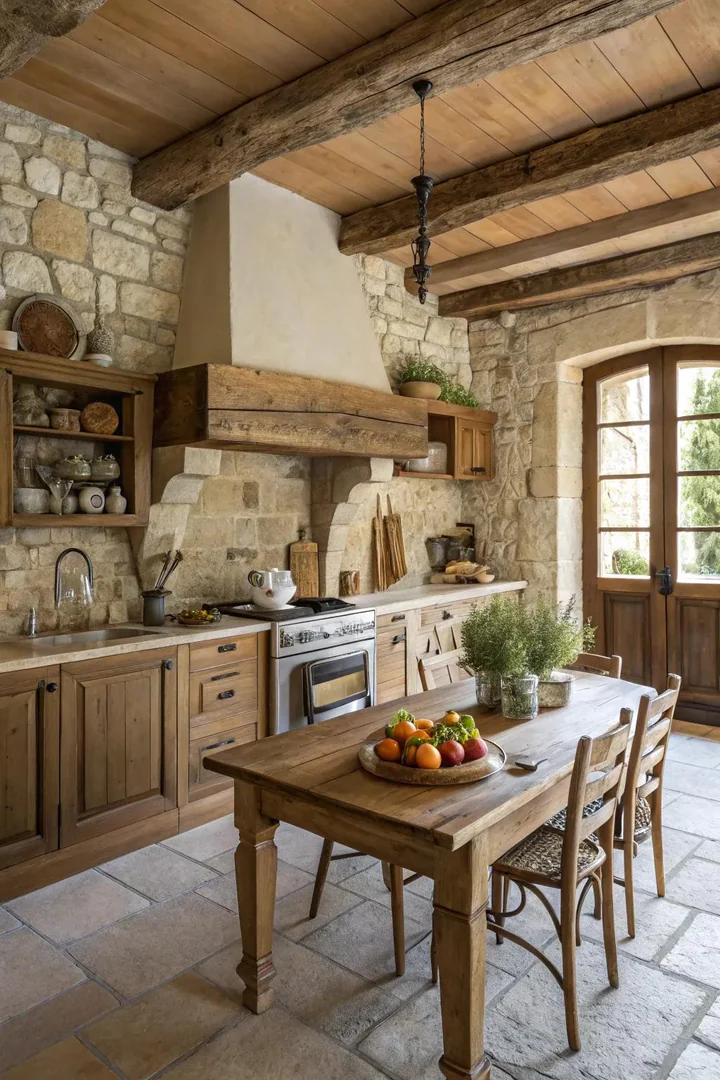
Replacing one or two sections of upper cabinets with open wooden shelves (2-inch-thick planks of reclaimed pine, white oak, or walnut, $30 to $80 per 36-inch shelf from a lumber yard or Etsy seller) mounted on wrought-iron brackets ($15 to $30 per pair from Signature Hardware or Amazon) opens the kitchen visually and creates display space for the pottery, copper bowls, ceramic pitchers, and cookbooks that define the French country aesthetic.
Display a collected mix of items on each shelf: white ironstone plates propped on their edges, a row of blue-and-white transferware cups, a stack of linen napkins, a small potted herb, and a vintage French cookbook. The arrangement should look casual and lived-in rather than symmetrical and staged. Leave 20% to 30% of the shelf space empty to prevent the shelves from looking cluttered. French country open shelving works best on one wall section (4 to 8 feet wide) with the remaining walls retaining closed cabinet doors for practical storage.
7. Antique and Vintage Accents
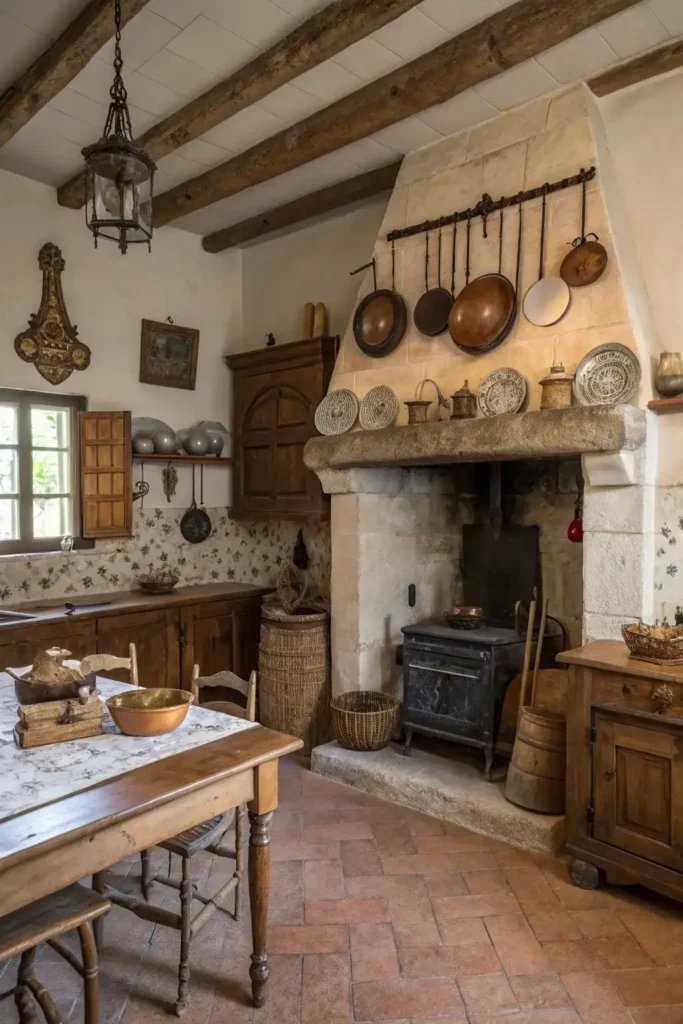
A French country kitchen includes at least 3 to 5 antique or vintage pieces (a copper pot rack, a zinc-topped pastry table, a carved wooden bread box, a set of vintage ceramic canisters, a framed antique botanical print, or an old iron scale) that add the patina and history that new furnishings cannot fake. Shop estate sales, flea markets (Brimfield in Massachusetts, Round Top in Texas, Rose Bowl in Pasadena), and online antique dealers (Chairish, 1stDibs, Ruby Lane) for French and European kitchen antiques.
An antique zinc-topped table ($400 to $1,500 from antique dealers) used as a kitchen island or prep table provides a work surface with genuine age marks, patina, and character. A set of vintage French copper pots ($50 to $200 each from antique shops or Etsy, look for “Mauviel” or “Dehillerin” stamps) hung from a wall-mounted pot rack ($40 to $100 from Enclume or Old Dutch International) adds functional antiques to the cooking zone. Place antiques where they can be seen and used daily rather than locked in a display case.
8. Dark Stone Countertops
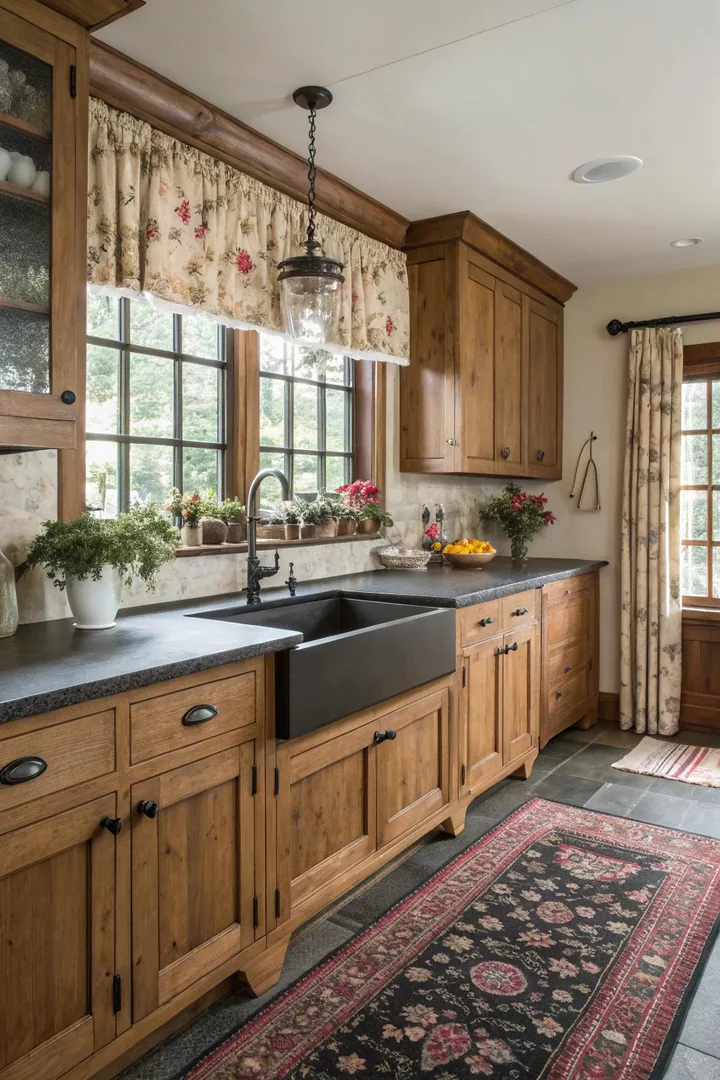
Honed black granite (Absolute Black or Black Pearl, $40 to $65 per square foot installed), soapstone ($60 to $120 per square foot), or honed Belgian Blue limestone ($50 to $80 per square foot) provides a dark, matte countertop surface that grounds the kitchen’s lighter cabinet colors and creates the tonal contrast that French country kitchens rely on for visual depth. Dark countertops paired with cream or white cabinets, warm wood floors, and copper accents create the classic French provincial color balance.
Soapstone (a natural stone containing talc, which gives it a soft, silky touch and a dark gray-to-black color that deepens over time with mineral oil applications) was used in French farmhouse kitchens for centuries because the stone resists heat (hot pots can be placed directly on the surface without trivets), resists staining from acidic foods (lemon juice, wine, tomato sauce), and develops a living patina that adds character with age. Apply food-grade mineral oil ($8 per 16-ounce bottle) to soapstone countertops monthly for the first year, then quarterly, to accelerate the patina development.
9. Fabric Cabinet Skirts
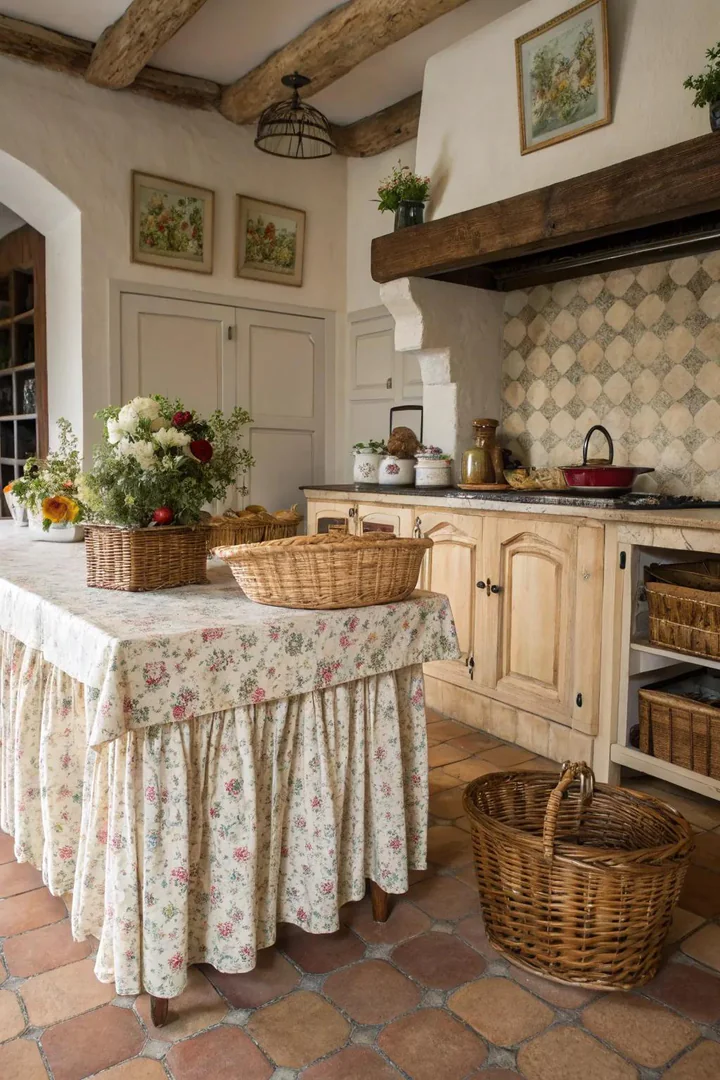
A gathered fabric skirt hung from a tension rod ($5 from a hardware store) or a curtain wire ($3 for a 16-foot coil of brass curtain wire) below the countertop, covering the lower cabinet face or hiding an open under-counter storage area, is a signature French country detail found in kitchens across Provence, Normandy, and the Loire Valley. French kitchen skirts are traditionally made from cotton toile, ticking stripe, or linen in cream, blue, or red.
A skirt works in two positions: replacing a missing or removed cabinet door (hiding the open shelf behind a soft, gathered fabric panel that pushes aside for access) or covering a freestanding sink console where exposed plumbing runs below the basin. Cut the fabric to 1.5 times the width of the opening (for a full gather) and hem the top edge with a rod pocket or clip rings. A fabric skirt costs $10 to $30 to make (1 to 2 yards of fabric plus a tension rod) and installs in 10 minutes. Browse complementary wall treatments at wainscoting ideas for your kitchen for paneling styles that coordinate with fabric skirts.
10. Displayed Cookware
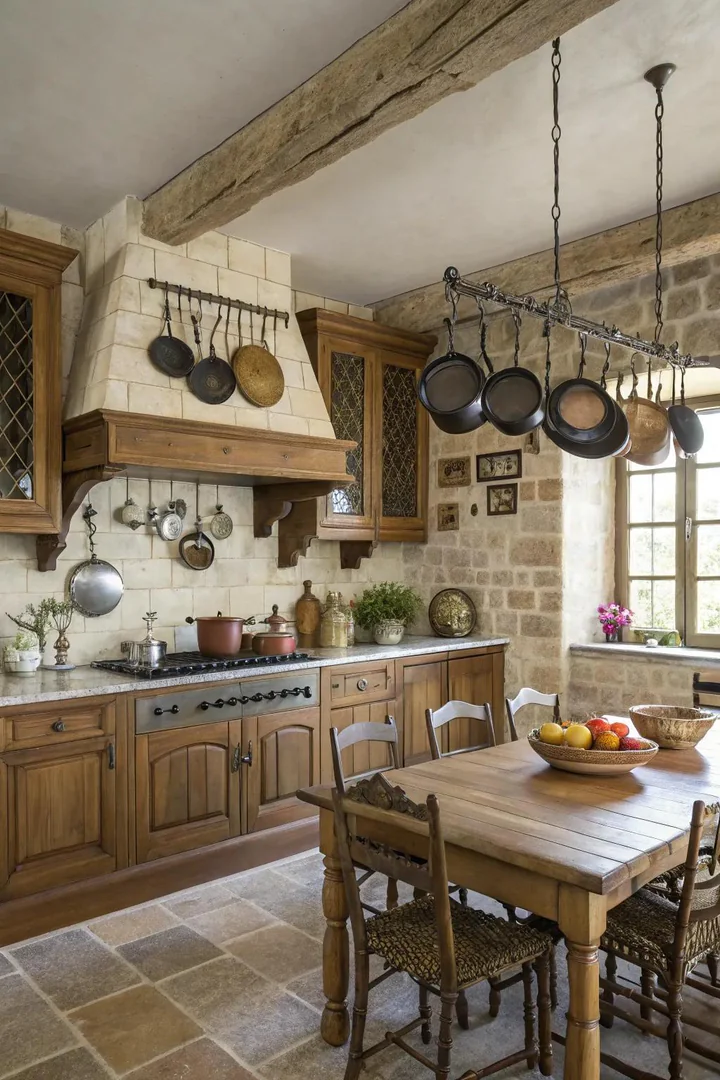
Hanging pots, pans, colanders, and cooking utensils from a ceiling-mounted pot rack (Enclume Premier Oval Rack, $200 to $400 in hammered steel or chrome; Old Dutch International Half-Round Pot Rack, $80 to $120), a wall-mounted iron bar with S-hooks ($20 to $50 for a 36-inch wrought-iron bar with 8 to 12 hooks from Etsy or Amazon), or a pegboard rail system displays the kitchen’s working tools as decorative objects. French country kitchens treat cookware as art, not clutter.
Copper pots (Mauviel M’150B, $100 to $400 per piece), enameled cast-iron Dutch ovens (Le Creuset Signature 5.5-quart, $370 in Flame Orange or Marseille Blue; Staub 5.5-quart, $300 in Cherry or Basil), and hand-forged iron skillets (Smithey No. 12 Skillet, $160) display beautifully because the materials, shapes, and patina of quality cookware create visual interest equal to any wall art. Hang the most photogenic pieces (the copper sauté pan, the blue Le Creuset, the rustic iron skillet) at the front of the rack and tuck utilitarian items (the stainless stockpot, the non-stick frying pan) behind them or in closed cabinets.
11. Open Pantry Storage
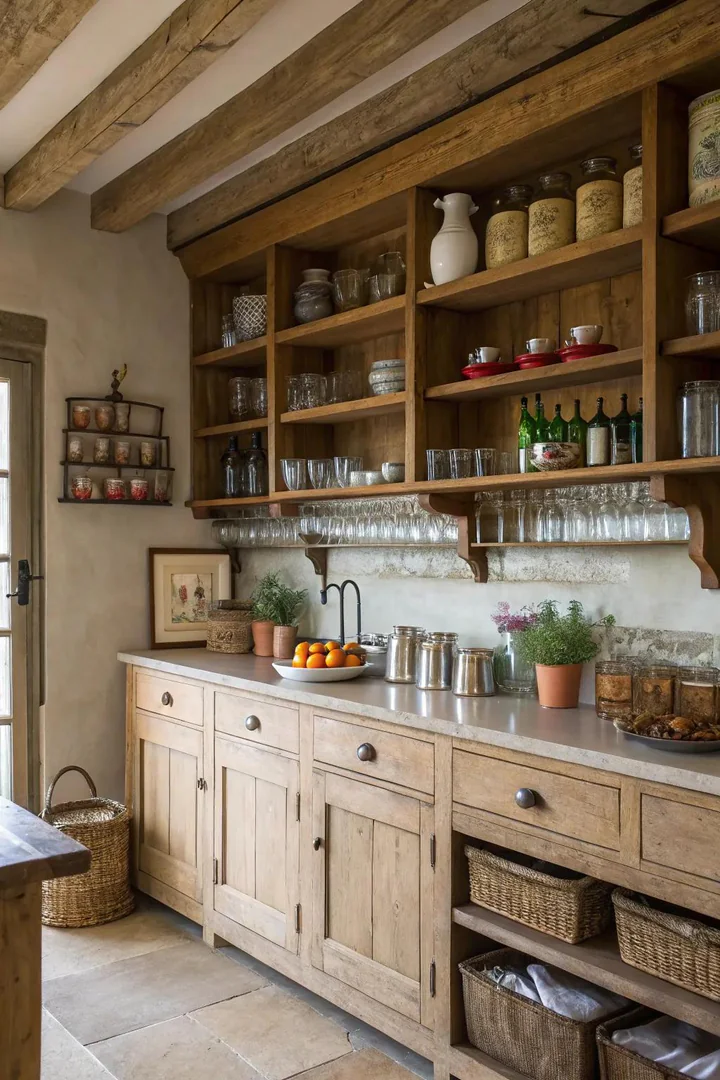
Storing staple ingredients (flour, sugar, rice, pasta, dried beans, coffee, tea, olive oil, vinegar) in clear glass jars (Le Parfait French Glass Canning Jars, $8 to $15 each in 1-liter and 2-liter sizes; Weck Tulip Jars, $5 to $10 each; or IKEA KORKEN, $3 to $5 each) arranged on open shelves or on the countertop creates a visible pantry display that reads as both decorative and functional. French country kitchens prefer transparent, accessible storage over hidden, behind-closed-doors pantries because the displayed ingredients contribute color, texture, and visual warmth to the room.
Arrange jars by height (tallest at the back, shortest at the front) on a wooden tray ($15 to $30 from Pottery Barn or HomeGoods) for a grouped, intentional look. Label each jar with a hand-written kraft-paper tag ($5 for a 100-tag pack from Amazon) or a printed waterproof label ($10 for a custom set from Etsy) for a finished, organized presentation. Open pantry storage works on a dedicated pantry shelf, on the countertop beside the cooking zone, or on a freestanding wooden baker’s rack ($100 to $300 from Wayfair or Pottery Barn) positioned against a kitchen wall.
12. Architectural Details
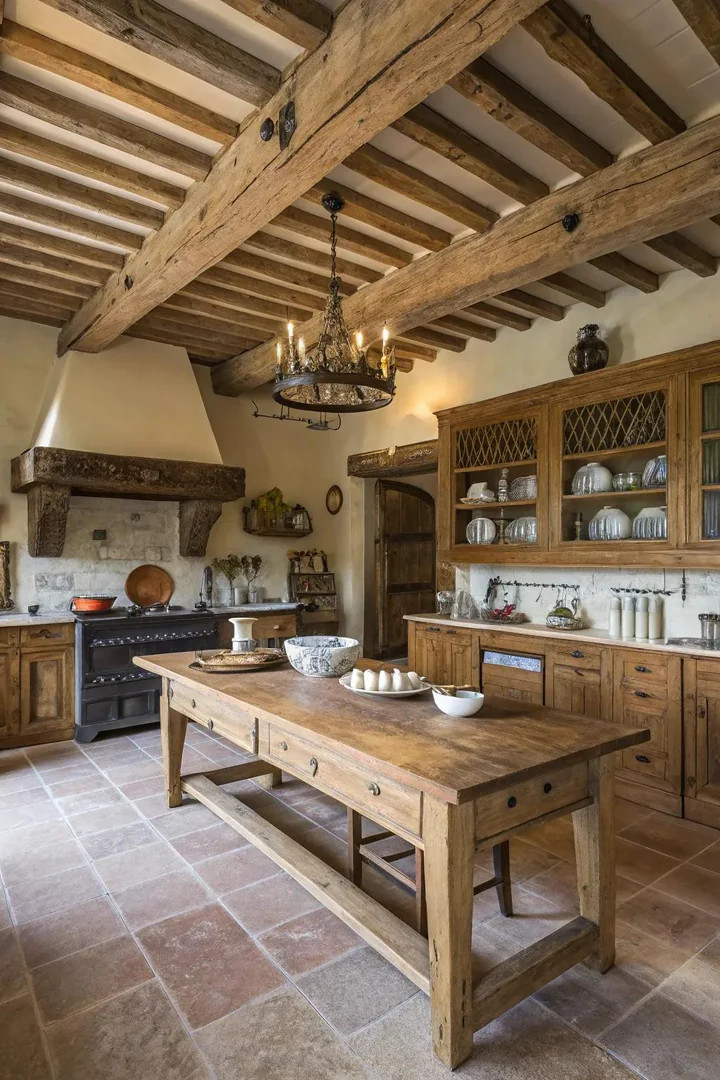
Exposing, restoring, or adding architectural details (ceiling beams, arched doorways, corbels, ceiling medallions, crown molding, wainscoting, plaster walls, niches, and built-in plate racks) gives the kitchen the structural bones that French country design depends on for its sense of permanence and history. Faux ceiling beams (Barron Designs Faux Wood Beams, $60 to $150 each for 8-foot lengths in walnut, oak, or reclaimed-wood finishes) mount to the ceiling with screws and provide the visual weight of solid timber at a fraction of the cost and structural load.
An arched doorway between the kitchen and dining room (framed with a prefabricated arch kit from CurveMakers, $150 to $400, or built on-site from drywall and metal studs, $300 to $600 by a carpenter) replaces a rectangular opening with a European-inspired curve that softens the transition between rooms. Add crown molding ($2 to $5 per linear foot for MDF or pine crown from Home Depot) at the ceiling line and at the top of upper cabinets to create a visual connection between the cabinets and the ceiling that reads as built-in and permanent.
13. Gathering-Focused Layout
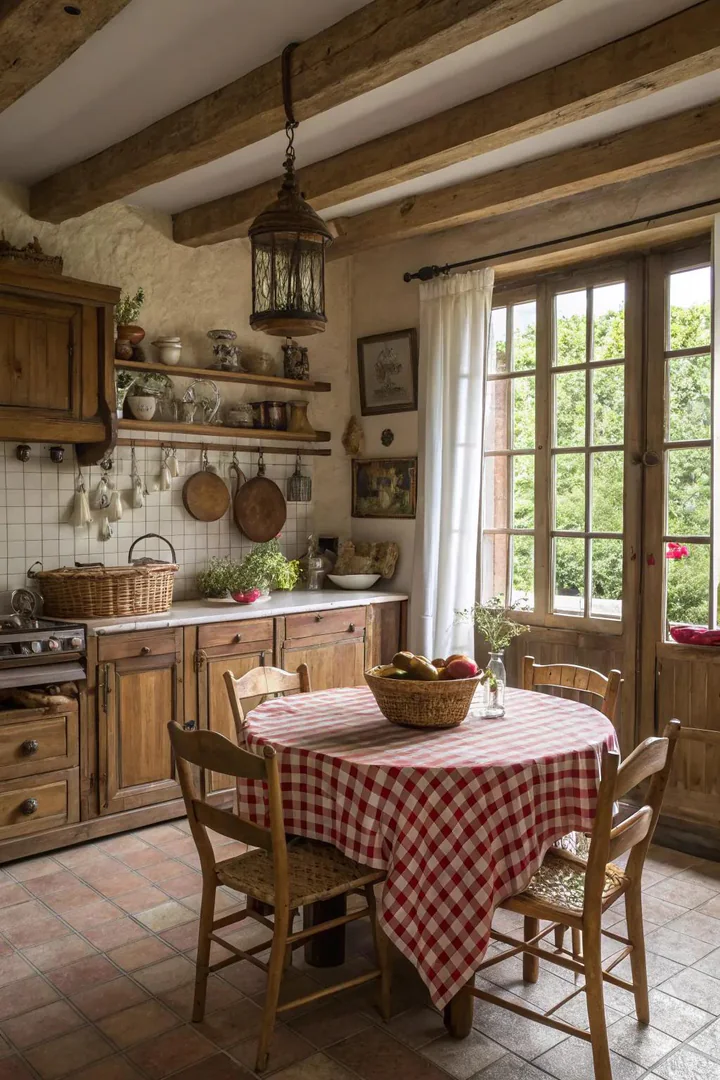
French country kitchens prioritize a large, central gathering table (a farmhouse table, a trestle table, or a refectory table, 6 to 8 feet long, seating 6 to 10 people) over a conventional kitchen island because the French kitchen tradition centers on communal cooking, eating, and socializing at a shared table rather than working at a countertop bar. A reclaimed-pine farmhouse table ($300 to $800 from Pottery Barn, Restoration Hardware, or Etsy sellers) with turned legs, a plank top, and visible knots and grain serves as prep surface, dining table, homework station, and gathering point.
Position the gathering table in the center of the kitchen (in rooms 12 by 14 feet or larger) or against one wall as a breakfast table (in smaller kitchens). Surround the table with mismatched chairs (a mix of painted wooden chairs, rush-seat chairs, a bench on one side, and one or two upholstered end chairs) for the collected, unmatched look that distinguishes French country from matched dining sets. A French country kitchen without a gathering table is missing the social center of the room. See how cabinet colors set the backdrop for gathering spaces at sunflower kitchen cabinets for warm, inviting color strategies.
14. Hand-Painted Decorative Tiles
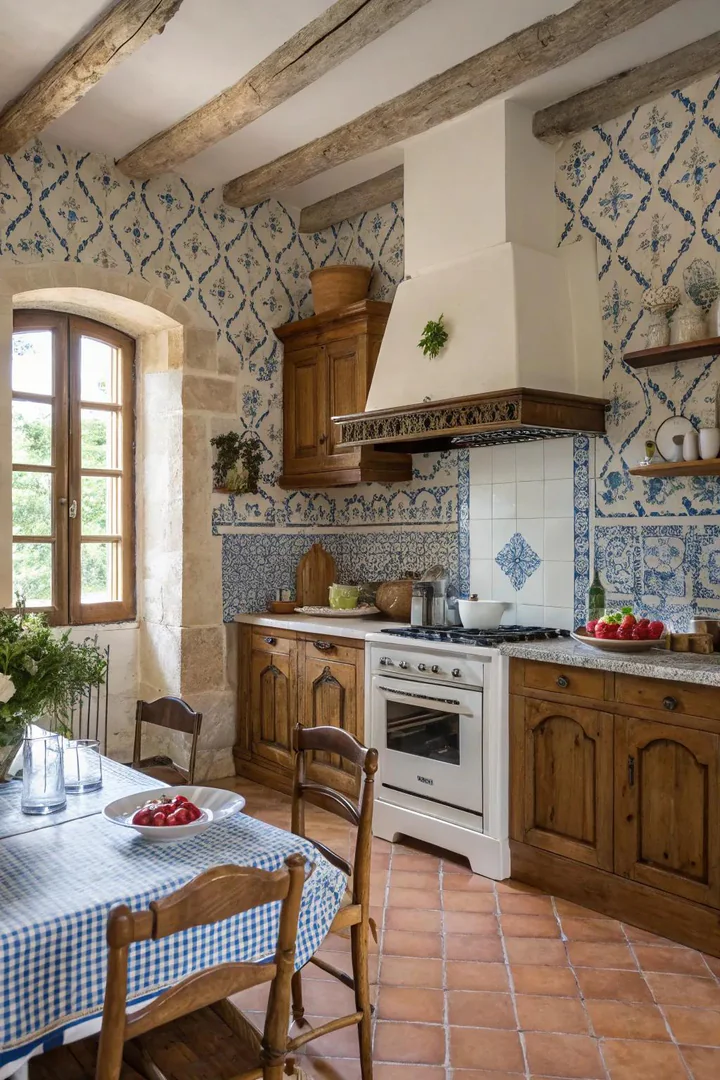
Hand-painted ceramic tiles ($15 to $40 per square foot from specialty importers like Tabarka Studio, Cle Tile, or direct from French and Portuguese tile workshops) featuring floral motifs, roosters, fruit baskets, pastoral scenes, or geometric patterns in blue-and-white, yellow-and-green, or terracotta-and-cream color palettes create an authentic French backsplash or accent panel. Each tile is individually painted by an artisan, producing slight variations in color, line weight, and pattern alignment that give the installation a handmade quality.
A 4-by-4-inch or 6-by-6-inch hand-painted tile installed in a repeating grid (all tiles the same pattern) or a patchwork arrangement (each tile a different pattern within a shared color palette) covers the backsplash between the countertop and upper cabinets. A single decorative tile centered behind the stove (a focal tile, often depicting a rooster, a basket of lavender, or a French countryside scene) surrounded by plain white or cream field tiles creates a framed art piece within the tile installation.
15. Kitchen Wall Mural
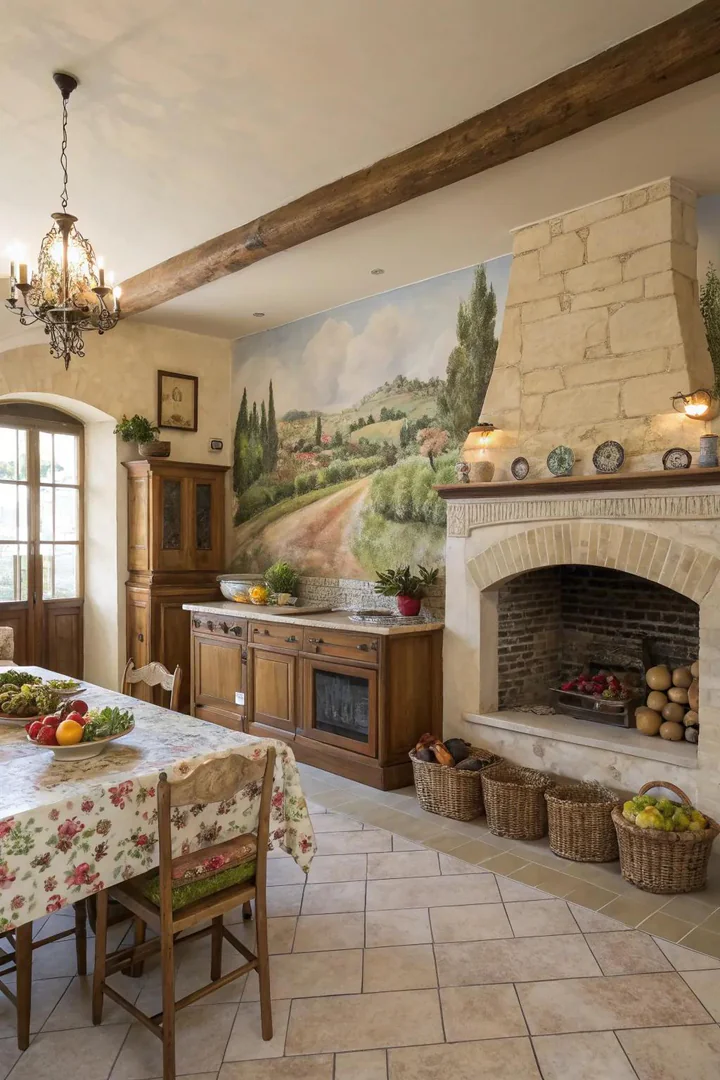
A hand-painted mural on the kitchen wall (above the dining area, behind the range, or on a blank wall visible from the kitchen entry) depicting a Provencal countryside scene, a French market scene, a vineyard, an olive grove, or a Tuscan countryside brings the French countryside into the kitchen through permanent wall art. A professional muralist charges $500 to $3,000 for a 4-by-8-foot to 8-by-12-foot kitchen mural depending on detail and complexity.
A DIY mural using a projected image (project a French countryside photograph onto the wall with a digital projector, trace the outlines with pencil, and paint with Benjamin Moore Regal Select interior paint in matte, $45 per gallon) costs $50 to $150 in materials and takes a weekend. A mural in soft, muted colors (sage green, warm gold, soft blue, cream, terracotta) integrates with the kitchen’s color palette. Seal the mural with a clear matte polyurethane ($14 per quart) to protect the paint from kitchen grease and moisture.
16. Textured Plaster Walls
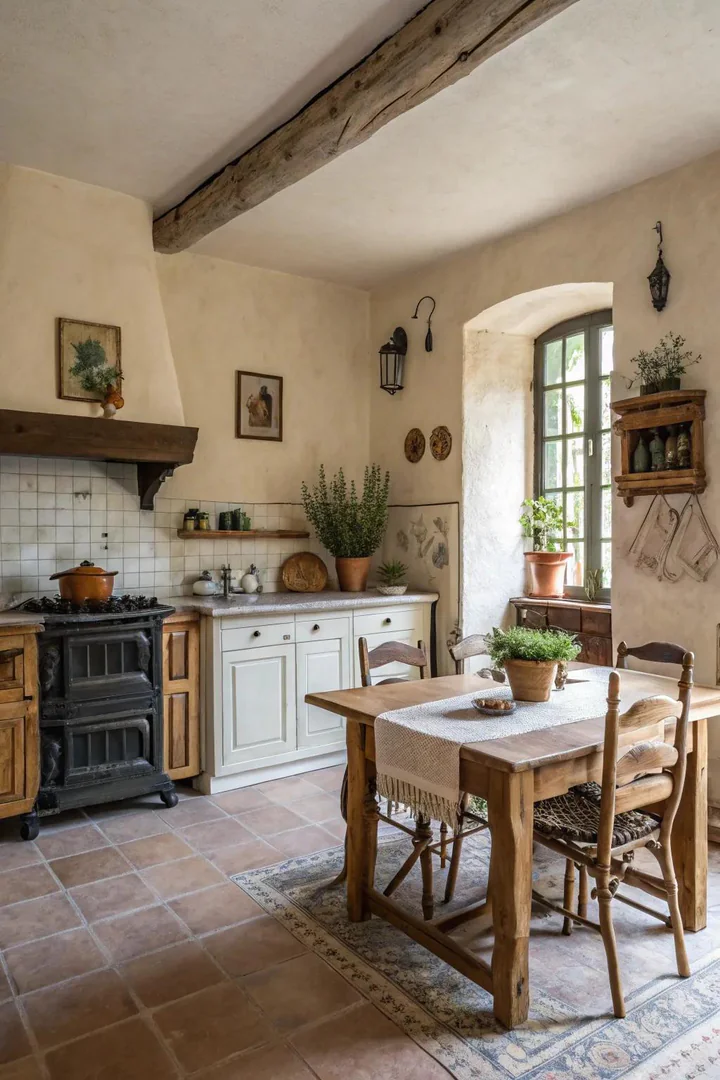
Applying Venetian plaster, lime wash (Portola Paints Lime Wash, $75 per gallon), or hand-troweled joint compound ($15 per 5-gallon bucket of USG Sheetrock Plus 3) to the kitchen walls creates the irregular, hand-finished surface texture that French country interiors use in place of flat, rolled-on paint. A lime-washed wall has a chalky, matte surface with subtle color variation (lighter and darker patches that shift with the light angle) that flat paint cannot produce.
Apply lime wash with a large masonry brush ($12) in overlapping, cross-hatch strokes over a primed wall. The translucent lime wash allows the underlying wall color to show through, creating a layered, aged appearance with a single application. For deeper texture, apply joint compound with a 6-inch drywall knife in random, overlapping strokes (skip-trowel technique), allow to dry overnight, sand the highest ridges lightly with 120-grit, and paint over the textured surface with a matte wall paint. The textured wall adds Old World character to a new-construction kitchen at a material cost of $30 to $100 for a full kitchen.
17. Classic French Color Palette
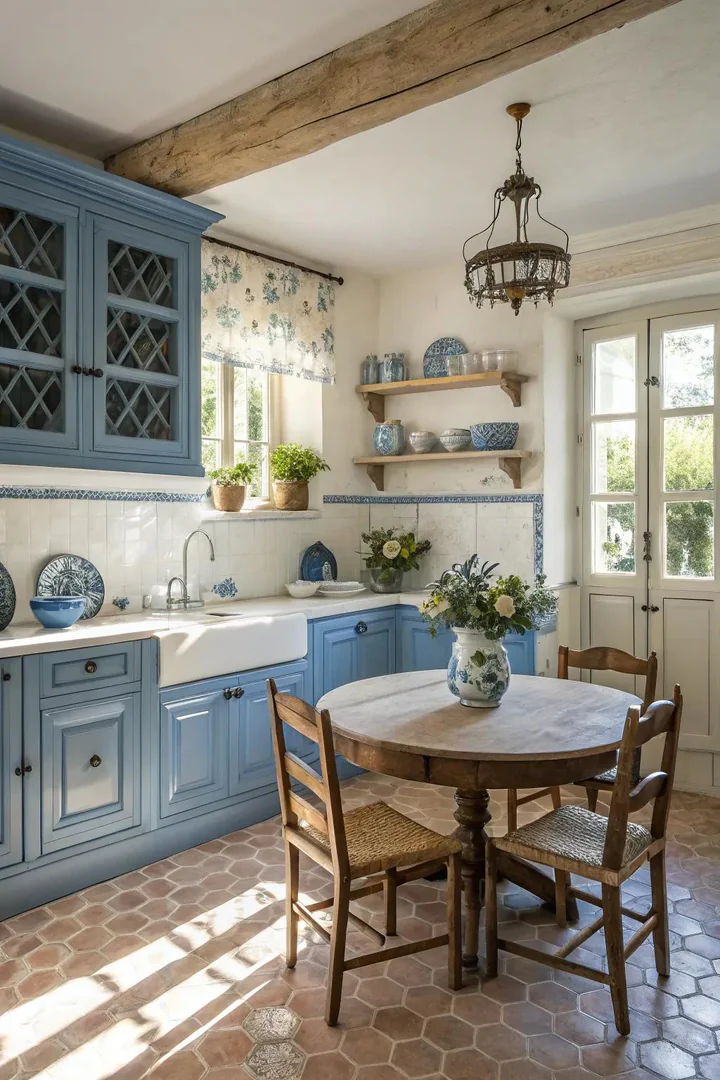
The French country color palette draws from the Provencal countryside: lavender blue (Benjamin Moore Misty Blue 820), sage green (Sherwin-Williams Evergreen Fog SW 9130), sunflower yellow (Benjamin Moore Hawthorne Yellow HC-4), cream (Benjamin Moore Navajo White OC-95), warm white (Benjamin Moore White Dove OC-17), terracotta (Sherwin-Williams Cavern Clay SW 7701), and soft red (Benjamin Moore Heritage Red HC-181). A French country kitchen uses 3 to 4 of these colors: one on the cabinets, one on the walls, one in the textiles, and one in the accessories.
A classic French color combination: cream cabinets, sage-green walls, blue-and-cream toile curtains, and terracotta tile floors. Another classic combination: white cabinets, lavender-blue walls, yellow-and-white gingham chair cushions, and warm oak floors. The palette avoids stark contrasts (no pure white with pure black) and avoids cool, contemporary tones (no charcoal gray, no teal, no millennial pink). Every color in a French country kitchen should look like it could exist in a Provencal garden, a French pottery glaze, or a sun-bleached linen tablecloth.
18. Original Architectural Features
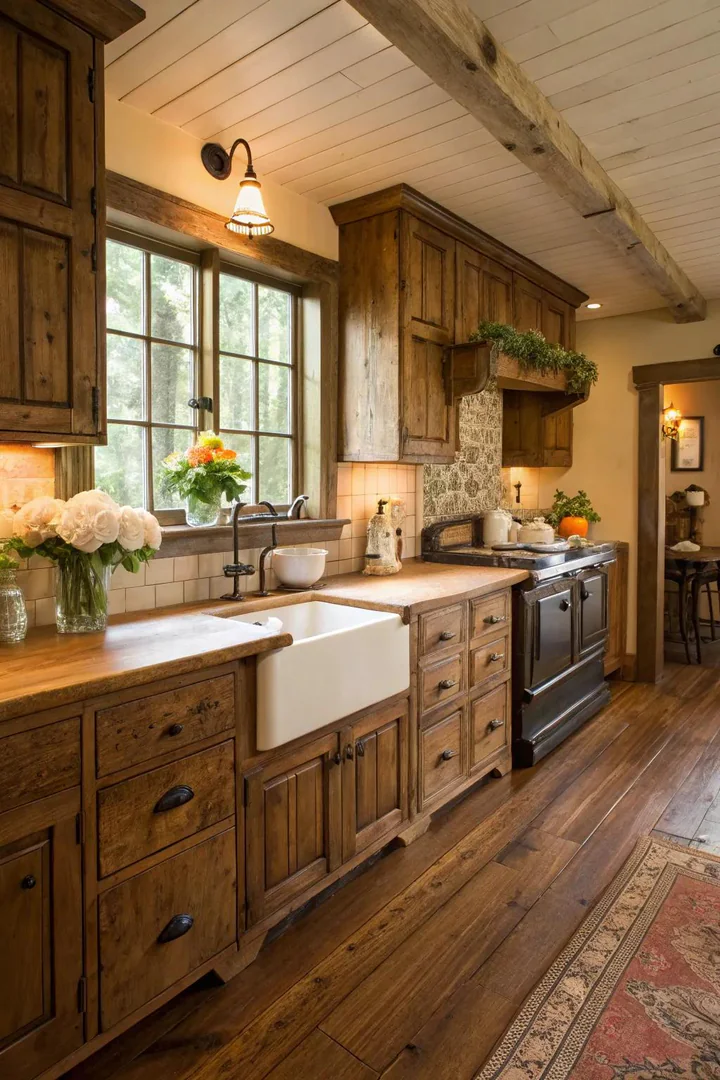
Preserving and restoring original architectural features (exposed brick walls, original plaster, hand-hewn ceiling beams, wide-plank pine floors, stone lintels above doorways, built-in bread ovens, original fireplace surrounds) gives the kitchen an authenticity that new construction and reproduction details cannot match. An exposed brick wall (revealed by removing drywall or plaster from the original brick) cleaned with a wire brush and sealed with a matte brick sealer (Seal-Krete Original Waterproofing Sealer, $30 per gallon) becomes a textural backdrop that anchors the kitchen in its architectural history.
Original wide-plank floors (pine boards 8 to 12 inches wide, found in homes built before 1940) refinished with a matte oil-based finish (Rubio Monocoat, $60 per 350-ml can, applied in a single coat with no sanding between coats) preserve the original saw marks, nail holes, and patina while protecting the wood from kitchen spills and foot traffic. French country design values imperfection: a crooked beam, a cracked plaster wall, a worn stone threshold are features to preserve, not problems to fix. Browse wall paneling options at kitchen backsplash ideas for tile installations that complement exposed architectural surfaces.
19. Gilded Hardware and Fixtures
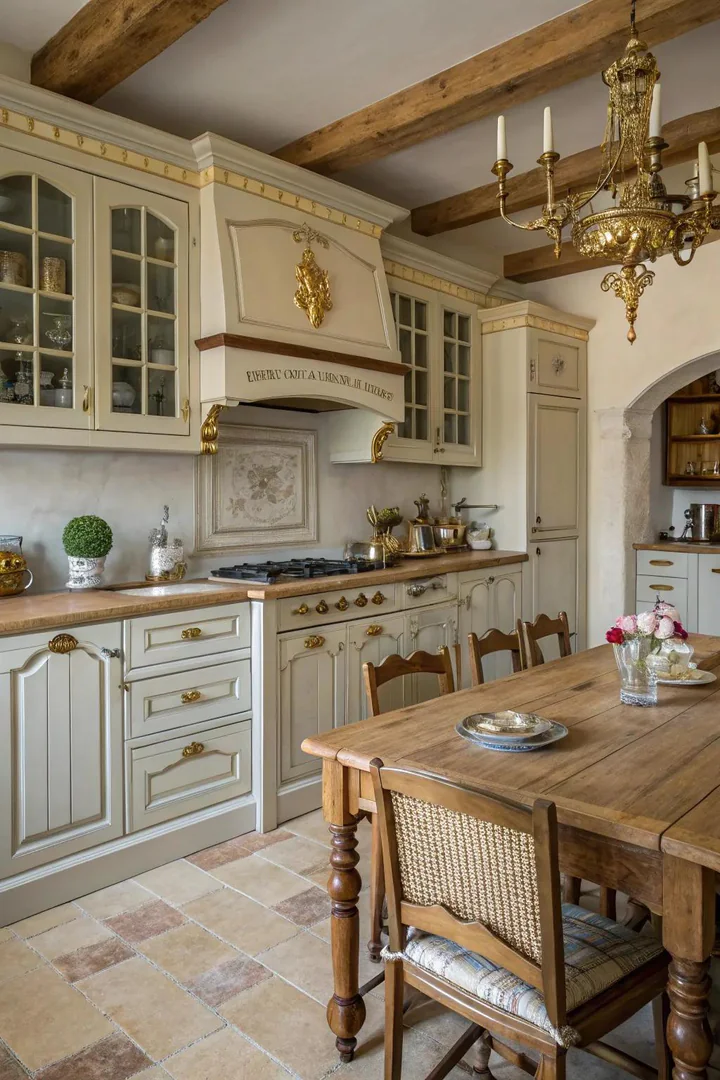
Unlacquered brass or antique gold cabinet hardware, faucets, light fixtures, and curtain rods add warm metallic accents that reference the gilded mirrors, brass candelabras, and gold-leaf frames found in French chateaux and Parisian apartments. Unlacquered brass cabinet pulls ($12 to $25 each from Schoolhouse Electric, Rejuvenation, or Emtek) develop a living patina over time as the brass oxidizes from bright gold to a warm, aged brown-gold.
A brass bridge faucet (Kingston Brass Heritage, $200 to $350; Rohl Country Kitchen Bridge Faucet, $600 to $900) with cross handles replaces a modern pull-down sprayer with a traditional, European-inspired fixture that anchors the sink zone in French country style. Match the hardware metal across all kitchen zones (cabinet pulls, faucet, light fixtures, curtain rod, pot rack hooks) in the same brass or gold finish for a cohesive metallic story. Mixing metals (brass pulls with chrome faucet with black light fixture) reads as eclectic-modern rather than French country. Discover more cabinet hardware approaches at painted kitchen cabinet ideas for hardware-and-color pairings, or browse the full design library at The Designers Company.
How to Create a French Country Kitchen
1. Start with the Floor and the Cabinet Color
Choose the floor material first (limestone, terracotta, or wide-plank wood) because the floor sets the kitchen’s foundational color temperature and textural tone. A warm terracotta floor calls for cream or soft-green cabinets. A cool limestone floor calls for white or soft-blue cabinets. Paint the cabinets in the chosen French country color with a matte or satin finish (not high-gloss, which reads as contemporary). A distressed or lightly sanded paint finish (sand through the top coat at edges and corners to reveal the primer or bare wood below) adds the wear-and-age character that French country cabinets display.
2. Add Natural Materials and Textural Layers
Replace synthetic or manufactured elements with natural materials wherever possible: a butcher-block countertop instead of laminate, a linen curtain instead of a vinyl blind, a woven basket instead of a plastic bin, a ceramic crock instead of a plastic utensil holder. Each natural-material substitution adds textural warmth and visual weight that synthetic materials cannot provide. French country kitchens layer 5 to 8 different textures (stone, wood, iron, copper, linen, ceramic, wicker, leather) in a single room.
3. Introduce Collected and Antique Pieces
Add 3 to 5 vintage or antique pieces (a copper pot, a ceramic pitcher, a wooden bread board, an iron candle holder, a framed botanical print) sourced from flea markets, antique shops, estate sales, or family hand-me-downs. French country kitchens look assembled over decades, not purchased in a single shopping trip. Each antique piece should serve a function (the copper pot hangs on the rack and cooks on the stove; the ceramic pitcher holds wooden spoons; the bread board holds the evening’s baguette) or occupy a prominent display position (the framed print on the wall, the iron candle holder on the table).
4. Finish with Textiles and Soft Goods
Layer patterned textiles (toile curtains, gingham napkins, floral chair cushions, a linen table runner) in a coordinated color palette (2 to 3 colors, mixed scales) to soften the kitchen’s hard surfaces and add the pattern richness that French country interiors demand. Textiles are the least permanent and least expensive decorative layer, making them the easiest way to introduce or refresh the French country style in an existing kitchen without remodeling.
French Country Kitchen Element Comparison
| Element | Cost Range | DIY Difficulty | Visual Impact | Permanence |
|---|---|---|---|---|
| Stone or terracotta floor | $8–$25/sq ft | Professional install | Very high | Permanent |
| Painted cabinets | $200–$600 | Intermediate | High | Semi-permanent |
| Open shelving | $50–$200 | Beginner | High | Reversible |
| Plaster range hood | $500–$2,500 | Advanced | Very high | Permanent |
| Toile curtains | $25–$100 | Beginner | Moderate | Removable |
| Unlacquered brass hardware | $200–$600 (full set) | Beginner | Moderate | Reversible |
Frequently Asked Questions
What is the difference between French country and French provincial style?
French country refers broadly to the rustic, rural aesthetic of the French countryside (Provence, Normandy, Loire Valley), characterized by natural materials, warm colors, collected antiques, and an emphasis on comfort and informality. French provincial is a more refined subset that incorporates curved furniture lines (cabriole legs, serpentine fronts), carved moldings, and more formal fabric treatments (silk, damask, velvet) adapted from Parisian court furniture for provincial homes. In kitchens, the practical distinction is minimal: French country tends toward more rustic finishes (rougher textures, more distressing, more iron and copper) while French provincial tends toward smoother finishes (cleaner paint, more carved wood, more porcelain and silver).
Can you create a French country kitchen in a modern home?
A modern home’s clean lines and open floor plans actually provide an ideal backdrop for French country elements because the simple architectural shell lets the layered textures, warm colors, and collected antiques stand out without competing with ornate architectural details. Add faux ceiling beams, a plaster range hood, natural stone or terracotta flooring, and painted cabinets in French country colors to a modern kitchen shell. The key adaptation: French country in a modern home should feel edited (fewer pieces, each carefully chosen) rather than saturated (every surface covered in pattern and texture).
What countertop material is most authentic for French country?
Honed natural stone (limestone, soapstone, or marble in a matte, unsealed or lightly sealed finish) and butcher block (end-grain walnut or edge-grain maple, oiled rather than polyurethane-sealed) are the most historically authentic French country countertop materials. Both materials develop patina with use: stone absorbs minor stains that add character, and butcher block develops knife marks and oil darkening that deepen the surface’s visual warmth. Polished granite and engineered quartz read as contemporary; French country countertops should look and feel natural, not manufactured.
How do you avoid making a French country kitchen look dated?
Three strategies prevent the “1990s Tuscan kitchen” trap: (1) Choose muted, gray-undertone versions of French country colors (sage green instead of Kelly green, dusty blue instead of cobalt, warm cream instead of bright yellow) that read as modern-provincial rather than primary-color-country. (2) Edit the accessories to 3 to 5 meaningful antique pieces rather than filling every surface with roosters, sunflowers, and wine-themed decor. (3) Mix in a few modern elements (a simple matte-black faucet, a minimalist pendant light, a clean-lined bar stool) that anchor the French country pieces in the present decade rather than recreating a period room.
What lighting works best in a French country kitchen?
A wrought-iron chandelier ($100 to $400 from Pottery Barn, World Market, or Restoration Hardware) with candle-style bulbs or a brass lantern pendant ($80 to $250 from Visual Comfort, Circa Lighting, or Ballard Designs) hung over the table or island provides the warm, ambient light that French country kitchens need. Avoid recessed LED cans as the sole light source (the flat, even light eliminates the shadows and warmth that give French country interiors their atmosphere). Supplement overhead fixtures with under-cabinet task lights and a table lamp or candle on the dining table for layered, warm-toned illumination.