
Black Kitchen Cabinet Ideas: 23 Bold Designs That Steal the Show
Black kitchen cabinet ideas represent the boldest color choice in kitchen design — a commitment to drama, contrast, and visual weight that lighter cabinet colors simply cannot deliver. Black cabinets absorb light rather than reflecting it, which means they create depth, shadow, and a sense of enclosure that makes the kitchen feel more intimate and moody than the same room in white or cream. In large, well-lit kitchens, black cabinets ground the space and prevent it from feeling cavernous. In open-concept homes, black cabinets define the kitchen zone as a distinct, anchored area within the broader floor plan.
The 23 black kitchen cabinet ideas below show every way to use black cabinetry — from full all-black kitchens to two-tone schemes, black-and-white pairings, wood-and-black combinations, and single-element accents like a black island or black lower cabinets. Each idea names specific paint colors, finishes, materials, and hardware to help you build a complete black kitchen palette.
1. Embrace the All-Black Look
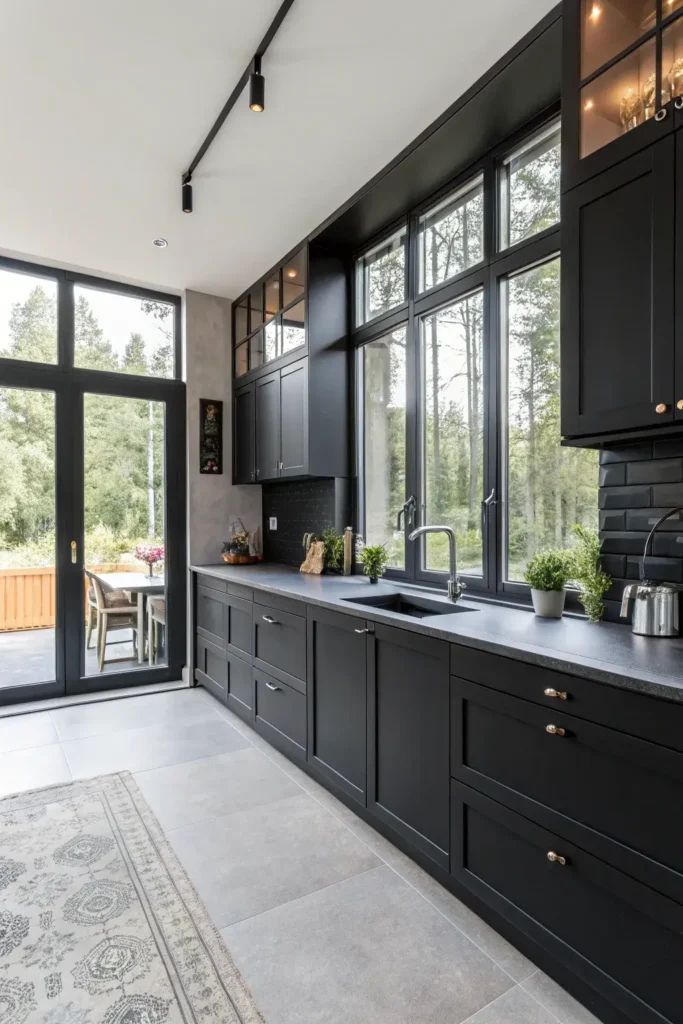
An all-black kitchen — black upper cabinets, black lower cabinets, black island, and black countertops — creates a cocoon-like, enveloping atmosphere where the cabinetry recedes into the walls and the architecture of the room takes over. The all-black approach works best in kitchens with high ceilings (9 feet or above), large windows, and ample square footage, where the dark color absorbs light without making the room feel cramped.
Use matte black (not glossy) for an all-black kitchen — matte finishes absorb light evenly and hide fingerprints, while gloss finishes create distracting reflections and show every smudge. Benjamin Moore Black (2132-10), Sherwin-Williams Tricorn Black (SW 6258), and Farrow & Ball Off-Black (No.57) are proven all-cabinet blacks. Vary the textures within the all-black scheme to prevent the room from looking flat: matte cabinet fronts, honed black granite or soapstone countertops, a textured black tile backsplash, and matte black hardware create surface variation that the eye can read even though the color is uniform.
2. Combine with White for Contrast
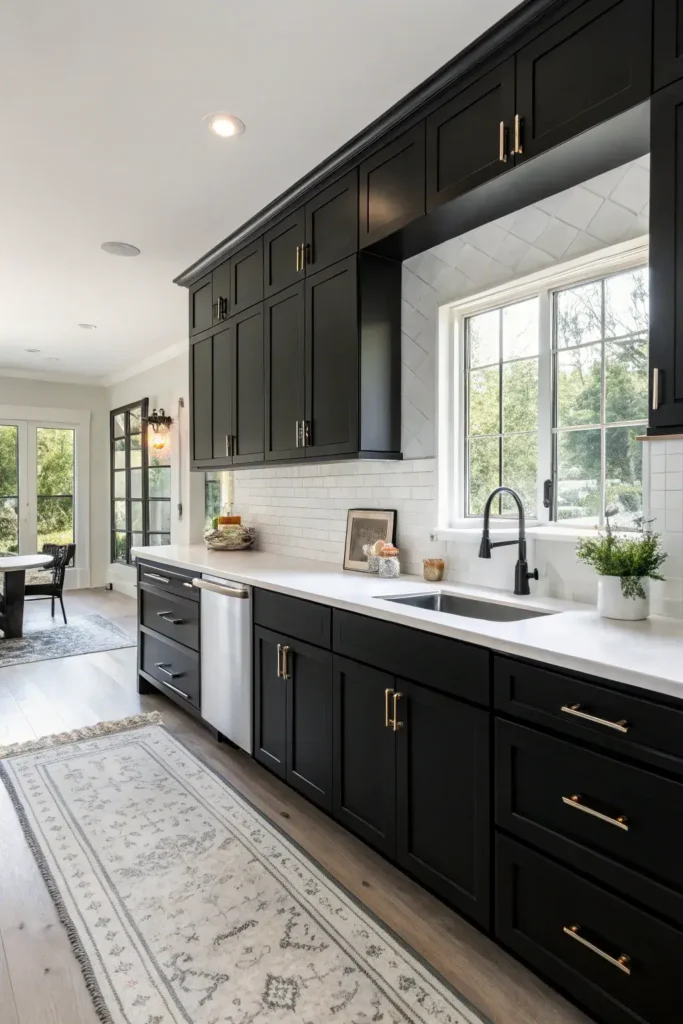
Black-and-white is the highest-contrast kitchen color scheme available — every boundary between black and white reads as a crisp, graphic edge that gives the kitchen a clean, architectural quality. The most common configuration is black lower cabinets with white upper cabinets, which keeps the visual weight low (grounding the room) while maintaining brightness at eye level and above (keeping the room from feeling dark).
White countertops on black base cabinets create the strongest horizontal contrast line in the kitchen. Calacatta or Carrara marble, white quartz (Caesarstone Pure White or Cambria Torquay), and solid white Corian all produce bright, clean counter surfaces that pop against black bases. Paint the walls white (Benjamin Moore Chantilly Lace OC-65 or Simply White OC-117) to maximize contrast with the black cabinets. For more on pairing kitchen cabinet colors, see our dedicated guide.
3. Introduce Coziness with Timber
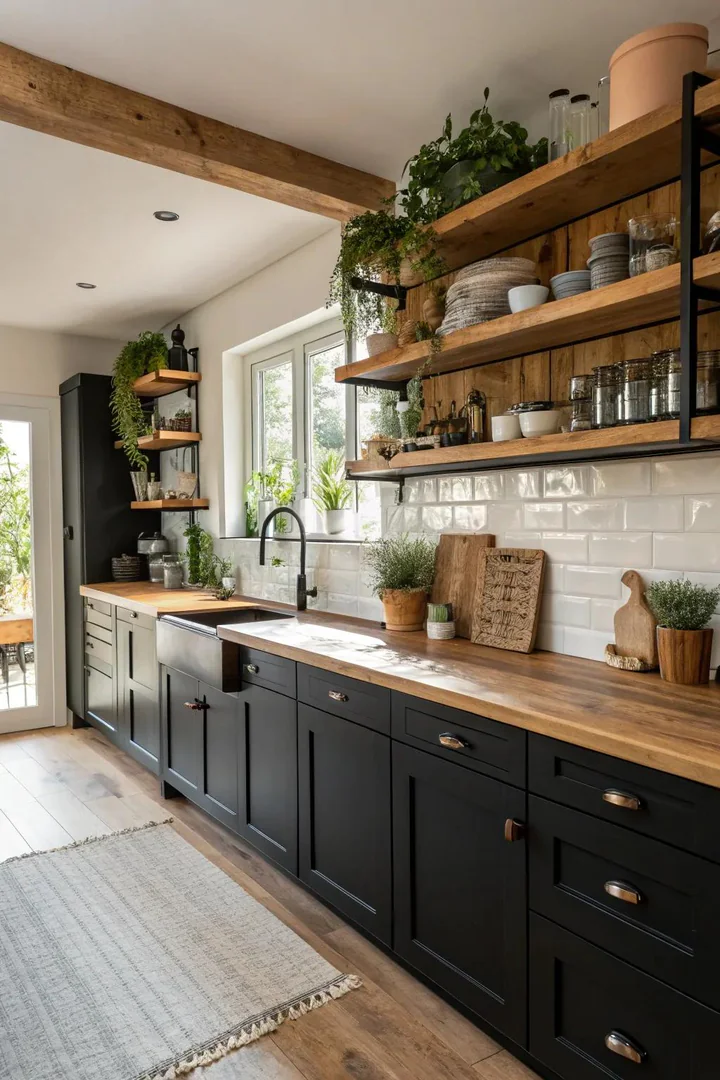
Wood accents — a butcher block countertop, floating wood shelves, a wood island top, or exposed ceiling beams — break the severity of an all-black kitchen and introduce organic warmth that makes the space feel inhabitable rather than gallery-like. Black and wood is one of the most natural material pairings in design because the contrast between manufactured darkness and organic grain creates visual tension that feels both modern and timeless.
Medium-toned woods (white oak, hickory, walnut) provide the strongest contrast with black. Light woods (maple, birch, ash) create a softer, Scandinavian-inspired contrast. Very dark woods (espresso-stained oak, wenge) may blend too closely with the black cabinets and lose the contrast effect. A butcher block island top (from John Boos, Lumber Liquidators, or a local millwork shop) in white oak is the single most effective wood accent in a black kitchen — it adds a large surface of warm, natural material at counter height that balances the dark cabinetry above and below.
4. Choose Open Shelving
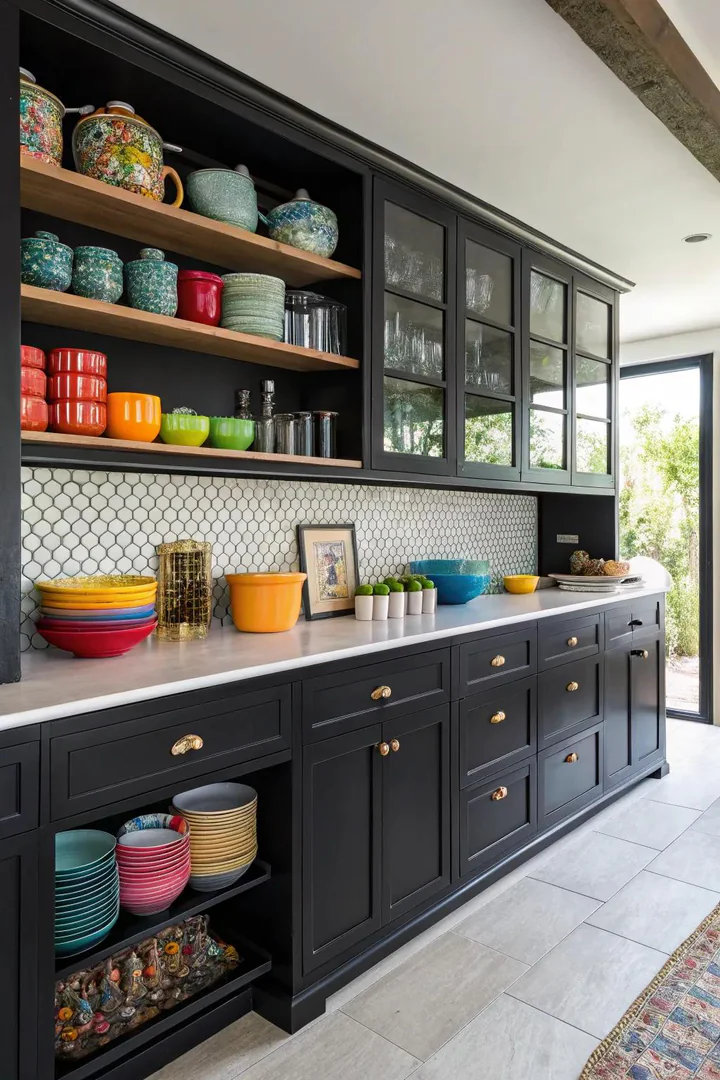
Open shelving in a black kitchen replaces one or more sections of closed upper cabinets with floating shelves, breaking the solid wall of dark cabinetry and introducing visual breathing room. The items displayed on open shelves — white dishes, copper pots, green plants, glass jars — add color and texture that the closed black cabinet fronts cannot provide, creating a layered, collected look.
Use natural wood shelves (white oak or walnut, 2 inches thick, from Shelfology or a local lumber yard) for warmth, or paint the shelves the same matte black as the cabinets for a monochromatic gallery effect. Position the open shelves flanking the range hood or the sink window — these are the two locations where the eye naturally focuses, making the displayed items most visible. Arrange the shelves with the “rule of three” — three items per vignette, varying height and material — to create an intentional, curated display rather than a cluttered shelf.
5. Add a Statement Backsplash
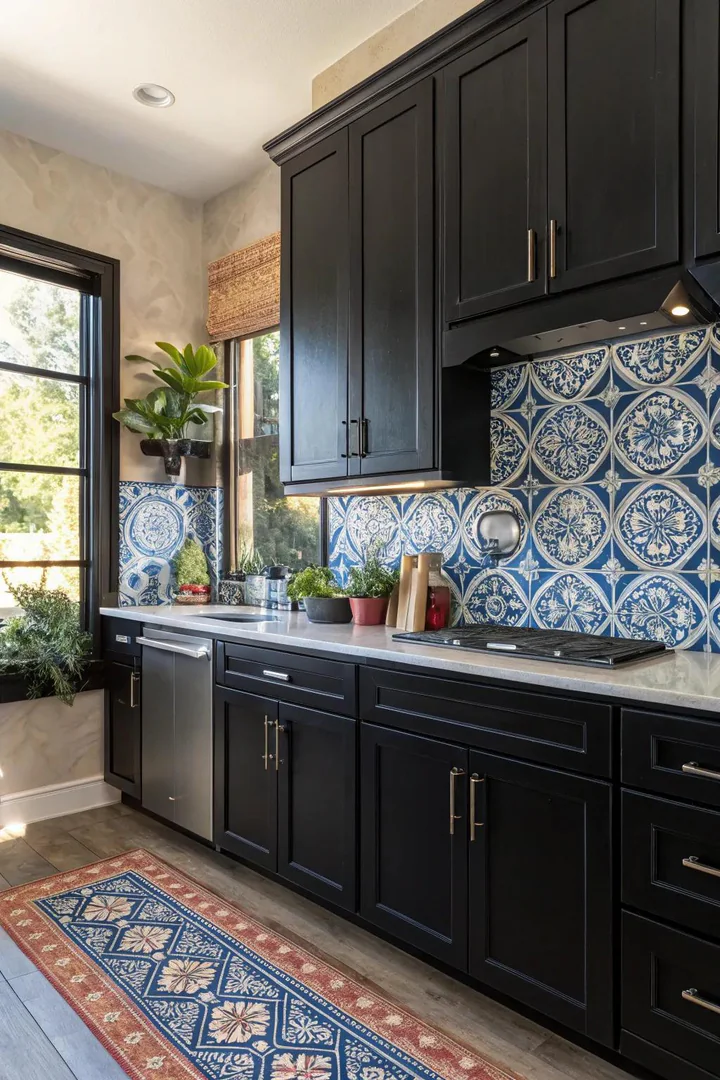
A bold backsplash between black upper and lower cabinets stands out with maximum visibility because the dark cabinets frame it like a picture frame, making the backsplash the kitchen’s focal point. In a kitchen with lighter cabinets, the backsplash blends with the surroundings; in a black kitchen, it pops dramatically against the dark surround.
White marble slab (Calacatta or Statuario, full-height from counter to upper cabinets) creates the most striking contrast against black cabinets. Patterned cement tile (Moroccan or geometric patterns from Cement Tile Shop or Clé) in blue, green, or terracotta introduces color and pattern. Zellige tile (handmade Moroccan tile with irregular surfaces from Clé or Fireclay Tile) in white, green, or blue adds artisanal texture. For a bold contemporary look, explore our glass backsplash kitchen guide.
6. Mixed Metals Experimentation
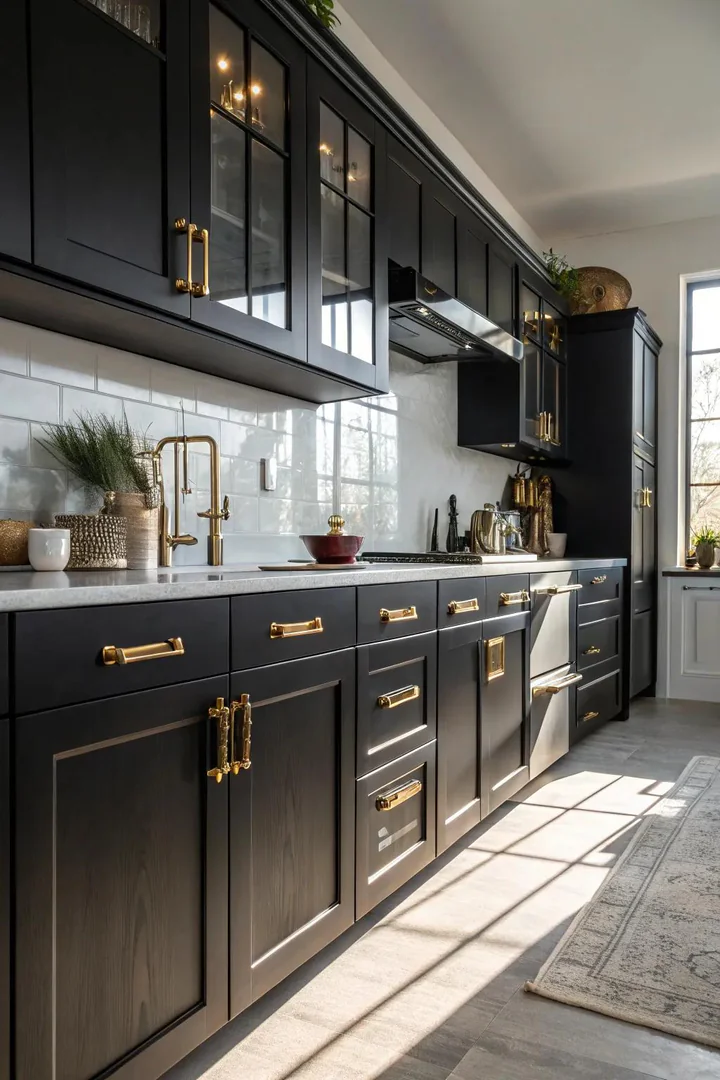
Black cabinets serve as a neutral backdrop that makes metallic hardware, fixtures, and lighting pop with maximum visibility. Where lighter cabinets absorb the visual impact of hardware, black cabinets amplify it — every brass pull, every chrome faucet, every copper pendant reads as a bright accent against the dark surface.
Mix two or three metals for a collected, layered look: brass cabinet pulls (Rejuvenation, Emtek, or Top Knobs), a polished nickel faucet (Kohler Purist or Delta Trinsic), and matte black pendant lights create a three-metal combination that is rich without being chaotic. The key rule is to use one dominant metal on hardware (60-70% of visible metal) and one or two accent metals on fixtures and lighting (30-40%). Brass and gold tones are the most popular hardware choice with black cabinets because the warm metal creates a warm-cool contrast against the cool black.
7. Incorporate Texture Using Matte Finishes
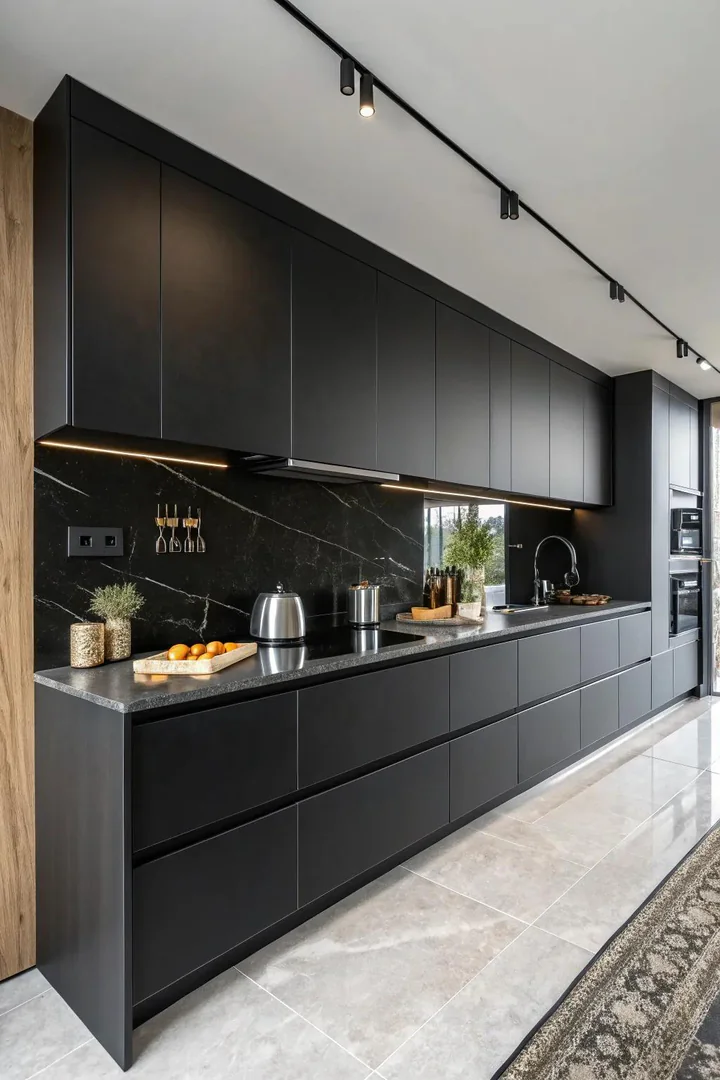
Matte black cabinet finishes absorb light and create a velvety, tactile surface that feels softer and more approachable than glossy or semi-gloss black. Matte finishes also hide fingerprints, water spots, and cooking splatter better than any other sheen level, making them the most practical choice for a kitchen where cabinet fronts are touched and splashed dozens of times a day.
Benjamin Moore Advance in matte or Sherwin-Williams Emerald Urethane in matte are the two best cabinet paints for matte black finishes — both cure to a hard, wipeable surface that resists chipping and staining. For factory-finished cabinets, look for matte or “super matte” door finishes (IKEA KUNGSBACKA in anthracite, KraftMaid or Aristokraft in Black, or European brands like Nobilia and Leicht that offer true super-matte thermofoil doors). Super-matte finishes (also called anti-fingerprint finishes) use a specialized coating that actively repels oils from fingertips.
8. Utilize Natural Illumination
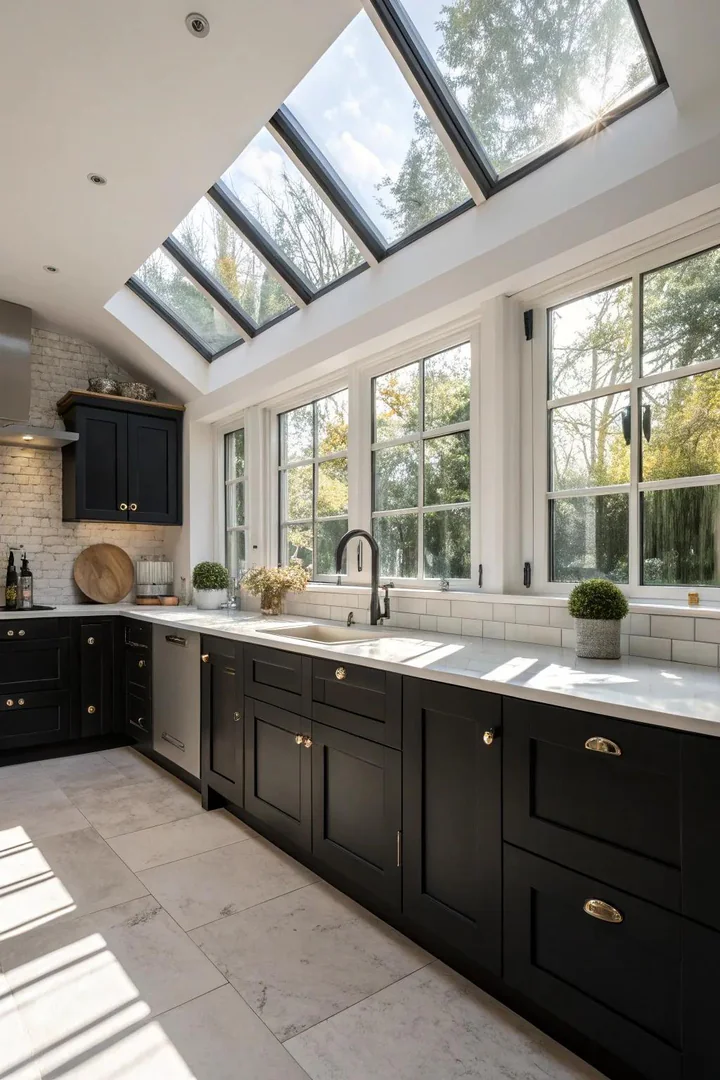
Natural light is the single most important factor in whether a black kitchen feels dramatic and inviting or dark and oppressive. Black surfaces absorb rather than reflect light, so a black kitchen needs more natural light than a white kitchen to achieve the same perceived brightness level. Large windows, skylights, and glass doors flood the space with daylight that illuminates the black surfaces and creates the warm, shadowed depth that makes black kitchens look stunning.
If the kitchen has limited windows, compensate with other light sources: light-colored countertops (white marble, white quartz) that reflect light upward onto the black cabinets; a white ceiling that bounces light back down; a light-colored floor (light oak, light tile) that reflects light upward; and layered artificial lighting (recessed ceiling lights, under-cabinet LED strips, pendant lights) that provides bright, warm illumination after sunset. For a full guide on kitchen lighting strategies, see our article.
9. Generate Tension with a Gloomy Island
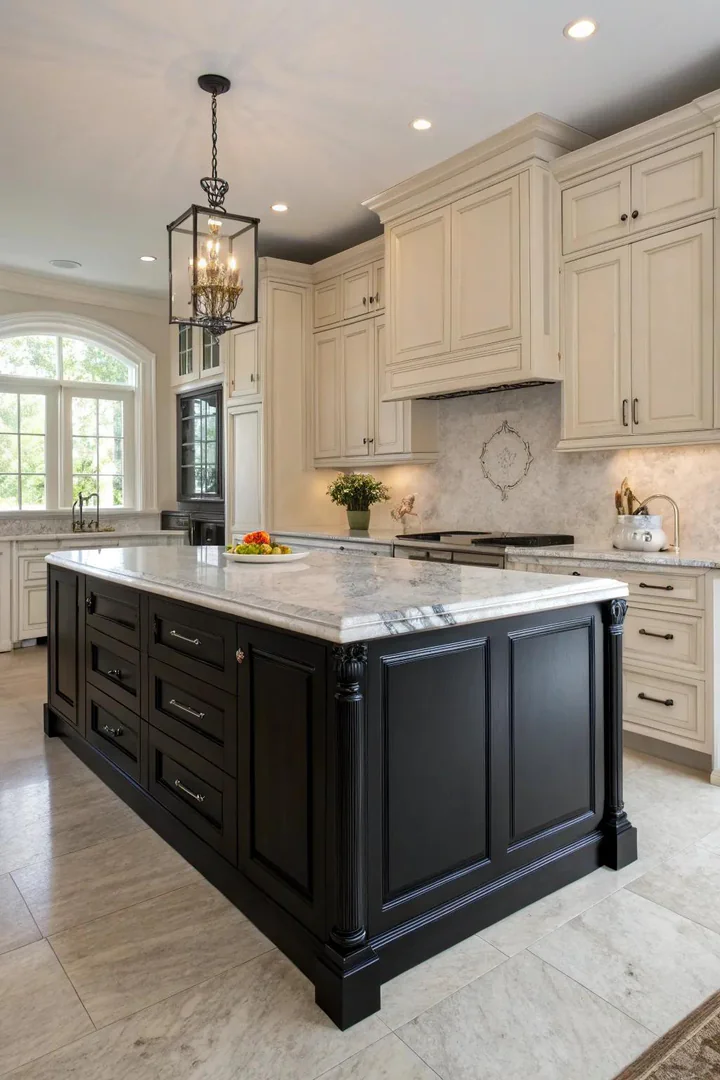
A single black island in a kitchen with lighter perimeter cabinets introduces black in a controlled, high-impact way — the island becomes the visual anchor and focal point of the kitchen without committing the entire room to dark cabinetry. The black island reads as a piece of statement furniture (like a dark dining table or a dark piano) placed in a lighter room.
Paint the island a true black (Benjamin Moore Black or Sherwin-Williams Tricorn Black) while keeping the perimeter cabinets white, cream, grey, or natural wood. Top the black island with a contrasting countertop — white marble, white quartz, or light butcher block — so the island reads as a two-toned piece rather than a dark monolith. A 4-to-8-foot-long black island with a white marble top, brass hardware, and two or three pendant lights overhead creates one of the strongest focal points a kitchen can have.
10. Combine Classic and Contemporary Styles
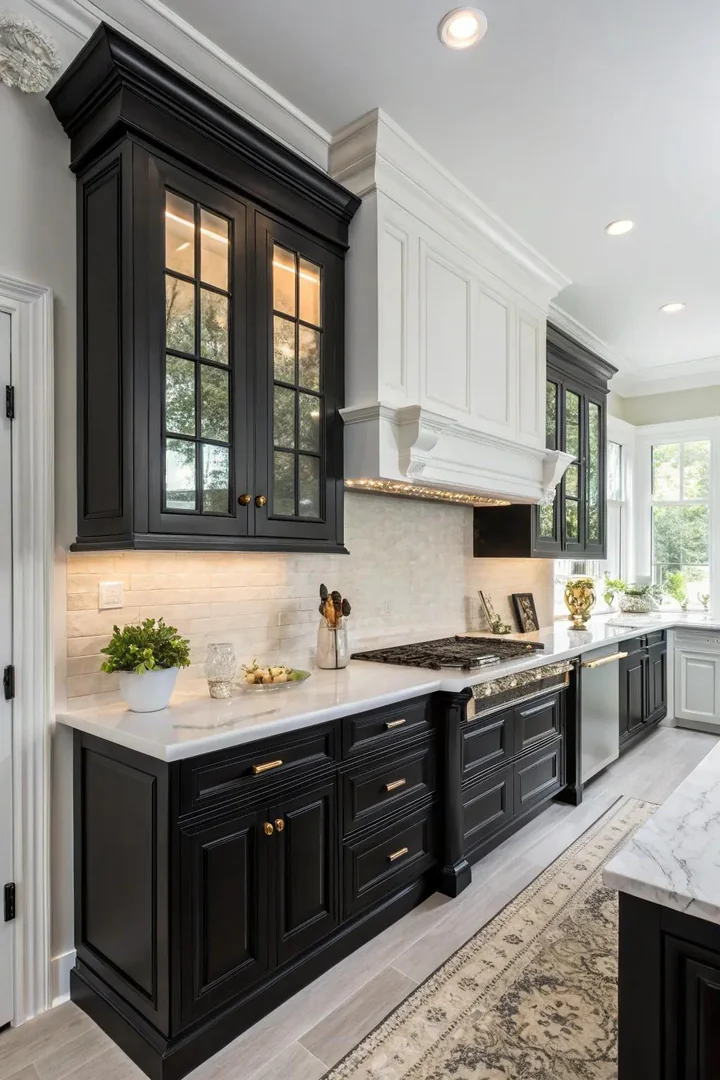
Black cabinets bridge traditional and modern styles because black is simultaneously the most modern paint color (clean, graphic, minimalist) and a historically rooted cabinet choice (Victorian-era kitchens, English butler’s pantries, and French country kitchens all used dark-painted cabinetry). A black Shaker cabinet with brass bin pulls looks traditional; the same cabinet with matte black bar pulls looks contemporary.
Create the transitional look by pairing traditional cabinet details (Shaker doors, raised-panel doors, inset construction, crown molding) with modern hardware (slim bar pulls, minimal knobs) and modern fixtures (clean-lined faucets, simple pendant lights). A black inset Shaker cabinet with polished nickel bin pulls, marble countertops, and a subway tile backsplash creates a classic English kitchen feel. The same black cabinet with brass bar pulls, a quartz waterfall counter, and a full-height slab backsplash creates a modern-luxe look.
11. Incorporate Color with Accessories
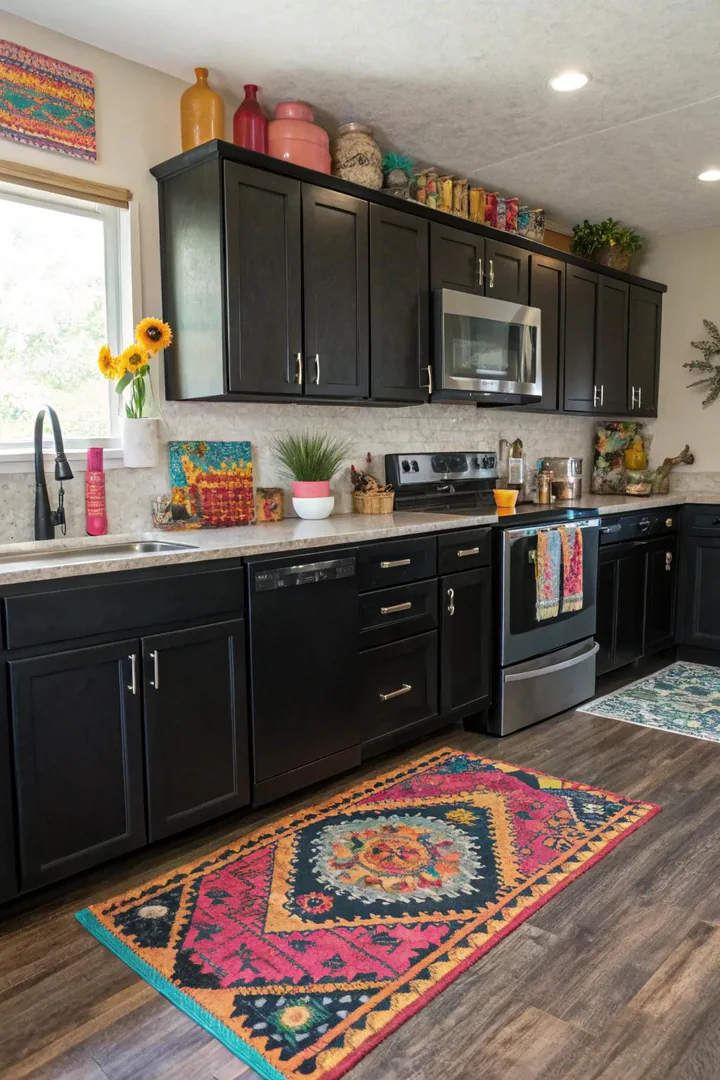
Black cabinets make every color placed next to them look more vivid, more saturated, and more alive — black functions as a visual amplifier that intensifies any color in its vicinity. A red KitchenAid stand mixer on a black countertop looks three times as red as the same mixer on a white countertop. This amplification effect means that even small colored accessories (a green plant, a yellow fruit bowl, a blue ceramic vase) create strong pops of color against a black kitchen backdrop.
Choose one accent color and repeat it in three to five small accessories throughout the kitchen: a colored stand mixer, matching canisters, a stack of colored cookbooks, a fruit bowl, and a hand towel. Red, emerald green, cobalt blue, and mustard yellow are the colors that pop most vividly against black. Keep the accent items small and changeable — replacing a red hand towel with a green one changes the kitchen’s accent color in seconds, while a red backsplash is permanent.
12. Experiment with the Two-Tone Style
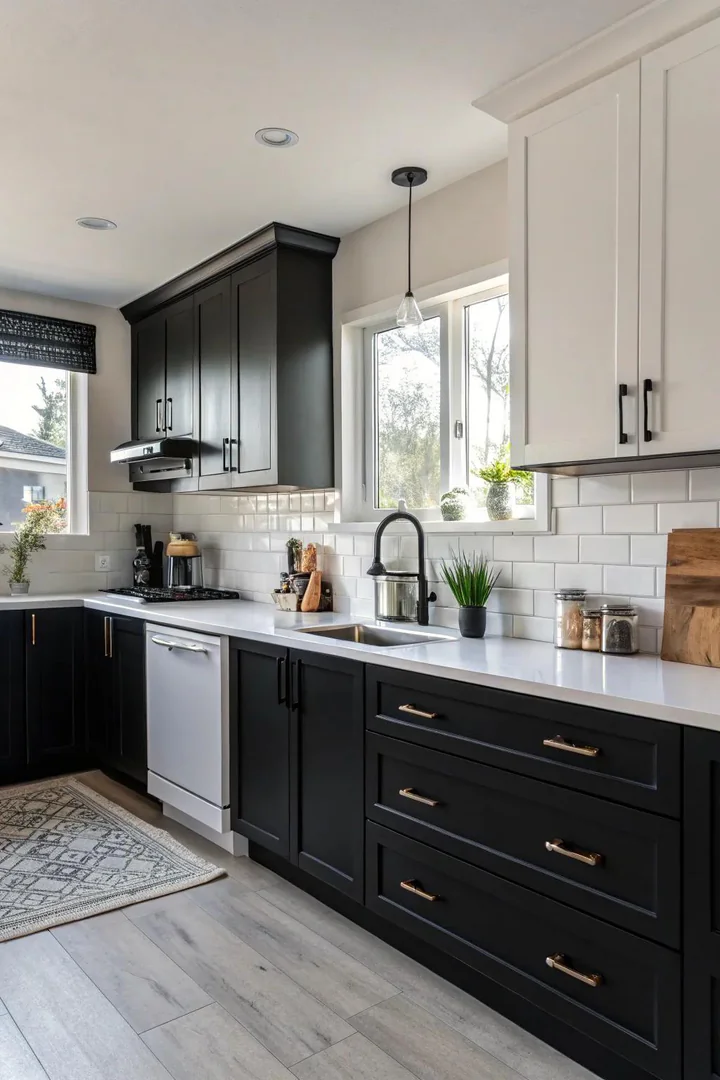
Two-tone kitchens use black on one section of cabinetry (typically the lower cabinets or the island) and a contrasting color on the other section (white, grey, cream, or natural wood on the uppers). This approach delivers the drama of black without the total commitment of an all-black kitchen, and it creates a visual division that adds depth and architectural interest to the room.
The most common two-tone configuration — black lowers, white uppers — keeps the visual weight low and the brightness high. Black uppers with white lowers is less common but creates a more dramatic, unexpected look. A black island with matching-wood perimeter cabinets creates a furniture-like contrast. Use the same hardware finish on both cabinet colors to unify the two tones — matching brass pulls on both black and white cabinets tie the scheme together even though the paint colors differ.
13. Adopt the Industrial Aesthetic
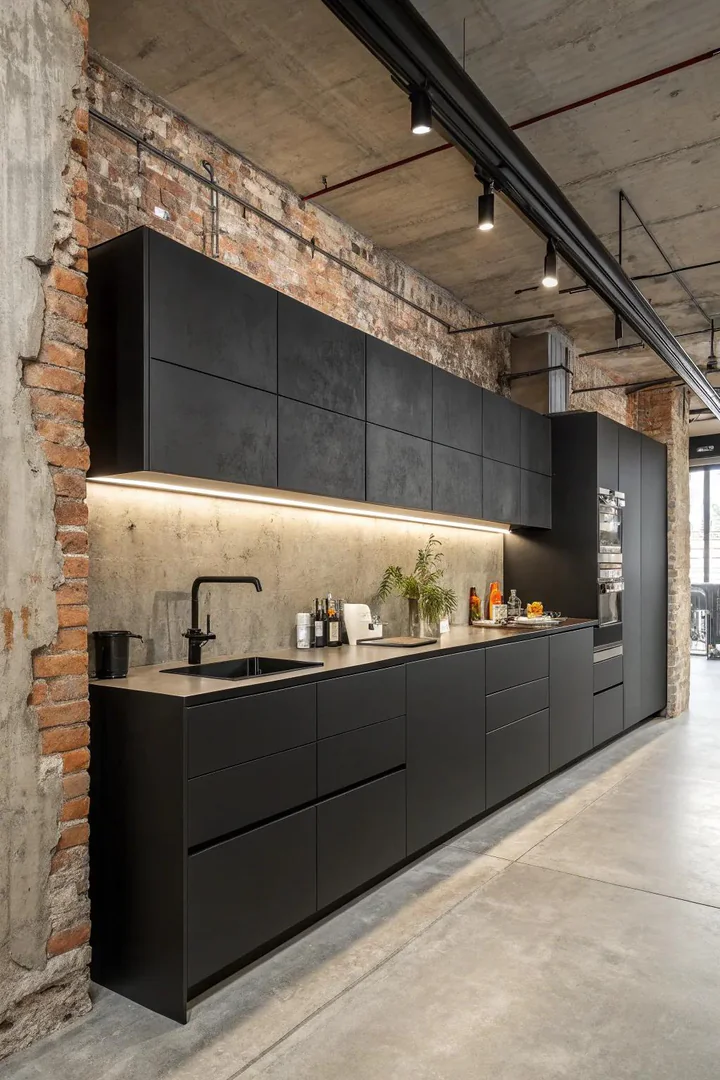
Black cabinets are the foundation of the industrial kitchen aesthetic because they reference the dark-painted steel, cast iron, and wrought iron found in factories, workshops, and commercial kitchens. Paired with exposed brick, concrete floors, steel-frame windows, and stainless steel appliances, black cabinets complete the industrial material palette.
Build the industrial look with raw, honest materials: black flat-panel or Shaker cabinets (matte finish), a stainless steel countertop or concrete countertop, a stainless steel or black iron open shelving system, exposed ductwork or pipe-bracket shelving, industrial-style pendant lights (from Barn Light Electric, Rejuvenation, or Schoolhouse Electric), and a concrete or dark hardwood floor. Use matte black hardware — bar pulls, bin pulls, or simple knobs in black iron or blackened steel — rather than polished metals, which read as too refined for the industrial aesthetic.
14. Emphasize with Under-Cabinet Illumination
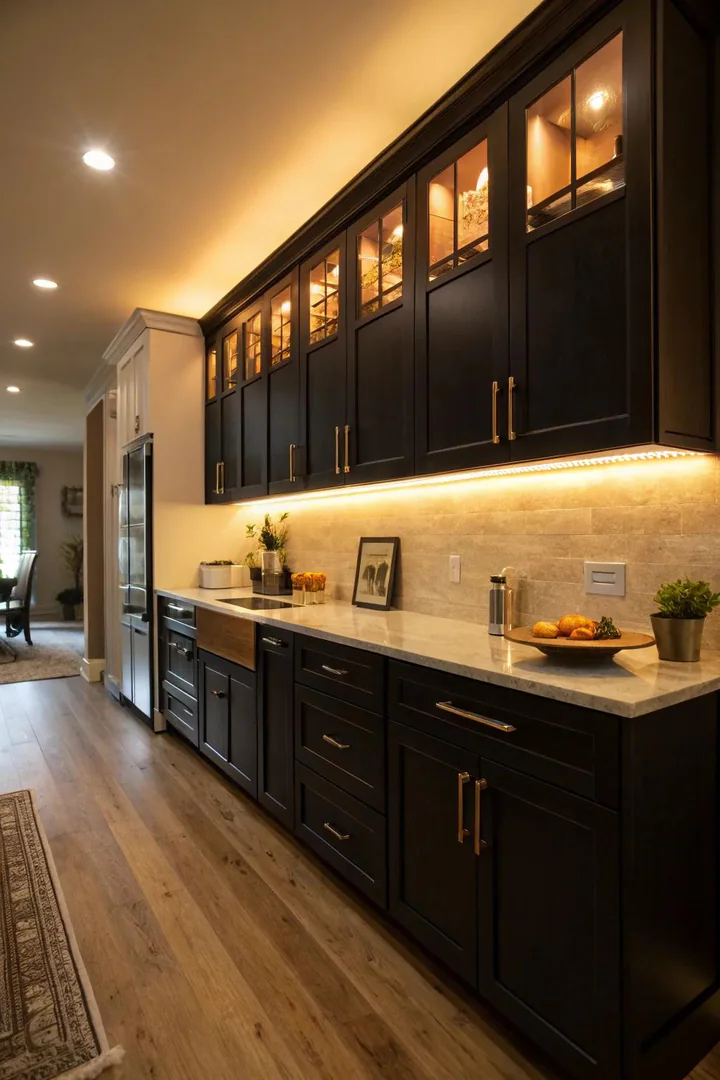
Under-cabinet LED lighting is not optional in a black kitchen — it is essential. Black upper cabinets absorb the overhead ceiling light that normally bounces off lighter cabinets down onto the counter, leaving the counter surface darker than it would be in a white or light-colored kitchen. LED strips or puck lights mounted to the underside of the upper cabinets restore the task lighting that the black cabinets absorb.
Install continuous LED strip lights (from WAC Lighting, GE, or Kichler) in warm white (2700K-3000K) on the underside of every upper cabinet. Use an aluminum channel with a frosted diffuser to prevent visible LED dots and create smooth, even light. Wire the under-cabinet lights to a dimmer switch (Lutron Caseta is the most reliable residential option) so you can adjust brightness from full task lighting to a low ambient glow. Under-cabinet lights on a dimmer also create a dramatic evening effect — the warm glow washing down the backsplash and countertop from beneath the black cabinets looks like a high-end restaurant kitchen.
15. Incorporate Texture Using Natural Stone
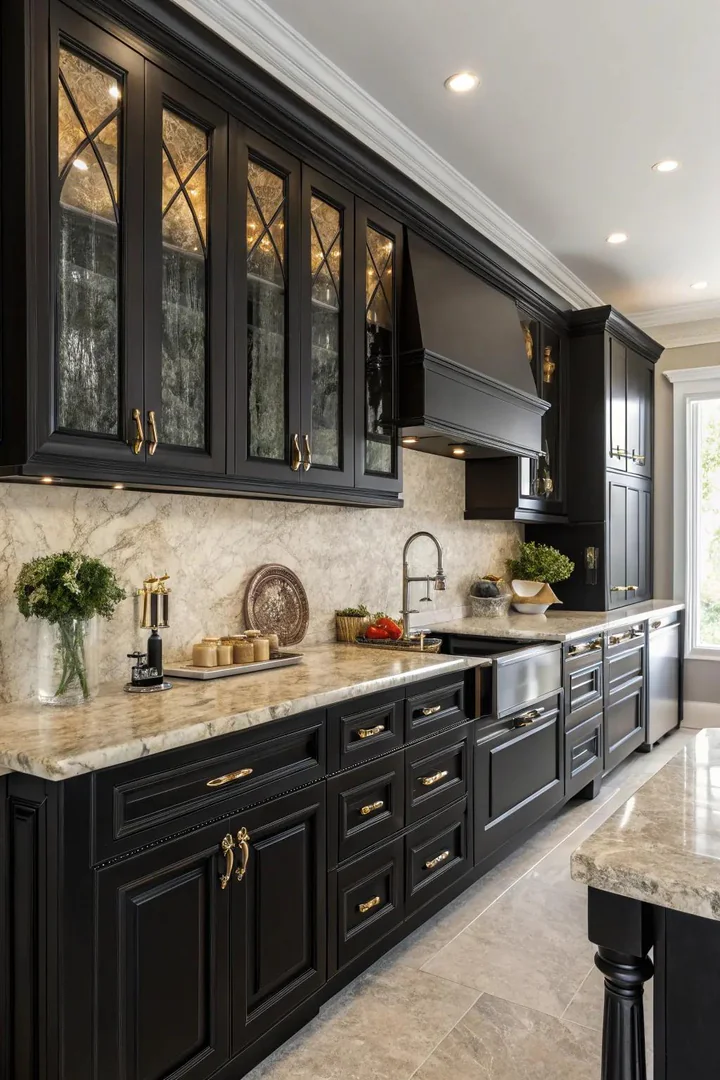
Natural stone — marble, granite, quartzite, soapstone, or slate — introduces organic texture, veining, and variation that softens the manufactured uniformity of painted black cabinets. The irregular patterns in natural stone (no two slabs are identical) create a sense of geological depth that contrasts with the flat, man-made surface of a painted cabinet door.
White-veined marble (Calacatta Gold, Statuario, or Carrara) against black cabinets produces the most luxurious combination — the bold veining creates a dramatic artwork-like surface against the dark background. Honed black soapstone or honed black granite on black cabinets creates a tonal, moody effect where the stone and cabinets share a dark palette but differ in texture (matte paint vs. smooth stone). Quartzite (Taj Mahal, Sea Pearl, or Super White) provides a marble-like appearance with superior hardness and stain resistance.
16. Add Cabinets with Glass Fronts
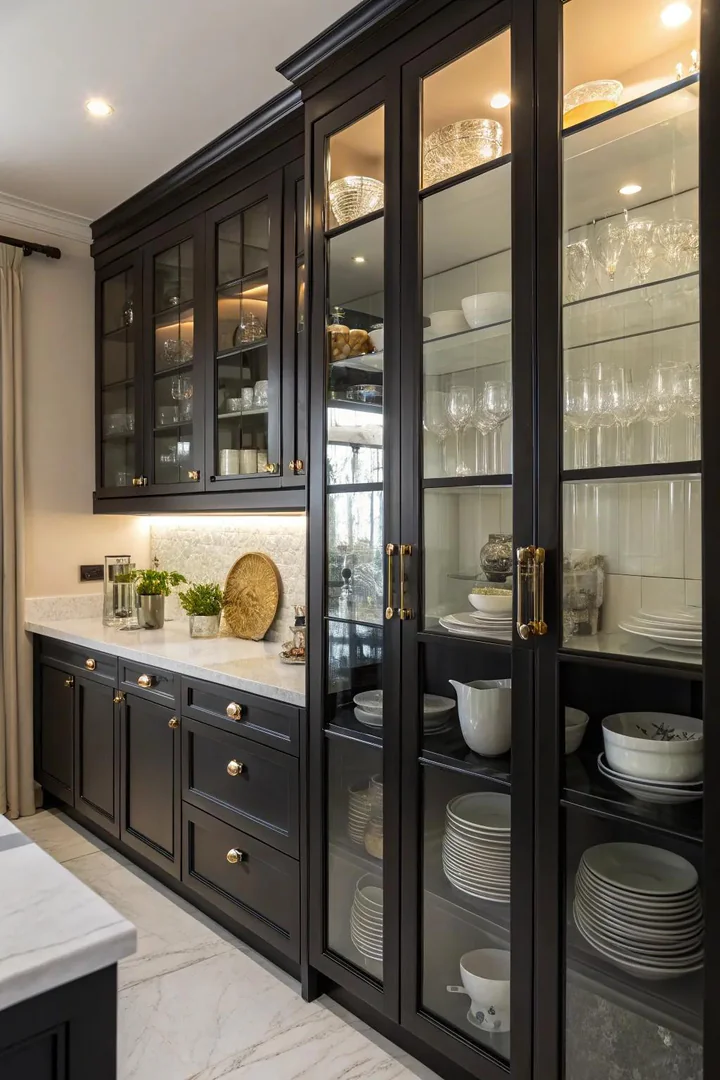
Glass-front upper cabinets in a black kitchen provide visual relief from the solid dark surfaces by revealing the lighter-colored contents inside (white dishes, clear glassware, ceramic pieces), effectively creating windows of light within the dark wall of cabinetry. The glass panels also make the upper cabinets feel less heavy and monolithic.
Use clear glass for cabinets with organized, attractive contents. Use seeded or ribbed glass for a decorative, partially obscured effect. Paint the cabinet interior a contrasting color — white or light grey — so the lighter interior shows through the glass and creates maximum contrast with the black exterior. Add interior cabinet lighting (small LED puck lights or strip lights mounted inside the cabinet) to illuminate the glass-front cabinets from within, creating a glowing display case effect in the evening.
17. Incorporate Glamour with Metallic Accents
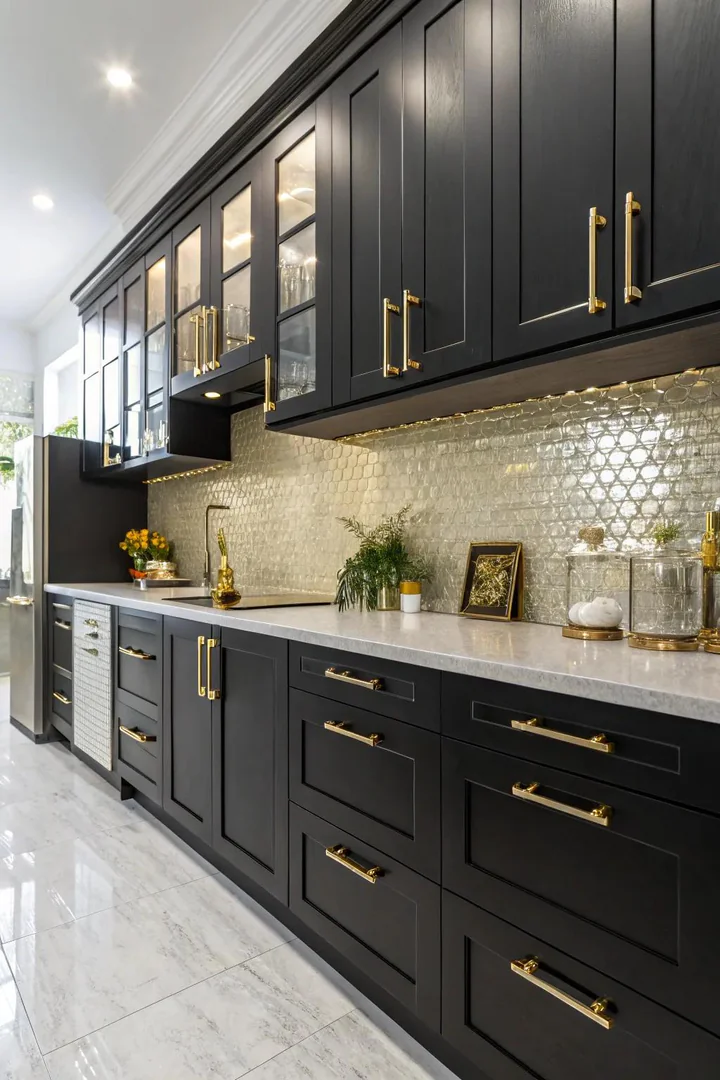
Metallic accents — gold hardware, a brass range hood, copper pendant lights, or a mirrored backsplash — introduce reflective, light-catching surfaces that prevent a black kitchen from feeling too dark or too flat. Metallics bounce light around the room and create sparkle that enlivens the matte darkness of the cabinets.
Gold and brass are the most glamorous metallic pairings with black because the warm gold tone creates a luxurious, jewelry-like contrast (think of a black evening gown with gold accessories). Unlacquered brass hardware (from Rejuvenation, Schoolhouse Electric, or Emtek) develops a living patina that adds character over time. A brass or gold range hood (custom-fabricated or from companies like Copperworks or Custom Range Hoods) creates a statement focal point. For maximum glamour, add a metallic backsplash (antiqued mirror tiles, brass sheet, or gold mosaic tile) that reflects light back into the room.
18. Experiment with a Chic Monochrome Style
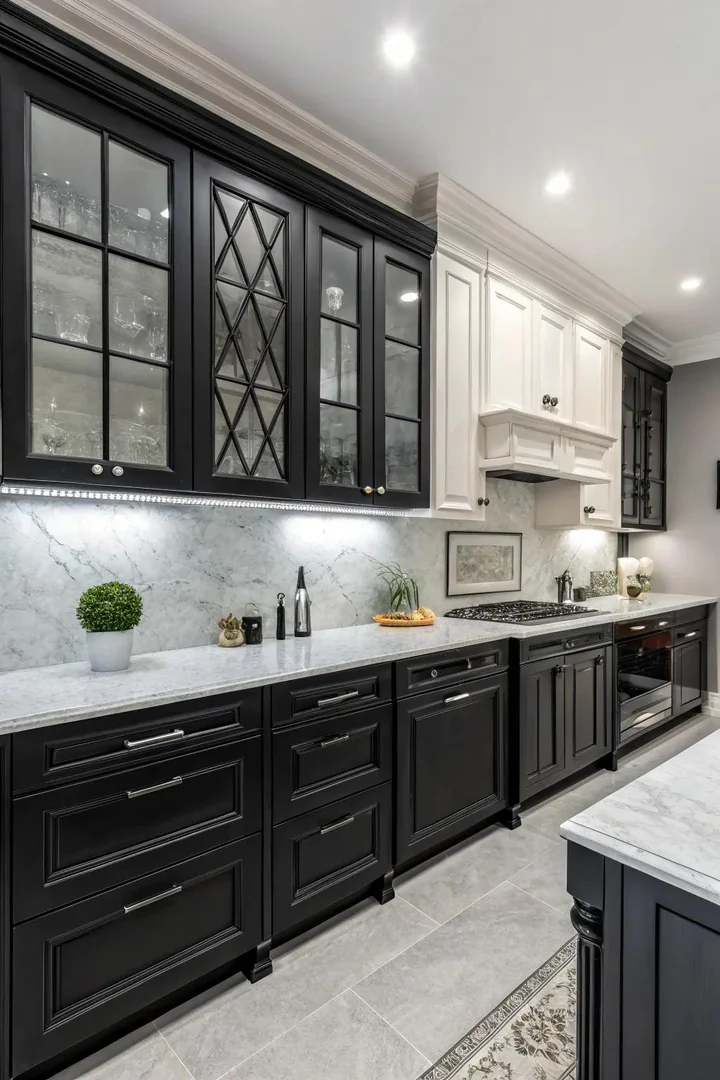
A monochrome black kitchen uses only black, charcoal, dark grey, and white — no warm wood tones, no colored accents, no brass or gold — to create a refined, editorial-quality kitchen that looks like a page from an architecture magazine. The monochrome palette relies entirely on value contrast (light to dark) and texture variation (matte vs. glossy, smooth vs. textured) rather than color contrast.
Build the monochrome scheme in three values: black (cabinets, hardware), dark grey (countertops, backsplash), and white (ceiling, walls, interior of glass-front cabinets). Keep all metals in the same family — polished chrome, polished nickel, or stainless steel (cool silvers) rather than warm brass or gold. Use a white marble or light grey quartz countertop to provide the brightest horizontal surface in the room. The monochrome approach requires more textural variety to prevent flatness — mix matte cabinets, honed stone, ribbed glass, and brushed metal to create visual depth within the limited color range.
19. Establish a Country Atmosphere
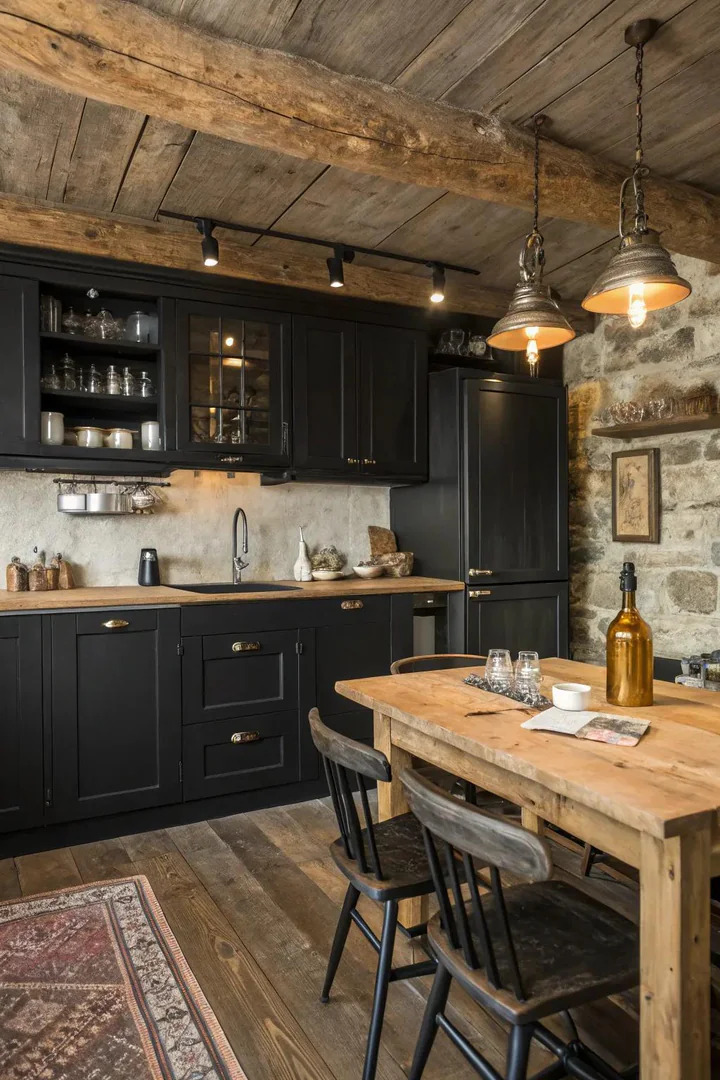
Black cabinets in a rustic kitchen create a moody, cabin-like atmosphere that feels like a mountain lodge or a European country house. The dark cabinets provide the visual weight and groundedness that rustic spaces need, while natural materials (reclaimed wood, stone, wrought iron) provide the warmth and texture that prevent the black from feeling cold or modern.
Pair black cabinets with reclaimed wood floating shelves, a stone or stacked-stone backsplash, a farmhouse apron-front sink in white fireclay, butcher block countertops, and oil-rubbed bronze or black iron hardware (bin pulls, cup pulls, or hand-forged knobs from blacksmith artisans). Add a vintage rug, woven baskets, and ceramic crocks for accessories. For more rustic design ideas, see our farmhouse kitchen cabinet guide.
20. Integrate High-Gloss Finishes
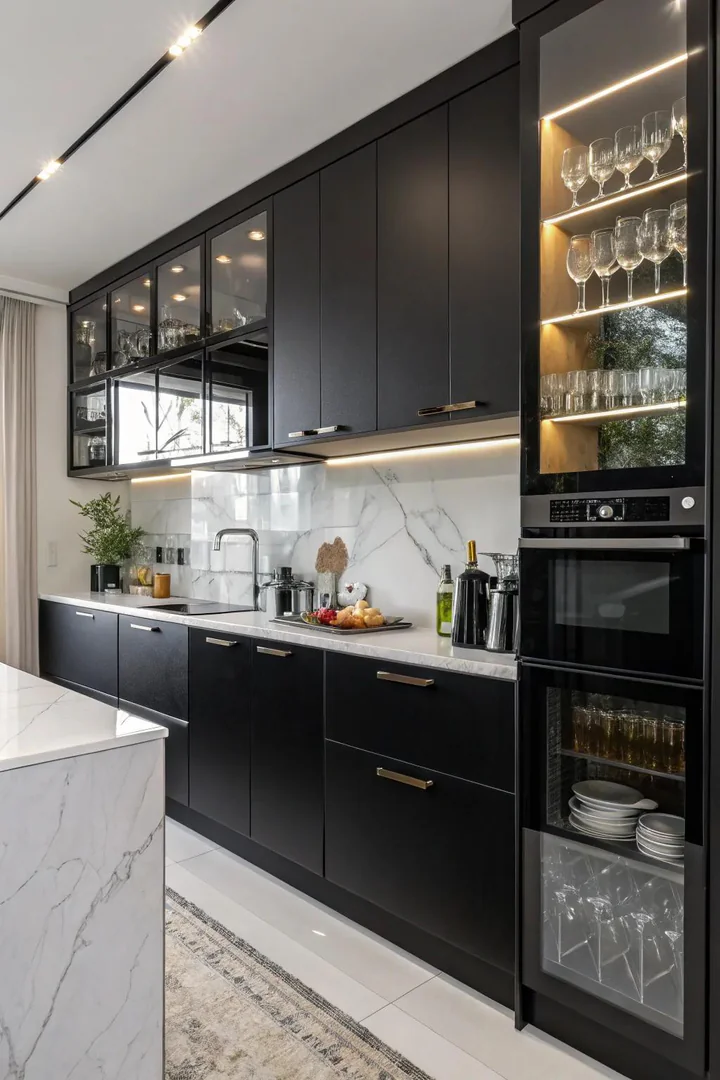
High-gloss black cabinets create a mirror-like, lacquered surface that reflects light, other objects, and the room’s architecture in its surface — the effect is similar to a polished black piano or a luxury car’s paint finish. Gloss black cabinets make a kitchen feel more spacious than matte black because the reflective surface bounces light around the room rather than absorbing it.
High-gloss finishes require the flattest, smoothest door construction available — any imperfection in the substrate (MDF is preferred over solid wood for gloss finishes) shows as a ripple or divot in the reflective surface. Factory-applied gloss finishes (from Italian cabinet brands like Snaidero, Pedini, or Scavolini, or from IKEA’s RINGHULT series in black) produce the smoothest results. Expect to clean high-gloss black cabinets frequently — every fingerprint, water spot, and dust particle is visible on the reflective surface. Use microfiber cloths and a gentle glass cleaner (Method or Windex vinegar formula) for streak-free cleaning.
21. Incorporate a Retro Flair
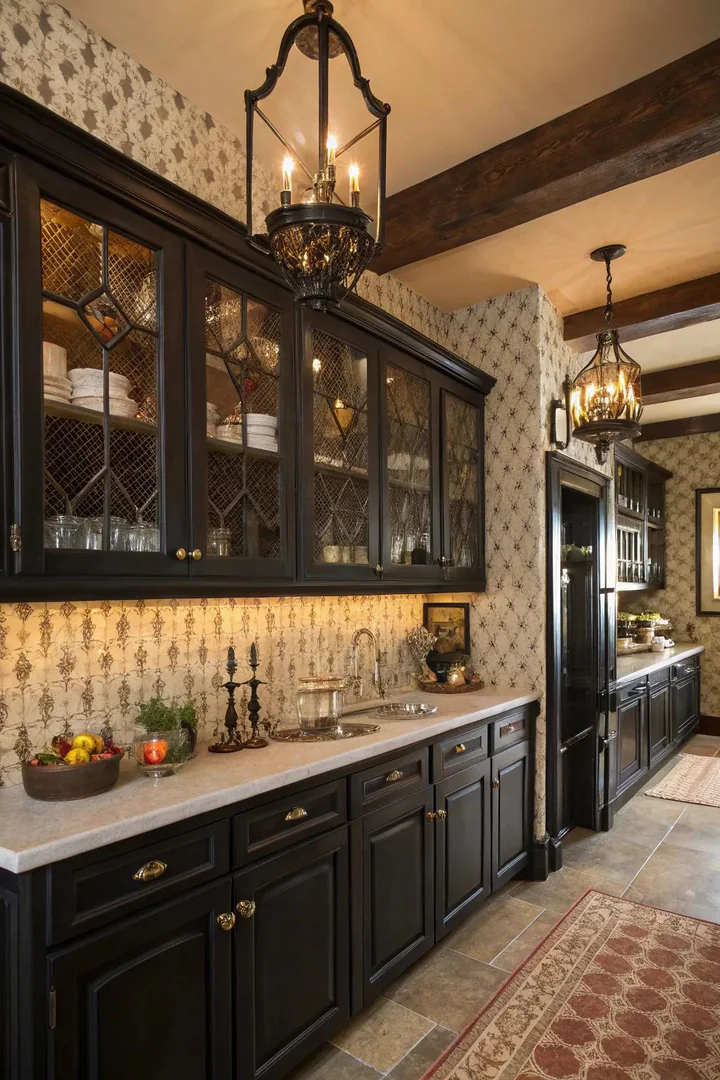
Black cabinets paired with vintage-inspired elements — a retro-style range, checkerboard flooring, art deco hardware, or a vintage schoolhouse pendant light — create a kitchen that references a specific era (1920s Art Deco, 1940s industrial, 1950s diner) while maintaining a modern construction and layout. The vintage elements add personality and nostalgia that prevent the black cabinets from feeling generic or builder-grade.
A retro-style range (from Big Chill, Elmira Stove Works, or SMEG) in a bright accent color (red, blue, cream, or mint green) creates a stunning focal point against black cabinets. Black-and-white checkerboard floor tile (from Daltile or Merola) creates an instant 1920s or bistro-inspired base. Art deco cabinet hardware (geometric pulls in brass or chrome from Anthropologie, Rejuvenation, or Liz’s Antique Hardware) adds period-appropriate detail. A vintage schoolhouse or industrial pendant light (from Schoolhouse Electric or Barn Light Electric) provides the overhead fixture that completes the retro composition.
22. Introduce Intensity with Dark Flooring
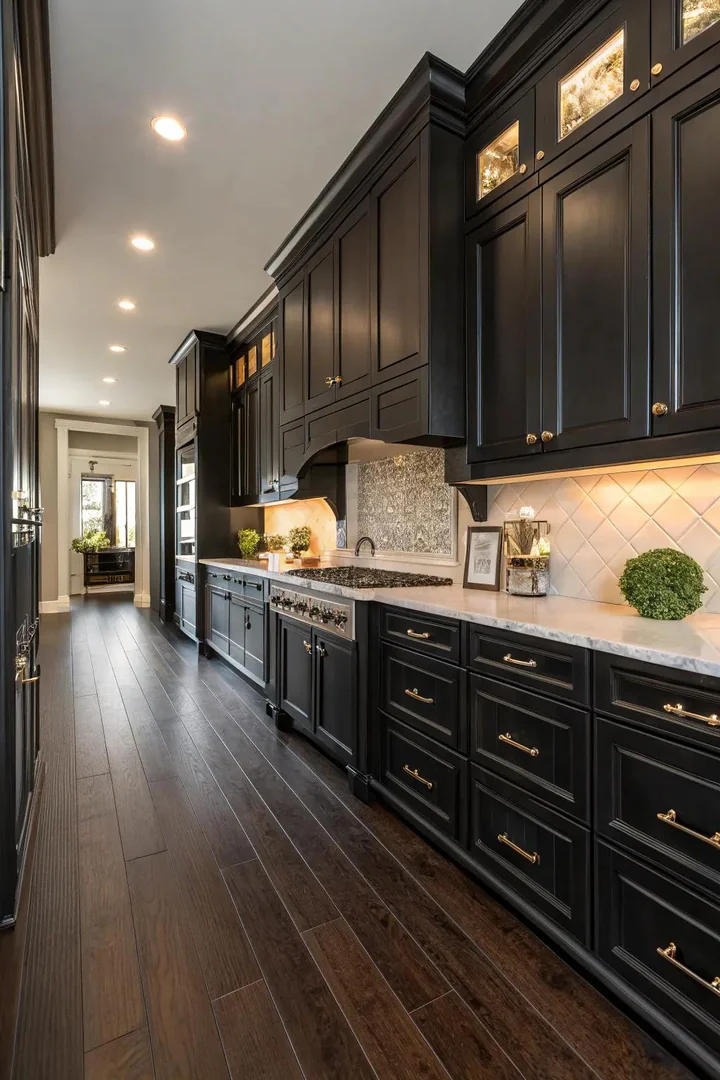
Dark flooring — ebony-stained hardwood, dark grey slate, charcoal porcelain tile, or dark walnut — paired with black cabinets creates a continuous dark envelope from floor to mid-height that grounds the kitchen with maximum visual weight. This bold approach works in kitchens with white ceilings and ample natural light, where the dark lower half contrasts with the bright upper half to create a dramatic, gallery-like spatial division.
Dark-stained white oak (DuraSeal Ebony or Jacobean stain) is the most popular dark floor for black kitchens because the wood grain remains visible through the dark stain, providing texture that solid-color tile cannot. Dark slate (natural cleft or honed from Vermont quarries) provides a matte, textured surface with tonal variation. Dark porcelain tile (12×24 or 24×24 format in charcoal or black from Daltile, Floor & Decor, or Porcelanosa) provides a consistent, low-maintenance dark surface. Add a light area rug or runner in front of the sink and stove to break the dark expanse and protect the floor from splashing.
23. Choose Minimalist Equipment
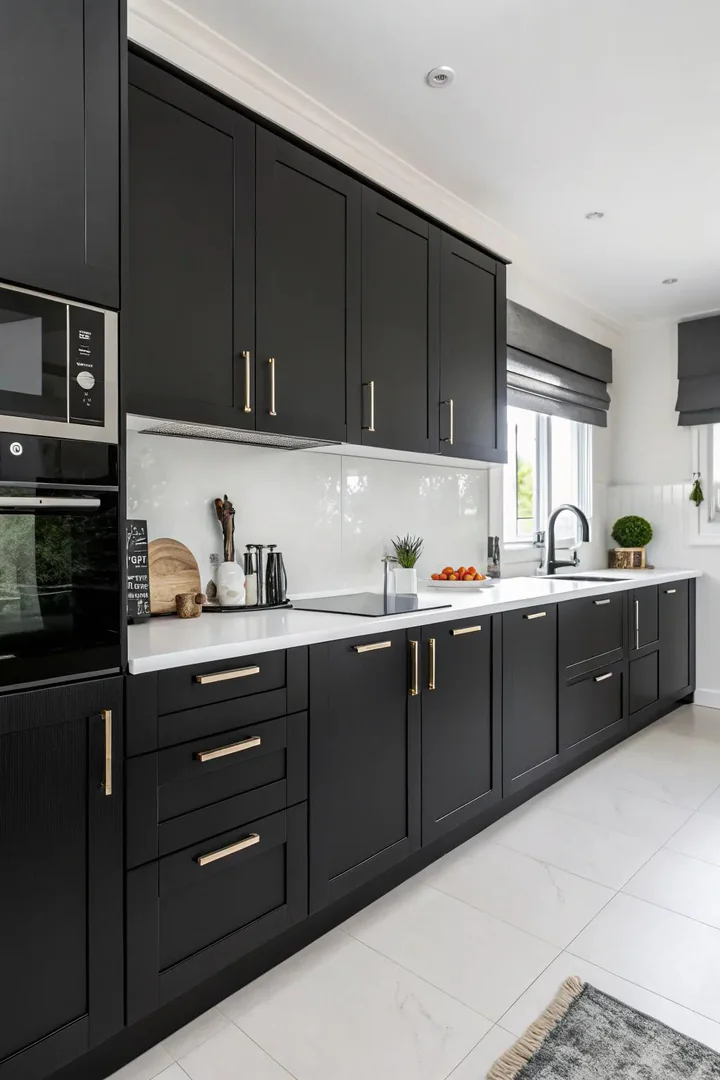
Minimalist hardware — slim bar pulls, thin edge pulls, integrated finger pulls, or handleless push-to-open mechanisms — lets the black cabinet surface read as an uninterrupted plane of color with no protruding elements to break the clean lines. The less hardware visible, the more the cabinet color dominates the visual impression of the kitchen.
Matte black bar pulls (3-to-5-inch center-to-center, from Top Knobs, Amerock, orDERA Hardware) blend with the cabinet color and virtually disappear, creating a nearly invisible hardware solution. For maximum minimalism, use push-to-open mechanisms (Blum TIP-ON) that eliminate visible hardware entirely, or integrated J-pull edge profiles that route a grip channel into the top or bottom edge of the cabinet door. If you want the hardware to be visible as a design element, use a contrasting metal (polished nickel or brass) in a slim, simple profile — the contrast makes the hardware read as a thin metallic line across the dark surface.
How to Design with Black Kitchen Cabinets
Assessing Your Kitchen’s Light Conditions
Count the windows, measure their size, and note which direction they face before committing to black cabinets. South-facing and west-facing kitchens receive the most natural light and can handle the most black cabinetry. North-facing kitchens with small windows should limit black to the lower cabinets or the island while keeping the uppers and walls light. If the kitchen receives fewer than 4 hours of direct sunlight daily, plan for aggressive artificial lighting (recessed ceiling lights, under-cabinet LEDs, and pendant fixtures) to compensate.
Selecting the Right Black Paint
Not all blacks are the same — some lean warm (Benjamin Moore Soot, with a brown undertone), some lean cool (Sherwin-Williams Iron Ore, with a grey-blue undertone), and some are true neutral black (Benjamin Moore Black, Sherwin-Williams Tricorn Black). Test three to five black paint samples on a cabinet door under the kitchen’s actual lighting at different times of day. In warm light (south-facing windows, warm-white bulbs), cool blacks look rich and deep; in cool light (north-facing windows, daylight bulbs), warm blacks look more inviting.
Planning the Finish and Maintenance
Matte and satin finishes hide fingerprints and imperfections but are harder to wipe clean. Semi-gloss and high-gloss finishes are easier to clean but show every fingerprint, water spot, and surface imperfection. For families with children, choose satin — it provides the best balance between fingerprint concealment and cleanability. For adult-only households that prioritize appearance, choose matte for warmth or high-gloss for drama. Budget for more frequent cleaning than lighter cabinets require — black surfaces show dust and water marks that lighter surfaces hide.
Black Cabinet Finish Options Comparison
| Finish | Fingerprint Visibility | Cleanability | Best For |
|---|---|---|---|
| Matte | Low | Moderate | Modern, warm aesthetics |
| Satin | Low-medium | Good | Families, daily-use kitchens |
| Semi-gloss | Medium-high | Very good | Traditional, transitional styles |
| High-gloss | Very high | Excellent | Contemporary, luxury kitchens |
| Super matte (anti-fingerprint) | Very low | Good | High-traffic, European-style |
Common Black Cabinet Mistakes to Avoid
Using black cabinets in a dark kitchen without compensating. A kitchen with small north-facing windows, low ceilings, and no skylights will feel cave-like with full black cabinetry. Add light-colored countertops, a white backsplash, a white ceiling, and strong artificial lighting (under-cabinet LEDs are non-negotiable) to prevent the room from feeling oppressive.
Matching black hardware to black cabinets. Matte black pulls on matte black cabinets disappear entirely, making the cabinets hard to open and removing the design detail that hardware provides. If you want invisible hardware, use push-to-open mechanisms instead. If you are using traditional pulls and knobs, choose a contrasting metal (brass, polished nickel, or chrome) that reads as a visible accent against the dark surface.
Skipping under-cabinet lighting. Black upper cabinets absorb the ceiling light that lighter cabinets reflect down onto the counter. Without under-cabinet LEDs, the counter surface in a black kitchen is noticeably darker than the same counter in a white kitchen. Install under-cabinet lighting before the cabinets are installed (hardwired) or immediately after (plug-in or battery strips).
Choosing high-gloss without understanding the maintenance. High-gloss black shows every fingerprint, water droplet, and dust particle. If you are not prepared to wipe cabinet fronts daily, choose matte or satin instead. Visit The Designers Company for more kitchen cabinet guides, color pairing ideas, and design inspiration.
Frequently Asked Questions
Do black cabinets make a kitchen look smaller?
Black cabinets can make a small kitchen feel more enclosed because dark surfaces absorb rather than reflect light. In kitchens under 100 square feet, limit black to the lower cabinets or the island and use white or light-colored upper cabinets, countertops, and walls. In kitchens over 150 square feet with good natural light, full black cabinetry does not significantly reduce the perceived size — the room has enough volume and light to absorb the dark color.
What countertop color goes best with black cabinets?
White countertops (white marble, white quartz, or white solid surface) create the highest contrast and the most classic pairing. Light-toned butcher block adds warmth. Dark countertops (black granite, soapstone) create a monochromatic look for the boldest kitchens. Avoid medium-toned countertops (beige, tan, medium grey) that neither contrast nor coordinate — they look like an accidental mismatch rather than a design choice.
Are black cabinets hard to keep clean?
Black cabinets show fingerprints, water spots, and dust more than lighter cabinets. Matte and satin finishes are the easiest to maintain because they hide marks between cleanings. High-gloss finishes require daily wiping. Clean all black cabinets with a soft microfiber cloth and a gentle cleaner (warm water with a drop of dish soap, or a dedicated cabinet cleaner like Murphy Oil Soap or Method All-Purpose). Avoid abrasive sponges and harsh chemicals that can dull the finish.
What wall color works with black cabinets?
White walls (Benjamin Moore Simply White, Sherwin-Williams Extra White) create the strongest contrast and the brightest room. Light grey walls (Benjamin Moore Revere Pewter, Sherwin-Williams Agreeable Gray) create a softer, warmer contrast. Dark walls (charcoal, navy, deep green) create a moody, enveloping effect — use only in large, well-lit kitchens. Warm whites work better than cool whites because they prevent the black cabinets from looking harsh under warm-white lighting.
Can I paint existing cabinets black?
Yes — painting cabinets black is one of the most dramatic kitchen updates available for under $5,000 (professional) or under $500 (DIY). Sand the existing finish, apply a high-adhesion primer (Zinsser BIN shellac-based or KILZ Adhesion), and topcoat with two coats of cabinet-quality paint (Benjamin Moore Advance or Sherwin-Williams Emerald Urethane) in your chosen black. Professional painters typically charge $3,000-7,000 for a full kitchen. DIY results depend on thorough preparation — skipping sanding or priming leads to peeling within months.
What metal hardware looks best on black cabinets?
Brushed or satin brass is the most popular hardware choice because the warm gold tone creates maximum contrast and warmth against the cool black surface. Polished nickel provides a bright, reflective contrast. Chrome provides a modern, cool contrast. Oil-rubbed bronze blends with the dark cabinets for a subtle, coordinated look. Matte black hardware disappears against matte black cabinets — use it only if you want invisible hardware (otherwise use push-to-open mechanisms).
Conclusion
Black kitchen cabinets are the boldest color choice you can make in a kitchen, and they reward that boldness with drama, depth, and a design impact that no lighter color can match. Whether you commit to an all-black kitchen, introduce black on just the island or the lower cabinets, or pair black with white, wood, or metallic accents, the dark color anchors the room and makes every other element — the countertops, the backsplash, the hardware, the lighting — stand out with greater clarity and intensity.
Start by assessing your kitchen’s natural light — the more light available, the more black you can use. Choose a matte or satin finish for the most practical daily performance. Pair the black cabinets with a contrasting countertop (white marble or butcher block), install under-cabinet LED lighting as a non-negotiable requirement, and select hardware in a metal finish (brass, nickel, or chrome) that adds a visible accent against the dark surface. The result is a kitchen that commands attention the moment you walk in.