
Kitchen Drawer Design Ideas with 14 Stunning Upgrades You’ll Love
Kitchen drawer design ideas go far beyond the standard 4-inch-deep utensil tray that comes pre-installed in most stock cabinets. Drawers are the most accessed storage in any kitchen — you open them dozens of times a day to grab a knife, a spatula, a measuring cup, or a spice — and yet most kitchen drawers are basic, undivided boxes where everything piles on top of everything else, forcing you to rummage through a tangle of tools every time you need one item.
The 14 kitchen drawer design ideas below show how to upgrade your drawers from disorganized catch-alls into purpose-built systems — tiered utensil trays, integrated knife blocks, LED-lit interiors, spice racks, deep pot-and-pan drawers, hidden charging stations, and handleless fronts — that store more items in less space and make every cooking session faster and less frustrating.
1. Layered Utensil Organizers

A tiered cutlery drawer uses a removable upper tray that slides or lifts to reveal a second storage layer underneath, effectively doubling the capacity of a single drawer without taking up additional cabinet space. The upper tray holds everyday cutlery — forks, knives, spoons, teaspoons — while the lower level stores less frequently used items like serving utensils, chopsticks, corn holders, cocktail forks, and steak knives.
The IKEA UPPDATERA series offers a modular two-tier system with bamboo and plastic components that fit standard 15-to-36-inch-wide drawers. For a more premium option, Rev-A-Shelf’s 4WTCD series features a hardwood upper tray on full-extension ball-bearing slides that glides forward for access to the lower tier. Custom tiered inserts from brands like Docking Drawer or Hafele provide exact-fit solutions for non-standard drawer widths. The upper tray should be shallow (1.5 to 2 inches deep) so it does not consume too much of the drawer’s total depth — a 4-inch-deep drawer with a 1.5-inch upper tray leaves 2.5 inches of usable depth in the lower tier, enough for most serving utensils.
2. LED-Illuminated Drawer
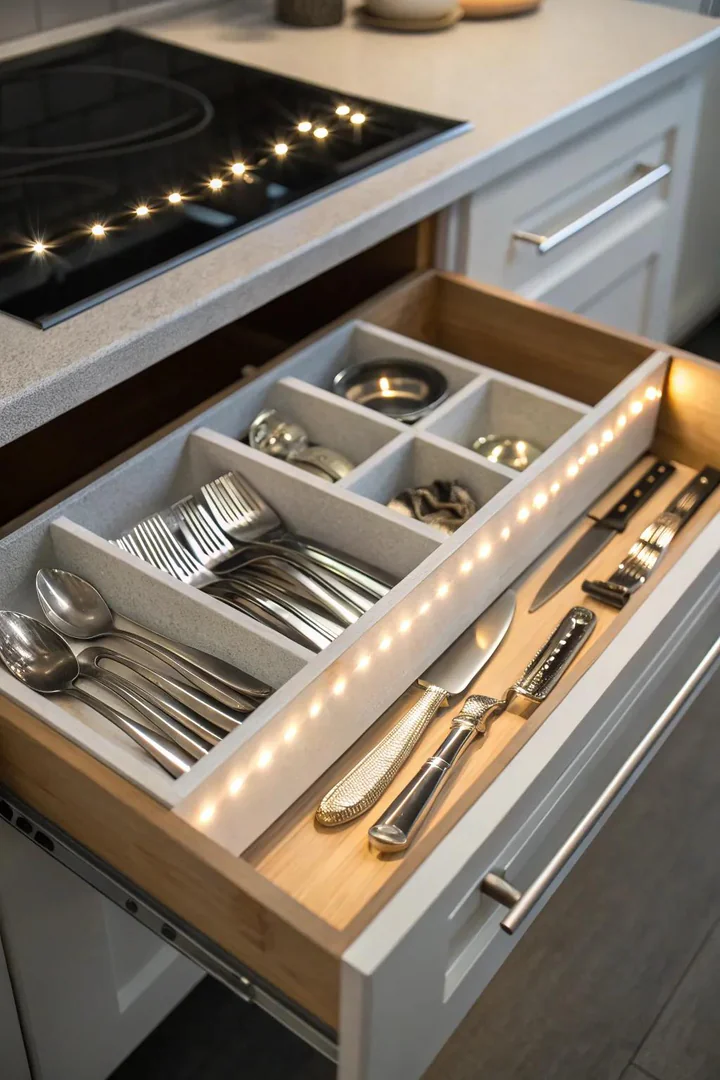
LED drawer lighting activates automatically when the drawer opens and illuminates the contents from above or from the sides, making it easy to see and identify every item inside — especially in deep drawers, lower-cabinet drawers, and drawers located in dimly lit areas of the kitchen that ceiling lights do not reach. Without dedicated lighting, the bottom 2 to 3 inches of a deep drawer is essentially invisible when you are looking down into it from a standing position.
Battery-powered LED strip lights with magnetic mounting and a motion sensor (from Brilliant Evolution, OxyLED, or Closet Light brand) are the simplest aftermarket solution — peel-and-stick the strip inside the front rail of the drawer, and the motion sensor triggers the light every time you open the drawer. Hardwired options from Hafele (Loox LED system) or Blum (integrated into their LEGRABOX drawer system) connect to the home’s 12V low-voltage wiring for a permanent, battery-free installation. Choose warm-white LEDs (3000K) for a soft glow that does not look clinical, and position the strip at the front or sides of the drawer rather than the back, so the light falls on the contents you see first when you pull the drawer open.
3. Knife Block Drawer with Integrated Design
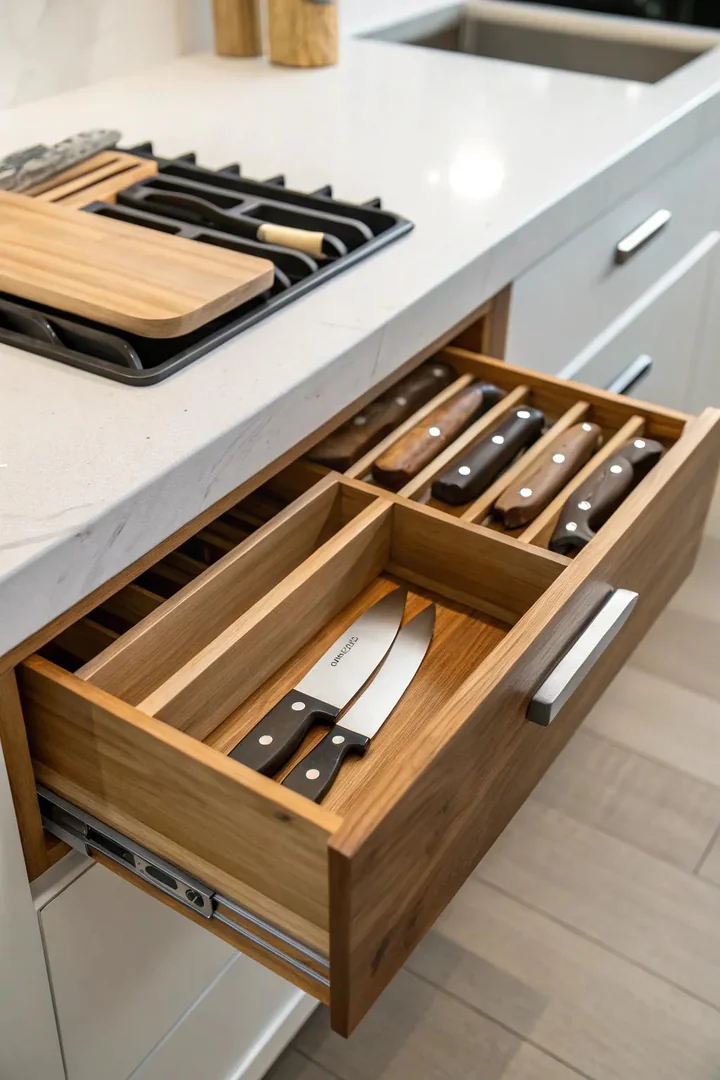
An integrated knife block drawer stores knives blade-down in a slotted insert fitted inside a standard drawer, keeping blades protected, safely out of reach of children, and completely off the countertop. Countertop knife blocks take up 6 to 8 inches of valuable counter space, magnetic wall strips expose blade edges, and loose knives in a utensil drawer dull the edges and create a safety hazard — the in-drawer knife block solves all three problems at once.
In-drawer knife block inserts come in two formats: slotted wood blocks (from Wusthof, Shun, or Rev-A-Shelf) with fixed slots sized for specific blade profiles, and universal inserts (from Kapoosh or Noble Home) filled with flexible plastic or bamboo rods that grip any blade shape and size. Slotted blocks protect blades better and look more refined; universal inserts accommodate odd-sized knives and cleavers that may not fit standard slots. Size the drawer for the insert: a 15-to-18-inch-wide drawer accommodates most 11-to-16-slot knife block inserts. The drawer should be at least 3.5 inches deep for paring and utility knives, and 5 to 6 inches deep for chef’s knives and bread knives with longer blades.
4. Utensil Drawer Dividers
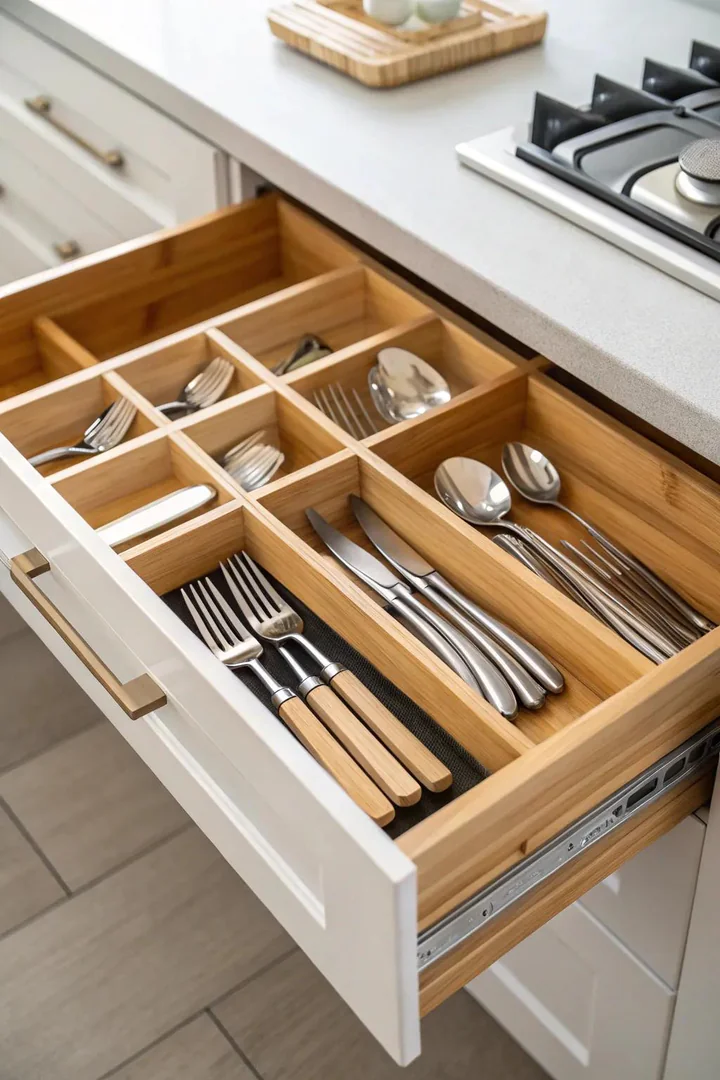
Drawer dividers separate a single open drawer cavity into distinct compartments for different utensil types — spatulas in one section, whisks in another, wooden spoons in a third — preventing the jumbled pile that forms when everything shares one undivided space. Dividers transform the act of finding a utensil from a rummaging exercise into a glance-and-grab retrieval that takes less than two seconds.
Expandable bamboo drawer organizers (from Seville Classics, Dynamic Gear, or KitchenEdge) adjust from 13 to 19 inches wide and fit most standard kitchen drawers without modification. For a more custom look, individual bamboo divider strips (from Totally Bamboo or Core Bamboo) can be arranged in any configuration to create compartments sized to your specific utensil collection. Spring-loaded adjustable dividers (from OXO or Drew Barrymore’s Beautiful line at Walmart) tension-fit between the drawer walls and can be repositioned instantly without tools. The best material for kitchen drawer dividers is bamboo — it is naturally moisture-resistant, antimicrobial, and harder than most hardwoods, so it handles the constant contact with wet and oily utensils without warping or splitting.
5. Drawers with Glass Fronts
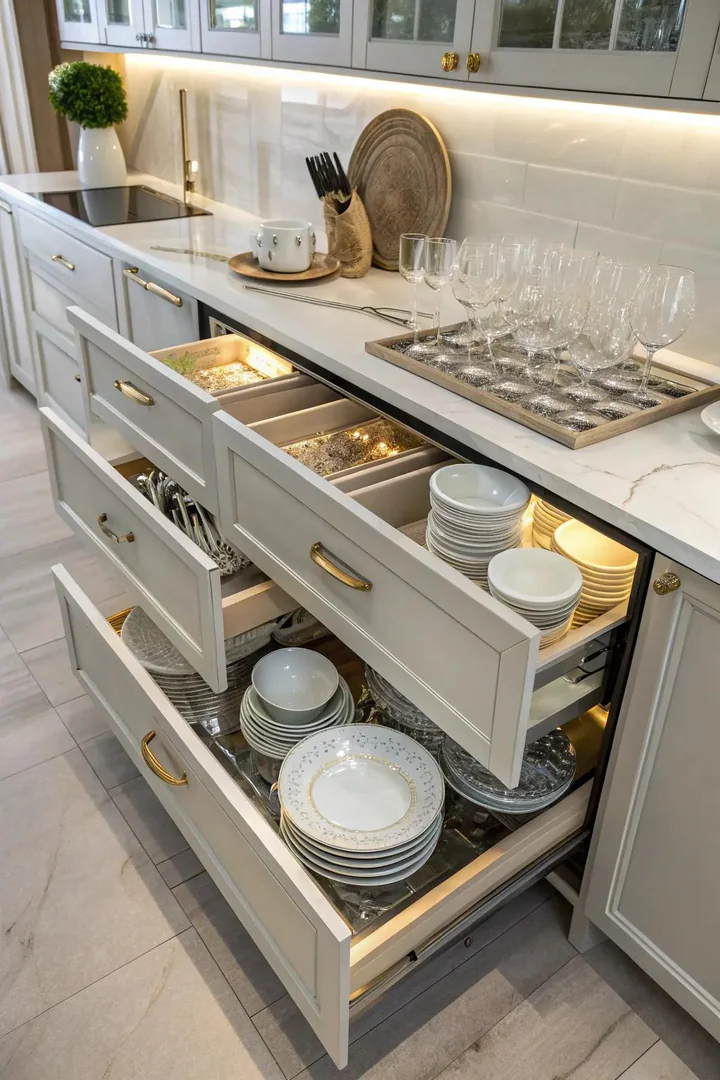
Glass-front drawers feature a clear, frosted, or ribbed glass panel set into the drawer face, allowing you to see the contents at a glance without opening the drawer. This saves time in a busy kitchen — you can scan three or four glass-front drawers in a second to locate the item you need instead of opening each one and looking inside. Glass fronts also add a decorative display element, turning organized contents (neatly stacked linens, a row of spice jars, color-coordinated plates) into visible kitchen decor.
Clear tempered glass shows contents crisply and works for drawers with perfectly organized, attractive contents — spice jars with matching labels, a set of white linens, or a row of matching containers. Frosted or etched glass shows contents as shapes and shadows, which is more forgiving for drawers with less photogenic contents (mixed plasticware, random cooking tools). Ribbed or reeded glass provides a decorative texture that partially obscures the contents while still indicating what is inside. Order glass-front drawer fronts from your cabinet manufacturer as an upgrade, or retrofit existing drawers by having a glass shop cut tempered panels to fit a routed channel in the drawer face.
6. Drawers for Spice Racks
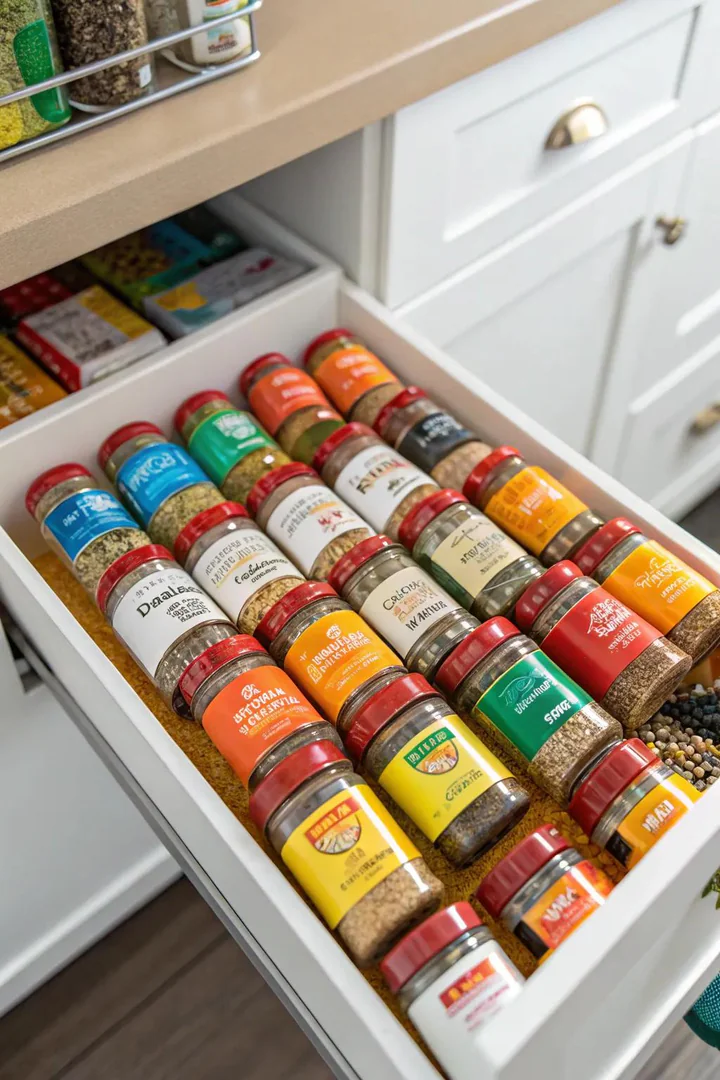
A spice drawer stores spice jars or containers in angled rows with the labels facing upward, so you can read every label at once when you open the drawer — unlike a cabinet shelf where jars hide behind each other and you must pull out five to find the one in the back. A well-designed spice drawer stores 30 to 60 spice jars in a single 15-to-24-inch-wide drawer, keeping the entire collection visible, accessible, and off the counter.
The two spice drawer formats are angled inserts and flat inserts. Angled inserts (from SpiceStack, Lynk Professional, or Rev-A-Shelf) tilt each row of jars at a 15-to-30-degree angle so the labels face upward and every jar in every row is visible without moving anything. Flat inserts (from YouCopia SpiceLiner or Bamboo Spice Drawer Organizer from Amazon Basics) store jars upright with the labels on top — simpler but requires top-labeled jars or custom labels on the lids. Place the spice drawer within arm’s reach of the stove — ideally the drawer directly below the cooktop or the first drawer to the left or right of the range — so spices are accessible during active cooking without walking across the kitchen.
7. Deep Drawers for Cookware and Frying Pans
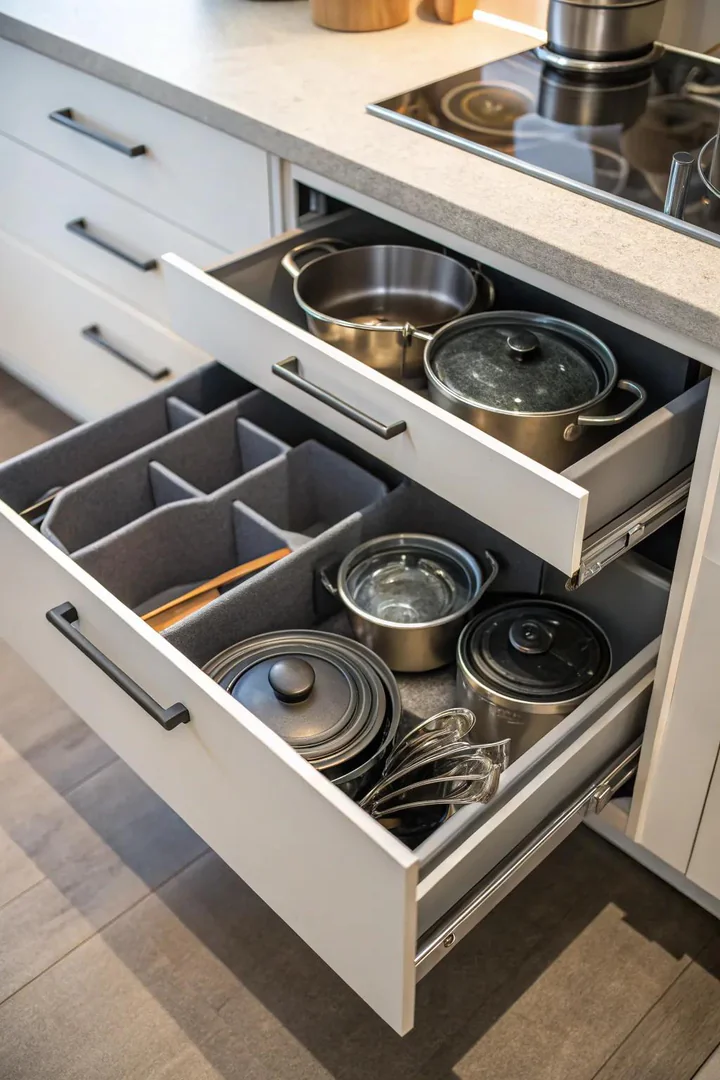
Deep drawers (8 to 12 inches deep) designed specifically for pots, pans, Dutch ovens, and stockpots replace the traditional lower cabinet with hinged door and fixed shelf — an arrangement that forces you to stack heavy cookware, reach to the back of a dark cabinet, and pull out three pots to access the one you need. A deep drawer on full-extension slides lets you see and access every piece of cookware from above, without bending, reaching, or restacking.
Deep drawer base cabinets are available from IKEA (SEKTION line with MAXIMERA deep drawers), KraftMaid (Deep Drawer Base), and most semi-custom and custom cabinet manufacturers. Pair the deep drawer with a peg system insert (wooden dowels set into a drilled bottom panel) that holds pots and lids upright and separated — Blum’s ORGA-LINE internal divider system and Rev-A-Shelf’s peg board organizer both provide adjustable peg configurations. Full-extension, heavy-duty drawer slides (rated for 100+ pounds from Blum TANDEMBOX or Grass Nova Pro) are essential — standard slides cannot handle the weight of cast iron and stainless steel cookware. For more on maximizing small kitchen storage, see our dedicated guide.
8. Design of Microwave Drawer
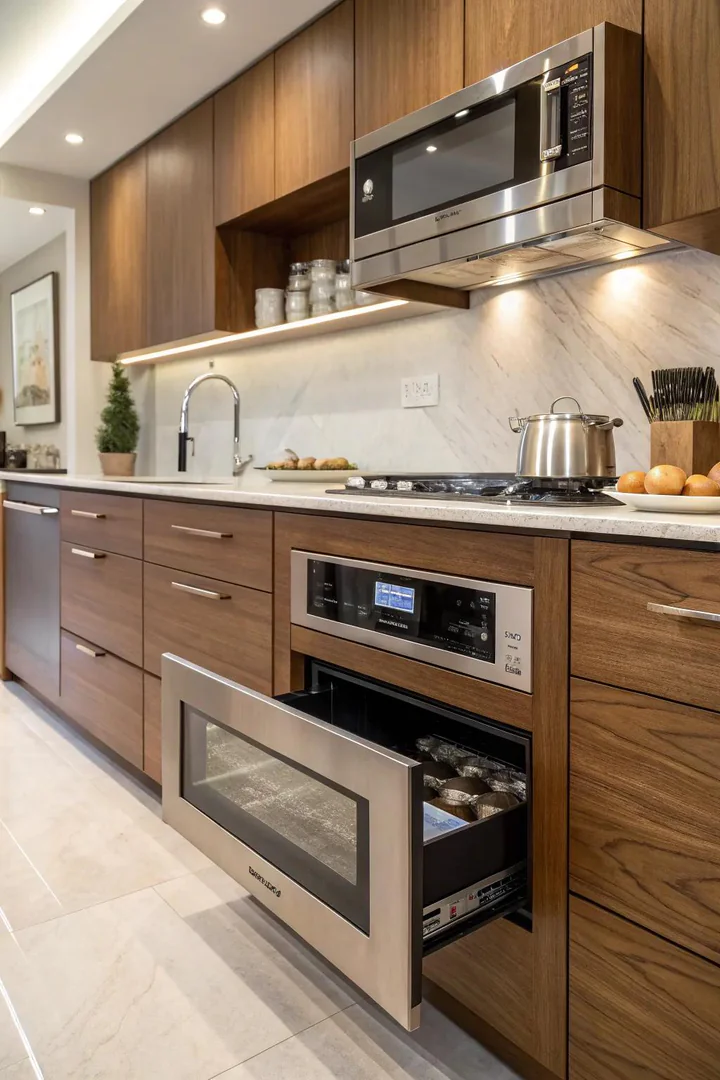
A microwave drawer installs under the counter (typically below the island or in a lower cabinet run) and opens by pulling out like a drawer rather than swinging a door open. This placement frees up the counter space that a countertop microwave occupies and eliminates the over-the-range microwave that blocks upper cabinet space and venting. The drawer format also provides ergonomic loading — you place food into the microwave at waist height rather than lifting heavy dishes to chest height above the range.
Sharp is the dominant manufacturer of microwave drawers, with the SMD2489ES (24-inch width, 1.2 cubic feet) and SMD2470AH (24-inch, 1.2 cubic feet with wave touch controls) being the most popular models. Bosch (HMD8451UC) and Wolf (MDD30TE/S) offer premium alternatives with larger capacities and more refined controls. Microwave drawers require a dedicated 120V electrical outlet inside the cabinet cavity, a 24-inch-wide cabinet opening, and 15 to 18 inches of vertical clearance. The installation is straightforward for a qualified electrician and cabinet installer — most kitchen renovation contractors have experience with microwave drawer installations.
9. Drawers in the Corner
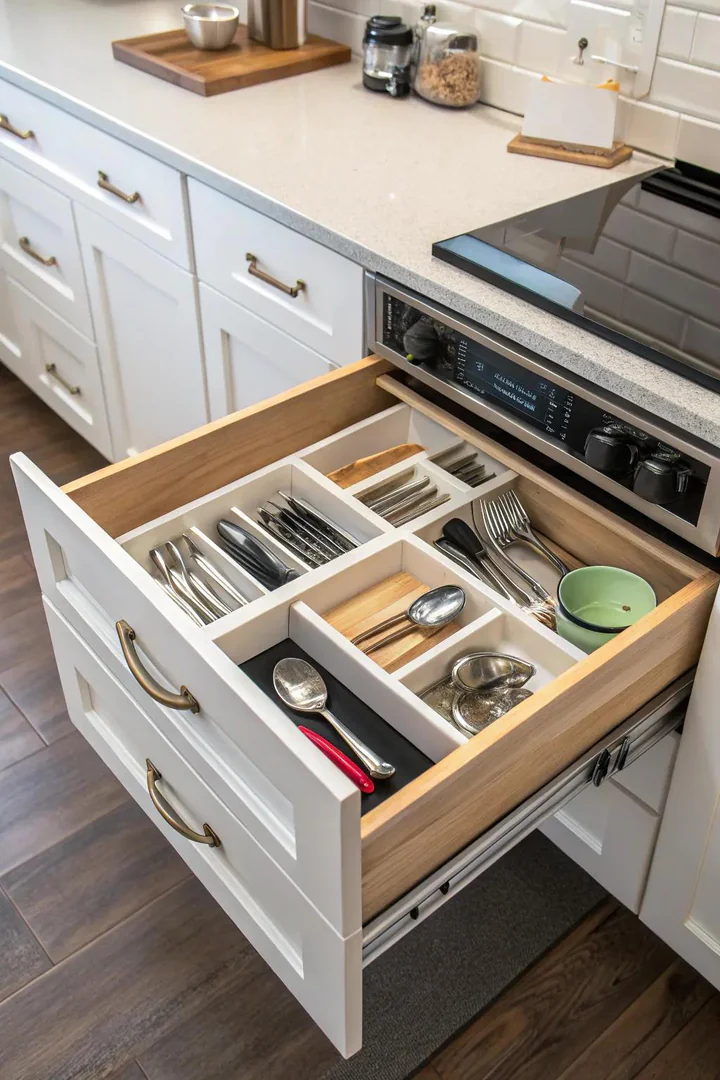
Corner drawers access the deep, hard-to-reach space where two perpendicular cabinet runs meet — the notorious kitchen dead zone that traditional Lazy Susans, blind-corner pull-outs, and fixed shelves fail to make fully usable. A corner drawer opens at a 45-degree angle from the corner, pulling the full depth of the corner space outward into the kitchen so you can see and reach everything stored inside without crawling halfway into the cabinet.
Corner drawers use a 45-degree or V-shaped drawer box that fits into the triangular space where two cabinet runs meet. Blum’s SPACE CORNER system is the most widely available corner drawer hardware, using a specially designed drawer runner that allows the V-shaped drawer to glide smoothly on full-extension slides. Hafele and Hettich also manufacture corner drawer hardware systems. The corner drawer typically stores large flat items that benefit from the wide, irregular shape: baking sheets, cutting boards, platters, and oversized serving trays. For help with difficult kitchen cabinet layouts, including corners, see our planning guide.
10. Storage for Vertical Drawers
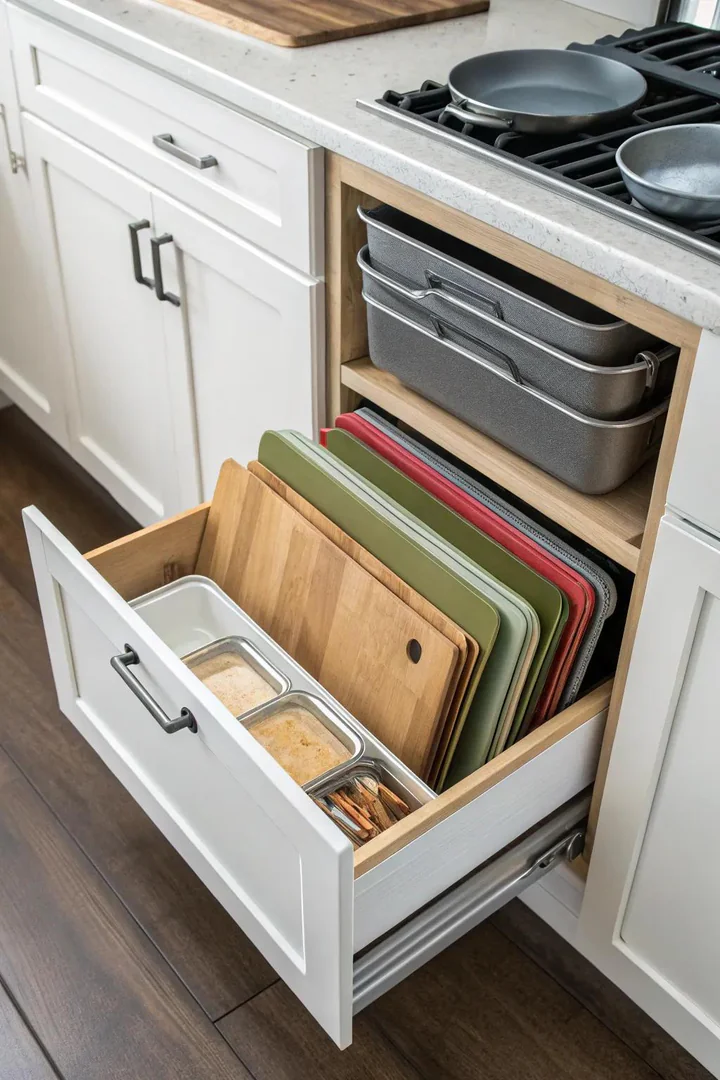
Vertical drawer storage uses tall, narrow pull-out drawers (3 to 9 inches wide and 12 to 30 inches tall) that store items upright rather than stacked flat. This format is ideal for baking sheets, cutting boards, serving trays, muffin tins, and cooling racks — items that are thin, flat, and nearly impossible to organize in a standard horizontal drawer or shelf where they stack into a precarious pile that topples every time you pull one out.
Rev-A-Shelf’s tray divider pull-out (from the 447 series) installs inside a base cabinet and provides three to five vertical slots separated by metal or wood dividers, each slot holding one baking sheet, cutting board, or tray. The entire unit pulls out on full-extension slides so you can access each slot from above. IKEA’s UTRUSTA pull-out rack and KraftMaid’s tray divider base cabinet provide built-in vertical storage options at the time of cabinet purchase. Vertical storage also works above the refrigerator — a narrow, tall cabinet above the fridge with a pull-out vertical insert stores oversized baking sheets and pizza peels that do not fit in standard base cabinets.
11. Concealed Charging Points
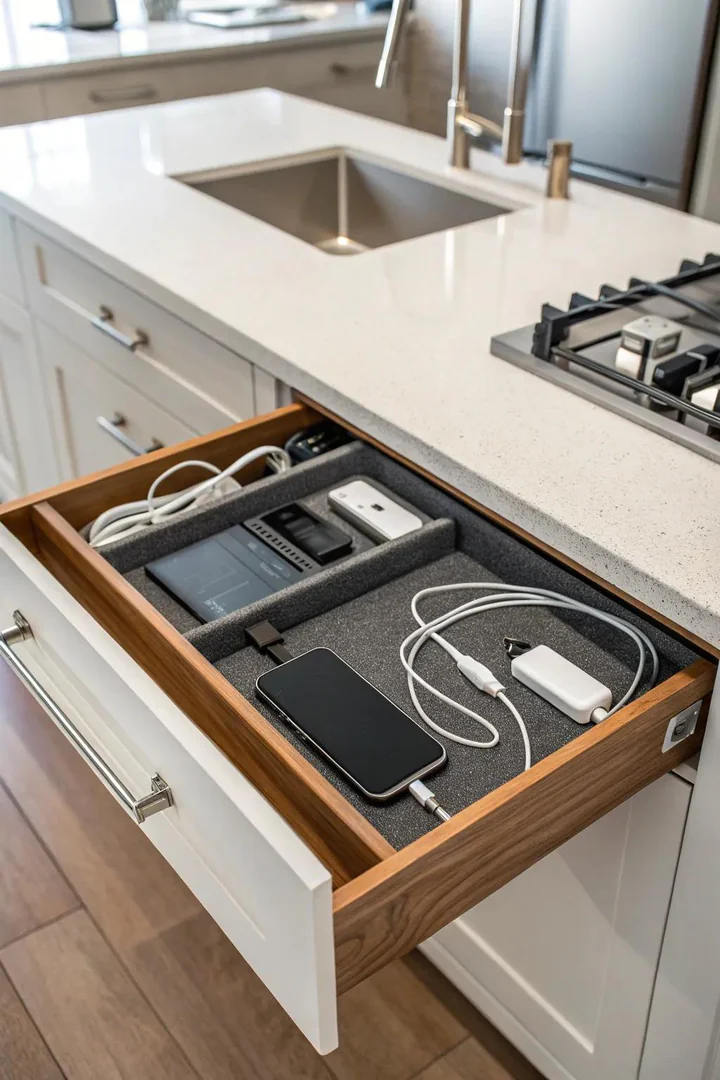
A hidden charging station built into a kitchen drawer stores and charges phones, tablets, wireless earbuds, and smartwatches out of sight — keeping the countertop free of tangled charging cables, device clutter, and the splash zone around the sink and stove. The device charges inside the closed drawer, and you retrieve it when it is fully charged, eliminating the counter cable pile that accumulates around kitchen outlets.
Docking Drawer (dockingdrawer.com) is the leading manufacturer of in-drawer electrical outlets, offering the Blade series (two 120V outlets plus two USB ports) and the Style series (multiple outlet and USB configurations) that install inside a standard drawer with a power cord that routes through a notch in the back of the drawer box to a wall outlet behind the cabinet. The Docking Drawer units are UL-listed and designed specifically for in-drawer installation, with automatic power cutoff if the drawer overheats. For a simpler DIY approach, route a flat USB charging cable through a 1-inch hole drilled in the back of the drawer box to an outlet strip mounted inside the cabinet behind the drawer.
12. Woven Drawer Organizers
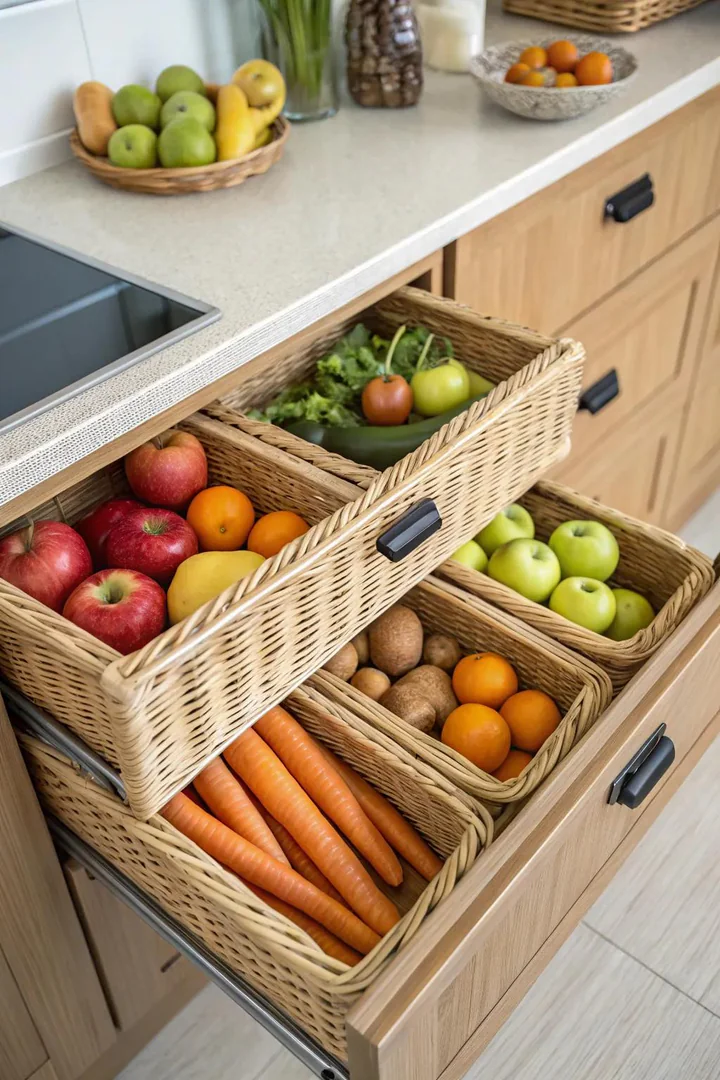
Wicker, rattan, or woven seagrass drawer inserts replace the standard wood or plastic drawer box with a basket-style container that adds natural texture and a cottage or coastal aesthetic to the kitchen cabinetry. When you open the drawer, the woven material is visible from above, creating a warmer, more artisanal look than a painted or laminated wood box. Wicker drawers are particularly popular in farmhouse, cottage, French country, and coastal kitchen styles.
Wicker drawer baskets are available in two configurations: full-replacement baskets that replace the entire drawer box (the basket rides on the existing drawer slides) and drop-in inserts that sit inside the existing wood drawer box as a liner. Full-replacement baskets (from Rev-A-Shelf’s wicker series or Hafele’s wicker basket system) provide the most authentic woven look because the basket is visible from the front when the drawer is open. Drop-in wicker bins (from Container Store, Target Threshold, or West Elm) are a non-permanent option for renters. Wicker drawers work best for storing dry goods, linens, bread, produce (onions, potatoes, garlic), and items that benefit from air circulation — avoid wicker for wet or greasy items that can stain the natural fiber.
13. Portable Drawer Systems
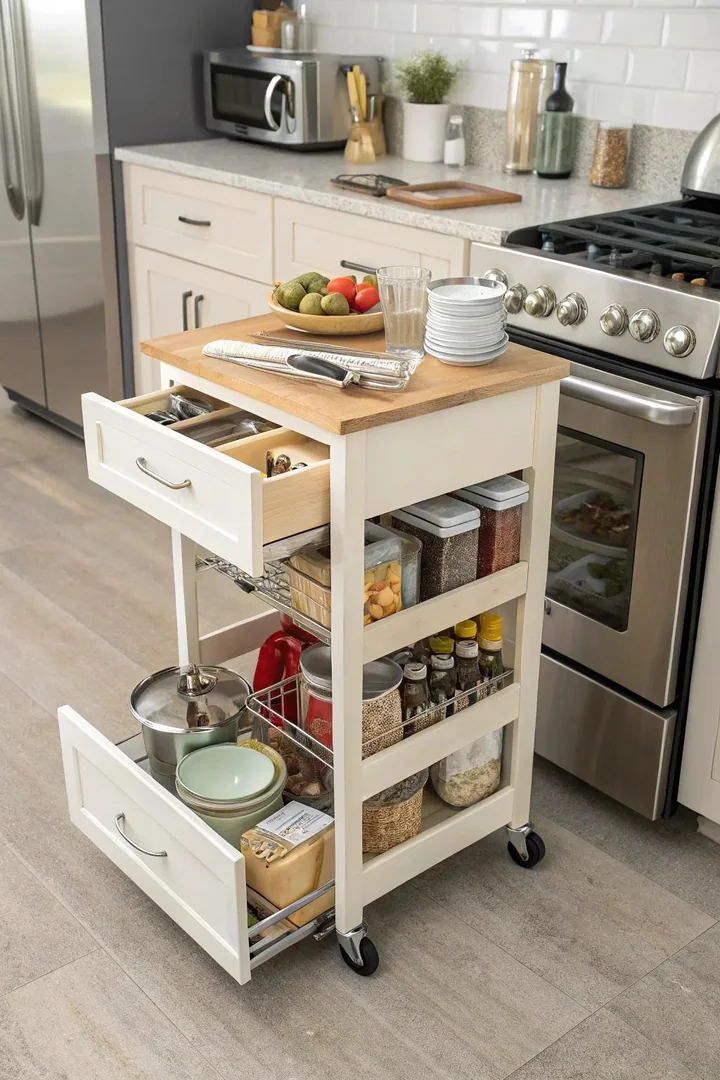
Movable drawer units — rolling carts, portable islands, and freestanding drawer towers on locking casters — add drawer storage to kitchens where the existing cabinetry lacks sufficient drawer space, without requiring any renovation, demolition, or cabinet modification. The movable unit rolls to wherever you need it during cooking and parks against a wall or under a counter when not in use.
Stainless steel kitchen carts with drawers (from Seville Classics, Trinity, or IKEA’s FLYTTA series) provide two to four drawers plus a countertop work surface on a wheeled frame that rolls anywhere in the kitchen. Narrow rolling drawer towers (from Slim Rolling Storage Cart brands on Amazon, typically 6 to 10 inches wide) slide into the gap between the refrigerator and the cabinet or between the stove and the countertop, accessing dead space that no built-in cabinet can reach. A butcher block island cart with drawers (from John Boos, Chris & Chris, or Catskill Craftsmen) provides both mobile prep surface and drawer storage in a single piece that functions as a portable island. Lock the casters when the cart is in use at a station to prevent rolling during cutting and food prep.
14. Drawers Without Handles
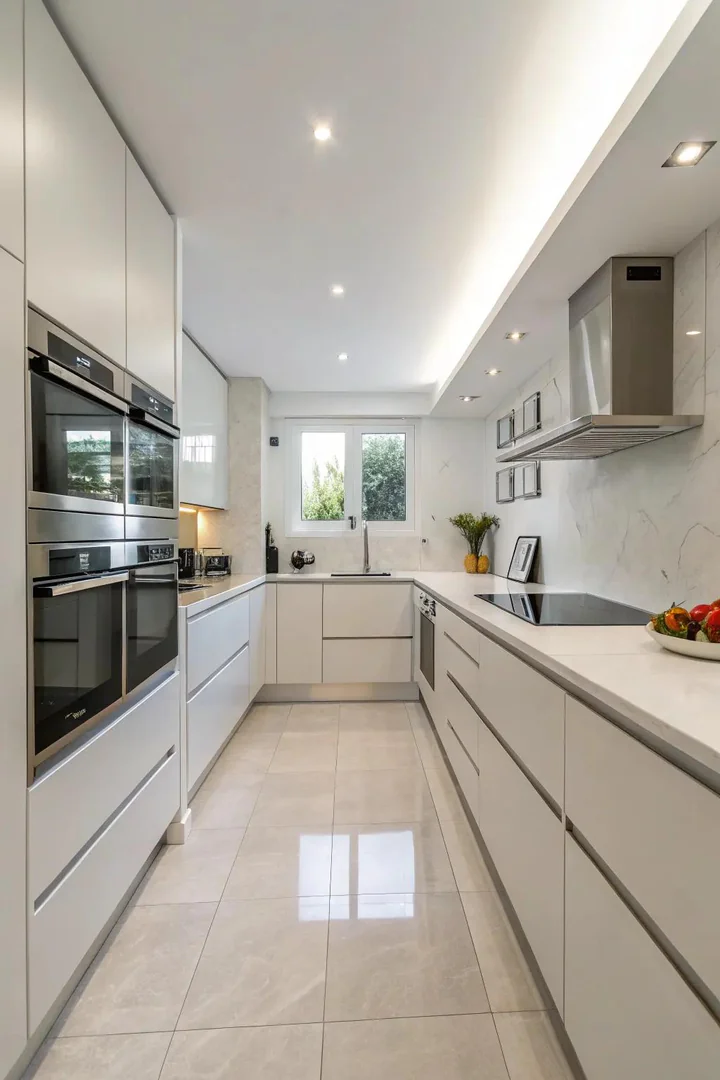
Handleless drawers — drawers that open via push-to-open mechanisms, integrated finger pulls routed into the top edge of the drawer face, or J-channel grip profiles on the bottom or top of the drawer front — create a smooth, uninterrupted cabinet surface with no protruding hardware. This minimalist approach produces the cleanest visual line in a kitchen, where dozens of visible pulls and knobs across 20 to 30 drawers and doors can create visual clutter that competes with the cabinet color and material for attention.
Three mechanisms make handleless drawers possible: push-to-open hardware (Blum TIP-ON or Hettich Push-to-Open) uses a spring-loaded mechanism that releases the drawer when you push the face inward; touch-to-open (Blum SERVO-DRIVE) uses an electric motor triggered by a light touch; and integrated grip profiles (J-pull or finger pull routed into the top or bottom edge of the drawer front) provide a physical grip without a visible handle. Push-to-open is the most affordable and most common; electric touch-to-open is the most seamless and the most expensive; and integrated grip profiles provide the most reliable grip without electronics. Choose matte or satin drawer-front finishes with handleless designs — high-gloss surfaces show fingerprints from every push.
How to Upgrade Your Kitchen Drawers
Choosing Between Retrofit and Replacement
Retrofit upgrades — drawer organizer inserts, LED strips, dividers, and drop-in spice racks — install into your existing drawers without removing or replacing any cabinetry, making them the fastest and most affordable way to improve drawer function. Full drawer replacement (new drawer boxes, new slides, new fronts) costs more and requires either a cabinet installer or a confident DIYer but provides deeper drawers, smoother slides, and soft-close mechanisms that retrofits cannot match. Retrofit first; replace only the drawers that retrofits cannot fix.
Selecting the Right Drawer Slides
Drawer slides determine how far the drawer opens, how much weight it can carry, and how smoothly and quietly it moves. Side-mount ball-bearing slides (from Accuride or Liberty Hardware) are the standard; undermount slides (from Blum TANDEM or Grass Dynapro) are invisible and quieter; full-extension slides pull the drawer completely out of the cabinet for full access to the back; and soft-close mechanisms (Blum BLUMOTION, Hettich Silent System) prevent slamming. Replace old slides with full-extension, soft-close undermount slides — the improvement in daily use is immediate and dramatic.
Budgeting for Drawer Upgrades
Drawer organizer inserts cost $15-60 per drawer. LED drawer lighting costs $15-40 per drawer (battery-powered) or $50-150 per drawer (hardwired). New full-extension soft-close slides cost $25-80 per pair. A new drawer box with slides costs $100-300 per drawer. A microwave drawer costs $1,000-2,500 installed. Budget the upgrades in priority order: organize the drawers you use most often first (utensil drawer, spice drawer, cookware drawer), then upgrade slides on drawers with worn or sticky hardware, then add LED lighting to deep or dark drawers.
Kitchen Drawer Upgrades Comparison
| Upgrade | DIY Difficulty | Cost Per Drawer | Impact on Daily Use |
|---|---|---|---|
| Bamboo dividers/organizers | Easy (drop-in) | $15-60 | High — instant organization |
| In-drawer knife block | Easy (drop-in) | $30-80 | High — frees counter space |
| Spice rack insert | Easy (drop-in) | $20-50 | High — every spice visible |
| LED strip lighting | Easy (adhesive) | $15-40 | Medium — see contents clearly |
| Soft-close slides | Moderate (tools needed) | $25-80 | High — no more slamming |
| Deep pot/pan drawer | Professional install | $200-500 | Very high — no more stacking |
| Corner drawer system | Professional install | $300-800 | High — reclaims dead space |
| Microwave drawer | Professional install | $1,000-2,500 | Medium — frees counter/wall |
Common Kitchen Drawer Mistakes to Avoid
Using drawers without organizers. An empty drawer with no dividers, inserts, or organizers becomes a junk drawer within a week because nothing has a designated position. Every kitchen drawer should have at least a basic organizer insert — even a $15 bamboo tray dramatically improves the drawer’s usability and keeps items separated and findable.
Overloading drawers beyond the slide rating. Standard drawer slides are rated for 75 pounds; heavy-duty slides for 100 to 150 pounds. Loading a standard-rated drawer with cast iron cookware, heavy ceramic plates, or a full collection of canned goods exceeds the slide rating and causes the slides to bind, sag, or fail. Check the slide’s weight rating (printed on the slide or listed in the product specs) before loading heavy items, and upgrade to heavy-duty slides if needed.
Putting the spice drawer far from the stove. A spice drawer located more than two steps from the stovetop creates a bottleneck during active cooking — you step away from a hot pan to grab a spice, and the food burns or overcooks while you are rummaging. Place the spice drawer directly below the cooktop or in the first drawer to the left or right of the range. For more layout tips, explore our kitchen cabinet color ideas guide.
Choosing shallow drawers for cookware. A standard 4-inch-deep drawer cannot hold a stockpot, a Dutch oven, or a 12-inch skillet with a handle. Cookware drawers need to be 8 to 12 inches deep and mounted on slides rated for 100+ pounds. If your existing base cabinets have only shallow drawers, convert one lower cabinet from a door-and-shelf configuration to a deep-drawer configuration with a new drawer box and heavy-duty slides. Visit The Designers Company for more kitchen organization guides and cabinet upgrade ideas.
Frequently Asked Questions
Are drawers better than cabinets with doors?
For most kitchen storage, yes. Drawers provide full visibility of contents (you see everything from above), full access (pull the drawer out to reach items at the back), and better ergonomics (no bending or reaching into dark cabinet interiors). Drawers are better for utensils, cookware, dishes, spices, linens, and food storage containers. Cabinets with doors are better for tall items (blenders, stand mixers, cereal boxes) and plumbing locations (under the sink).
How deep should kitchen drawers be?
Standard utensil drawers are 3 to 4 inches deep. Knife and spice drawers need 4 to 6 inches. Cookware drawers (pots, pans, Dutch ovens) need 8 to 12 inches. Baking sheet drawers need at least 3 inches (for vertical storage) or 6 inches (for flat storage). When ordering new cabinets, specify the deepest drawers available in the base-cabinet positions near the stove and prep area.
Can I add drawers to existing cabinets?
Yes — a cabinet with a hinged door and fixed shelf can be converted to drawers by removing the door, shelf, and hinges, and installing drawer boxes on new slide hardware mounted to the cabinet side walls. DIY drawer conversion kits (from Rev-A-Shelf’s 4WDB series or Slide-A-Shelf) provide pre-made drawer boxes and slides that fit standard 12-to-36-inch-wide base cabinets. Professional conversion by a cabinet installer costs $200-500 per cabinet.
What is the best material for drawer organizers?
Bamboo is the best all-around material — it is moisture-resistant, antimicrobial, harder than most hardwoods, and attractive in any kitchen style. Bamboo organizers handle the constant contact with wet and oily utensils without warping, staining, or degrading. Acrylic and clear plastic organizers are the best for visibility (you can see through the dividers) but scratch over time. Metal organizers are the most durable but can scratch drawer interiors.
How many drawers does a kitchen need?
A well-functioning kitchen needs a minimum of six dedicated drawers: one for utensils/cutlery, one for cooking tools (spatulas, whisks, tongs), one for spices, one for dish towels/linens, one for food storage containers/wraps, and one deep drawer for pots and pans. Larger kitchens benefit from eight to twelve drawers that add dedicated storage for knives, baking supplies, junk/miscellaneous, and electronics/charging.
Do soft-close drawers require special maintenance?
Soft-close mechanisms (Blum BLUMOTION, Hettich Silent System, Grass Soft-Close) require no regular maintenance. The damper is a sealed fluid cartridge or air piston that decelerates the drawer as it closes. Over time (10-15 years), the damper fluid may lose viscosity and the closing action may become less smooth — replacement damper cartridges are available from the hardware manufacturer and snap into the existing slides without tools. Keep the slide tracks free of debris and food particles by wiping with a dry cloth once or twice a year.
Conclusion
Every kitchen drawer upgrade — from a $15 bamboo divider insert to a $2,500 microwave drawer — pays back its cost in daily time savings and reduced frustration at the exact moments when you need to cook efficiently. The most impactful upgrades are often the simplest: organizing the utensil drawer, adding a spice rack insert next to the stove, and converting one lower cabinet to a deep pot-and-pan drawer eliminate the three most common kitchen storage frustrations in a single weekend.
Start with the drawers you open most often — the utensil drawer, the cooking-tool drawer, and the junk drawer — and add organizers, dividers, or inserts that give every item a designated position. Then work outward: upgrade slides on drawers that stick or slam, add LED lighting to deep drawers you cannot see into, and plan a deep-drawer conversion for the cookware cabinet that requires you to stack and restack heavy pots every time you cook.