
Modern Kitchen Ideas: 15 Stunning Designs That Elevate Your Home Today
Modern kitchen ideas shape every decision a homeowner makes about layout, cabinetry, countertops, lighting, and storage. A modern kitchen strips away ornamental detail and replaces it with clean geometry, honest materials, and a workflow that makes cooking faster and easier. Flat-panel cabinets, integrated appliances, quartz and natural stone countertops, and layered LED lighting systems define the look, while deep-drawer storage, induction cooking, and touchless faucets define the function.
The 15 modern kitchen ideas below break down every room element with specific product names, brand recommendations, and installation guidance. Each idea names real materials and tested strategies so you can plan a kitchen that matches your budget, your space, and the way you actually cook. Whether you are gutting a 1990s kitchen or fine-tuning a recent build, these ideas give you a clear framework for every choice.
1. Open-Concept Kitchen Layouts
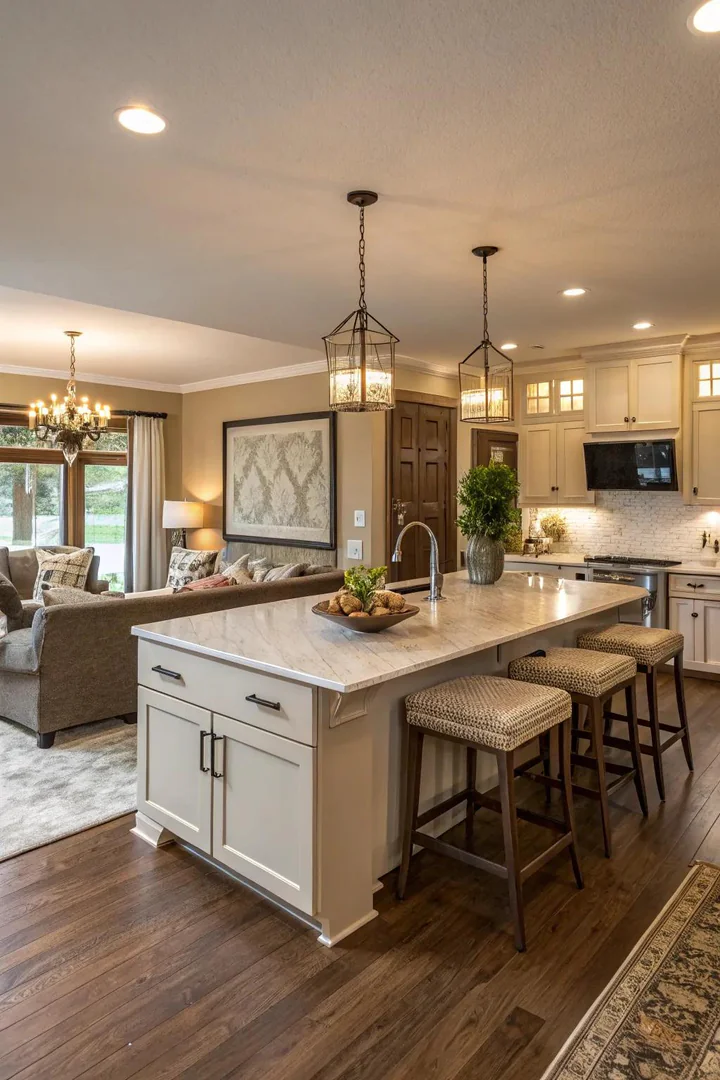
Open-concept kitchen layouts remove walls between the kitchen, dining area, and living room to form a single continuous space. Cooking, eating, and socializing happen in the same room without doors or partitions blocking sight lines. Architects began favoring this layout after 2010 because families wanted the cook to stay part of the conversation rather than disappear behind a swinging door.
A kitchen island anchors the open layout by replacing the missing wall as a spatial divider. Position the island with the sink or cooktop on the kitchen side and bar stools on the living-room side. Leave a minimum of 42 inches of clearance on every side for comfortable traffic flow. For different kitchen cabinet layout ideas that work with open floor plans, our dedicated guide covers L-shaped, U-shaped, and galley configurations in detail.
Visual tidiness matters more in an open layout because the kitchen stays visible from every angle. Concealed storage, panel-ready appliances, and a coordinated finish palette keep the room looking intentional. A single material running from the kitchen countertop to the island to the backsplash ties the space together and prevents the kitchen from reading as a separate zone.
2. Flat-Panel Cabinet Design
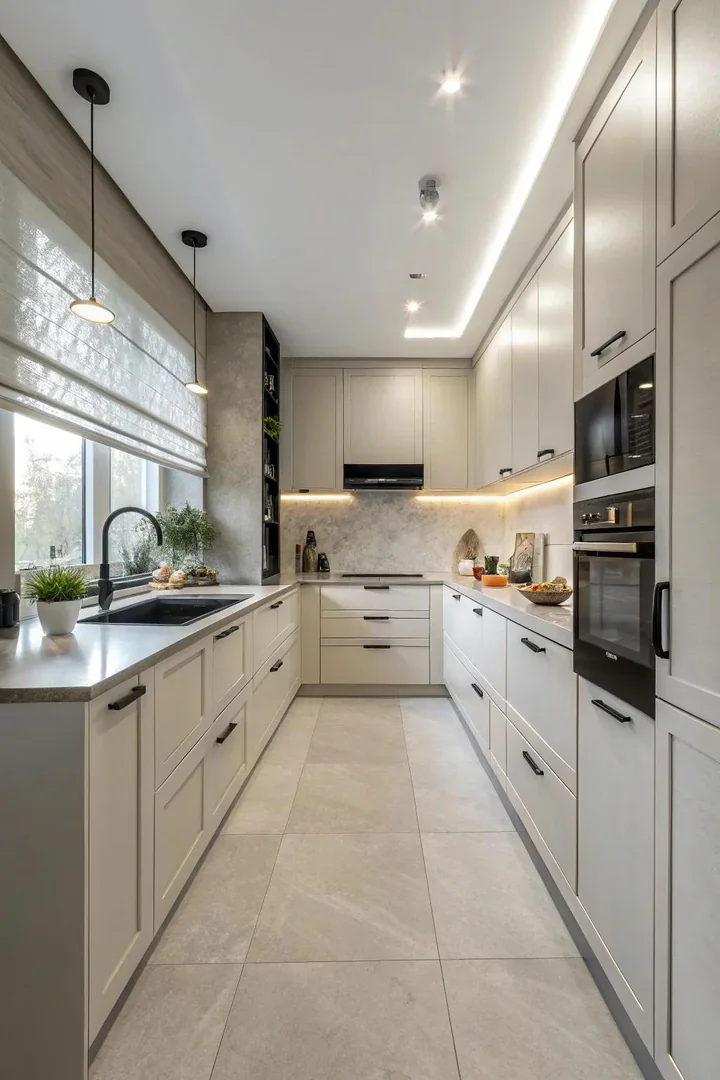
Flat-panel slab doors with no frame, no raised panel, and no beadboard define the modern kitchen cabinet. The cabinet face becomes a clean plane of color rather than a decorative surface covered in profiles and moldings. IKEA VOXTORP, Reform Copenhagen custom fronts, and Semihandmade slab doors all produce handle-free cabinet faces in dozens of finishes at different price points.
Modern cabinets extend to the ceiling with no gap and no crown molding. The unbroken vertical line from countertop to ceiling makes the room feel taller and eliminates the dust-collecting space above traditional upper cabinets. Push-to-open mechanisms from Blum (Tip-On) or integrated J-pull channels replace protruding knobs and bar pulls for the cleanest possible surface.
Matte or ultra-matte finishes in lacquer, thermofoil, or flat-sheen paint hide fingerprints better than high-gloss surfaces and read as more contemporary. Two-tone cabinetry works well in modern kitchens when you pair a darker lower cabinet (charcoal, navy, forest green) with a lighter upper (white, warm grey, pale oak veneer). The contrast creates depth without adding decorative hardware.
3. Layered Kitchen Lighting
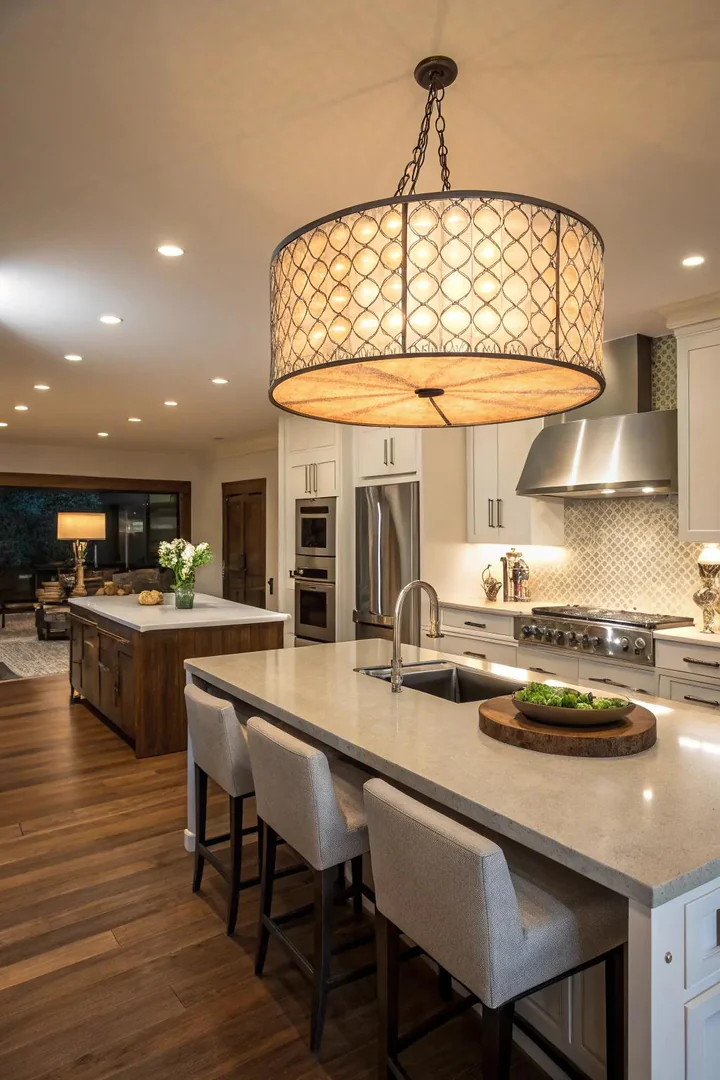
Modern kitchen lighting uses three layers: ambient light from recessed LED downlights in the ceiling, task light from under-cabinet LED strips and pendant fixtures over the island, and accent light from in-cabinet illumination and toe-kick LEDs. Each layer serves a different purpose, and all three working together produce a room that feels warm and functional at any hour.
Pendant lights over the island carry outsized visual weight because a modern kitchen has so few decorative objects. A matte black metal pendant from Tom Dixon or Muuto Unfold suits an industrial-modern kitchen. A handblown glass fixture from Niche Modern pairs well with organic-modern spaces. Brushed brass linear chandeliers from Visual Comfort or Cedar and Moss add warmth to neutral-toned rooms. Hang pendants 30 to 36 inches above the countertop and space them 24 to 30 inches apart. Our guide to lighting over kitchen sink windows covers above-sink placement strategies that complement island pendants.
Under-cabinet LED strips (from WAC Lighting, Philips Hue, or GE) illuminate the countertop work surface and eliminate shadows that overhead lights cast. Warm-white LEDs at 2700K to 3000K produce the most inviting kitchen atmosphere. Cool-white LEDs at 4000K or above make the room feel clinical.
4. Panel-Ready Integrated Appliances
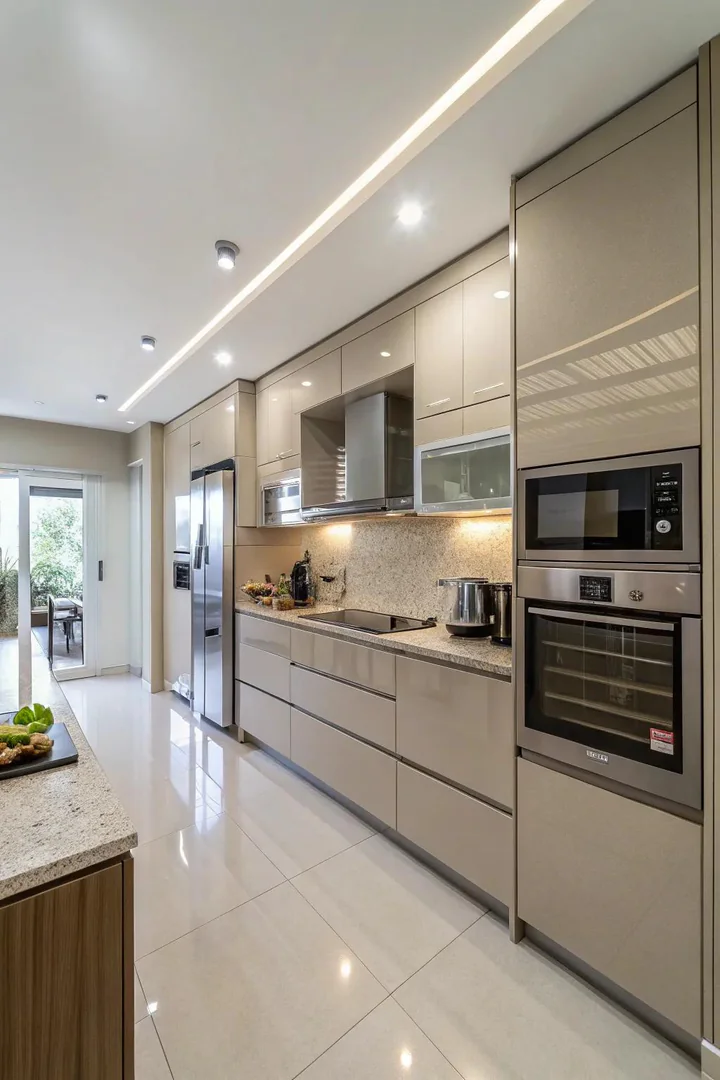
Panel-ready appliances accept custom cabinet panels on their front faces so the refrigerator, dishwasher, and freezer disappear into the cabinetry. The kitchen reads as a continuous wall of flat panels rather than a row of stainless steel boxes. Sub-Zero, Thermador, Bosch Benchmark, and Fisher and Paykel all manufacture panel-ready refrigerator columns that accept 3/4-inch-thick panels matching your exact cabinet finish.
Panel-ready dishwashers from Bosch (800 series), Miele (G7000 line), and Fisher and Paykel accept the same matching panels. A panel-ready microwave drawer from Sharp or Wolf mounts below the countertop and eliminates the over-range microwave that breaks the clean sight line above the cooktop. The upfront cost runs 20 to 40 percent higher than freestanding stainless steel, but the visual payoff transforms the kitchen from appliance-driven to architectural.
Speed ovens from Miele and Wolf combine convection, microwave, and steam cooking in a single built-in unit, reducing the number of visible appliances. Column-style refrigerator-and-freezer pairs from Sub-Zero (18-inch and 30-inch columns) let you split cold storage across two locations in the kitchen, freeing wall space for cabinetry or a pantry.
5. Natural Materials and Organic Textures
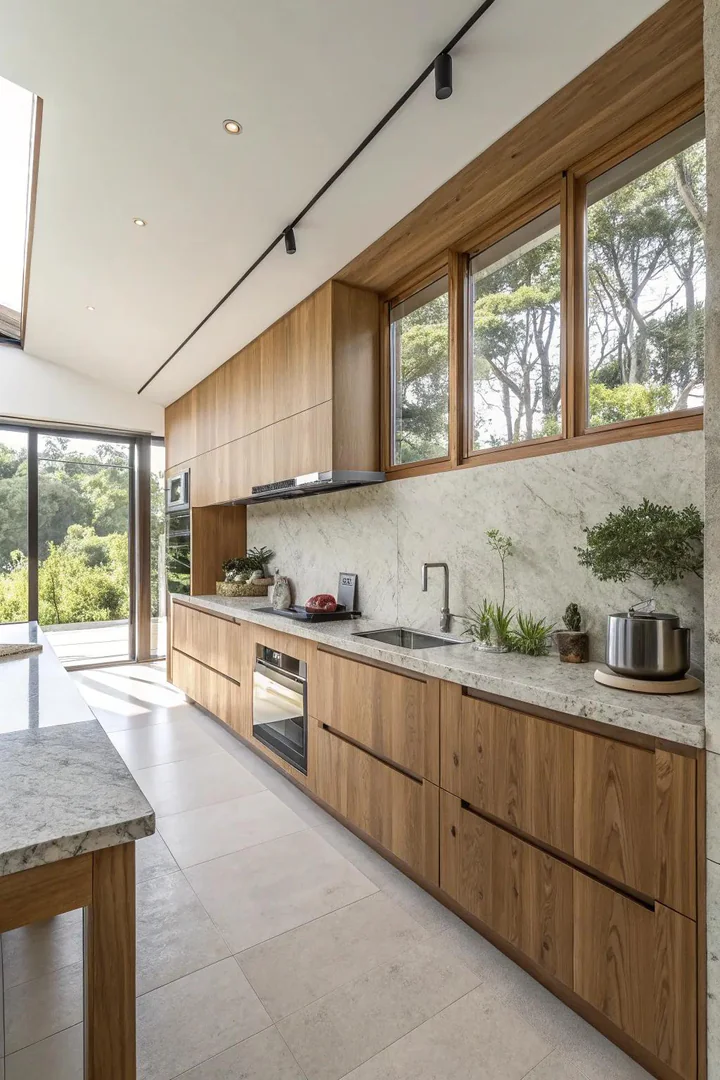
Natural materials prevent a modern kitchen from feeling cold and sterile by adding warmth, tactile variation, and the imperfect beauty of organic surfaces. The most successful modern kitchens balance manufactured precision (flat-panel cabinets, engineered quartz, stainless steel) with natural imperfection (a live-edge walnut shelf, a honed marble countertop with visible veining, a handmade zellige tile backsplash).
White oak is the most popular natural wood for modern kitchens because its neutral, warm tone and straight grain complement both white and dark cabinet palettes. Rift-sawn white oak has an even straighter grain pattern than plain-sawn and reads as more contemporary. Use white oak for floating shelves, island cladding, range hood wrapping, or a breakfast bar surface. Pair backsplash materials with oak cabinets carefully to avoid clashing warm and cool tones in the same sight line.
Honed natural stone (Carrara marble, soapstone, Taj Mahal quartzite) adds organic veining and surface depth that engineered quartz cannot replicate. Natural stone requires periodic sealing and stains more easily than quartz, but homeowners who value material authenticity accept that trade-off. Concrete countertops (poured in place or from precast fabricators like Trueform Concrete) offer a third natural option with an industrial-artisanal character.
6. Smart Storage Systems
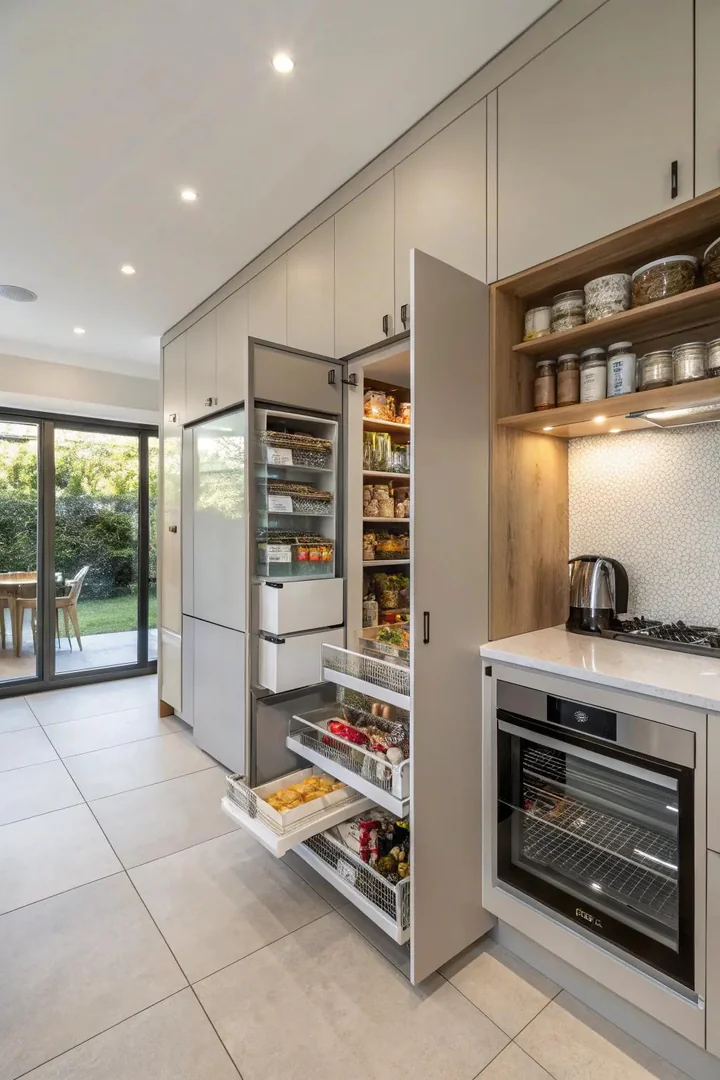
Modern kitchen storage replaces traditional shelved base cabinets with full-access drawer systems. Deep pot drawers from Blum (Legrabox) or Hettich (ArciTech) hold pots, pans, and baking sheets in a single visible layer. You see every item at a glance instead of crouching and reaching past stacked cookware in a dark cabinet behind a door.
Corner cabinets lose no space in a modern kitchen. LeMans II pull-out trays from Hafele, magic corner units from Kessebohmer, and full-access lazy Susans convert dead corner space into usable storage. Tall pantry cabinets with internal pull-out shelving (IKEA UTRUSTA system or Rev-A-Shelf pull-out pantry) turn a floor-to-ceiling column into an organized walk-in pantry where every shelf slides out for full visibility.
Drawer dividers, utensil inserts, and spice-jar organizers (from brands like Joseph Joseph, Drew Barrymore Beautiful, and Yamazaki Home) keep drawers sorted by function. Appliance garages built into the countertop backsplash area hide stand mixers, toasters, and blenders behind a tambour or lift-up door so the countertop stays clean between meals.
7. Multi-Functional Kitchen Islands
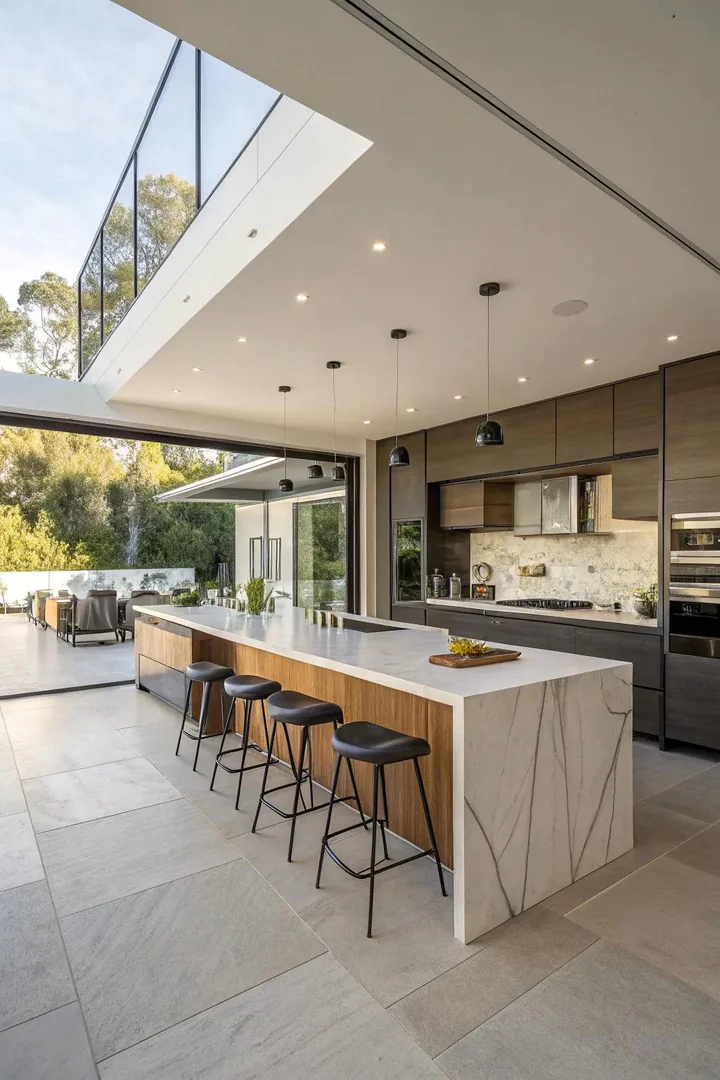
A modern kitchen island combines food prep, cooking, eating, dishwashing, and storage in a single workstation. An island-mounted induction cooktop, an undermount prep sink, a cantilevered countertop overhang for bar seating, and deep drawers on the kitchen side turn the island into the room’s command center. A well-designed island replaces the need for a separate prep table, breakfast bar, and pantry overflow cabinet.
Size the island to your kitchen footprint: 4 feet long by 2 feet deep minimum for a small kitchen, 6 to 8 feet long by 3 to 4 feet deep for a standard room, and 10 feet or longer for a large open-concept space. The waterfall edge, where the countertop material continues vertically down one or both sides to the floor, creates a monolithic look that reads as architectural furniture. Porcelain slab, quartz, and natural stone all work for waterfall edges. For compact kitchens where a full island does not fit, our guide to small kitchen bar ideas shows peninsula and fold-down alternatives that deliver the same functionality in less space.
Built-in wine refrigerators, open display shelving on the dining-room face, and pop-up electrical outlets with USB-C ports make the island a true multi-purpose piece. Wireless phone charging pads embedded in the countertop (from Kichler or Legrand) add a tech-forward detail that guests notice immediately.
8. Bold Color Accents
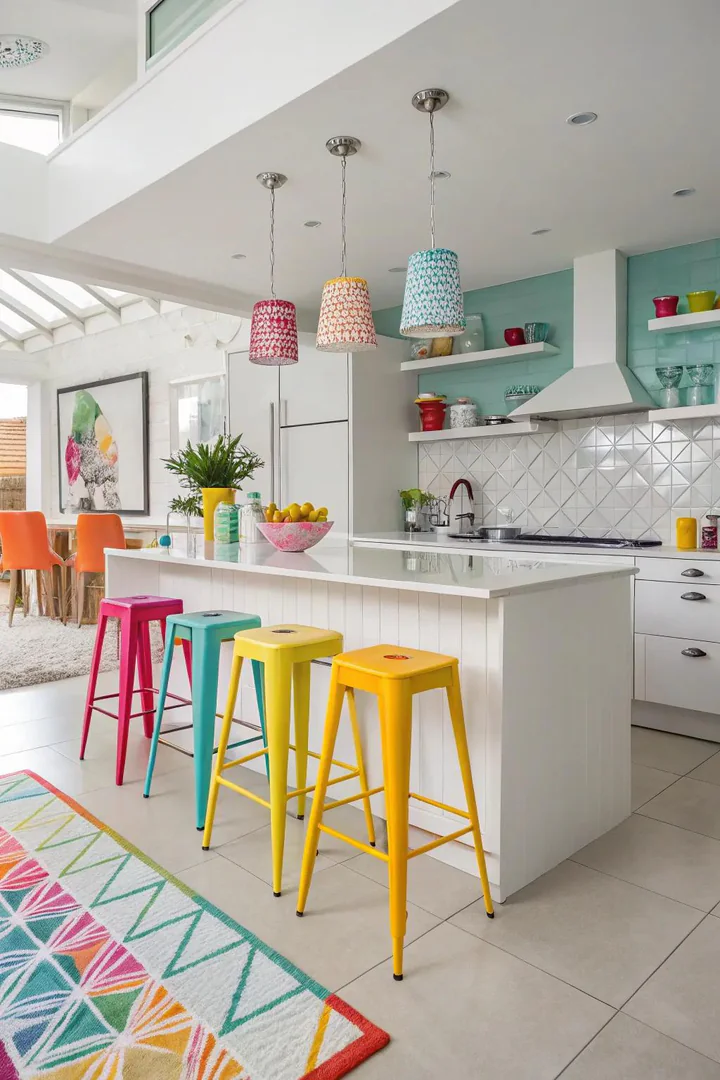
Modern kitchens favor neutral palettes (white, grey, black, natural wood), so a single concentrated color accent provides personality without breaking the restrained aesthetic. The 80/20 rule works best: 80 percent neutral surfaces, 20 percent color applied to one or two elements. A deep green island (Benjamin Moore Essex Green HC-188 or Farrow and Ball Studio Green No.93) paired with white perimeter cabinets and brass hardware is one of the most requested modern kitchen color combinations.
Concentrate the accent and repeat it once or twice at smaller scale. A cobalt blue backsplash (Fireclay Tile Adriatic Sea or Clé Tile Zellige in Cobalt) echoed in a set of blue ceramic bowls on an open shelf looks planned. Distributing three or four bold colors across the same kitchen (a red range, a yellow island, a blue backsplash) creates visual noise rather than a focal point.
Colored appliances from brands like Big Chill, SMEG, and Lacanche let you introduce a statement color through a single freestanding piece. A matte black range from Bertazzoni or a white range from La Cornue Fe acts as both a functional anchor and a color statement. Swap the range finish to change the kitchen’s mood without repainting a single cabinet.
9. Sustainable Kitchen Design
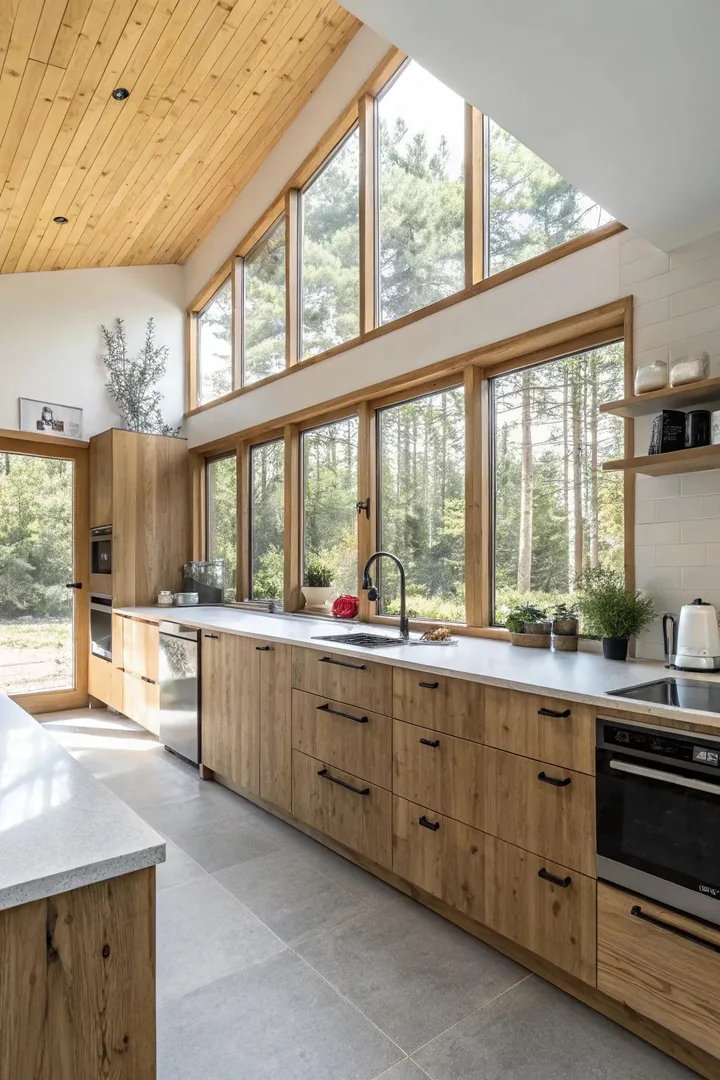
Sustainable kitchen design reduces the room’s environmental footprint through material selection (reclaimed wood, recycled glass countertops, bamboo cabinetry, low-VOC paint from Benjamin Moore Natura or Sherwin-Williams Harmony), energy-efficient appliances (Energy Star-certified refrigerators, induction cooktops, LED lighting), and water-saving fixtures (low-flow faucets, efficient dishwashers).
Switching from a gas range to an induction cooktop delivers the single largest sustainability upgrade. Induction heats faster, wastes less energy, produces no combustion byproducts, and gives more precise temperature control than gas. Bosch, Thermador, Samsung, and GE Profile all produce 30-inch and 36-inch induction cooktops for residential kitchens. Pairing an induction cooktop with an Energy Star dishwasher (Bosch 800 series uses only 3.5 gallons per cycle) and a 1.5 GPM touchless faucet from Moen or Delta cuts daily energy and water consumption by 30 to 40 percent compared to a gas-and-conventional setup.
Recycled-content countertops from IceStone (concrete mixed with recycled glass) and Paperstone (compressed recycled paper with natural resin) offer genuinely sustainable surface options that do not sacrifice durability. FSC-certified wood cabinetry and bamboo-plywood carcasses provide renewable-material alternatives to standard MDF or particleboard construction.
10. Monochromatic Kitchen Schemes
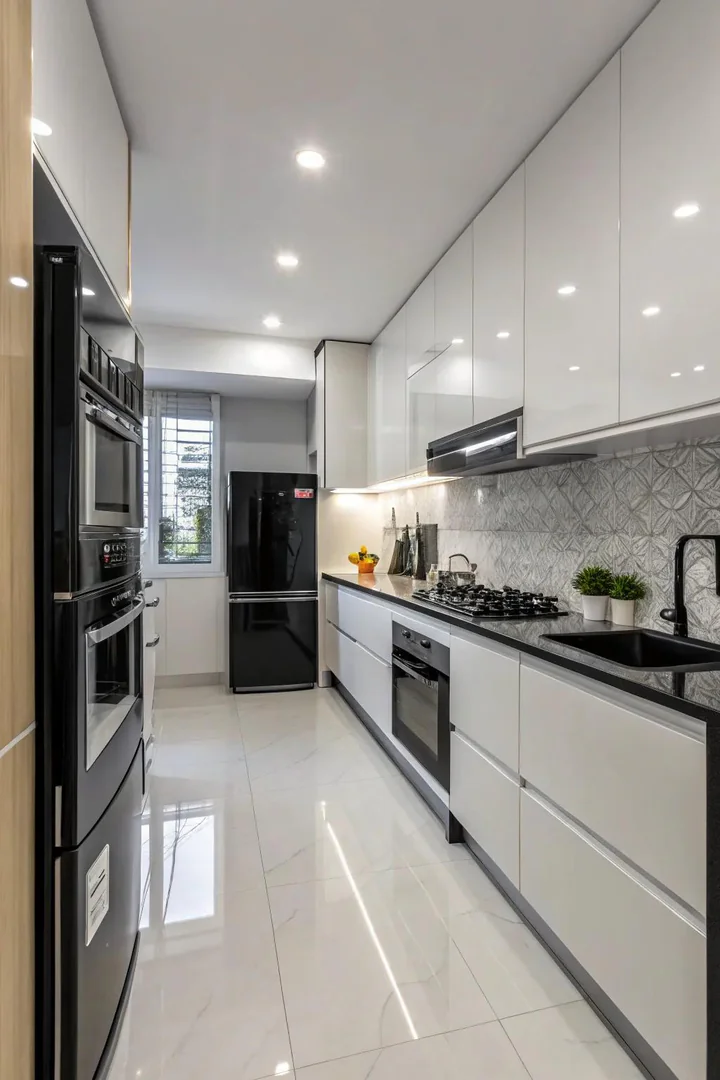
A monochromatic kitchen uses shades of a single color on every surface to create the most visually calm and architecturally unified modern room. All-white, all-grey, all-black, and all-greige kitchens make the space feel like one sculptural object rather than a collection of separate cabinets, countertops, and walls that happen to share a room.
Texture and sheen variation prevent monotony. Matte cabinet fronts, a honed stone countertop with visible veining, a textured tile backsplash, and a polished metal faucet share the same color temperature but differ in surface quality. An all-white kitchen could pair matte painted cabinets, honed Calacatta marble with grey veining, glossy white subway tile, polished nickel hardware, and white oak floating shelves. Five different textures in the same white family give the room depth without adding a second color.
Dark monochromatic kitchens (charcoal cabinets, black granite, dark bronze hardware, black matte faucet from Brizo or Kohler Purist) create a moody, enveloping space that photographs well and feels intimate in the evening. Dark kitchens need strong lighting to function, so plan for more lumens per square foot than a white kitchen requires.
11. Textured Finishes and Surface Depth
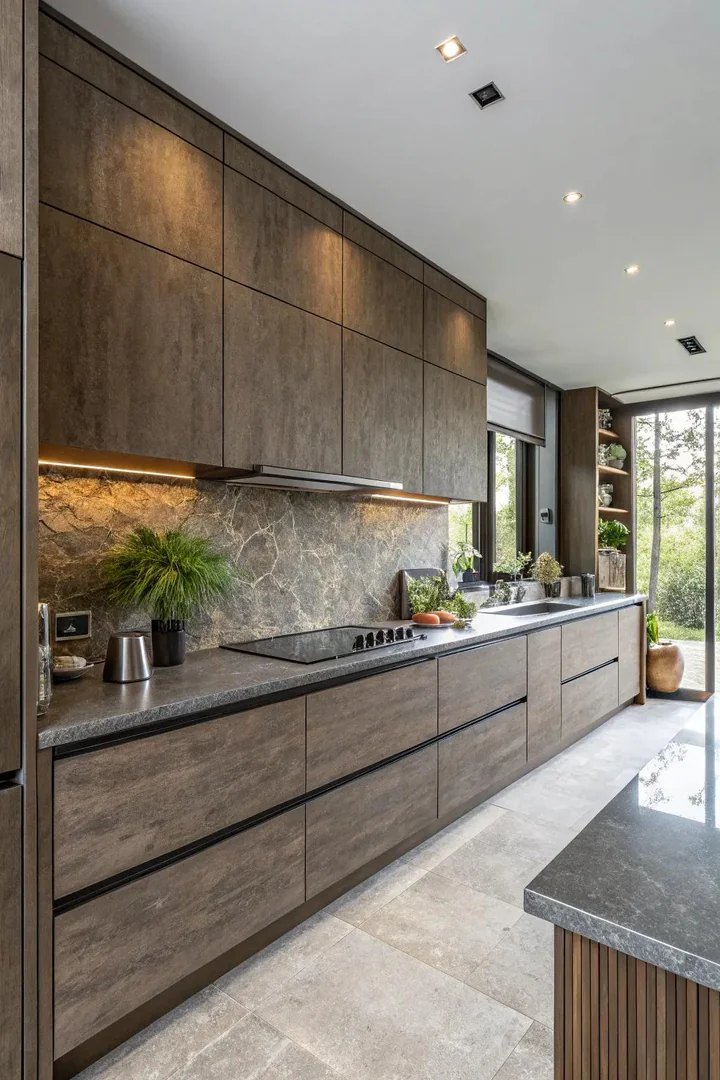
Textured finishes add tactile depth and visual complexity to modern kitchen surfaces without introducing color contrast or ornamental detail. Fluted glass, reeded wood panels, ribbed ceramic tile, hammered metal, and micro-cement accomplish what molding profiles and carved details do in traditional kitchens, but through surface variation rather than applied decoration.
Fluted glass (reeded glass) on upper cabinet doors is one of the strongest current modern kitchen trends. Vertical ridges obscure cabinet contents enough to hide clutter while allowing light through, producing a translucent architectural surface. Order fluted glass from local glass shops by specifying the reed spacing (1/4-inch reeds are the most popular for kitchen cabinets) and the glass thickness (3/16-inch or 1/4-inch tempered).
Reeded wood panels on island faces, range hoods, or accent walls add rhythm through repeating vertical grooves. Micro-cement from brands like Mortex or Colour Cement creates a hand-troweled, slightly irregular surface with an artisanal quality when applied to countertops, backsplashes, or island faces. Zellige tile (handmade Moroccan clay tile with irregular glaze variation) on backsplashes adds handcrafted texture at roughly $15 to $25 per square foot installed.
12. Industrial Design Elements
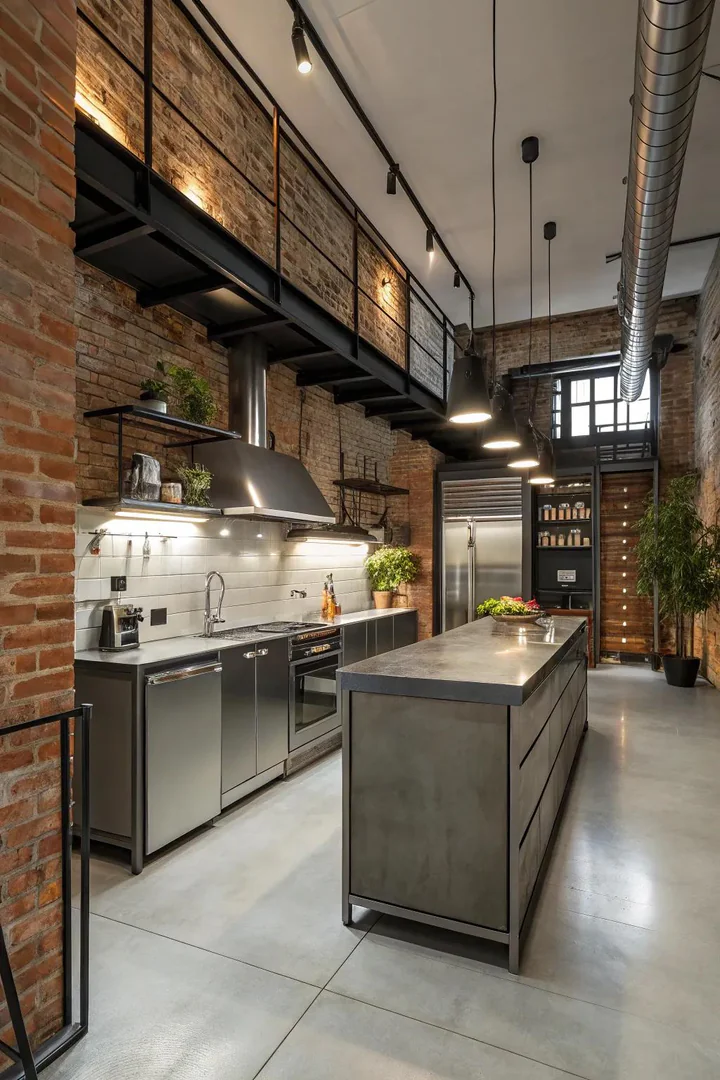
Industrial elements reference the raw, functional aesthetic of factory loft conversions and commercial kitchens. Exposed steel beams, concrete countertops, pipe-bracket open shelving, wire-cage pendant lights, and commercial-grade stainless steel surfaces work in modern kitchens because both styles share the same values: function over decoration, honesty of materials, and a preference for showing structure rather than hiding it.
Introduce industrial elements selectively rather than committing to a full warehouse look. A poured concrete countertop paired with clean white cabinets produces a balanced industrial-modern room. Black steel-framed glass cabinet doors in an otherwise warm-wood kitchen add an edge without overpowering the space. Commercial stainless steel wall shelving from Metro or Eagle Group replaces upper cabinets with visible, accessible storage that looks like a restaurant prep station.
Balance raw industrial surfaces with enough warmth (wood tones, warm-white lighting at 2700K, linen or cotton textiles, a woven pendant light) to keep the room from feeling institutional. A single reclaimed-wood floating shelf above a stainless steel counter, or a warm brass faucet against a concrete backsplash, creates the right tension between hard and soft.
13. Large Kitchen Windows
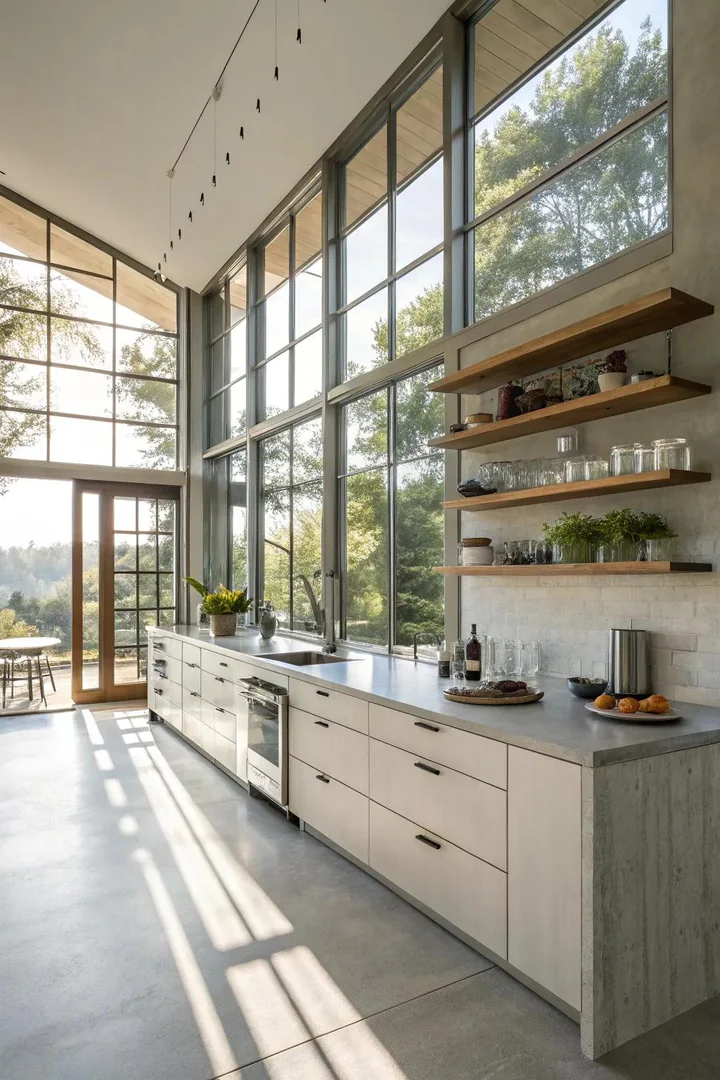
Large windows are a hallmark of modern kitchen design because they flood the room with natural light, connect the interior to the landscape, and make the kitchen feel bigger than its actual square footage. Natural daylight is the most flattering and most energy-efficient light source, and modern architects prioritize it above nearly every other kitchen feature.
Replace small, divided-lite windows with large single-pane units from Marvin, Andersen, or Pella in aluminum-clad or fiberglass frames for maximum light and minimum visual obstruction. A picture window above the sink (replacing a traditional small double-hung) turns dishwashing into a moment with a garden view. Sliding or folding glass doors from NanaWall, LaCantina, or Western Window Systems open the kitchen to an outdoor dining terrace and blur the boundary between inside and outside.
Black-framed steel windows and doors (from brands like Crittall, Portella, or Rehme) add an architectural grid pattern that reads as modern and industrial at the same time. Fixed clerestory windows placed above upper cabinets bring in light without sacrificing wall storage. Low-E glass coatings and argon-filled double-pane units keep energy efficiency high even with oversized window openings.
14. Contrasting Material Pairings
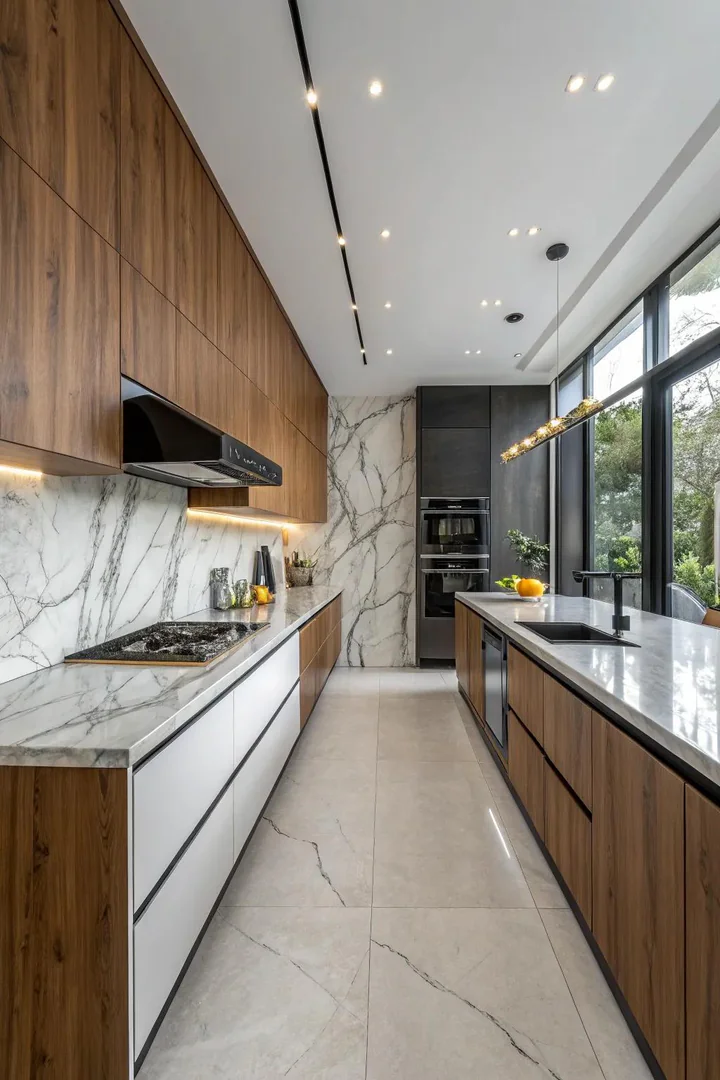
Material contrast creates visual tension and depth in a modern kitchen without relying on decorative ornamentation. Pairing smooth with rough, warm with cool, natural with manufactured, and matte with glossy produces a room that feels layered and considered. The most successful modern kitchens combine two or three contrasting materials in a deliberate palette rather than distributing many similar finishes across every surface.
Choose materials that differ on at least two axes: color and texture, or temperature and sheen. A walnut island with a white quartz top contrasts on color (dark and light), temperature (warm and cool), and material type (wood and stone). Three axes of contrast in two elements is why that combination reads as so visually satisfying. Materials that are too similar (light grey cabinets with a light grey quartz countertop and a light grey tile backsplash) blur together and lose all visual impact.
Brass or unlacquered brass hardware against matte charcoal cabinets produces a warm-cool contrast that ages gracefully as the brass develops a natural patina. Polished stainless steel against rough-sawn oak creates a manufactured-natural contrast. Honed stone against high-gloss lacquer cabinets pairs matte with shiny. Every pairing tells the eye where to look, giving the kitchen a focal hierarchy.
15. Curated Kitchen Art and Decor
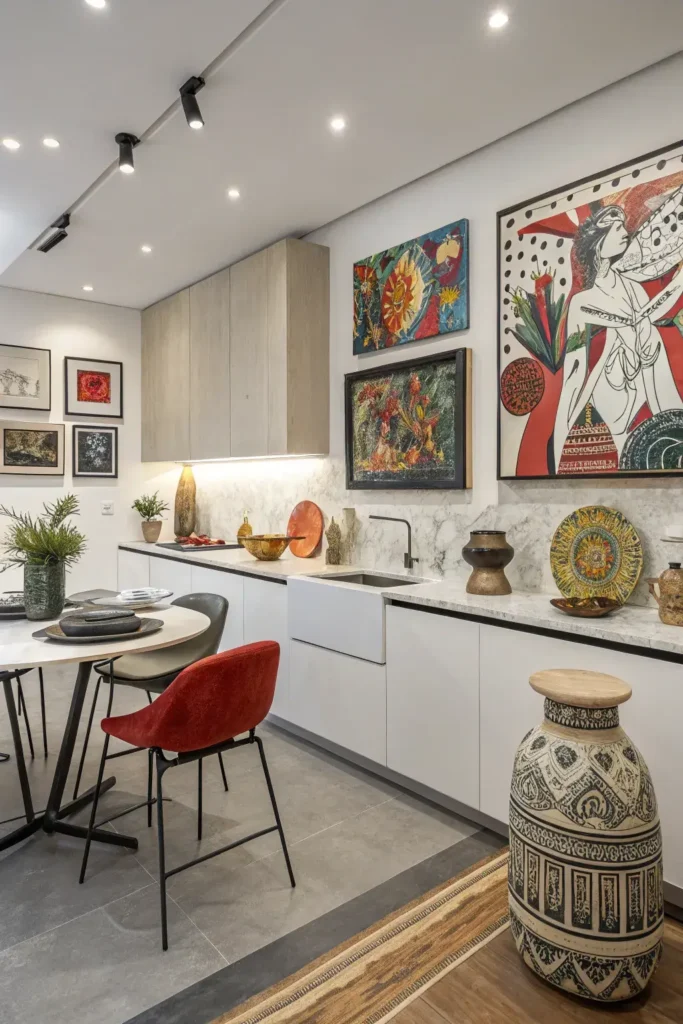
Art and decor in a modern kitchen follow a less-is-more principle. One or two carefully chosen pieces have more impact in a minimalist space than a dozen smaller items because the art stands out precisely when nothing else competes for attention. A single large photograph on the wall behind the breakfast area, a sculptural pendant light, or a collection of handmade ceramic vessels on a floating shelf all serve as focal points.
Choose objects that share the kitchen’s material palette or complement it through contrast: a warm-toned abstract painting in a cool grey kitchen, a matte black sculptural bowl on a white marble counter, or a set of stoneware pieces from East Fork, Heath Ceramics, or Hasami Porcelain displayed on an open shelf. Rotating seasonal objects (a stone fruit bowl in summer, a dried eucalyptus arrangement in winter) keeps the kitchen feeling fresh without permanent clutter.
Clean countertops and unadorned wall surfaces are part of the modern aesthetic. Every object on display should be there because you chose it deliberately, not because it accumulated over time. A curated kitchen looks intentional; a cluttered kitchen looks disorganized regardless of how expensive its cabinets are.
Modern Kitchen Backsplash Trends
The backsplash is the one surface in a modern kitchen where bold pattern, color, and texture can appear without overwhelming the room. Large-format porcelain slabs (from Neolith, Dekton, or SapienStone) in marble-look or concrete-look finishes create a grout-free surface that reads as a continuous panel from countertop to upper cabinets. Fewer grout lines mean easier cleaning and a more architectural appearance.
Zellige tile from Morocco, with its hand-cut edges and uneven glaze, introduces artisanal texture at $15 to $25 per square foot installed. Stacked subway tile (no offset, bricks aligned vertically) looks more contemporary than the traditional running-bond pattern. Full-height backsplashes that run from countertop to ceiling replace the need for upper cabinets on one wall and make the kitchen feel taller.
Book-matched natural stone slabs (two consecutive slabs from the same block, opened like a book to mirror the veining) produce a symmetrical pattern that reads as both natural and designed. Sintered stone panels from Lapitec and Neolith offer the look of marble with near-zero porosity and no sealing requirement.
Smart Technology for the Modern Kitchen
Modern kitchen technology solves real daily problems rather than adding novelty features. Touchless faucets from Moen (MotionSense) and Delta (Touch2O) let you turn water on and off with an elbow or forearm when your hands are covered in raw chicken or dough. Induction cooktops with integrated ventilation (Bosch Benchmark, Bora) pull smoke and steam downward through the cooktop surface, eliminating the need for an overhead range hood and preserving clean ceiling sight lines.
Under-cabinet tablet mounts and recessed pop-up outlets with USB-C ports keep devices charged and recipes visible without taking up counter space. Smart lighting systems from Lutron (Caseta), Philips Hue, and Ketra let you program scenes (bright task lighting for cooking, dim warm lighting for dinner) that activate with a voice command or a wall button.
Built-in water filtration (Moen GXQ Series, InSinkErator) delivers filtered water from the main faucet, removing the need for a countertop pitcher filter or a separate filtered-water tap. Waste-management upgrades include built-in composting bins, cabinet-mounted recycling sorting stations, and garbage disposals with continuous-feed operation (InSinkErator Evolution series) that handle food scraps quietly.
How to Plan a Modern Kitchen Renovation
Setting Your Budget and Priorities
A modern kitchen renovation runs $25,000 to $75,000 for a mid-range project and $75,000 to $150,000 or more for a high-end build, depending on kitchen size, material quality, and whether the layout changes. Prioritize spending on elements you cannot easily swap later: cabinetry (the most visible and most-used component), countertops, and the layout itself. Lighting fixtures, hardware, paint, and decorative objects can be updated at lower cost down the road.
Choosing Between Modern Sub-Styles
Modern kitchen design includes several sub-styles that share clean lines but differ in material palette and mood. Warm-modern (natural wood, brass, warm whites, organic textures) is the most universally appealing and the easiest to live with long-term. Cool-modern (grey, white, chrome, concrete) is sharper and more architectural but can feel stark without careful material balancing. Industrial-modern (steel, concrete, exposed structure) is raw and edgy but needs warm elements to feel residential. Scandinavian-modern (light wood, white, minimal, functional) is the most restrained and space-efficient of the four.
Working with a Kitchen Designer
A professional kitchen designer with NKBA or AKBD credentials costs $5,000 to $15,000 in design fees but saves money through layout optimization, material sourcing, and contractor coordination. The designer produces floor plans, elevation drawings, a material schedule, and appliance specifications before any demolition begins. Pre-construction planning eliminates the costly mid-build changes that happen when design decisions are made on-site with a contractor holding a sledgehammer. Visit The Designers Company for more renovation guides, material comparisons, and kitchen planning resources.
Modern Kitchen Features Comparison
| Feature | Budget Option ($) | Mid-Range Option ($$) | Premium Option ($$$) |
|---|---|---|---|
| Cabinets | IKEA VOXTORP slab-front | Semihandmade on IKEA frames | Custom flat-panel from local shop |
| Countertop | Butcher block or laminate | Engineered quartz (Caesarstone, Silestone) | Honed marble or quartzite slab |
| Lighting | Recessed LEDs plus basic pendants | Three-layer LED system with dimmers | Lutron smart system with designer pendants |
| Appliances | Freestanding stainless steel | Panel-ready dishwasher plus stainless fridge | Fully integrated panel-ready suite |
| Storage | Standard soft-close drawers | Blum Legrabox deep-drawer system | Full Blum or Hettich with corner solutions |
| Backsplash | Large-format ceramic tile | Porcelain slab or zellige tile | Book-matched natural stone slab |
| Faucet | Single-handle pull-down (Moen Align) | Touchless pull-down (Delta Trinsic Touch2O) | Pot filler plus touchless main (Kohler Artifacts) |
Common Modern Kitchen Design Mistakes
Choosing aesthetics over daily function. Handle-free cabinets look beautiful, but push-to-open mechanisms from budget brands can malfunction within two years. Specify Blum Tip-On or Hettich Push-to-Open Silent for reliability. A waterfall island adds $1,000 to $3,000 in countertop material cost. Decide whether the visual return justifies that investment before committing.
Skipping the lighting plan. A modern kitchen lit only by recessed ceiling cans looks flat, washed out, and uninviting after dark. Plan all three lighting layers (ambient, task, accent) before construction starts, because adding fixtures after the ceiling is finished means cutting drywall, running wire, and patching. That retrofit costs three to five times more than doing it during the initial build.
Using only cold materials. Grey cabinets, grey quartz, grey tile, stainless steel appliances, and chrome hardware in the same kitchen creates a room that feels sterile. Add at least one warm element: wood shelving, a brass faucet, warm-toned pendant lights, or a textured natural-material backsplash. Warmth comes from material temperature and light color, not from clutter.
Over-specifying technology. Touchscreen refrigerators, app-controlled ovens, and voice-activated faucets sound appealing in a showroom. Most of these features add complexity, maintenance requirements, and obsolescence risk without solving a real cooking problem. Choose technology that saves time daily (induction cooking, touchless faucets, soft-close drawers) and skip features whose novelty fades after the first month.
Frequently Asked Questions
What countertop material works best in a modern kitchen?
Engineered quartz (Caesarstone, Silestone, Cambria) is the most popular countertop for modern kitchens because it comes in consistent colors, resists stains without sealing, and costs $50 to $120 per square foot installed. Honed natural marble costs more ($75 to $200 per square foot) and requires sealing every 6 to 12 months, but its organic veining gives a warmth that quartz cannot match. Porcelain slab countertops from Dekton or Neolith offer a third option with near-zero porosity and resistance to UV fading.
How much does a modern kitchen renovation cost per square foot?
A mid-range modern kitchen renovation costs $150 to $350 per square foot, including cabinetry, countertops, appliances, flooring, lighting, and labor. A high-end renovation with custom cabinets, panel-ready appliances, and natural stone surfaces costs $350 to $700 per square foot. A 150-square-foot kitchen at mid-range runs roughly $22,500 to $52,500 before permits and design fees.
Do modern kitchens need an island?
Not every modern kitchen has room for an island. A kitchen needs a minimum of 10 by 12 feet of open floor space to fit an island with proper clearances (42 inches on all sides). Smaller kitchens benefit from a peninsula, a rolling cart, or a fold-down wall-mounted table that provides prep space without permanently blocking the traffic path. The island is a feature of modern kitchen design, not a requirement.
What backsplash pairs best with flat-panel cabinets?
Large-format porcelain tile (12 by 24 inches or larger) minimizes grout lines and creates a clean, uninterrupted surface that matches the flat-panel aesthetic. Full-height quartz or porcelain slab backsplashes (countertop to ceiling, no grout at all) are the cleanest option. Zellige tile adds handmade texture as a deliberate contrast to the precision of flat-panel doors.
How do you choose hardware for modern cabinets?
Modern cabinets look best with minimal hardware: integrated J-pull channels routed into the cabinet edge, push-to-open mechanisms (no visible hardware at all), or slim bar pulls in matte black, brushed nickel, or brushed brass. Avoid ornate knobs, ceramic pulls, or cup handles. Keep the hardware finish consistent throughout the kitchen and match it to the faucet and lighting finish for a coordinated look.
What flooring works best in a modern kitchen?
Large-format porcelain tile (24 by 24 inches or 12 by 24 inches) in a concrete or stone finish creates the cleanest modern floor because oversized tiles minimize grout lines. Wide-plank engineered hardwood (7 to 9 inches wide, in white oak or European oak from Hallmark Floors or Provenza) adds warmth. Polished concrete sealed in place is the most minimal and most industrial option. Avoid small mosaic tiles, ornate patterns, and wood-look vinyl planks, as each reads as a traditional or budget compromise.
Conclusion
Modern kitchen design is a functional philosophy built on clean sight lines, efficient workflow, durable materials, and thoughtful lighting. The 15 ideas above cover every room element, from the open-concept layout that connects cooking to living, to the flat-panel cabinets that define the visual character, to the deep-drawer storage systems that make daily use effortless.
Start your kitchen plan with the layout and the cabinetry. Those two decisions determine 80 percent of the kitchen’s appearance and daily function. Layer in a three-zone lighting plan, choose materials for contrast and warmth, and add one or two personal touches that make the room yours. The best modern kitchens feel calm, organized, and quietly beautiful. A well-designed kitchen turns cooking into a pleasure because the design stays out of the way.