Hot Tub Patio Ideas: 19 Luxurious Designs to Elevate Your Backyard
A hot tub patio combines heated water therapy with an outdoor living area designed for relaxation, entertaining, and year-round use. Standard acrylic hot tubs from Jacuzzi, Hot Spring, and Bullfrog Spas cost $3,000-$12,000 and weigh 3,000-5,000 pounds when filled, so the patio surface beneath them needs a reinforced concrete pad or compacted gravel base rated for at least 125 pounds per square foot.
The 19 ideas below cover everything from greenery borders and ambient lighting to fire pits, waterfall features, sound systems, and themed outdoor rooms built around a hot tub. Each entry includes specific materials, brand names, and cost ranges so you can plan your patio setup with a clear budget. Browse The Designers Company for hundreds more outdoor and interior project guides.
1. Surround with Greenery
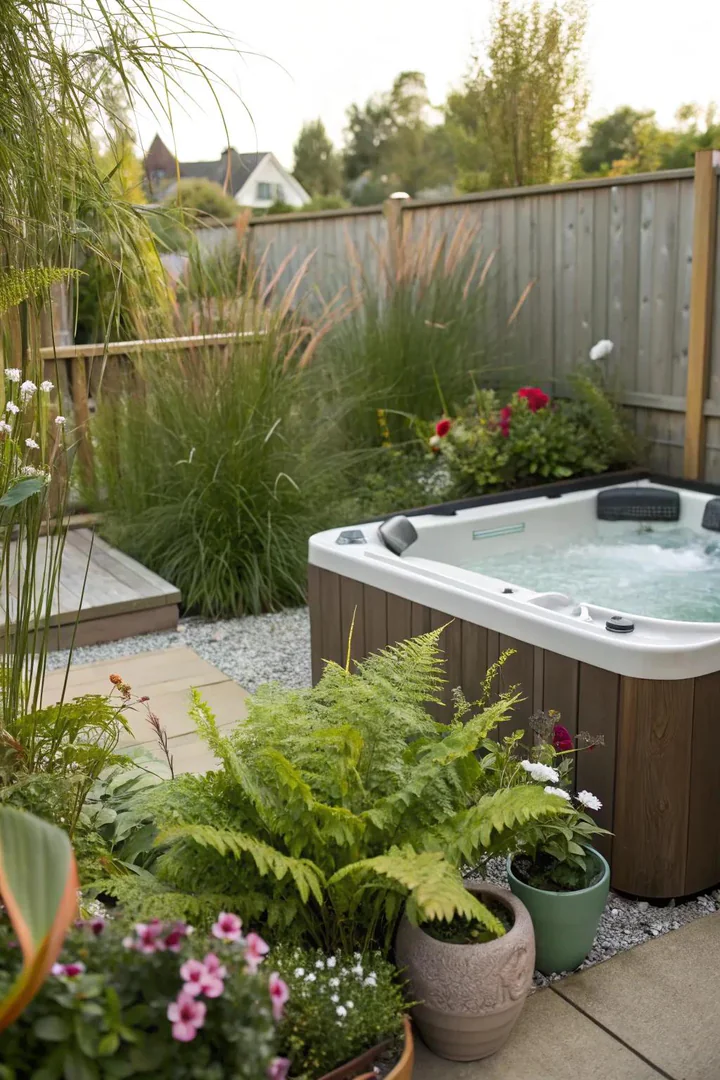
Planting a dense border of evergreen shrubs and ornamental grasses around your hot tub creates natural privacy and a garden-like setting. Clumping bamboo (Fargesia rufa, $30-$60 per 5-gallon pot) grows 12-15 feet tall in 2-3 years and stays contained without spreading. Japanese holly (Ilex crenata, $25-$40 each) forms a tight hedge at 4-6 feet tall that keeps its leaves year-round.
Leave a 3-foot clearance zone between plants and the hot tub shell for service access to pumps, jets, and electrical panels. Use moisture-loving plants like Boston ferns ($8-$15 each) and elephant ears (Colocasia, $10-$20 per bulb) closest to the tub where splash and humidity levels run highest. Mulch planting beds with 3 inches of cedar chips to suppress weeds and reduce soil splash onto the patio surface.
2. Ambient Lighting
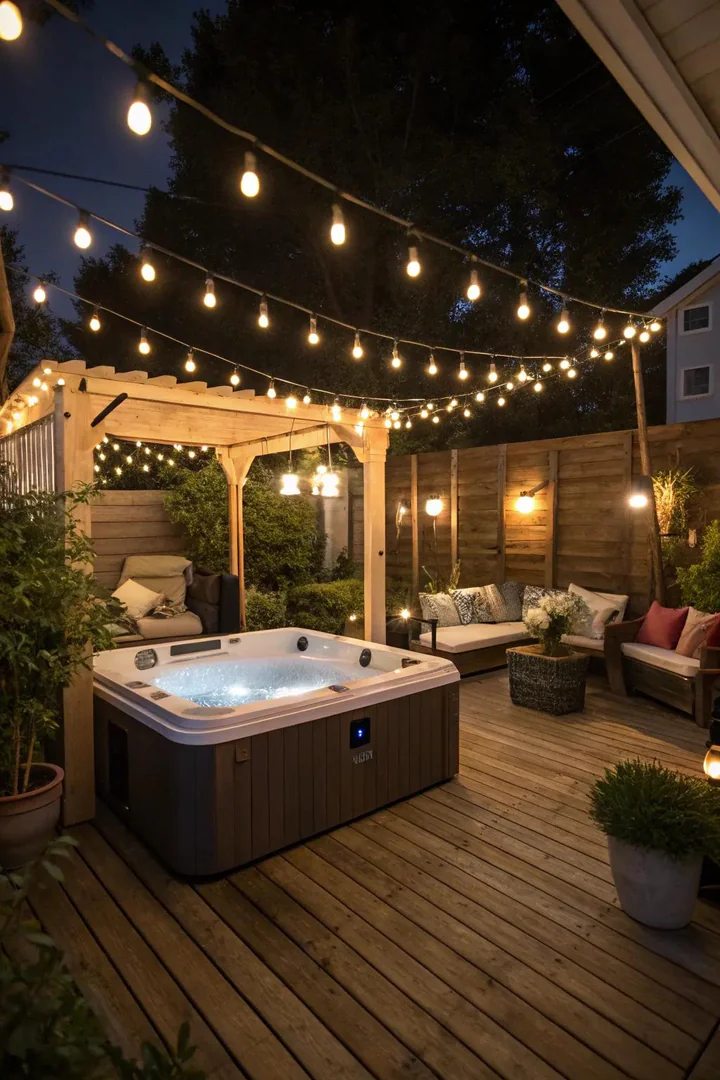
Low-voltage LED lighting turns a hot tub patio into a nighttime retreat without the harsh glare of overhead floodlights. Kichler and WAC Lighting path bollards ($30-$80 each) placed every 4-6 feet along walkways provide safe footing at 2-3 watts per fixture. Recessed step lights ($15-$30 each) built into patio risers or retaining walls mark elevation changes near the tub.
String lights (commercial-grade S14 LED bulbs on 48-foot strands, $25-$50) draped between posts or trees above the patio create a warm canopy of light. Set all patio lighting on a dimmer switch or smart plug ($15-$30) so you can drop intensity to 20-30% while soaking. Submersible LED puck lights ($10-$20 for a 4-pack) placed inside waterproof lanterns or glass jars add flickering color accents around the tub perimeter.
3. Natural Materials
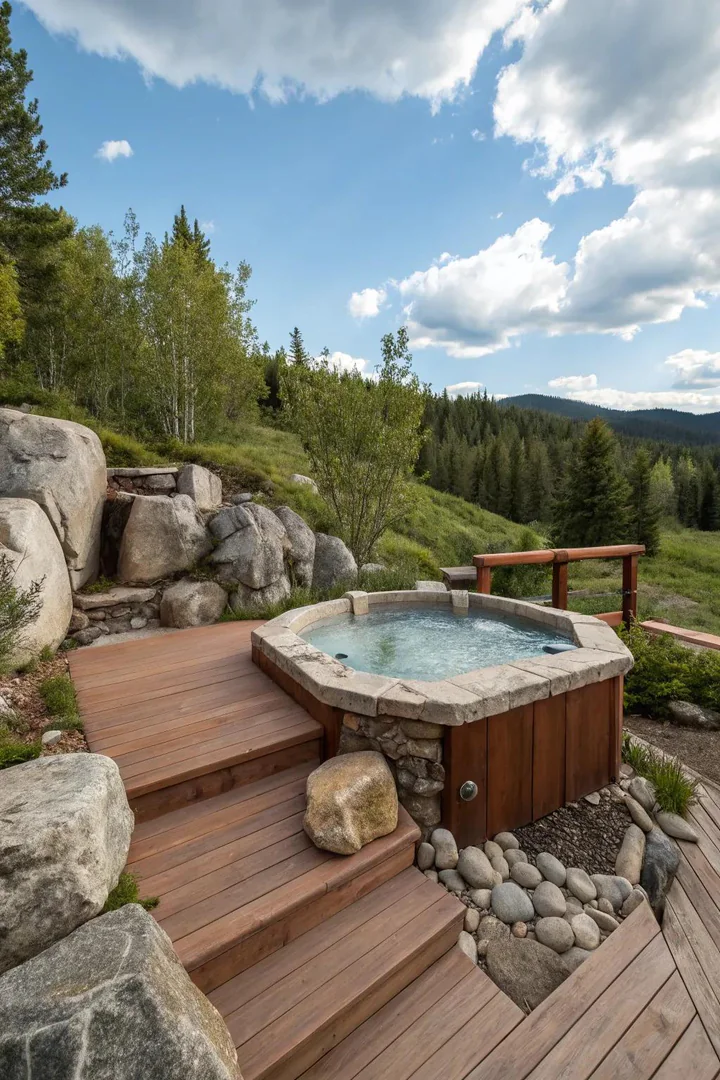
Natural stone, cedar, and gravel give a hot tub patio an organic look that blends with the surrounding yard. Flagstone pavers ($3-$7 per square foot) or travertine tiles ($5-$15 per square foot) set on a compacted gravel base create a durable, slip-resistant walking surface around the tub. Pair with a cedar or redwood tub surround ($500-$2,000 for a custom-built frame) that conceals the hot tub shell and provides a bench-height sitting ledge.
River rock borders ($40-$80 per ton, covering roughly 50-70 square feet at 3 inches deep) define the patio edge and prevent grass from creeping onto the stone surface. A natural stone patio ties in well with deck inlay ideas that combine wood and stone on the same level for a mixed-material outdoor floor. Seal natural stone annually with a penetrating sealer like Miracle 511 to prevent water staining and chlorine discoloration from hot tub splash-out.
4. Privacy with a Pergola
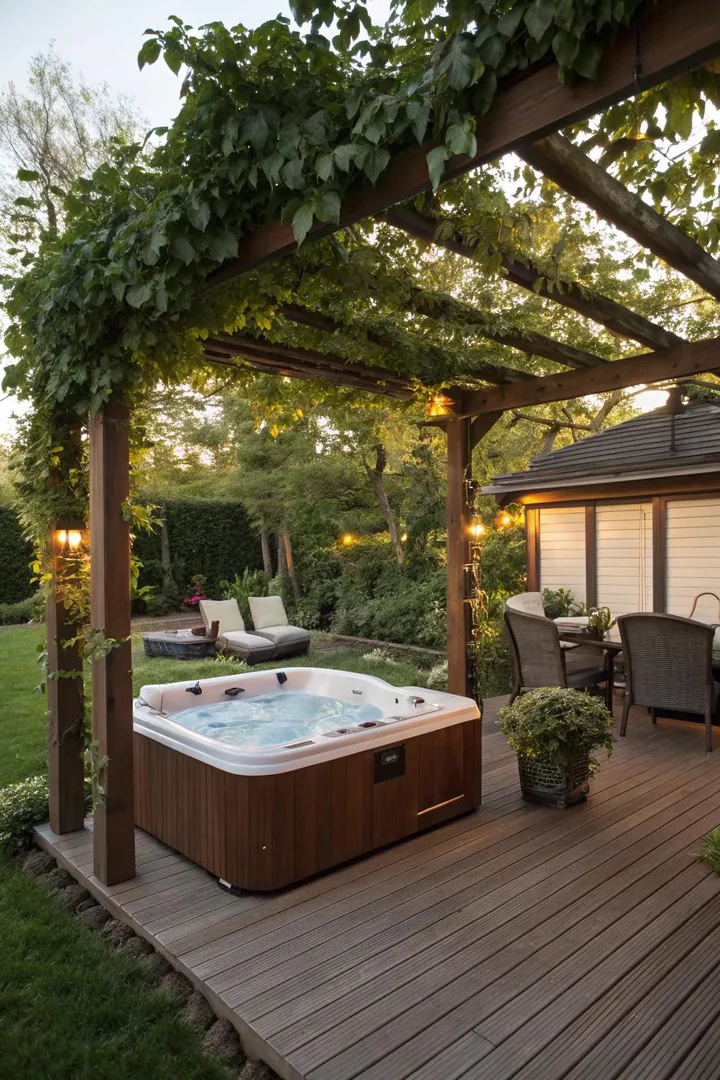
A pergola built directly over or beside the hot tub provides overhead shade and a mounting structure for privacy screens, curtains, or climbing plants. A 10×10-foot pressure-treated pine pergola kit costs $1,200-$2,500, while cedar or redwood versions run $2,500-$5,000. Add lattice side panels ($20-$40 per 4×8-foot sheet) on two or three sides for immediate screening while you wait for climbing plants to fill in.
Wisteria, climbing hydrangea, and star jasmine (Trachelospermum jasminoides) all grow well on pergola posts and rafters, reaching full coverage in 2-4 growing seasons. Train vines along galvanized wire guides stretched between eye hooks screwed into the rafters at 12-inch intervals. A front porch provides similar opportunities for overhead cover and plant training, as shown in front porch decorating ideas that pair vines with structural shade.
5. Fire Feature for Warmth
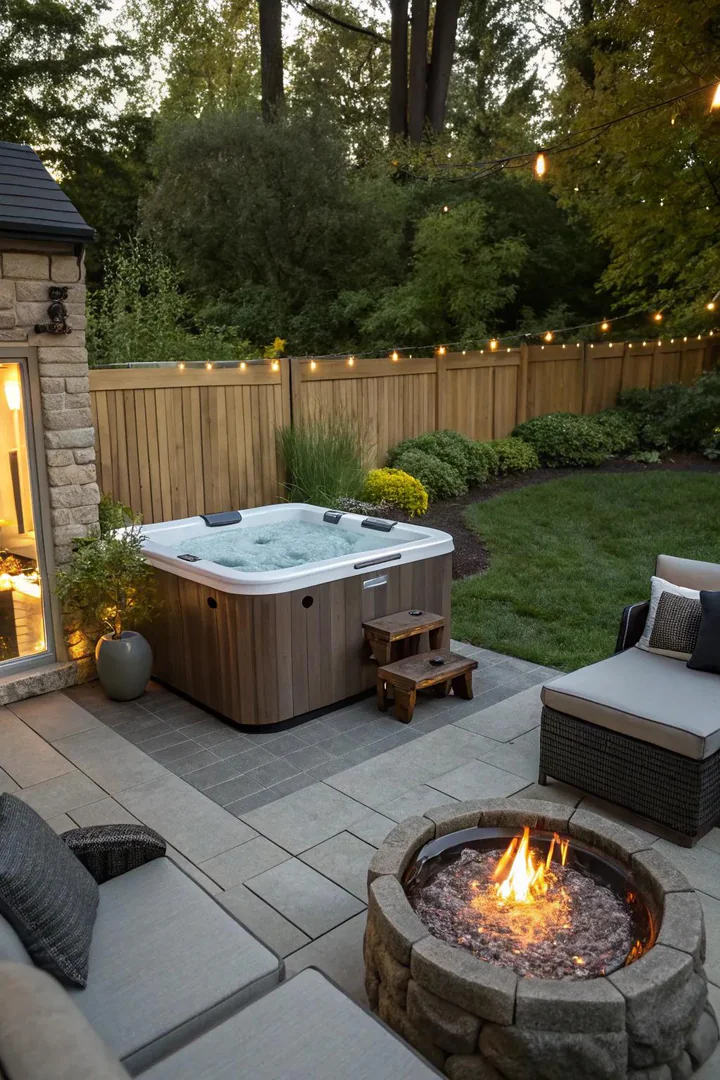
A fire pit or fire table near the hot tub extends patio use into cold weather and gives guests a warm spot to dry off after soaking. Propane fire tables from Outland Living and Bond Manufacturing ($150-$500) run on a standard 20-pound tank and produce 50,000-60,000 BTU of heat. Natural gas fire pits plumbed into your home’s gas line ($500-$2,000 installed) eliminate tank refills entirely.
Place the fire feature at least 10 feet from the hot tub and 15 feet from any overhead structure (pergola, awning, tree branches) to meet standard fire safety clearances. Use fire-rated glass beads ($20-$40 per 10-pound bag) or lava rock ($15-$30 per bag) as the fire media rather than traditional wood logs, which produce sparks and ash that can damage the hot tub cover and clog filters.
6. Minimalist Modern Design
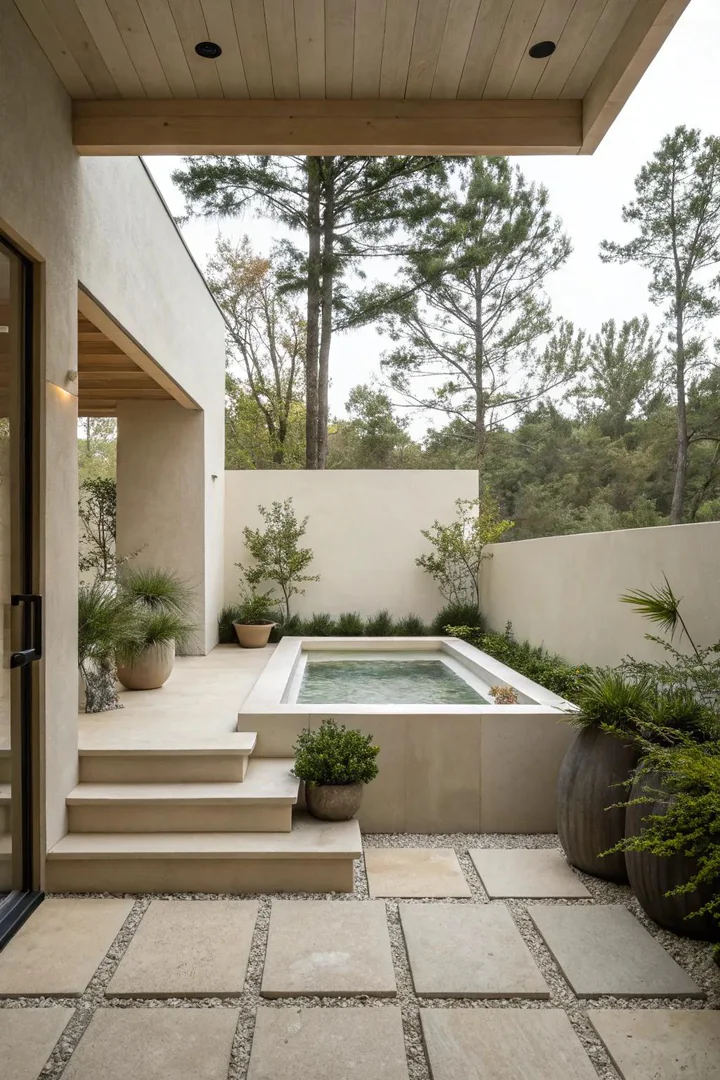
A minimalist hot tub patio strips away decorative clutter and focuses on clean geometry, neutral colors, and high-quality materials. Choose a square or rectangular hot tub (Bullfrog Spas A Series, $8,000-$14,000) over a rounded model, and sink the tub flush with the patio surface for a built-in, architectural look. Pour a smooth-finished concrete pad ($6-$10 per square foot) in a matching gray tone to create a continuous floor plane.
Limit the material palette to two or three finishes: concrete, dark-stained cedar, and brushed stainless steel hardware. Skip ornamental planters, colored lighting, and patterned rugs in favor of a single statement plant (mature Japanese maple or olive tree in a 24-inch Cor-Ten steel planter, $200-$500) and a pair of low-profile lounge chairs in black or charcoal. Run electrical and plumbing connections underground through buried conduit to keep the patio surface free of visible wires and hoses.
7. Waterfall Feature
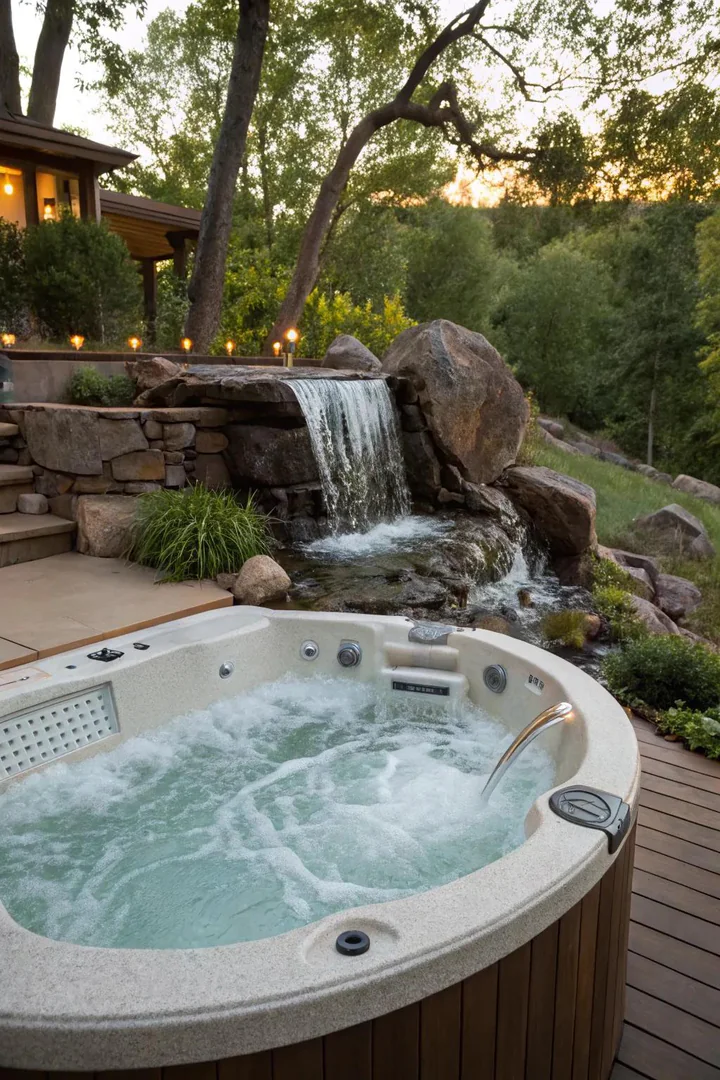
A freestanding waterfall wall or spillway fountain next to the hot tub adds the sound of running water without the construction of a full pond. Aquascape AquaSurge pumps ($150-$300) power wall-mounted spillways that sheet water down a stacked stone or copper face panel, recirculating through a hidden basin buried at ground level.
Pre-built waterfall kits from Blue Thumb and Atlantic Water Gardens ($300-$1,200) include the pump, basin, tubing, and spillway lip for a weekend DIY installation. Stack natural fieldstone or cut stone veneer around a rigid foam form to build a 3-4 foot tall waterfall wall for under $500 in materials. Position the waterfall upwind of the hot tub so the breeze carries mist and sound toward the soaking area rather than away from it.
8. Outdoor Art
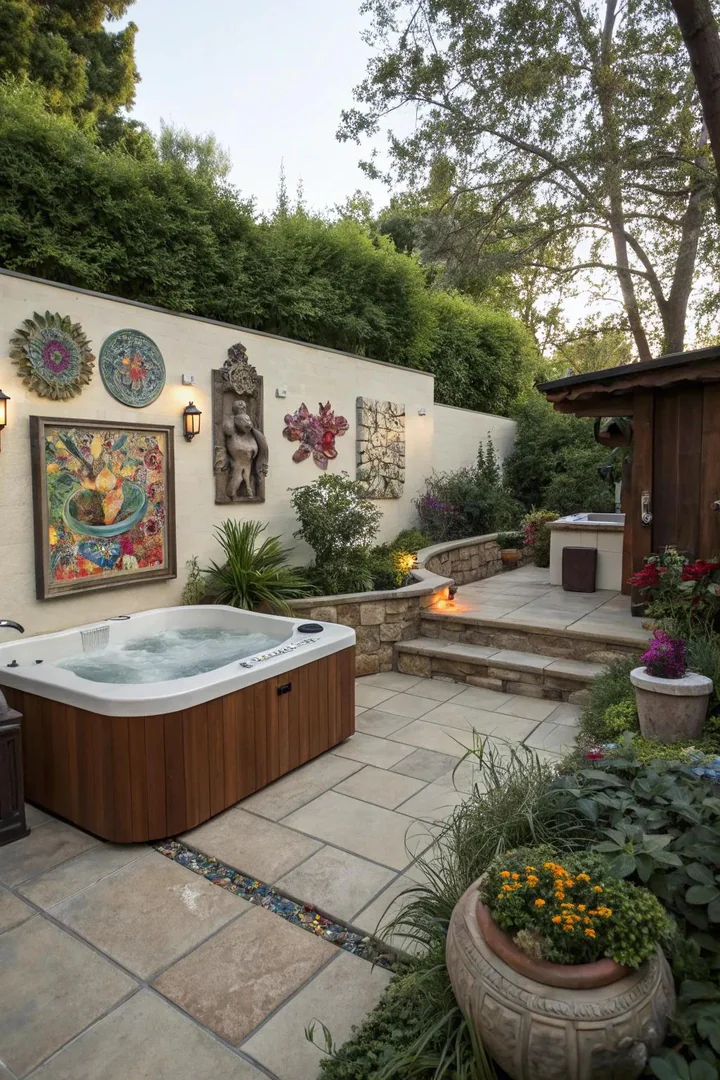
Outdoor-rated sculptures, wall panels, and ceramic pieces give your hot tub patio personality beyond the standard furniture-and-plants setup. Powder-coated steel and aluminum wall art ($30-$150 per piece) from Red Barrel Studio and George Oliver mounts directly to a fence, privacy screen, or house wall behind the tub area. Cor-Ten steel develops a controlled rust patina over 6-12 months that adds warmth without maintenance.
Ceramic and glazed pottery pieces (large floor vases, wall-mounted plates, or patterned tile panels) bring color to neutral stone or wood patios. Choose frost-resistant stoneware or vitrified clay rated for outdoor use to prevent cracking in freeze-thaw climates. Hang artwork at seated eye level (36-42 inches from the patio surface) so you can appreciate the pieces while soaking in the tub.
9. Rustic Look
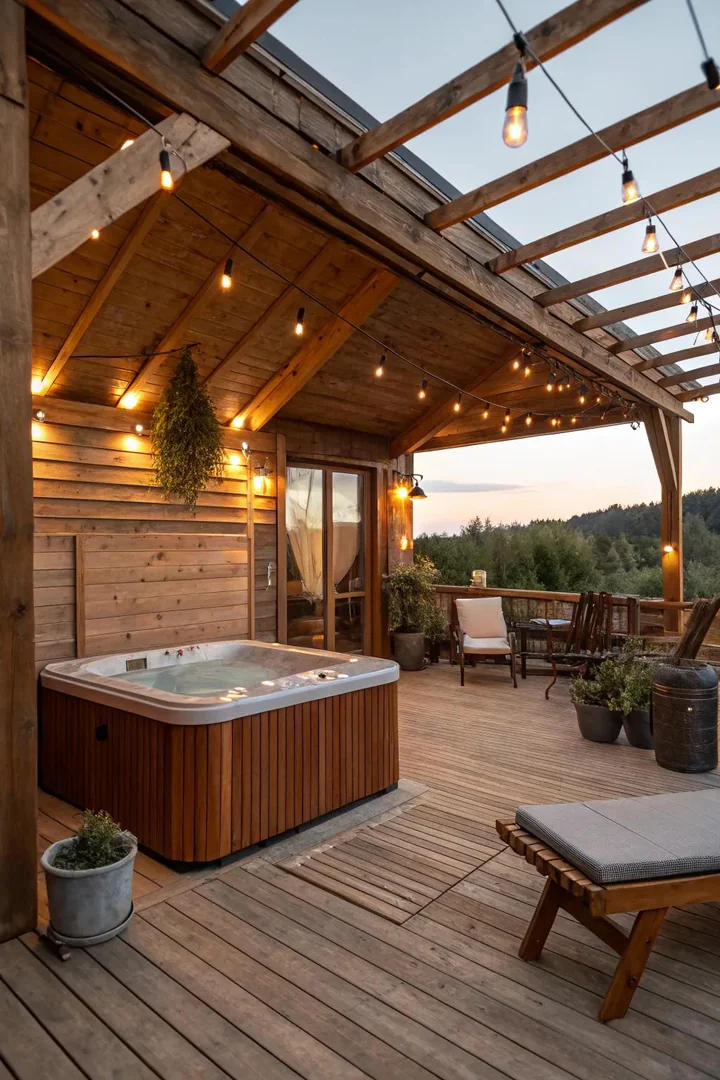
Reclaimed barn wood, rough-sawn cedar, and stacked fieldstone give a hot tub patio a cabin or lodge feel. Build the tub surround from reclaimed lumber ($5-$12 per board foot from salvage dealers) sealed with a UV-protective oil like Penofin Verde to preserve the weathered grain. Stack dry-laid fieldstone ($3-$6 per square foot) for a retaining wall or seat wall at sitting height (18-20 inches) near the tub.
Wrought-iron lanterns ($20-$60 each) with LED candle inserts and a cast-iron fire bowl ($100-$300) round out the rustic atmosphere without the fire risk of open flames near a wood surround. Add a hand-hewn timber overhead beam (6×8 or 8×8 rough-sawn Douglas fir, $3-$6 per linear foot) supported by stone column bases for a partial roof that shelters the tub from rain and falling leaves.
10. Multi-Level Decking
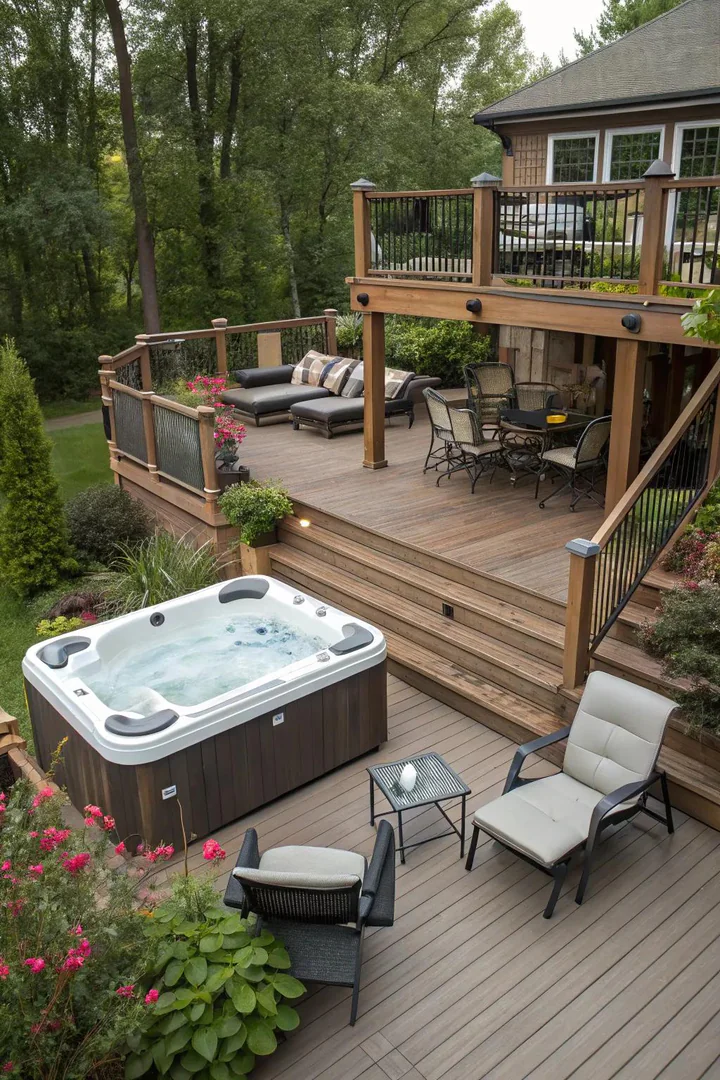
A multi-level deck drops the hot tub into a lower tier while keeping the lounge or dining area on the upper platform, creating visual separation between activity zones. Sink the tub 12-18 inches below the main deck surface so the rim sits at bench height for easy entry. Reinforce the lower level framing with doubled 2×10 joists on 12-inch centers and concrete footings rated for the tub’s filled weight (3,000-5,000 pounds).
Connect the two levels with a set of 3-4 wide stairs (48-60 inches across) or a gradual ramp for accessible entry. Built-in LED riser lights ($10-$20 each) on every step face mark the elevation change at night. The upper deck level works well for a dining table, grill station, or lounge chairs where guests can stay dry while watching the hot tub area below. A similar layout strategy applies to townhouse patio ideas where limited square footage demands vertical separation of zones.
11. Zen Space
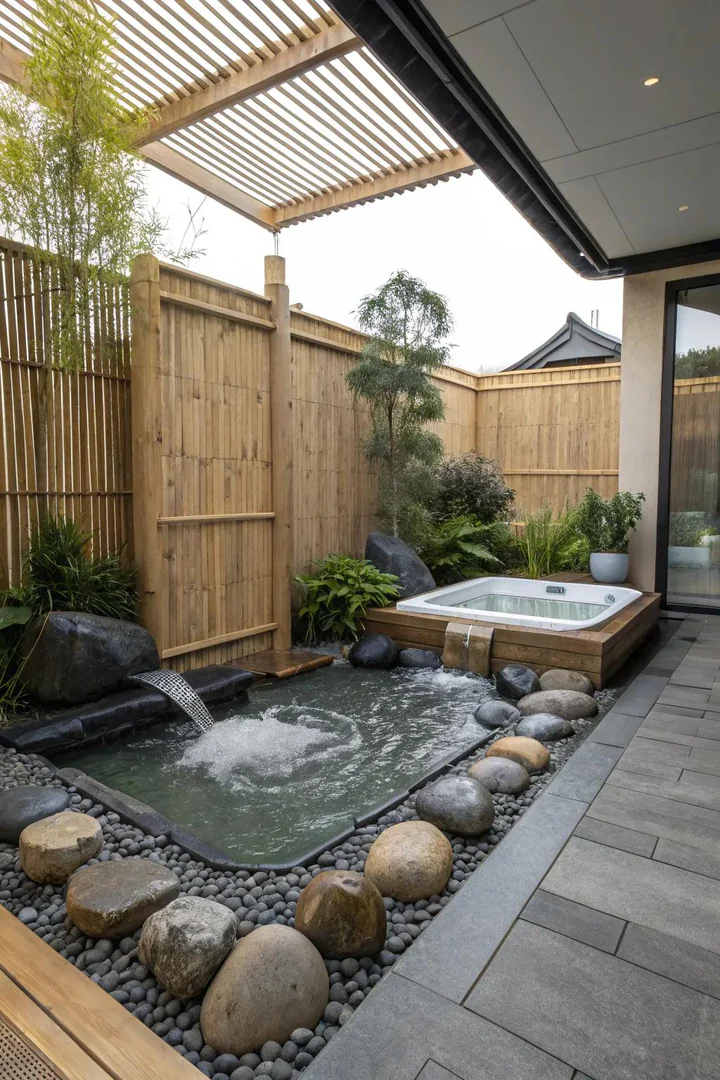
A zen-inspired hot tub patio uses raked gravel, natural boulders, and minimal plantings to create a meditative soaking environment. Lay 2-3 inches of decomposed granite or pea gravel ($30-$50 per ton, covering 50-80 square feet) around the tub and rake concentric patterns using a traditional wooden kumade rake ($15-$30). Place 3-5 large boulders (200-500 pounds each, $50-$200 per boulder delivered) in an asymmetric arrangement.
Japanese black pine (Pinus thunbergii, $80-$150 for a 3-gallon pot), mondo grass (Ophiopogon japonicus, $3-$5 per plug), and dwarf Japanese maple (Acer palmatum ‘Shaina’, $40-$80) all suit the scale and color palette of a zen garden without outgrowing the space. Build a bamboo deer scarer (shishi-odoshi) from 3-inch-diameter bamboo poles ($10-$20 in materials) that tips and strikes a stone basin at intervals, adding a rhythmic water sound to the garden.
12. Comfortable Seating
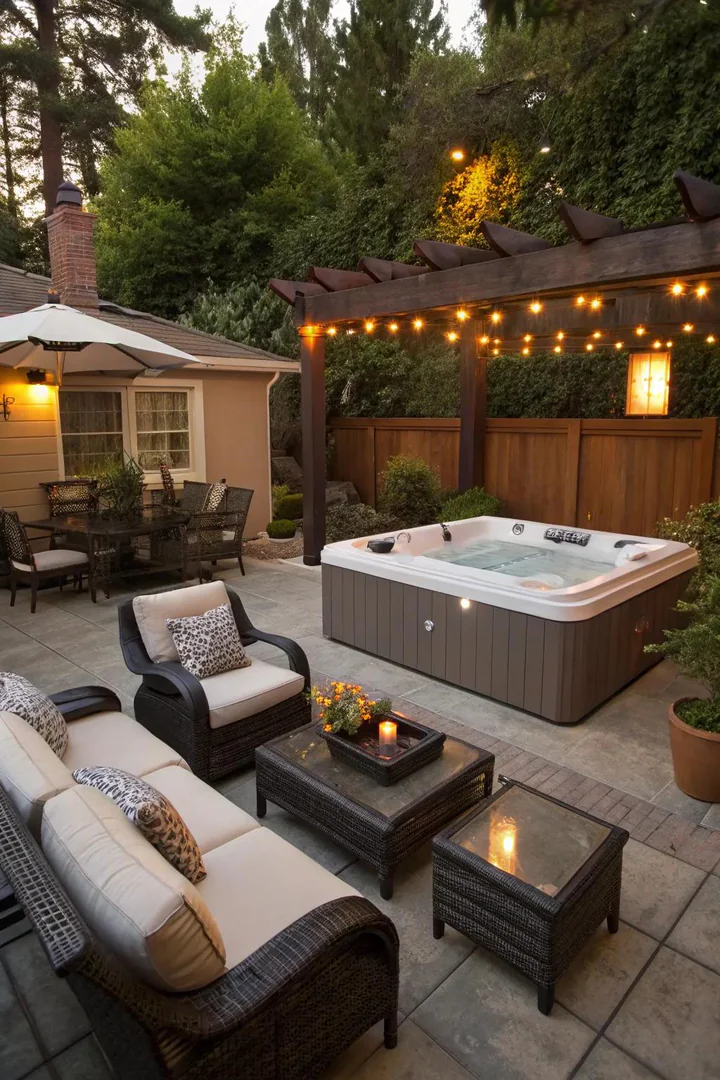
A dedicated seating area next to the hot tub gives guests a place to relax before and after soaking. All-weather sectional sofas from Outer ($3,000-$6,000) and Pottery Barn Outdoor ($1,500-$4,000) use marine-grade aluminum frames and Sunbrella fabric cushions rated for 10+ years of full outdoor exposure. Position seating within arm’s reach of the tub rim so guests can set drinks on the edge without getting up.
Built-in bench seating constructed from the same material as your deck or patio surround saves floor space and costs $200-$500 in lumber for a 6-8 foot bench. Add 4-inch-thick outdoor cushions ($40-$80 each) with quick-dry foam inserts that shed water in minutes rather than hours. A side table or built-in shelf at tub-rim height (32-36 inches) holds towels, drinks, and a waterproof Bluetooth speaker within easy reach.
13. Sound System
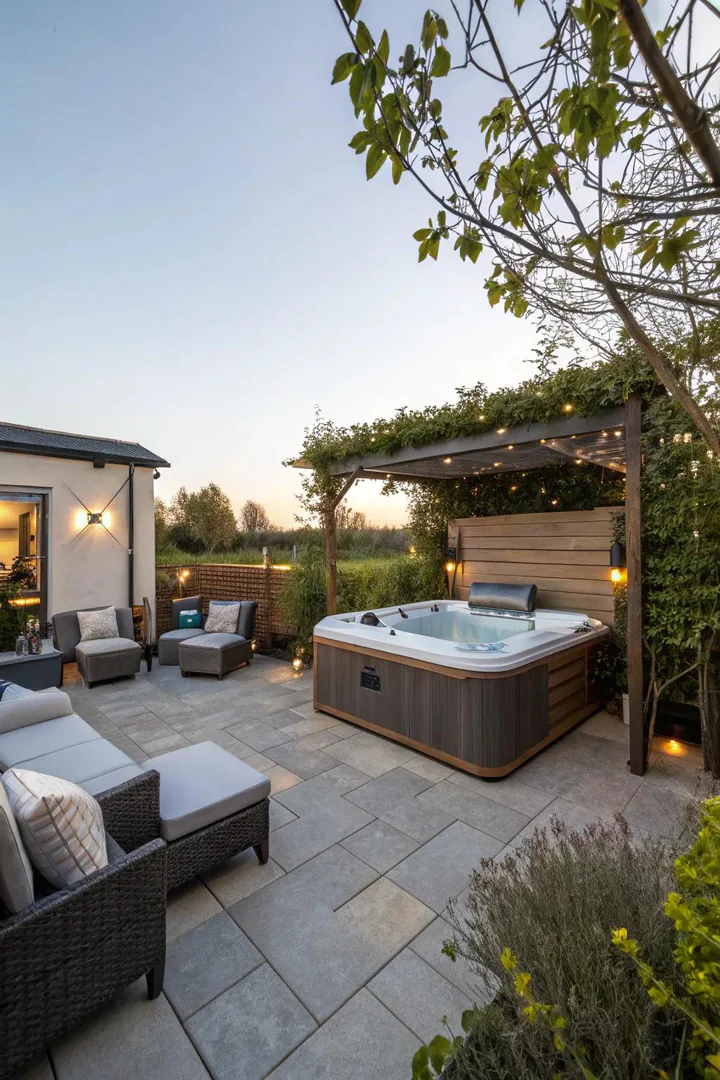
A dedicated outdoor sound system puts music and ambient audio right at the hot tub without relying on a phone speaker. Sonos Outdoor speakers by Sonance ($400-$800 per pair) mount to walls, posts, or soffits and deliver full-range sound in a weather-sealed IP67-rated enclosure. Klipsch and Polk Audio outdoor speakers ($100-$300 per pair) offer a budget-friendly alternative with 70-100 watt power handling.
Rock-shaped garden speakers from Niles and OSD Audio ($80-$200 each) sit directly on the ground among plants and boulders, blending into a garden setting around the tub. Run speaker wire through UV-rated conduit buried 6-8 inches underground to prevent damage from lawn equipment. Connect all outdoor speakers to a Wi-Fi-enabled amplifier (Sonos Amp, $700; Yamaha WXA-50, $350) for streaming from any room in the house.
14. Color Harmony
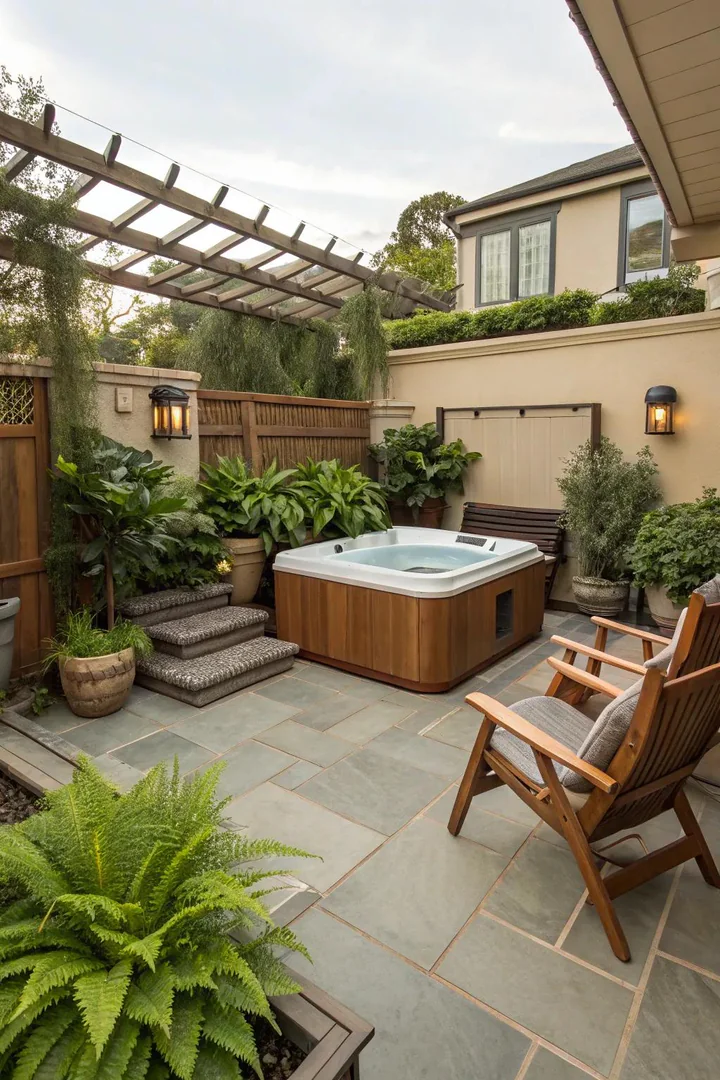
Picking a 3-color palette for your hot tub patio keeps the space visually organized and intentional. Start with the dominant surface color (gray concrete, warm cedar, or ivory travertine), add an accent through cushion fabric and planters (navy, terracotta, or sage green), and use a third color sparingly in throw pillows, candles, or ceramic accessories.
Match your hot tub shell color to the patio palette. Jacuzzi and Hot Spring both offer shells in midnight blue, sandstone, platinum, and sterling silver to coordinate with common outdoor materials. Avoid bright white tub shells on dark patios because the high contrast draws the eye to the tub equipment rather than the surrounding design. A warm gray or taupe shell blends with both stone and wood finishes.
15. Windbreak
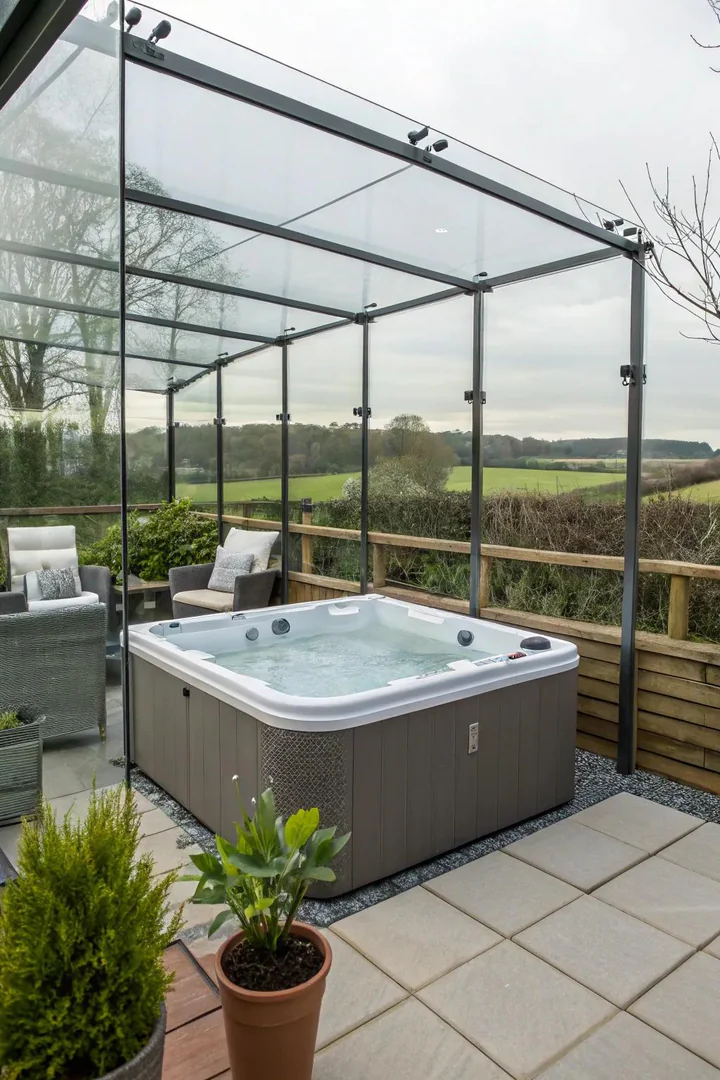
A windbreak wall on the prevailing-wind side of your hot tub blocks cold drafts that pull heat from the water surface and chill exposed skin. Build a 5-6 foot tall slatted cedar or composite screen ($10-$20 per linear foot in materials) with 1-inch gaps between horizontal boards to reduce wind speed by 50-60% without creating turbulence. Solid walls actually perform worse than slatted ones because wind hits a solid barrier, lifts over it, and drops down harder on the other side.
Glass windbreak panels ($80-$200 per 4×6-foot tempered panel) block wind completely while preserving the view. Mount frameless tempered glass between stainless steel standoff posts for a modern, open look. For a living windbreak, plant a row of Emerald Green arborvitae (Thuja occidentalis, $30-$50 each for 5-gallon pots) at 3-foot spacing, reaching 12-15 feet tall and 3-4 feet wide at maturity for a year-round green wall.
16. Shade Structure
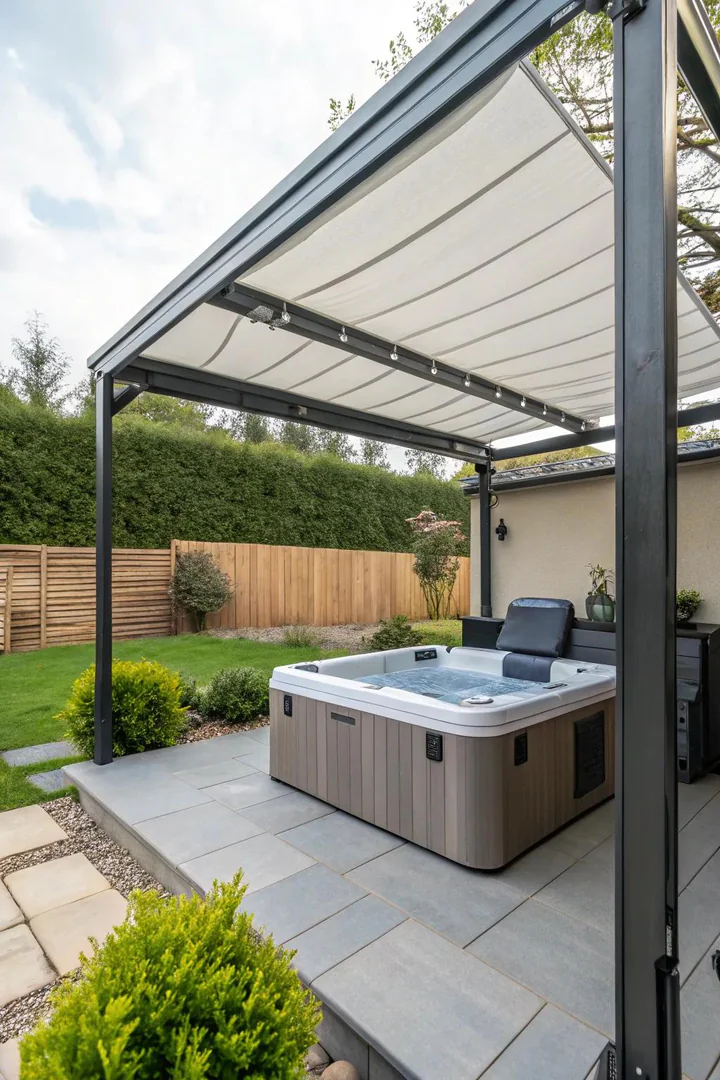
A shade structure over the hot tub protects the water from sun-driven chemical breakdown and keeps the tub surface cooler on summer afternoons. Shade sails from Coolaroo and Artpuch ($30-$100 for a 12×12-foot triangle or rectangle) mount to house walls, fence posts, or dedicated steel poles and block 90-95% of UV rays. Use marine-grade 316 stainless steel turnbuckles ($10-$20 each) and 3/8-inch cable to tension the sail taut enough to shed rainwater.
A cantilever umbrella (10-13 foot diameter, $200-$800 from California Umbrella or Abba Patio) gives adjustable shade that swings out of the way when you want full sun. Anchor the umbrella base in a concrete-filled sleeve set into the patio during construction, or use a 100-150 pound weighted base on existing surfaces. Retractable awnings ($400-$4,000 depending on size and motorization) provide the most shade control with a single push-button operation.
17. Texture with Rugs
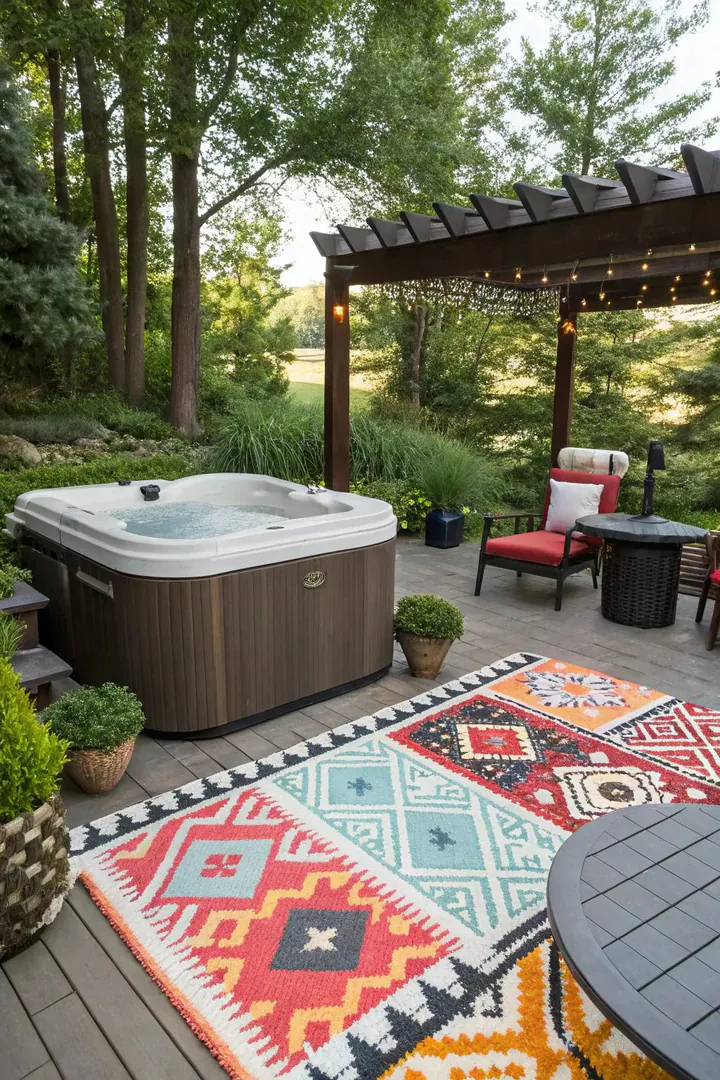
An outdoor rug placed between the hot tub and seating area defines the lounge zone and adds warmth and texture underfoot. Polypropylene outdoor rugs from Safavieh and nuLOOM ($50-$200 for a 5×8-foot size) resist moisture, mold, and UV fade while drying completely in 1-2 hours after rain. Choose a low-pile or flatweave construction that lies flat on concrete or composite surfaces without tripping edges.
Position the rug far enough from the tub (3-4 feet minimum) to avoid constant soaking from splash-out, but close enough that you step onto it immediately after exiting. Secure rug corners with double-sided outdoor carpet tape ($8-$12 per roll) or heavy rubber-backed corner grips to prevent sliding on smooth patio surfaces. Replace outdoor rugs every 3-4 seasons as UV exposure eventually breaks down polypropylene fibers even with UV-stabilizer additives.
18. Strategic Placement for Views
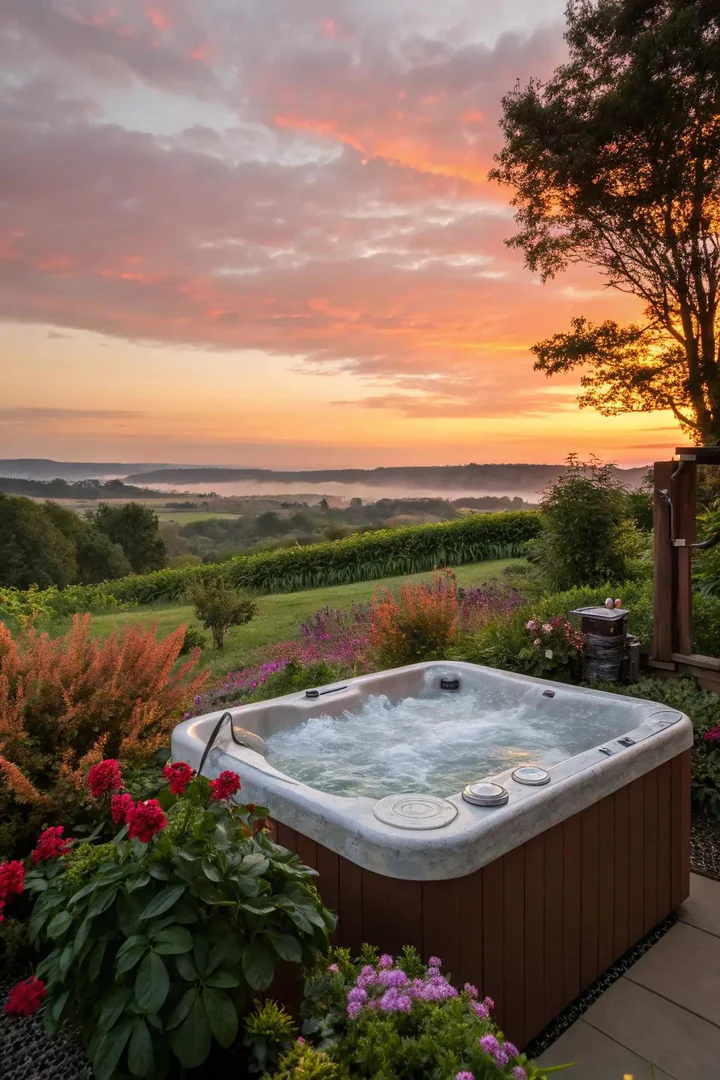
Positioning the hot tub to face your property’s best view (mountain ridgeline, lake, sunset direction, or garden focal point) turns every soak into a visual experience. Before pouring the pad or building the deck, sit in a chair at the proposed tub height (32-36 inches above the patio surface when seated in the tub) and verify sightlines from that lower eye level. Obstacles like fence rails, shrub tops, and neighboring rooflines often block views that look clear from standing height.
Replace solid railings with horizontal cable wire ($15-$25 per linear foot) or frameless glass panels ($80-$150 per linear foot) on any deck edge between the tub and the view. Angle the tub so the primary seating positions (the seats with the most jets) face the view rather than pointing at the house wall. For properties near water, consider how a smaller pool option like those in ideas for small backyard pools might complement the hot tub with a second water feature in the sightline.
19. Themed Escape
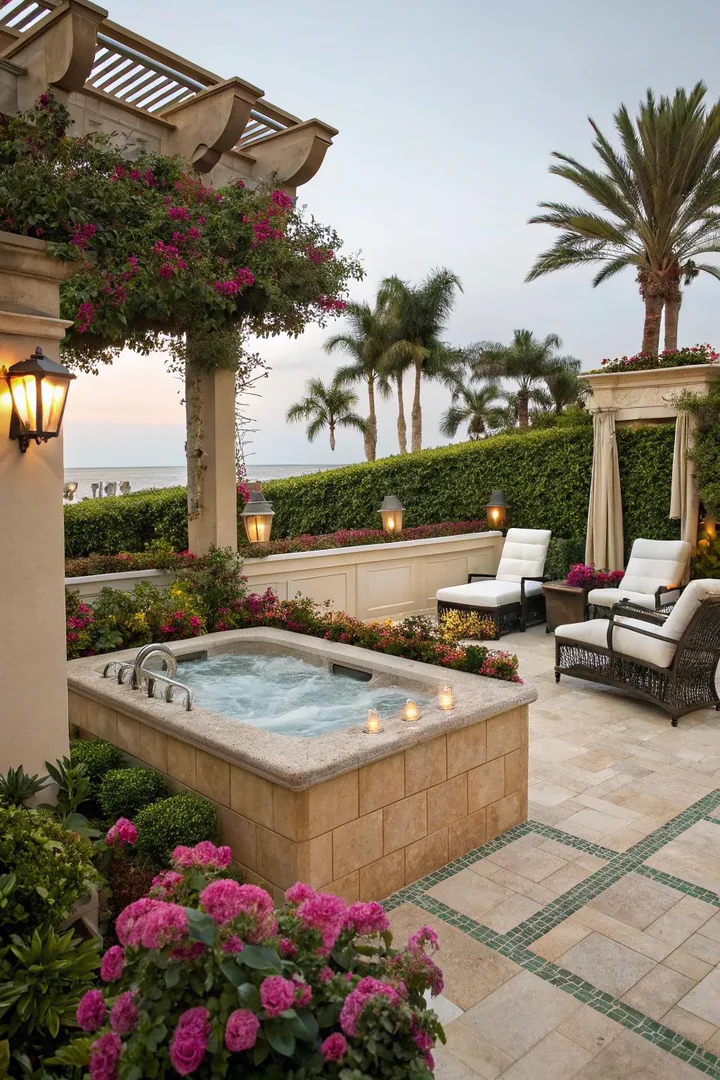
A themed hot tub patio commits fully to a single design direction (tropical island, Mediterranean villa, mountain lodge, or desert oasis) for a vacation-at-home atmosphere. A tropical theme layers queen palms ($100-$300 each for 8-foot specimens), bird of paradise ($25-$50 per pot), and tiki torches ($10-$20 each) around a bamboo privacy fence ($3-$5 per linear foot for a 6-foot-tall roll). Add a thatched palapa or tiki hut roof ($500-$2,000 for a 10-foot-diameter kit) over the tub area for authentic shade.
A Mediterranean theme uses terracotta tile pavers ($4-$8 per square foot), iron lanterns ($30-$80 each), lavender and rosemary plantings ($5-$15 each), and a stucco half-wall ($10-$15 per square foot) around the tub surround. Commit to the theme across all accessories (towels, cushions, serving ware, lighting) for a unified look that reads as intentional rather than random. Rotate seasonal accents (throw pillows, lantern colors, potted flowers) 2-3 times per year to keep the themed patio fresh without a full redesign.
Hot Tub Patio Material Comparison
| Patio Surface | Cost per Sq Ft | Slip Resistance | Heat Retention | Maintenance | Best For |
|---|---|---|---|---|---|
| Poured Concrete | $6-$10 | High (broom finish) | Moderate | Seal every 2-3 years | Modern, minimalist |
| Concrete Pavers | $8-$15 | High | Low | Re-sand joints yearly | Traditional, versatile |
| Natural Flagstone | $10-$20 | Very high | Low | Seal annually | Rustic, organic |
| Travertine Tile | $5-$15 | High (tumbled) | Low | Seal every 1-2 years | Mediterranean |
| Composite Decking | $8-$15 | Moderate | Moderate | Soap and water | Multi-level builds |
| Pressure-Treated Wood | $4-$8 | Moderate (wet = low) | Low | Stain every 2-3 years | Budget builds |
| Pea Gravel | $1-$3 | High | Very low | Rake and top off yearly | Zen, casual |
How to Build a Hot Tub Patio
1. Choose the Location and Check Utilities
Place the tub within 15 feet of your electrical panel to minimize wiring costs, and verify that your panel has room for a dedicated 240V/50A breaker (required for most 4-8 person tubs). Confirm the site drains away from the house foundation with a minimum 1/4-inch-per-foot slope. Call 811 to mark underground utility lines before any excavation.
2. Prepare the Foundation
Excavate 6-8 inches of soil and fill with 4 inches of compacted 3/4-inch crushed stone topped by 2 inches of leveling sand. For a poured concrete pad, lay 4-inch-thick 3,500 psi concrete over 6×6 welded wire mesh on the gravel base. The pad should extend 3-4 feet beyond the tub footprint on all sides for a walking surface and equipment access.
3. Run Electrical and Plumbing
Hire a licensed electrician to install a dedicated 240V/50A GFCI-protected circuit from your panel to a disconnect box mounted within line-of-sight of the tub (required by NEC code). Run 6-gauge THWN wire through schedule 40 PVC conduit buried 18 inches deep. A garden hose fills most hot tubs in 1-2 hours, but install a dedicated hose bib within 25 feet of the tub for convenient water top-offs.
4. Set the Hot Tub and Level
Use a furniture dolly or hot tub cart (rentable for $50-$100 per day) to roll the empty tub onto the pad. Check level across the rim in both directions using a 4-foot spirit level and adjust with composite shims ($5-$10 per pack) under the tub feet. Connect the tub to the electrical disconnect, fill with water, and run the jets for 30 minutes to prime the pump and check for leaks at all fitting connections.
5. Build the Surround and Finish
Frame a surround from pressure-treated 2x4s and clad with composite decking, cedar boards, or stone veneer to hide the tub shell and mechanical access panel. Leave one removable panel (secured with magnetic catches or thumb screws) on the equipment side for pump and heater service. Install the patio surface (pavers, stone, or additional decking), add lighting, and attach any privacy screens or shade structures to complete the project.
Frequently Asked Questions
How thick should a concrete pad be for a hot tub?
A minimum 4-inch-thick concrete pad with 3,500 psi strength and 6×6 welded wire mesh reinforcement supports any residential hot tub up to 6,000 pounds filled weight. Extend the pad 3-4 feet past the tub edges on all sides. Pouring a 5-6 inch pad adds $1-$2 per square foot in concrete costs and provides extra margin for 8+ person tubs that exceed 5,000 pounds.
Can you put a hot tub on pavers?
Yes, but the paver base must be properly prepared with 6-8 inches of compacted crushed stone and 1-2 inches of leveling sand. Interlock the pavers tightly and fill joints with polymeric sand to prevent shifting under the tub weight. Avoid placing a hot tub on pavers laid directly on soil or sand without a stone sub-base, as the ground will settle unevenly and stress the tub shell.
How far should a hot tub be from the house?
Most building codes require a minimum 5-foot clearance between a hot tub and any permanent structure, and 10 feet from overhead power lines. Place the tub at least 10 feet from any open flame (grill, fire pit) and ensure the electrical disconnect box is mounted within sight of the tub but at least 5 feet away from the water. Closer placement to the house keeps electrical runs shorter and reduces installation costs.
How much does it cost to run a hot tub monthly?
A well-insulated acrylic hot tub with a locking hardcover costs $20-$50 per month in electricity to maintain at 100-104 degrees Fahrenheit year-round. Older or poorly insulated tubs can run $75-$100+ per month. Full-foam insulated tubs (Jacuzzi J-300 and J-400 series, Hot Spring Highlife Collection) hold heat 30-40% more efficiently than partial-foam models. Chemical costs (chlorine or bromine, pH balancers, shock treatment) add $15-$25 per month.
Do you need a permit to install a hot tub?
Most municipalities require an electrical permit for the 240V dedicated circuit but do not require a separate building permit for the tub itself if the patio is at grade level. A raised deck or platform supporting the tub may trigger a building permit if the surface exceeds 200 square feet or sits more than 30 inches above grade. Check with your local building department before starting work, as permit requirements vary by jurisdiction.