
White Kitchen Gray Countertops Ideas: 20 Chic Designs You’ll Adore
White kitchen gray countertops ideas pair bright white cabinetry with gray stone, quartz, or concrete surfaces for a palette that balances warm and cool tones without committing to a single temperature. Gray countertops range from pale silver Carrara marble to dark charcoal soapstone, and each shade creates a different relationship with white cabinets depending on the gray’s undertone (blue, green, warm taupe, or neutral). Below are 20 material-and-style combinations organized by countertop type, backsplash pairing, hardware finish, and layout, followed by a maintenance comparison, a how-to selection guide, and FAQs on cost, durability, and stain resistance.
1. South-Facing Windows with Light Gray Quartz
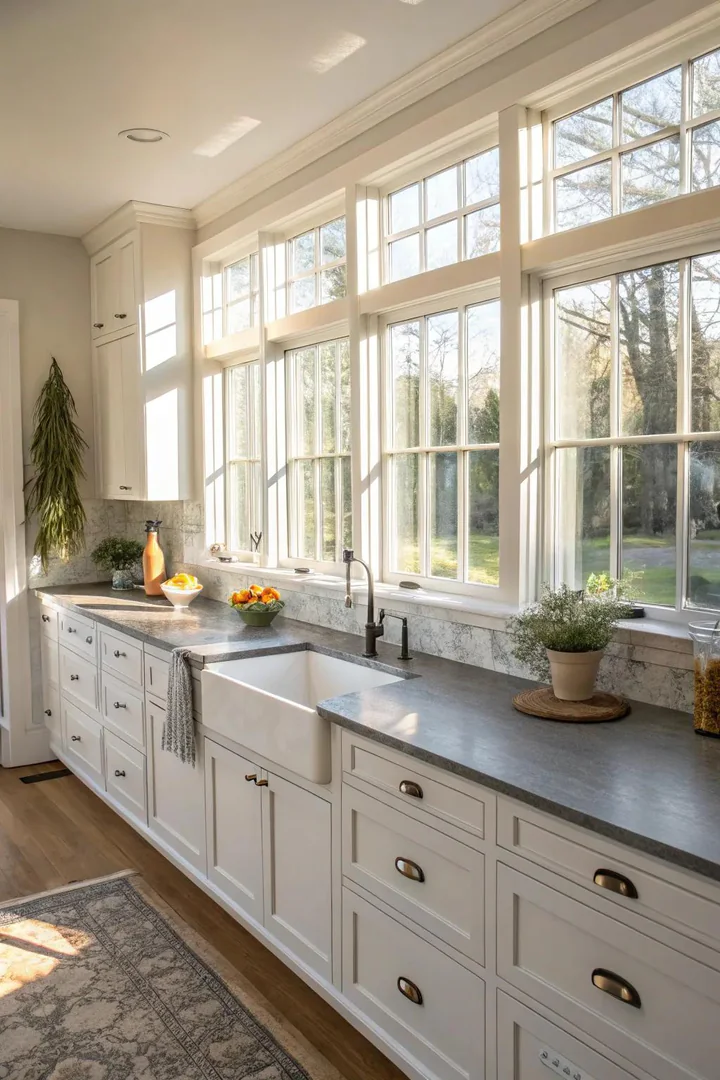
A light gray quartz countertop from Caesarstone Privy 5003 ($65 per square foot installed) or Silestone Steel ($60 per square foot) reads as a warm neutral under direct sunlight from south- or west-facing windows. Natural light pulls out the faint warm undertone in light gray quartz, softening what would appear cooler under fluorescent lighting. A kitchen with 6 or more feet of window wall benefits from a lighter gray because the stone reflects daylight back into the room, amplifying brightness without glare.
Pair light gray quartz with Benjamin Moore Chantilly Lace OC-65 on the cabinets for a true-white-to-pale-gray transition, or Sherwin-Williams Alabaster SW 7008 for a creamier white that warms the palette further. Under-cabinet LED strip lighting in 2700K to 3000K color temperature fills the shadow zone below the upper cabinets where daylight does not reach, keeping the gray countertop reading consistently warm from morning through evening.
2. Open Shelving with Honed Gray Marble
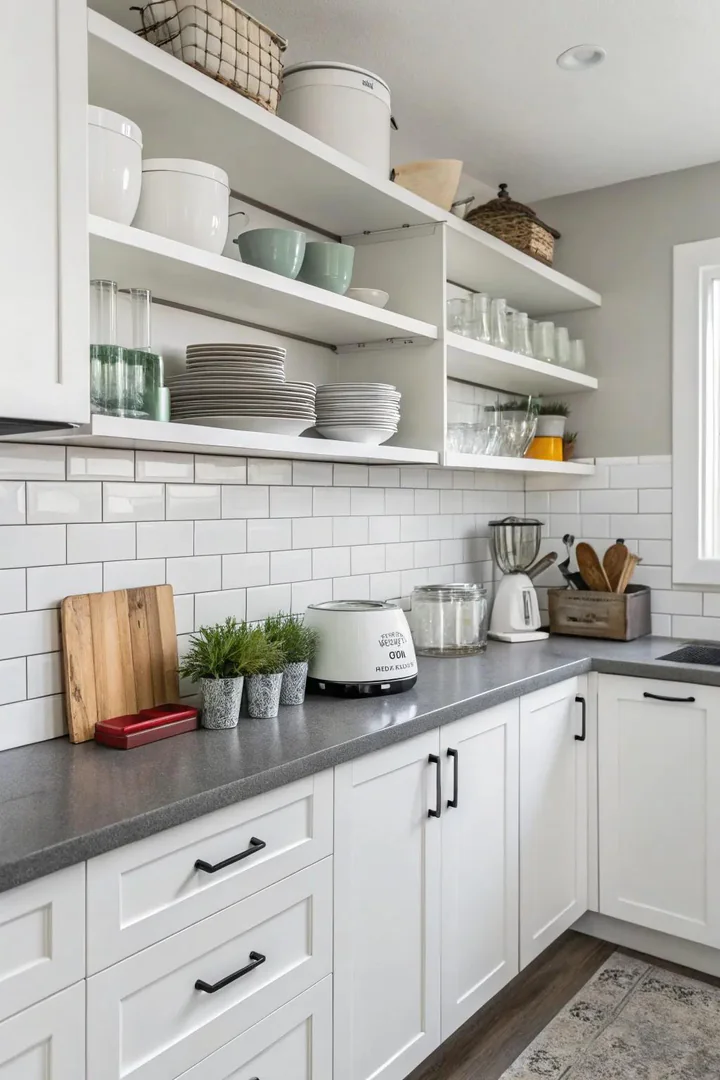
Replacing upper cabinets on the sink wall with floating oak shelves opens the sightline to a honed Bardiglio gray marble countertop ($80 per square foot installed) that would otherwise hide behind closed cabinet doors. Honed marble has a matte, velvety finish that absorbs light rather than reflecting it, producing a softer, quieter gray than a polished surface. Bardiglio marble carries dramatic white veining on a medium-gray field that reads as a natural landscape rather than a manufactured pattern.
Open shelves above a honed marble counter display white dishware, clear glassware, and ceramic vessels that echo the white-and-gray palette without introducing competing colors. Stack white dinner plates in graduated sizes and group clear glass tumblers to maintain visual order. Honed marble etches more visibly than polished marble when exposed to acidic liquids (lemon juice, vinegar, tomato sauce), so seal the surface every 6 months with Tenax Hydrex or Miracle Sealants 511 to slow absorption.
3. Engineered Quartz for Zero-Maintenance Gray
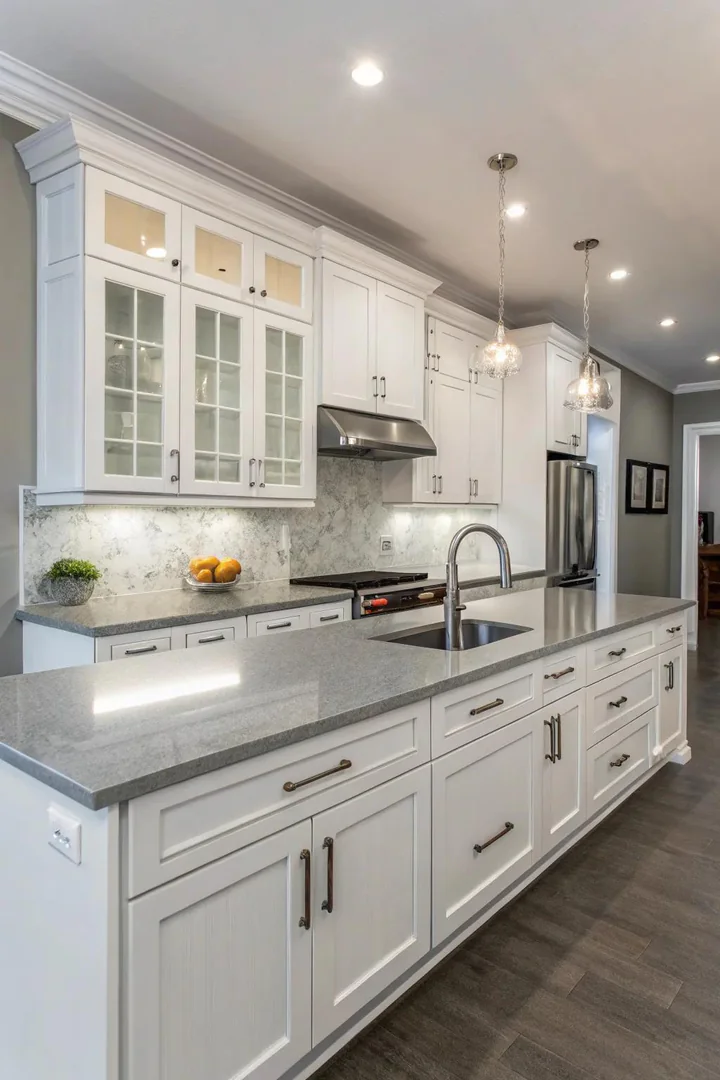
An engineered quartz countertop from Cambria Berwyn ($75 per square foot) or MSI Calacatta Classique ($55 per square foot) delivers the veined look of natural marble without the sealing, etching, or staining risk. Quartz is 93% ground natural quartz bound with 7% polymer resin, producing a non-porous surface that resists wine, coffee, oil, and lemon juice without a sealant. A 25-year limited warranty from most quartz manufacturers covers cracking, chipping, and staining under normal residential use.
Gray quartz with white veining mimics Carrara or Calacatta marble so closely that the difference is invisible at arm’s length. The distinction appears under a magnifying glass: marble veining follows natural mineral deposits and varies across each slab, while quartz veining repeats in a factory-programmed pattern that trained eyes can spot at the seam between two slabs. For large kitchens with 40+ square feet of countertop, request a full-slab layout from the fabricator to minimize visible seams.
4. Minimalist White-and-Gray with Flat-Panel Cabinets
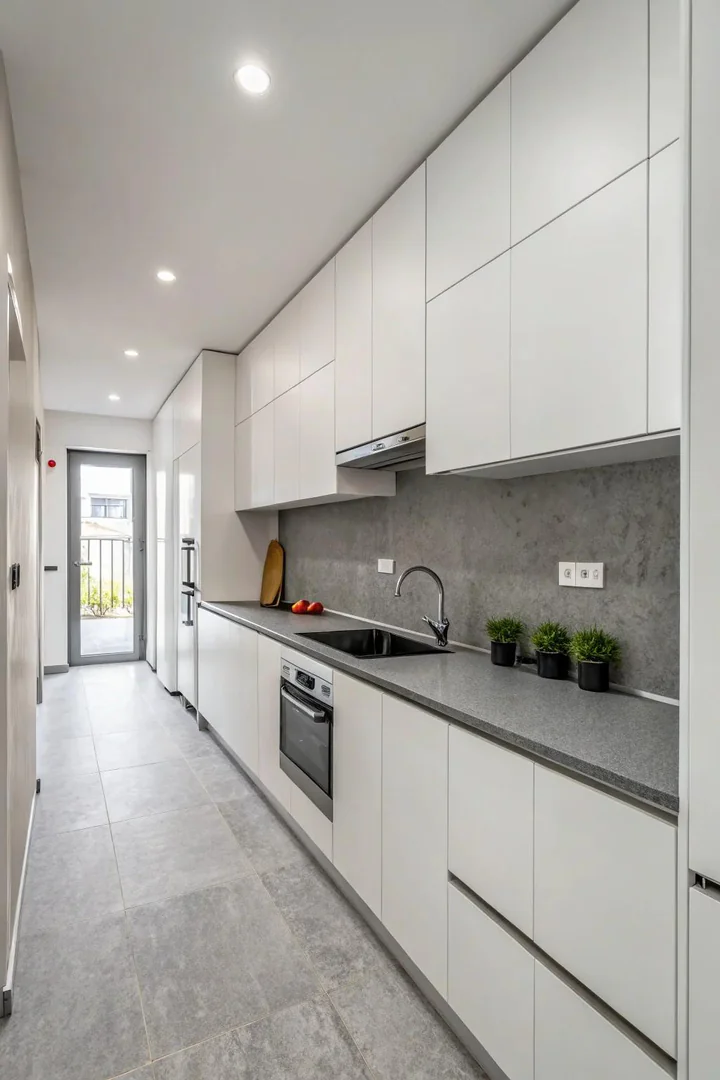
A flat-panel (slab-front) white cabinet from IKEA VOXTORP ($60 per door) or a custom European-style cabinet with a j-pull integrated handle strips the kitchen to its simplest geometry: flat white planes meeting a flat gray countertop with no molding, beading, or raised panel detail. The absence of ornamentation lets the material contrast between white and gray carry the design without distraction. A dark gray Dekton Trilium ($80 per square foot) or Silestone Charcoal Soapstone ($70 per square foot) provides the strongest contrast against true-white slab doors.
Minimalist kitchens require concealed hinges, touch-latch or push-to-open doors, and integrated appliance panels that maintain the flush, hardware-free facade. A matte or soft-matte cabinet finish hides fingerprints better than high-gloss lacquer. Pair with a slim-profile undermount sink in stainless steel or matte white composite to keep the countertop edge uninterrupted by a drop-in sink rim.
5. Gray-and-White Subway Tile Backsplash
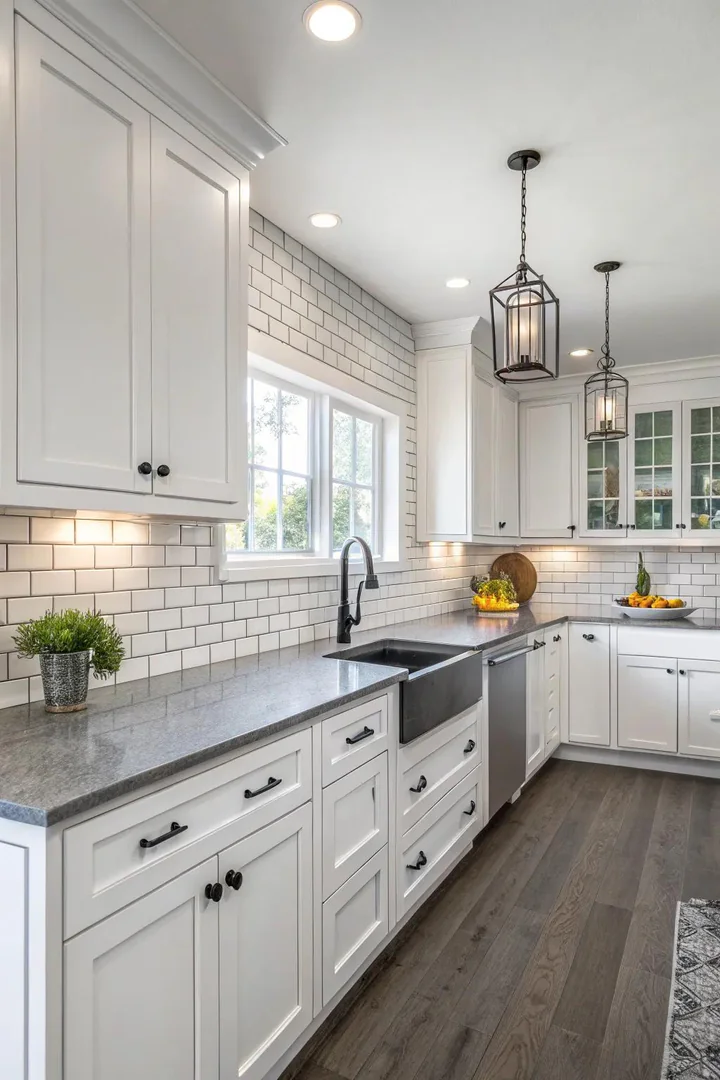
A 3-by-6-inch white ceramic subway tile from Daltile Finesse ($2 per square foot) or Bedrosians Cloe ($10 per square foot for the handmade look) bridges the white cabinets and gray countertop by covering the vertical gap between them in a neutral that belongs to both. A beveled subway tile catches light along the angled edge and adds shadow lines that give the backsplash a textured, dimensional quality that a flat tile lacks.
Grout color controls the subway tile’s personality: white grout blends the tiles into a near-solid wall, gray grout defines each tile’s rectangle and references the gray countertop below, and charcoal grout creates a graphic grid pattern that becomes the backsplash’s dominant feature. A 1/16-inch grout joint with matching white grout produces the cleanest, most continuous look. A 1/8-inch joint with contrasting gray grout produces a more traditional, detailed pattern.
6. Panel-Ready Integrated Appliances
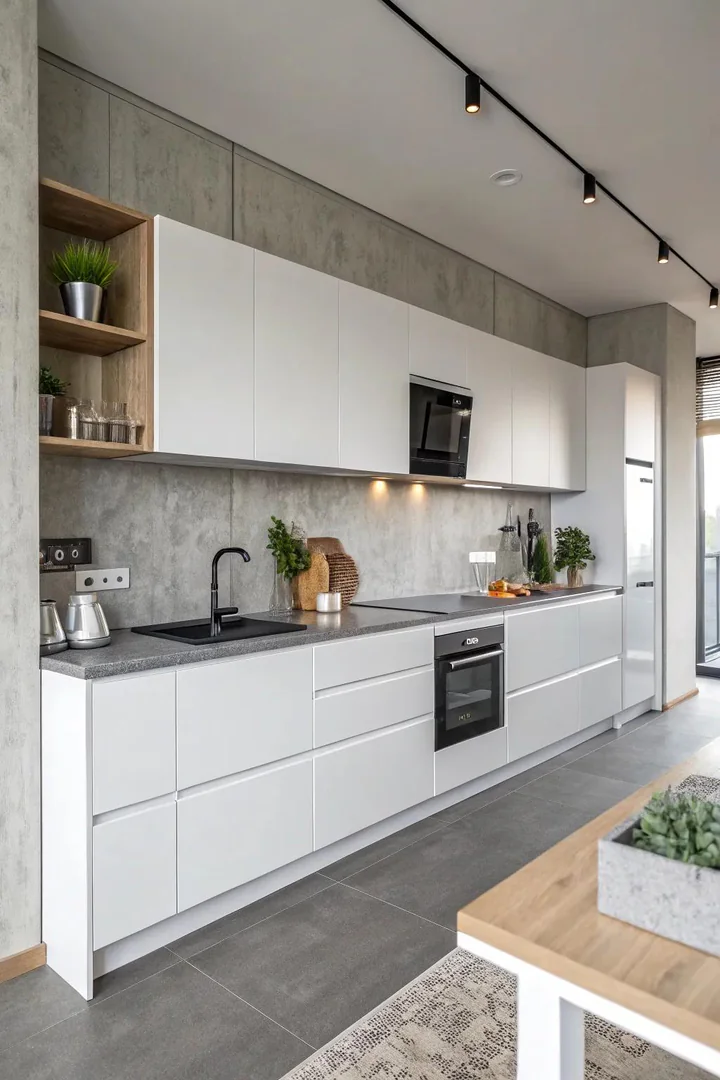
A panel-ready refrigerator from Bosch Benchmark B36IT900NP ($4,800) or Fisher & Paykel RS3684WRUVK5 ($3,900) accepts a custom white cabinet panel that makes the refrigerator disappear into the cabinet run. Integrated appliances remove the visual interruption of a stainless-steel or black box in the middle of a white wall, allowing the white-cabinet-to-gray-countertop story to run unbroken across the room.
Panel-ready dishwashers from Miele G7166SCVI ($1,600) and Bosch 800 Series SHPM88Z75N ($1,200) accept the same custom panel material as the surrounding cabinets. The only visible appliance in a fully integrated kitchen is the range or cooktop, which provides a purposeful contrast point in stainless steel. Coordinating the appliance panel material (paint, veneer, or thermofoil) with the surrounding cabinet doors requires ordering the panels from the same cabinet manufacturer to match grain, sheen, and color batch.
7. Warm Wood Accents Against Cool Gray
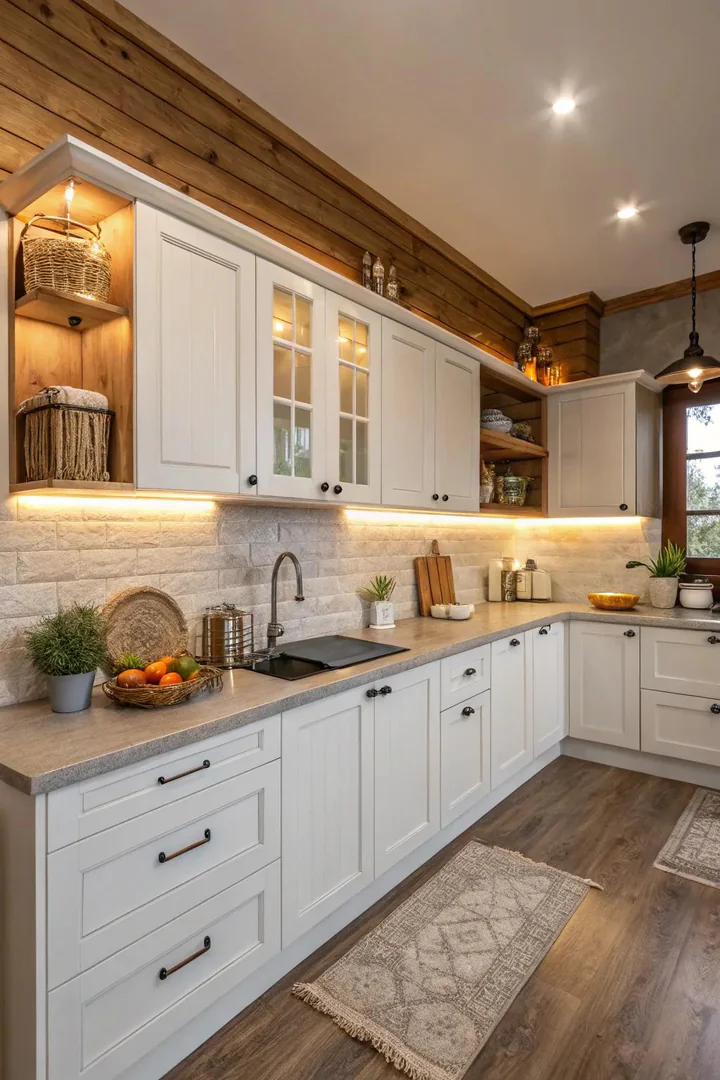
Introducing white oak floating shelves, a walnut butcher-block island top, or rift-sawn oak cabinet panels on the island base warms a white-and-gray palette that can otherwise read clinical. Wood brings organic grain, warm tone, and textural variety that stone and paint cannot produce. A white oak waterfall shelf ($25 per linear foot from a local mill) mounted between upper cabinets and the gray countertop connects the two planes with a warm-toned horizontal line.
Match the wood tone to the gray countertop’s undertone: warm gray (taupe or greige undertone) pairs with honey-toned white oak and hickory. Cool gray (blue or green undertone) pairs with walnut and rift-sawn ash, whose darker tones ground the cool palette. A matte polyurethane finish on the wood protects against kitchen moisture and grease while preserving the natural grain visibility that a high-gloss finish obscures.
8. Classic White Shaker Cabinets with Dark Gray Granite
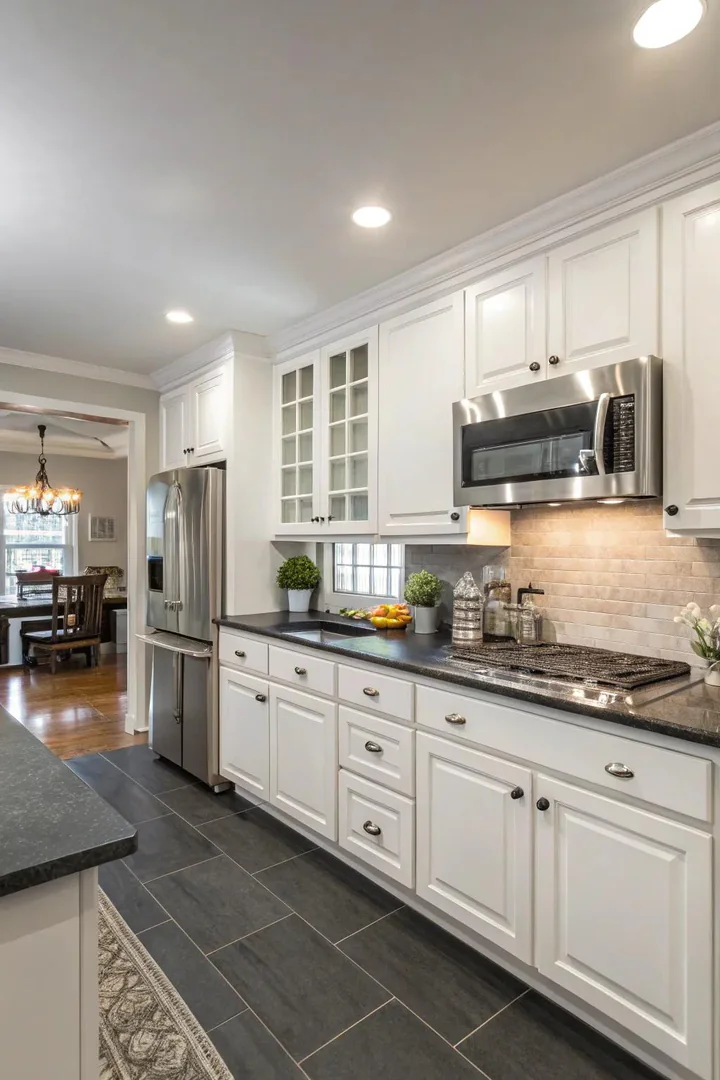
A dark gray granite countertop in Steel Gray ($45 per square foot installed) or Absolute Black Honed ($55 per square foot) paired with white Shaker cabinets creates the highest-contrast version of the white-and-gray kitchen. Dark gray granite contains mineral flecks of silver, black, and white that catch light and create depth that a solid-color engineered surface cannot reproduce. The natural stone variation means each slab is unique.
Dark gray granite absorbs light and anchors the visual weight of the kitchen at counter level, making upper cabinets and walls feel lighter by contrast. A polished finish on dark granite reflects under-cabinet lighting and brightens the countertop zone, while a leathered (textured) finish absorbs light and hides fingerprints, water spots, and daily wear. Granite requires sealing every 12 to 18 months with a penetrating impregnator, but sealed granite resists staining from wine, oil, and coffee as effectively as quartz.
9. Herringbone Pattern Flooring Under Gray Counters
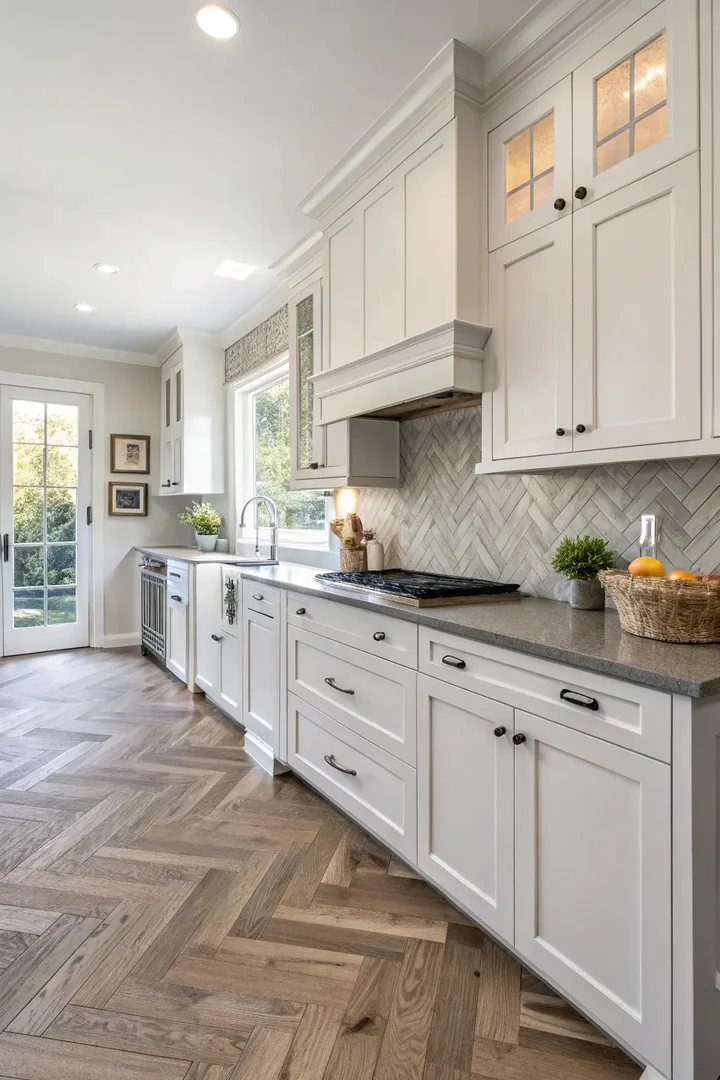
A herringbone-laid hardwood floor in white oak from Bona certified mills ($8 per square foot for 3/4-inch solid) or European oak engineered planks from Mohawk RevWood ($5 per square foot) adds directional energy to the floor plane that echoes the veining movement in a gray marble or quartz countertop. Herringbone pattern arranges 3-to-5-inch-wide planks at 45-degree angles, creating a zigzag rhythm that makes a galley kitchen appear wider and a square kitchen appear longer depending on the direction of the zigzag.
Light-toned white oak herringbone floors maintain the bright, airy quality of a white kitchen while adding warm wood contrast below the cool gray countertop. Medium-toned floors in natural or honey stain bridge the gap between white cabinets and gray stone. A matte or satin polyurethane finish on the herringbone floor aligns with the matte quality of honed or leathered gray countertops, creating a consistent sheen level across the room.
10. Carrara Marble Countertop with Soft Gray Veining
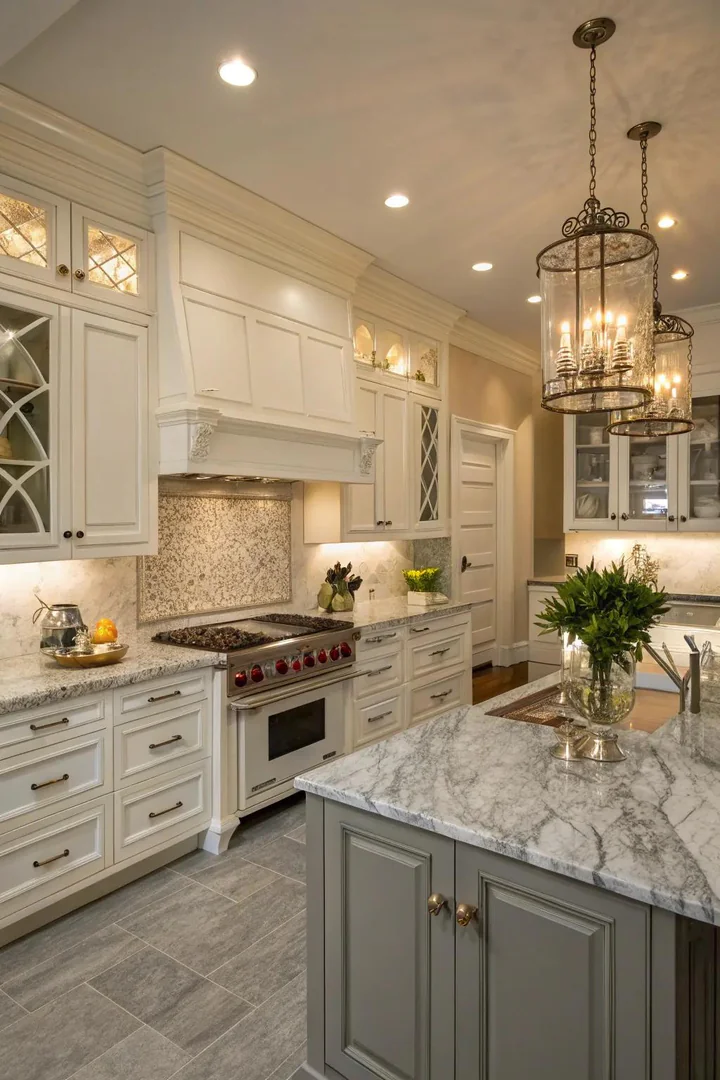
A Carrara marble countertop ($50 to $80 per square foot installed) from Italian quarries near Carrara, Tuscany, places soft dove-gray veining on a white-to-bluish-white field, creating a countertop that reads as both white and gray simultaneously. Carrara marble’s veining is finer and more evenly distributed than Calacatta marble, which carries bolder, fewer veins on a warmer white ground. A kitchen that already has white cabinets and white walls benefits from Carrara’s gray veining as the primary source of tonal variation.
Carrara marble etches when exposed to acids (citrus, vinegar, wine) and stains when oil or red sauce sits on an unsealed surface. A honed finish shows etching less visibly than a polished finish because the matte surface already diffuses light. Sealing with Dry Treat Stain-Proof ($40 per bottle, covers 200 square feet) every 6 to 12 months provides the strongest protection against oil and water absorption. Homeowners who want the Carrara look without the maintenance should consider Carrara-look quartz from Caesarstone Statuario Nuvo 5131.
11. Oversized Glass Pendant Lights Above a Gray Island
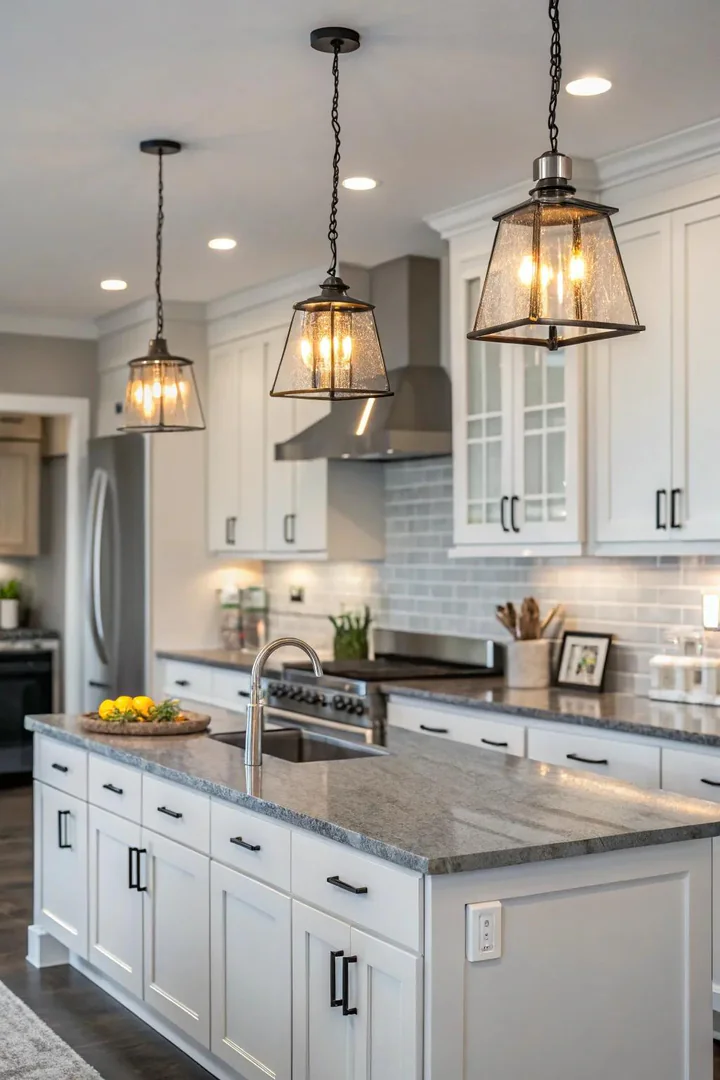
Two or three oversized clear glass globe pendants from West Elm Sculptural Glass Globe ($149 each, 12-inch diameter) or Restoration Hardware 20th Century Factory Filament ($195 each) hung 30 to 36 inches above a gray countertop island create a vertical focal point that draws the eye upward from the stone surface. Clear glass pendants cast unfiltered light directly onto the countertop, bringing out the veining and mineral patterns in natural stone.
Space pendants evenly across the island length, starting 6 inches in from each end. For a 72-inch island, two pendants centered at 24 and 48 inches create balanced illumination. For a 96-inch island, three pendants at 24, 48, and 72 inches cover the full work surface. A 2700K to 3000K LED Edison bulb ($8 per bulb) inside a clear glass shade produces warm light that prevents the gray countertop from reading cold or institutional under overhead illumination.
12. Mixed Metal Hardware on White Cabinets
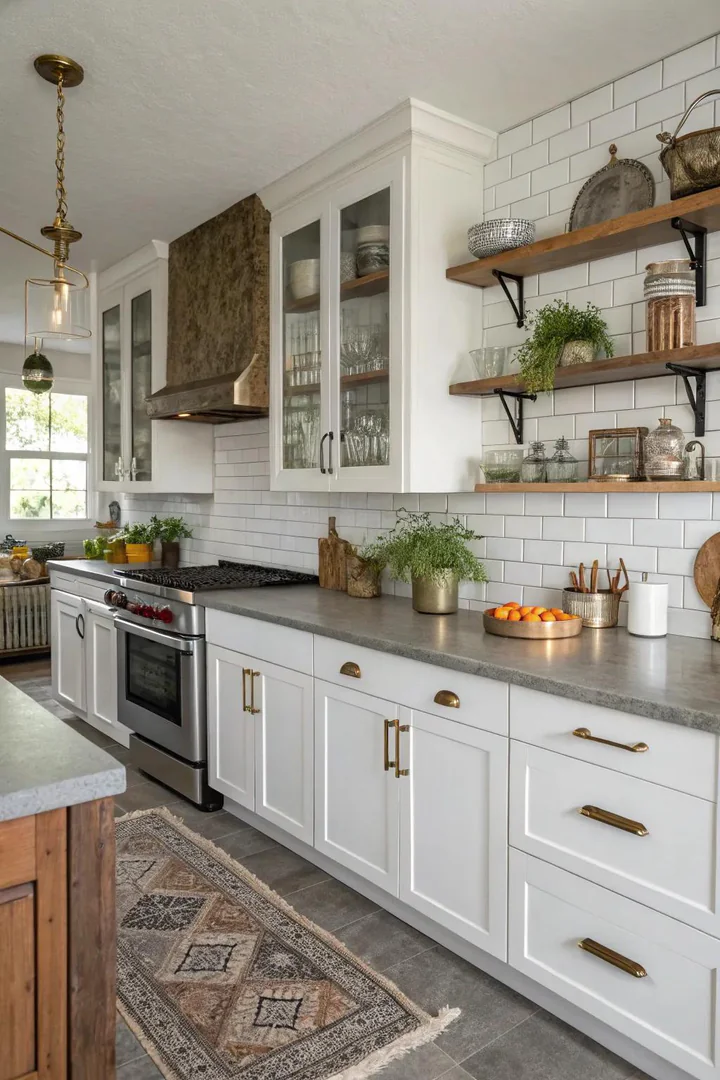
Mixing brushed brass pulls on the upper cabinets with matte black knobs on the lower cabinets (or vice versa) adds metallic depth to a white-and-gray kitchen without introducing a third color. Amerock Mulholland bar pulls in champagne bronze ($6 each) and Top Knobs Aspen round knobs in flat black ($5 each) create a two-tone metal palette that references both warm and cool tones in the room.
The rule for mixed metals: choose a dominant metal (60% to 70% of the hardware) and a secondary metal (30% to 40%), and apply each consistently by zone (uppers vs. lowers, perimeter vs. island, or drawers vs. doors). Avoid splitting mixed metals randomly across a single cabinet run, which reads as accidental rather than intentional. Coordinate the faucet finish with one of the two hardware metals to anchor the metal palette at the sink zone. Find more color and material pairing approaches at ideas to maximize kitchen cabinet space, where cabinet interior organization complements exterior design.
13. Stainless Steel Appliances as the Silver Accent
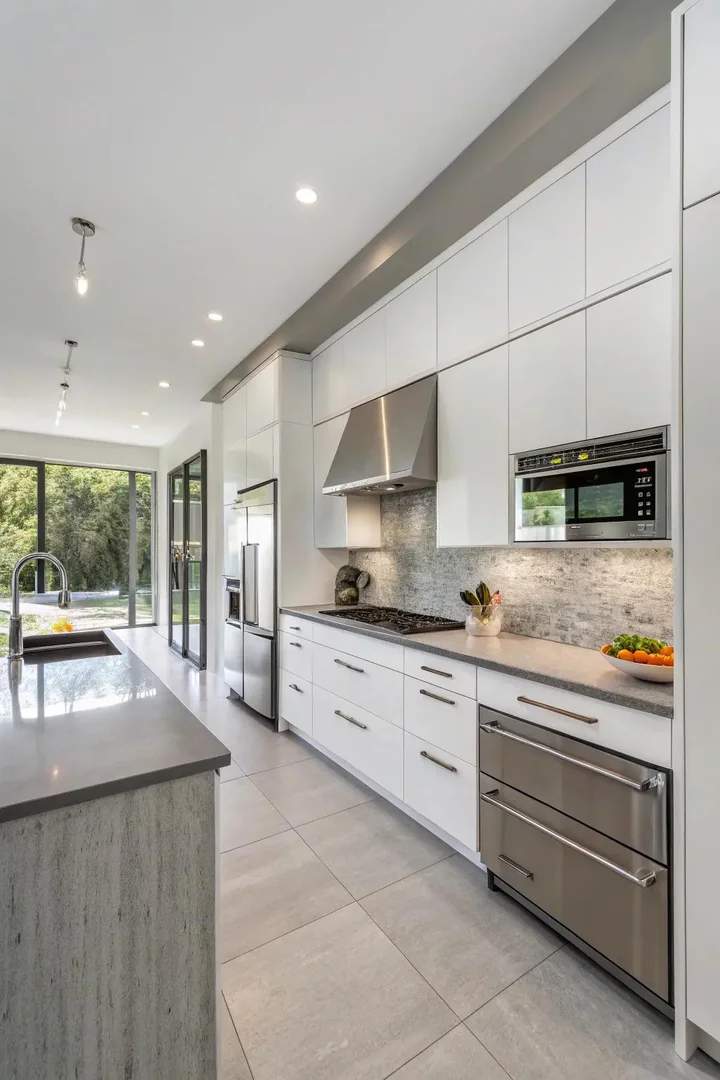
A stainless-steel appliance suite from KitchenAid, GE Profile, or Samsung Bespoke introduces a third gray tone that bridges the white cabinets and gray countertop through its reflective silver surface. Fingerprint-resistant stainless finishes from GE Profile (PVD) and Samsung (fingerprint-resistant steel) reduce the daily wiping that polished stainless demands. A 36-inch stainless range from GE Cafe CGS750P2MS1 ($2,200) anchors the cooking zone with a professional aesthetic that references commercial kitchen design.
Stainless steel reads as a metallic gray that shifts between cool silver and warm pewter depending on the surrounding light color. Warm 2700K under-cabinet lighting makes stainless lean warm, while 4000K daylight-balanced bulbs make stainless read cooler. Coordinate the stainless appliance finish with either brushed nickel or chrome cabinet hardware (both carry a silver tone) rather than brass or matte black, which create a three-metal palette that can feel busy in a small kitchen.
14. Floating Display Shelves Flanking a Window
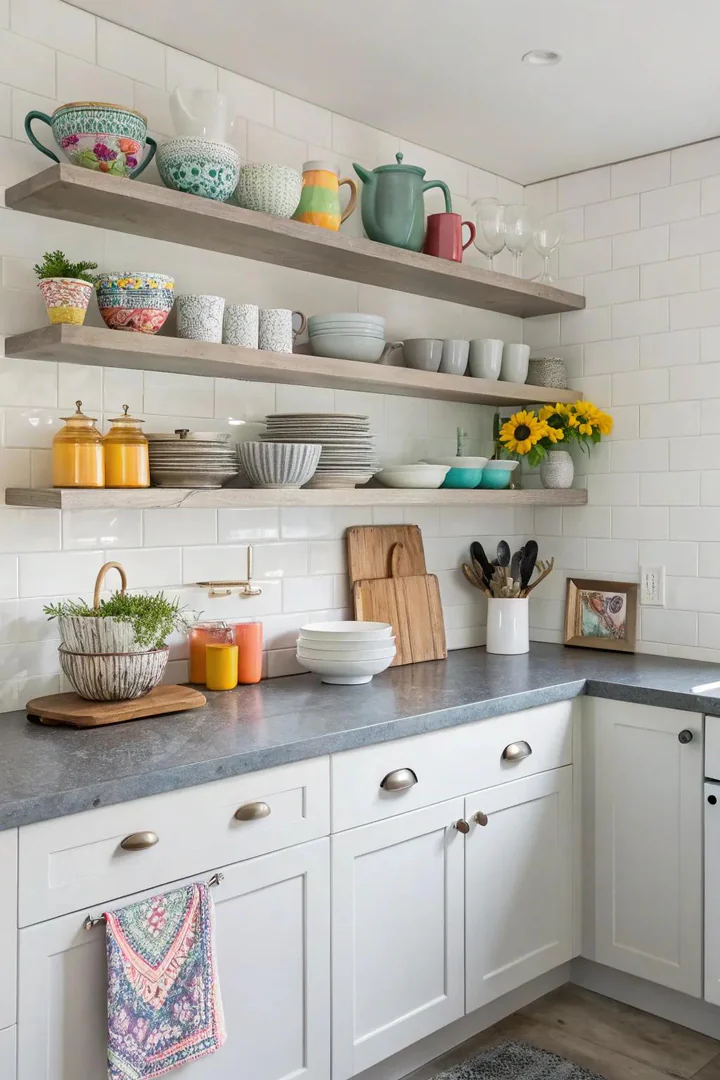
Mounting 10-inch-deep floating shelves from Threshold at Target ($20 each) or custom 1.5-inch-thick white oak shelves ($40 per linear foot from a local mill) on either side of a kitchen window creates a display zone for cookbooks, ceramic vessels, plants, and curated objects that soften the hard white-and-gray material palette. Two shelves per side, spaced 12 inches apart vertically, provide enough display real estate without overwhelming the window.
Floating shelves beside a window capture natural daylight from the side, creating bright, shadow-free illumination on displayed objects that under-cabinet lights cannot replicate. Paint the floating shelves the same white as the cabinets for a built-in look, or leave natural wood exposed for a warm contrast. Style the shelves with objects in white, gray, green (plants), and one warm metallic (brass or copper) to maintain the room’s palette while adding life and texture.
15. Waterfall Gray Countertop on the Island
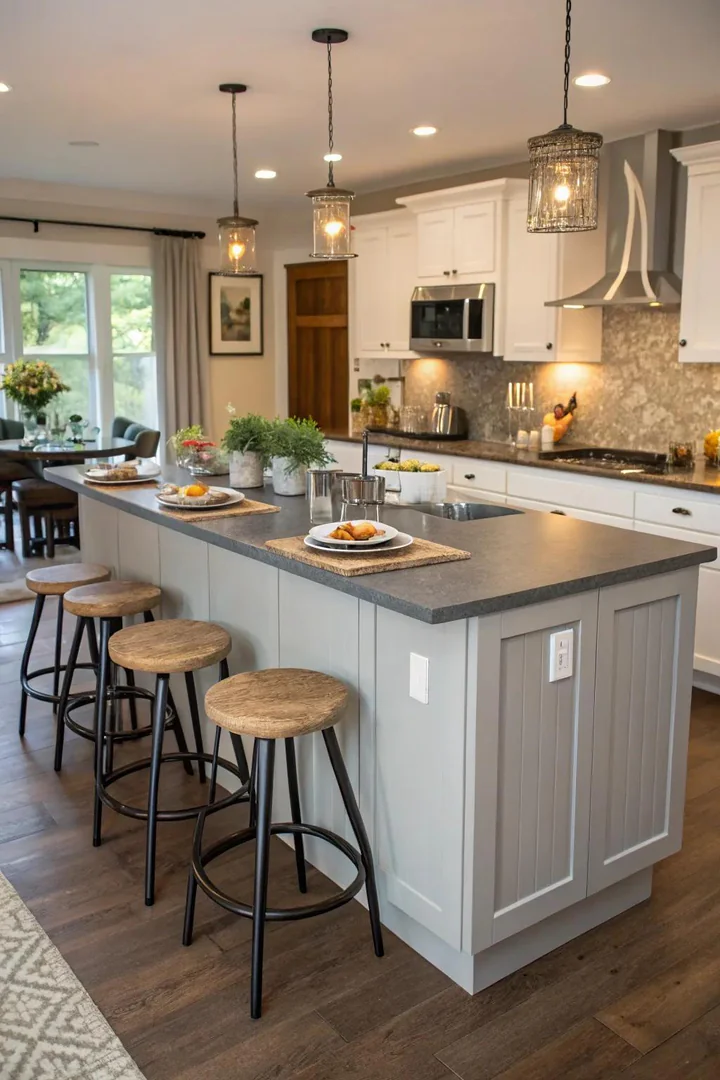
A waterfall edge wraps the gray countertop material down the sides of the island to the floor, creating an uninterrupted stone surface that turns a horizontal counter into a sculptural object. Waterfall edges add roughly $800 to $1,200 to the island fabrication cost (two mitered end panels plus seam polishing) but eliminate the need for a separate island base material. Caesarstone Rugged Concrete 4033 ($70 per square foot) and Cambria Helmsley ($85 per square foot) produce dramatic waterfall surfaces with visible texture and veining that flows from the top down the sides.
A waterfall island with 12 to 15 inches of countertop overhang on the eating side accommodates 26-inch counter-height stools from Article Esse ($199 each) or CB2 Vapor ($179 each) for casual dining. The gray waterfall panel behind the stools becomes the visual backdrop of the seating zone, so choose a countertop with veining that reads well vertically. Bookmatched waterfall panels (the two side panels cut from the same slab and flipped to mirror each other) create a symmetrical vein pattern at the island corners.
16. Statement Range Hood in Painted or Plastered White
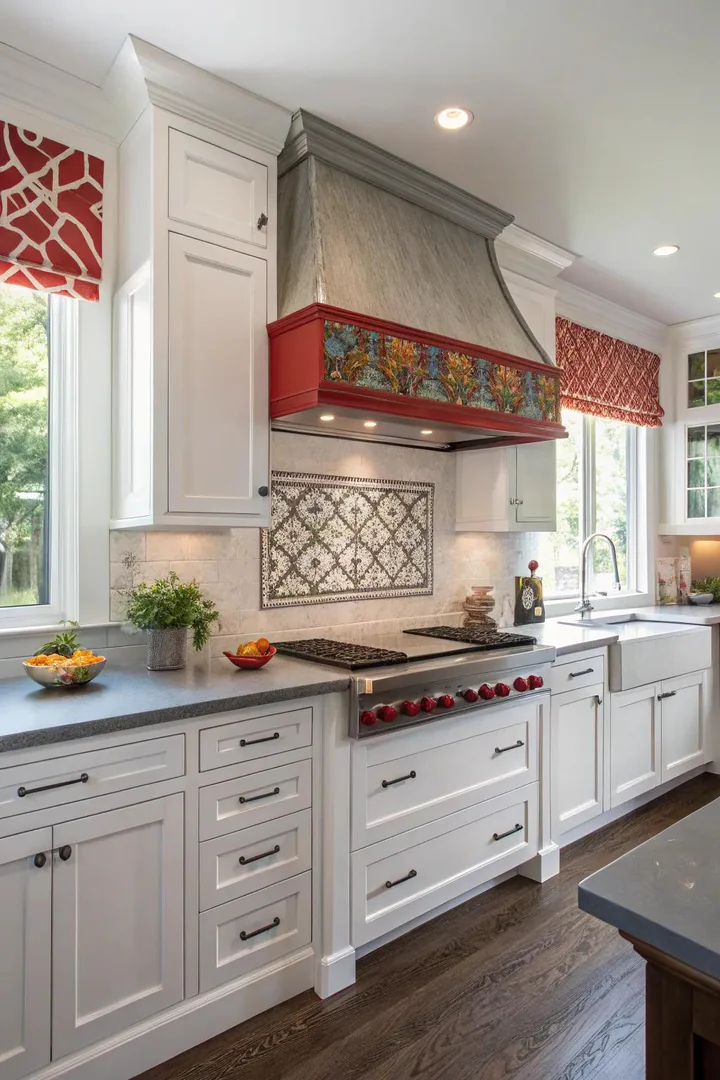
A custom plaster range hood finished in Venetian plaster or lime wash creates a sculptural white focal point above the cooktop that anchors the upper wall and frames the gray countertop below. Plaster hoods cost $1,500 to $3,000 for custom fabrication (metal liner plus plaster application), compared to $300 to $600 for a standard stainless-steel chimney hood. The matte, hand-troweled texture of plaster adds a tactile quality that painted drywall and smooth stainless cannot match.
A 600 to 900 CFM blower insert from Zephyr ($400) or Broan-NuTone ($250) fits inside a custom plaster hood shell and provides the ventilation performance of a commercial unit behind an artisan-finished exterior. Pair the white plaster hood with a pot rail mounted on the backsplash below the hood to hang copper pots and utensils, adding a warm metallic accent between the white hood and the gray countertop.
17. Industrial Black Steel Accents with Gray Concrete
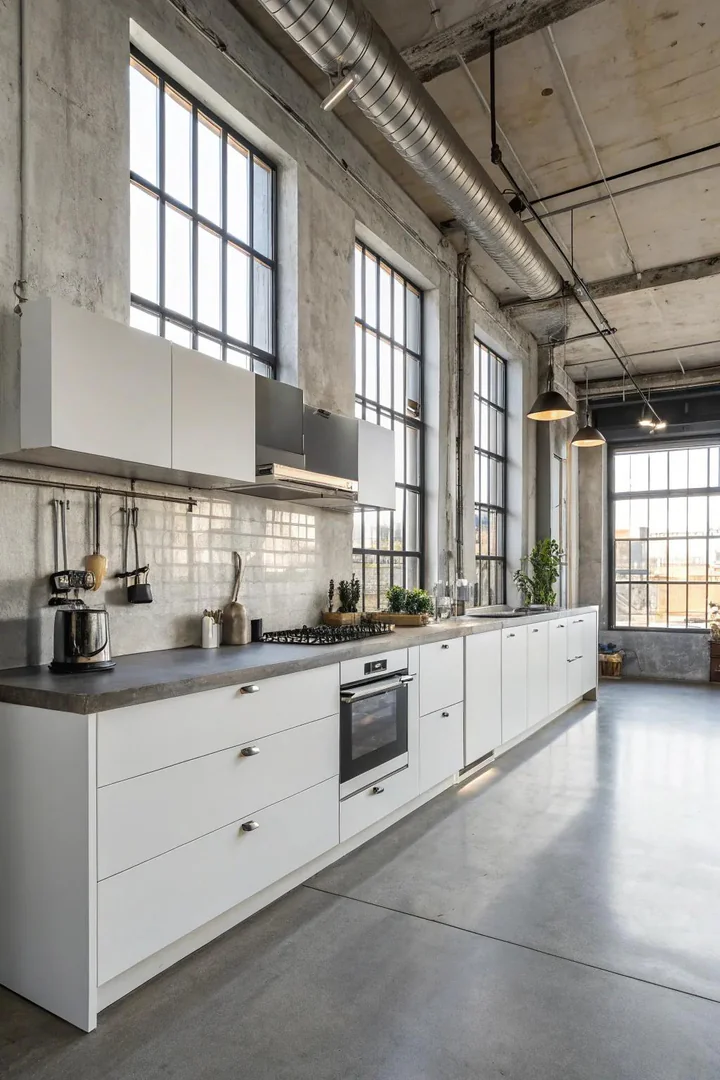
A poured concrete countertop from a local concrete fabricator ($65 to $100 per square foot) or a precast concrete from Concrete Collaborative ($80 per square foot) brings raw, industrial texture to the gray countertop plane. Concrete accepts integral pigments that produce any shade from pale dove to charcoal, and surface treatments (acid stain, trowel marks, exposed aggregate) add handmade character that no manufactured stone replicates. Seal concrete with a food-safe penetrating sealer and wax every 3 to 6 months.
Pair gray concrete counters with matte black steel-frame open shelving, black iron pipe pot racks, and black window frames to build an industrial material palette. The black metal accents read as the darkest gray in the room, extending the tonal range from white cabinets through gray concrete to near-black steel. A raw steel pendant light from Schoolhouse Electric ($250) or Rejuvenation Eastmoreland ($200) connects the black accents overhead. Browse additional cabinet combinations at mosaic kitchen backsplash ideas, where gray-toned mosaics pair with white and gray kitchens.
18. Patterned Encaustic or Zellige Tile Backsplash
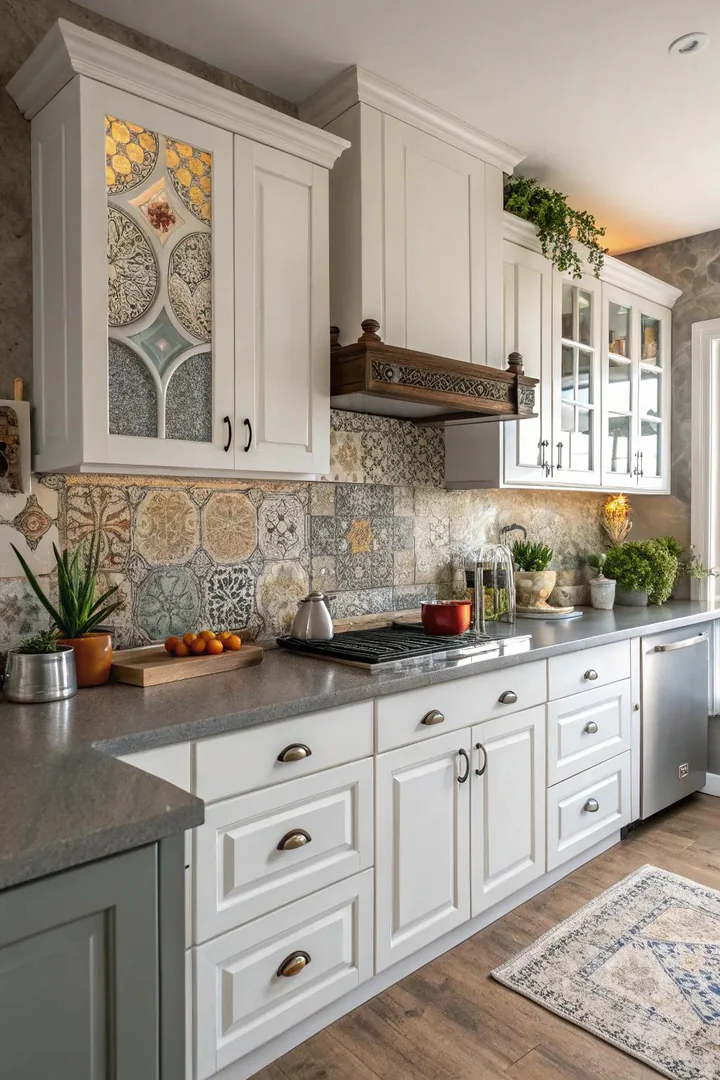
A gray-and-white encaustic cement tile from Cement Tile Shop ($10 to $15 per tile) or a hand-glazed zellige tile from Clé Tile ($20 per square foot) in weathered white or pale gray introduces pattern, texture, and artisan imperfection into a white-and-gray kitchen that might otherwise read too controlled. Encaustic cement tiles carry geometric patterns (Moorish star, arabesque, quatrefoil) pressed into pigmented cement, while zellige tiles carry a hand-dipped glaze that pools and cracks for a one-of-a-kind surface.
A patterned backsplash should be the only patterned surface in a white-and-gray kitchen. Pair patterned tile with solid (non-veined) gray quartz or concrete countertops so the two surfaces do not compete for attention. A single-pattern tile covering the full backsplash from countertop to upper cabinet creates a wallpaper-like effect, while a patterned tile used only behind the range (as a feature panel) keeps the pattern contained and focal.
19. Full-Height Slab Backsplash Matching the Countertop
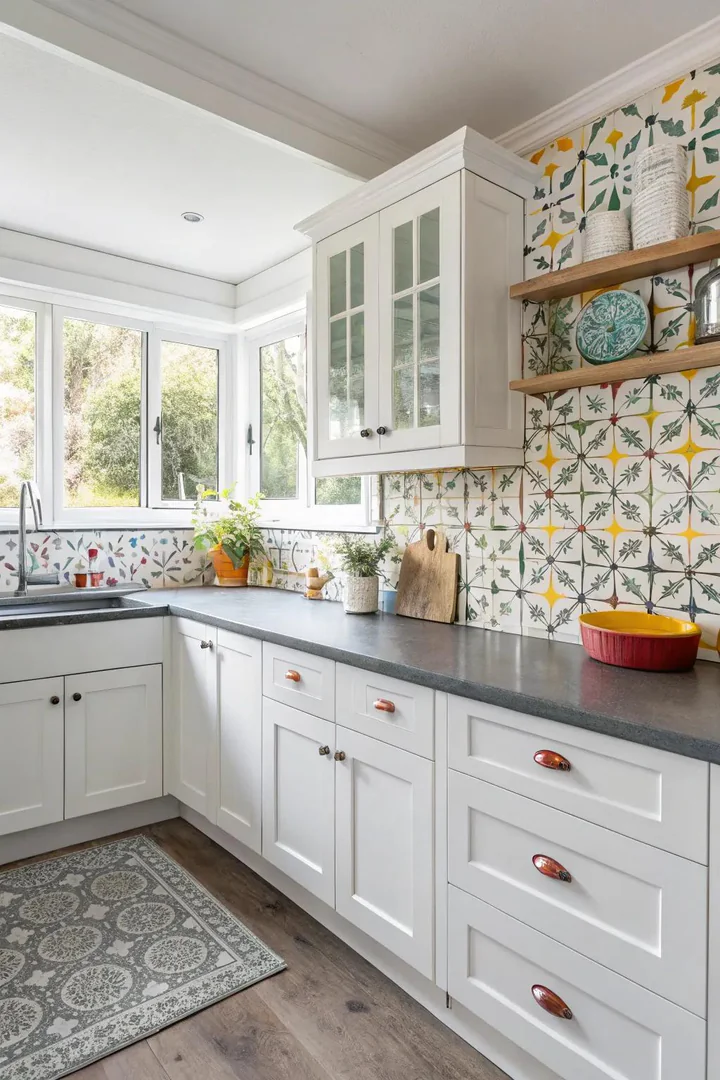
Extending the same gray countertop material up the wall as a full-height slab backsplash (countertop to upper cabinet, typically 18 inches) eliminates the horizontal break between counter and backsplash and creates a continuous gray surface that wraps from horizontal to vertical. A full-height slab backsplash in Cambria Brittanicca ($85 per square foot) or Caesarstone Empira White 5151 ($75 per square foot) produces a monolithic stone wall with veining that flows from countertop to backsplash.
Fabricators cut the backsplash panels from the same slab as the countertop and bookend the veining so the pattern continues upward from the counter edge. A waterproof silicone bead at the counter-to-backsplash joint replaces grout and stays flexible as the materials expand and contract with temperature changes. Full-height slab backsplashes cost more than tile ($30 to $50 per square foot for the slab alone) but eliminate grout lines, which reduces long-term cleaning effort and mold risk behind the sink and range.
20. Ceiling-Height White Cabinets with Gray Quartz
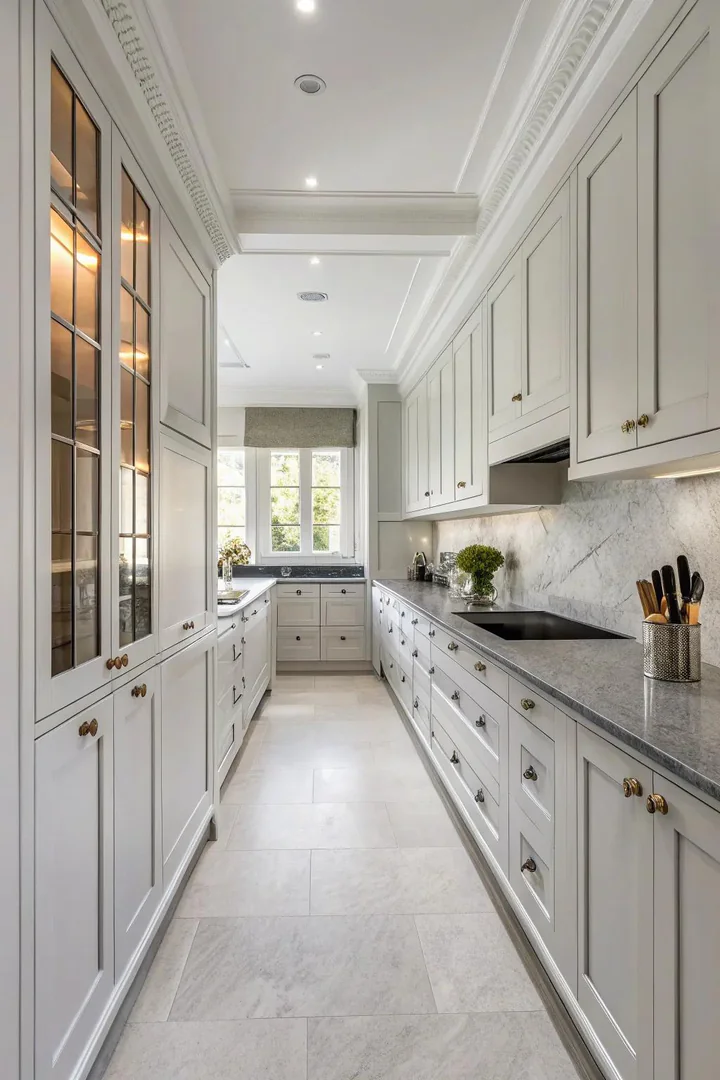
Extending upper cabinets from the countertop to the ceiling (typically 96 to 108 inches total height) fills the soffit gap that collects dust and visual clutter in standard 30-inch-tall upper cabinet installations. 42-inch upper cabinets from KraftMaid ($350 per cabinet) or IKEA SEKTION 40-inch ($200 per cabinet) stacked with a 12-inch matching cabinet on top reach most 8-foot ceilings. The floor-to-ceiling white cabinet wall amplifies the white-to-gray contrast by maximizing the white surface area above the gray countertop line.
Ceiling-height cabinets require a step stool or a rolling library ladder ($250 from Rockler) for top-shelf access, so store rarely used items (holiday platters, large serving bowls, bulk reserves) on the highest shelves. Crown molding at the cabinet-ceiling junction closes any gap caused by an uneven ceiling line and gives the installation a built-in furniture quality. A light rail molding at the bottom of the upper cabinets conceals under-cabinet LED strip lighting and creates a finished edge. Pair ceiling-height cabinets with a grey kitchen cabinet island base for a two-tone white-perimeter, gray-island layout. Visit emerald green kitchen design ideas for a contrasting accent color that pairs with white and gray.
How to Choose the Right Gray Countertop Shade for Your White Kitchen
1. Identify the Cabinet White Undertone
Hold a pure white paint chip (Benjamin Moore Chantilly Lace) next to your cabinet door in natural daylight. A cabinet that reads warmer than the chip has a yellow, cream, or pink undertone. A cabinet that reads cooler has a blue or gray undertone. Warm whites pair with warm grays (taupe, greige, mushroom), and cool whites pair with cool grays (blue-gray, charcoal, steel). Mixing warm cabinets with cool gray countertops creates a temperature clash that reads as “off” without the viewer understanding why.
2. Test Countertop Samples Under Your Kitchen’s Lighting
Request 6-by-6-inch samples from 3 countertop suppliers and live with them on your existing counter for 48 hours. View each sample in morning daylight, afternoon sun, overhead fluorescent light, and evening under-cabinet LED light. Gray stone shifts dramatically between cool fluorescent lighting (reads blue) and warm LED lighting (reads taupe). A gray that looks perfect in the showroom under 4000K commercial lighting may read entirely different under your home’s 2700K kitchen lighting.
3. Match the Gray Intensity to the Kitchen Size
A small kitchen (under 100 square feet) benefits from a light gray countertop that reflects daylight and maintains brightness. A large, well-lit kitchen (200+ square feet with multiple windows) can support a dark charcoal or graphite countertop without the room feeling heavy. Medium gray works in mid-sized kitchens as a safe middle ground. The general guideline: the darker the gray, the more natural light the kitchen needs to balance the visual weight of the stone.
Gray Countertop Material Comparison
| Material | Cost per Sq Ft | Sealing Required | Stain Resistance | Heat Tolerance | Gray Shade Range |
|---|---|---|---|---|---|
| Engineered quartz | $55–$85 | No | Excellent | Moderate (use trivets) | Silver to charcoal |
| Carrara marble | $50–$80 | Yes, every 6–12 months | Fair (etches with acid) | Good | Dove to blue-gray |
| Granite | $45–$75 | Yes, every 12–18 months | Good | Excellent | Steel to black |
| Soapstone | $70–$100 | Oil, not sealant | Good (self-healing) | Excellent | Blue-gray to charcoal |
| Concrete | $65–$100 | Yes, every 3–6 months | Fair (porous) | Good | Custom: any shade |
| Dekton (ultra-compact) | $75–$100 | No | Excellent | Excellent | Silver to anthracite |
Frequently Asked Questions
Do gray countertops make a white kitchen look cold?
Gray countertops with warm undertones (taupe, greige, mushroom) read as warm neutrals that prevent the kitchen from feeling clinical. Pair warm-toned gray stone with warm-white cabinets (cream undertone), warm wood accents (white oak, walnut), and warm-temperature lighting (2700K to 3000K) to maintain a cozy atmosphere. Cool gray countertops (blue or steel undertone) can read cold in north-facing kitchens with limited natural light, so reserve those shades for south-facing or well-lit rooms.
What is the most durable gray countertop material?
Engineered quartz and Dekton (ultra-compact surface) score highest on durability tests: both resist scratching, staining, heat, and moisture without sealing. Quartz rates 7 on the Mohs hardness scale (compared to granite at 6 to 7 and marble at 3 to 4). Dekton withstands direct flame and hot-pot placement without scorching, making it the strongest performer behind a gas range. Granite offers excellent scratch and heat resistance but requires periodic sealing to maintain stain protection.
How much does a gray quartz countertop cost compared to gray marble?
Gray quartz runs $55 to $85 per square foot installed, while gray marble (Carrara, Bardiglio) runs $50 to $80 per square foot installed. The material cost is comparable, but marble adds ongoing maintenance cost: $40 to $80 per year for sealant and $200 to $400 for professional honing every 3 to 5 years to remove etching. Over a 10-year period, quartz costs $0 in maintenance while marble accumulates $400 to $1,200 in sealing and refinishing, making quartz the lower total-cost-of-ownership choice.
Can you pair gray countertops with gray cabinets instead of white?
A gray-on-gray kitchen works when the cabinet gray and the countertop gray differ by at least 3 shades on the same tonal scale. Light gray cabinets (Sherwin-Williams Repose Gray SW 7015) with dark charcoal countertops, or charcoal cabinets with pale silver countertops, create contrast within the gray family. Matching cabinet and countertop in the same shade of gray produces a monolithic look that can feel flat without a strong accent color (brass hardware, white backsplash, or a warm wood island) to break the monotone.
What backsplash material pairs best with white cabinets and gray countertops?
White subway tile is the most popular pairing because the white tile connects to the cabinets while the gray grout (or gray tile accent) connects to the countertop. A full-height slab backsplash in the same gray countertop material creates the most cohesive look. Patterned encaustic tiles in gray-and-white add visual interest without introducing a third color. Avoid busy multicolor mosaic backsplashes in a white-and-gray kitchen because the color restraint of the palette is the design’s strength. Visit The Designers Company for more kitchen design guides covering backsplash, cabinet, and countertop pairings.