
Outdoor Kitchen Storage Ideas: 26 Smart Ways to Maximize Space
Outdoor kitchen storage ideas solve the single biggest functional challenge of cooking outside: keeping tools, ingredients, cookware, cleaning supplies, and serving items organized, accessible, and protected from rain, humidity, temperature swings, insects, and UV exposure that would destroy anything you store indoors without a second thought. An outdoor kitchen without purpose-built storage forces you to carry everything in and out of the house for every meal, defeating the convenience that an outdoor cooking space is supposed to provide.
The 26 outdoor kitchen storage ideas below cover every storage category — drawers, pantries, access doors, warming drawers, trash systems, spice racks, coolers, corner shelves, hanging racks, under-counter fridges, pull-out cutting boards, wine storage, modular shelving, hooks, sink storage, open shelving, grill storage, sliding doors, vertical systems, hidden compartments, adjustable shelves, weatherproof cabinets, bench seating with storage, rolling carts, and custom built-in units. Each idea includes specific products, materials, and installation approaches for outdoor conditions.
1. Drawers for Cabinets
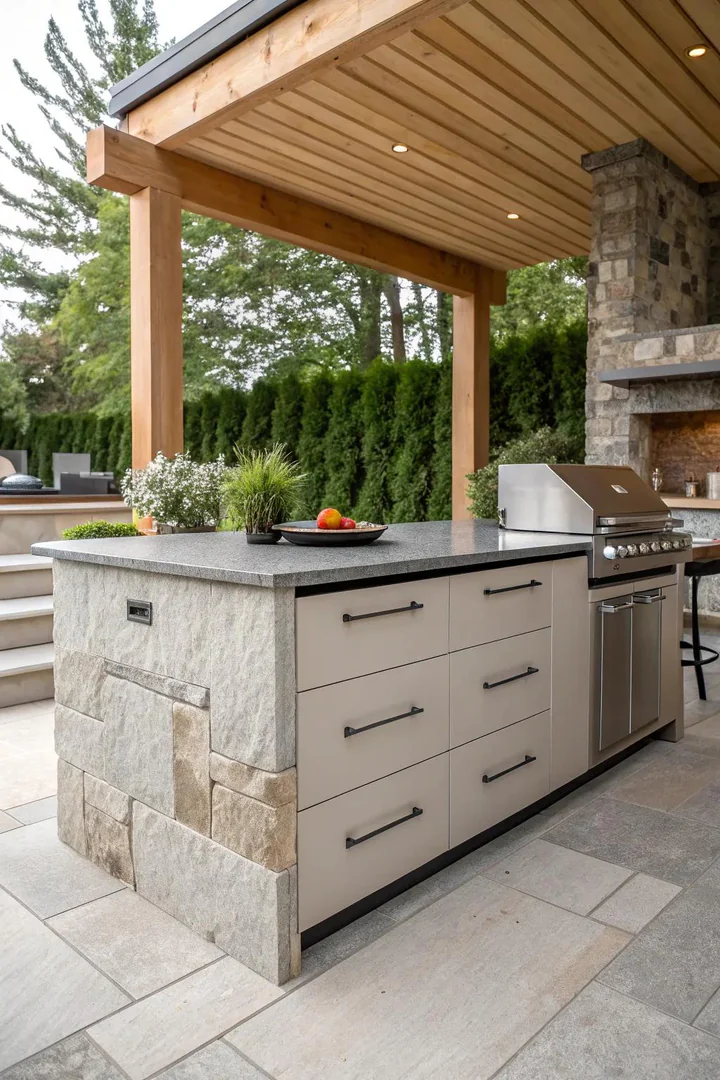
Stainless steel cabinet drawers are the foundation of outdoor kitchen storage — they pull out to reveal the full depth of the cabinet interior, making it easy to see and reach everything stored inside without bending down and reaching blindly into a dark cabinet. Unlike swinging cabinet doors, drawers keep contents organized in visible layers and prevent items from falling behind each other.
Choose 304-grade stainless steel drawers (from Blaze, Lynx, or Bull Outdoor Products) with marine-grade ball-bearing drawer slides rated for 100 pounds or more. Standard outdoor kitchen drawer sizes are 15-inch, 20-inch, and 30-inch widths. Use drawer dividers or organizer inserts (stainless steel or heavy-duty plastic) to separate utensils, bottle openers, thermometers, and grilling tools within each drawer. Full-extension slides that allow the drawer to open past the cabinet face provide better access than partial-extension slides.
2. Pantry for Dry Storage
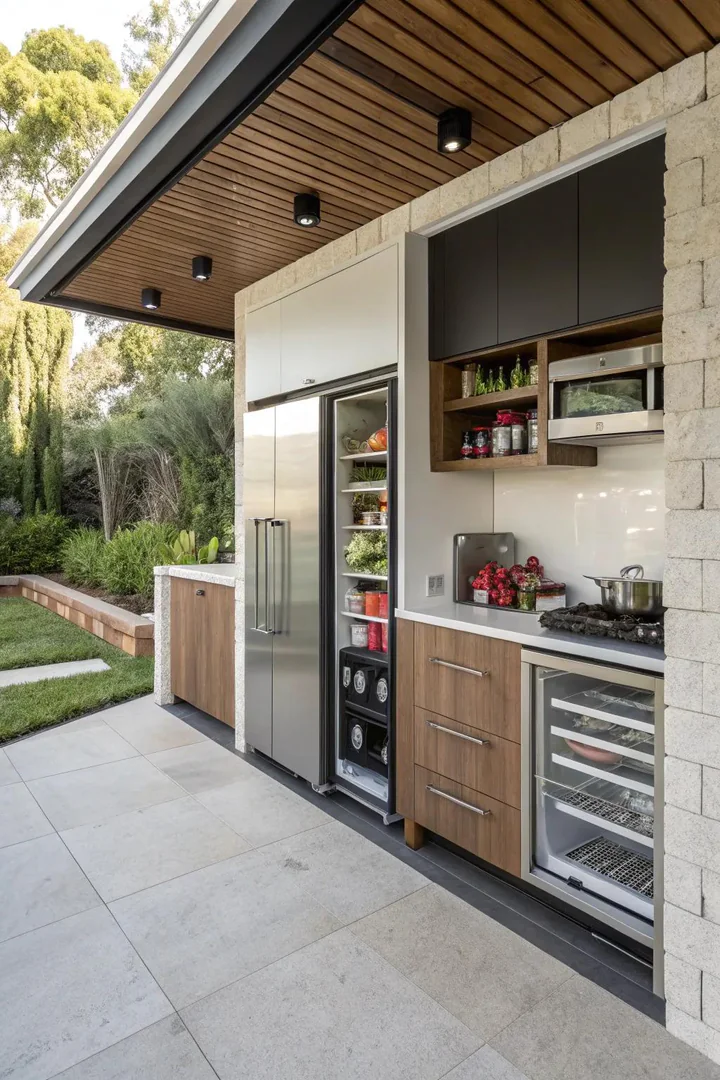
A sealed, weatherproof dry storage pantry keeps non-perishable ingredients — cooking oils, spices, rubs, sauces, charcoal, wood chips, aluminum foil, plastic wrap, and paper plates — protected from rain, humidity, and pests. Without dedicated dry storage, these items either sit exposed on the counter (where they deteriorate quickly in outdoor conditions) or must be carried out from the house for every cooking session.
Build or install a tall, narrow cabinet (12 to 18 inches wide, 24 inches deep, 30 to 42 inches tall) with a sealed gasket door and adjustable internal shelves. Use marine-grade stainless steel or outdoor-rated polymer (from brands like NatureKast or Werever) that resists moisture, UV, and temperature changes. Add rubber gasket seals to the door edges to keep moisture, dust, and insects out. Store items in sealed, airtight containers (OXO Pop Containers or Cambro round containers) rather than in original paper or cardboard packaging that absorbs humidity.
3. Entrance Panels
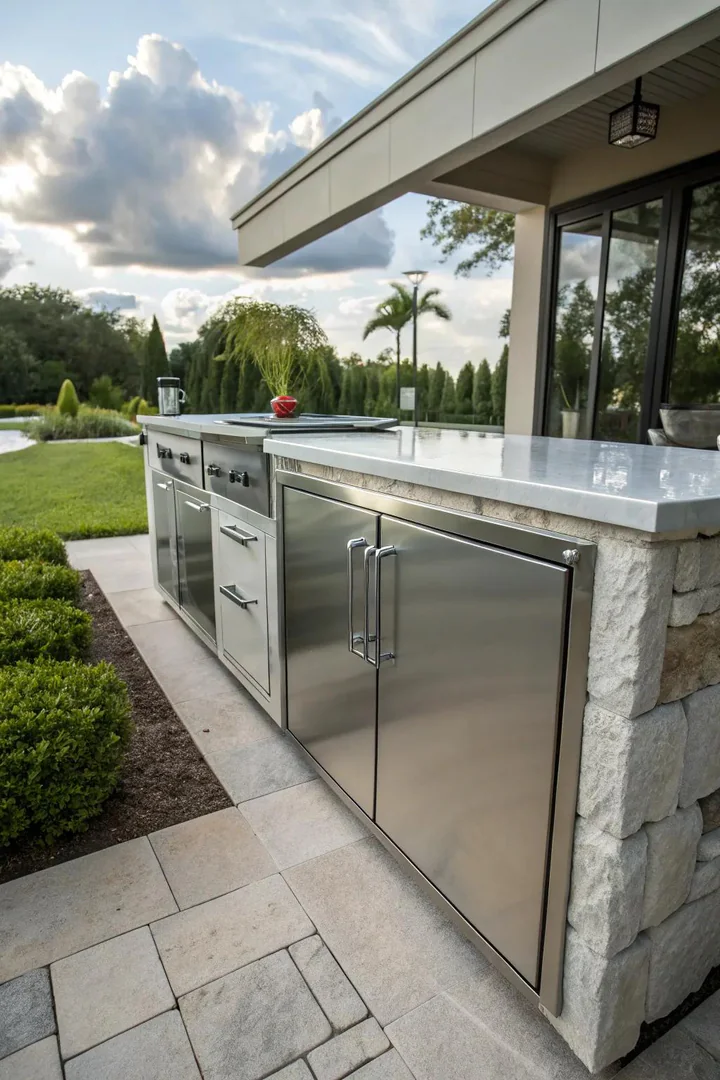
Stainless steel access doors — single or double panel doors that mount flush into the outdoor kitchen island face — provide quick access to the interior cavity of the island where you can store propane tanks, gas line valves, electrical connections, cleaning supplies, and bulk items that do not need to be organized in drawers. Access doors are the most cost-effective outdoor storage solution because they use the existing island cavity as the storage space.
Standard access door sizes include 17×24 inches (single), 31×24 inches (double), and 20×27 inches (vertical single). Choose doors with a magnetic or spring-loaded latch that stays securely closed in wind. Beveled edges and flush-mount frames prevent water pooling on the door face. Bull Outdoor Products, Blaze, and Stanbroil offer access doors in 304 stainless steel with multiple mounting options. For the island interior behind the access door, add a shelf bracket and a removable shelf to create two-tier storage rather than a single open cavity.
4. Heat Retention Drawers
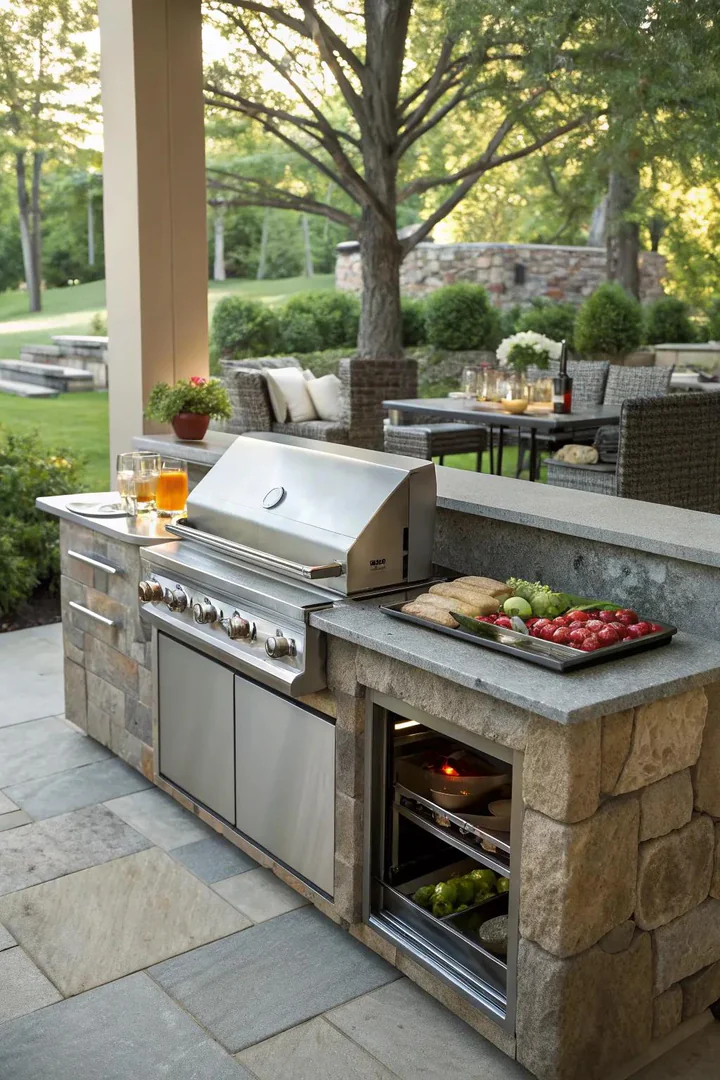
Electric warming drawers built into the outdoor kitchen island keep finished dishes, buns, tortillas, and side dishes at serving temperature (140°F to 200°F) while the main course finishes on the grill. A warming drawer eliminates the timing pressure of coordinating multiple dishes — you can grill the steaks, pull them to the warming drawer to rest, and grill the vegetables without the steaks getting cold on a countertop.
Outdoor-rated warming drawers (from Lynx, Alfresco, or Twin Eagles) are built with weatherproof housings and corrosion-resistant heating elements designed for exterior installation. Standard widths are 24 and 30 inches. Features to look for include adjustable temperature control (not just on/off), a moisture slide (adds humidity to prevent bread from drying out), and a removable drip tray for easy cleaning. When the warming drawer is not warming food, it functions as a standard storage drawer for towels, aprons, and other heat-tolerant items.
5. Drawers for Trash and Recycling Bins
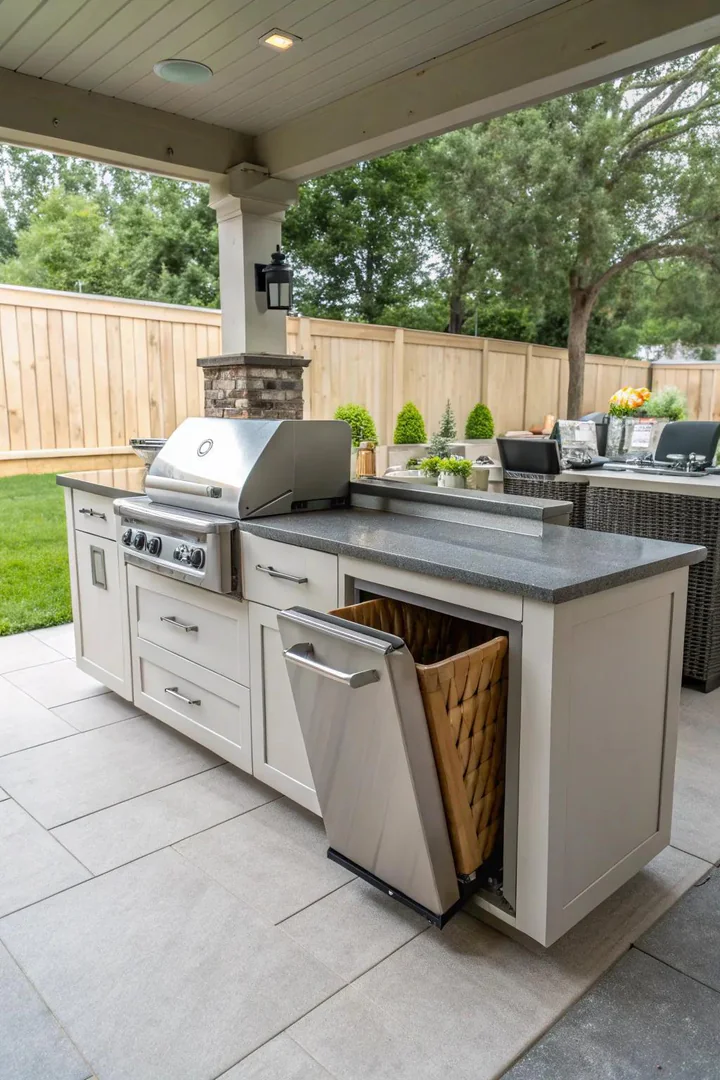
A pull-out trash and recycling drawer conceals garbage and recyclables inside the kitchen island, keeping them hidden from view, contained from wind, and inaccessible to insects, raccoons, and other pests that are attracted to outdoor food waste. An exposed outdoor trash can next to a cooking area is a magnet for flies, wasps, and animals — a sealed pull-out drawer eliminates that problem.
Choose a stainless steel trash drawer (from Bull, Blaze, or Coyote) with a full-extension slide and a sealed lid or cover plate. Standard configurations include single-bin (for trash only) and dual-bin (trash plus recycling) in 18-to-20-gallon capacity. The best designs have a removable liner or bag frame that lifts out for emptying and cleaning. Position the trash drawer within arm’s reach of the primary prep and cooking zones so you can discard trimmings, packaging, and napkins without walking across the patio.
6. Drawer for Paper Towel Holder
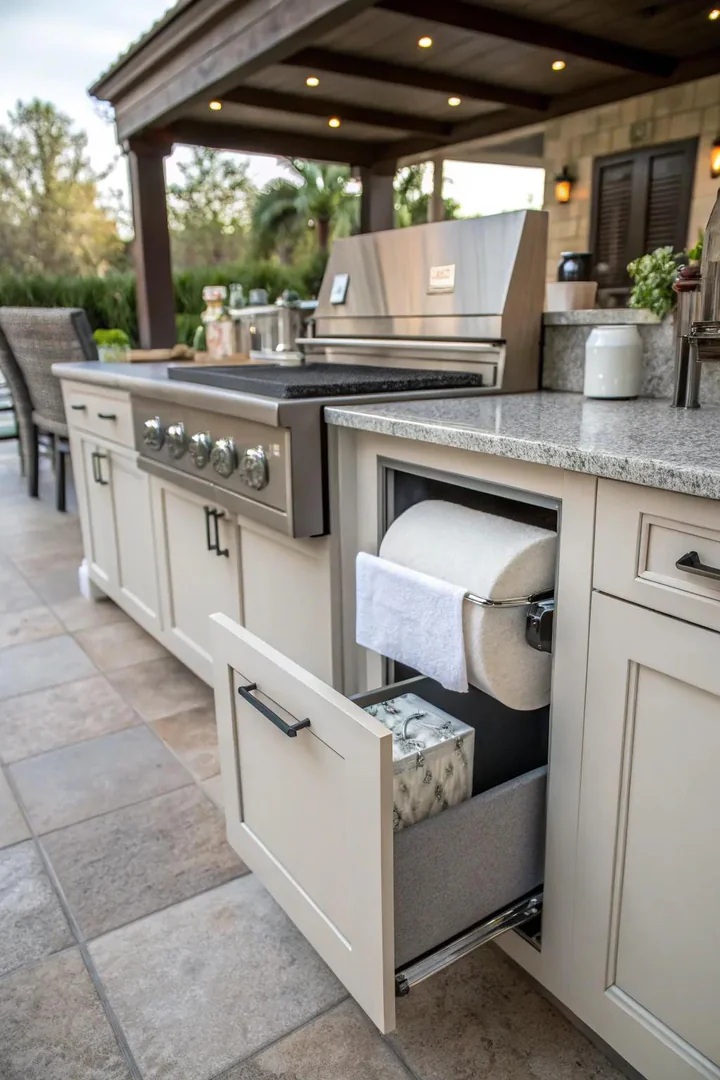
A dedicated paper towel holder drawer stores the roll inside a pull-out compartment with a built-in dispenser bar, keeping the paper towels protected from rain, wind, and sun that quickly deteriorate an exposed roll left on the counter. Outdoor paper towels exposed to weather become damp, brittle, faded, and unusable within days — a concealed drawer extends the roll’s life indefinitely.
The drawer design uses a spring-loaded or friction-fit horizontal bar inside the drawer that holds the roll in place and allows single-sheet tearing when the drawer is pulled open. Some models (from Blaze and Bull) combine the paper towel holder with a secondary storage compartment below for cleaning sprays, extra rolls, and trash bags. Mount the paper towel drawer near the primary prep zone for easy access during food preparation and cleanup.
7. Seasoning Shelf
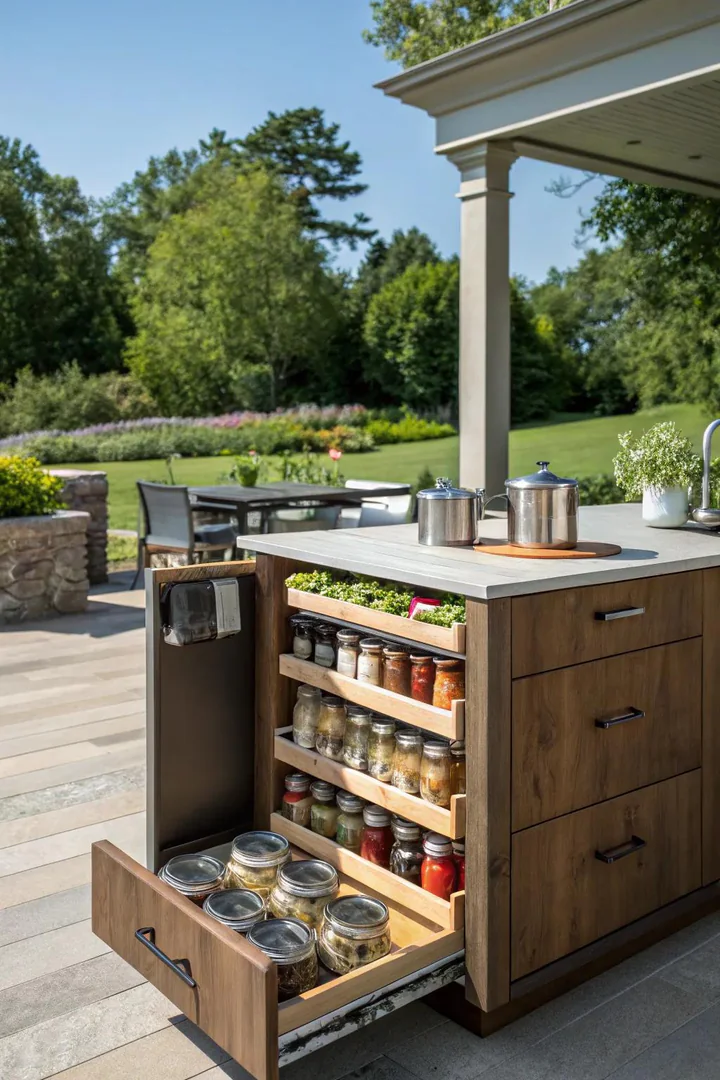
A dedicated pull-out spice rack or seasoning shelf — a narrow, vertical drawer with tiered shelves sized to hold spice jars, rub containers, and sauce bottles — keeps your outdoor cooking seasonings organized, visible, and within arm’s reach of the grill or cooktop. Outdoor grilling and smoking rely heavily on rubs, marinades, and finishing sauces, so having them organized and accessible rather than scattered on the counter or carried out from the house dramatically improves the cooking workflow.
Install a 6-to-9-inch-wide pull-out spice rack (from Rev-A-Shelf or Lynx) between cabinets or at the end of an island run. Use stainless steel or marine-grade plastic construction for corrosion resistance. Tiered shelves (three to four levels) allow you to see all bottles and jars at once when the rack is pulled out. Store spices in sealed, airtight containers (small glass jars with silicone-seal lids or weatherproof plastic containers) rather than in original paper or cardboard packaging that absorbs outdoor humidity.
8. Integrated Coolers
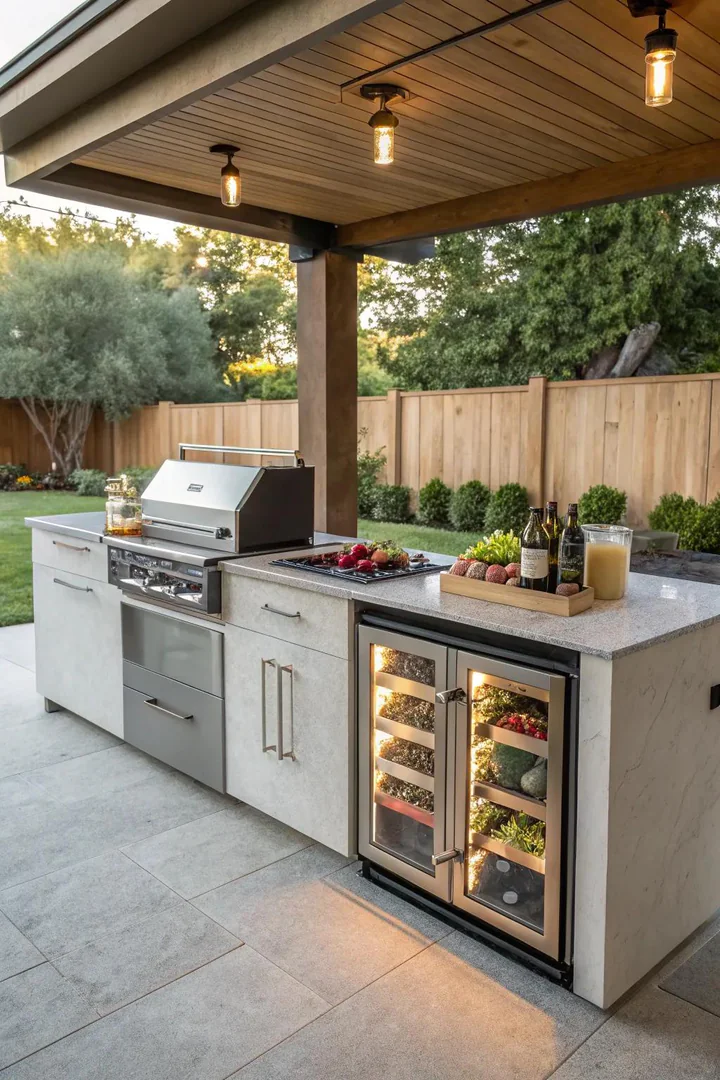
Built-in ice coolers — insulated stainless steel bins recessed into the countertop or installed as drop-in inserts in the island — keep beverages, fresh ingredients, and raw proteins cold without electricity. Ice coolers are simpler and more reliable than refrigeration in outdoor settings because they have no compressor, no electrical requirements, and no mechanical parts that can fail in heat, humidity, or rain.
Drop-in cooler inserts (from Bull, Blaze, and Fire Magic) are available in sizes from 12×18 inches (holds 6-12 beverages) to 25×15 inches (holds 24-36 beverages). Choose inserts with a built-in drain that connects to a drain line (for permanent installations) or a removable plug (for periodic draining). Double-wall insulated construction keeps ice frozen longer and prevents condensation on the exterior. Position the cooler within the island countertop near the bar or serving area, not near the hot grill zone where heat accelerates ice melt. For more outdoor setup ideas, see our covered outdoor kitchen guide.
9. Corner Storage Shelves
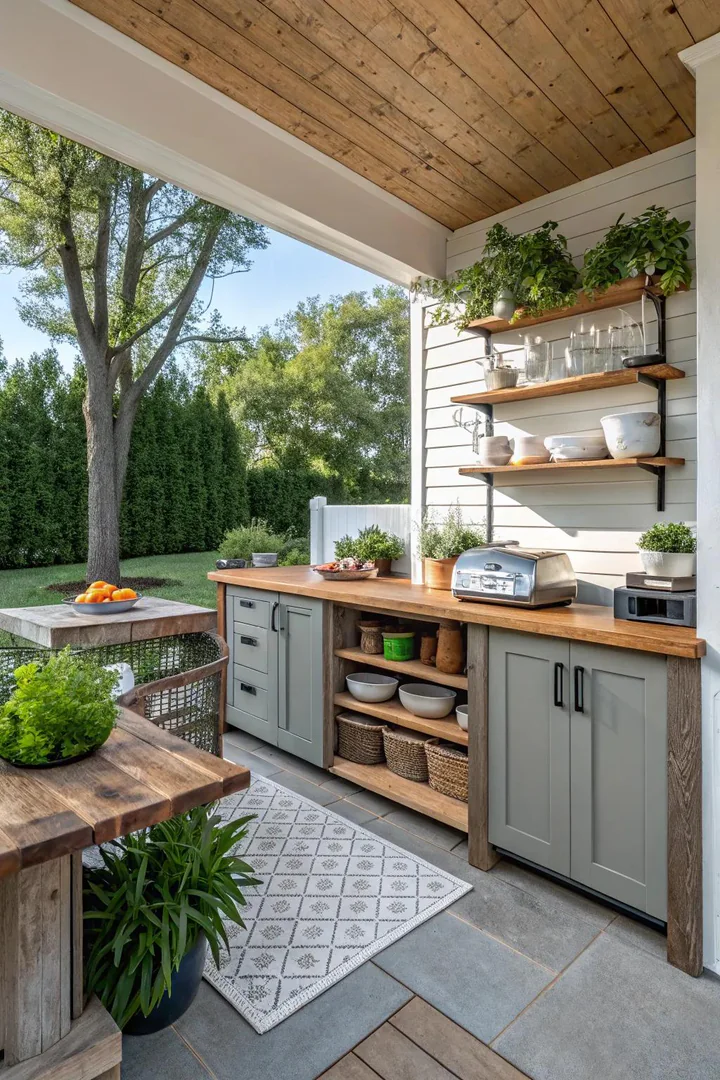
L-shaped and U-shaped outdoor kitchen layouts create corner junctions where two cabinet runs meet at a 90-degree angle, producing a deep, triangular cabinet interior that is notoriously difficult to access and organize. Corner shelving solutions — lazy Susans, pull-out trays, or angled shelves — recover this dead corner space and make it usable for storing large items like stockpots, Dutch ovens, and bulk supplies.
A stainless steel lazy Susan (rotating shelf system) is the most common corner solution, allowing you to spin the shelf to bring items from the back to the front. Pull-out corner trays (from Rev-A-Shelf) slide the entire shelf forward out of the corner on full-extension rails. For outdoor kitchens, choose corner shelving in stainless steel or marine-grade polymer that resists the corrosion and moisture damage that wood or particleboard corner units cannot survive outdoors.
10. Cookware Hanging Storage
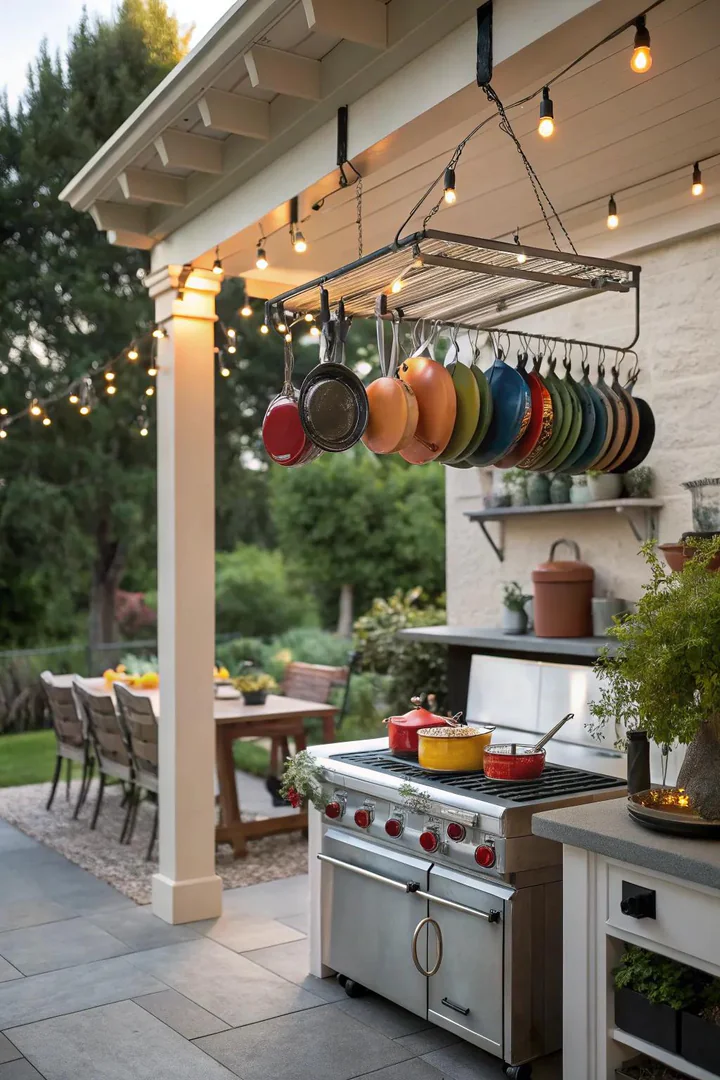
An overhead pot rack or wall-mounted cookware rail hung above or beside the outdoor kitchen grill station keeps pots, pans, skillets, and grill baskets within arm’s reach while freeing up valuable cabinet and drawer space below. Hanging storage is especially efficient in outdoor kitchens with limited cabinet space, where every drawer and shelf is at a premium.
Install a stainless steel or powder-coated steel pot rack (from Enclume, Cuisinart, or IKEA KUNGSFORS) under a covered pergola or pavilion roof to protect the cookware from direct rain. Use S-hooks rated for 15 pounds or more to hang cast iron skillets, stainless steel sauté pans, and grill baskets. Wall-mounted rail systems (a horizontal bar with sliding hooks) provide more flexible arrangement than fixed overhead racks. Apply a light coat of food-grade mineral oil to cast iron and carbon steel pans stored on outdoor racks to prevent rust between uses.
11. Fridge Designed for Under the Counter
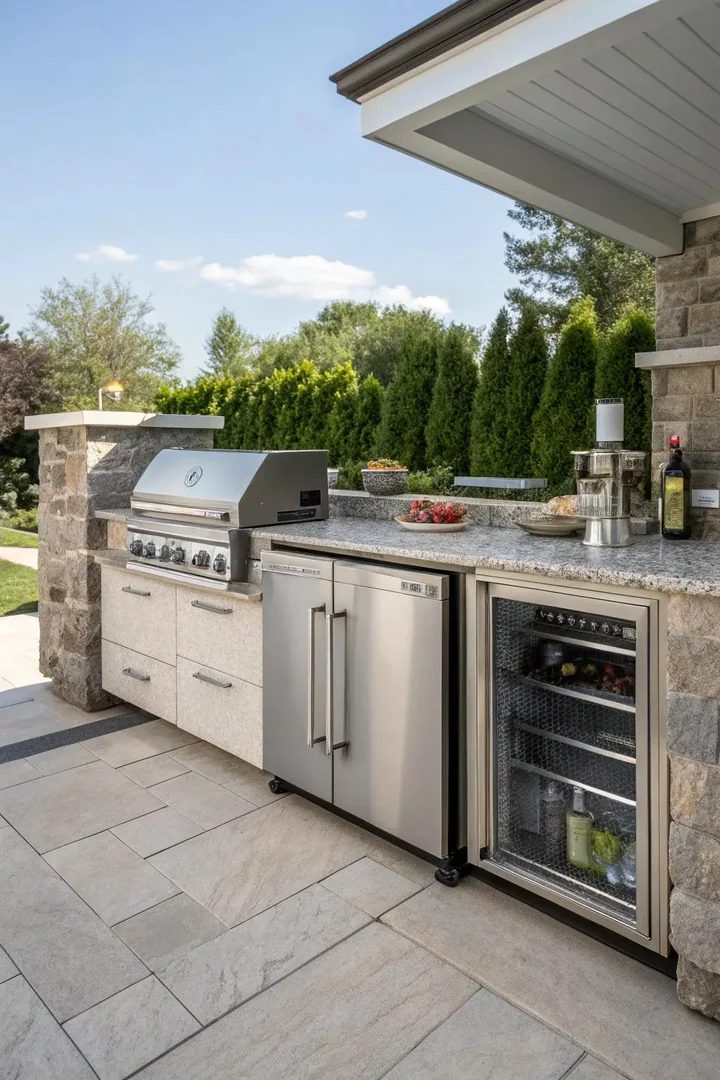
An outdoor-rated under-counter refrigerator (typically 24 inches wide, 24 inches deep, and 34 inches tall) built into the kitchen island provides 4.0 to 5.5 cubic feet of cold storage for raw proteins, marinades, salads, condiments, and beverages. An outdoor-rated fridge is engineered to operate reliably in ambient temperatures from 40°F to 110°F, with weatherproof seals, corrosion-resistant condensers, and UV-resistant exteriors that indoor fridges lack.
Choose a UL-rated outdoor refrigerator (from Blaze, Lynx, True Residential, or Perlick) with a front-venting compressor designed for built-in installation. Front-venting is required for island installation — rear-venting models overheat inside enclosed cabinetry. Features to prioritize include digital temperature control, interior LED lighting, adjustable shelving, and a lock to prevent unwanted access. Position the fridge away from the grill to avoid heat exposure that forces the compressor to work harder.
12. Retractable Cutting Board
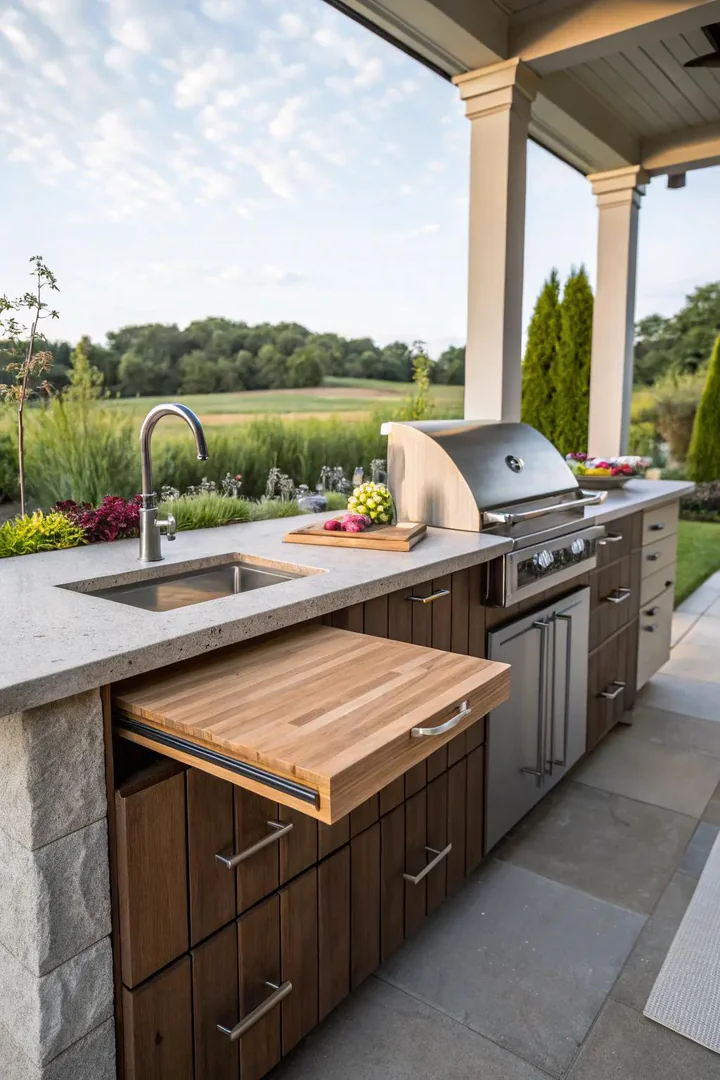
A pull-out cutting board — a thick hardwood or HDPE board mounted on full-extension drawer slides just below the countertop — provides an instant additional prep surface that slides away when not in use. Outdoor kitchen countertops are often limited in size (especially in compact or linear layouts), so a hidden pull-out board gives you dedicated prep space without permanently occupying counter area.
Install the cutting board on heavy-duty, full-extension ball-bearing slides rated for at least 75 pounds. Use a thick (1.5 to 2 inches), end-grain maple or walnut board, or a commercial-grade HDPE board (from Boos or San Jamar) that resists moisture, bacteria, and warping in outdoor conditions. HDPE is the better choice for outdoor kitchens because it is dishwasher-safe, non-porous, and will not crack or warp in humidity or temperature swings the way hardwood can.
13. Storage for Wine
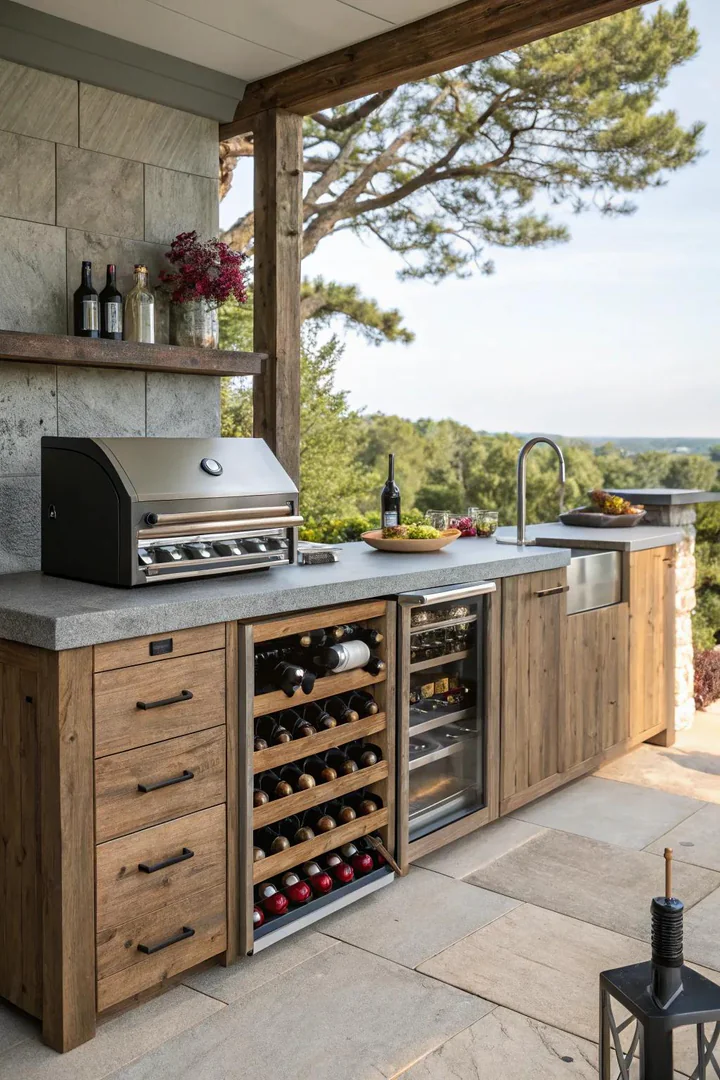
An outdoor wine cooler or wine rack built into the kitchen island stores bottles at a consistent temperature and within arm’s reach of the serving and dining area. Outdoor-rated wine coolers maintain 45°F to 65°F even in high ambient temperatures, protecting wine from the heat damage that would rapidly spoil bottles stored in uncooled outdoor cabinets during summer months.
Outdoor-rated wine coolers (from Perlick, True Residential, and Blaze) are available in 15-inch (holds 20-24 bottles) and 24-inch (holds 40-48 bottles) built-in sizes. Choose a dual-zone model that keeps whites at 45-50°F on one shelf and reds at 55-65°F on another. For non-refrigerated wine storage (short-term, same-day service), a simple stainless steel wine rack or cubby built into the island stores 6 to 12 bottles horizontally. Position wine storage away from the grill and direct sun to minimize heat exposure.
14. Modular Storage Shelving Systems
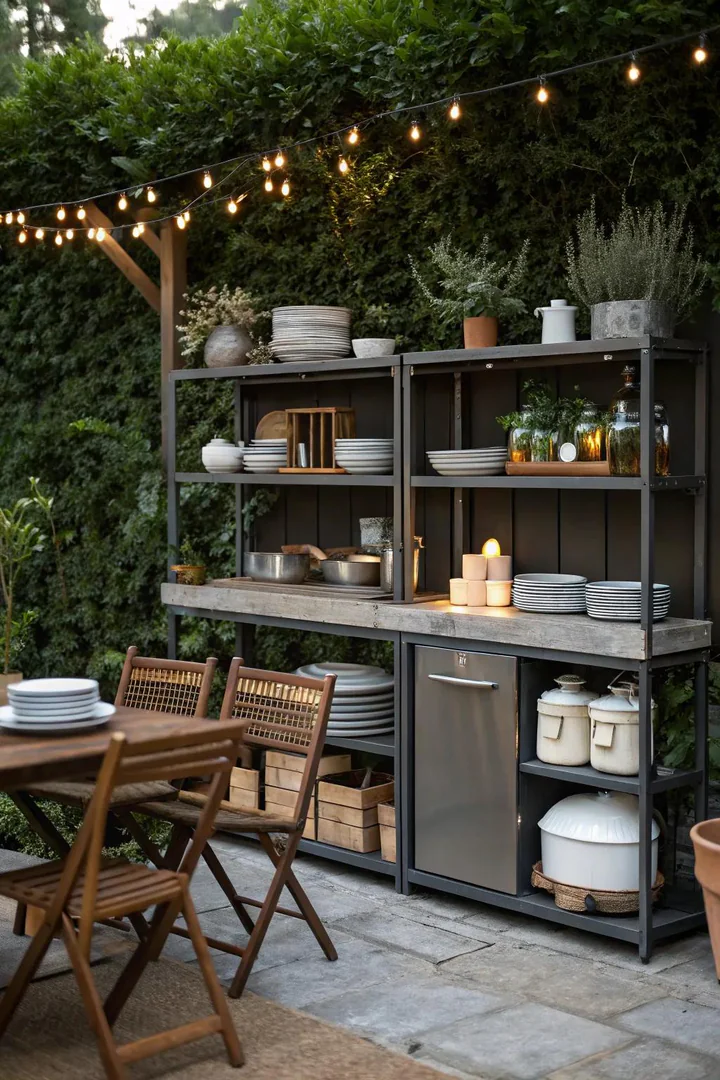
Modular shelving systems — freestanding or wall-mounted units with adjustable shelf heights and configurable components — provide flexible, expandable storage that can be reconfigured as your outdoor kitchen needs change. Unlike fixed, built-in cabinets, modular shelving can be rearranged, added to, or relocated without demolition or reconstruction.
Choose modular shelving in stainless steel (NSF commercial kitchen shelving from Metro, Regency, or Seville Classics) or powder-coated steel rated for outdoor use. Standard unit sizes are 36×18 inches, 48×18 inches, and 48×24 inches, with four to six adjustable shelves per unit. Add shelf liners to prevent small items from falling through the wire grid. Position modular shelving under a covered structure (pergola, pavilion, or roof overhang) for protection from direct rain. For more small kitchen storage ideas that translate to outdoor spaces, see our dedicated guide.
15. Hooks for Hanging
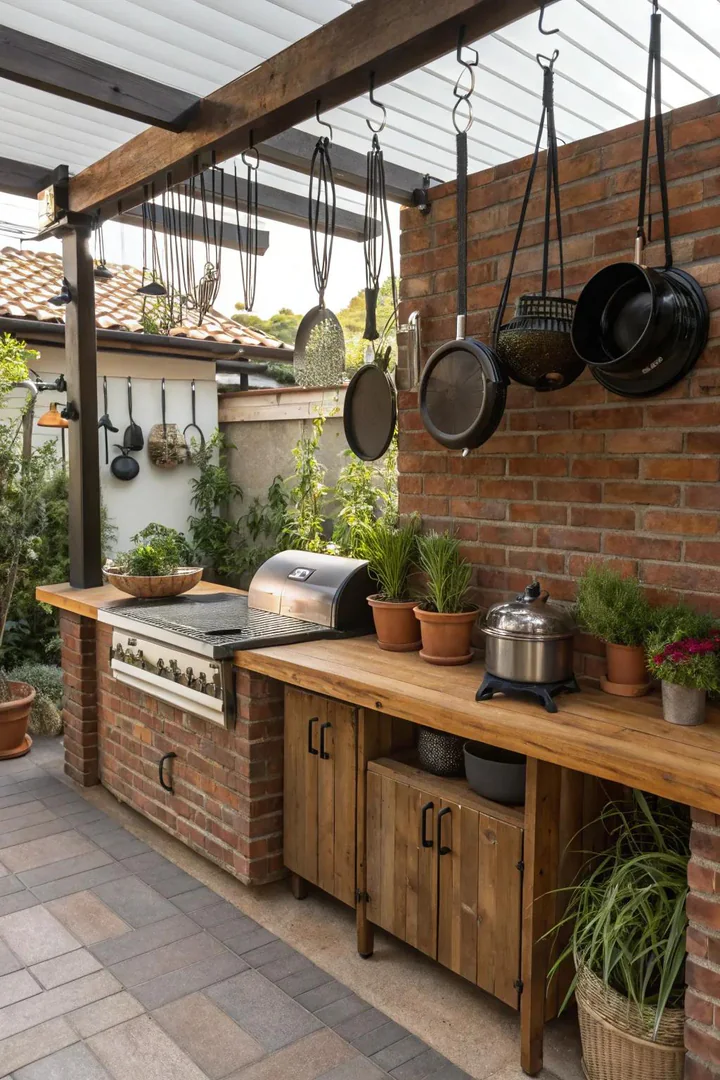
Wall-mounted or rail-mounted hooks keep grilling tools (tongs, spatulas, brushes, forks), aprons, towels, and oven mitts visible and within arm’s reach of the cooking station. Hooks use vertical wall space that would otherwise go unused, freeing up drawers and cabinets for items that need enclosed, protected storage.
Install a stainless steel or powder-coated steel hook rail (from IKEA KUNGSFORS, Enclume, or Amazon commercial kitchen suppliers) on the wall behind or beside the grill. Use S-hooks or J-hooks rated for outdoor use (stainless steel or marine-grade metal) to prevent rust. Space hooks 4 to 6 inches apart for easy access without crowding. A magnetic knife strip (from Mercer or Messermeister, in stainless steel) mounted alongside the hook rail stores knives securely without a bulky knife block. Keep frequently used tools (tongs, spatula, basting brush) on hooks and store less-used tools in drawers.
16. Storage for Outdoor Sinks
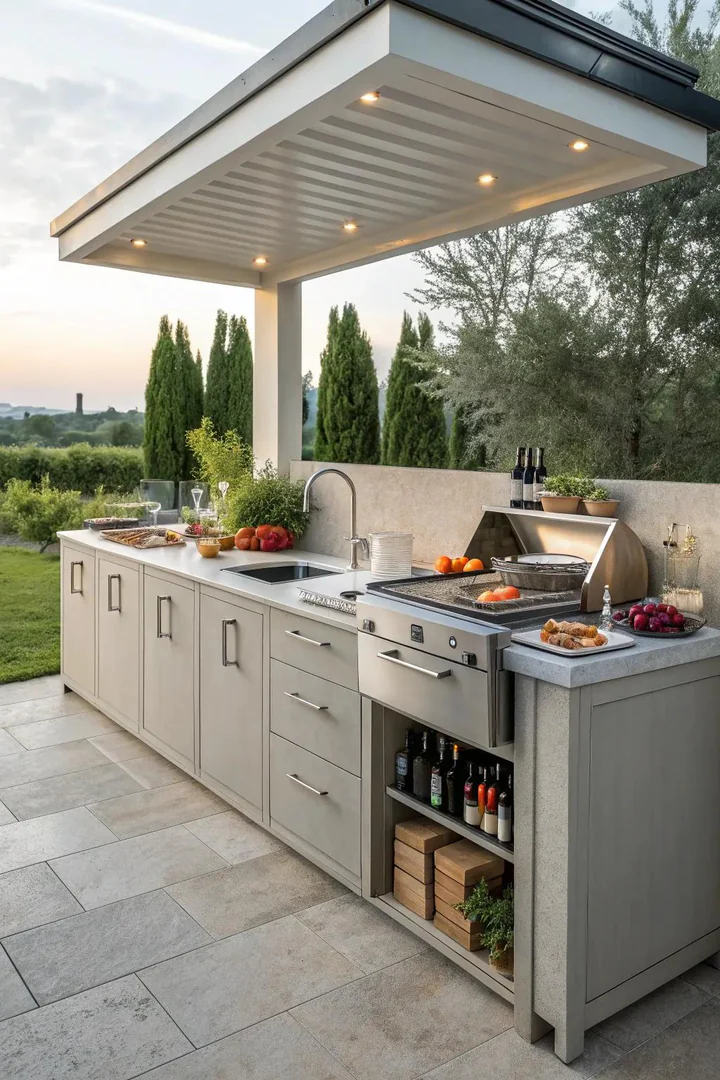
The cabinet space beneath an outdoor sink stores dish soap, hand soap, sponges, brushes, cleaning sprays, trash bags, and other cleaning supplies in a convenient location right where you wash, rinse, and clean up. Under-sink storage is the natural home for cleaning supplies in any kitchen — outdoor or indoor — because it places those items at the point of use.
Install a pull-out organizer tray or a small two-tier shelf inside the under-sink cabinet to maximize the irregular space around the drain pipes and P-trap. Use sealed, waterproof containers (plastic bins or caddies) to store supplies and prevent moisture damage. A mounted paper towel holder on the inside of the cabinet door keeps paper towels dry and accessible. Choose under-sink cabinets with a sealed bottom pan (stainless steel or waterproof liner) that catches drips and leaks from the plumbing connections above.
17. Exposed Shelving
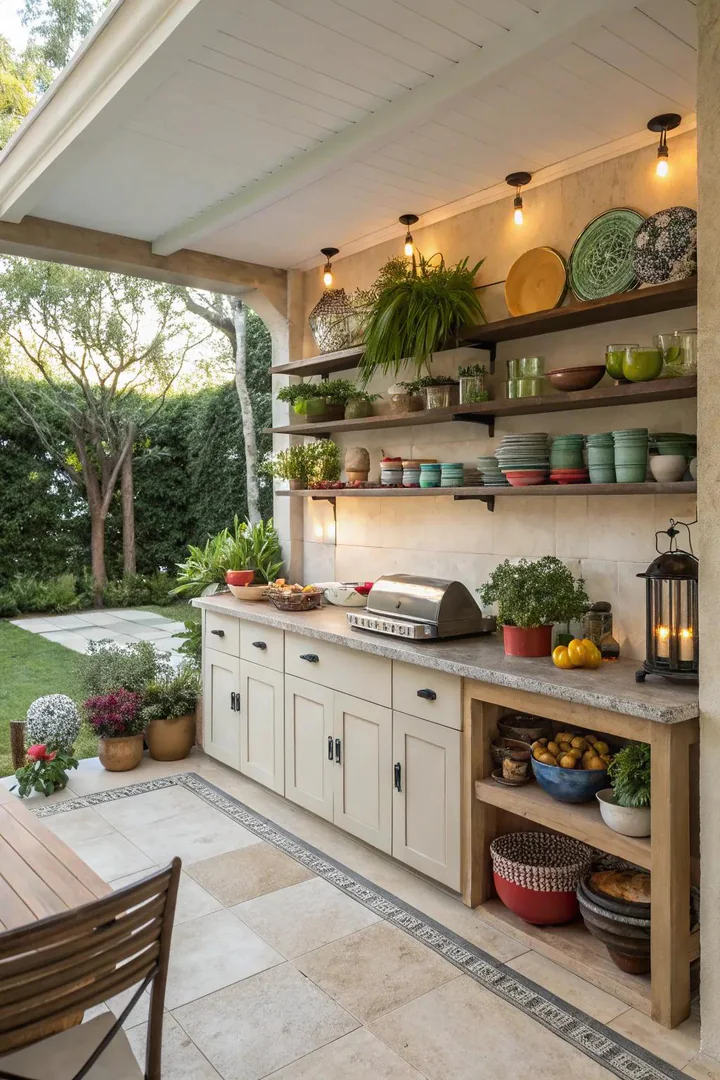
Open shelving — floating shelves or bracket-mounted shelves without doors or fronts — displays cookware, serving dishes, and decorative items while providing quick, grab-and-go access that closed cabinets cannot match. Open shelving works best for items that are used frequently (daily plates, glasses, and serving bowls) and can tolerate some outdoor exposure.
Mount stainless steel or marine-grade teak floating shelves on the wall above or beside the outdoor kitchen counter. Use heavy-duty L-brackets or concealed floating shelf hardware rated for the weight of the items you plan to store. Position open shelves under a covered roof to protect contents from direct rain. Display attractive, weather-tolerant items (stainless steel serving bowls, melamine plates, glass hurricane lanterns) on the open shelves and store moisture-sensitive items in enclosed cabinets. Clean open shelves every one to two weeks because outdoor exposure causes faster dust and pollen accumulation than indoor shelving. For more kitchen shelving and display ideas, browse our kitchen decor ideas guide.
18. Storage for Built-In Grills
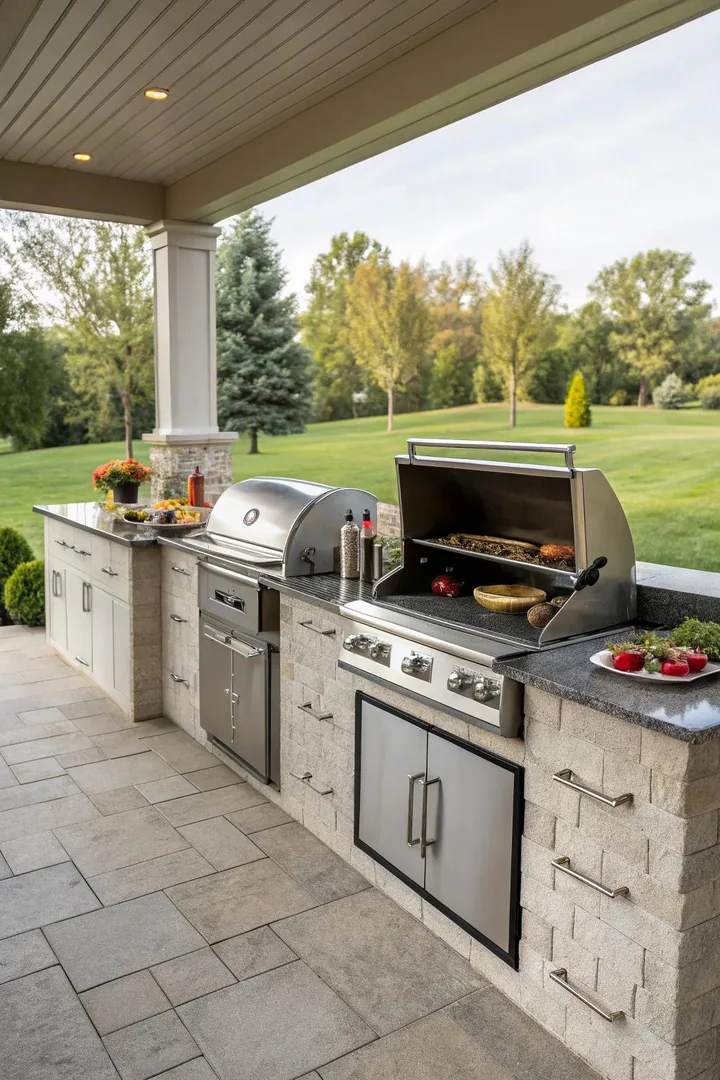
The cabinet space directly below and beside a built-in grill is the highest-value storage real estate in the outdoor kitchen because it puts propane tanks, charcoal, wood chunks, grill brushes, drip pans, and replacement grill grates within arm’s reach of the cooking zone. Purpose-built grill storage cabinets are designed with ventilation openings (required by code for propane tank enclosures) and heat-resistant construction.
Install stainless steel doors and drawers (from the same manufacturer as your grill for a matched finish) in the island sections flanking the grill. Dedicate one compartment to the propane tank (with required ventilation openings per local fire code), one to charcoal and wood storage, and one to grill tools and maintenance supplies. A narrow pull-out spice rack or tool holder beside the grill provides instant access to seasonings and tongs. For layout planning ideas that optimize your grill-zone storage, see our kitchen cabinet layout guide.
19. Shifting Entrances
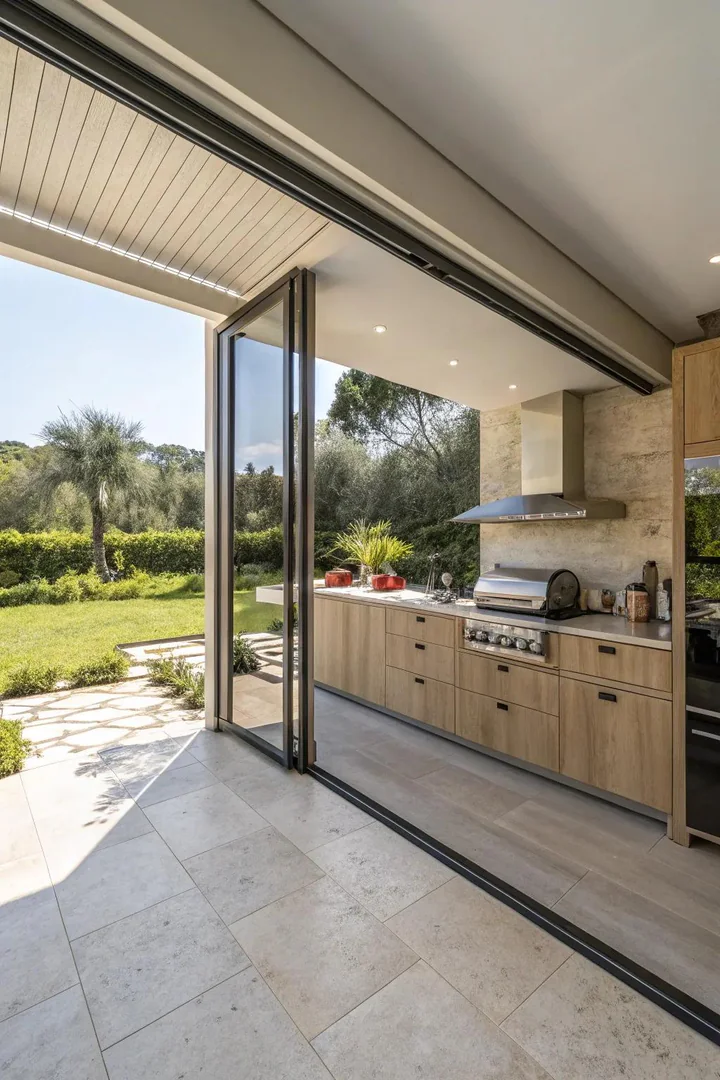
Sliding cabinet doors — panels that glide horizontally on a track rather than swinging open on hinges — provide access to cabinet interiors without requiring the clearance space that swinging doors demand. In tight outdoor kitchen layouts where countertop overhang, bar seating, or adjacent appliances limit the swing radius, sliding doors keep cabinets accessible without blocking walkways.
Choose stainless steel sliding doors with a smooth-action ball-bearing track that resists corrosion and debris jamming in outdoor conditions. Standard widths are 24 inches and 30 inches. Barn-door-style slides (where the panel rides on an exposed top rail) add a rustic, modern farmhouse aesthetic. Pocket-door-style slides (where the panel recedes into the cabinet wall) provide a cleaner, more streamlined look but require a wider cabinet frame to accommodate the hidden panel.
20. Solutions for Vertical Storage
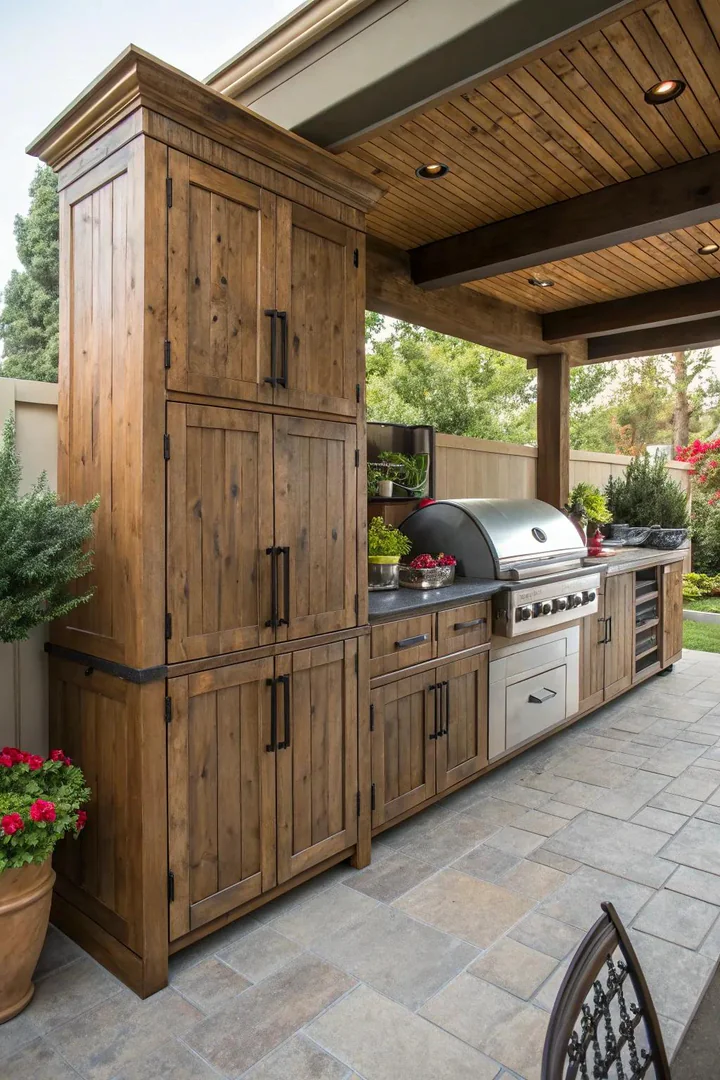
Vertical storage — narrow, tall pull-out racks, wall-mounted pegboards, magnetic strips, and vertical dividers inside cabinets — uses the full height of the available storage space rather than stacking items flat in shallow layers. Vertical storage is especially valuable in compact outdoor kitchens where horizontal counter and cabinet space is limited.
Install vertical dividers inside deep cabinets to store cutting boards, baking sheets, grill grates, and cooling racks on edge (standing vertically) rather than stacked flat. A narrow, 6-inch-wide vertical pull-out (from Rev-A-Shelf) between cabinets stores spice bottles, sauce bottles, and utensils in a single vertical column. Wall-mounted stainless steel pegboard (from Wall Control) provides infinite hook-and-shelf configurations for hanging tools, holding containers, and mounting accessories on otherwise unused wall surfaces.
21. Concealed Storage Areas
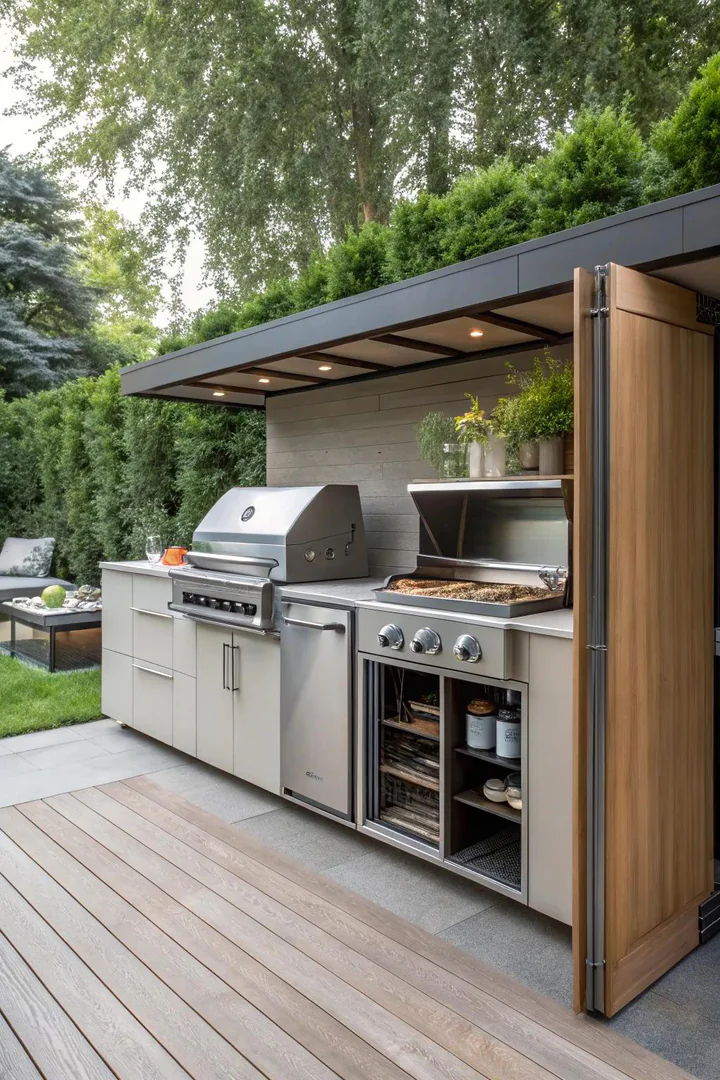
Hidden storage compartments — flip-top counter sections, spring-loaded pop-up shelves, or concealed drawers disguised as architectural panels — keep valuable items (speakers, electronics, liquor, expensive knives) secure and out of sight when the outdoor kitchen is not in use. Hidden storage is particularly important in outdoor kitchens accessible to guests, neighbors, or the public (pool areas, rooftop terraces, commercial venues).
A flip-top countertop section (hinged at the back, with a gas strut assist) reveals a recessed compartment below that can hold a blender, a mixer, or an appliance garage. A push-latch drawer with no visible handle (touch-to-open mechanism) hides behind a smooth panel face that looks like solid island cladding. Spring-loaded pop-up shelves (from Rev-A-Shelf Mixer Lift) raise heavy appliances to counter height and lower them back into concealed cabinets. Add a lock to any hidden compartment that stores valuable or hazardous items.
22. Versatile Shelving
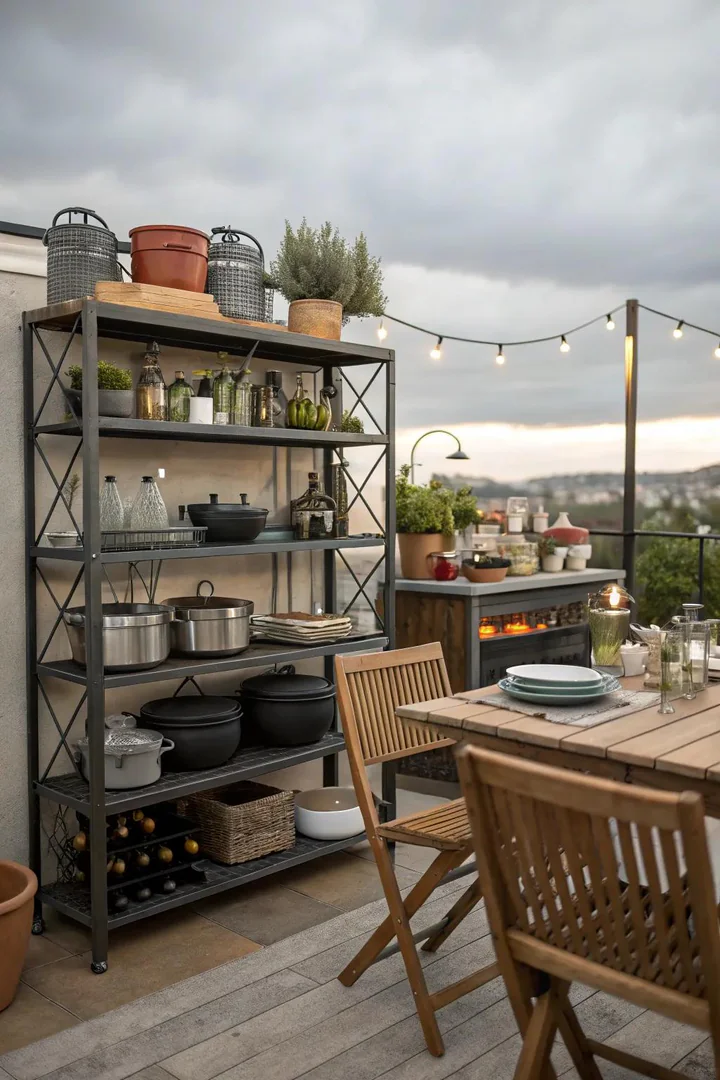
Adjustable shelving — cabinets and storage units with shelf heights that can be repositioned on pin-and-hole tracks or adjustable brackets — lets you reconfigure the interior layout as your storage needs change. Fixed shelves force you to stack small items in tall spaces (wasting vertical room) or cram tall items into short spaces (requiring you to lay bottles on their sides). Adjustable shelves eliminate both problems.
Install shelf pin tracks (metal strips with holes drilled at 1-inch or 32mm increments) inside every cabinet, with removable stainless steel shelves that rest on shelf pins. This allows you to add, remove, or reposition shelves in seconds without tools. Space the pin holes at 1-inch intervals for maximum flexibility. Choose stainless steel shelves (not glass, which can shatter with temperature changes, or wood, which warps in humidity) for durability in outdoor conditions.
23. Storage That Withstands Weather Conditions
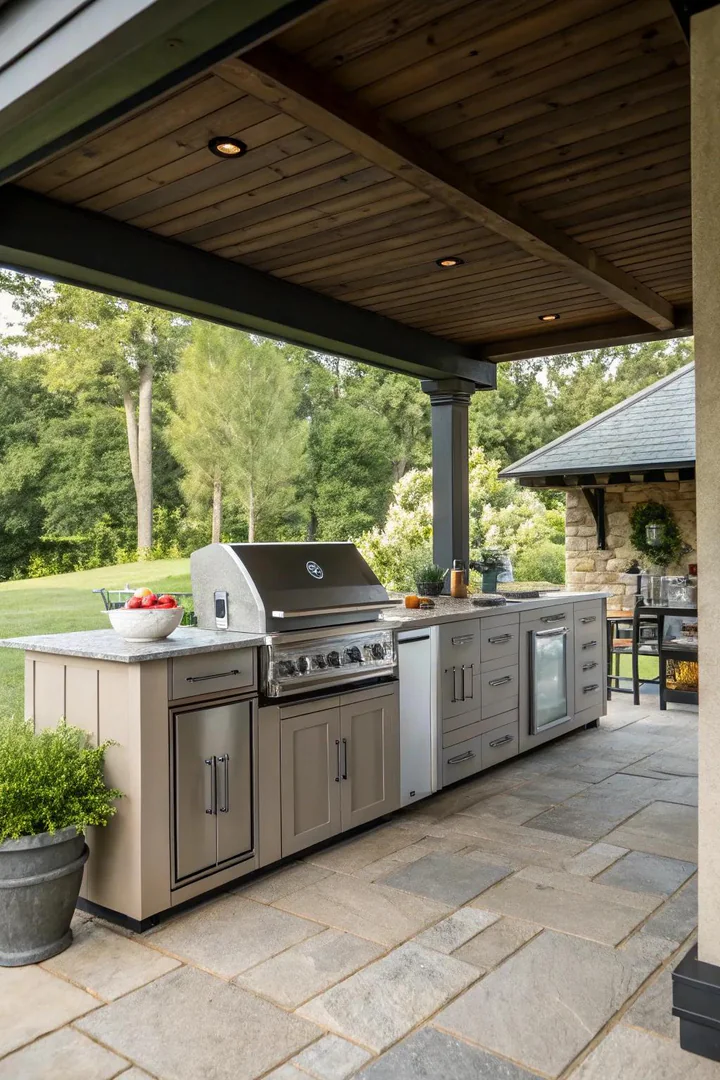
Weatherproof storage — cabinets and enclosures built specifically to withstand rain, snow, UV exposure, temperature extremes, and humidity — is the baseline requirement for any permanent outdoor kitchen storage that will remain outside year-round without a cover. Standard indoor cabinets (particleboard, MDF, or unfinished wood) will swell, warp, delaminate, and disintegrate within one to two seasons of outdoor exposure.
Materials rated for permanent outdoor storage include 304-grade stainless steel (the industry standard for outdoor kitchen cabinets), marine-grade polymer (HDPE from NatureKast or Werever — will not rot, rust, warp, or fade), marine-grade teak (naturally weather-resistant hardwood, but expensive), and powder-coated aluminum. Avoid painted wood, laminated particleboard, and standard plywood. Add rubber gasket seals to cabinet doors and drawer faces to keep wind-driven rain and dust out of the cabinet interiors.
24. Integrated Seating with Storage Solutions
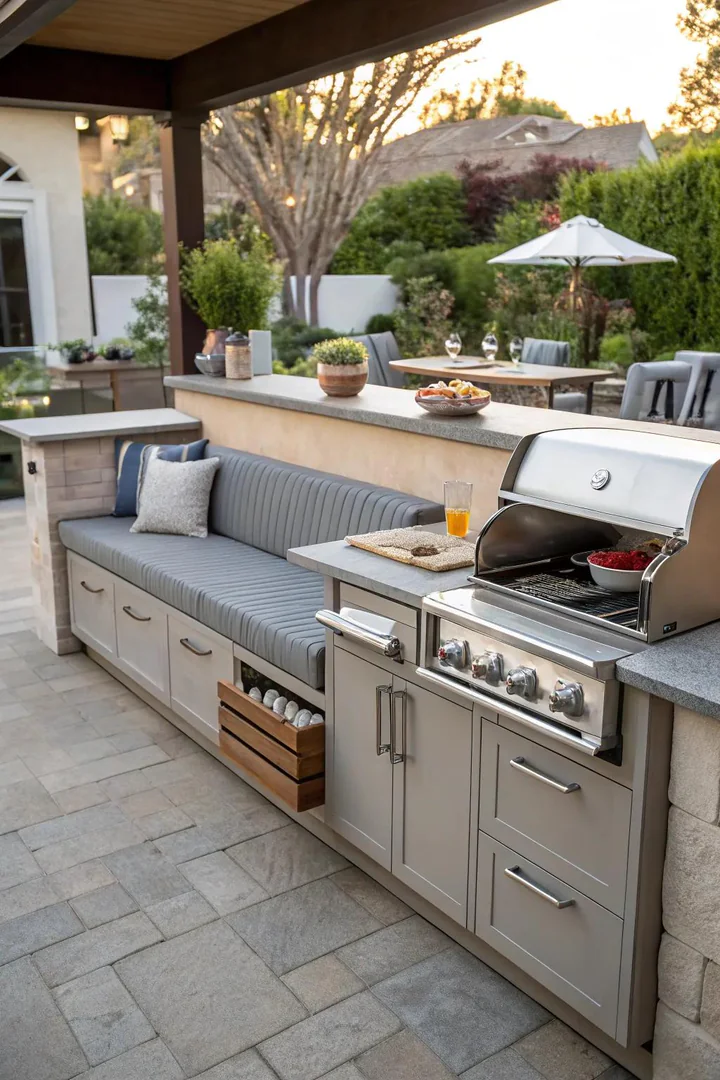
Built-in bench seating — banquette-style benches or L-shaped bench seats built along the edge of the outdoor kitchen or dining area — with hinged tops or pull-out drawers beneath the seat provides seating for guests and concealed bulk storage in the same footprint. The bench seat doubles as a storage chest for items you need infrequently but want stored outdoors (extra cushions, tablecloths, citronella candles, party supplies).
Build bench seating from weather-resistant materials (marine-grade plywood sealed with exterior polyurethane, composite decking boards, or marine-grade polymer). Add a hinged lid with gas strut assists for smooth, one-hand opening. Line the interior with waterproof fabric or a sealed plastic bin to protect stored items from moisture. Add ventilation holes (covered with mesh screens to keep insects out) to prevent mildew inside the closed bench. Standard bench height is 18 inches (matching standard chair seat height) and depth is 18 to 24 inches.
25. Mobile Storage Trolleys
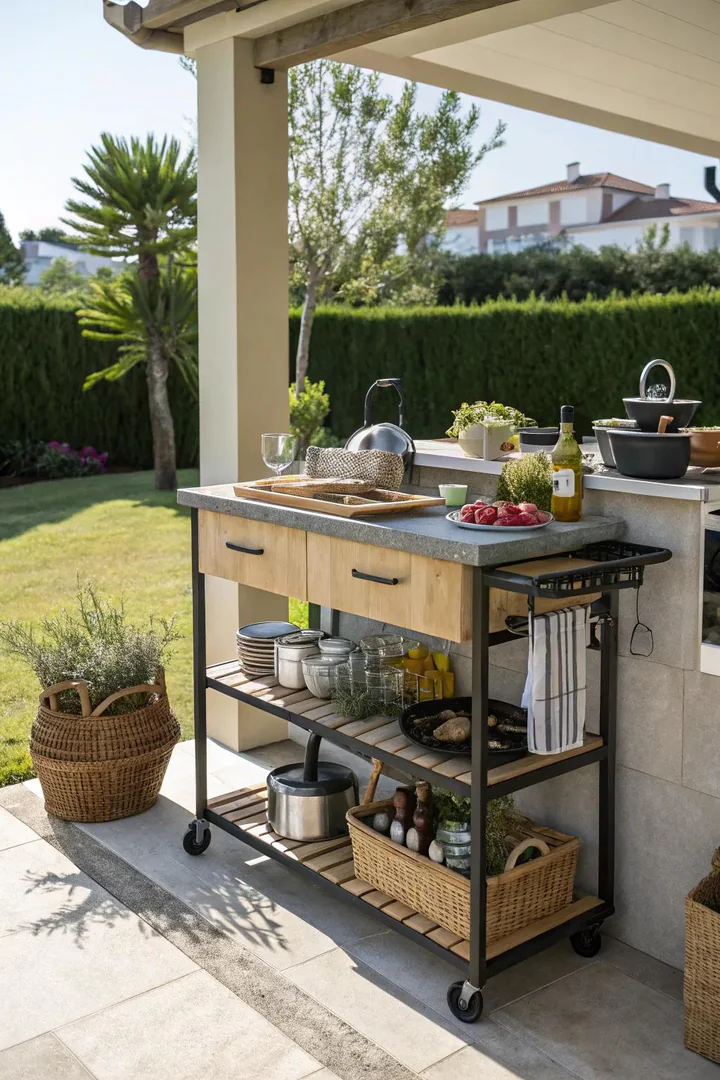
Rolling storage carts — wheeled utility carts, bar carts, or prep carts with shelves, drawers, or compartments — provide mobile storage that can be positioned wherever it is needed during cooking and wheeled to a covered area or garage for protected storage when not in use. Portable carts are the most flexible outdoor storage solution because they are not permanently installed and can be repositioned, removed, or stored indoors as seasons change.
Choose rolling carts in stainless steel (commercial kitchen utility carts from Seville Classics or Trinity) or powder-coated steel (bar carts from Target, IKEA, or West Elm) with locking caster wheels that hold the cart in place on uneven patio surfaces. A three-tier utility cart provides two shelves for storage and a top surface for prep. A dedicated bar cart with bottle storage, glass hooks, and a wine rack functions as a mobile beverage station. Roll the cart to the garage or a covered porch when not in use to extend its life in any weather.
26. Bespoke Built-In Units
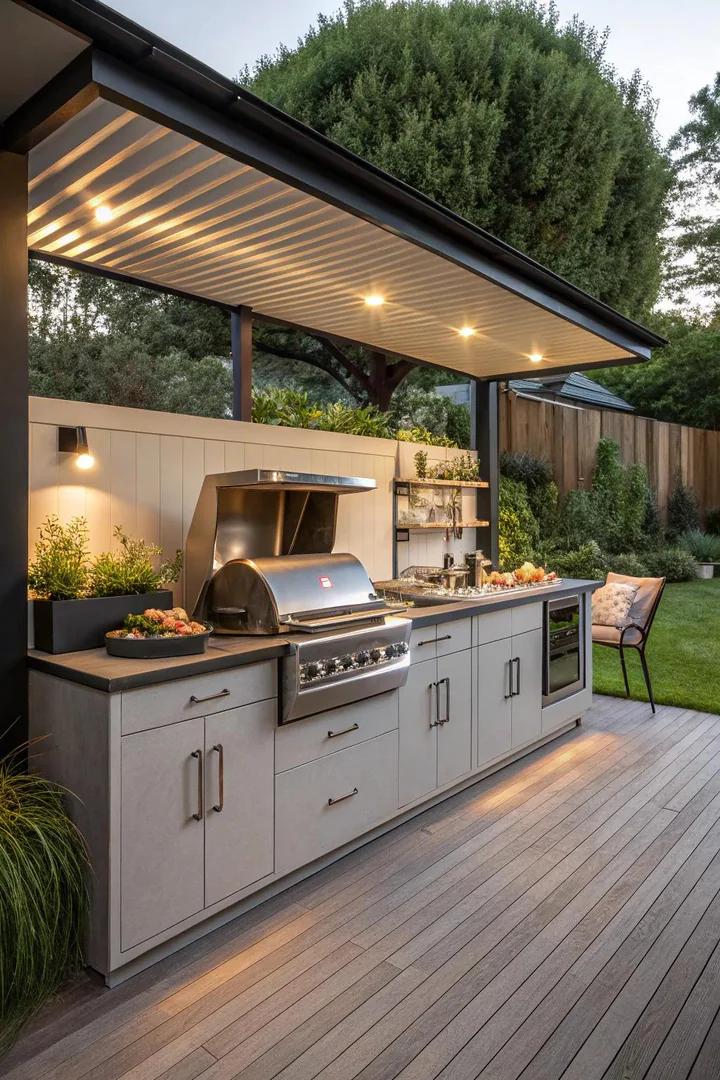
Custom-built storage units — cabinets, drawers, shelves, and compartments designed and fabricated to fit your specific outdoor kitchen dimensions, appliance cutouts, and storage needs — provide the most efficient use of every available inch because nothing is wasted on standard sizes that do not match your space. Custom cabinetry is the most expensive storage option but also the most precise.
Work with an outdoor kitchen fabricator or cabinetmaker who specializes in stainless steel or marine-grade polymer cabinetry (companies like Danver, Brown Jordan Outdoor Kitchens, or NatureKast). Provide detailed measurements of every opening, appliance cutout, and corner condition. Custom features to specify include pull-out drawers at exact widths for your utensil collection, sized compartments for specific appliances, integrated towel bars and paper towel holders, built-in trash and recycling systems, and appliance garages for mixers and blenders. Visit The Designers Company for more outdoor kitchen design and storage planning resources.
How to Plan Your Outdoor Kitchen Storage
Assessing What You Need to Store
Before selecting storage solutions, make a complete inventory of everything you want to store in the outdoor kitchen: cooking tools (tongs, spatulas, brushes, thermometers), cookware (pots, pans, grill baskets, smoker boxes), tableware (plates, glasses, napkins, serving platters), food and beverages (spices, oils, condiments, drinks), cleaning supplies (soap, sponges, towels, trash bags), and fuel (propane, charcoal, wood chips). Categorize each item by how often you use it (every cook, weekly, monthly, seasonally) and store frequently used items in the most accessible locations — eye-level drawers and hooks — while relegating seasonal items to lower cabinets and bench storage.
Choosing Materials for Outdoor Conditions
Every material in an outdoor kitchen storage system must withstand continuous exposure to rain, UV radiation, temperature swings (from below freezing to above 100°F depending on your climate), humidity, cooking grease, and pests. The top-tier material is 304-grade stainless steel — corrosion-resistant, easy to clean, fireproof, and virtually indestructible in outdoor conditions. Marine-grade HDPE polymer (NatureKast, Werever) is the leading alternative — it will not rot, warp, crack, or fade, and it costs less than stainless. Avoid wood (rots and warps unless it is marine-grade teak or Ipe), particleboard (swells and delaminates), and painted MDF (peels and deteriorates).
Organizing by Cooking Zone
Arrange storage by cooking zone — prep, cook, serve, and clean — so that every item is stored at its point of use. The prep zone (near the countertop) stores knives, cutting boards, bowls, spices, and oils. The cook zone (near the grill or burner) stores tongs, spatulas, thermometers, fuel, and grill accessories. The serve zone (near the bar or dining area) stores plates, glasses, napkins, and beverages. The clean zone (near the sink) stores soap, sponges, towels, and trash bags. This zone-based approach minimizes unnecessary walking and reaching during the cooking workflow.
Outdoor Kitchen Storage Options Comparison
| Storage Type | Best For | Cost Range | Weather Resistance |
|---|---|---|---|
| Stainless steel drawers | Utensils, tools | $200-600 | Excellent |
| Under-counter fridge | Perishables, beverages | $800-3,000 | Excellent (outdoor-rated) |
| Rolling cart | Flexible extra storage | $50-300 | Good (store when not in use) |
| Modular shelving | Bulk items, large cookware | $100-400 | Good (under cover) |
| Bench with storage | Seasonal items, cushions | $300-1,500 | Good (with waterproof liner) |
| Custom built-in cabinets | Full kitchen fit-out | $2,000-15,000+ | Excellent |
Common Outdoor Kitchen Storage Mistakes to Avoid
Using indoor-rated materials outdoors. Standard indoor kitchen cabinets (particleboard, MDF, laminated wood) will swell, warp, delaminate, and disintegrate within one to two outdoor seasons. Every material in the outdoor kitchen must be rated for continuous outdoor exposure — 304 stainless steel, marine-grade polymer, marine-grade teak, or powder-coated aluminum. Saving money on indoor materials costs far more in replacement within two years.
Ignoring ventilation for propane storage. Propane tanks stored inside enclosed outdoor kitchen cabinets without ventilation openings create a potentially dangerous gas buildup. Local fire codes require ventilation openings (usually louvered vents at the bottom and top of the enclosure) for any compartment that houses a propane tank. Check your local building code requirements before enclosing a propane tank.
Placing heat-sensitive storage too close to the grill. Cabinets, drawers, and especially refrigerators placed directly adjacent to the grill absorb radiant heat that can warp drawer slides, overheat compressors, and degrade plastic components. Leave at least 6 to 12 inches of buffer space (or an insulating heat shield) between the grill and adjacent storage units. Position the refrigerator at the far end of the island, away from the grill.
Forgetting drainage for ice and water features. Built-in coolers, ice bins, and outdoor sinks generate water that must drain somewhere. Without a proper drain line connected to a floor drain, gravel bed, or dry well, melted ice and rinse water will pool inside the island, promoting rust, mold, and structural damage. Plan drain lines during the design phase, not as an afterthought.
Frequently Asked Questions
What materials are best for outdoor kitchen cabinets?
304-grade stainless steel is the gold standard for outdoor kitchen cabinets — it resists corrosion, heat, UV, and moisture indefinitely with minimal maintenance. Marine-grade HDPE polymer (from NatureKast or Werever) is the leading alternative — lighter than stainless, available in multiple colors, and completely weatherproof. Marine-grade teak is a premium natural wood option that weathers to a silver-grey patina. Avoid MDF, particleboard, painted plywood, and standard indoor cabinetry.
How do I protect outdoor kitchen storage from rain?
Use weatherproof materials (stainless steel, marine-grade polymer) with sealed gasket doors and beveled edges that prevent water pooling. Cover the outdoor kitchen with a permanent roof structure (pergola with a solid roof, pavilion, or awning) for maximum protection. When the kitchen is not in use, cover exposed surfaces with fitted waterproof covers (from Coverstore or custom fabricators). Store moisture-sensitive items in sealed, airtight containers inside the cabinets.
Do I need a special refrigerator for an outdoor kitchen?
Yes. Standard indoor refrigerators are not designed to operate reliably in outdoor temperatures above 90°F or below 40°F, and their components corrode rapidly in rain and humidity. Outdoor-rated refrigerators (UL-listed for outdoor use) have weatherproof seals, corrosion-resistant condensers, wider operating temperature ranges, and front-venting compressors designed for built-in island installation. Outdoor refrigerators cost more ($800 to $3,000+) but are the only reliable option for permanent outdoor cold storage.
How much storage does an outdoor kitchen need?
A minimal outdoor kitchen (grill and prep counter only) needs at least 2 to 3 drawers and 1 to 2 access doors for basic tool and supply storage. A mid-range outdoor kitchen (grill, side burner, sink, and fridge) needs 4 to 6 drawers, 2 to 3 access doors, and dedicated storage for trash, spices, and cleaning supplies. A full-featured outdoor kitchen (multiple cooking stations, bar area, dining space) needs 8 to 12 storage zones including all of the above plus wine storage, bench seating with storage, and modular or custom cabinetry.
How do I keep insects and pests out of outdoor kitchen storage?
Use sealed gasket doors on all enclosed cabinets. Store food items (spices, oils, dry goods) in airtight containers, not in original paper or cardboard packaging. Keep trash in sealed pull-out bins with lids. Clean up food debris immediately after every cooking session — crumbs, grease, and standing water attract insects and rodents. Apply a perimeter insect barrier spray (from Ortho or Spectracide) around the base of the outdoor kitchen structure seasonally.
Can I use IKEA cabinets for an outdoor kitchen?
Standard IKEA kitchen cabinets (SEKTION, METOD) are made from particleboard with melamine laminate — materials that swell, warp, and delaminate when exposed to outdoor moisture and temperature changes. Do not install standard IKEA cabinets in an uncovered outdoor kitchen. However, stainless steel IKEA accessories (KUNGSFORS rails, hooks, and shelves) and powder-coated steel carts are suitable for covered outdoor kitchens with minimal direct rain exposure. For permanent outdoor installations, invest in purpose-built outdoor cabinetry from outdoor kitchen manufacturers.
Conclusion
An outdoor kitchen without organized, weatherproof storage is just a grill on a patio — you spend more time carrying things in and out of the house than you spend cooking. The 26 outdoor kitchen storage ideas above give you the full range of options from simple additions (hooks, rolling carts, access doors) to full-scale solutions (custom stainless steel cabinetry, under-counter refrigerators, built-in bench seating with concealed storage) to equip your outdoor kitchen with everything you need, stored where you need it, protected from the weather.
Start with the essentials — drawers for tools, a trash system, and a sealed pantry for dry goods — and add specialized storage (warming drawers, wine coolers, hidden compartments) as your outdoor cooking evolves. Choose materials rated for permanent outdoor exposure (304 stainless steel, marine-grade polymer, marine-grade teak) and you will have storage that lasts as long as the outdoor kitchen itself.