
Red Kitchen Ideas: 18 Bold Designs That Transform Your Space
Red kitchen ideas bring warm, high-energy color into the busiest room of the house through cabinets, backsplashes, islands, countertops, appliances, light fixtures, bar stools, flooring, wall paint, and decorative accents. Red ranges from deep burgundy and wine to true cherry red to bright tomato and fire-engine red, and each shade creates a different atmosphere: dark reds feel formal and grounded, mid-tone reds feel warm and appetizing, and bright reds feel bold and modern. Below are 18 ways to add red to a kitchen with specific paint colors, product names, material costs, and design pairings, followed by a how-to planning guide, a comparison table, and FAQs.
1. Red Artwork and Decorative Accents

Hanging red-themed artwork (a framed abstract canvas in reds and golds, $20 to $80 from Society6 or Etsy; a vintage food advertisement poster, $10 to $30; or a set of red botanical prints, $15 to $40 for a set of 3) on the kitchen wall above the dining area or beside the range hood adds red without permanent commitment. Red artwork works as a seasonal or mood-driven change: swap the prints when you redecorate rather than repainting cabinets or replacing a backsplash.
Pair wall art with red countertop accessories: a red ceramic utensil crock ($10 to $25 from Le Creuset in Cerise), a red KitchenAid Stand Mixer ($250 to $350 in Empire Red), red dish towels ($8 to $15 for a set of 4 from Williams Sonoma), and a red fruit bowl or cake stand ($15 to $35). Grouped together on the counter, these accessories create a concentrated red accent that reads as intentional and designed rather than random splashes of color across the room.
2. Red Kitchen Island
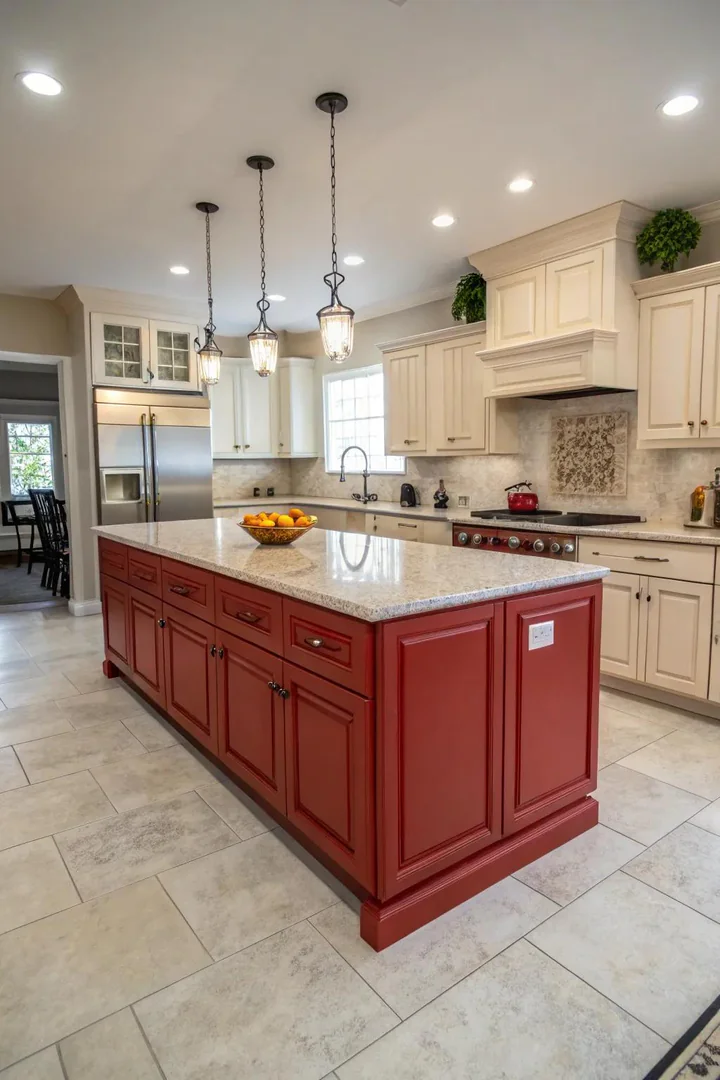
Painting the kitchen island in bold red (Benjamin Moore Heritage Red 1306, a rich colonial red; Sherwin-Williams Fireworks SW 6867, a bright true red; or Farrow and Ball Rectory Red No. 217, a deep, slightly muted red) while keeping the perimeter cabinets in white, cream, or gray creates a single dramatic focal point that anchors the kitchen without overwhelming the room. A red island on a white-cabinet kitchen produces a 90/10 color ratio (90% neutral, 10% red) that feels balanced and intentional.
A standard 36-by-60-inch island requires 1 quart of paint ($15 to $25) for two coats. Sand the existing surface with 150-grit sandpaper, prime with a bonding primer (Zinsser BIN Shellac Primer, $15 to $20 per quart), and apply two coats of satin or semi-gloss cabinet paint with a 4-inch foam roller for a smooth, brush-mark-free finish. Add a butcher-block top ($100 to $200 for a 25-by-50-inch slab from John Boos) or a white marble top ($200 to $500 for a remnant from a stone fabricator) to the red base for a warm, two-tone island. Browse more kitchen color contrast strategies at off grid outdoor kitchen ideas for outdoor-indoor kitchen pairings.
3. Red Backsplash
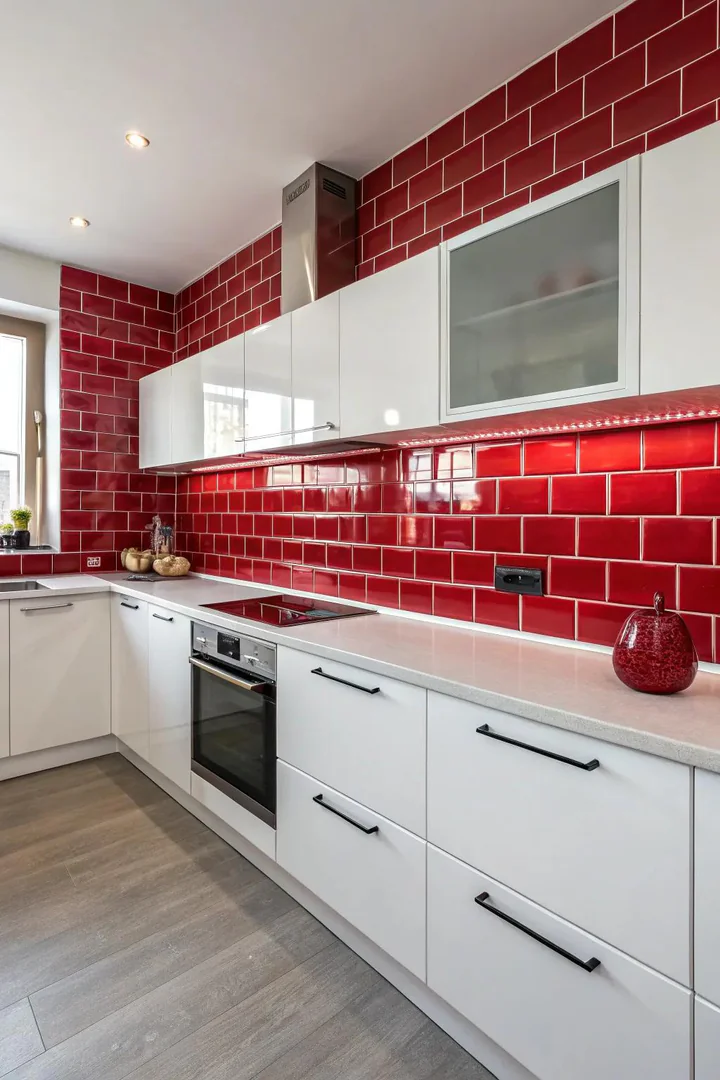
A red tile backsplash behind the range and countertop adds color to the most visible wall in the kitchen without touching the cabinets, countertops, or floor. Red subway tile (3×6 inches, $5 to $10 per square foot from Daltile, MSI, or Floor and Decor) in a classic brick-lay pattern produces a vintage diner or farmhouse look. Red glass mosaic tile (1×1 inch or 2×2 inch sheets, $10 to $25 per square foot from Modwalls or TileBar) catches light and adds a glossy, reflective quality that makes a small kitchen feel larger.
A standard backsplash (the area between the countertop and upper cabinets, typically 18 inches tall and 8 to 12 feet wide) covers 12 to 15 square feet. At $5 to $25 per square foot for tile, plus $5 to $10 per square foot for installation (or DIY with pre-mixed mastic adhesive, $15 to $25 per gallon, and sanded grout, $10 to $15 per bag), a red backsplash costs $120 to $525 installed. Pair a red backsplash with white cabinets and black or dark-gray countertops for maximum contrast, or with natural wood cabinets and cream countertops for a warmer, softer palette.
4. Red Kitchen Walls
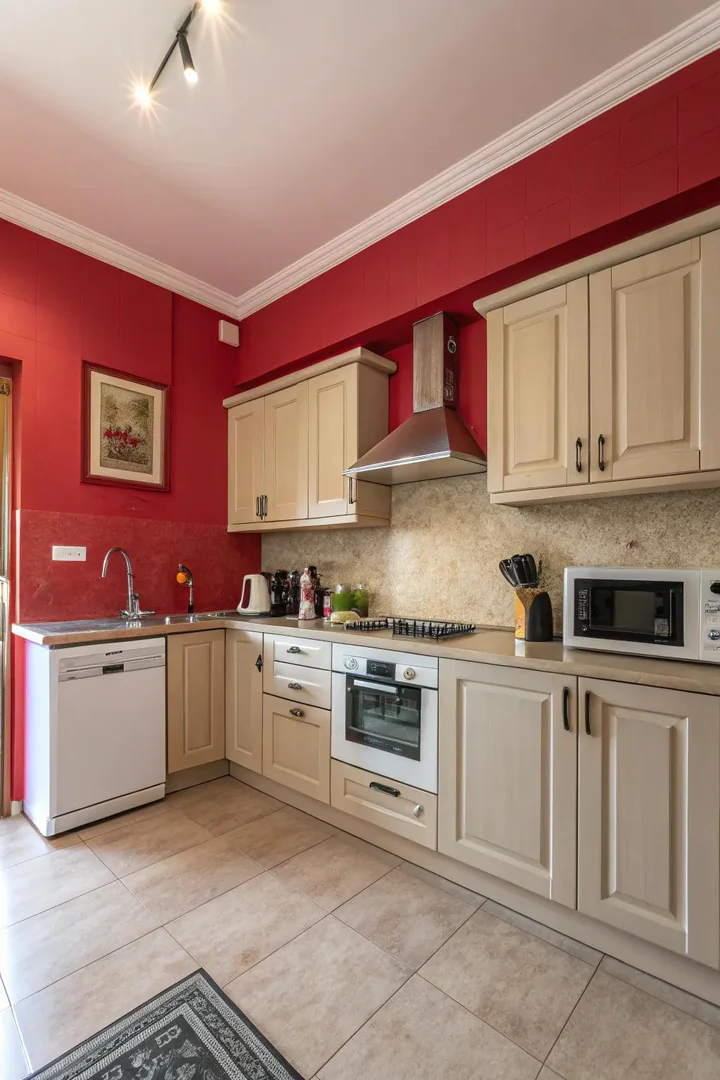
Painting all four kitchen walls in a warm red (Benjamin Moore Caliente AF-290, their 2018 Color of the Year, a deep, saturated true red; Sherwin-Williams Red Bay SW 6321, a warm terracotta-tinged red; or PPG Candy Apple PPG1065-7, a bright, clean red) creates an enveloping, high-energy room that makes the kitchen feel warm, intimate, and appetizing. Red walls require high-quality paint with strong pigment (red is one of the hardest colors to achieve full coverage; plan for 3 coats rather than the standard 2) and a tinted primer (ask the paint store to tint the primer to a medium red or pink to reduce the number of topcoats from 4 to 3).
A 10-by-12-foot kitchen with 8-foot ceilings has approximately 350 square feet of wall area minus windows, doors, and cabinets (net paintable area: 100 to 150 square feet for a kitchen with upper and lower cabinets on two or three walls). At 350 to 400 square feet of coverage per gallon, 1 gallon of premium paint ($40 to $60 for Benjamin Moore Regal Select or Sherwin-Williams Emerald) covers the paintable wall area in 3 coats. Red walls pair best with white or cream cabinets, white trim and moldings, and stainless-steel or black appliances.
5. Red Countertops
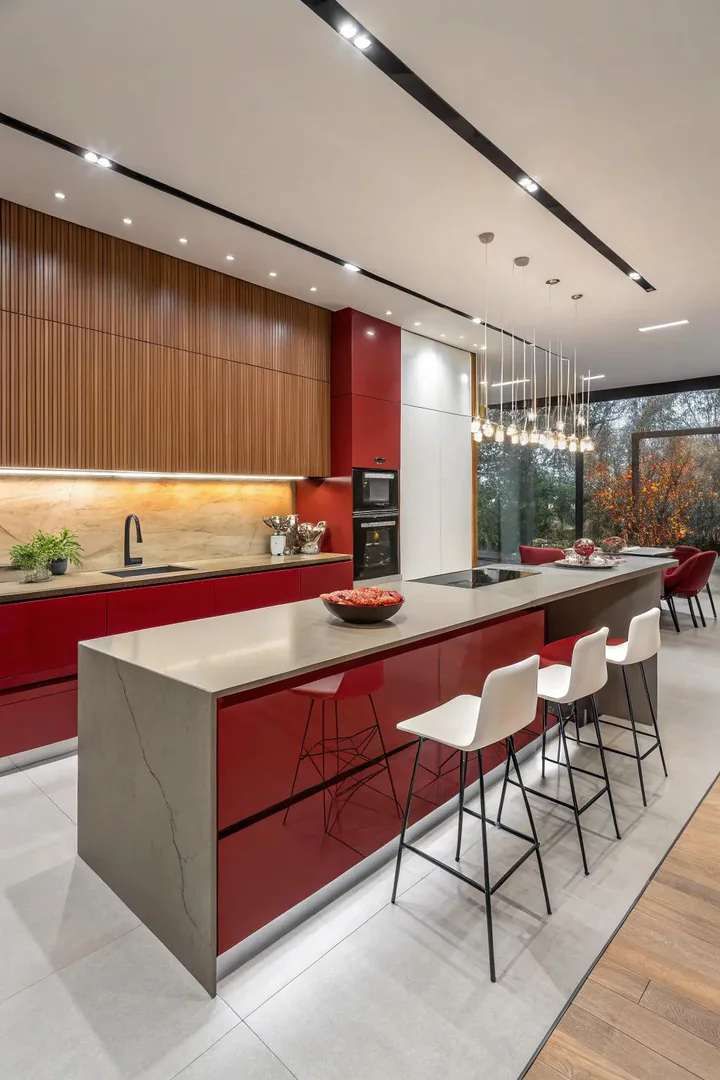
A red quartz countertop (Caesarstone 3452 Red Shimmer, $55 to $75 per square foot installed; Silestone Rojo Stellar, $50 to $70 per square foot installed) or a red laminate countertop (Formica 6901 Jaipur, a deep red; $10 to $30 per square foot for material, plus fabrication) brings color to the horizontal work surface, where it catches light, reflects onto the walls and cabinets, and becomes the visual anchor of the room. Red countertops read as bold and modern, most striking against white, gray, or black cabinetry.
A standard L-shaped kitchen has 25 to 40 square feet of countertop. At $55 to $75 per square foot installed for quartz, a red quartz countertop costs $1,375 to $3,000. At $10 to $30 per square foot for laminate, a red laminate countertop costs $250 to $1,200 including fabrication. A red concrete countertop (DIY poured in place using Quikrete Countertop Mix, $25 per 80-pound bag, tinted with Quikrete Liquid Cement Color in Red, $5 per 10-ounce bottle) costs $3 to $8 per square foot in materials and produces a matte, industrial-style red surface with visible texture and variation.
6. Red and Black Kitchen
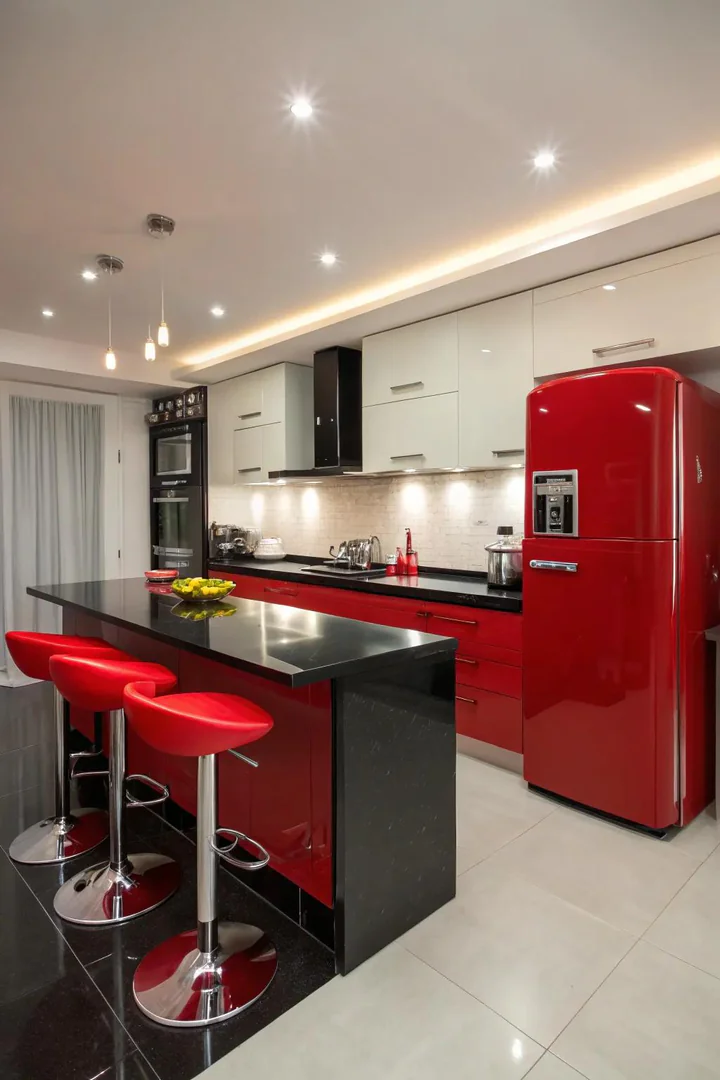
Pairing red cabinets or red walls with black countertops, black appliances, and black hardware creates a high-contrast, dramatic kitchen with a modern or industrial personality. Black absolute granite ($40 to $60 per square foot installed), black soapstone ($60 to $100 per square foot), or black laminate ($10 to $25 per square foot) on the countertops grounds the red and prevents the color from feeling overwhelming.
Add matte black cabinet pulls ($3 to $8 each from Amerock or Top Knobs), a matte black faucet ($100 to $250 from Delta Trinsic or Moen Align), and black pendant lights ($30 to $80 each from Globe Electric or West Elm) against red-painted or red-stained cabinets. A red-and-black kitchen works best with a single metallic accent (brushed gold or brass in the light fixtures, or stainless steel in the appliances) to break the two-color scheme and add warmth. A white backsplash (subway tile, $3 to $5 per square foot) between the red upper cabinets and black countertop provides a visual buffer strip that prevents the two dark colors from colliding.
7. Open Layout with Red Accents
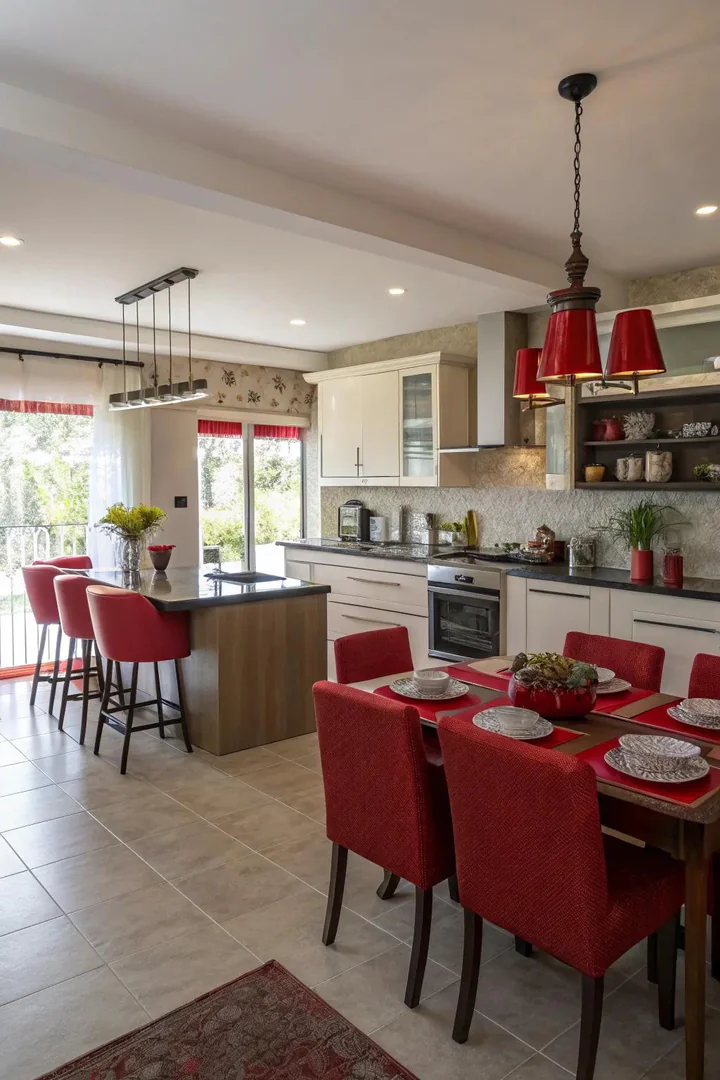
In an open-concept kitchen (where the kitchen shares an uninterrupted sightline with the living room and dining room), red accents in the kitchen must coordinate with the color palette of the adjacent rooms. Rather than painting all the kitchen cabinets red (which would dominate the entire open floor plan), place red in 2 to 3 concentrated spots: the island, the pendant lights, and the bar stools, or the backsplash, the range hood, and the countertop accessories.
Echo the kitchen’s red in the living and dining areas with 1 to 2 matching accessories per room (red throw pillows on the sofa, $15 to $25 each; a red table runner on the dining table, $10 to $20; a red vase or candle on a bookshelf, $8 to $15). Repeating the same red shade across the open floor plan creates visual continuity and makes the red kitchen accents look planned rather than isolated. A neutral base palette (white walls, wood floors, gray or beige upholstery) in the open layout allows the red accents to pop without competing with other strong colors.
8. Bold Red Cabinets
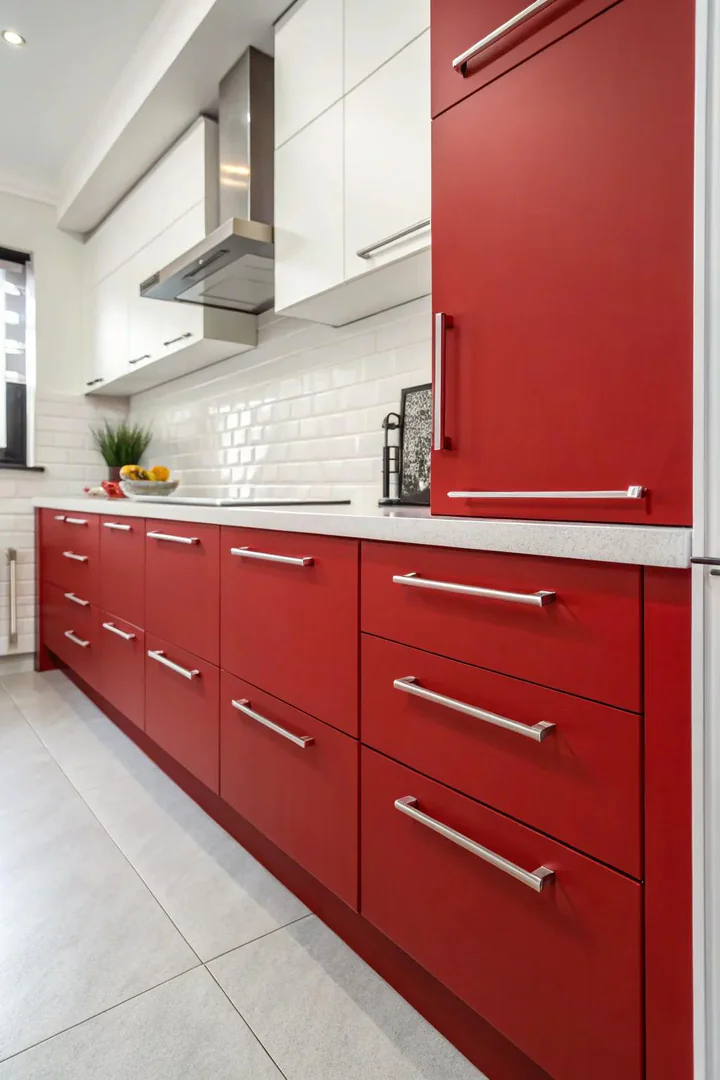
Painting or refacing all the kitchen cabinets in full red (Benjamin Moore Exotic Red 2086-10, a deep jewel-tone red; Sherwin-Williams Real Red SW 6868, a saturated primary red; or a custom auto-paint spray finish from a cabinet refinisher) is the most committed red kitchen transformation: every door, drawer front, and face frame becomes red. Full red cabinets work best in kitchens with plenty of natural light (a north-facing kitchen with small windows and red cabinets can feel cave-like and dark).
Balance full red cabinets with white or light-gray countertops (white quartz, Carrara marble, or light-gray concrete) and a white backsplash to keep the upper half of the kitchen bright. Chrome or brushed-nickel hardware ($2 to $6 per pull from Liberty Hardware) adds a cool metallic contrast that prevents the red cabinets from reading as flat. A professional cabinet painter charges $3,000 to $6,000 to sand, prime, and spray-paint a full set of kitchen cabinets; a DIY repaint using Benjamin Moore Advance ($50 per gallon, self-leveling alkyd formula) costs $150 to $300 in paint and primer for a 20-to-30-door kitchen.
9. Red Flooring
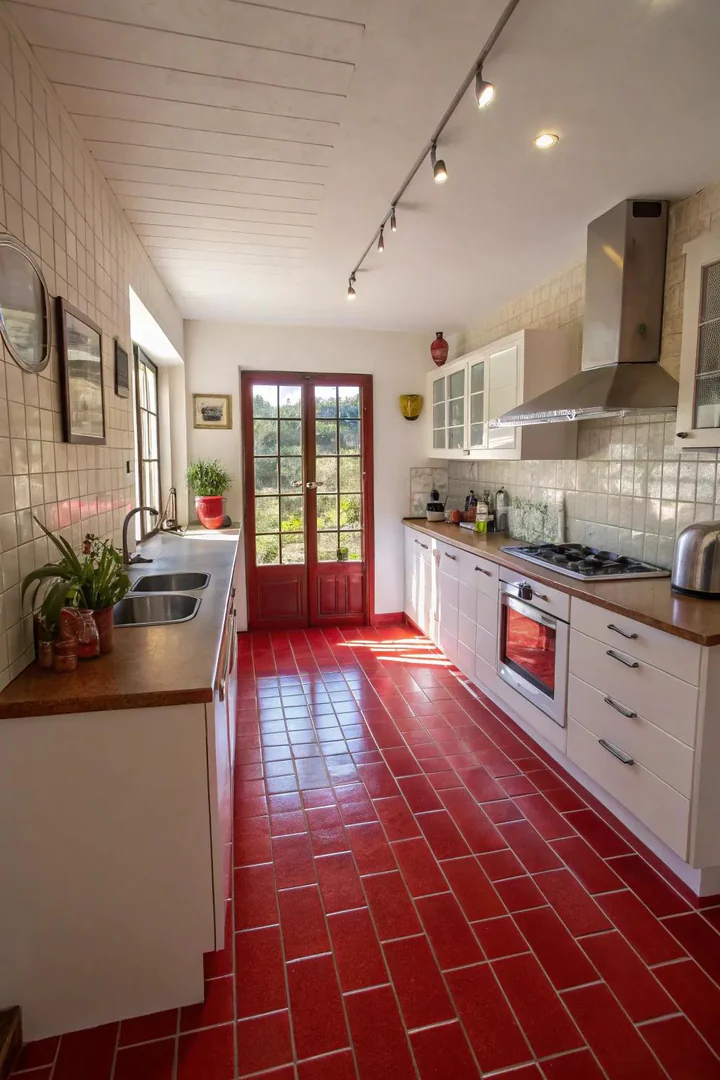
A red-toned floor grounds the entire kitchen from the bottom up and warms every color above it. Red oak hardwood ($3 to $8 per square foot unfinished, $6 to $12 installed) has a natural pink-to-red undertone that deepens with age and sunlight, providing subtle red without painted color. Brazilian cherry (Jatoba) hardwood ($6 to $12 per square foot, $10 to $16 installed) starts as an orange-red and darkens to a deep burgundy within 6 to 12 months of sunlight exposure.
For a bold, modern red floor, red-stained concrete ($2 to $6 per square foot for acid stain or dye application over existing concrete) produces a variegated, mottled red surface with industrial character. Red vinyl plank flooring (Lifeproof or COREtec in cherry or mahogany tones, $2 to $5 per square foot from Home Depot) provides a waterproof, scratch-resistant red-toned floor that installs as a floating floor over existing subfloor in a weekend. A 10-by-12-foot kitchen (120 square feet) costs $240 to $600 for red vinyl plank material. Pair a red floor with white or cream cabinets and a neutral countertop so the floor carries the color story without competition from above.
10. Red Pendant Lights
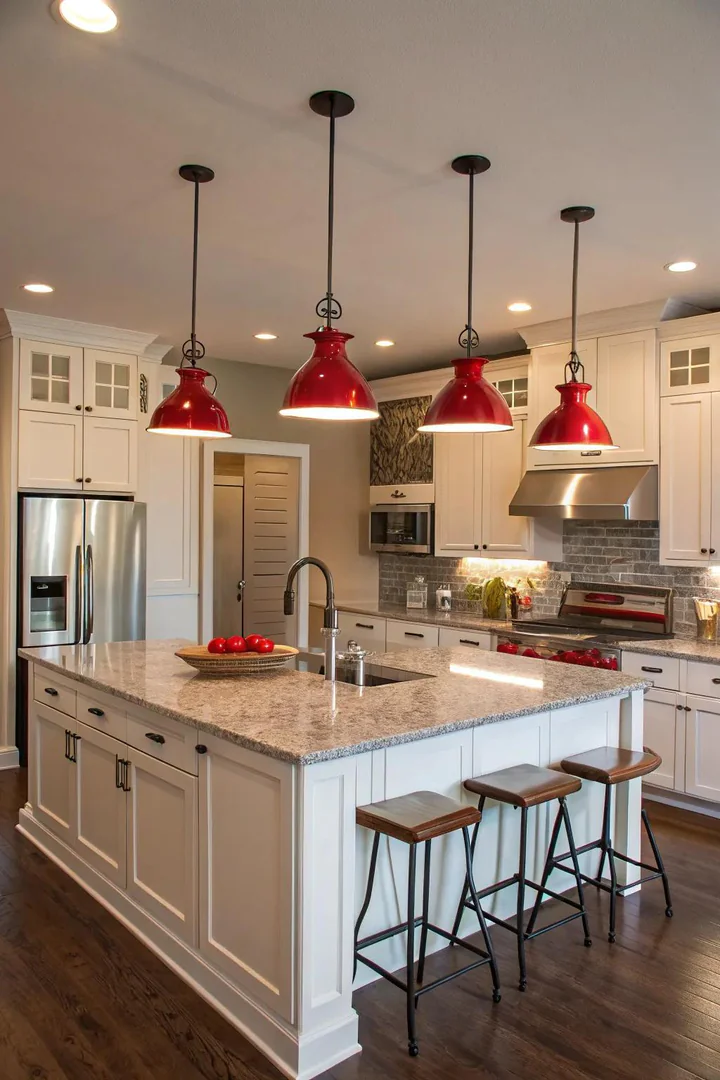
Hanging 2 to 3 red pendant lights over the kitchen island or peninsula introduces red at eye level where the color catches attention without requiring any permanent surface change to the cabinets, walls, or countertops. A red enamel dome pendant ($30 to $80 each from Barn Light Electric or Schoolhouse) in a vintage warehouse style suits farmhouse, industrial, and vintage kitchens. A red glass pendant ($40 to $100 from Pottery Barn or West Elm) in a blown-glass or art-glass style adds translucent red light and a jewel-like quality.
Space pendant lights 24 to 30 inches apart over a 6-to-8-foot island, centered on the island’s length, and hang them 30 to 36 inches above the countertop surface (measured from the bottom of the pendant shade to the island top). A red metal shade directs light downward onto the work surface (task lighting for chopping, reading recipes, and serving), while a red glass globe diffuses light in all directions for a softer, ambient glow. Red pendants pair well with brass or gold hardware on the cabinets and faucet for a warm metallic echo that complements the red without matching it exactly.
11. Rustic Red and Wood
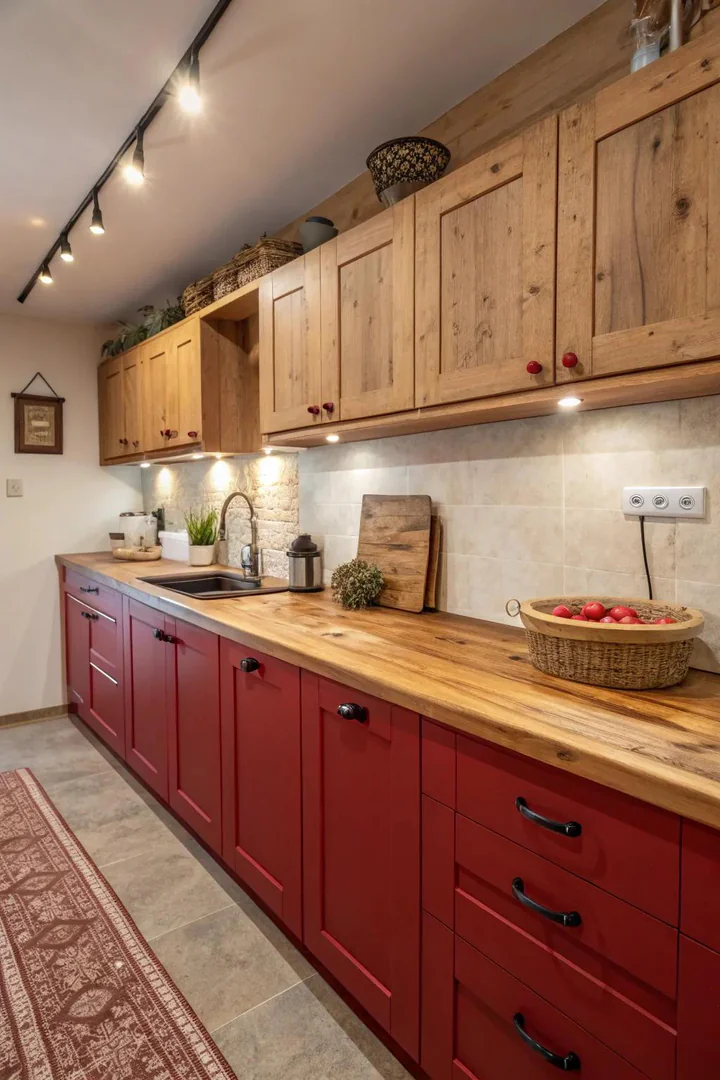
Combining red paint or red stain with exposed natural wood (reclaimed barn wood, rough-sawn cedar, or knotty pine) creates a warm, rustic kitchen with farmhouse, cabin, or country character. Paint the lower cabinets in a barn red (Benjamin Moore Cottage Red HC-184, a muted, earthy red with brown undertones; Sherwin-Williams Rustic Red SW 7593) and leave the upper cabinets, ceiling beams, or open shelving in natural, unsealed, or lightly oiled wood.
A reclaimed-wood open shelf ($20 to $60 for a 36-to-48-inch plank from a salvage yard or Etsy) mounted on black iron brackets ($10 to $20 per pair) against a barn-red painted wall produces the classic red-and-wood farmhouse look. Add a cast-iron skillet ($20 to $40 for a Lodge 12-inch) hung from a wall hook, a wooden cutting board leaned against the backsplash ($15 to $40 from Totally Bamboo), and a galvanized metal bucket ($8 to $15) holding wooden spoons and spatulas for rustic accessories that reinforce the wood-and-red palette. See more natural wood and color combinations at DIY backyard hammock ideas for warm-toned outdoor design.
12. Red Appliances
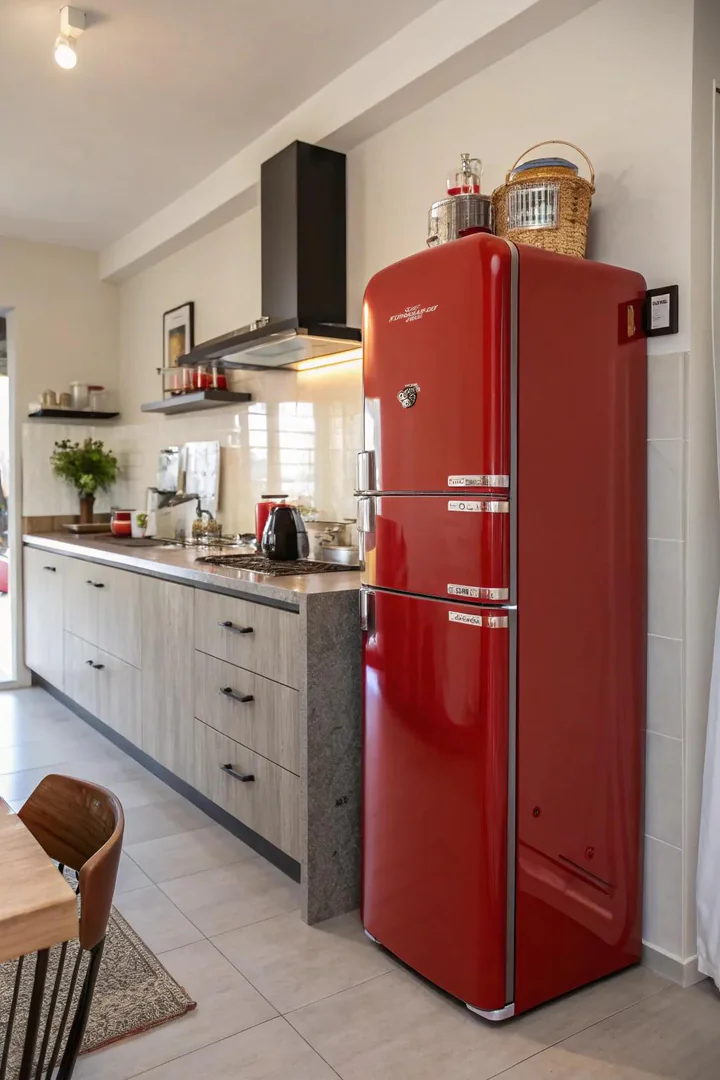
Replacing standard stainless-steel or white appliances with red appliances adds color through functional objects that earn their counter space and wall space regardless of color. KitchenAid Stand Mixer ($250 to $350 in Empire Red, the brand’s best-selling color), Smeg FAB28 50s-Style Refrigerator ($1,800 to $2,200 in red, a 1950s-style single-door fridge), KitchenAid KMT2115ER 2-Slice Toaster ($70 to $90 in Empire Red), and Breville BKE820CRNXL IQ Kettle ($130 to $170 in cranberry red) provide a full lineup of red countertop appliances.
Group red appliances together on one counter zone (a 3-to-4-foot stretch of counter near the coffee station or breakfast area) rather than scattering them across the kitchen. A concentrated grouping of 3 to 4 red appliances produces a stronger color statement than one red item on each counter. Keep the surrounding counter clear and the backsplash neutral (white, gray, or stainless) so the red appliances stand out against a clean background. A red toaster, red kettle, and red stand mixer on a white-quartz countertop against a white-subway-tile backsplash creates a vintage diner vignette that costs $350 to $600 for the three appliances.
13. Vintage Red Floor Tiles
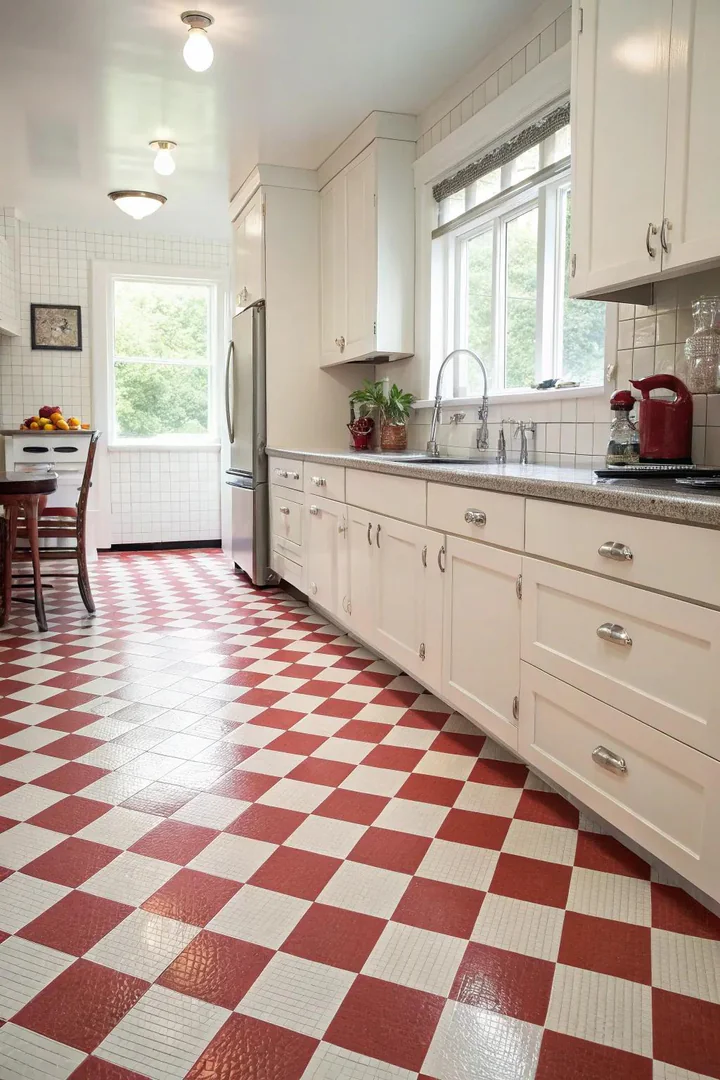
A red-and-white checkerboard floor (alternating 12-by-12-inch red and white ceramic tiles, $2 to $5 per square foot from Daltile, MSI, or Floor and Decor) produces an instant 1950s diner or vintage farmhouse floor that anchors the kitchen in a specific decade and color scheme. A 10-by-12-foot kitchen (120 square feet) requires approximately 120 tiles and costs $240 to $600 for tile plus $300 to $600 for professional installation (or DIY with thinset mortar, $10 to $20 per bag, and a 1/4-inch square-notch trowel, $10).
A red hexagonal mosaic tile (1-inch or 2-inch hex tiles, $8 to $15 per square foot from Merola or TileBar) mixed with white hex tiles in a scattered or patterned layout creates a vintage look with more visual complexity than a simple checkerboard. Red encaustic cement tiles ($8 to $20 per square foot from Cement Tile Shop or Granada Tile) in Moroccan or Mediterranean patterns add red through intricate, hand-painted geometric designs that make the floor itself a work of art. A patterned red tile floor works best in a kitchen with simple, solid-color cabinets and countertops so the floor pattern does not compete with busy surfaces above.
14. Red and White Kitchen
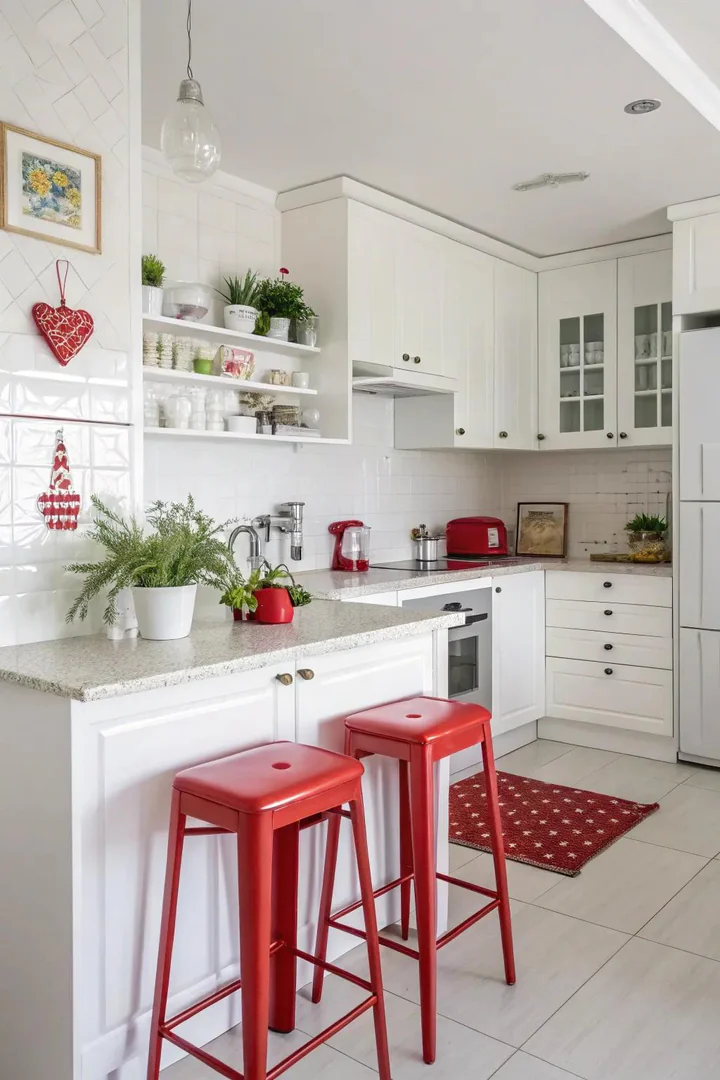
A red-and-white color scheme (the most classic red kitchen palette) pairs red cabinets, a red island, or red accessories with white walls, white countertops, and white backsplash for a clean, bright, high-contrast room that feels fresh rather than dark. White acts as a visual palate cleanser between red surfaces, preventing the red from becoming oppressive. A 60/40 white-to-red ratio (white walls, white countertops, white upper cabinets, with red lower cabinets and a red island) keeps the room airy and open.
Add white porcelain farmhouse sink ($200 to $400 from Kohler Whitehaven or Kraus Turino), white subway tile backsplash ($3 to $5 per square foot), and white quartz countertops (Caesarstone Pure White 1141, $50 to $70 per square foot installed) to anchor the white half of the palette. Introduce a third accent color through hardware and light fixtures: brushed brass ($3 to $8 per pull) warms the red-and-white scheme, while polished chrome ($2 to $5 per pull) keeps it cool and modern. A red-and-white kitchen with brass hardware and a wood floor produces a warm, classic space that photographs well and appeals to a wide range of buyers at resale.
15. Red Lighting Fixtures
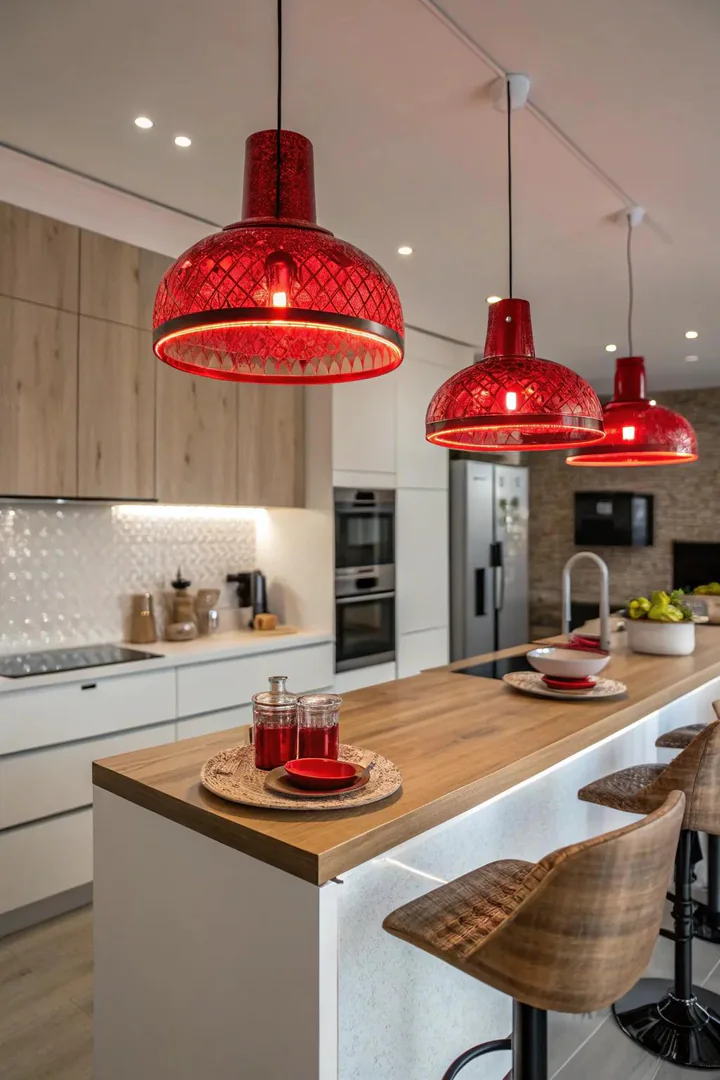
Beyond pendant lights, red flush-mount ceiling fixtures ($30 to $80 from Lamps Plus or Wayfair), red under-cabinet LED strips ($15 to $30 for a 16-foot roll of Govee RGBIC LED Strip Lights set to red), and red table lamps on open shelves ($20 to $50) add color through light sources placed throughout the kitchen at different heights. A red flush-mount fixture on a white ceiling draws the eye upward and adds red to the vertical plane without using wall paint or tile.
Red-hued lighting also changes the perceived color temperature of the room: red light makes warm tones (wood, cream, gold, copper) glow and makes cool tones (blue, gray, silver) recede. A smart bulb ($10 to $15 per bulb from Philips Hue or LIFX) set to a warm red-amber hue in an existing fixture adds red light without replacing the fixture itself. Use red accent lighting in the evening for a warm, restaurant-like ambiance, and switch to full-spectrum white light during daytime cooking for accurate color perception when preparing food.
16. Red Bar Stools
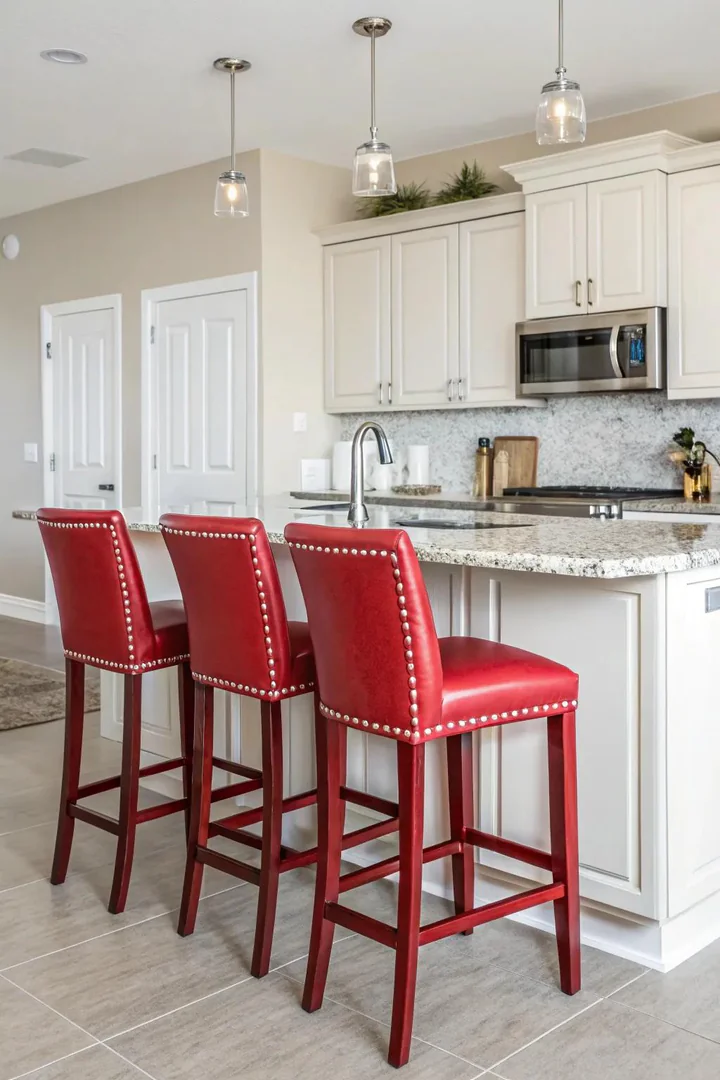
Placing 2 to 4 red bar stools at the kitchen island or peninsula brings red into the room through movable furniture that can be replaced, recovered, or relocated without repainting or retiling. A red vinyl vintage bar stool ($80 to $150 each from Coaster Furniture or Amazon) with a chrome pedestal base and swivel seat creates a 1950s diner look. A red metal industrial stool ($40 to $80 each from Flash Furniture or Tolix in powder-coated red) suits modern, industrial, and farmhouse kitchens.
A red upholstered counter stool ($100 to $250 each from West Elm or CB2) with a fabric or leather seat on a wood or metal base provides a more refined, less vintage red accent. Match the stool height to the counter: counter-height stools (24 to 26 inches from floor to seat top) for a 36-inch-high counter, and bar-height stools (28 to 30 inches) for a 42-inch-high bar top. Leave 6 to 8 inches of knee clearance between the seat top and the counter underside for comfortable seating.
17. Subtle Red Accents
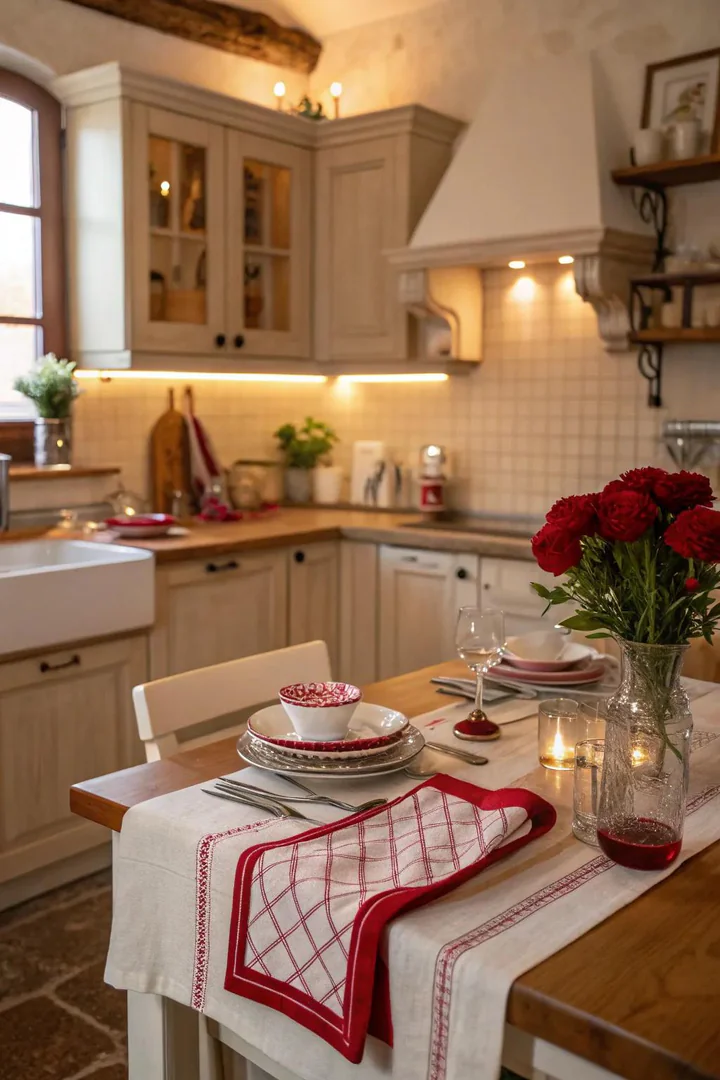
For homeowners who want red in the kitchen without a bold commitment, small, changeable red accents introduce the color through items that cost $5 to $30 each and can be swapped in minutes. A red vase ($8 to $20) on the windowsill, a red clock ($15 to $40) on the wall, a red rug (a 2-by-3-foot washable kitchen mat, $15 to $30 from Ruggable), a red pot or Dutch oven ($30 to $60 for a Lodge enameled Dutch oven in red) displayed on the stove top, and red cloth napkins ($10 to $20 for a set of 4) in a holder on the counter add red without any paint, tile, or construction.
A red window valance or cafe curtain ($15 to $35 from Target or IKEA) softens the window and adds red to the upper half of the kitchen. A red ceramic canister set ($20 to $40 for a set of 3 from Anchor Hocking or Wayfair) holding flour, sugar, and coffee on the counter provides both storage function and color. Subtle accents let you test whether red works in your kitchen before committing to a permanent red backsplash, island, or cabinet paint job. Explore more accent color strategies at small U-shaped kitchen ideas for color placement in compact kitchens.
18. Eclectic Red Mix
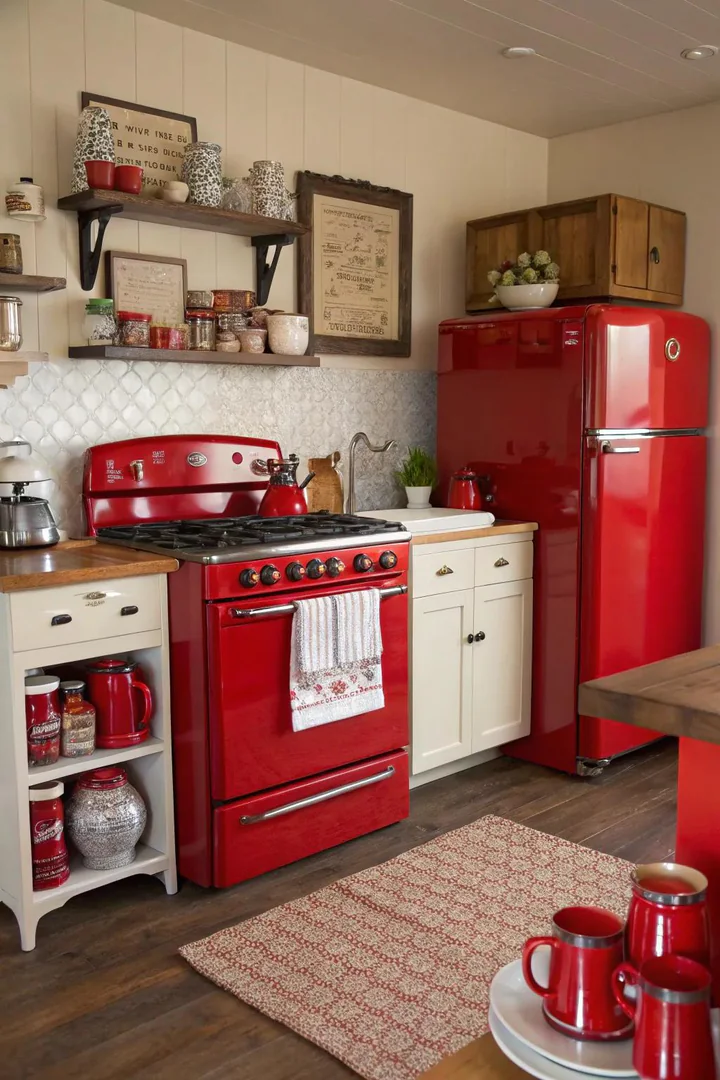
An eclectic red kitchen mixes multiple shades, textures, and surfaces of red in the same room: burgundy cabinets with tomato-red bar stools, a terracotta tile floor with cherry-red pendant lights, or cranberry walls with scarlet dish towels and a raspberry rug. Rather than matching one exact red throughout the room, an eclectic approach layers 3 to 4 different red tones that share the same warm or cool undertone (all warm reds: tomato, brick, terracotta, cranberry; or all cool reds: crimson, raspberry, cherry, wine).
Mixing warm reds with cool reds (a blue-based crimson backsplash with an orange-based terracotta floor) creates a clashing tension that reads as unintentional. Keep all reds in the same temperature family and vary the saturation and value instead: a deep, dark burgundy on the lower cabinets, a medium cherry-red on the island, and a bright tomato-red on the pendant lights produces a layered, tonal red scheme. Add pattern through a red-and-cream toile curtain ($15 to $30), a red geometric rug ($20 to $50), or red-and-white plaid dish towels ($8 to $15) for texture variety within the red palette. Visit wood kitchen cabinet color ideas for more cabinet color pairings, or browse The Designers Company for the full design inspiration library.
How to Choose the Right Red for Your Kitchen
1. Test Red Paint Samples on the Kitchen Wall
Red paint looks dramatically different depending on the light source and the surrounding colors. A red that looks warm and rich under the warm bulbs at the paint store can look orange under fluorescent kitchen lighting or purple in a north-facing kitchen with cool, blue-tinted natural light. Buy 3 to 4 paint samples ($4 to $8 each for a sample pot from any paint brand) in different red tones: one warm red (tomato, brick), one true red (fire-engine, cherry), one cool red (crimson, wine), and one muted red (barn red, terracotta). Paint each sample on a 12-by-12-inch section of the kitchen wall, view them at different times of day (morning, midday, evening with artificial light), and choose the shade that looks best in the actual kitchen lighting.
2. Decide the Red-to-Neutral Ratio
A kitchen that is 100% red (red cabinets, red walls, red floor, red accessories) feels overwhelming and fatiguing. A kitchen with 10% to 20% red (2 to 3 red accent pieces in an otherwise neutral room) may not register the red as an intentional design choice. The effective range for a red kitchen is 20% to 40% red surfaces (red island plus red pendant lights plus red bar stools, or red lower cabinets plus red backsplash) with the remaining 60% to 80% in white, cream, gray, natural wood, or black neutrals.
3. Pair Red with a Complementary Material
Red pairs strongest with white (clean, high contrast), natural wood (warm, rustic), black (dramatic, modern), gold and brass (warm, upscale), and gray (contemporary, understated). Avoid pairing red with orange, pink, or purple on large surfaces — these adjacent-hue combinations compete rather than complement. A single pairing material (red plus white, or red plus wood) produces a more cohesive kitchen than three or four competing neutrals around the red.
Red Kitchen Style Comparison
| Red Element | Cost | Permanence | Best Pairing | Style |
|---|---|---|---|---|
| Red cabinets (full) | $150–$6,000 | High | White counters, white backsplash | Bold modern, vintage |
| Red island only | $15–$50 (paint) | Medium | White/gray perimeter cabinets | Farmhouse, transitional |
| Red backsplash | $120–$525 | High | White cabinets, dark counters | Vintage, Mediterranean |
| Red appliances | $70–$2,200 each | Medium | White counters, neutral cabinets | Vintage, eclectic |
| Red accents only | $5–$50 each | Low | Any neutral kitchen | Any style |
| Red floor | $240–$1,920 | High | White/cream cabinets | Rustic, traditional |
Frequently Asked Questions
Does red make a kitchen look smaller?
Red is an advancing color (it appears to move toward the viewer), so large expanses of red on the walls or cabinets in a small kitchen can make the room feel more enclosed than the same room painted white or light gray. Counteract the advancing effect by using red on one accent wall or the island only (rather than all surfaces), pairing red with white countertops and white upper cabinets (the white expands the upper half of the room visually), and maximizing natural and artificial light. In a kitchen larger than 100 square feet, full red cabinets do not create a noticeably smaller-feeling room.
What is the best red paint for kitchen cabinets?
Benjamin Moore Advance ($50 to $55 per gallon, waterborne alkyd, self-leveling, hard-curing) in Caliente AF-290 or Heritage Red 1306 is the most recommended red cabinet paint among professional painters. Sherwin-Williams Emerald Urethane Trim Enamel ($75 to $85 per gallon, acrylic-alkyd hybrid, extremely durable) in Fireworks SW 6867 is a premium alternative. Both products self-level to reduce brush and roller marks, cure to a hard, scrubbable finish within 7 to 14 days, and resist yellowing over time (a common problem with oil-based paints on light colors, less noticeable on red but still relevant for color accuracy).
Does a red kitchen affect home resale value?
A full red kitchen (red cabinets, red walls, red countertops) is a strong personal preference that limits buyer appeal at resale — most buyers prefer neutral kitchens (white, gray, wood tones) that they can personalize after moving in. A red accent (red island, red backsplash, or red appliances in an otherwise neutral kitchen) does not negatively affect resale and can make the listing photos more memorable and eye-catching. Paint is the easiest and cheapest change a new buyer can make ($100 to $300 for a full kitchen repaint), so red paint on the walls or cabinets is a lower-risk commitment than a red tile backsplash or red countertops (which cost $500 to $3,000 to replace).
What metals pair best with a red kitchen?
Brushed brass and brushed gold add warmth that complements red’s warm undertone, producing a traditional, upscale look (red cabinets with brass pulls and a brass faucet). Polished chrome and brushed nickel add a cool contrast that modernizes the red and keeps the room from feeling too warm (red cabinets with chrome pulls and a stainless-steel faucet). Matte black creates a dramatic, graphic contrast (red cabinets with black pulls, black faucet, and black pendant lights). Avoid mixing more than two metal finishes in the same kitchen — one for hardware and faucet, one for lighting is the standard two-metal rule.
Can you use red in a modern, minimalist kitchen?
Red works in a modern kitchen when applied as a flat, unbroken surface (slab-front cabinets with no visible frame or panel detail, painted or lacquered in a high-gloss or matte red) paired with handleless push-to-open cabinets, integrated appliances, and a monolithic countertop. The minimalist structure (no ornament, no hardware, no visible hinges) prevents the red from reading as vintage or farmhouse. A high-gloss lacquer finish (applied by a professional cabinet finisher, $5,000 to $10,000 for a full kitchen) reflects light across the flat slab surface and produces a contemporary, European-style red kitchen with a glass-like smoothness.