
Kitchen Wall Sconce Ideas: 22 Stylish Ways to Upgrade Your Walls
Kitchen wall sconces mount directly to the wall between 60 and 72 inches above the floor and deliver task, accent, or ambient light in spots that ceiling fixtures and recessed cans leave dark. Sconces beside the range hood, flanking a window over the sink, or bracketing open shelving fill shadow gaps that a single overhead light source creates, and the fixtures themselves add architectural detail to flat drywall.
Choosing the right sconce depends on three factors: the light output you need (measured in lumens), the finish that matches your existing hardware (brushed nickel, matte black, aged brass, oil-rubbed bronze), and the shade direction (uplight, downlight, or both). A sconce rated at 400 to 600 lumens suits accent lighting beside shelving, while a 800-to-1,200-lumen fixture with a focused downlight shade handles task lighting above a prep counter or breakfast bar.
Browse The Designers Company for more kitchen lighting, layout, and renovation ideas that pair wall sconces with pendants, under-cabinet strips, and recessed fixtures into a complete layered lighting plan.
1. Minimalist Cylinder Sconces
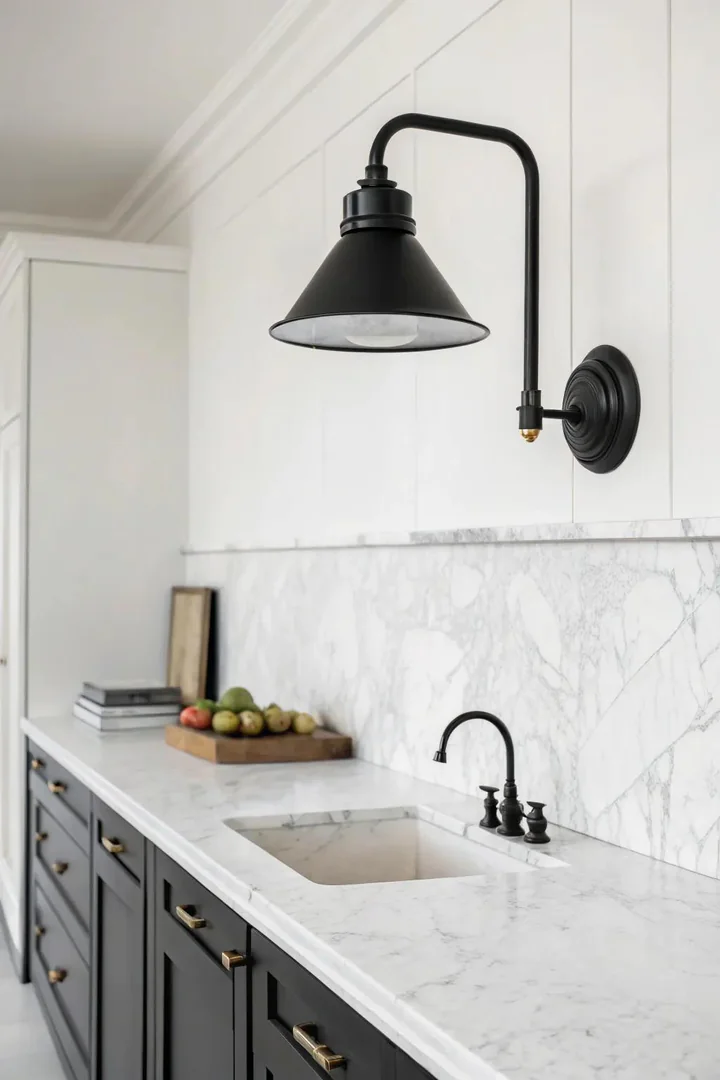
A slim cylindrical sconce with a closed top and open bottom casts a tight, focused cone of light downward without spilling glare across adjacent surfaces. Cedar and Moss’s Axis sconce and Schoolhouse Electric’s Aero fixture both use a narrow aluminum or spun-steel cylinder in matte black, brushed brass, or satin white that blends into clean-lined modern and Scandinavian kitchens.
Mount a pair of minimalist cylinder sconces 36 inches apart on either side of open shelving to wash light across dish displays and glassware. The narrow profile, typically 3 to 4 inches in diameter, keeps the fixture flush against the wall and avoids interfering with cabinet doors or range hood clearance. Use a GU10 LED spotlight bulb rated at 3000K for warm white task light, or 2700K for a softer ambient glow that suits evening cooking.
Minimalist sconces work as the only wall-mounted light in a kitchen that already has recessed ceiling cans and under-cabinet LED strips. The cylinder shape adds a single vertical accent without competing with the horizontal lines of countertops, shelving, and cabinet rails.
2. Vintage Lantern Sconces
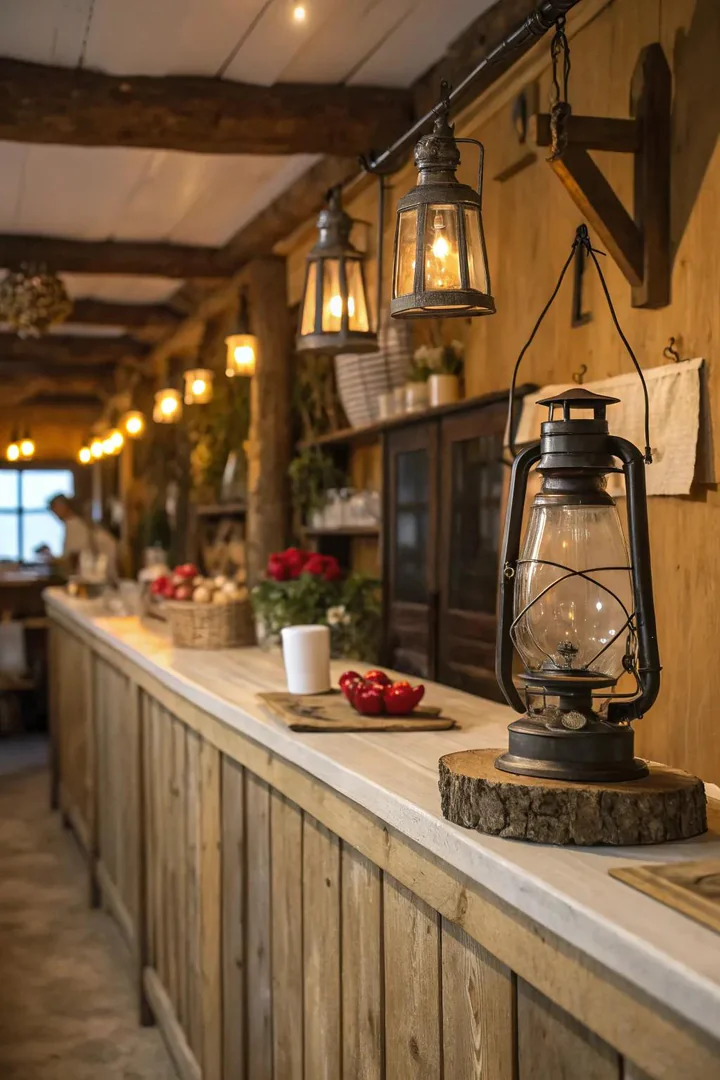
A lantern-style sconce with a clear or seeded glass cage and an aged-bronze or antique-brass frame recalls gas-lamp fixtures from the early 1900s. Feiss’s Declaration collection, Troy Lighting’s Henry Street series, and Kichler’s Barrington line all offer lantern sconces with hand-forged iron details and distressed finishes that suit farmhouse, cottage, and traditional kitchens.
Seeded glass diffuses the bulb slightly and creates a soft, speckled light pattern on the surrounding wall. Clear glass shows the filament of an Edison ST58 or ST64 bulb, turning the fixture into a decorative object as much as a light source. Choose a candelabra-base (E12) lantern for a delicate, period-accurate scale, or a standard-base (E26) version for higher lumen output in larger kitchens.
Hang lantern sconces at 66 inches above the floor on either side of a window, a range hood, or a doorway leading to a pantry. The enclosed glass cage protects the bulb from kitchen steam and grease splatter, making lantern sconces a practical choice for positions near the stove or sink.
3. Industrial Cage Sconces
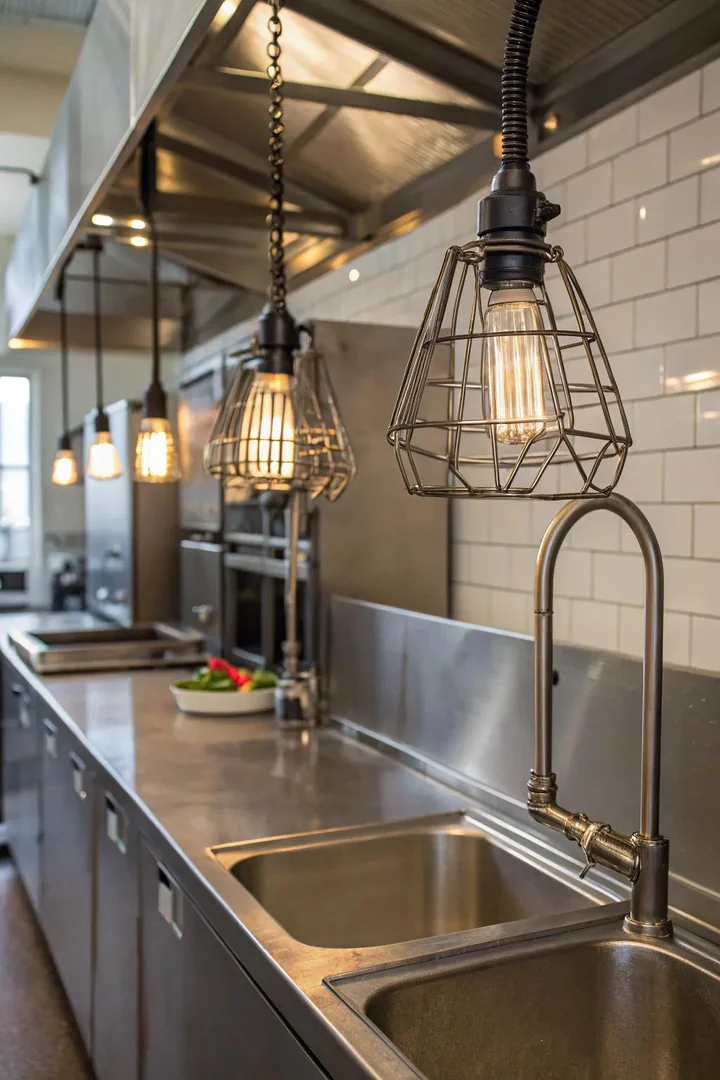
An open wire cage around a bare filament bulb creates an industrial-loft aesthetic that pairs with exposed brick, concrete counters, butcher-block islands, and black steel-frame windows. The cage casts angular, geometric shadow patterns on the wall and ceiling that shift as the bulb warms and cools. Globe Electric’s Jorah series and Amazon’s Stone and Beam Industrial collection both offer cage sconces under $30 with matte black, brushed pewter, and oil-rubbed bronze finishes.
Cage sconces expose the bulb completely, so bulb selection matters visually. A vintage-style filament bulb like the Feit Electric Original Vintage ST19 or the GE Reveal HD+ Edison bulb adds warm amber light at 2200K to 2500K and turns the bare bulb into a design feature. LED filament bulbs replicate the spiral or squirrel-cage look of incandescent Edison bulbs at a fraction of the energy cost, running 4 to 7 watts versus 40 to 60 watts.
Mount cage sconces at staggered heights in a cluster of three for an industrial gallery wall effect, or use a single cage sconce on a gooseneck arm above the kitchen sink where a pendant would hang too low. The open cage design allows full airflow around the bulb, keeping the fixture cool in kitchens that already run warm from oven and range heat.
4. Art Deco Sconces
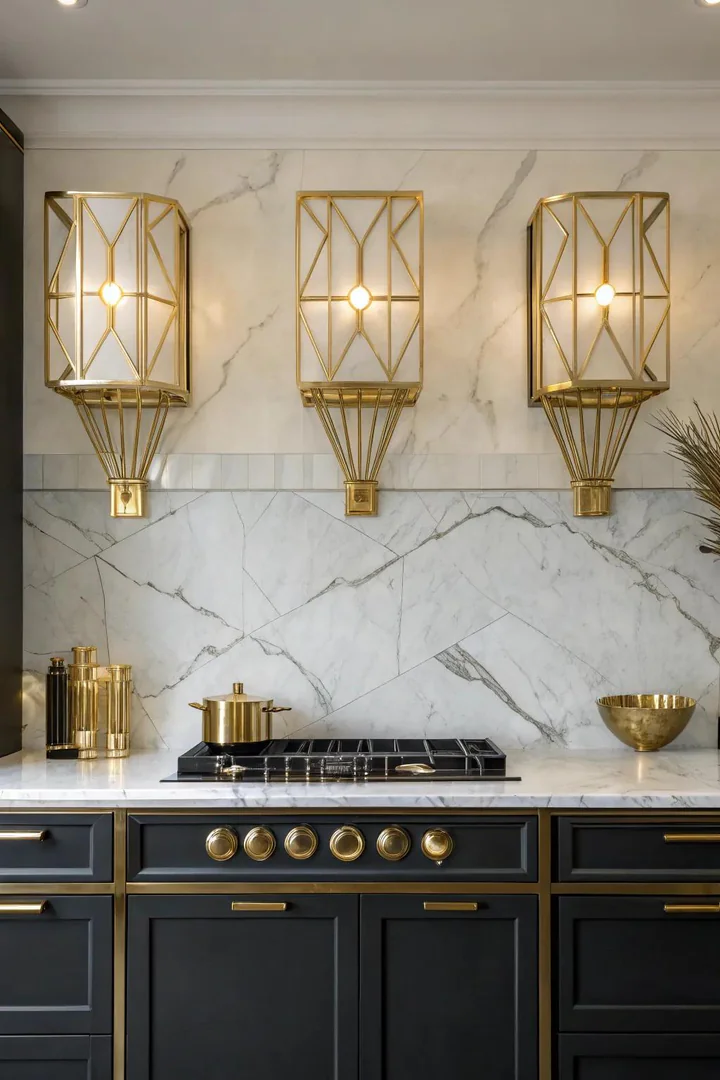
Art Deco sconces feature geometric lines, fluted or ribbed glass shades, and polished metallic finishes in brass, chrome, or nickel that reference 1920s and 1930s design. Hudson Valley Lighting’s Dawson collection and Mitzi’s Daphne series offer fluted glass globe sconces on streamlined brass arms that bring Art Deco geometry to a modern kitchen without looking like a period reproduction.
Ribbed glass shades break the light into soft, parallel bands that ripple across the wall, adding visual texture without a patterned wallpaper or tile. A globe or half-sphere fluted shade in opal white glass softens the light to a warm, even glow, while a clear ribbed shade lets the LED filament bulb show through and doubles as a decorative object.
Art Deco sconces suit kitchens with brass or gold cabinet hardware, marble or quartz countertops, and lacquered or high-gloss cabinet finishes. Place a pair flanking a framed piece of art, a chalkboard menu, or a decorative hood surround to create a symmetrical focal point on the wall. The polished brass finish requires occasional buffing with a microfiber cloth and brass polish like Brasso or Bar Keepers Friend to maintain its mirror sheen.
5. Nature-Inspired Sconces
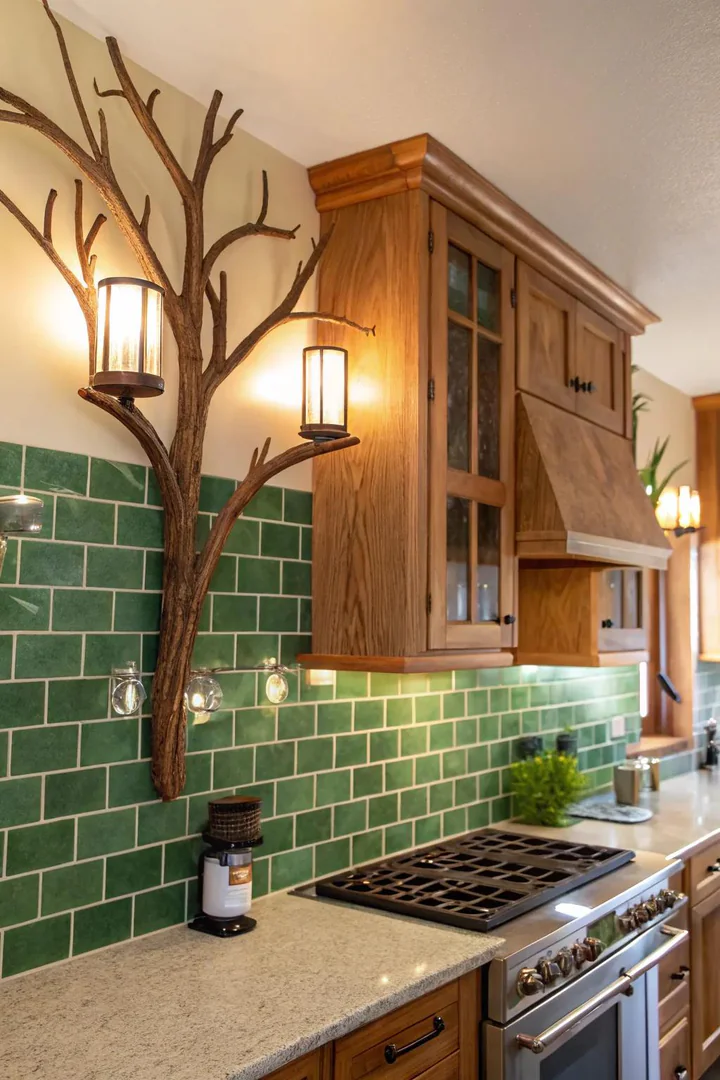
Sconces shaped like botanical branches, coral forms, or tree limbs bring organic, sculptural shapes to kitchen walls. Currey and Company’s Aubrey sconce features hand-wrought iron branches finished in antique gold leaf, while Visual Comfort’s Julie Neill Mandeville collection uses cast-brass vine forms with small bud-shaped candelabra sockets. The irregular, asymmetrical silhouettes soften the rigid geometry of kitchen cabinetry and countertop edges.
Nature-inspired sconces work as paired or single accent pieces rather than as primary task lights. Mount a single botanical branch sconce on the wall at the end of a run of upper cabinets where the kitchen transitions into a breakfast nook or dining area. The sculptural form marks the zone change and provides a warm accent glow that separates the cooking zone from the eating zone.
Choose a sconce in a finish that connects to other natural materials already in the kitchen: antique gold pairs with warm wood open shelving, verdigris or patina green links to natural stone backsplashes, and matte white coordinates with marble countertops and white shaker cabinets.
6. Mid-Century Modern Sconces
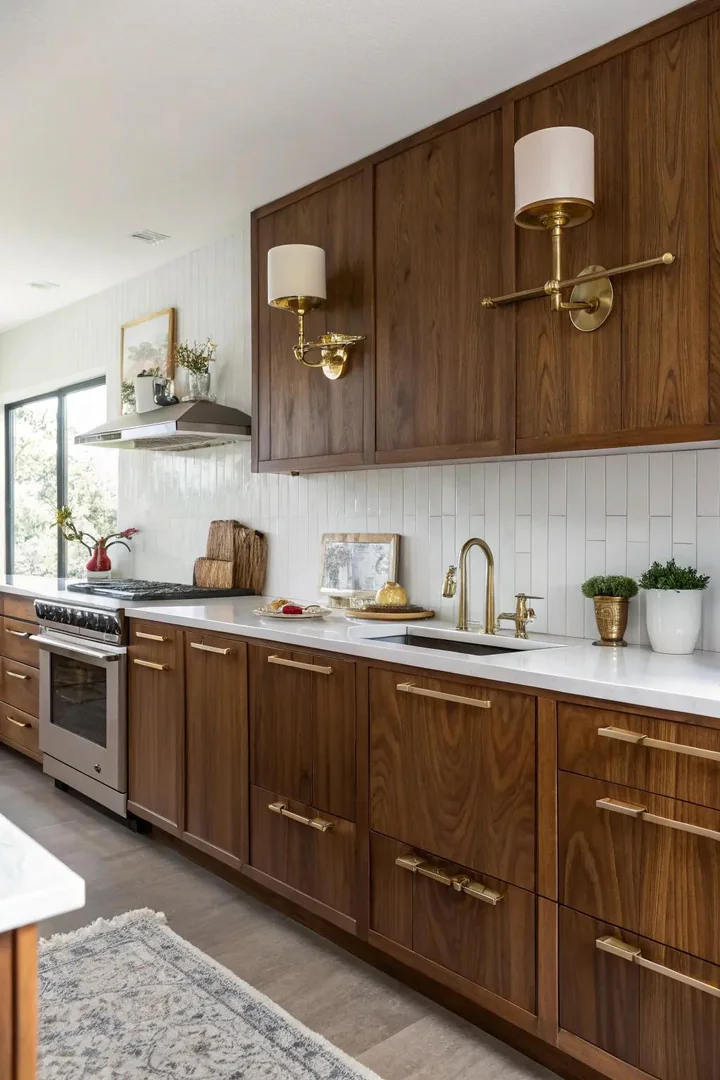
Mid-century modern sconces combine warm brass or brushed gold finishes with walnut wood accents, conical shades, and slender articulated arms. West Elm’s Mobile chandelier family includes a matching wall sconce with a spun-brass cone shade on an adjustable arm that pivots 180 degrees. Schoolhouse Electric’s Isaac sconce and Rejuvenation’s Berkley collection offer fixed-arm cone sconces in similar mid-century proportions at the $150 to $250 price point.
A swing-arm or articulated sconce mounted beside open shelving lets the homeowner aim the light cone at a cookbook, a cutting board, or a display of ceramics. The adjustable arm folds flat against the wall when not in use, maintaining a clean profile in narrow kitchens. Pair the sconce with a soft-white LED bulb (2700K to 3000K) inside the cone shade for focused downlight that avoids spilling glare into adjacent seating areas.
Mid-century modern sconces suit kitchens with flat-panel walnut or teak cabinetry, terrazzo or quartz countertops, and hardware in satin brass or champagne gold. The warm metal and wood combination reads as timeless rather than trendy, making the fixtures a safe long-term investment for a kitchen that leans toward clean, organic modernism.
7. Coastal Sconces
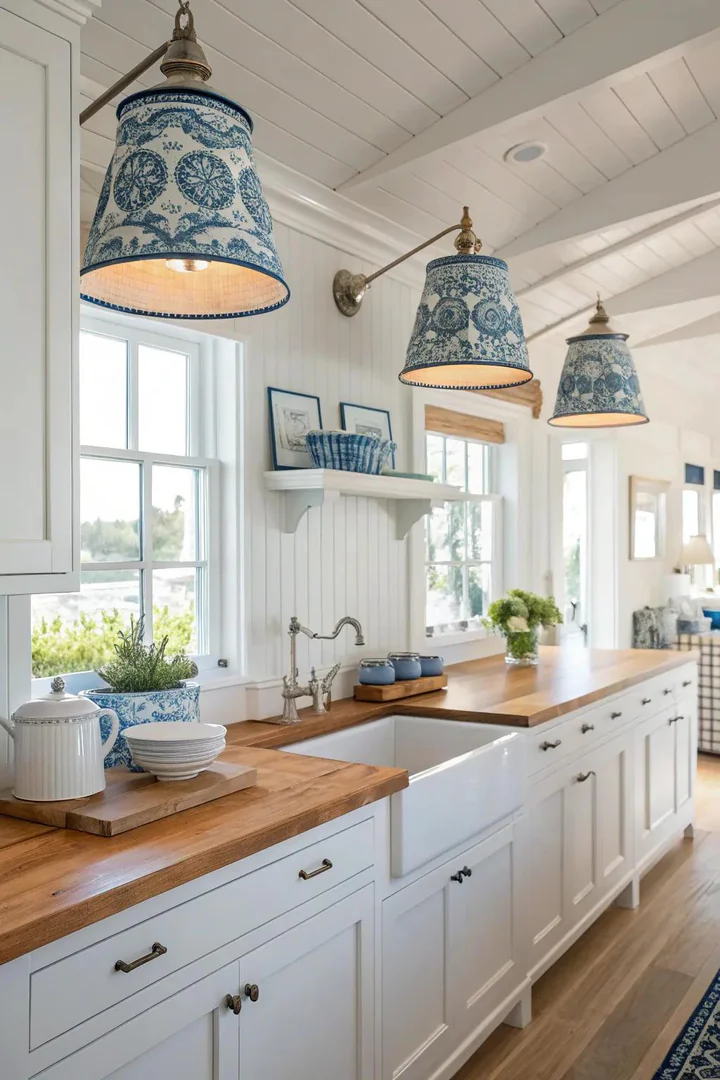
Coastal sconces use natural rope, woven rattan, bleached driftwood, or whitewashed metal to channel beach-house and lake-cottage atmospheres. Currey and Company’s Saltwater sconce wraps jute rope around a turned-wood column, while Serena and Lily’s Pacifica sconce features a woven rattan shade on a polished nickel arm. The natural-fiber textures filter and soften the light, casting a warm, patterned glow on the wall behind the fixture.
Mount coastal sconces in kitchens with blue-and-white palettes, shiplap walls, or tile backsplash designs in aqua, seafoam, or sandy beige. A pair of rope-wrapped sconces flanking a porthole mirror or a ship-wheel clock creates a cohesive nautical vignette on an accent wall. Choose a linen drum shade for a softer, diffused glow, or leave the bulb partially exposed for a casual, unfinished beach-shack feel.
Rope and rattan sconces collect kitchen grease and dust more readily than metal or glass fixtures. Vacuum the woven surfaces monthly with a brush attachment and spot-clean with a damp cloth and mild dish soap. Keep natural-fiber sconces at least 24 inches from the range or cooktop to avoid heat damage to the organic materials.
8. Rustic Wood and Iron Sconces
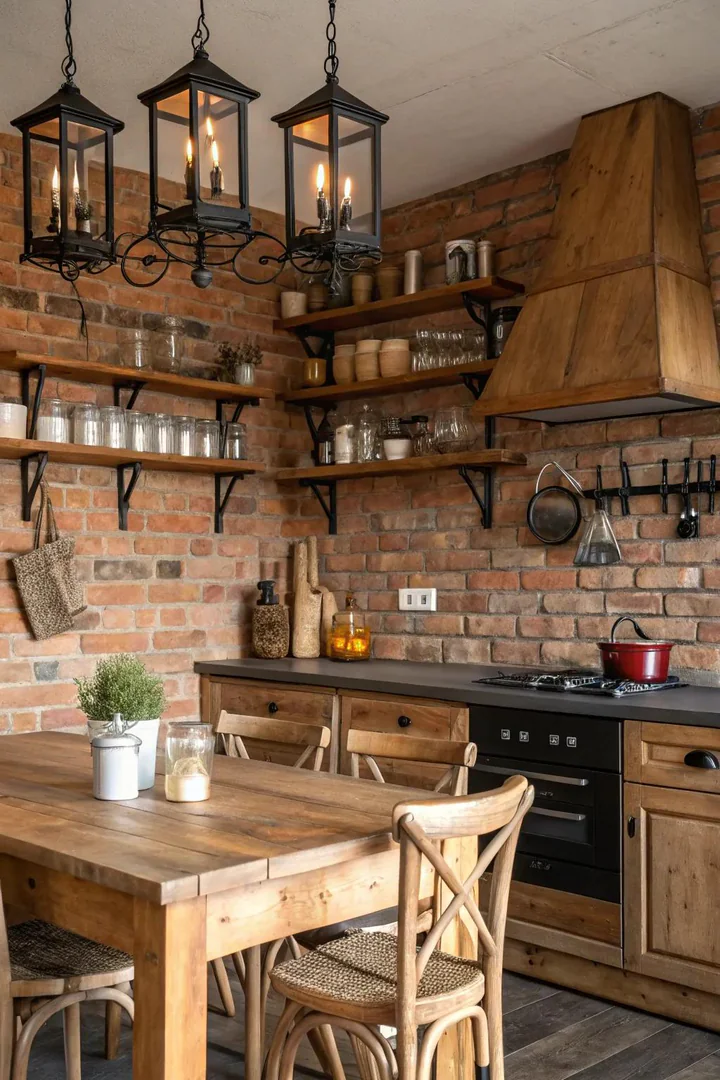
Rustic sconces combine reclaimed barn wood, hand-forged wrought iron, and clear Mason jar or seeded glass shades into fixtures that suit log-cabin, ranch, and country-farmhouse kitchens. Trent Austin Design’s Kennebunkport sconce and LNC’s Farmhouse Mason Jar series use a distressed wood backplate with an iron arm and a glass jar shade that holds a single E26 bulb. The combination of rough-sawn wood grain and hammered iron delivers a material contrast that polished-metal sconces cannot replicate.
A single rustic sconce mounted above the kitchen sink provides task light for washing dishes while the distressed wood backplate serves as a small decorative accent. Pair rustic sconces with other natural materials already in the kitchen: butcher-block counters in walnut or maple, open wood shelving, terracotta or slate backsplash tile, and cabinet hardware in oil-rubbed bronze or hammered iron.
Seal the reclaimed wood backplate with a clear matte polyurethane or Rubio Monocoat before installation to protect the wood from kitchen humidity and grease. The sealer darkens the grain slightly and prevents moisture absorption that can warp or crack the wood over time.
9. Geometric Shade Sconces
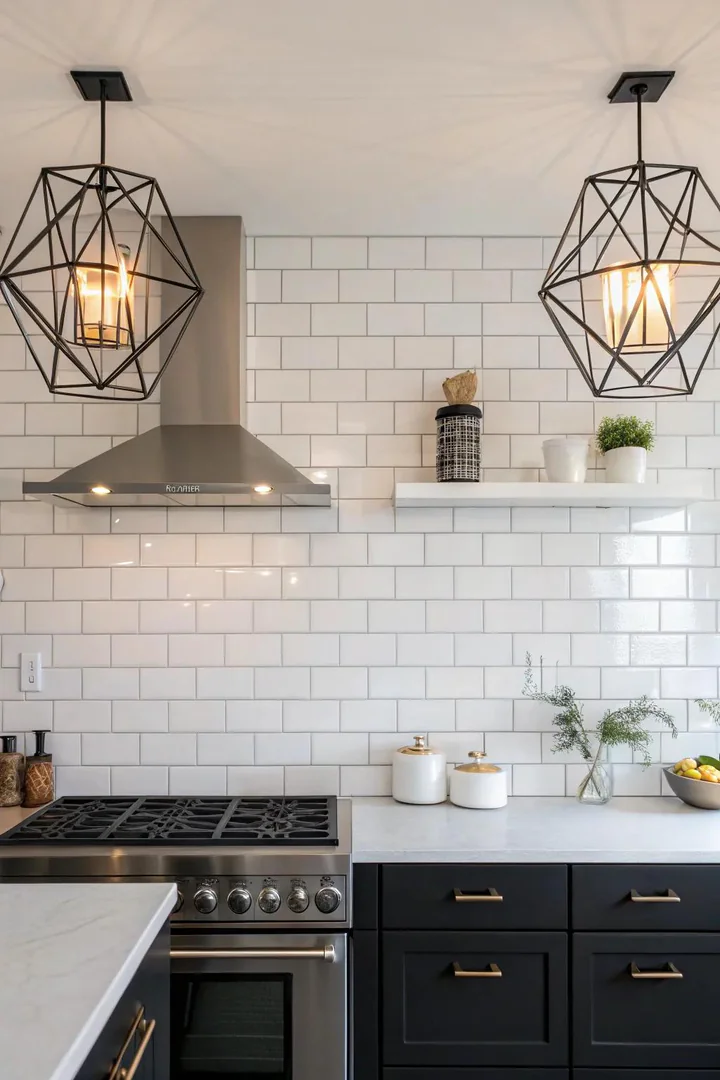
Geometric sconces use angular, faceted metal shades shaped like diamonds, hexagons, pyramids, or trapezoids to cast sharp-edged shadow patterns on the surrounding wall. West Elm’s Faceted Glass sconce and CB2’s Notch sconce feature multi-plane metal shades in matte black, antique brass, or polished nickel that read as modern sculpture during the day and produce dramatic light patterns at night.
A diamond-shaped shade mounted with one point facing up creates a vertical accent that draws the eye upward, while the same shade rotated 90 degrees produces a horizontal spread of light suited for washing a wide section of wall. Faceted glass versions, like the Mitzi Rosie sconce, combine geometric metalwork with clear or smoked glass panels that refract light into prismatic bands.
Geometric sconces work as standalone statement pieces because the unusual shade shape commands attention on its own. Mount a single geometric sconce on a blank wall between upper cabinets, or use a pair to bracket a clock, a menu board, or a piece of framed art. The angular shadows shift throughout the day as natural light from windows interacts with the fixture’s faceted planes.
10. Linen and Fabric Shade Sconces
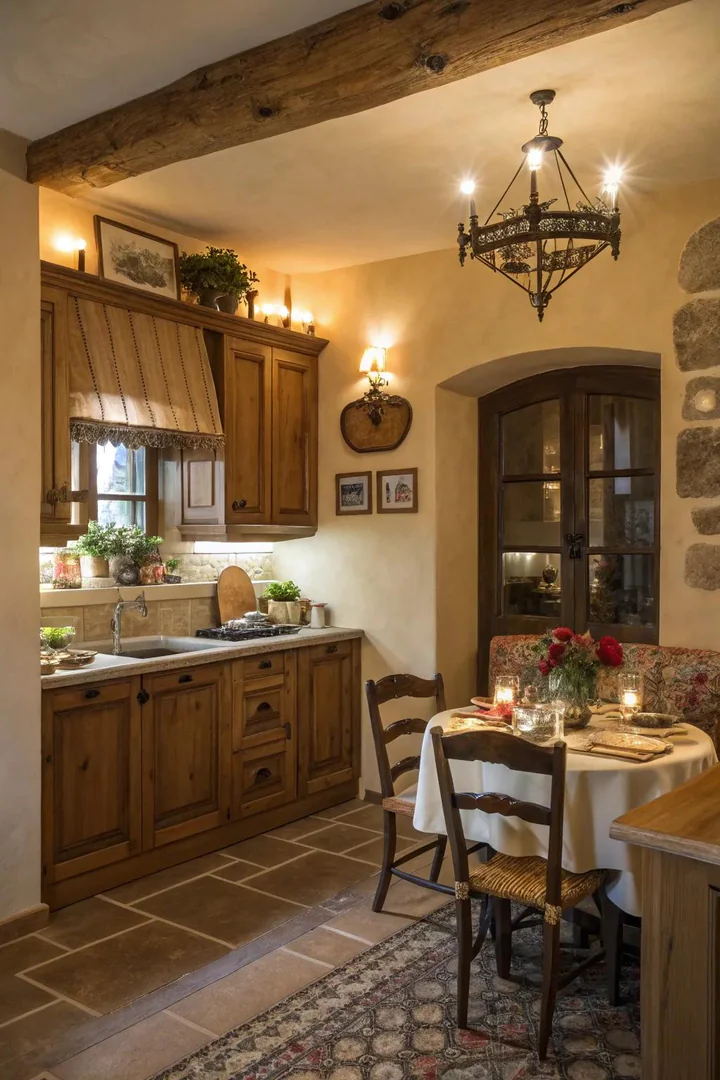
A fabric drum shade on a wall sconce diffuses light through the textile weave and casts a warm, even glow without the directional hot spots that open or glass-shaded sconces produce. Visual Comfort’s Barbara Barry French Cuff sconce and Restoration Hardware’s Library sconce both use a half-round or full-round linen shade on a metal arm in polished nickel, aged brass, or satin bronze.
Linen, cotton, and silk shades absorb and soften the light, reducing lumen output by 20 to 40 percent compared to an open bulb. Choose a fabric-shaded sconce for ambient accent lighting in breakfast nooks, eat-in kitchen dining areas, or above a bench seat where soft, flattering light matters more than raw brightness. Pair the sconce with a warmer bulb, 2200K to 2700K, inside the shade so the light filtering through the fabric reads as golden rather than cool or clinical.
Fabric shades collect kitchen grease and dust faster than metal or glass. Use a lint roller monthly and vacuum with a brush attachment quarterly. Avoid mounting fabric-shaded sconces directly beside the range or above the cooktop, as airborne cooking oils yellow and stiffen fabric over time. Reserve fabric shades for walls at least 4 feet from the primary cooking zone.
11. Polished Metallic Sconces
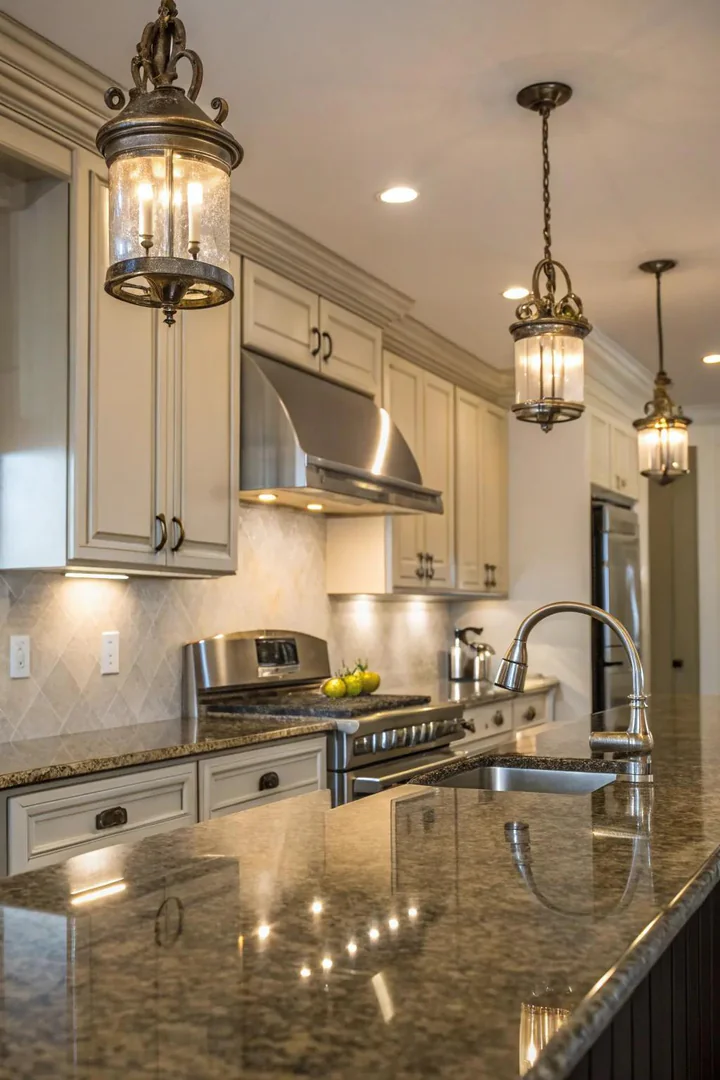
A polished-metal sconce in chrome, polished nickel, or mirror-finish brass reflects surrounding kitchen surfaces and bounces light across countertops, backsplashes, and cabinet faces. Cedar and Moss’s Alto sconce and Schoolhouse Electric’s Satellite fixture use a polished-brass or chrome socket holder with an exposed globe bulb, creating a fixture that functions as both a light source and a reflective accent piece.
Match the sconce metal to the kitchen’s dominant hardware finish: polished nickel pairs with stainless steel appliances and chrome faucets, polished brass links to gold cabinet pulls and brass pot rails, and satin bronze coordinates with oil-rubbed bronze hinges and drawer knobs. Mixing two metals is acceptable when each finish appears in at least two locations across fixtures, hardware, and accessories.
Polished finishes show fingerprints, water spots, and dust more readily than brushed or matte alternatives. Wipe polished brass and chrome sconces weekly with a dry microfiber cloth, and buff deeper marks with a specialty metal polish like Flitz or Cape Cod Metal Polishing Cloths. Polished-nickel and chrome finishes resist tarnishing indefinitely, while unlacquered polished brass develops a natural patina over six to twelve months unless maintained with regular polishing.
12. Farmhouse Gooseneck Sconces
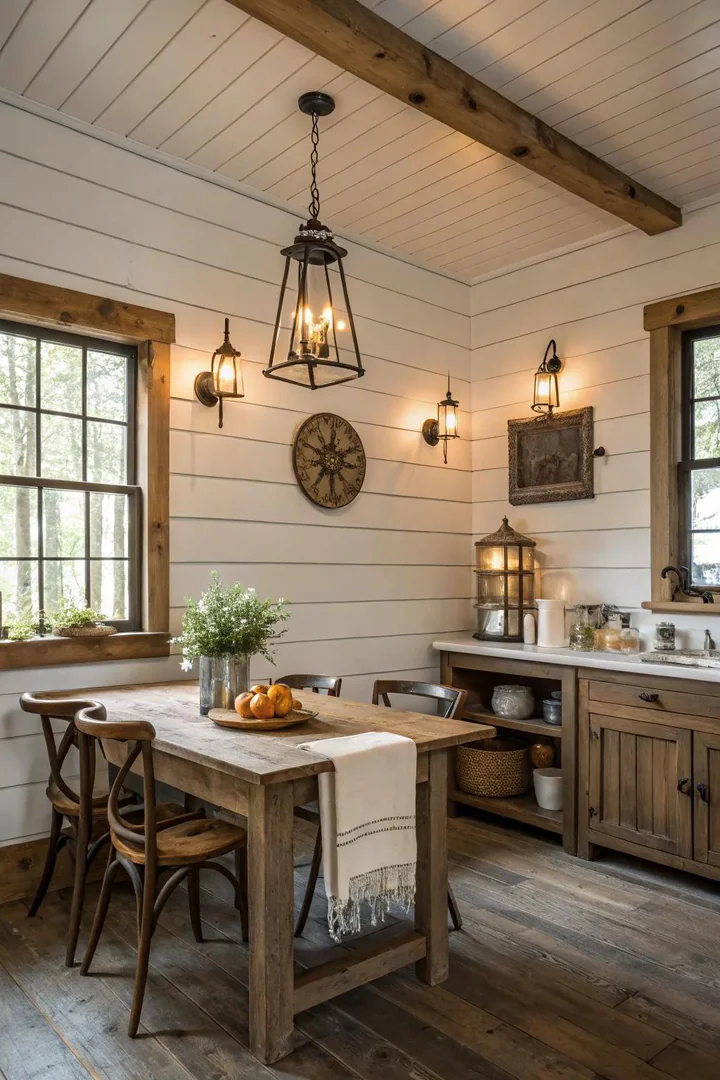
A gooseneck barn sconce with a spun-metal dome shade on a curved arm is the defining wall light of American farmhouse and barn-style kitchens. Barn Light Electric, Hi-Lite Manufacturing, and Cocoweb all offer customizable gooseneck sconces where the homeowner selects shade diameter (8, 10, 12, or 14 inches), arm length (13, 18, or 23 inches), and finish (galvanized steel, matte black, barn red, forest green, or textured white).
The dome shade directs all light downward, making gooseneck sconces excellent task lights for illuminating a countertop, a sink, or a breakfast bar. A 10-inch shade with a 13-inch arm provides clearance over a standard 25-inch-deep countertop without extending into the walking path. Mount the sconce 18 to 24 inches above the counter surface, measured from the bottom of the shade, for optimal task illumination without glare.
Galvanized-steel finishes resist rust and fingerprints, age gracefully in humid kitchen environments, and complement other farmhouse materials like shiplap, beadboard, and reclaimed-wood open shelving. Pair gooseneck sconces with matching gooseneck pendants from the same manufacturer to maintain a consistent arm curve and shade profile across all kitchen fixtures.
13. Sculptural Art Sconces
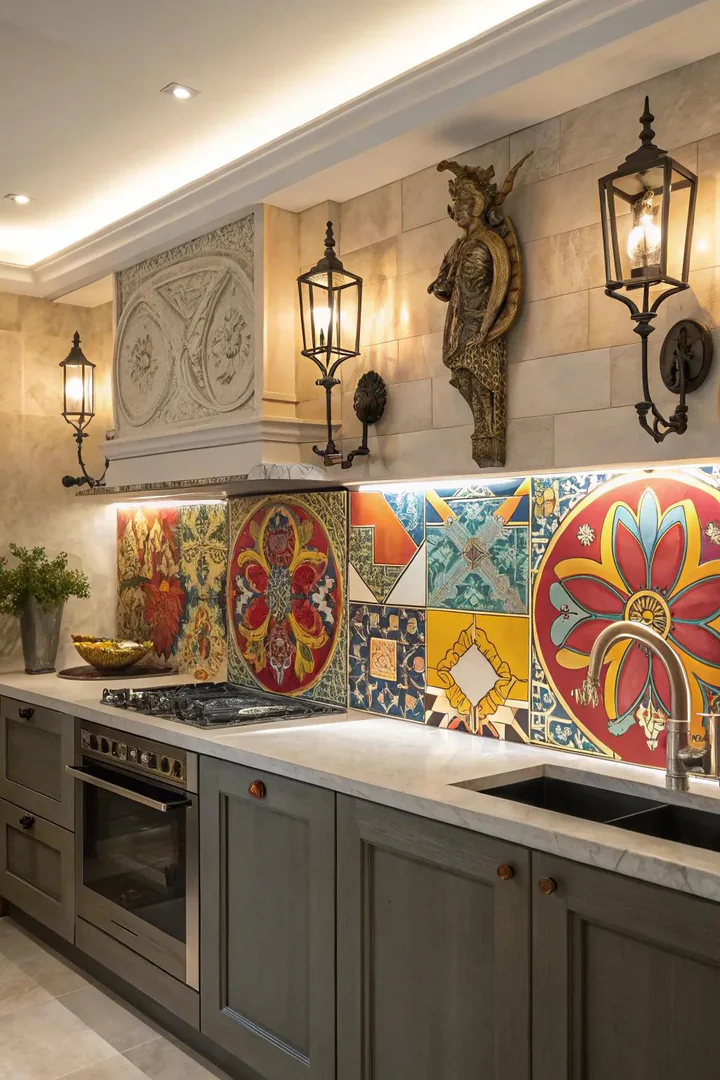
Sculptural sconces prioritize form alongside function, treating the fixture itself as a piece of wall-mounted art. Apparatus Studio’s Talisman sconce, Lindsey Adelman’s Branching Bubble wall mount, and Roll and Hill’s Agnes series use organic or abstract metal forms with integrated LED modules or small globe bulbs that appear to float within the sculpture.
A single sculptural sconce serves as a focal point on a blank kitchen wall, eliminating the need for artwork in that spot. Place the fixture at eye level, roughly 60 inches above the floor, on a wall visible from the primary seating area so the sculpture reads as both an art piece and a light source during dinner. The irregular shapes cast complex, layered shadows that add depth and visual movement to plain drywall or plaster walls.
Sculptural sconces occupy the high end of the price spectrum, often $500 to $2,000 per fixture from designer studios. Budget-conscious alternatives from West Elm, CB2, and AllModern offer sculptural silhouettes in cast aluminum or bent steel at the $100 to $300 range. Choose a fixture with a replaceable bulb rather than a sealed integrated LED module, as a failed LED in a sealed unit requires replacing the entire fixture.
14. Traditional Candle-Arm Sconces
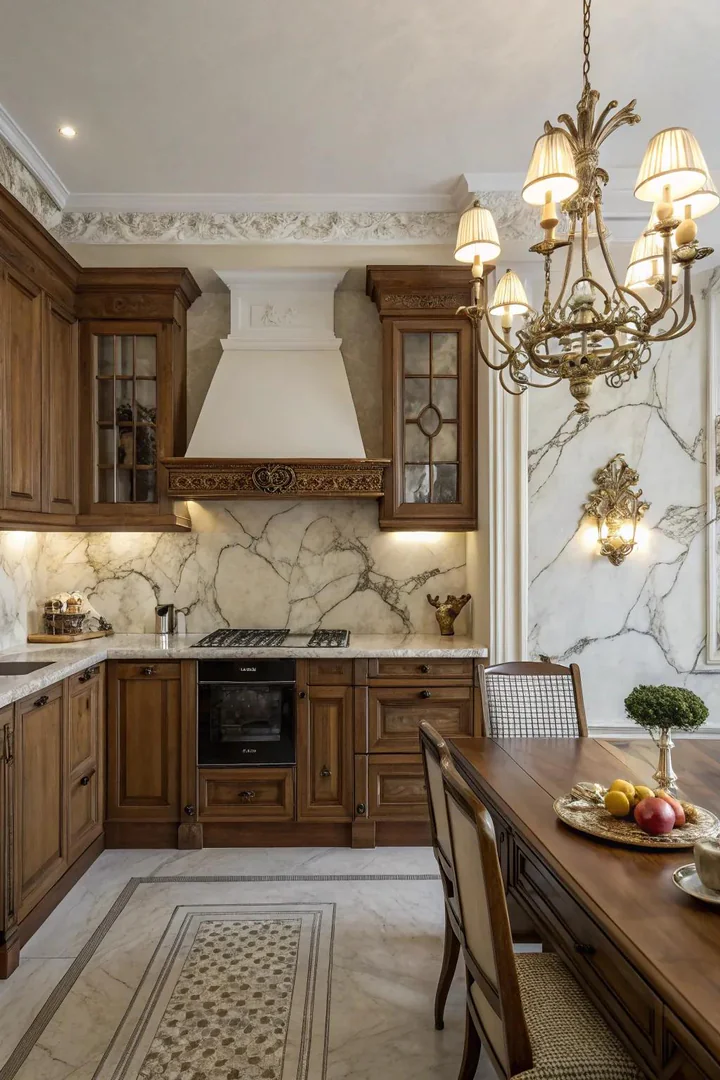
A two-arm or three-arm candle sconce with drip-wax candle covers and a decorative backplate brings Georgian, Federal, and European traditional style to a formal kitchen or butler’s pantry. Visual Comfort’s Chapman and Myers collection and Circa Lighting’s Sussex sconce offer candle-arm fixtures in antique-burnished brass, aged iron, and gilded finishes with hand-applied patina that replicates centuries-old metalwork.
Candle-arm sconces produce gentle, distributed light from multiple small bulbs, typically 25-watt or 40-watt equivalent LED candelabra (E12) bulbs. The multi-point light source creates a warm, diffused glow without the single bright spot of a downlight sconce. Use LED candelabra bulbs in a 2200K amber tone to mimic the flicker quality and color of real candlelight without the fire risk or wax drip.
Mount candle sconces on either side of a kitchen window, flanking a china cabinet, or bracketing a doorway between the kitchen and a formal dining room. The symmetrical placement reinforces the ordered, balanced composition that traditional kitchen design relies on. A dimmer switch on the candle sconce circuit lets the fixture shift from bright background light during cooking to a low, atmospheric glow during seated meals.
15. Matte Black Statement Sconces
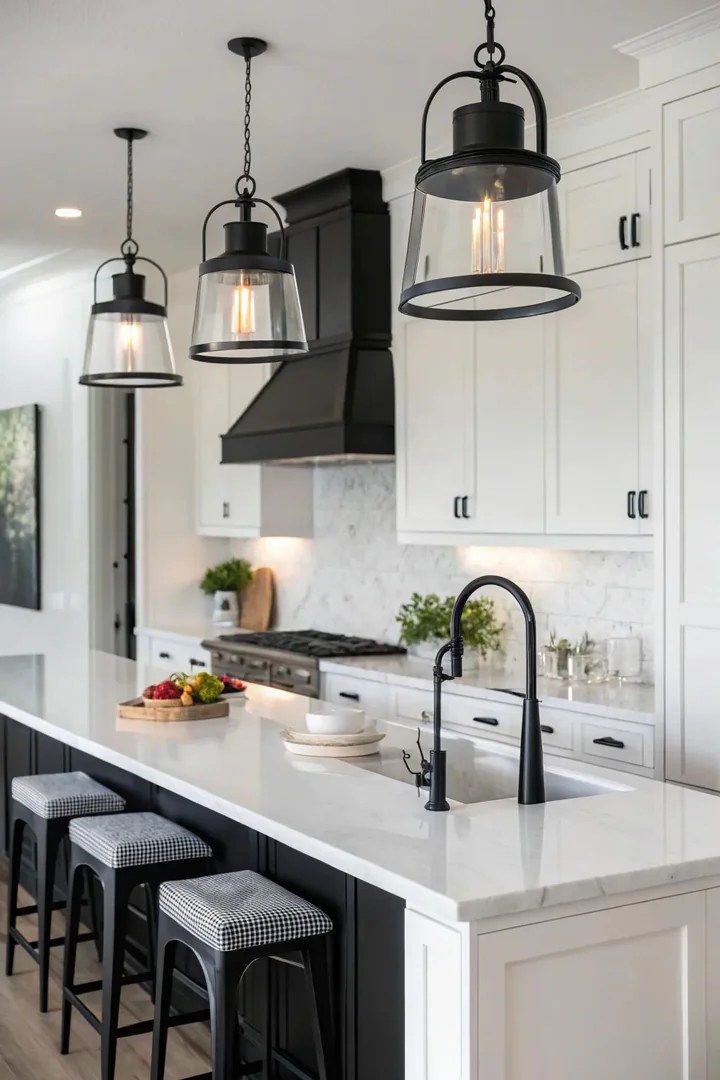
Matte black sconces create maximum contrast against white, cream, or light gray kitchen walls, turning the fixture itself into a graphic accent. Matte black powder-coat finishes absorb light rather than reflecting it, giving the sconce a solid, weighty presence on the wall. Progress Lighting’s Briarwood series, Sea Gull Lighting’s Alturas collection, and Hinkley’s Warwick line all offer matte black sconces in cone, cylinder, globe, and dome shade shapes.
A pair of matte black cylinder sconces flanking a white marble backsplash creates a tuxedo-style contrast that reads as intentional and architectural. Coordinate the matte black sconce finish with other black elements already in the kitchen: black cabinet hardware pulls, a black faucet from Delta’s Trinsic or Moen’s Align collection, black window mullions, or a black range like the Café Matte Collection from GE.
Matte black finishes hide fingerprints and kitchen grease better than polished or satin metals, reducing the frequency of cleaning. A damp microfiber cloth removes dust and light splatter without damaging the powder-coat surface. Avoid abrasive cleaners and scouring pads that scratch through the matte topcoat and expose the raw metal beneath.
16. Warm Copper and Brass Sconces
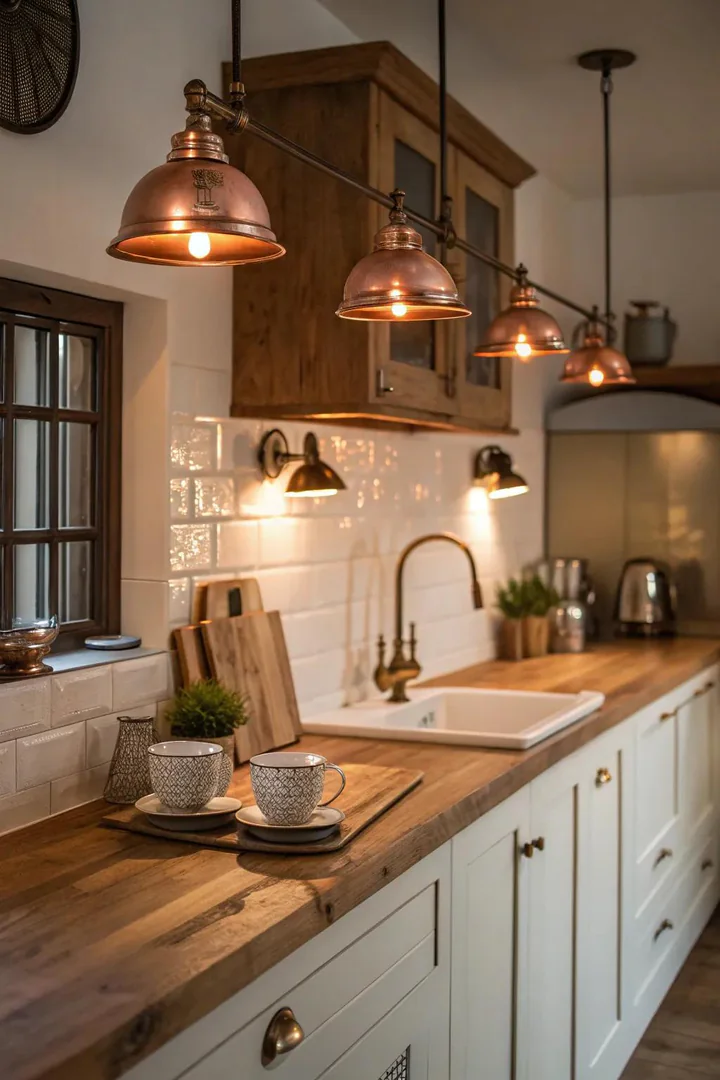
Copper and aged-brass sconces introduce a warm, reddish-gold tone that complements terracotta tile, warm wood cabinetry, and earth-toned countertops in granite, soapstone, or butcher block. A hammered copper dome shade from Barn Light Electric or a hand-patinated brass sconce from Rejuvenation’s Eastmoreland collection delivers a warm metallic glow that cool-toned chrome and nickel fixtures cannot match.
Unlacquered brass and raw copper develop a natural patina over time, darkening from bright penny to a deep, warm brown. The patina process takes six to twelve months in a kitchen environment and can be accelerated with a liver-of-sulfur solution or slowed with a lacquer topcoat. Living finishes appeal to homeowners who want their fixtures to age and mellow alongside reclaimed wood and natural stone surfaces.
Pair copper sconces with a renter-friendly kitchen update by choosing plug-in models that require no hardwiring. Plug-in copper sconces from Etsy artisan shops and Amazon’s Rivet brand mount with two screws, plug into a standard outlet, and leave no permanent wiring changes when the renter moves out. A fabric-covered cord channel painted to match the wall conceals the power cord from sconce to outlet.
17. Scandinavian Sconces
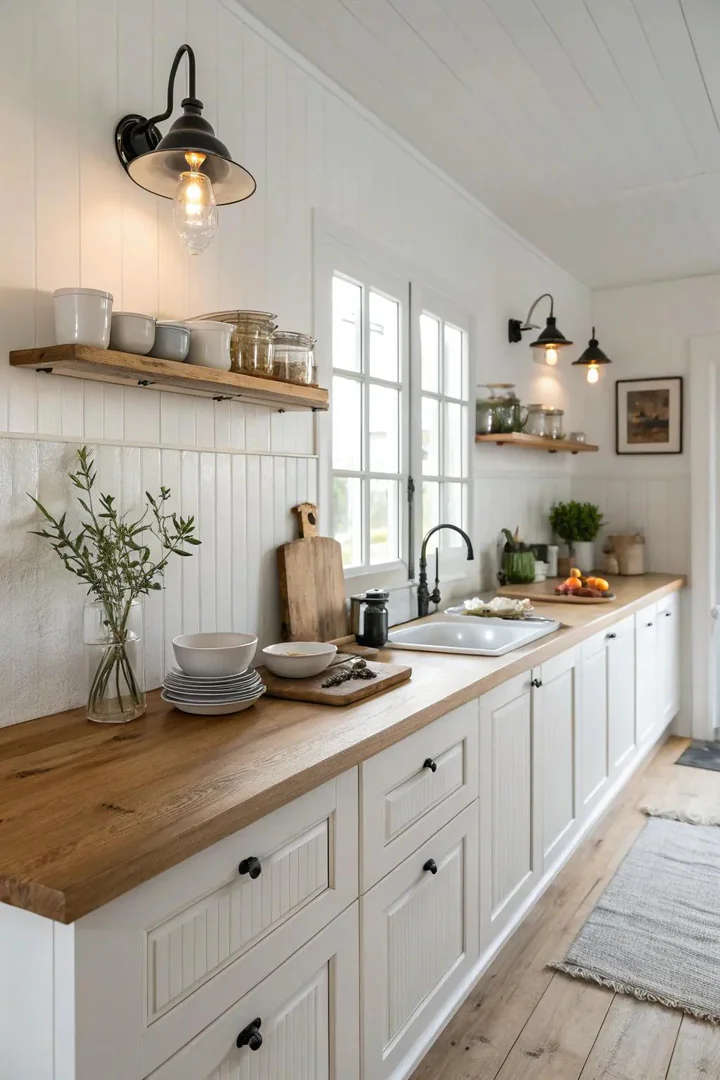
Scandinavian sconces favor matte white, pale gray, or natural ash finishes with clean cone or dome shades on thin, articulated arms. Muuto’s Tip wall lamp, Louis Poulsen’s AJ Mini, and IKEA’s SKURUP collection offer Scandinavian-designed sconces at three different price tiers: luxury ($400+), mid-range ($150 to $300), and budget ($20 to $40). The Arne Jacobsen-designed AJ sconce remains the benchmark of Scandinavian wall lighting, with its asymmetric conical shade directing light downward and outward in a controlled beam.
White-finished sconces disappear against white walls, creating a monochromatic look where only the light cone and the fixture’s shadow announce the sconce’s presence. A pivoting or articulated arm lets the homeowner redirect the light beam from the wall surface to a counter, a cookbook, or a cutting board without moving the fixture itself.
Scandinavian design prizes warmth despite the minimal palette. Pair white or light gray sconces with natural birch, ash, or oak wood accents on the arm or backplate to introduce organic warmth. Choose bulbs in the warm-white range (2700K to 3000K) rather than daylight (5000K) to keep the light golden and cozy in a kitchen where white-on-white could otherwise read as sterile.
18. Textured Ceramic Sconces
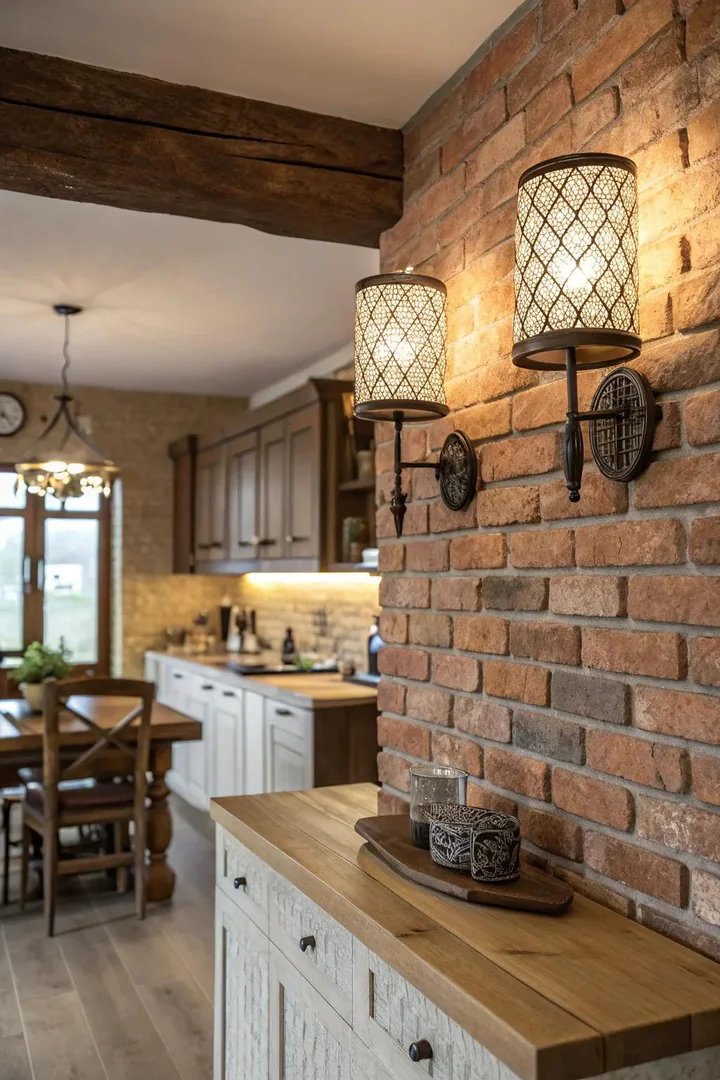
A ceramic wall sconce with a textured glaze surface adds artisan tactility that metal and glass fixtures lack. Justice Design Group’s Ambiance collection offers ADA-compliant ceramic sconces in bisque (unfinished), matte white, celadon green, and sienna brown with surface textures ranging from smooth to hammered to woven. The ceramic body diffuses light through its edges and bounces a warm glow off the wall behind the fixture.
Handmade ceramic sconces from studio potters on Etsy and from brands like Hammers and Heels feature hand-thrown or slab-built clay bodies with unique glaze crazing, drip patterns, and surface imperfections that mark each piece as one of a kind. A pair of matching-but-not-identical ceramic sconces flanking a kitchen window celebrates the handmade aesthetic rather than factory uniformity.
Mount ceramic sconces in positions protected from direct impact, as fired clay chips more easily than metal. The wall beside an entry doorway, the narrow strip between a window and upper cabinets, or the end wall of a galley kitchen all offer protected mounting spots. Ceramic conducts less heat than metal, so the sconce body stays cool to the touch even after hours of continuous use with an LED bulb inside.
19. Artisan Hand-Forged Sconces
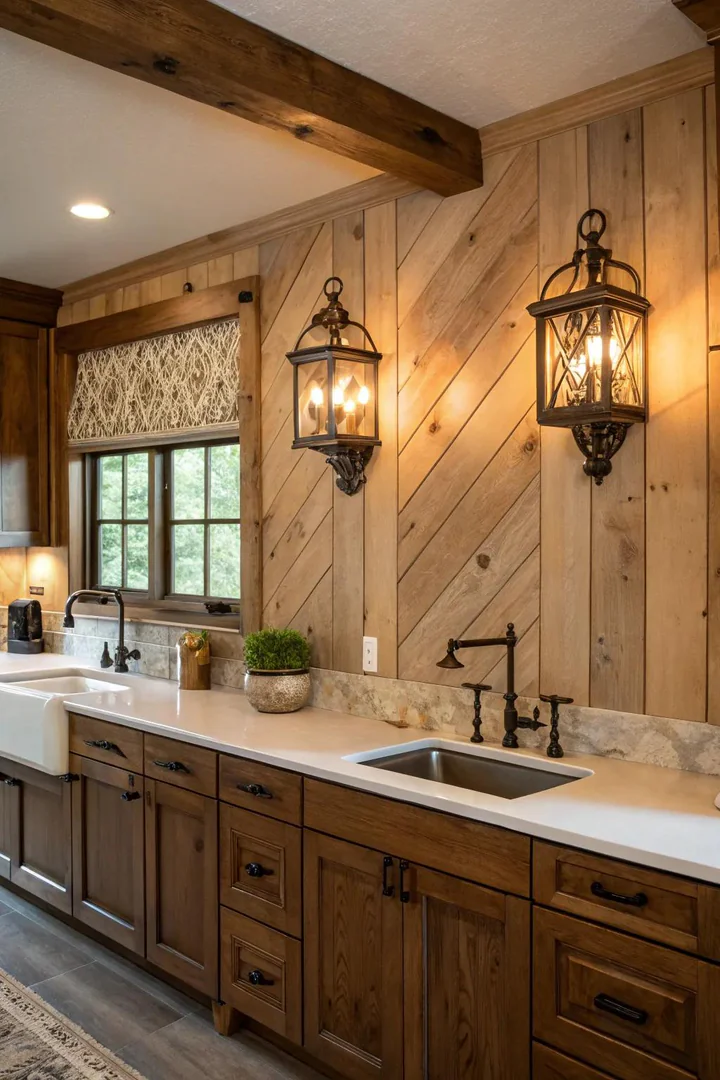
Hand-forged sconces made by blacksmiths from solid iron or mild steel bar stock carry hammer marks, fire scale, and irregular taper lines that reveal the smith’s hand in every detail. Hubbardton Forge, a Vermont-based manufacturer, produces over 200 hand-forged sconce designs ranging from simple single-arm candle holders to complex multi-branch fixtures. Each piece is bent, hammered, and welded by hand, then finished with a beeswax topcoat or a hand-applied patina in dark smoke, natural iron, or burnished steel.
The weight and material honesty of solid-iron sconces suit stone, timber-frame, and Craftsman-style kitchens where authenticity matters more than uniformity. A twisted-arm candle sconce mounted beside a stone chimney breast or a reclaimed-wood beam delivers a visual connection to pre-industrial lighting that cast or stamped-metal reproductions cannot achieve.
Hand-forged iron develops a stable, protective oxide layer over time that deepens the finish color without flaking. Wipe the fixture annually with a cloth dampened with mineral oil or Renaissance Wax to maintain the hand-applied patina and prevent moisture-related rust in humid kitchen environments. Budget $150 to $500 per fixture for production hand-forged sconces from Hubbardton Forge, or $300 to $1,200 for custom commissions from independent blacksmith studios.
20. Contemporary Angular Sconces
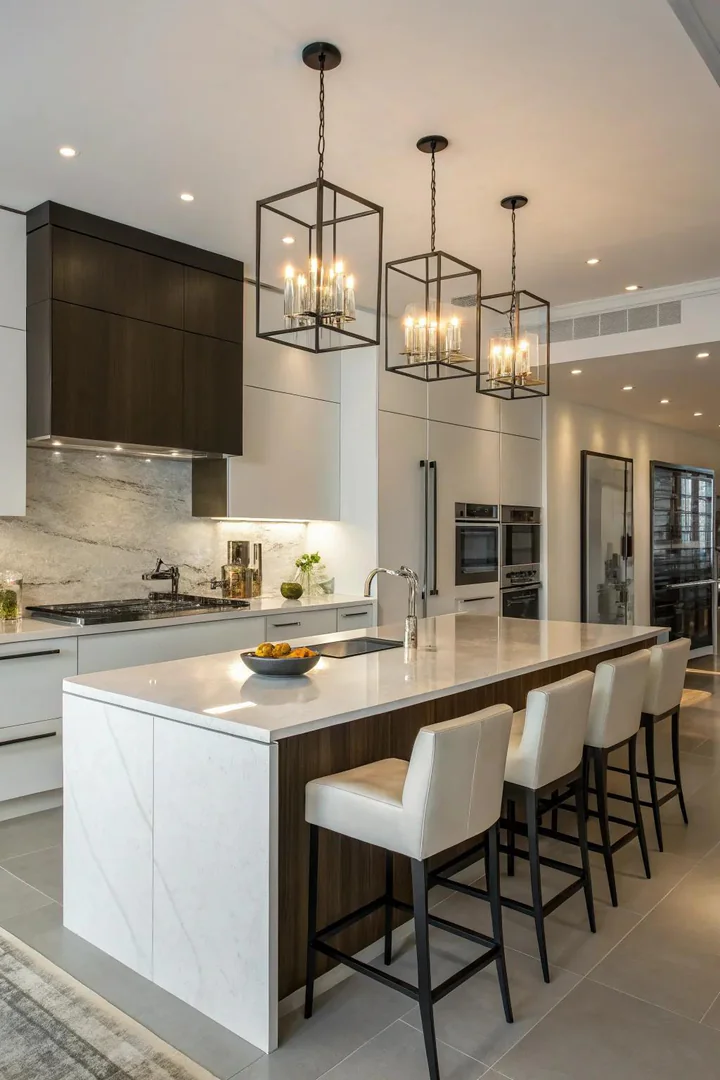
Contemporary angular sconces use flat metal planes, sharp creases, and asymmetric proportions to create fixtures that read as modern wall sculpture. WAC Lighting’s Blok series and Modern Forms’ Sole collection feature ultra-thin LED panels folded into angular shapes that produce both uplight and downlight from a single fixture. The integrated LED modules deliver 800 to 1,200 lumens at 3000K, providing enough light for task work while washing the wall above and below the fixture with soft ambient light.
An up-and-down light pattern from an angular sconce creates a vertical band of illumination on the wall that makes the ceiling appear taller and the wall more dimensional. Mount a pair of angular sconces 48 inches apart on a feature wall to create twin light columns that frame a piece of art, a floating shelf, or a window. The thin profile, often less than 2 inches from the wall, avoids the projection clearance issues that deep shade sconces create in narrow kitchens and galley layouts.
Integrated LED sconces last 30,000 to 50,000 hours before output drops below 70 percent of the original brightness. At 3 hours of daily use, the LED module lasts 27 to 45 years, effectively the lifetime of the fixture. The tradeoff is that a failed LED module on an integrated sconce requires replacing the entire fixture, so choose brands with strong warranties (WAC and Modern Forms both offer 5-year limited warranties).
21. Eclectic Mixed-Style Sconces
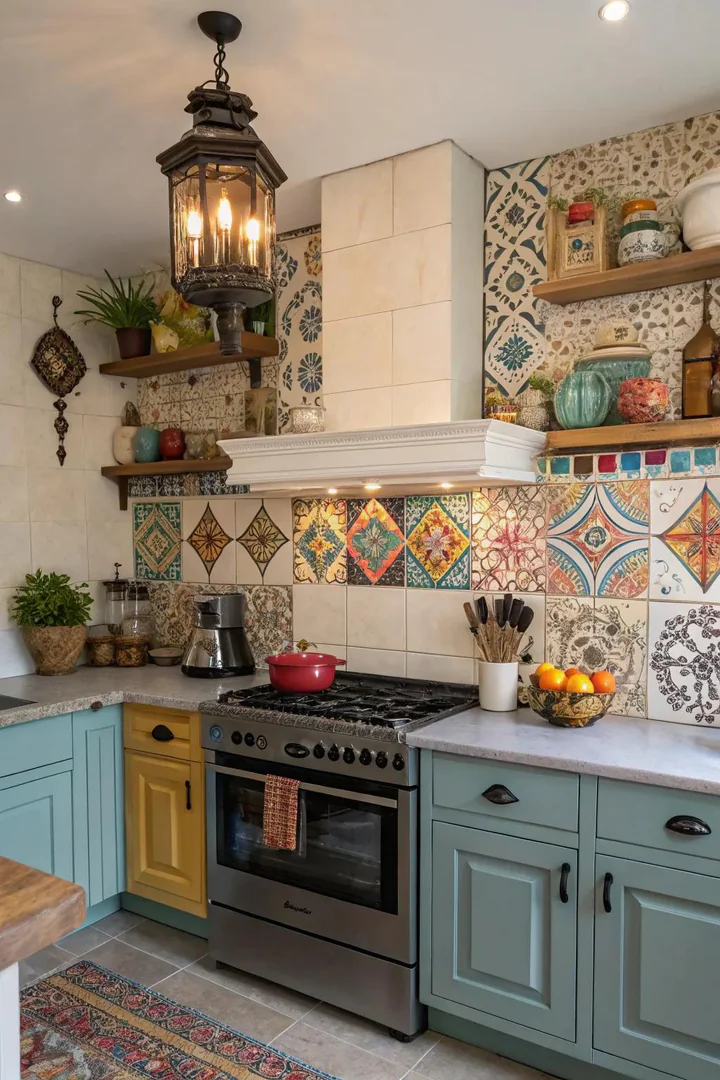
Eclectic kitchens pair two or more sconce styles deliberately rather than matching every fixture. A brass mid-century cone sconce beside the range and a ceramic globe sconce beside the sink creates an intentional mismatch that reads as collected over time rather than bought as a set. The key to a successful eclectic sconce pairing is a shared connecting thread: the same finish color, the same bulb type, or the same mounting height.
Homeowners building a basement kitchen can use eclectic sconces to inject personality into a below-grade space that lacks the natural architectural character of a main-floor kitchen. Different sconce shapes at different positions around the room break up the uniform drywall surfaces and create distinct zones: a task sconce above the prep area, an accent sconce beside a bar shelf, and a decorative sculptural piece near the stairway entrance.
Limit the mix to two or three distinct sconce styles and repeat at least one finish across all fixtures to avoid visual chaos. A matte black finish shared across all sconces ties together a brass-arm cone sconce, an iron cage sconce, and a ceramic dome sconce into a family. Keep the mounting height consistent at 66 inches above the floor for all sconces to create a horizontal line that unifies the mismatched shapes.
22. Crystal and Cut-Glass Sconces
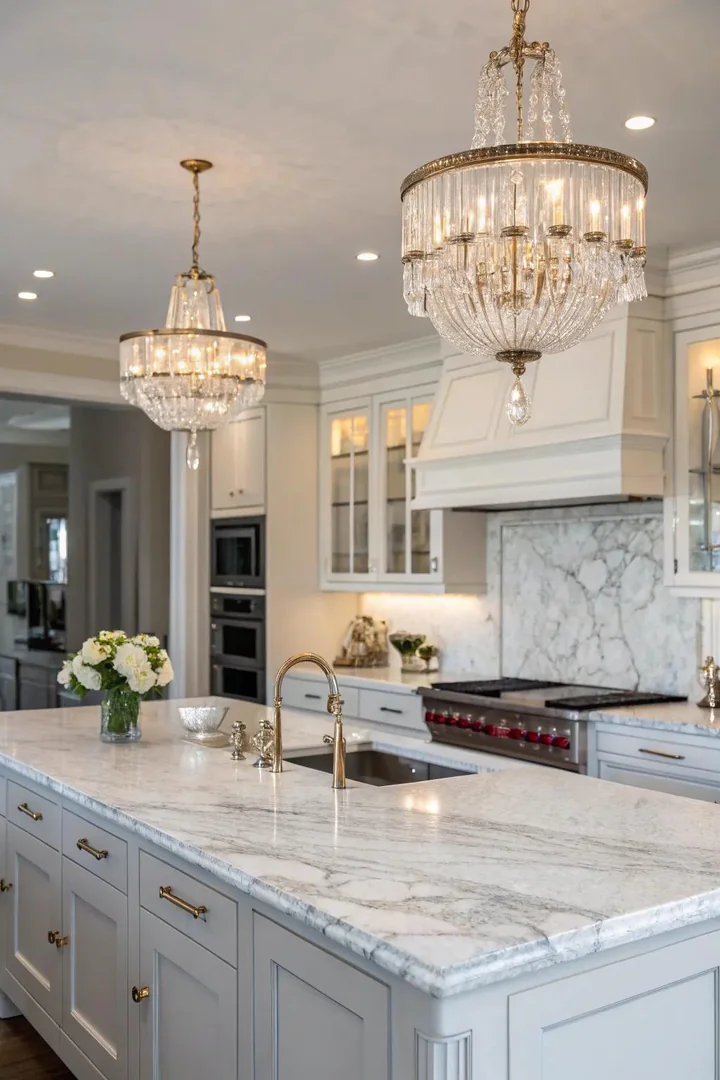
Crystal sconces bring formal sparkle and prismatic light refraction to kitchens that lean toward luxury, glam, or traditional design. Schonbek’s Swarovski crystal sconces and Crystorama’s Calypso collection feature hand-cut or machine-cut crystal prisms, beads, and drops that split white light into rainbow spectra on surrounding walls and ceilings. A single crystal sconce beside a white marble backsplash or a polished quartz countertop multiplies the reflections and fills the kitchen with scattered prismatic light.
Crystal sconces require regular cleaning to maintain their sparkle, as kitchen grease and airborne cooking oils dull the faceted surfaces. Remove individual crystal drops and soak them in warm water with a drop of dish soap, then dry with a lint-free cloth. Alternatively, spray the assembled fixture with a crystal chandelier cleaner like Hagerty Crystal Cleaner, which dissolves grease and evaporates without wiping.
Reserve crystal sconces for kitchen positions at least 5 feet from the range or cooktop to minimize grease accumulation. A crystal sconce flanking a kitchen archway, beside a glass-front china cabinet, or above a butler’s pantry counter adds formal sparkle without exposing the delicate crystal to heavy cooking fumes. Pair crystal sconces with polished nickel or chrome hardware and honed white marble for a cohesive luxury palette.
How to Choose and Install Kitchen Wall Sconces
1. Determine the Light Function and Placement
Decide whether each sconce position needs task light (focused downlight for a counter, sink, or cookbook), accent light (a decorative wash on a wall, shelf display, or artwork), or ambient light (a soft uplight that bounces off the ceiling and fills the room). Task sconces need 600 to 1,200 lumens with a downward-focused shade, while accent and ambient sconces need only 200 to 500 lumens with a diffused or upward-facing shade. Mark each sconce position on the wall with painter’s tape at 60 to 66 inches above the floor, centered on the feature they light.
2. Choose the Fixture Style and Finish
Match the sconce finish to the kitchen’s existing hardware and appliance metals. A kitchen with brushed-nickel cabinet pulls and a stainless steel fridge calls for sconces in brushed nickel or polished chrome. A kitchen with oil-rubbed bronze hinges and a black matte range pairs with sconces in aged bronze or matte black. Select a shade shape that complements the cabinet profile: flat-panel modern cabinets suit cylinder or cone shades, raised-panel traditional cabinets pair with globe or lantern shades, and open-shelf farmhouse kitchens match dome and gooseneck barn-style shades.
3. Run the Electrical Wiring
Hardwired sconces require a junction box recessed into the wall at the mounting point. Hire a licensed electrician to run 14/2 Romex cable from the nearest circuit (a 15-amp or 20-amp kitchen lighting circuit) to the new junction box location. The electrician cuts a hole in the drywall, installs an old-work electrical box, pulls cable through the wall cavity, and connects the wires to a switch. Budget $150 to $300 per sconce for new-wiring electrical work, or $50 to $100 per fixture if tapping into an existing nearby junction box. Plug-in sconces skip this step entirely.
4. Mount the Sconce and Connect the Wiring
Turn off the circuit breaker for the kitchen lighting circuit. Attach the sconce’s mounting bracket to the junction box using the provided screws. Connect the fixture’s black wire to the house’s black (hot) wire, white to white (neutral), and bare copper to bare copper (ground) using wire nuts rated for the wire gauge. Tuck the connected wires into the junction box, slide the sconce body over the mounting bracket, and secure it with the decorative cap nut or set screw. Restore power and test the fixture with the wall switch.
5. Adjust the Light Angle and Install the Bulb
Install the recommended bulb type: an E26 medium-base LED for most sconces, an E12 candelabra-base LED for candle-arm and small-scale fixtures, or a GU10 pin-base LED for spotlight-style cylinders. Aim adjustable or swing-arm sconces toward their target surface and lock the arm in position. Connect the sconce to a dimmer switch if the circuit supports one. Lutron’s Caseta and Leviton’s Decora Smart dimmers work with most LED bulbs and allow brightness adjustment from the wall switch or a smartphone app.
Kitchen Wall Sconce Style Comparison
| Sconce Style | Price Range | Best Finish | Light Direction | Kitchen Style Match |
|---|---|---|---|---|
| Minimalist Cylinder | $40 – $200 | Matte black, satin white | Downlight | Modern, Scandinavian |
| Vintage Lantern | $60 – $250 | Aged bronze, antique brass | Ambient (all directions) | Farmhouse, cottage |
| Industrial Cage | $20 – $80 | Matte black, pewter | Ambient (open cage) | Industrial, loft |
| Art Deco Fluted | $100 – $400 | Polished brass, chrome | Diffused (glass shade) | Glam, transitional |
| Gooseneck Barn | $80 – $300 | Galvanized, barn red | Focused downlight | Farmhouse, country |
| Mid-Century Cone | $100 – $300 | Brushed brass, walnut | Adjustable directional | Mid-century modern |
| Crystal/Cut-Glass | $150 – $800 | Polished nickel, chrome | Prismatic (multi-directional) | Luxury, traditional |
| Ceramic | $50 – $250 | Bisque, matte white, celadon | Up-and-down wash | Artisan, bohemian |
Frequently Asked Questions
What height should kitchen wall sconces be mounted?
Mount kitchen sconces with the center of the fixture 60 to 66 inches above the finished floor. Position task-oriented sconces 18 to 24 inches above the countertop surface they illuminate, measured from the bottom of the shade. Keep the bottom edge of any sconce at least 6 inches above the backsplash tile line to avoid visual crowding where the wall and tile meet.
How many lumens does a kitchen wall sconce need?
Task sconces beside a sink, prep counter, or cookbook shelf need 600 to 1,200 lumens for comfortable close-up work. Accent and ambient sconces used for decorative wall washing or general room glow need 200 to 500 lumens. A pair of 400-lumen sconces flanking a window produces 800 combined lumens, enough for moderate task lighting in that zone without adding a ceiling fixture.
Can I use plug-in sconces instead of hardwired in a kitchen?
Plug-in sconces mount with screws and plug into a standard 120-volt outlet, requiring no electrician and no wall-cavity wiring. The visible power cord runs from the fixture to the nearest outlet and can be concealed with a paintable cord channel from Legrand or SimpleCord. Plug-in sconces suit rental kitchens, temporary installations, and walls where opening the drywall for new wiring is impractical or too expensive.
Should kitchen sconces match the pendant lights?
Sconces do not need to be the exact same fixture as the pendants, but they should share a visual connection: the same metal finish, the same design era (both mid-century, both industrial, both farmhouse), or the same shade material (both glass, both metal, both fabric). Matching the finish is the simplest unifier. A brushed brass pendant over the island paired with brushed brass sconces on the perimeter wall reads as a coordinated lighting plan without requiring identical fixtures.
What bulb color temperature works best in kitchen sconces?
Warm white LED bulbs rated at 2700K to 3000K produce a golden, inviting glow that suits most kitchen styles and flatters food, skin tones, and natural materials. Reserve 2200K amber-tone bulbs for accent and mood sconces where a candlelight quality is preferred. Avoid daylight-rated bulbs (5000K and above) in kitchen sconces, as the blue-white light clashes with warm wood, brass hardware, and stone surfaces that kitchens typically feature.
How far apart should a pair of wall sconces be spaced?
Space a matching pair of sconces 36 to 48 inches apart when flanking a window, artwork, or range hood. Wider spacing (48 to 60 inches) suits large walls or wide windows, while tighter spacing (24 to 36 inches) works for narrow walls or small accent features. Keep the two fixtures equidistant from the center of the object they frame, and mount both at the same height using a laser level to ensure perfect horizontal alignment.
Conclusion
Kitchen wall sconces fill the lighting gaps that ceiling fixtures and recessed cans leave behind, adding task-focused brightness beside the sink and stove, accent glow along shelving and art walls, and ambient warmth in breakfast nooks and dining corners. The 22 styles above cover every kitchen aesthetic from farmhouse gooseneck to Art Deco fluted glass, and every budget from $20 industrial cage sconces to $800 Swarovski crystal fixtures.
Start by identifying the wall positions that need more light, then choose a sconce style and finish that matches your existing hardware and design direction. A single well-placed sconce transforms a dark corner, and a matching pair flanking a window or range hood creates a symmetrical anchor that pulls the entire kitchen’s lighting plan together.