
White Kitchen Cabinets with Black Hardware: 16 Inspired Makeovers
White kitchen cabinets with black hardware combine the brightest, most light-reflective cabinet color with the darkest, most visually grounding hardware finish to create a high-contrast pairing that works across every kitchen style — modern, farmhouse, transitional, coastal, Scandinavian, and traditional. The white-and-black combination is one of the most enduring palettes in kitchen design because it is clean, graphic, and impossible to date.
The 16 white kitchen cabinets with black hardware ideas below explore small pulls, mixed shapes, textured surfaces, farmhouse knobs, oversized bar pulls, precision-placed hardware, understated accents, versatile hardware styles, modern-classic combinations, varied sizing, contemporary profiles, coastal pairings, mixed metal finishes, supporting glass-front hardware, natural material accents, and open shelving brackets. Each idea includes specific hardware products, sizing guidance, installation tips, and style pairings for achieving the exact look you want.
1. Compact, Easy Tugs
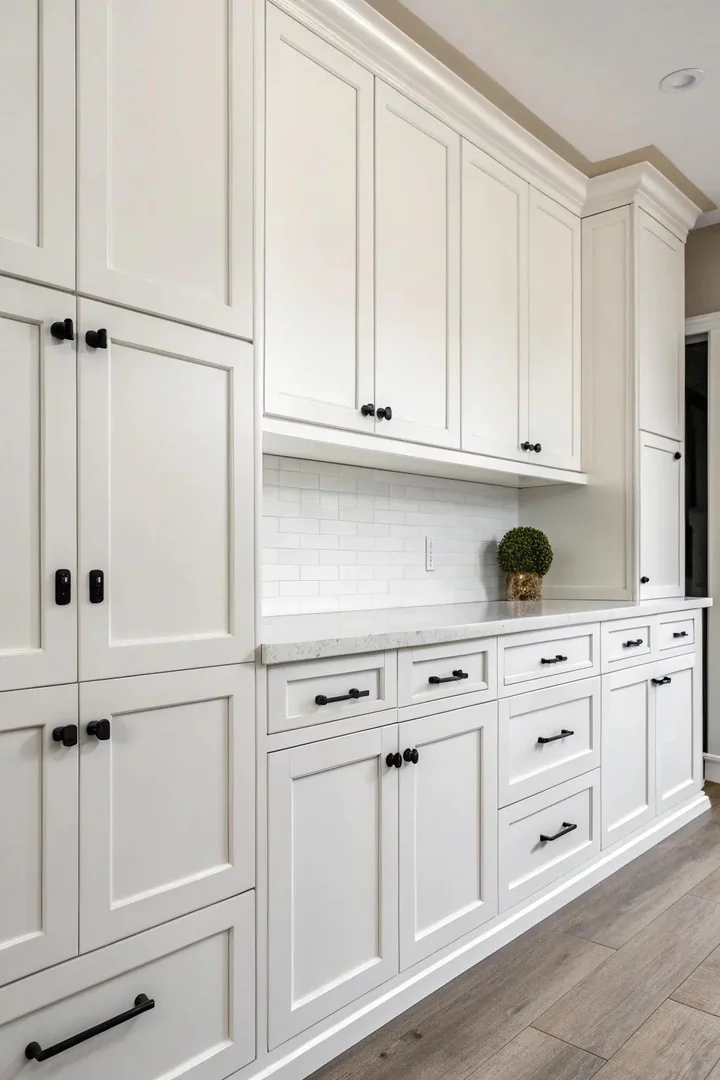
Small, simple matte black pulls — 3-inch or 4-inch center-to-center bar pulls with a slim, cylindrical or flat-bar profile — provide the cleanest, most understated way to add black hardware to white cabinets. Small pulls are visible enough to define the cabinet grid (marking each door and drawer) but discreet enough that the hardware reads as an accent detail rather than a bold statement, keeping the focus on the cabinets and countertops.
The Top Knobs Nouveau III 3-inch pull (M1839, flat black), the Amerock Bar Pull 3-3/4-inch (BP40515FB, flat black), and the Goldenwarm 3-inch European bar pull (available in bulk packs on Amazon) are all popular, well-reviewed options for this approach. Install small pulls horizontally on drawers (centered vertically, or offset 1 to 2 inches from the top edge) and vertically on doors (positioned 2.5 to 3 inches from the top corner on upper cabinets and from the bottom corner on base cabinets). For more on pairing hardware with cabinet styles, browse our kitchen cabinet ideas guide.
2. Combine and Combine Shapes
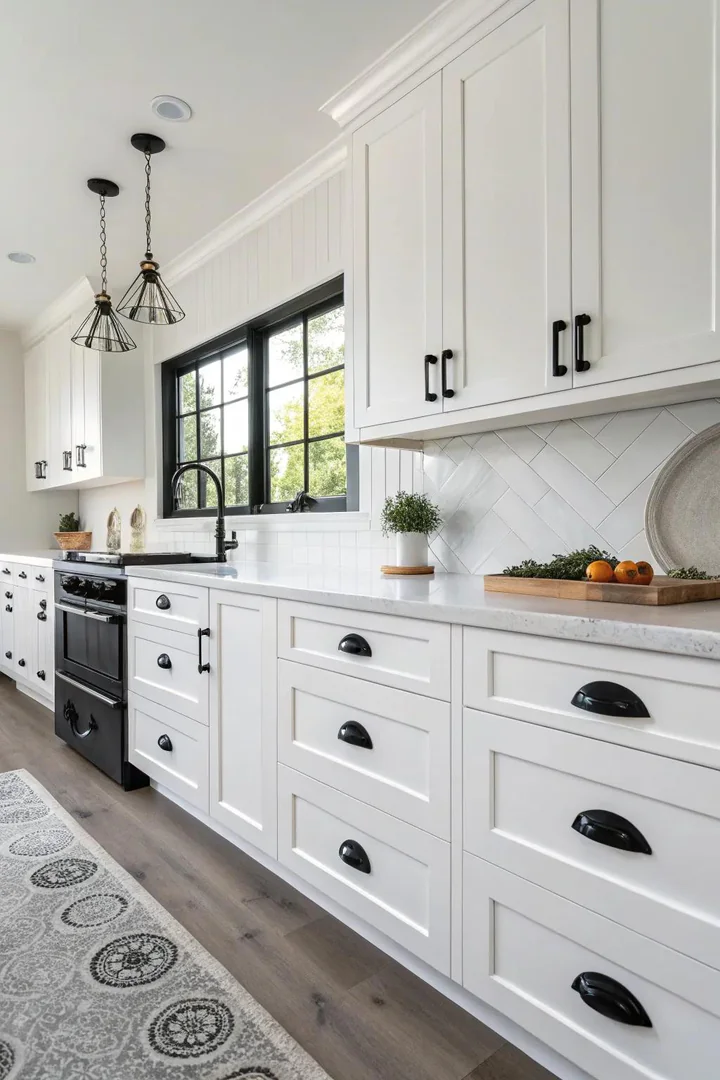
Mixing hardware shapes — round knobs on doors, bar pulls on drawers, half-moon cup pulls on bin-style drawers, and ring pulls on specialty cabinets — within the same matte black finish creates visual variety and functional tailoring that a single hardware shape cannot achieve. Different hardware shapes work better on different cabinet parts: knobs work on small doors and light drawers, bar pulls work on large doors and heavy drawers, and cup pulls work on wide, shallow drawers.
The key to mixing shapes successfully is maintaining a single finish (matte black or flat black) and a shared design language (all geometric, all rounded, or all with the same mounting detail). A classic combination: round mushroom knobs (Amerock Blackrock BP55272FB or Top Knobs Aspen Round 1-5/8-inch M1592) on upper cabinet doors, 5-inch or 6-inch bar pulls (Top Knobs Hopewell M1850) on lower cabinet drawers, and bin/cup pulls (Amerock Cupboard Pull BP53010FB) on any apron-front drawers. All three shapes share the flat black finish and a clean, modern aesthetic.
3. Textural Highlights
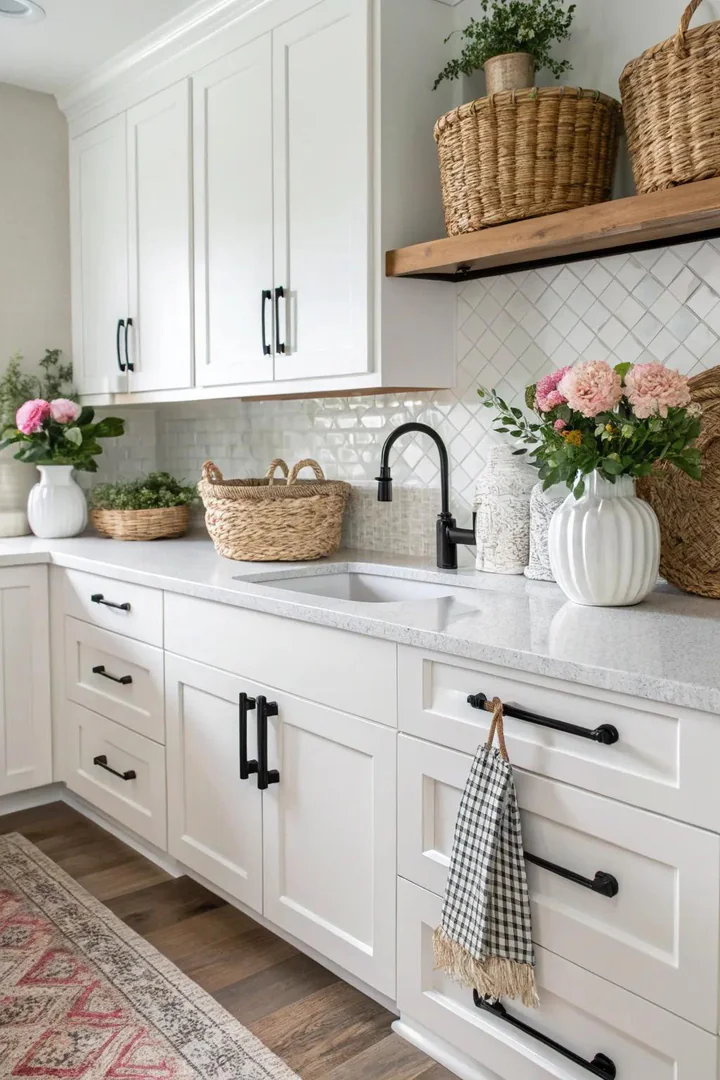
Textured black hardware — hammered-finish pulls, knurled (diamond-patterned) knobs, ribbed bar handles, rope-twist pulls, or hand-forged iron hardware with visible hammer marks — adds a tactile, artisanal quality that softens the graphic severity of the black-on-white contrast. Textured hardware catches light differently than smooth matte finishes, creating subtle sparkle, shadow, and depth on the cabinet surface.
Knurled hardware (a fine, diamond-crosshatch pattern rolled into the metal surface) is currently one of the most popular textured options: the Emtek Select Knurled Bar Pull (in flat black), the Buster + Punch Knurled T-Bar, and the CB2 GWS Knurled Pull offer this finish in various sizes. Hammered hardware (hand-forged iron with visible hammer marks) suits rustic, craftsman, and industrial kitchens — source from Rocky Mountain Hardware, Acorn Manufacturing, or Etsy blacksmiths. Pair textured black hardware with smooth white Shaker or slab-front cabinets so the hardware texture stands out against the clean cabinet surface.
4. Charming Farmhouse Aesthetic
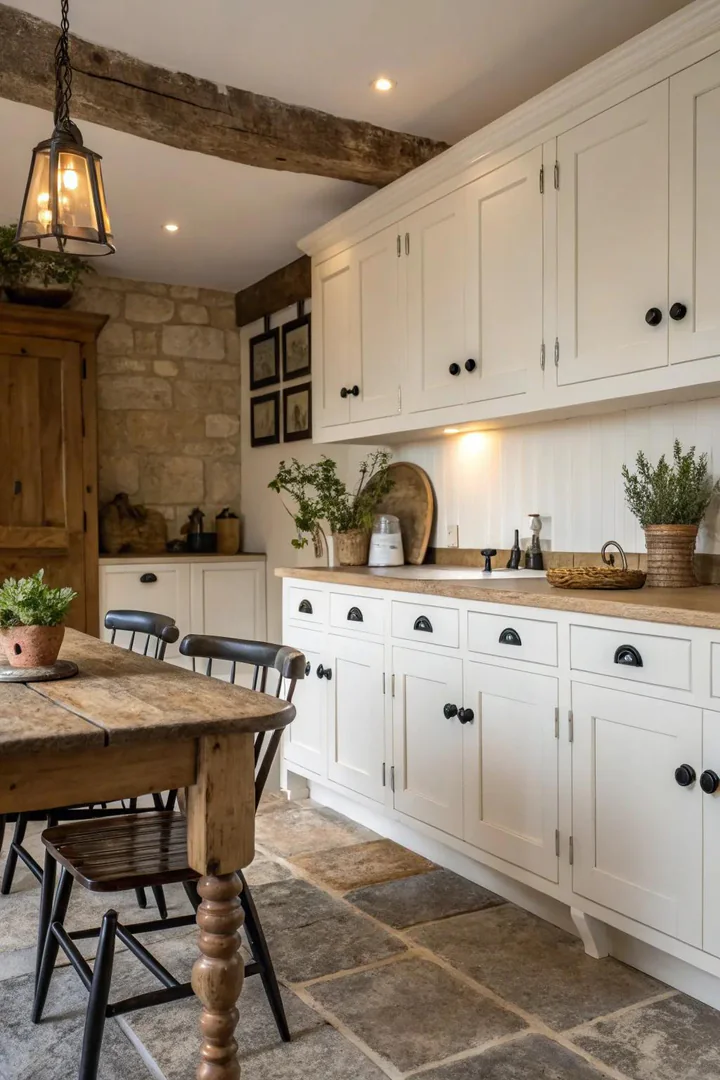
Farmhouse-style black hardware — cast iron round knobs, wrought iron bin pulls, hand-forged strap hinges, iron latch pulls, and black iron ring pulls — pairs naturally with white Shaker, beadboard, or inset cabinets to create the classic American farmhouse kitchen look. Farmhouse hardware has a heavier, more handmade quality than modern matte black hardware, with visible casting marks, slightly irregular shapes, and a rough or semi-rough surface texture.
Source farmhouse-style black hardware from Rejuvenation (the Massey collection, cast iron), Nostalgic Warehouse (iron bin pulls and ring pulls), House of Antique Hardware (period reproduction iron knobs and latches), and Signature Hardware (forged iron cup pulls and strap hinges). Black cast iron knobs (1 to 1.25 inches in diameter) on white inset-panel doors recreate the historical farmhouse look most authentically. For a farmhouse kitchen that uses black hardware on both cabinets and furniture pieces, see our farmhouse kitchen cabinet ideas guide.
5. Structure and Purpose
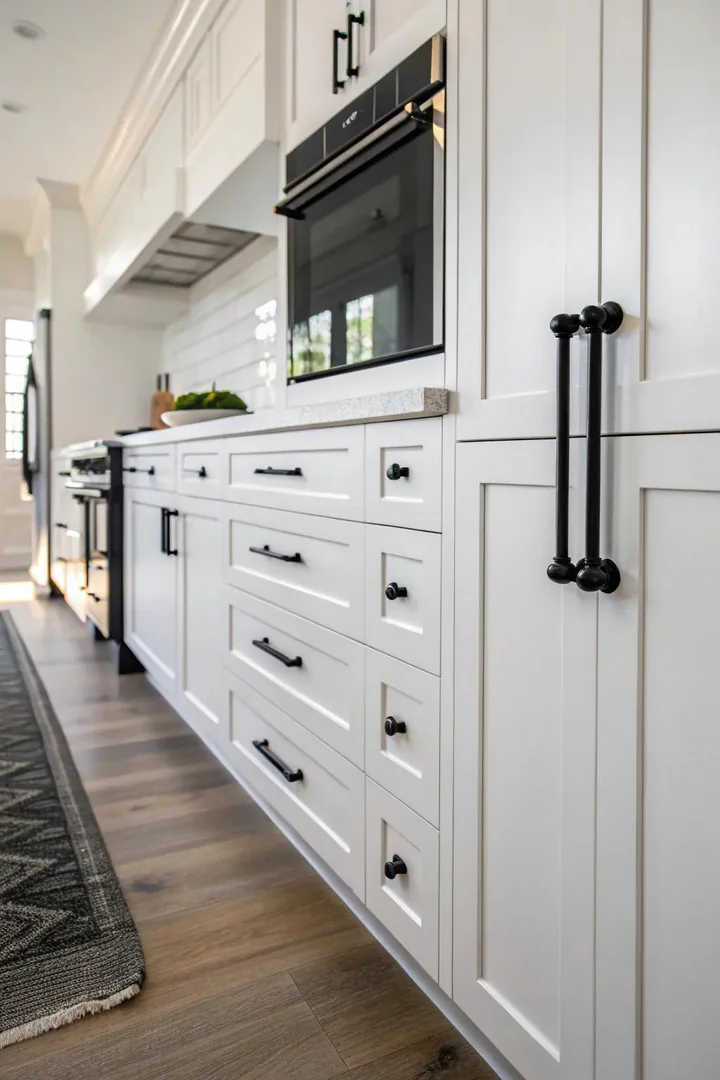
Oversized black hardware — 8-inch, 10-inch, or 12-inch bar pulls, large D-shaped handles, or appliance-length pulls — serves both a visual and ergonomic purpose: the larger profile creates a stronger graphic line across the white cabinet surface while providing a full-hand grip that makes heavy drawers, large doors, and appliance panels easier to open. Oversized pulls are especially practical on deep pot-and-pan drawers, trash/recycling pull-outs, and integrated appliance panels.
For the strongest visual impact, use a single oversized pull per drawer and per door rather than pairs of smaller pulls. The Top Knobs Hopewell 8-5/16-inch pull (M1850, flat black), the Emtek Alexander 12-inch bar pull, and the Richelieu Contemporary 10-inch pull (BP305225790090) are solid oversized options. Size the pull to approximately one-third to one-half the width of the drawer or door for proportional balance — a 30-inch drawer looks best with an 8- to 10-inch pull, while a 36-inch drawer can handle a 12-inch pull.
6. Focus on Precision
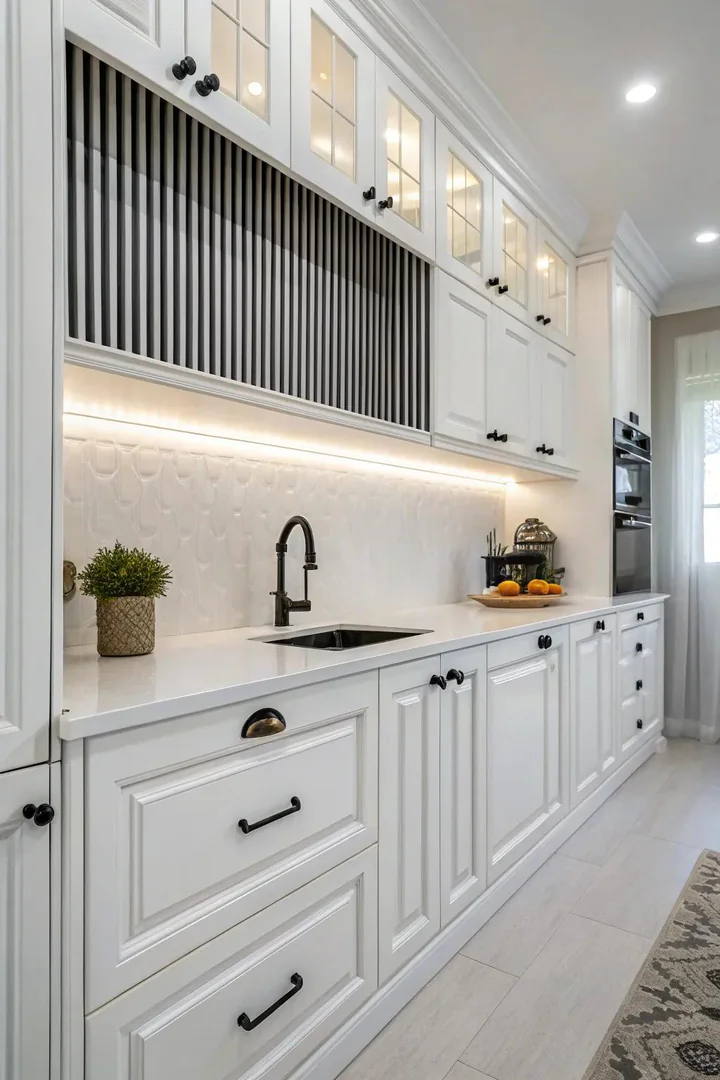
Precise hardware placement — every pull and knob at exactly the same height, the same distance from the door edge, and the same center-to-center spacing across the entire kitchen — amplifies the graphic impact of black hardware on white cabinets by creating a perfectly aligned grid of black accents across the cabinet field. Sloppy or inconsistent placement is far more visible with high-contrast hardware because every pull stands out sharply against the white surface.
Standard placement guidelines: upper cabinet door knobs at 2.5 to 3 inches down from the bottom corner; base cabinet door knobs at 2.5 to 3 inches up from the top corner; drawer pulls centered horizontally and positioned 2 to 3 inches from the top edge of the drawer face. Use a hardware installation jig (from True Position Tools, Cabinet Hardware Jig, or Kreg) to drill perfectly aligned holes across every cabinet — the jig clamps to the door or drawer face and positions the drill bit at the exact same location every time.
7. Significant Effect with Minor Equipment
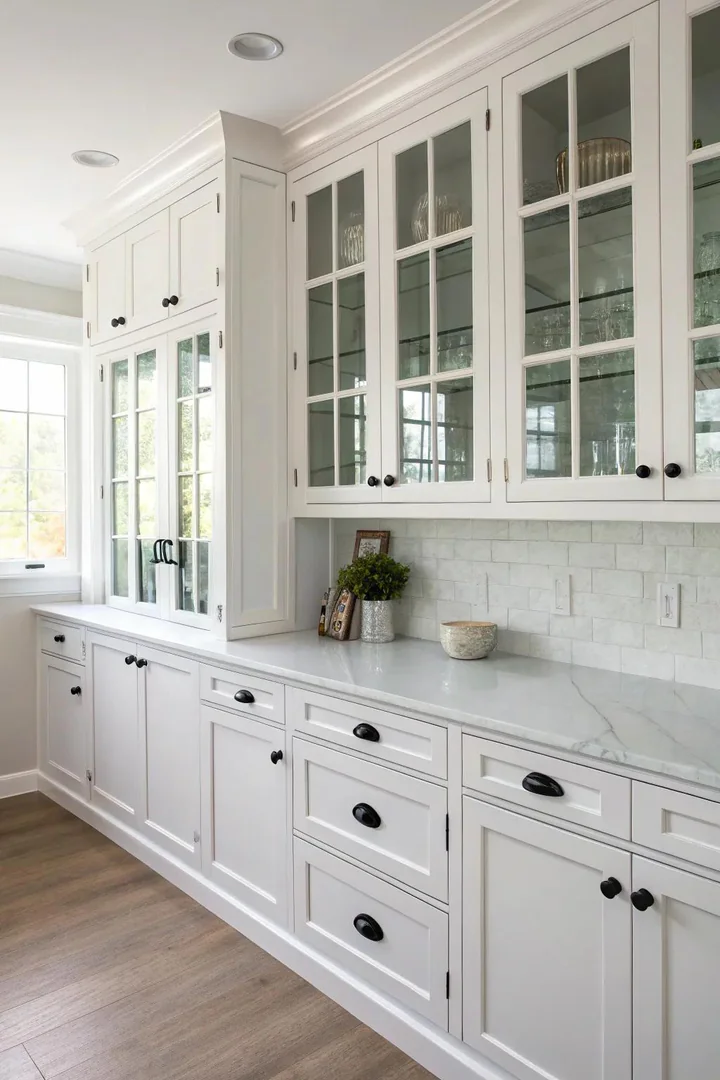
Small black knobs — round, mushroom, or dome-shaped knobs in 1-inch to 1.25-inch diameter — create a controlled, measured contrast on white cabinets that is strong enough to read as intentional but small enough to keep the overall kitchen feeling calm and uncluttered. Petite knobs work particularly well on glass-front cabinets, where the knob serves as a tiny punctuation mark against the transparent glass and the white frame.
On glass-front cabinets, the small black knob becomes especially visible because the glass panel provides no visual distraction — the knob is the only opaque element on the door. Choose a simple round knob (Amerock Blackrock 1-5/16-inch BP55272FB, or Top Knobs Aspen Round 1-1/8-inch M1592) for a minimalist look, or a faceted crystal-inspired knob with a black base for a more decorative approach. Install knobs on glass-front doors at the same height as knobs on adjacent solid doors to maintain the horizontal alignment across the kitchen.
8. Flexible Hardware Designs
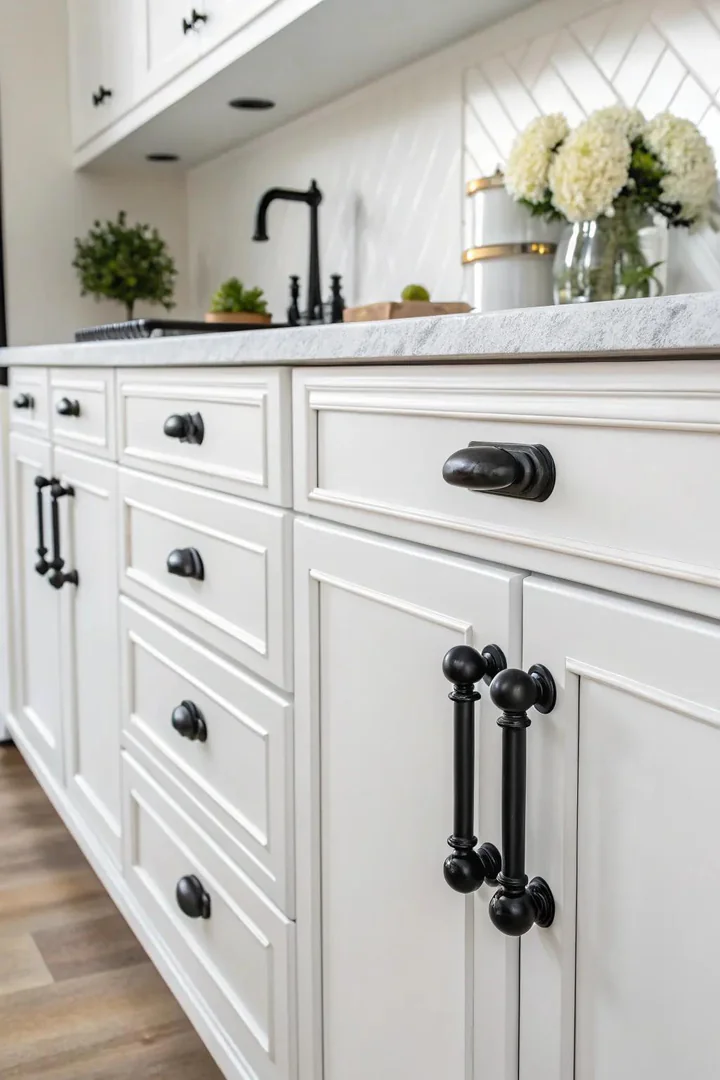
Matte black hardware is the most versatile hardware finish available because it pairs well with every countertop material (white marble, gray quartz, butcher block, concrete, soapstone, stainless steel), every backsplash type (subway tile, mosaic, natural stone, solid surface), and every kitchen metal (stainless steel appliances, brass light fixtures, chrome faucets, copper accents). Black hardware does not compete with other metallic finishes the way brass, gold, or nickel might.
This versatility means you can change the kitchen’s countertop, backsplash, light fixtures, and accessories over time without needing to replace the hardware — the matte black pulls and knobs will work with the new elements just as well as the old ones. Matte black is also the most forgiving hardware finish for daily use: it does not show fingerprints the way polished chrome or brass does, it does not tarnish or develop patina like unlacquered brass, and it does not scratch visibly the way polished nickel can.
9. Contemporary and Enduring
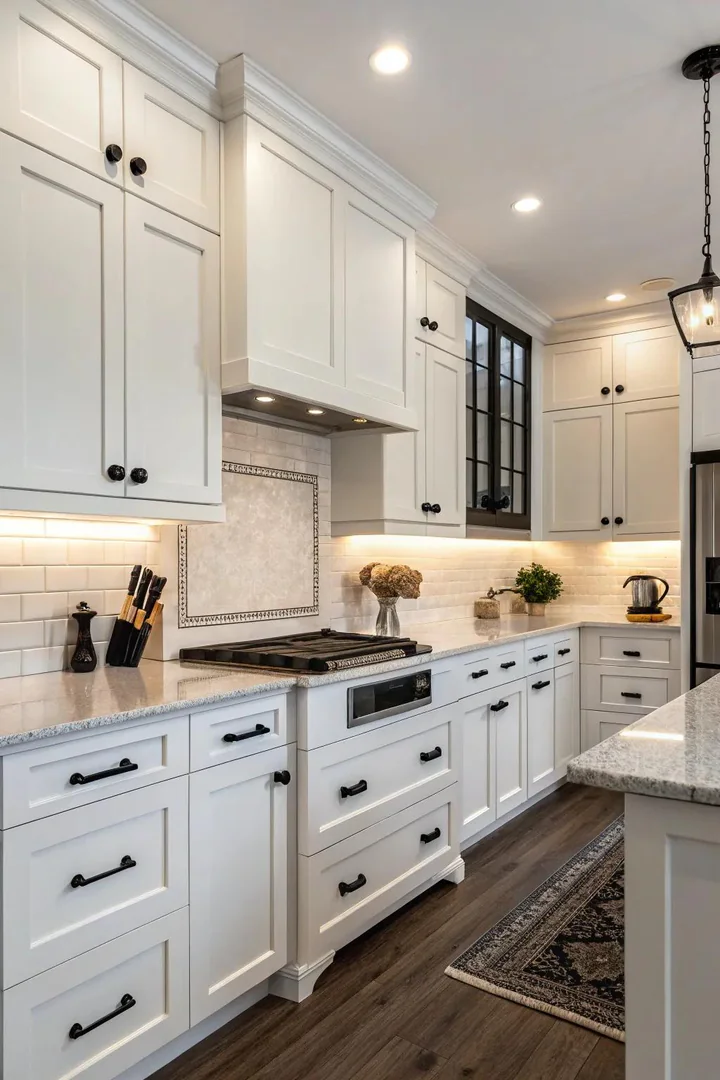
The combination of white cabinets and black hardware is simultaneously modern (the graphic, high-contrast aesthetic reads as current and designed) and timeless (black iron hardware on white-painted woodwork has existed in kitchens since the colonial era). This dual quality makes white-with-black-hardware one of the safest design choices for kitchen resale value — it appeals to buyers who prefer both contemporary and traditional aesthetics.
To lean more modern with this combination, choose flat-panel (slab) doors, thin linear bar pulls, integrated appliance panels, and a waterfall-edge quartz countertop. To lean more traditional, choose Shaker or inset-panel doors, round cast iron knobs, bin pulls, and a marble or butcher block countertop. The same matte black hardware works in both directions — the door style and countertop material determine whether the kitchen reads modern or classic, not the hardware finish itself.
10. Change It Up
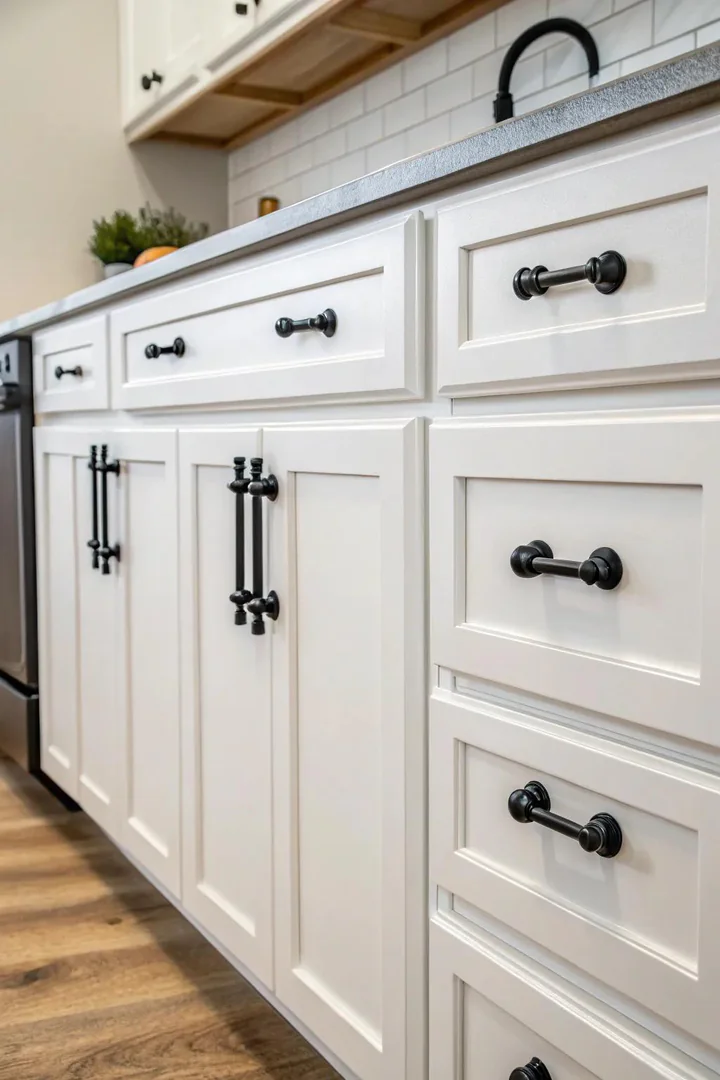
Using different hardware sizes on different cabinet types — small knobs on upper doors, medium pulls on base doors, and long pulls on wide drawers — creates a functional hierarchy where the hardware size corresponds to the physical effort required to open each cabinet. Small, lightweight upper doors need only a fingertip knob. Heavy, fully loaded base drawers need a full-hand pull. Extra-wide pot-and-pan drawers need an oversized pull for two-handed operation.
A practical sizing hierarchy: 1-inch to 1.25-inch knobs on upper cabinet doors, 4-inch to 5-inch pulls on base cabinet doors and standard drawers, and 8-inch to 12-inch pulls on extra-wide or extra-deep drawers. Keep all hardware in the same matte black finish and the same design family (all from the same manufacturer’s collection, or all sharing the same profile shape) so the size variation reads as intentional rather than random. This approach is especially effective in kitchens with a mix of drawer and door cabinet sizes where one hardware size would look disproportionate on some units.
11. Modern Style
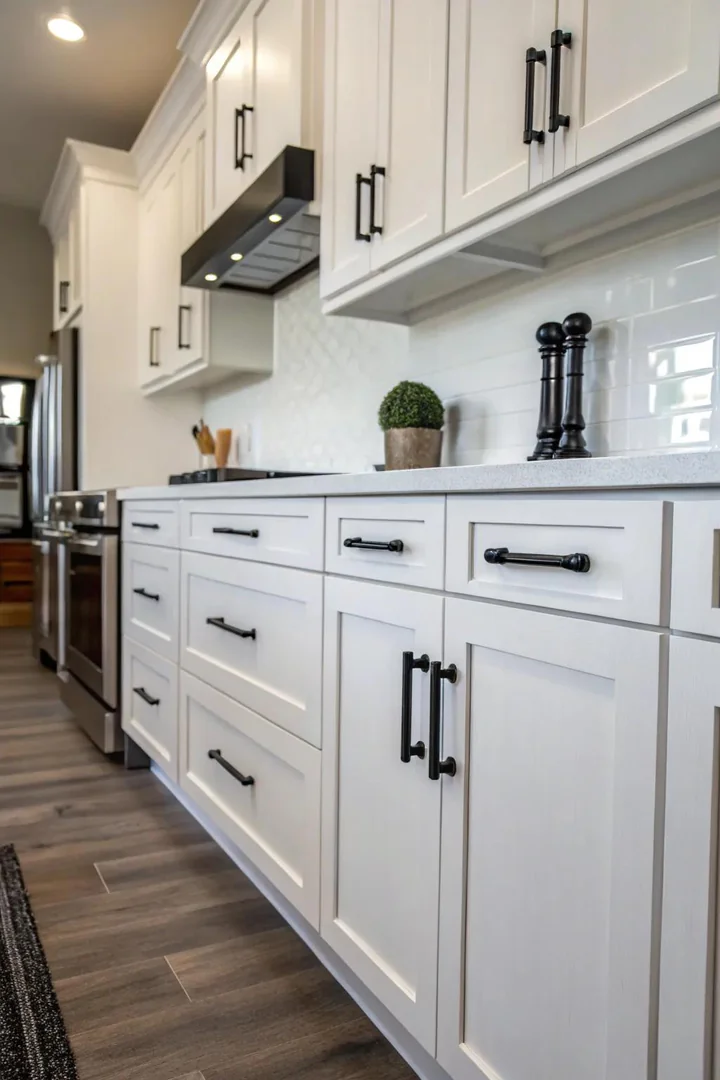
Sleek, thin-profile black hardware — slim wire pulls, tab pulls, edge pulls, or ultra-thin linear pulls with a rectangular cross-section — gives white cabinets a distinctly contemporary, European-influenced look that prioritizes clean lines and minimal visual weight. Thin-profile hardware almost disappears into the cabinet surface, creating a kitchen that reads as architectural and precise rather than decorative.
Edge pulls (a thin L-shaped or C-shaped pull that wraps around the top or bottom edge of the door) provide the lowest-profile hardware option — the pull is nearly invisible from the front because it sits on the door edge rather than the face. The Hafele Tab Pull, the Kethy Edge Pull, and the Emtek Edge Pull are available in matte black and provide a barely-there hardware presence. For slightly more visibility, a thin rectangular bar pull (6mm to 8mm diameter, 5 to 8 inches long) in flat black from Top Knobs (Princetonian series) or Emtek (Alexander series) creates a fine black line across the white surface.
12. Seaside Accents
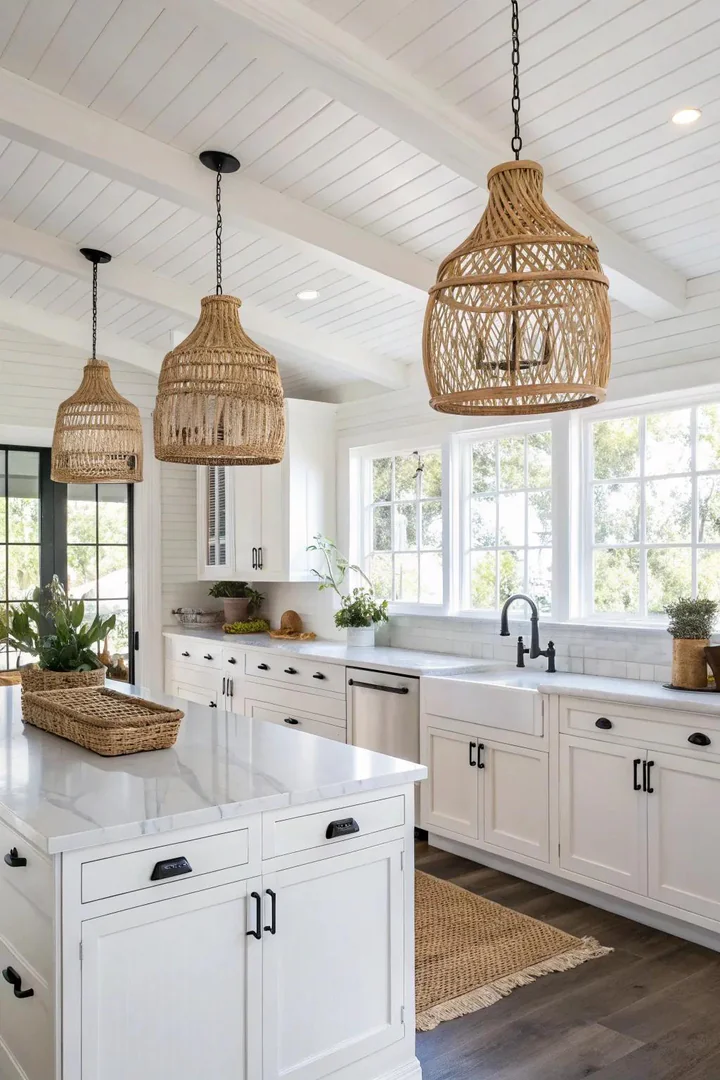
White cabinets with black hardware form the base palette of a coastal kitchen when paired with natural materials — rattan pendant lights, woven seagrass baskets, driftwood accents, linen curtains, and blue-green glass accessories. The white-and-black combination provides the clean, bright background that coastal style requires, while the natural textures and oceanic colors layered on top create the relaxed, beach-house atmosphere.
In a coastal kitchen, keep the black hardware simple and understated (small knobs or short bar pulls) so the hardware does not compete with the natural-material accents that define the coastal aesthetic. Pair with a white shiplap backsplash, light wood or white oak countertops or floating shelves, woven rattan or raffia pendant lights (from Serena & Lily, Pottery Barn, or McGee & Co.), and blue or seafoam ceramic accessories. The coastal palette layers warm natural tones (rattan, wood, linen) and cool oceanic tones (blue, green, seafoam) over the black-and-white base.
13. Blend Finishes
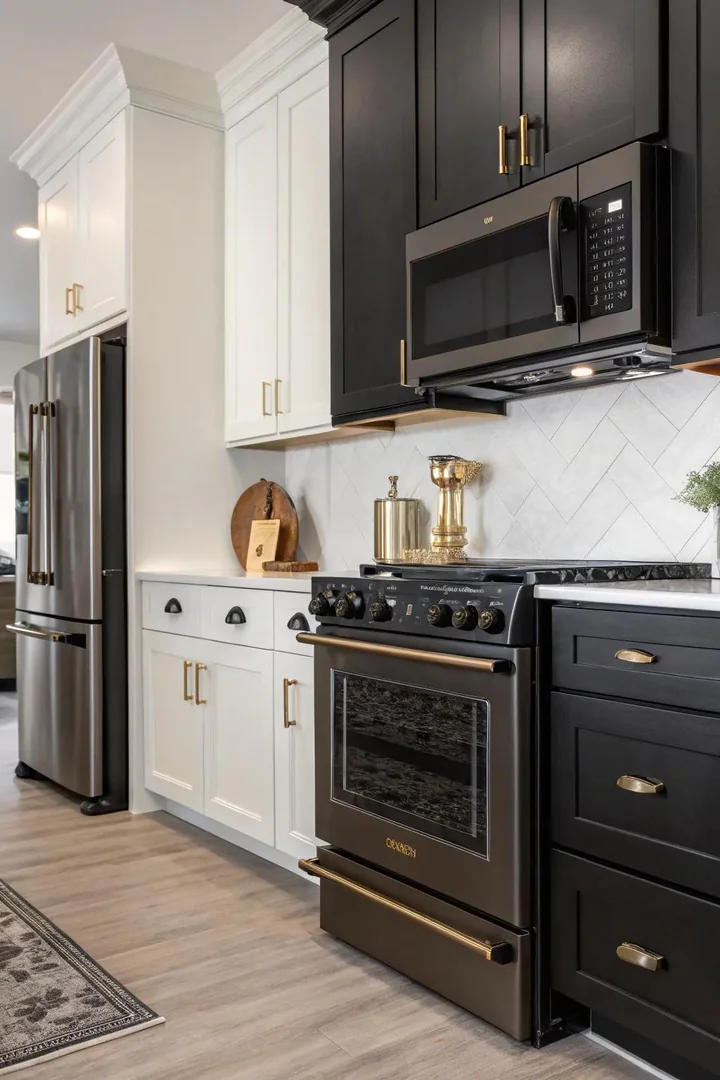
Mixing matte black cabinet hardware with a second metal finish — brushed brass light fixtures, polished nickel faucet, copper range hood, or stainless steel appliances — adds warmth and depth to the black-and-white palette that a single-metal kitchen cannot achieve. Mixed metals make the kitchen feel collected and layered rather than matched and catalog-perfect, creating a more personal, designer-curated look.
The standard approach to mixing metals with black hardware: black pulls and knobs on all cabinets (the dominant metal), a contrasting warm metal on light fixtures and decorative elements (the accent metal), and the appliance metal (stainless steel, typically) treated as a neutral that does not count toward the metal mix. Common pairings: matte black hardware + brushed brass light fixtures + stainless appliances; matte black hardware + polished nickel faucet + brass pendants; or matte black hardware + copper range hood + unlacquered brass shelf brackets. For guidance on pairing cabinet colors with mixed metal finishes, see our kitchen cabinet color ideas guide.
14. Assisting Position
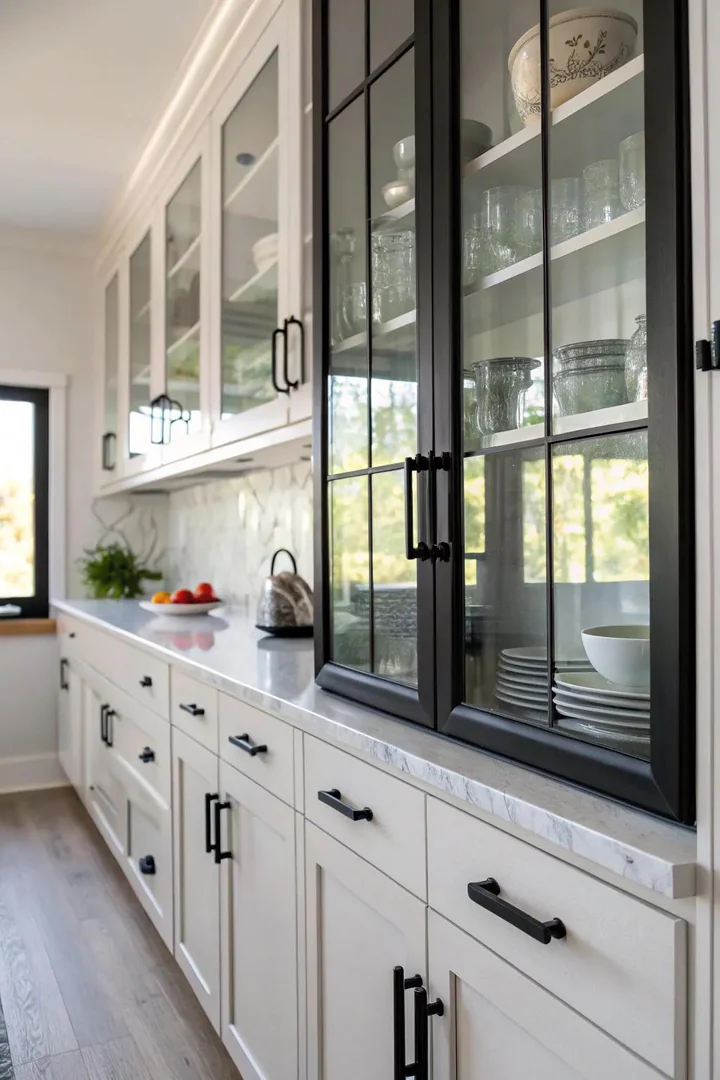
On statement cabinets — glass-front doors, fluted glass panels, open display shelves, or cabinets with decorative door profiles — black hardware plays a supporting role, framing and highlighting the cabinet’s special feature rather than competing with it. The hardware should draw the eye to the glass, the texture, or the display without becoming the focal point itself.
For glass-front cabinets, use a small, simple black knob or a thin bar pull that does not obscure the glass panel. For fluted or reeded cabinet doors, choose hardware with a smooth, flat profile that contrasts with the door’s texture rather than adding more texture. For open display shelves with black metal brackets, coordinate the bracket finish with the cabinet hardware finish (both in matte black) so the shelf brackets and cabinet pulls form a unified metalwork palette across the kitchen.
15. Natural Highlights
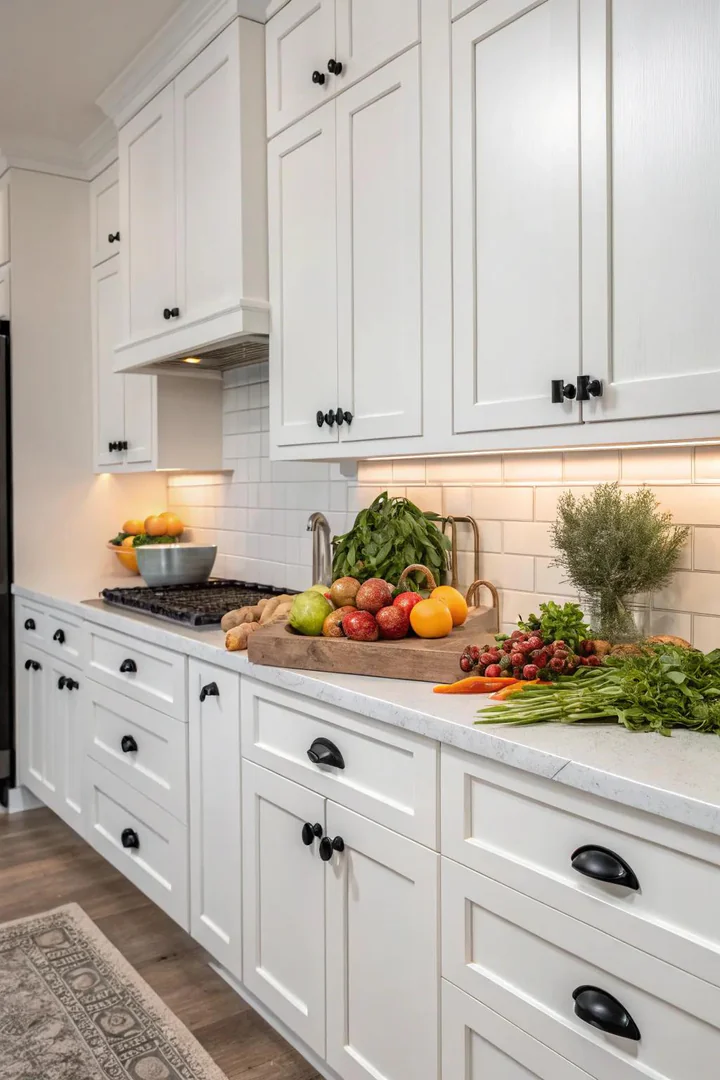
Adding organic, natural-material accents — a butcher block countertop, a live-edge wood shelf, woven baskets on top of the cabinets, a terracotta pot of herbs, or a wooden cutting board propped against the backsplash — warms up the black-and-white kitchen palette with earth tones and natural textures that prevent the space from feeling sterile or clinical. The organic elements introduce the brown, tan, and green tones that white and black alone cannot provide.
Place warm wood elements at strategic points: a butcher block section on the island or peninsula (even if the rest of the countertop is stone or quartz), floating shelves in natural walnut or white oak above the counter, a wooden paper towel holder, and a wooden fruit bowl on the counter. Add greenery with a potted herb garden (rosemary, basil, thyme in small terracotta pots) on the windowsill or a trailing pothos plant on a high shelf. These natural accents break the graphic severity of the black-on-white contrast and make the kitchen feel warm and lived-in. Visit The Designers Company for more kitchen style inspiration.
16. Stylish Storage Units
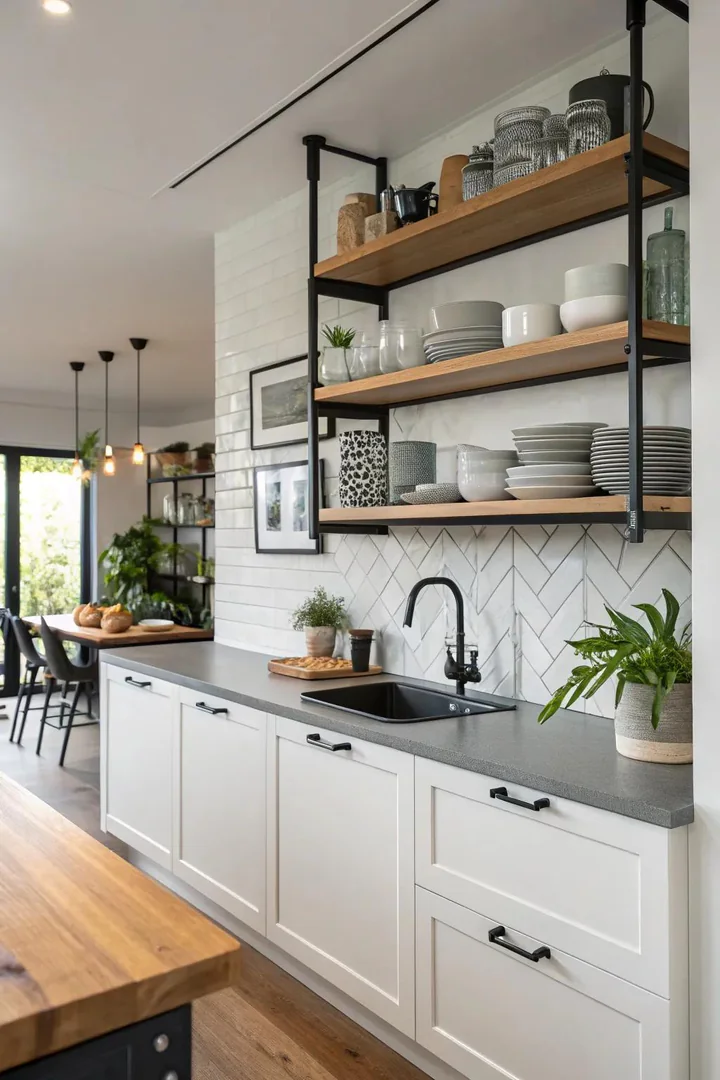
Replacing some upper cabinets with open shelving supported by black metal brackets — L-shaped brackets, hairpin brackets, or industrial pipe brackets in matte black steel — extends the black hardware theme from the cabinet pulls onto the wall above, creating a cohesive black-metal accent that ties the entire kitchen together. The black shelf brackets become part of the same visual system as the cabinet hardware.
Choose shelf bracket profiles that complement the cabinet hardware style: thin, flat L-brackets (from D. Lawless Hardware or Cascade Iron Co.) for modern kitchens, hairpin brackets for mid-century kitchens, and industrial pipe brackets (from Pipe Decor or Industrial By Design) for industrial and farmhouse kitchens. Use shelves in natural wood (walnut, white oak, or maple) to contrast with the black brackets, or paint the shelves white to match the cabinets for a monochromatic look. For more styling ideas for kitchen decor and shelving, explore our kitchen decor ideas collection.
How to Choose Black Hardware for White Cabinets
Selecting the Right Finish
Not all “black” hardware is the same finish. Matte black (also labeled “flat black”) has a non-reflective, velvety surface that is the most popular and most forgiving option — it hides fingerprints and minor scratches. Satin black has a slight sheen that reflects a small amount of light. Oil-rubbed bronze appears black but has warm brown undertones and sometimes visible bronze highlights at the edges. True black (a high-gloss, lacquered black) is the most dramatic but shows every fingerprint and scratch. For most white kitchens, matte/flat black is the best choice.
Matching Hardware to Door Style
The cabinet door profile should guide the hardware choice. Shaker doors (with a recessed center panel and a simple frame) pair with almost any black hardware — knobs, bar pulls, bin pulls, ring pulls. Flat-panel (slab) doors pair best with slim, linear pulls or edge pulls that match the door’s minimalist profile. Raised-panel doors (with a profiled center panel) pair with traditional hardware — round knobs, bin pulls, or turned handles. Glass-front doors pair with small knobs or thin pulls that do not obscure the glass.
Budgeting for a Hardware Swap
A full hardware swap on a typical kitchen (20 to 30 cabinets and drawers) costs between $80 and $500 depending on the hardware brand and style. Budget options (Goldenwarm, Franklin Brass, Ravinte on Amazon) run $2 to $5 per piece in bulk packs of 10 to 30. Mid-range options (Amerock, Richelieu, Liberty Hardware) run $5 to $12 per piece. Premium options (Top Knobs, Emtek, Rejuvenation, Buster + Punch) run $12 to $40+ per piece. A hardware swap is one of the highest-impact, lowest-cost kitchen upgrades available — it requires only a drill, a jig, and an afternoon.
Black Hardware Styles Comparison
| Hardware Style | Best For | Size Range | Price Per Piece |
|---|---|---|---|
| Round knob | All door types | 1-1.5 inch diameter | $2-15 |
| Bar pull | Shaker and slab doors | 3-12 inch C-to-C | $3-25 |
| Bin/cup pull | Drawers, farmhouse | 3-4 inch C-to-C | $5-20 |
| Edge pull | Modern slab doors | 3-6 inch length | $8-30 |
| Ring pull | Traditional, farmhouse | 2-3 inch diameter | $5-20 |
| Knurled pull | Transitional, modern | 4-8 inch C-to-C | $10-40 |
| Oversized bar | Wide drawers, appliances | 8-18 inch C-to-C | $12-45 |
| Cast iron knob | Farmhouse, rustic | 1-1.25 inch diameter | $4-15 |
Common Black Hardware Mistakes to Avoid
Choosing the wrong black finish for the kitchen’s other metals. Matte black hardware next to glossy black appliance handles, oil-rubbed bronze light fixtures, and a satin nickel faucet creates a kitchen with four different “dark metal” finishes that do not quite match. Before buying hardware, check the black finish against the kitchen’s existing metal elements — faucet, light fixtures, appliance handles, and outlet/switch plates — and ensure the tones are compatible. Matte black hardware pairs best with matte black light fixtures and stainless steel appliances.
Installing hardware at inconsistent heights. On white cabinets, every piece of black hardware stands out sharply, so even small placement inconsistencies (a pull mounted 1/4 inch higher on one door than its neighbor) are immediately visible. Always use a hardware jig for drilling, and always measure from the same reference point (the top edge of the door or drawer) on every cabinet. Check alignment by stepping back 6 to 8 feet and looking at the hardware line across multiple cabinets.
Using hardware that is too small for the cabinet. A 1-inch knob on a 36-inch-wide drawer looks lost and makes the drawer difficult to open. Match the hardware scale to the cabinet size: small knobs for small doors (under 15 inches wide), medium pulls for standard doors and drawers (15 to 24 inches), and large pulls for wide drawers and appliance panels (24 inches and wider).
Buying hardware without testing in person. Online hardware photos often look different from the actual piece in hand — the size, weight, feel, and finish can surprise. Order 1 to 2 sample pieces before buying the full set, install them on a representative door and drawer, and live with them for a few days before committing to the full order.
Frequently Asked Questions
What shade of white works best with black hardware?
Bright, clean whites (Benjamin Moore Chantilly Lace OC-65, Sherwin-Williams Extra White SW 7006) create the highest contrast with black hardware and produce the most graphic, modern look. Warm whites (Benjamin Moore White Dove OC-17, Simply White OC-17, Sherwin-Williams Alabaster SW 7008) create a slightly softer contrast that works well in traditional and farmhouse kitchens. Avoid whites with strong yellow, pink, or green undertones — they can look dingy next to sharp matte black.
Should I match the faucet to the hardware?
Matching the faucet to the cabinet hardware (both in matte black) creates the most cohesive and coordinated look. However, a mixed-metal approach — black hardware with a brushed gold faucet, or black hardware with a polished nickel faucet — is equally acceptable and can add warmth and depth that an all-black metal palette lacks. If you mix metals, limit the kitchen to 2 to 3 metal finishes maximum to avoid visual chaos.
How many pieces of hardware do I need for my kitchen?
Count each cabinet door (one knob or pull per door) and each drawer (one pull per drawer; two pulls on extra-wide drawers over 30 inches). A typical kitchen has 15 to 25 doors and 8 to 15 drawers, requiring 23 to 40 pieces of hardware. Order 2 to 3 extra pieces (5 to 10 percent overage) for replacements, mistakes, or future additions. Many hardware manufacturers sell multi-packs (10-, 20-, or 30-packs) at a lower per-piece cost than individual purchases.
Can I install black hardware on existing white cabinets?
Yes. If the existing hardware has the same hole spacing (center-to-center measurement), you can swap the old hardware for new matte black pieces using the existing screw holes — a 10-minute job per cabinet. If the new hardware has a different hole spacing, you will need to drill new holes (using a hardware jig) and fill the old holes with wood filler, sand, and touch up with matching white paint. The old hardware screw holes are typically on the cabinet door’s back side, so filled holes are not visible from the front.
Is matte black hardware a trend that will date my kitchen?
Black hardware on white cabinets has been a staple of kitchen design for over 200 years — black iron hardware on white-painted woodwork is one of the oldest hardware-and-cabinet combinations in existence. The current popularity of matte black specifically (as distinct from oil-rubbed bronze or flat black) may shift in intensity, but the white-and-black pairing itself is not a trend — it is a permanent design classic that has never gone out of style in the history of kitchen design.
What size pulls should I use on Shaker cabinets?
On standard Shaker cabinet doors (12 to 18 inches wide), use 3-inch to 5-inch pulls or 1-inch to 1.25-inch knobs. On Shaker drawers (12 to 24 inches wide), use 4-inch to 6-inch pulls. On extra-wide Shaker drawers (24 to 36 inches wide), use 8-inch to 12-inch pulls. The pull length should be roughly one-third to one-half the width of the drawer face for proportional balance. Center the pull horizontally on the drawer face and position it 2 to 3 inches from the top edge.
Conclusion
White kitchen cabinets with black hardware is one of the most reliable, versatile, and enduring design combinations in kitchen design. The 16 ideas above cover every approach to this pairing — from small, discreet knobs to oversized statement pulls, from farmhouse cast iron to modern edge pulls, and from single-finish consistency to mixed-metal layering.
The hardware swap is one of the fastest and most affordable ways to update a white kitchen: choose the right style and size for your cabinet doors, invest in a hardware jig for precise drilling, and install in a single afternoon. Whether your kitchen leans modern, traditional, coastal, or farmhouse, matte black hardware on white cabinets provides the graphic contrast, visual definition, and timeless quality that makes the kitchen feel finished and intentionally designed.