
Farmhouse Kitchen Cabinet Ideas: 19 Rustic Looks That Elevate Spaces
Farmhouse kitchen cabinet ideas blend the warmth of rural craftsmanship with the functionality a modern kitchen demands. The farmhouse style started in 18th-century American and European country homes where kitchens used locally sourced wood, hand-forged hardware, and open storage because those were the materials and methods available — not because they were fashionable. Today, farmhouse cabinets reference that heritage through Shaker-style door profiles, natural wood finishes, visible joinery, and hardware with an aged or hand-worked character.
The 19 ideas below cover the full range of farmhouse cabinet treatments — from warm natural wood and distressed paint finishes to barn door panels, beadboard inserts, and industrial-farmhouse hybrids. Each idea includes specific materials, hardware, and finish recommendations so you can build a farmhouse kitchen that feels authentic rather than imitative.
1. Welcome the Comfort of Natural Wood
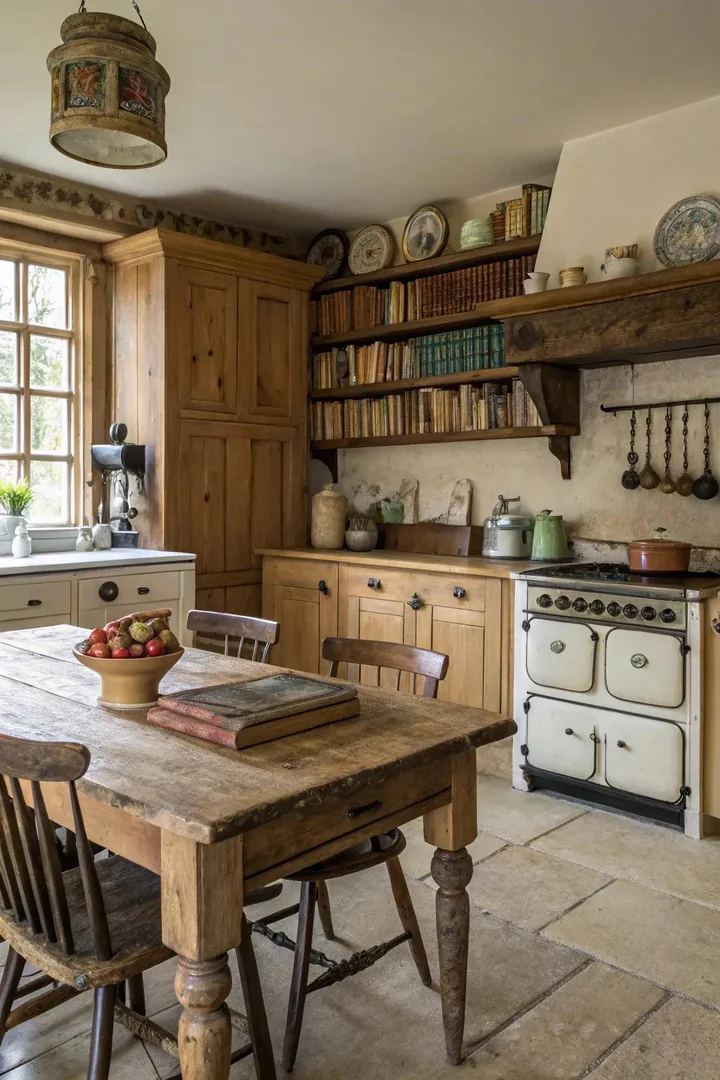
Natural wood cabinets — left unstained or finished with a clear matte sealant that lets the grain show — are the foundation of authentic farmhouse kitchen design. White oak, hickory, and knotty alder are the three most popular wood species for farmhouse cabinets because their prominent grain patterns, knot clusters, and natural color variation give each cabinet door a unique character that painted or laminate doors cannot replicate.
Apply a water-based polyurethane in a satin or matte sheen (General Finishes High Performance or Minwax Polycrylic) to protect the wood from kitchen moisture without adding the amber cast that oil-based finishes develop over time. For a warmer tone, use a single coat of Rubio Monocoat in Natural or Cotton White — this hardwax oil finish penetrates the grain rather than sitting on top, so the wood feels natural to the touch and the finish is repairable by spot-treating scratches without refinishing the entire door.
2. Enhance Appeal with Open Shelving
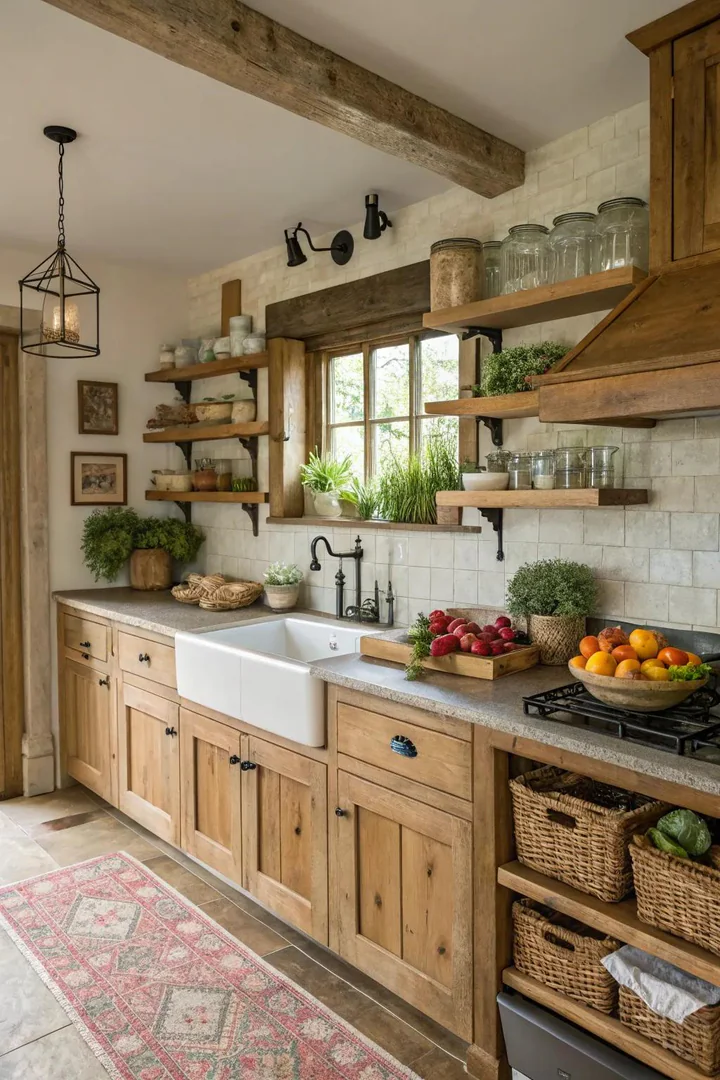
Replacing some or all upper cabinets with open wooden shelves is a defining farmhouse move — the open shelves reference the plate racks, pot rails, and pantry shelving of working country kitchens where everything was stored in the open for quick access. Thick floating shelves (two inches or more) in reclaimed pine, white oak, or walnut create the substantial, hand-hewn look that thin shelves cannot match.
Install the shelves on concealed floating-shelf brackets (Shelfology’s Heavy-Duty Brackets support up to 100 pounds per shelf) anchored into wall studs, not drywall. Space the shelves 12 to 14 inches apart vertically to fit dinner plates standing upright, short glasses, and medium-sized bowls. The trade-off with open shelves is maintenance — dishes collect kitchen grease and dust faster on exposed shelves than behind cabinet doors, so limit open shelving to items you use and wash daily (everyday plates, mugs, glasses) and keep seldom-used items in closed cabinets.
3. Be Daring with Vibrant Cabinets
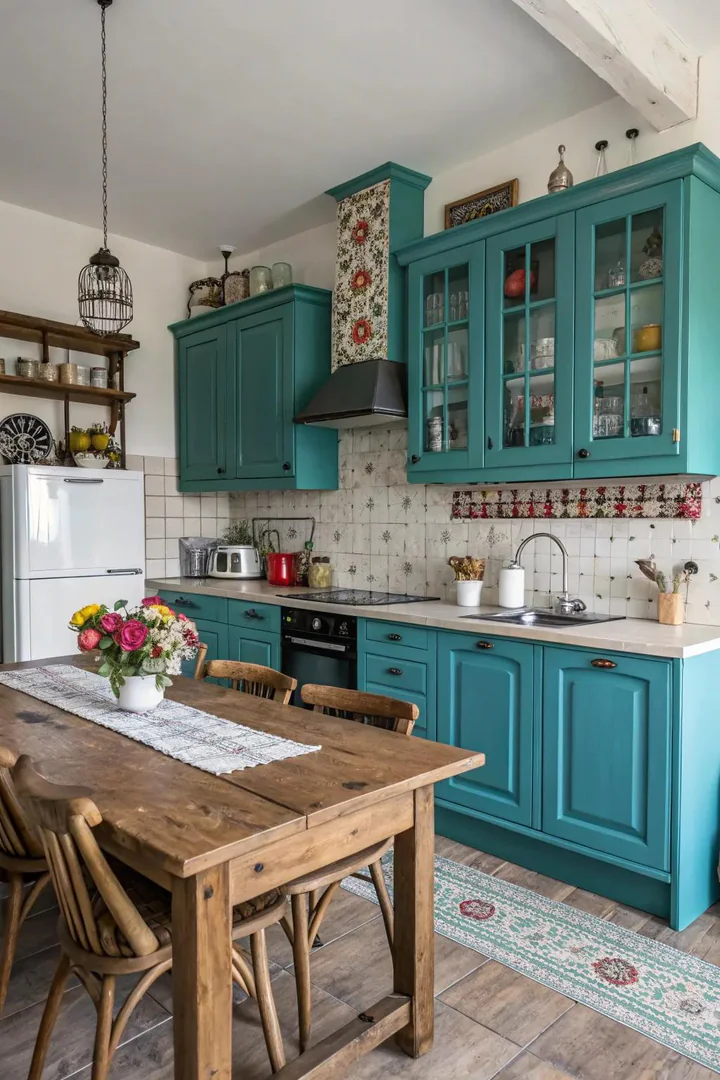
Farmhouse kitchens do not have to be white. Historical country kitchens used whatever paint was available locally — deep greens, slate blues, barn reds, and mustard yellows — and modern farmhouse design benefits from the same willingness to use saturated color on cabinetry. Benjamin Moore’s Newburyport Blue (HC-155), Sherwin-Williams’ Pewter Green (SW 6208), and Farrow & Ball’s Studio Green (No. 93) are three farmhouse-appropriate bold colors that pair well with natural wood countertops and aged brass hardware.
Paint the lower cabinets in the bold color and keep the upper cabinets white (or remove them in favor of open shelves) to prevent the color from overwhelming the room. The Shaker-style door profile — a flat center panel with a square-edge frame — takes bold paint colors well because the simple profile does not compete with the color for attention. Use a satin or semi-gloss sheen for durability and easy cleaning, and pair the bold cabinets with a neutral countertop (butcher block, honed marble, or white quartz) so the color remains the focal point.
4. Adopt the Barn Door Design
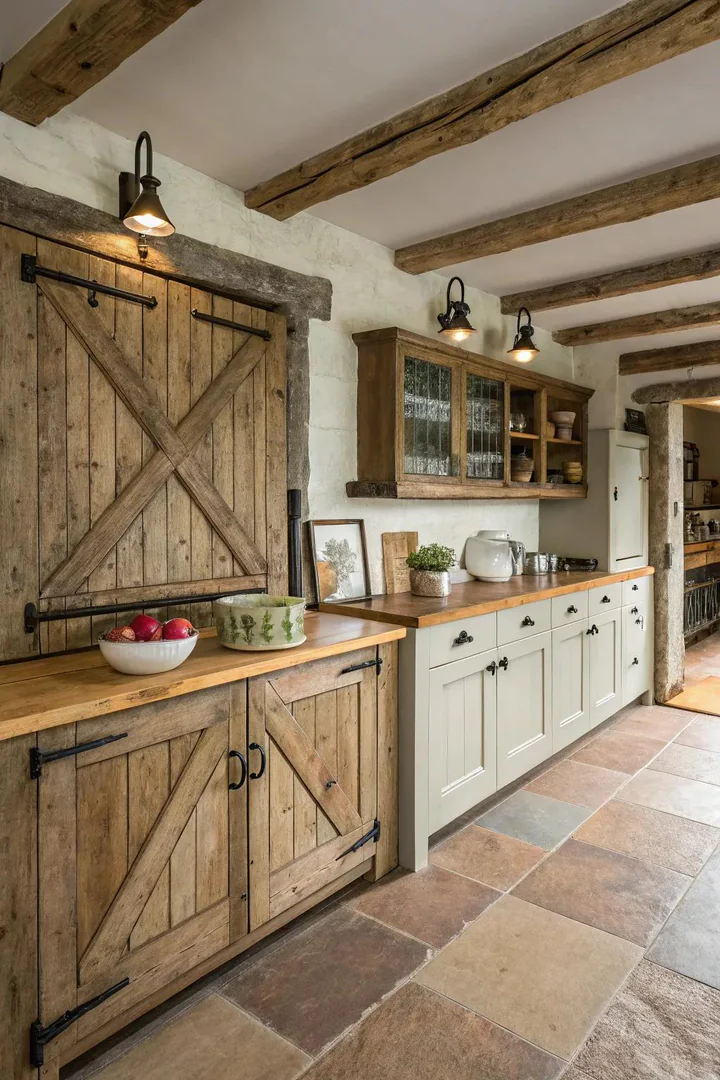
Barn door panels on a kitchen island or a pantry cabinet use the same Z-brace or X-brace construction as an actual barn door — vertical tongue-and-groove planks with diagonal or crossed braces on the face — to create a panel that reads unmistakably as farmhouse. The barn door panel can be decorative (fixed to the island or cabinet face with no functional hinge) or functional (sliding on a miniature barn-door track to open and close the cabinet).
For a functional sliding barn-door cabinet, use a miniature flat-track hardware kit (National Hardware or Everbilt both produce kits sized for cabinet doors) that mounts above the cabinet opening. The door slides sideways on the track rather than swinging outward, which saves floor clearance in tight kitchens. Build the door from 3/4-inch tongue-and-groove pine boards with a Z-brace screwed to the back for rigidity, stain or paint to match the kitchen’s palette, and mount on the track with the supplied rollers and guides.
5. Combine Contemporary and Classic Features
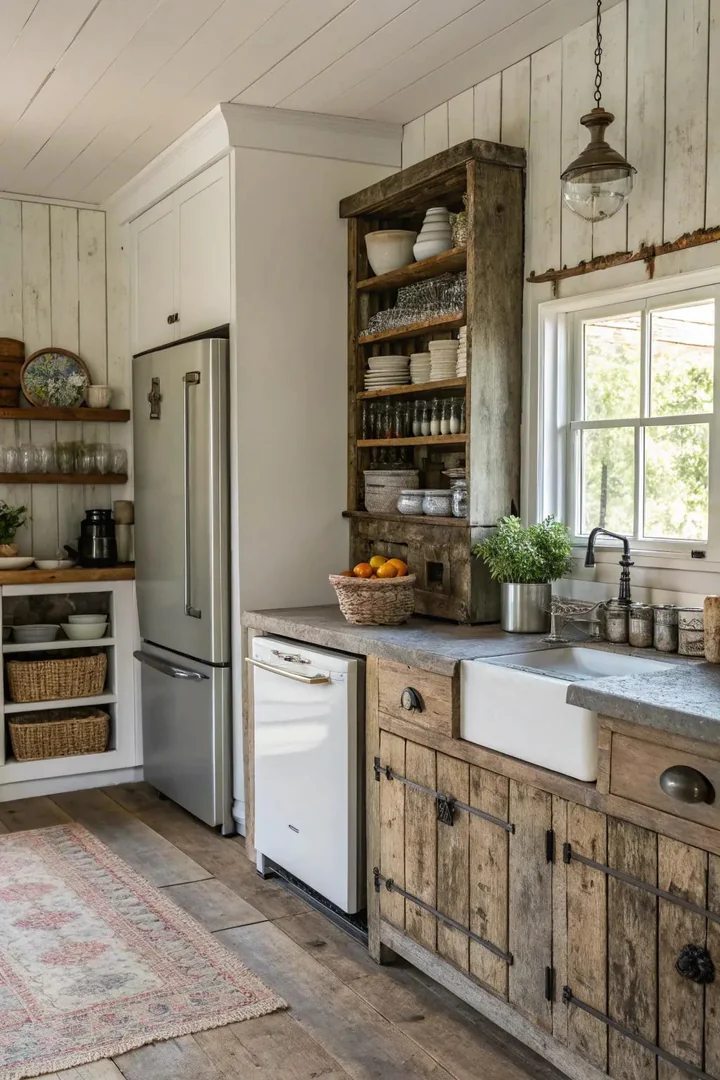
Modern farmhouse — the most popular variation of the style — mixes clean-lined contemporary elements (flat-panel cabinet doors, stainless steel appliances, quartz countertops) with traditional farmhouse details (shiplap backsplash, apron-front sink, aged brass hardware) in a way that feels current without losing the warmth and character of the original style. The modern elements keep the kitchen from looking like a period reproduction, and the farmhouse details keep it from feeling cold or sterile.
The balance point is usually about 60/40 in favor of modern: choose modern cabinetry (flat-panel or simple Shaker in a crisp white or light grey) and pair it with two or three strongly farmhouse elements — a thick butcher block countertop, iron bin-pull hardware, and a fireclay apron sink. Avoid overdoing the farmhouse accents (no need for a barn-door pantry, a rooster clock, and a mason-jar pendant light all in the same kitchen) — restraint keeps the modern-farmhouse mix feeling intentional rather than themed.
6. Choose Cabinets with Glass Fronts
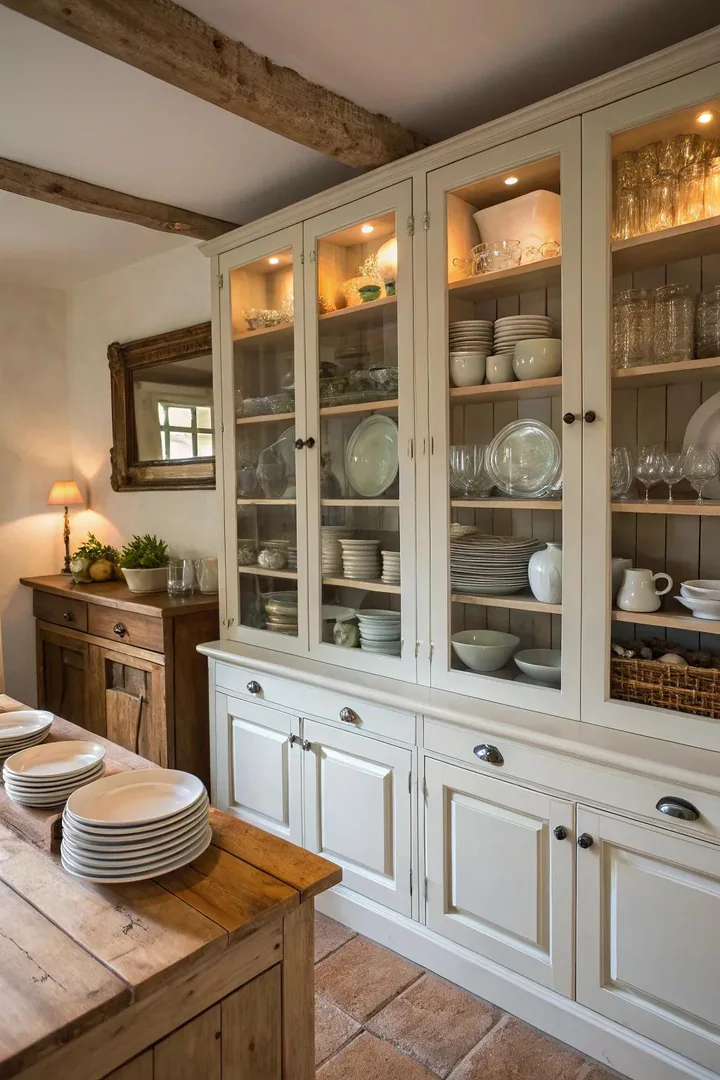
Glass-front upper cabinets split the difference between open shelving and closed cabinets — the contents are visible (giving the farmhouse display quality) but protected from kitchen grease and dust behind glass. Use seeded glass (also called bubble glass) for the most authentic farmhouse look — the small air bubbles in the glass create a wavy, imperfect surface that references hand-blown glass from the 18th and 19th centuries.
Seeded glass inserts are available from Bendheim Glass, Delphi Glass, and most local glass shops in standard cabinet door sizes. Have the glass cut to fit your existing cabinet door frames and install it with glass retainer clips and a thin bead of clear silicone. Pair seeded glass doors with interior cabinet lighting (a battery-operated LED puck light or a hardwired strip light under the cabinet top shelf) to illuminate the contents and create a warm glow that shows through the textured glass at night.
7. Emphasize with Metallic Details
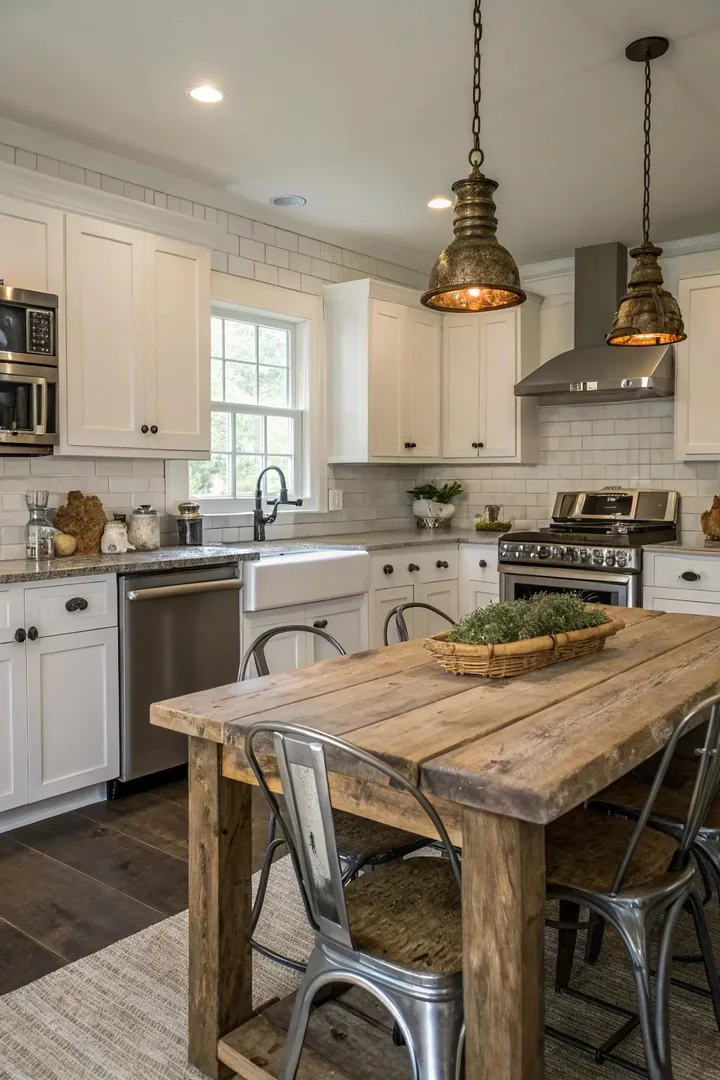
Cabinet hardware is the jewelry of a farmhouse kitchen — the pulls, knobs, hinges, and latches set the tone for the entire room. Aged brass, oil-rubbed bronze, and matte black iron are the three classic farmhouse hardware finishes, each referencing the hand-forged metalwork of traditional country kitchens. Rejuvenation, Schoolhouse Electric, and Amerock all produce farmhouse-appropriate hardware lines in these finishes.
Bin pulls (cup-shaped pulls mounted on the lower rail of the drawer face) are the most iconic farmhouse hardware style — they originated on apothecary drawers and general-store fixtures in the 19th century and carry that historical association into the modern kitchen. Pair bin pulls on drawers with round knobs on cabinet doors for a coordinated but not matchy-matchy look. Use the same finish across all hardware in the kitchen (all aged brass, all oil-rubbed bronze, or all matte black) to maintain visual consistency — mixing hardware finishes in a farmhouse kitchen can read as accidental rather than designed.
8. Achieve Contrast with Bicolor Cabinets
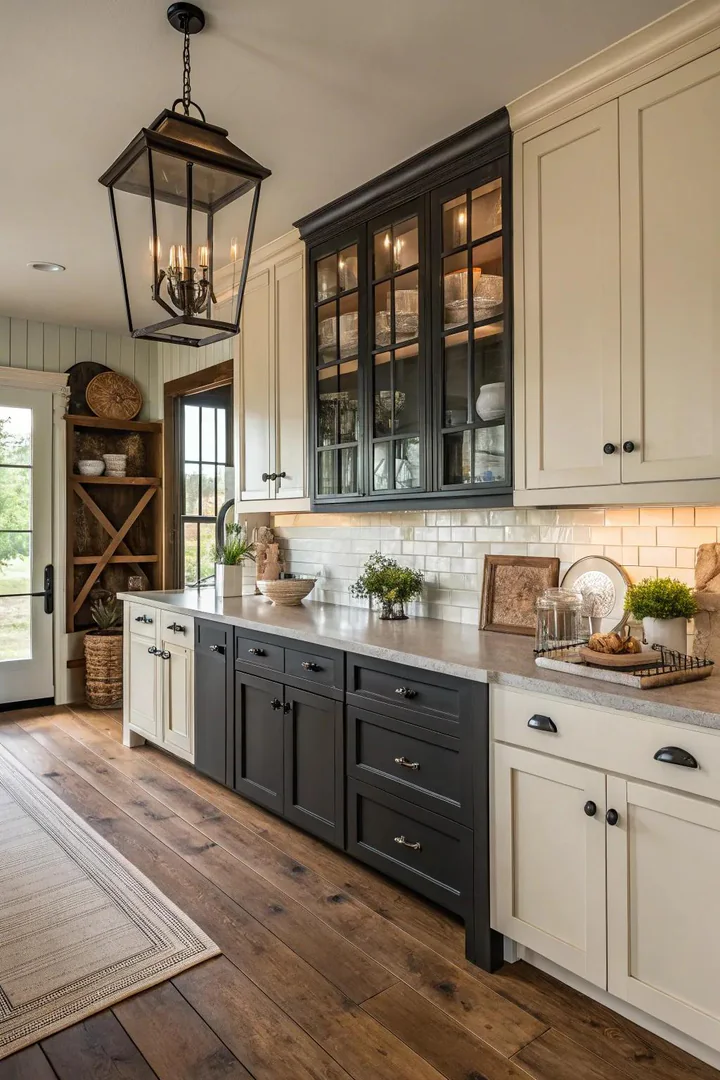
Two-tone cabinets — white uppers with a colored lower, or painted perimeter cabinets with a natural-wood island — create visual layering that prevents a farmhouse kitchen from looking monotonous. The two-tone approach references historical kitchens where cabinets were built at different times or from different materials, creating a collected-over-time look that a uniform cabinet finish cannot replicate.
The most popular farmhouse two-tone combinations are white uppers with navy or sage green lowers, white perimeter cabinets with a natural walnut or oak island, and cream uppers with charcoal-grey lowers. Keep the contrast moderate — extreme contrasts (pure white and jet black) can read as contemporary rather than farmhouse. For help choosing two-tone pairings that suit your kitchen’s light and layout, our kitchen cabinet color ideas guide covers the most popular farmhouse and transitional combinations.
9. Trial with Worn-Out Finishes
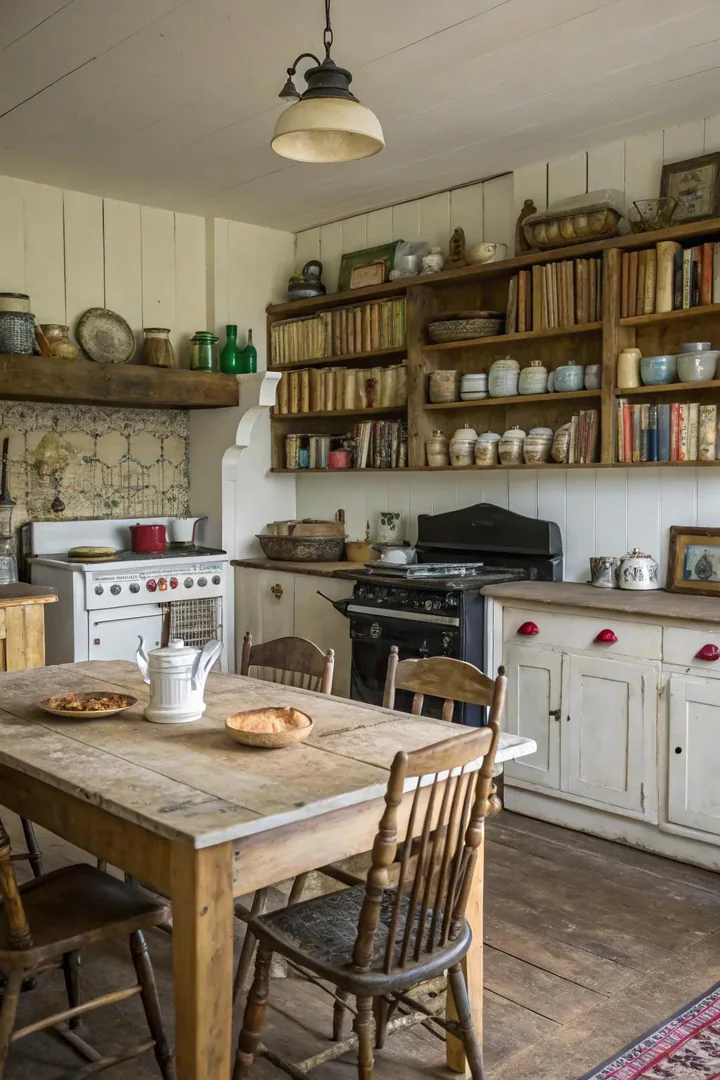
Distressed finishes — cabinets painted and then strategically sanded at the edges, corners, and around hardware to reveal the wood or a contrasting base coat underneath — give new cabinets the look of decades of natural wear. The distressing technique works best on Shaker-style doors with a flat center panel and a square-edge frame, where the sanding reveals clean lines at the frame edges and natural wear patterns around the knob or pull.
Apply a dark base coat (raw umber or dark brown) first, let it dry completely, rub a thin coat of furniture wax on the spots where you want the distressing to show through (edges, corners, around hardware), then apply the top coat (white, cream, or pale grey). After the top coat dries, sand through the waxed spots with 220-grit sandpaper — the wax prevents the top coat from bonding fully, so the sanding reveals the dark base coat underneath in a natural-looking pattern. Seal with a clear matte wax or polyurethane.
10. Add Glass Inserts
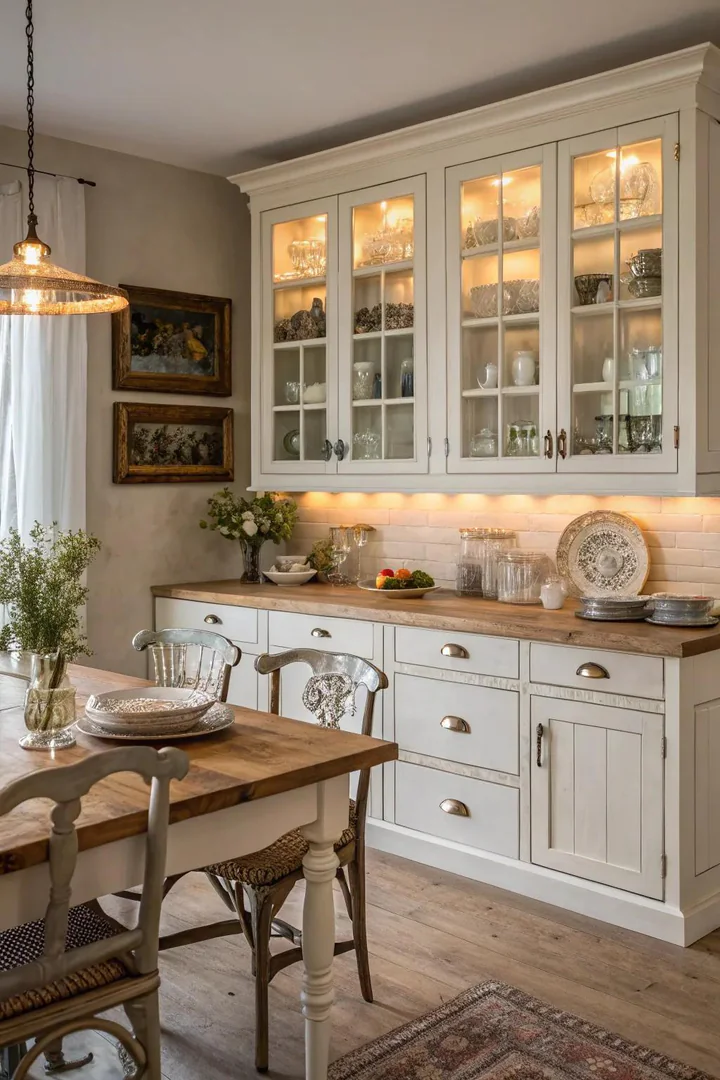
Glass inserts — glass panels set into the center of a Shaker or raised-panel cabinet door, replacing the solid wood or MDF center panel — open up individual cabinet doors to display their contents while keeping the rest of the cabinets solid. Use glass inserts selectively: one or two pairs of glass-front upper cabinets flanking the range hood or the kitchen window, with solid doors on the remaining cabinets. The selective approach creates visual variety without requiring every shelf to be display-ready.
Choose the glass type based on the desired level of visibility: clear glass shows everything (requires neatly organized contents), seeded glass shows shapes and colors but obscures details (more forgiving), and frosted or ribbed glass reveals only silhouettes (hides clutter completely). Mullion bars — thin wood or metal dividers that create a grid pattern within the glass panel — add a traditional farmhouse detail and make the glass panel more visually interesting than a single unbroken pane.
11. Utilize Reclaimed Wood for Unique Character
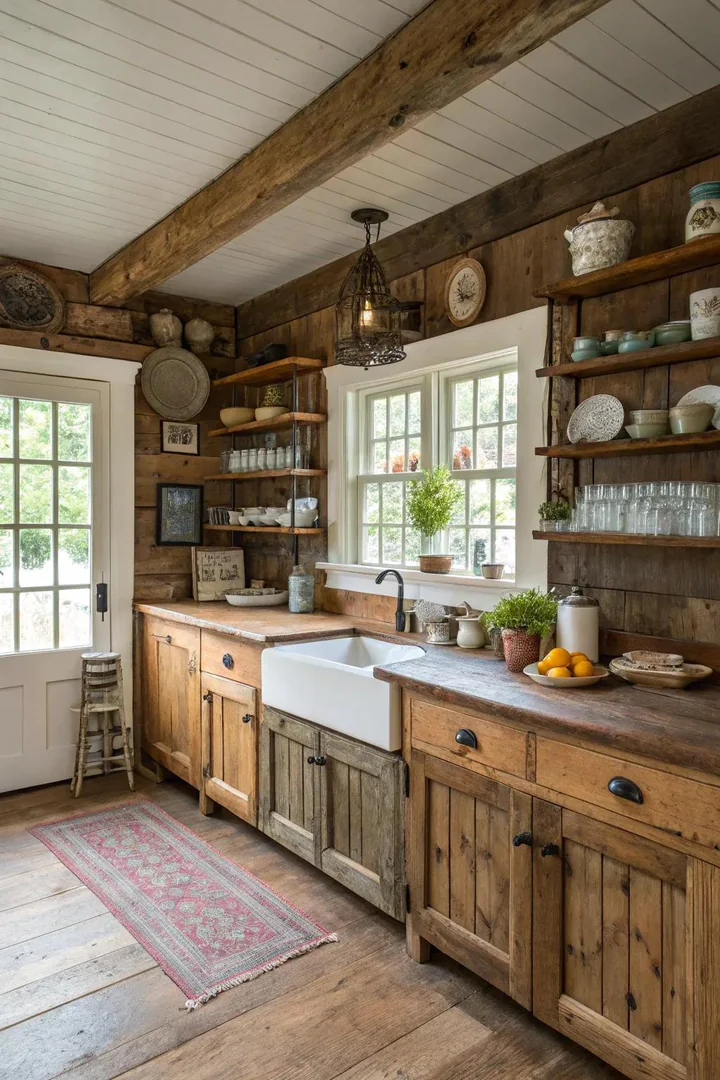
Reclaimed wood — salvaged from old barns, factories, warehouses, and demolished homes — brings a patina, grain pattern, and color depth that new wood cannot match because the wood has aged and weathered for 50 to 200 years. Reclaimed white oak, chestnut, and heart pine are the most sought-after species for farmhouse cabinet doors and island panels because their grain is tighter and more figured than modern lumber from fast-growth plantations.
Source reclaimed wood from reputable dealers (Longleaf Lumber, Vintage Timberworks, or Elmwood Reclaimed Timber) who kiln-dry the lumber to kill insects and stabilize moisture content before resale. Reclaimed wood that has not been kiln-dried can harbor powder-post beetles, carpenter ants, or excessive moisture that causes warping after installation. Expect to pay $8 to $20 per board foot for reclaimed hardwood — a premium over new lumber ($3 to $8 per board foot) but justified by the character and history each board carries.
12. Install a Farmhouse Sink
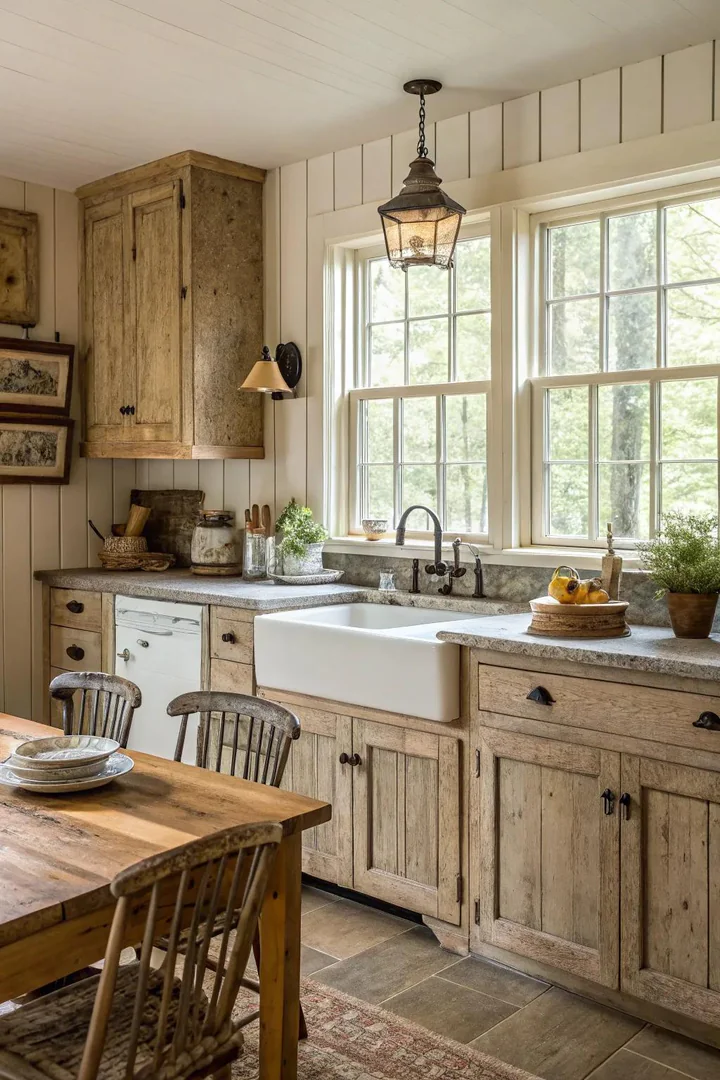
An apron-front (farmhouse) sink is the single most recognizable element of farmhouse kitchen design — the exposed front panel of the sink extends past the cabinet face, creating a visible apron that breaks the countertop line and adds a sculptural, old-world detail. Fireclay is the most popular material for farmhouse sinks because it is fired at extremely high temperatures (2,000°F+), producing a surface that resists chipping, staining, and thermal shock better than standard porcelain.
Rohl, Kohler (Whitehaven series), and Bocchi all produce fireclay farmhouse sinks in single-bowl and double-bowl configurations ranging from 30 to 36 inches wide. The single-bowl design is more practical for washing large pots and baking sheets; the double-bowl is more traditional and allows simultaneous washing and rinsing. The sink cabinet requires a modified face frame — the front rail is cut away to accommodate the apron — so order a farmhouse sink base cabinet specifically designed for apron-front installation.
13. Opt for Matte Finishes for a Contemporary Feel
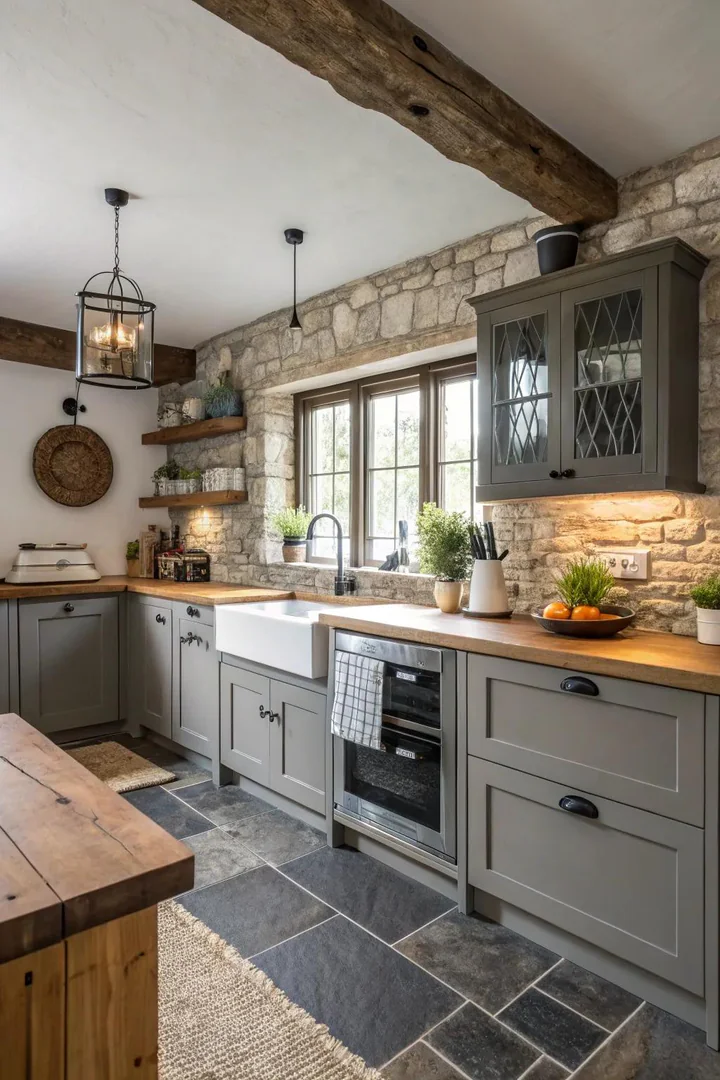
Matte paint finishes on farmhouse cabinets create a soft, chalk-like surface that absorbs light rather than reflecting it, giving the kitchen a warm, muted atmosphere that glossy or semi-gloss finishes cannot produce. The matte surface references the limewash and milk-paint finishes used in historical farmhouses before modern paints were available.
Benjamin Moore Advance in a matte sheen or Sherwin-Williams Emerald in a flat/matte finish produce durable matte surfaces that resist staining and clean with a damp cloth — critical in a kitchen where cabinet doors get touched with greasy or wet hands daily. Matte finishes show fingerprints less than gloss or semi-gloss but are slightly harder to wipe clean, so use them on upper cabinets and accent areas, and consider a satin sheen on lower cabinets and high-touch areas where cleaning frequency is highest.
14. Add Beadboard Panels
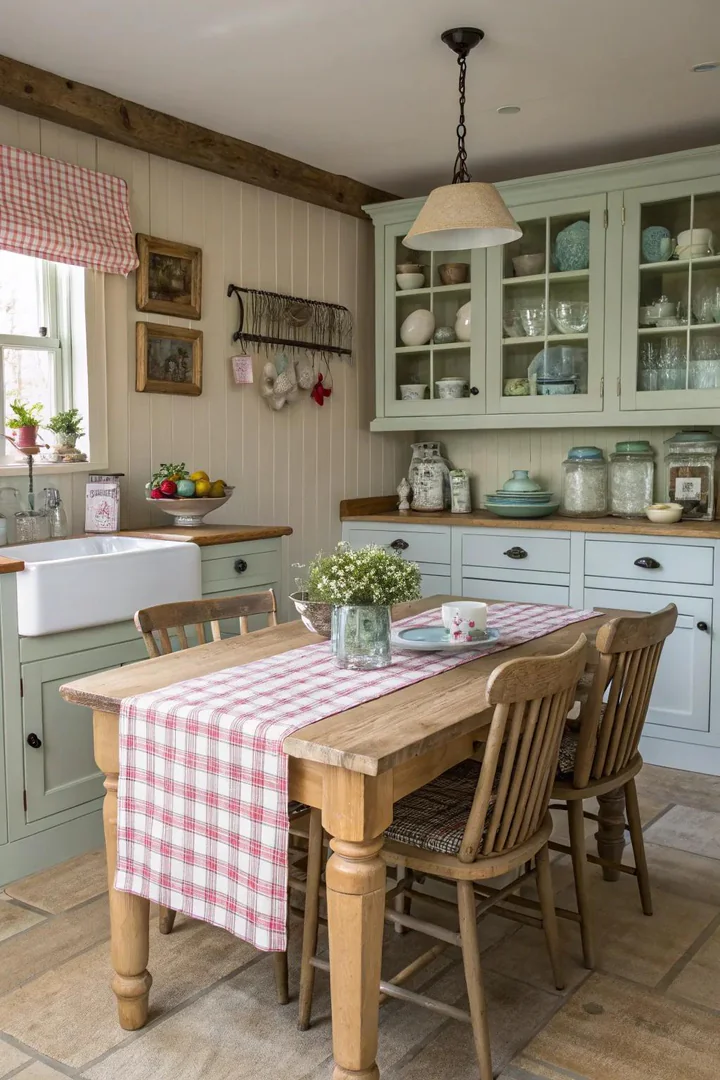
Beadboard — narrow tongue-and-groove boards with a rounded bead profile along each joint — is one of the most recognizable farmhouse materials, used historically as wall paneling, ceiling covering, and porch skirting in American country homes since the 1850s. Adding beadboard panels to the center of Shaker-style cabinet doors, the island front, or the backsplash introduces the vertical line pattern and the tactile texture that define the farmhouse aesthetic.
Beadboard panels are available as individual tongue-and-groove planks (sold at Home Depot and Lowe’s in 3-1/2 inch widths) or as full sheets (4×8 feet, pre-routed to look like individual planks). The sheet panels install faster and produce more uniform results — cut them to fit inside the cabinet door frame with a table saw or circular saw, glue them in place with construction adhesive, and paint. Individual planks produce a more authentic look with real joints and natural variation, but take longer to install and require more precise fitting.
15. Choose Open Cabinetry
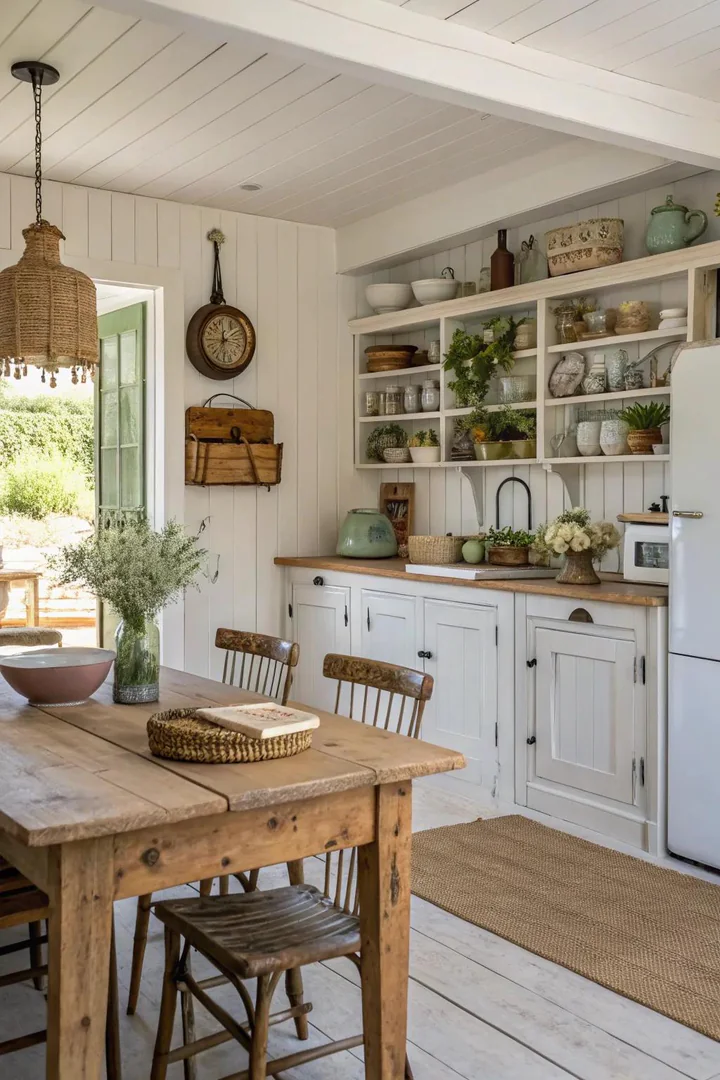
Open cabinetry — base and upper cabinets with the doors removed entirely, exposing the interior shelves — takes the open-shelving concept one step further by converting existing closed cabinets into display storage without removing the cabinet boxes or replacing them with floating shelves. The cabinet box, face frame, and interior shelves remain; only the doors come off.
Paint the interior of the cabinets the same color as the exterior for a seamless look, or paint the interior a contrasting color (a soft blue or sage green inside white cabinets) to create visual depth and draw the eye into the shelf. Replace the fixed shelves with adjustable pin-supported shelves so you can customize the spacing for different items. Open cabinetry works best for displaying uniform collections (white dishes, clear glasses, ceramic bowls) and less well for miscellaneous storage — visible clutter is the trade-off for the open, airy look.
16. Integrate Distinctive Hardware
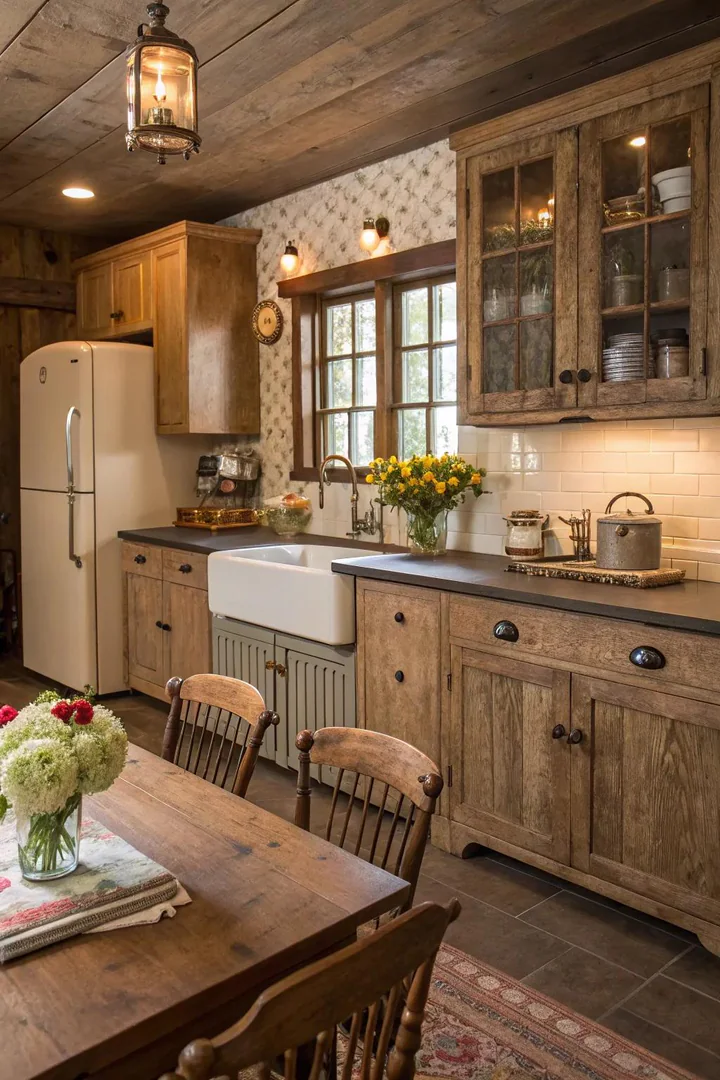
Swapping standard chrome or brushed-nickel hardware for period-appropriate or handmade pieces is the fastest and cheapest way to give generic cabinets a farmhouse identity. Look for hardware with visible forging marks, an aged patina, or an unusual shape — wrought-iron strap hinges, hand-hammered copper knobs, leather strap pulls, or cast-iron ring pulls — that references the handmade metalwork of country kitchens before mass production.
Etsy and specialty hardware suppliers (House of Antique Hardware, Horton Brasses, Crown City Hardware) carry reproduction and authentic antique hardware in farmhouse-appropriate styles. Budget $3 to $15 per knob and $6 to $25 per pull for reproduction hardware; authentic antique pieces cost more but carry real history. When the hardware is the statement piece, keep the cabinet door profile simple — a plain Shaker or flat-panel door lets the hardware stand out rather than competing with ornate millwork for attention.
17. Construct a Butcher Block Island
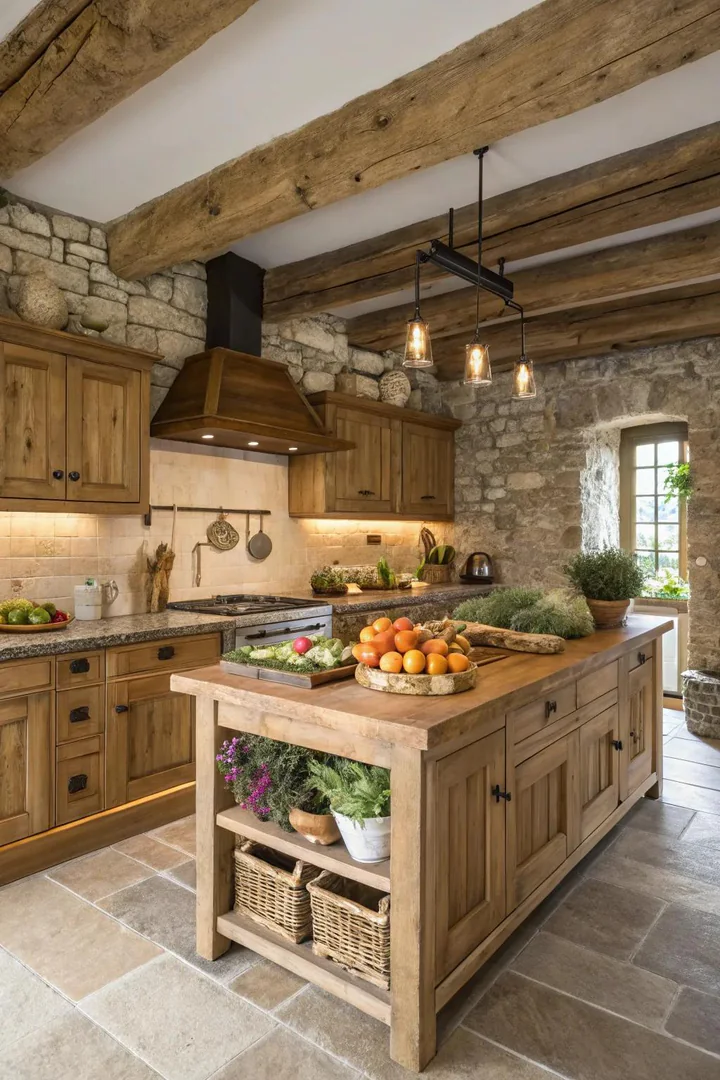
A butcher block countertop — end-grain or edge-grain hardwood glued into a thick slab — is the quintessential farmhouse island surface because it is the same material that professional butchers and bakeries have used for centuries. Maple and walnut are the two standard species: maple (John Boos, Lumber Liquidators) is light-colored, tight-grained, and the hardest common butcher block wood; walnut (Craft Art, Devos Custom Woodworking) is darker, warmer, and slightly softer but more visually dramatic.
Maintain the butcher block with monthly applications of food-grade mineral oil (Howard Butcher Block Oil or John Boos Mystery Oil), which penetrates the grain and prevents the wood from drying, cracking, and absorbing stains. For a more durable finish that requires less frequent maintenance, use a hardwax oil (Rubio Monocoat or Osmo TopOil) that creates a water-resistant surface while maintaining the wood’s natural feel. Butcher block countertops on a farmhouse island pair well with wainscoting on the island sides, painted base cabinets, and an apron-front sink.
18. Add Floating Shelves
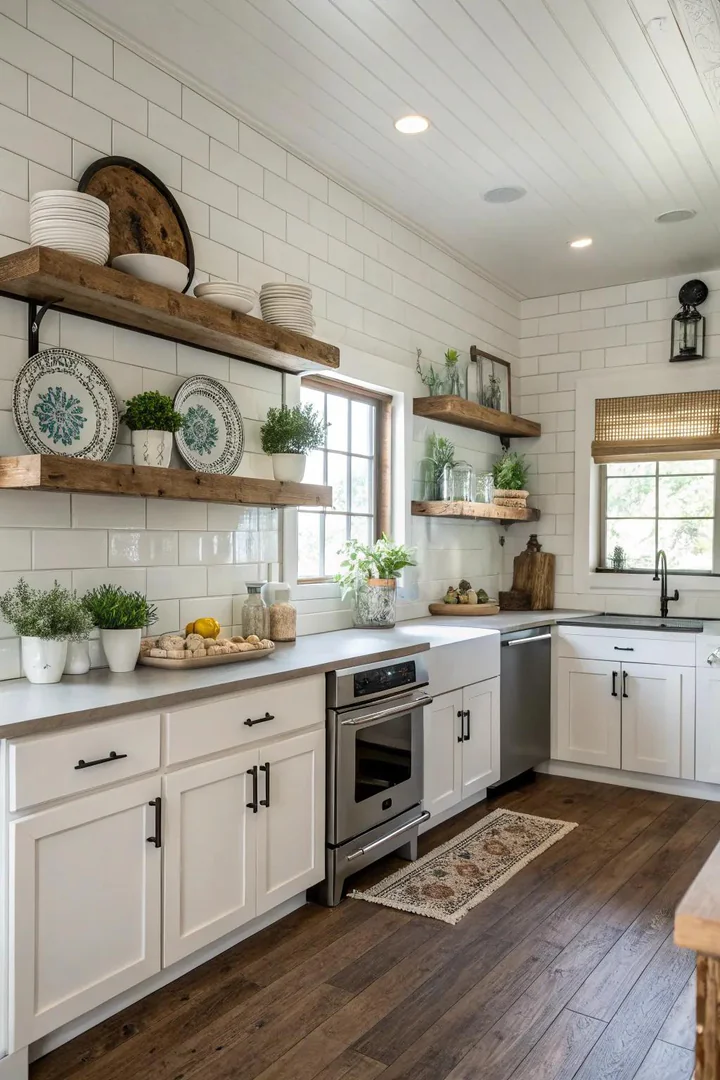
Floating shelves — thick solid wood slabs mounted to the wall with concealed brackets so no visible support is showing — provide a modern twist on the traditional farmhouse open-shelf concept. The lack of visible brackets gives the shelves a clean, contemporary line that works in modern-farmhouse kitchens where traditional shelf brackets (cast iron, wrought iron) might look too ornate.
Use solid hardwood slabs at least two inches thick (reclaimed pine, white oak, or walnut) for visual weight and structural integrity. Hollow floating shelves built over a steel rod bracket system (Shelfology or Cascade Iron Co.) can span up to 36 inches without sagging, even when loaded with dishes and cookbooks. Install the shelves on both sides of a window or flanking the range hood for a symmetrical composition that frames the kitchen’s focal point. Limit the floating shelf display to everyday items — a farmhouse kitchen with cluttered floating shelves looks messy, not charming.
19. Incorporate Industrial Features
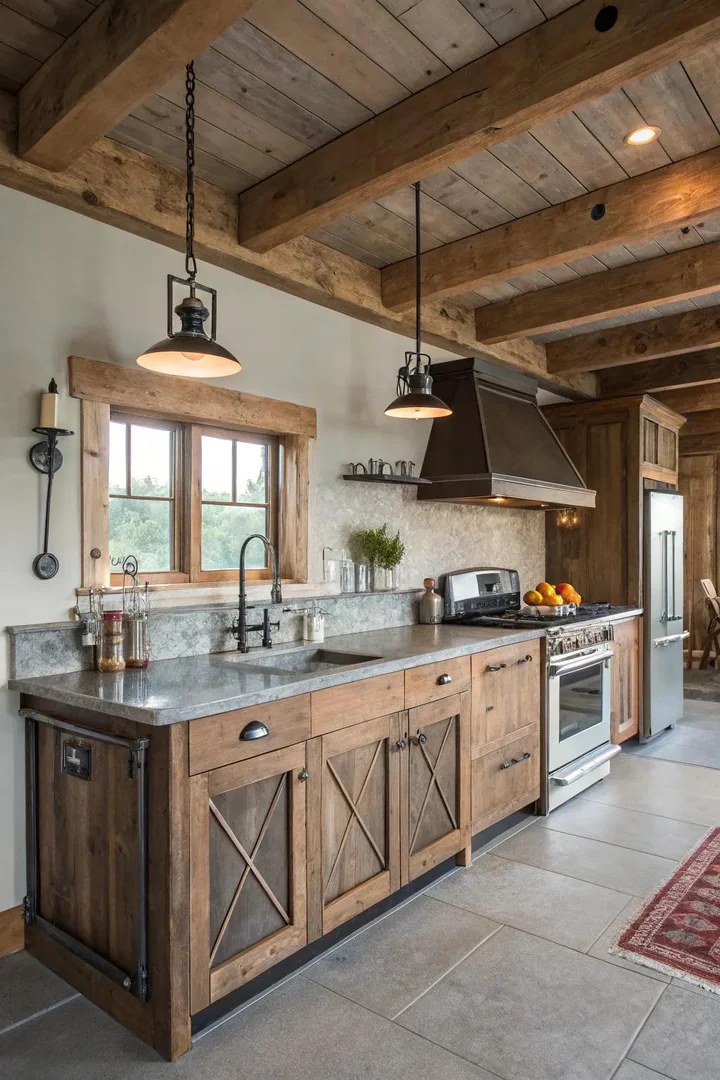
Industrial-farmhouse design pairs the warm, organic materials of farmhouse style (wood, natural fibers, hand-forged metal) with the raw, utilitarian materials of industrial design (steel, concrete, exposed pipe, factory lighting) to create a kitchen that feels both warm and edgy. The industrial elements add toughness and a masculine counterpoint to the softness of traditional farmhouse finishes.
Add industrial elements selectively: a steel-and-glass cabinet door (flat bar frame with wire glass or clear glass panels), pipe-bracket open shelving (threaded iron pipe flanges and fittings from a plumbing supply store), or a concrete countertop on the island with farmhouse-style wood cabinets below. The steel-pipe shelving bracket is a popular DIY project — assemble 3/4-inch black iron pipe fittings (flange, nipple, elbow, nipple, flange) into an L-shaped bracket, screw the flanges to the wall and the shelf underside, and load with cookbooks and kitchen tools. For more on mixing industrial metal with traditional white and copper kitchen finishes, our guide covers metal accent pairings that work in farmhouse settings.
How to Choose Farmhouse Kitchen Cabinets
Selecting the Right Door Profile
The Shaker door — a flat center panel with a square-edge frame — is the most versatile farmhouse cabinet door because it works across the full farmhouse spectrum from traditional to modern. Raised-panel doors skew more traditional and suit formal farmhouse kitchens with crown molding and ornate hardware. Flat-slab doors skew modern and suit minimalist farmhouse kitchens with clean lines and concealed hardware. Choose the door profile that matches the formality level of your kitchen.
Choosing Between Paint and Stain
Paint (white, cream, soft grey, or bold colors) hides the wood grain and creates a clean, uniform surface that suits modern farmhouse and traditional painted kitchens. Stain (natural, honey, walnut, or ebony) highlights the wood grain and creates a warm, organic surface that suits rustic farmhouse and arts-and-crafts kitchens. Choose paint on MDF or poplar doors (both take paint well) and stain on hardwood doors (oak, maple, or hickory) where the grain is worth showcasing.
Budgeting for Farmhouse Cabinets
Stock farmhouse-style cabinets (Hampton Bay from Home Depot, Diamond NOW from Lowe’s) cost $75 to $200 per linear foot installed. Semi-custom cabinets (KraftMaid, Merillat) cost $200 to $500 per linear foot. Custom cabinets from a local shop cost $500 to $1,200 per linear foot. The biggest cost variable is the material — MDF and poplar are cheapest, maple and oak are mid-range, and walnut and reclaimed wood are premium.
Farmhouse Cabinet Styles Comparison
| Style | Key Features | Best Finish | Price Range |
|---|---|---|---|
| Traditional Farmhouse | Raised panels, ornate hardware, beadboard | Distressed paint or natural stain | $$–$$$ |
| Modern Farmhouse | Shaker doors, clean lines, mixed materials | Matte or satin paint | $$ |
| Rustic Farmhouse | Reclaimed wood, visible joinery, barn doors | Clear seal or light stain | $$–$$$$ |
| Industrial Farmhouse | Metal accents, pipe brackets, mixed finishes | Two-tone paint + raw metal | $$–$$$ |
| Coastal Farmhouse | Beadboard, soft colors, brass hardware | Light colors in satin sheen | $$ |
Common Farmhouse Cabinet Mistakes to Avoid
Overdoing the theme. A kitchen with barn-door cabinets, rooster hardware, mason-jar lights, a chalkboard wall, and a shiplap backsplash all at once looks like a farmhouse gift shop, not a farmhouse kitchen. Choose two or three strongly farmhouse elements and let the rest of the kitchen be simple and neutral — the restrained approach looks more authentic because real farmhouses were not decorated to a theme.
Using the wrong white. Not all whites are farmhouse whites. Cool, blue-tinted whites (Benjamin Moore Decorator’s White, Sherwin-Williams Pure White) can feel clinical in a farmhouse kitchen. Warm whites with a slight cream or yellow undertone (Benjamin Moore White Dove, Sherwin-Williams Alabaster) feel softer and more appropriate for the farmhouse aesthetic. Test three to four white samples on the cabinet doors in your kitchen’s specific lighting before committing.
Ignoring the countertop-cabinet relationship. A farmhouse kitchen needs visual warmth, which typically comes from natural materials — wood, stone, or fireclay — on the countertop and backsplash. A cold quartz engineered stone on a farmhouse cabinet can undermine the warmth if the quartz pattern is too contemporary (large-format marble veining). Choose a quartz pattern that references natural stone or pair natural butcher block on the island with quartz on the perimeter for the best of both.
Skipping the hardware entirely. Handle-free farmhouse cabinets look unfinished — the hardware is an essential design element in the farmhouse style, not an optional accessory. Even if you prefer a minimal look, use small round knobs or simple bar pulls in an aged metal finish to give the cabinets the handmade, tactile quality that defines the farmhouse aesthetic.
Frequently Asked Questions
What color cabinets are best for a farmhouse kitchen?
White and cream are the most popular farmhouse cabinet colors because they create a clean, bright background that lets natural wood, hardware, and accessories provide the warmth and character. For a bolder look, sage green, navy blue, and soft grey are popular farmhouse accent colors for lower cabinets or islands. Natural wood (unstained oak, walnut, or pine) works in rustic farmhouse kitchens where the grain is part of the design.
Can I make existing cabinets look farmhouse?
Yes. Paint existing cabinets in a warm white or soft color using a cabinet-grade paint, swap the hardware for farmhouse-style bin pulls and knobs in aged brass or oil-rubbed bronze, and remove the doors from one or two upper cabinets to create open display shelving. These three changes — paint, hardware, and selective door removal — can convert standard builder-grade cabinets to a farmhouse look for under $500.
What countertop material pairs best with farmhouse cabinets?
Butcher block (maple or walnut) is the most authentically farmhouse countertop material. Honed marble and soapstone provide a traditional, soft-surface alternative with a natural feel. White or cream quartz with a subtle veined pattern offers a lower-maintenance alternative that references marble without the sealing and staining concerns. Avoid polished granite with bold patterns — it skews too contemporary for most farmhouse kitchens.
Is beadboard still in style for farmhouse kitchens?
Yes. Beadboard remains a defining farmhouse material, used on cabinet door panels, island sides, backsplashes, and ceilings. The vertical line pattern adds texture and visual rhythm that flat surfaces cannot provide. In modern-farmhouse kitchens, use beadboard selectively (one accent wall, the island back, or a few cabinet door panels) rather than covering every surface.
How do I choose hardware for farmhouse cabinets?
Match the hardware finish to the kitchen’s metal palette — aged brass with warm-toned kitchens, oil-rubbed bronze with dark-stained kitchens, and matte black iron with white or grey kitchens. Bin pulls on drawers and round knobs on doors is the classic farmhouse combination. Keep all hardware in the same finish for visual consistency.
What is the difference between farmhouse and cottage style cabinets?
Farmhouse cabinets reference agricultural and rural craftsmanship — heavier proportions, darker or natural wood finishes, iron and bronze hardware, and materials like reclaimed wood and beadboard. Cottage cabinets reference seaside and garden-inspired living — lighter proportions, pastel colors, glass-front doors, and hardware in polished nickel or brushed brass. The farmhouse style is warmer and earthier; the cottage style is lighter and airier. Visit The Designers Company for more kitchen cabinet guides, hardware recommendations, and farmhouse remodeling inspiration.
Conclusion
Farmhouse kitchen cabinets work because the style is rooted in function — Shaker doors are easy to build and clean, open shelves provide quick access, butcher block countertops double as cutting surfaces, and apron-front sinks hold oversized pots. The aesthetic appeal of farmhouse design is a byproduct of its practicality, which is why the style continues to work in modern kitchens where functionality matters as much as appearance.
Start with the cabinets (the largest visual surface in the kitchen) and build outward: choose a door profile and finish, select hardware that matches the formality level, and add farmhouse accents (a fireclay sink, open shelving, beadboard panels) selectively rather than all at once. A few well-chosen farmhouse elements in an otherwise simple kitchen create a stronger impression than a kitchen saturated with every farmhouse detail available.