
Kitchen Lighting Ideas: 19 Inspiring Styles That Brighten
Good kitchen lighting does three things at once: it makes food preparation safe and accurate, it sets the mood for the room, and it highlights the architectural and decorative features you spent money on. Most kitchens rely on a single overhead fixture — a flush-mount or a fluorescent panel — that casts flat, shadowless light across every surface. That one-source approach leaves countertops in shadow, makes colors look washed out, and turns the kitchen into the least inviting room in the house after dark.
The 19 kitchen lighting ideas below cover every category of fixture and technique — pendants, recessed cans, under-cabinet strips, chandeliers, natural light strategies, and statement pieces — with specific product recommendations and placement guidance for each. Whether you are building a new kitchen or upgrading the lighting in an existing one, these ideas show you how to layer light sources so every work surface is bright, every decorative detail is visible, and the overall mood shifts from functional to welcoming.
1. Diverse Combination

Mixing different fixture styles within the same kitchen — a pair of industrial pendants over the island, a crystal semi-flush over the sink, and brass sconces flanking open shelves — creates a collected, lived-in look that single-fixture kitchens cannot match. The key to an eclectic mix that works is keeping one element consistent across all the fixtures: the same metal finish (all brushed brass, all matte black), the same bulb color temperature (all 2700K warm white), or the same mounting height for pendant-style fixtures.
Start with your largest fixture (usually the island pendant or the dining-area chandelier) and choose the remaining fixtures to complement its scale and finish. A large Restoration Hardware iron pendant pairs with smaller Schoolhouse Electric sconces and a Visual Comfort flush-mount in the same dark bronze. The variety in shape creates interest; the consistency in finish creates cohesion. Keep the total number of different fixture styles to three or four — more than that and the room reads as scattered rather than curated.
2. Mirrored Surfaces
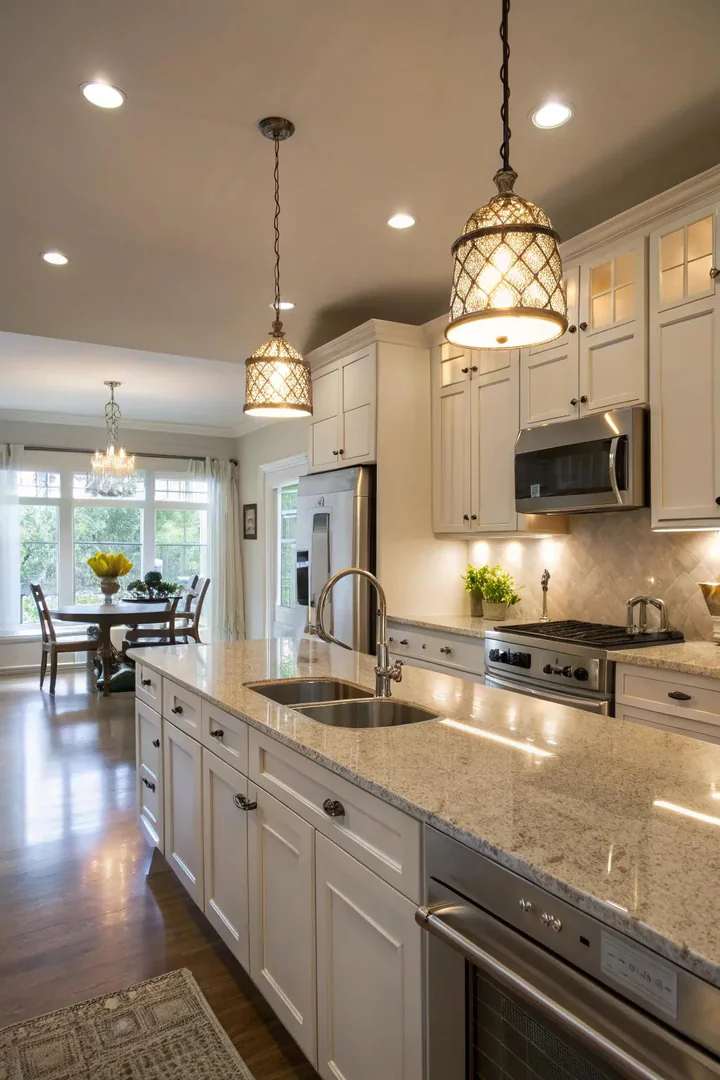
Reflective materials — polished chrome fixtures, mirrored backsplash tile, glossy lacquered cabinets, and glass-front doors — multiply the effect of every light source in the kitchen by bouncing light off surfaces and into corners that direct lighting cannot reach. A polished nickel pendant over the island throws light downward onto the countertop and simultaneously reflects ambient light sideways from its curved surface, acting as both a task light and a secondary ambient source.
Pair reflective fixtures with at least one matte surface in the room (honed stone countertop, matte-painted walls, natural wood shelving) to prevent the kitchen from feeling like a hall of mirrors. The contrast between a glossy chrome pendant and a matte white ceiling, or between a mirrored backsplash and a leathered granite countertop, gives the eye places to rest between the reflective highlights. For more on how lighting interacts with kitchen color choices, our color guide covers how different finishes absorb and reflect light.
3. Welcome Pendant Lighting
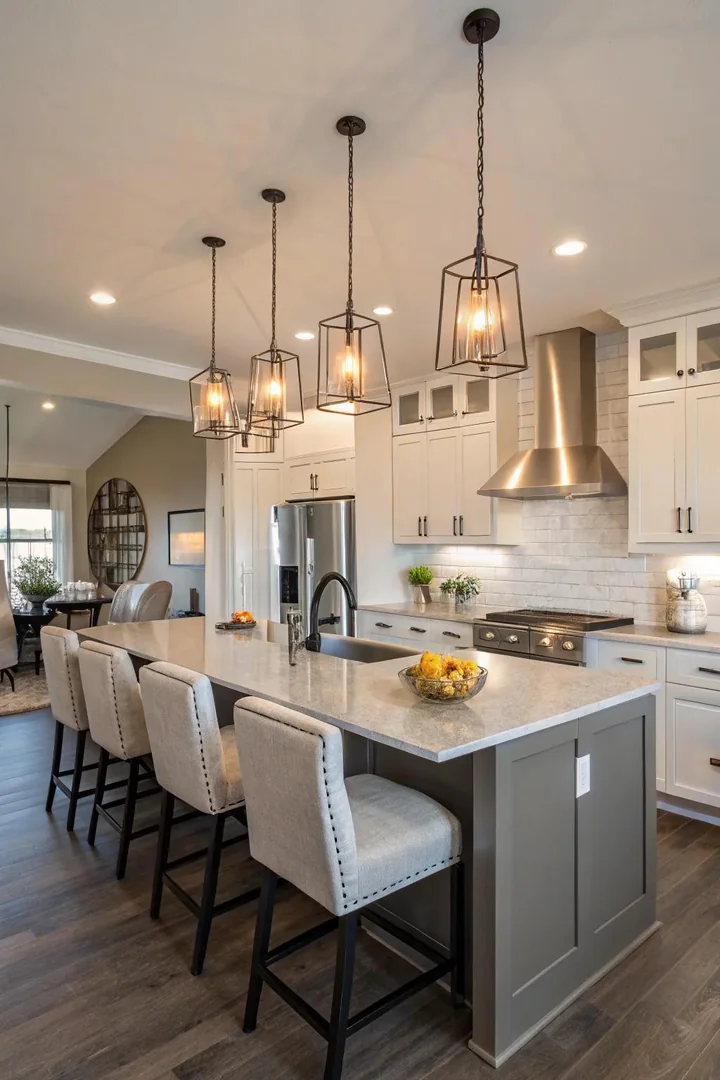
Pendant lights are the single most popular kitchen lighting upgrade because they provide focused task lighting over islands and peninsulas while serving as a decorative focal point that defines the room’s style. Hang pendants 30 to 36 inches above the countertop surface (measuring from the bottom of the shade to the counter) and space them 24 to 30 inches apart for even coverage without crowding. For a standard six-foot island, two large pendants (12 to 16 inches in diameter) or three smaller ones (8 to 10 inches) provide balanced light across the full work surface.
Choose a pendant shade material that directs light where you need it: an opaque metal shade (like the Hinkley Argo or the Hudson Valley Lambert) throws all light downward for strong task illumination, while a glass or open-cage shade (like the Kichler Everly or the Capital Lighting Greyson) disperses light in all directions for softer ambient coverage. Dimmable pendants on a separate circuit from the rest of the kitchen lighting let you shift the island from bright task mode during cooking to soft ambient mode during dinner.
4. Focused Task Lighting
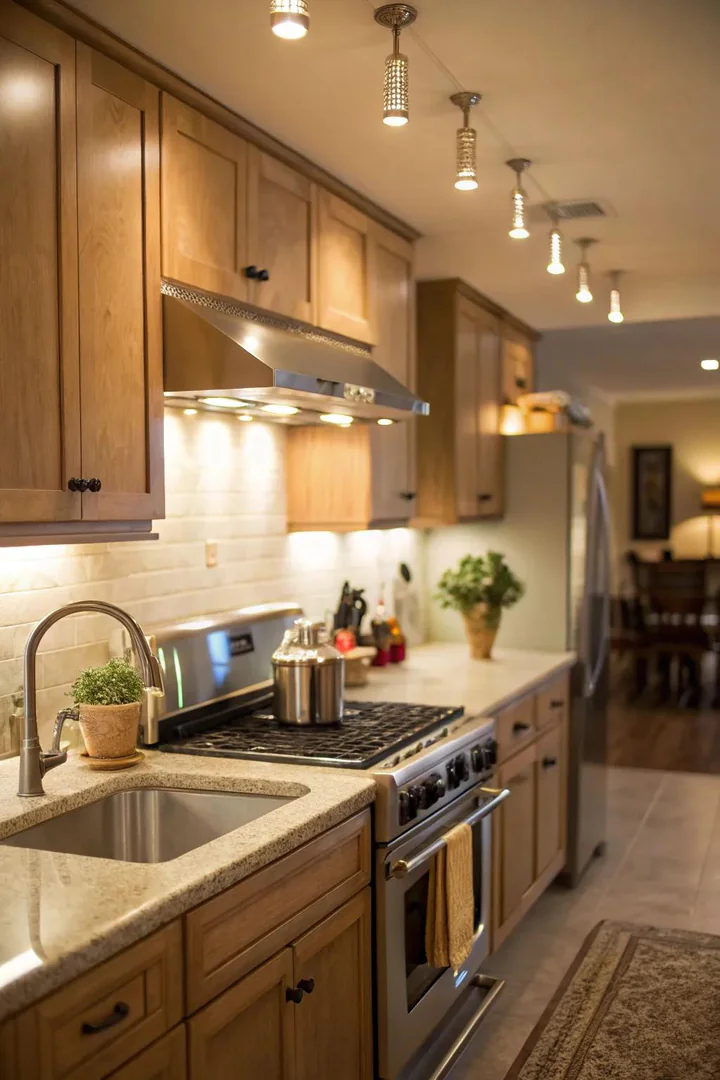
Task lighting targets the specific surfaces where you cut, chop, read recipes, and wash dishes — the countertop edge below upper cabinets, the sink area, and the stove surface. Under-cabinet LED strips (WAC Lighting InvisiLED, Kichler 6U series, or GE Premium LED bars) are the most effective task light because they mount directly below the upper cabinets and illuminate the countertop without casting your body’s shadow across the work surface, which overhead ceiling fixtures always do.
Install task lighting at the front edge of the upper cabinet’s bottom shelf, behind a small light rail or trim piece that hides the strip from view at eye level. A 3000K to 3500K color temperature provides accurate color rendering for food preparation without the clinical feel of a 5000K daylight bulb. Wire the under-cabinet lights to a dedicated switch or dimmer so you can run them independently of the overhead lighting — bright for cooking, dim for late-night snacking. For a full guide to kitchen cabinet lighting options, our dedicated article covers LED strips, puck lights, and in-cabinet illumination.
5. Creative Statement Artworks
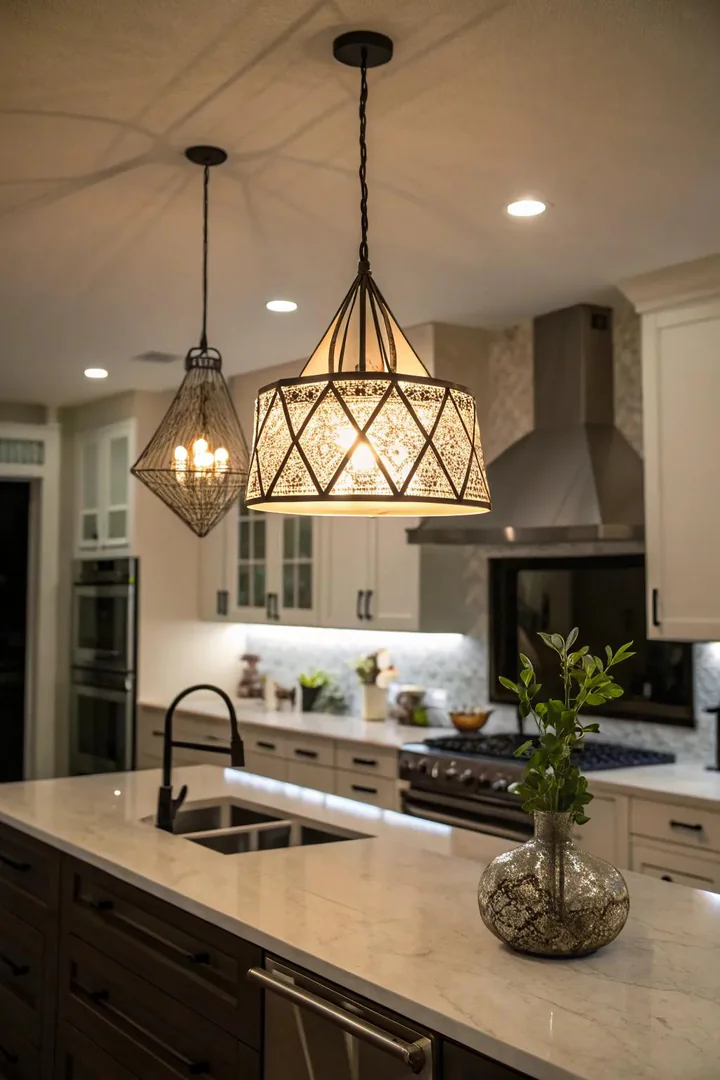
A sculptural light fixture — a hand-blown glass pendant, a branching molecular chandelier, or a woven fiber shade — turns the kitchen ceiling into a gallery wall where the fixture itself is the artwork. Lindsey Adelman Studio, Apparatus, and Roll & Hill produce sculptural fixtures that function as ambient light sources and conversation starters simultaneously. At a more accessible price point, West Elm’s Bower collection and CB2’s Siren pendant offer sculptural shapes in the $200 to $600 range.
Place a statement fixture where it has the most visual real estate — centered over an island, above a dining nook, or in a double-height ceiling area where the fixture can hang at full scale without crowding the room. Keep the surrounding fixtures simple (recessed cans, plain flush-mounts) so the statement piece gets full attention. One sculptural fixture per kitchen is enough — two compete for the eye rather than complementing each other.
6. Multilayered Illumination
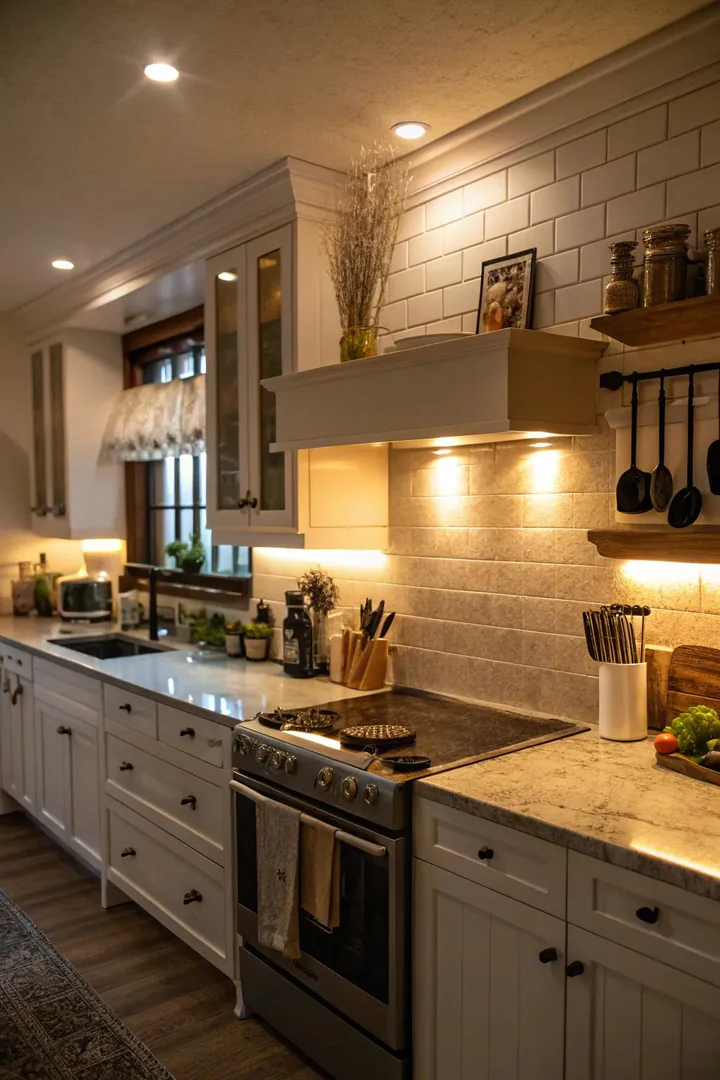
Professional lighting designers think in three layers: ambient (overall room brightness from ceiling fixtures), task (focused light on work surfaces), and accent (decorative light that highlights features). A kitchen with all three layers on separate dimmers can shift from full-brightness cooking mode to low-light entertaining mode to late-night accent-only mode without changing a single fixture. The layers are additive — you build from ambient up, adding task and accent where the room needs them.
For a typical kitchen, ambient comes from recessed cans or a central flush-mount, task comes from under-cabinet strips and pendant lights, and accent comes from in-cabinet puck lights, toe-kick LEDs, or picture lights above open shelving. Put each layer on its own dimmer circuit (Lutron Caseta or Leviton Decora Smart dimmers work with most LED fixtures) so you can adjust each independently. The three-layer approach costs more in wiring and switches but produces a kitchen that feels like a designed room rather than a work space.
7. Daring Geometric Forms
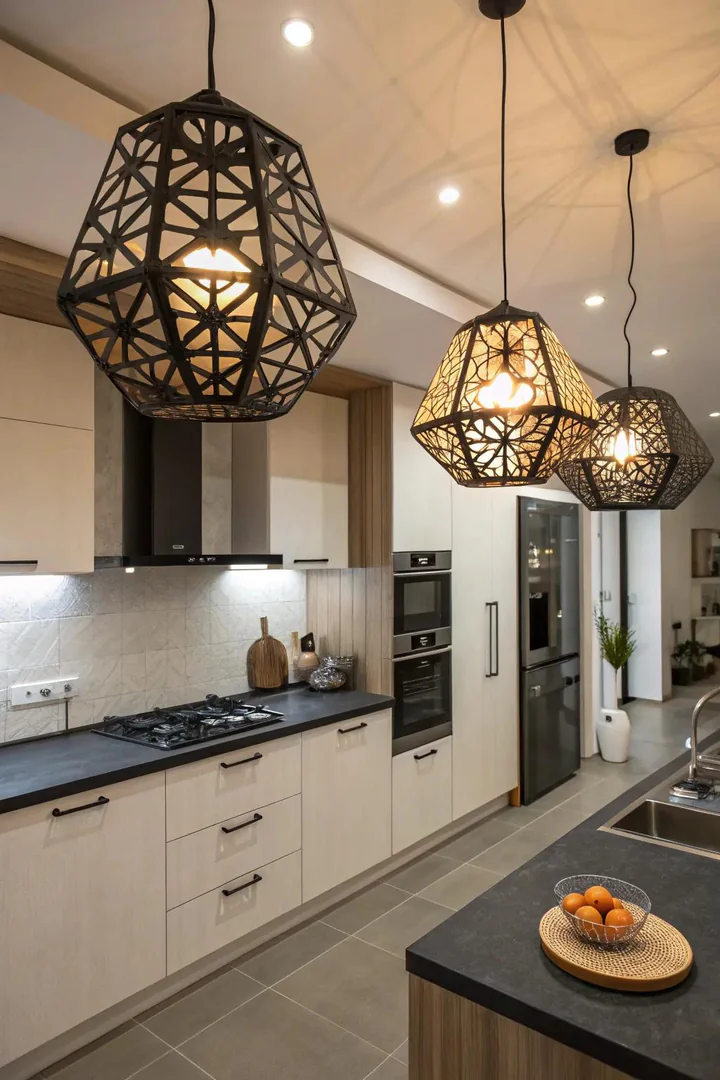
Geometric pendant lights — hexagonal cages, angular polyhedrons, intersecting rings, and faceted prisms — add an architectural quality to the kitchen ceiling that makes the fixture feel like a structural element rather than a decorative afterthought. Matte black geometric pendants from Kichler (Fulton series), Progress Lighting (Briarwood), and Troy Lighting create strong visual lines that contrast with the organic shapes of food, plants, and soft furnishings elsewhere in the kitchen.
Geometric fixtures work best in modern, mid-century, and industrial kitchens where the angular lines of the fixture echo the clean lines of flat-panel cabinetry, square-edge countertops, and minimal hardware. In a traditional or farmhouse kitchen, a geometric fixture can feel out of place — choose a softer geometric shape (rounded hexagons, organic polyhedrons) or a warmer finish (aged brass, antiqued bronze) to bridge the gap between geometric form and traditional style.
8. Highlight Open Shelving
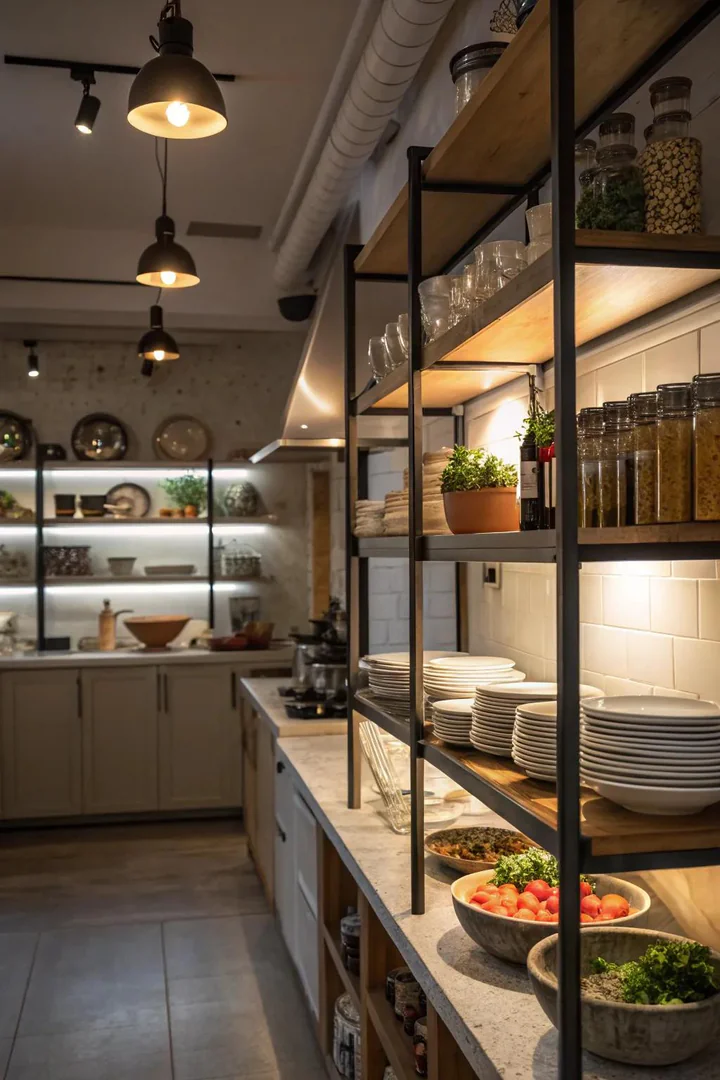
Open shelving needs its own light source to look intentional rather than unfinished. Without directed light, open shelves fade into the wall and the items displayed on them cast shadows rather than catching light. Small adjustable spotlights (WAC Lighting Tube series or Juno track heads) mounted on the ceiling and aimed at the shelf face create museum-quality illumination that makes ceramics, glassware, and cookbooks look like curated objects rather than stored items.
An alternative to ceiling-mounted spotlights is an LED strip mounted on the underside of each shelf, aimed downward to light the shelf below. This approach illuminates the shelf contents from above and creates a soft glow between the shelves that serves as ambient accent lighting for the room. Use a warm white LED strip (2700K to 3000K) with a high CRI (color rendering index) of 90 or above so the colors of your displayed items look accurate under the light.
9. Stylish Contemporary Designs
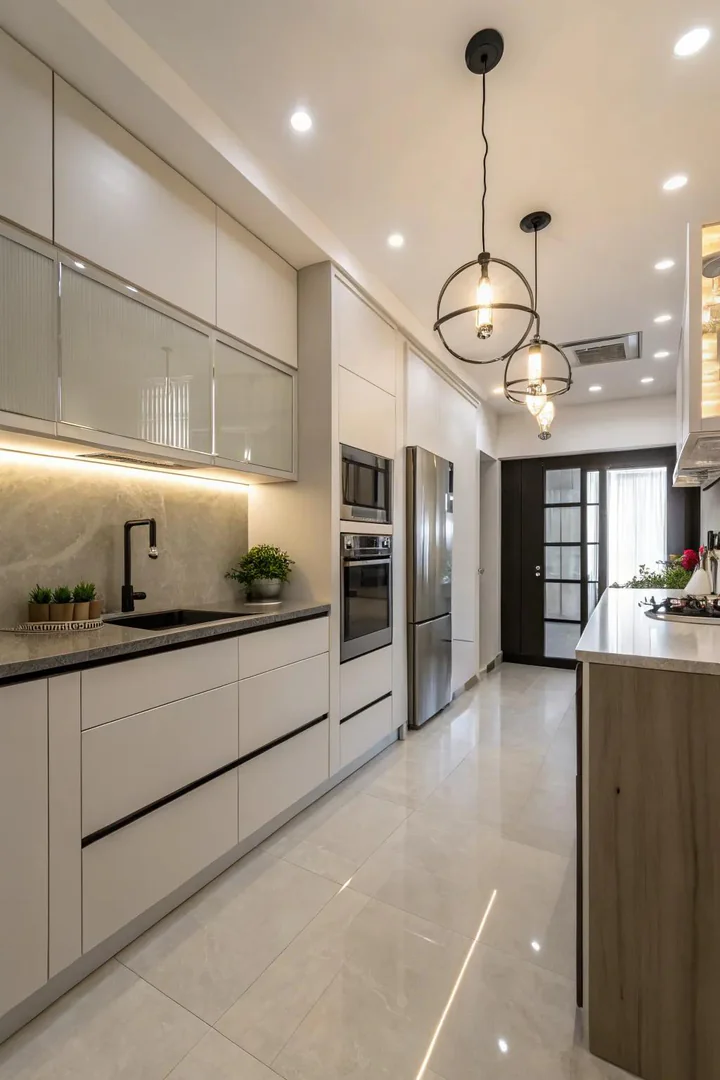
Modern kitchen lighting prioritizes clean lines, minimal ornamentation, and high-performance LED technology that delivers more light per watt than traditional incandescent or halogen fixtures. Slim LED panel lights (Lithonia CPANL, RAB Lighting EZPAN) mount flush to the ceiling and produce even, shadow-free illumination across the entire room — a dramatic upgrade from the single dome fixture that most builder-grade kitchens ship with. Linear LED suspended fixtures from Tech Lighting (Zhane series) and Sonneman (Stiletto) provide both task and ambient light in a single streamlined bar.
The modern aesthetic means hiding the light source whenever possible. Recessed cans with narrow trim rings (Halo RL4, Juno WF4), cove lighting tucked into crown molding, and integrated LED strips concealed behind toe kicks all produce light without showing a visible fixture. The result is a kitchen that appears to glow from its surfaces rather than from individual fixtures — a hallmark of luxury modern kitchen design where the architecture produces the light rather than bolted-on hardware.
10. Contemporary Recessed Illumination
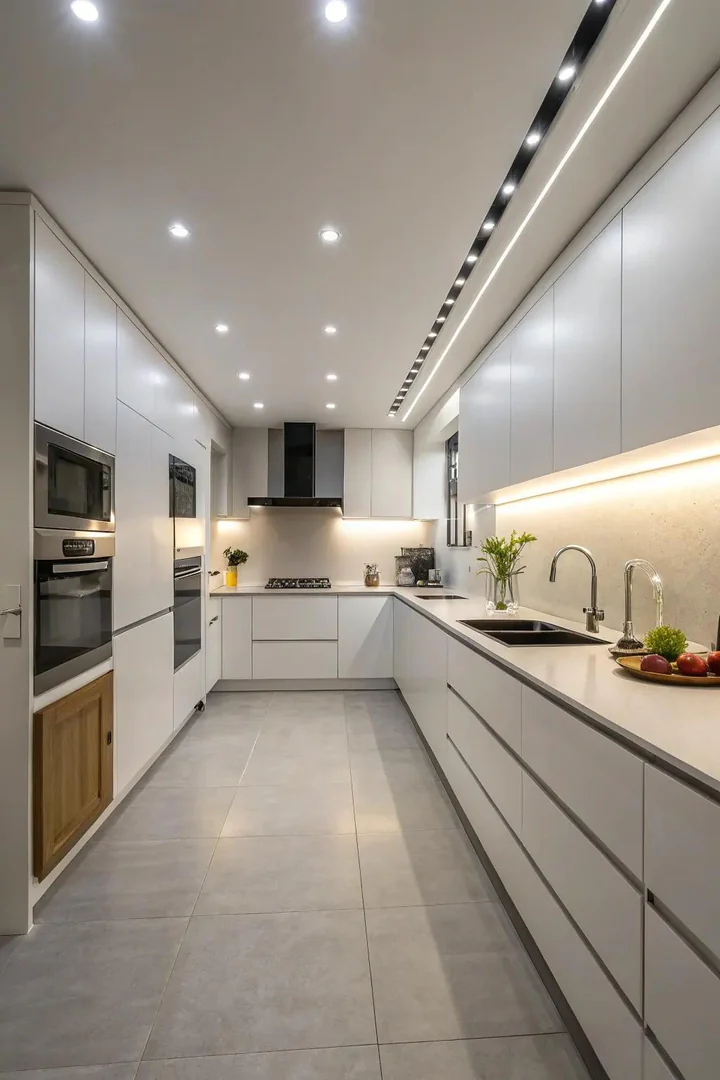
Recessed can lights (also called downlights or pot lights) provide even ambient illumination from the ceiling without any visible fixture hanging below the ceiling plane. For kitchens, use four-inch or six-inch recessed housings spaced four to six feet apart in a grid pattern that covers the full room. IC-rated housings (insulation contact) are required when the ceiling cavity contains insulation. Retrofit LED modules (Halo RL4, Commercial Electric Ultra Slim) convert existing recessed cans from halogen to LED without replacing the housing.
The biggest mistake with recessed lighting is spacing the cans too far apart, which creates pools of light separated by dark patches, or placing them directly above the countertop edge where your body blocks the light and casts a shadow over the work surface. Position recessed cans 24 to 30 inches out from the wall (measured to the center of the can) to wash light down the upper cabinet faces and onto the countertop. Use adjustable gimbal trim on cans near the perimeter to aim light toward the backsplash or artwork.
11. Playful Creations
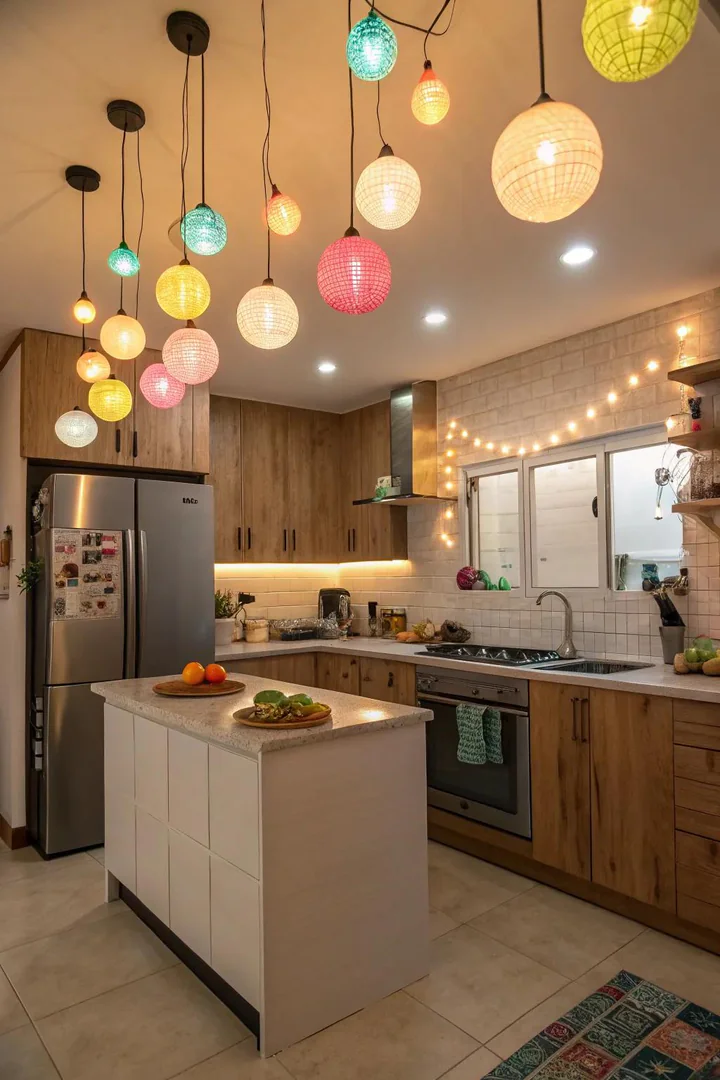
Whimsical light fixtures — cloud-shaped pendants, animal-form sconces, oversized Edison bulbs in novelty shapes, and hand-painted ceramic shades — inject personality into a kitchen that might otherwise feel purely functional. Dutchbone, Seletti, and Ferm Living all produce playful fixtures that treat lighting as a form of self-expression rather than just a utility. A bright-colored pendant (Muuto Unfold in dusty rose, HAY Sinker in lavender) adds a pop of color to an otherwise neutral kitchen.
Whimsical fixtures work best when the rest of the kitchen is relatively restrained — white or neutral cabinets, simple countertops, and minimal clutter give a playful fixture room to be the personality of the space without competing with busy surfaces. In a kitchen that already has patterned tile, colorful cabinets, and open shelving full of objects, a whimsical fixture adds noise rather than character. One playful piece against a calm backdrop makes a statement; three playful pieces against a busy backdrop makes a mess.
12. Cabinet Lighting Glow
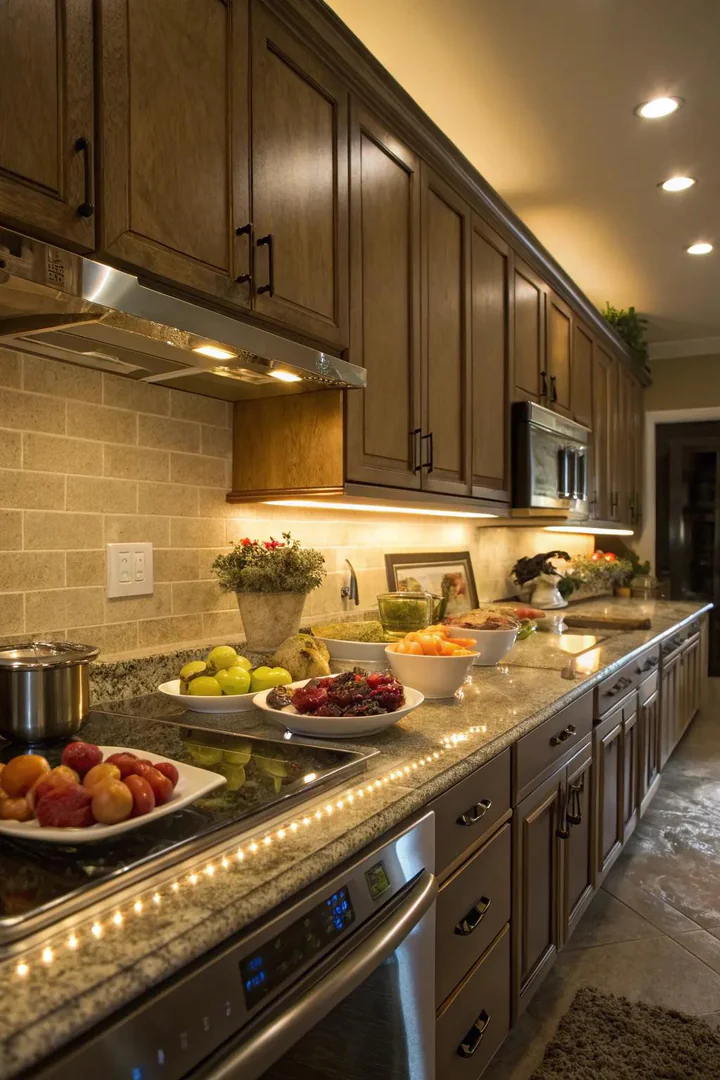
Under-cabinet lighting is the most functionally important kitchen lighting upgrade because it eliminates the shadow zone between the upper cabinets and the countertop — the exact area where you do the most detailed work (chopping, reading recipes, measuring ingredients). LED light bars from WAC Lighting (InvisiLED Pro 3), Kichler (6U Pro series), and GE (Premium Plus LED bar) mount to the underside of the upper cabinet with adhesive or screws and plug into a standard outlet or hardwire to a wall switch.
For the most even light distribution, use a continuous LED strip rather than individual puck lights, which create bright spots directly below each puck and dim areas between them. Mount the strip at the front edge of the cabinet (behind a light rail trim piece) so the light falls on the countertop work surface rather than the backsplash wall. A 90+ CRI LED strip in 3000K warm white provides accurate color rendering for food — you can see the difference between ripe and underripe produce, between raw and cooked meat, and between similar-looking spice jars.
13. Cozy and Welcoming Environment
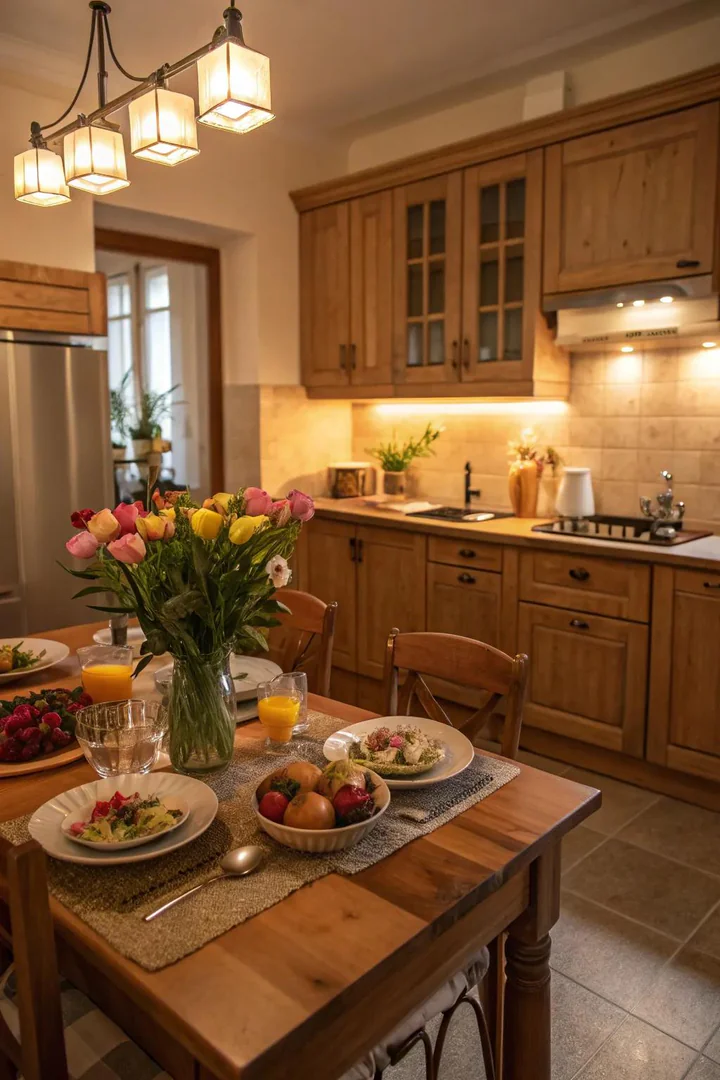
Color temperature — measured in Kelvins (K) — determines whether a kitchen feels warm and inviting or cold and clinical. Bulbs rated at 2700K produce a warm amber glow similar to incandescent light, while 4000K and 5000K bulbs produce a cooler, blue-white light that resembles daylight. For kitchens where the goal is warmth and comfort, keep all fixtures at 2700K to 3000K so the light enhances warm-toned surfaces (wood cabinets, stone countertops, warm paint colors) rather than washing them out.
Dimmer switches are the single most effective tool for creating a warm atmosphere because they let you reduce the light output of any fixture from full task brightness to a low ambient glow. Lutron Caseta, Leviton Decora Smart, and Legrand radiant all make LED-compatible dimmers that prevent the flickering and buzzing that cheap dimmers cause with LED bulbs. Install dimmers on every circuit — overhead cans, pendants, and under-cabinet lights — so you can lower the entire room to a candlelight-like warmth for dinner or evening gatherings.
14. Elegance of Chandeliers
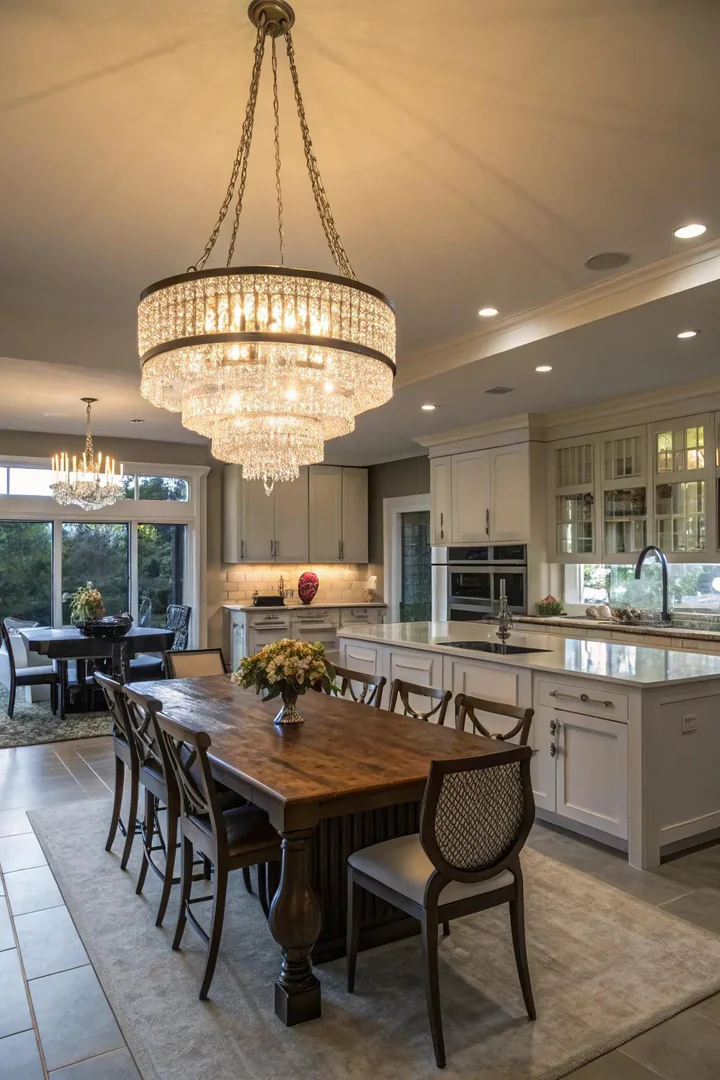
A chandelier in the kitchen feels like an unexpected upgrade — a fixture traditionally associated with dining rooms and foyers brought into the most utilitarian room in the house. Over an island, a breakfast nook, or a kitchen table, a chandelier signals that this kitchen is not just a work space but a room designed for gathering and entertaining. Visual Comfort (Darlana collection), Currey & Company, and Capital Lighting all produce kitchen-appropriate chandeliers in iron, brass, crystal, and wood at price points from $300 to $3,000.
Scale the chandelier to the surface below it: for an island, the fixture width should be roughly one-half to two-thirds the island’s width; for a breakfast nook, the fixture should be 12 inches narrower than the table on each side. Hang the chandelier so the bottom sits 30 to 34 inches above the countertop (for an island) or 30 to 36 inches above the table surface (for a dining area). Use LED candelabra bulbs (Philips Warm Glow or Feit Electric) that dim to a warm amber tone rather than the flat-white dimming of standard LED bulbs.
15. Retro Elements
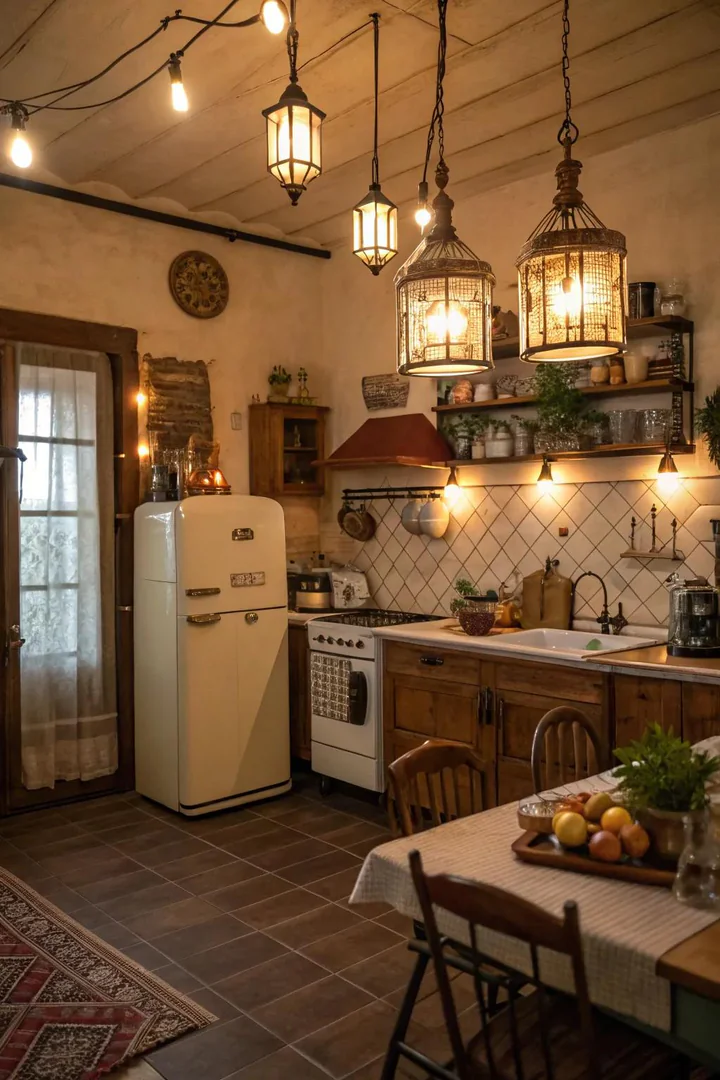
Vintage-style fixtures — exposed Edison bulbs, enamel warehouse shades, milk glass schoolhouse pendants, and brass library sconces — bring a sense of history and warmth to modern kitchens that new-production fixtures struggle to replicate. Schoolhouse Electric, Rejuvenation, and Barn Light Electric all specialize in reproduction vintage fixtures manufactured with modern wiring and LED compatibility. Actual vintage fixtures from salvage shops and antique markets provide genuine patina but should be rewired by a licensed electrician before installation.
The vintage look works in farmhouse, industrial, craftsman, and eclectic kitchens where the fixture’s age and character complement the room’s material palette. Pair an enamel warehouse shade in forest green or black with open shelving, butcher-block countertops, and subway tile for a classic early-20th-century kitchen aesthetic. Use LED filament bulbs (Feit Electric Original Vintage or Bulbrite Nostalgic) that mimic the warm amber glow and visible filament of antique carbon-filament bulbs at a fraction of the energy cost.
16. Vibrant Accessories
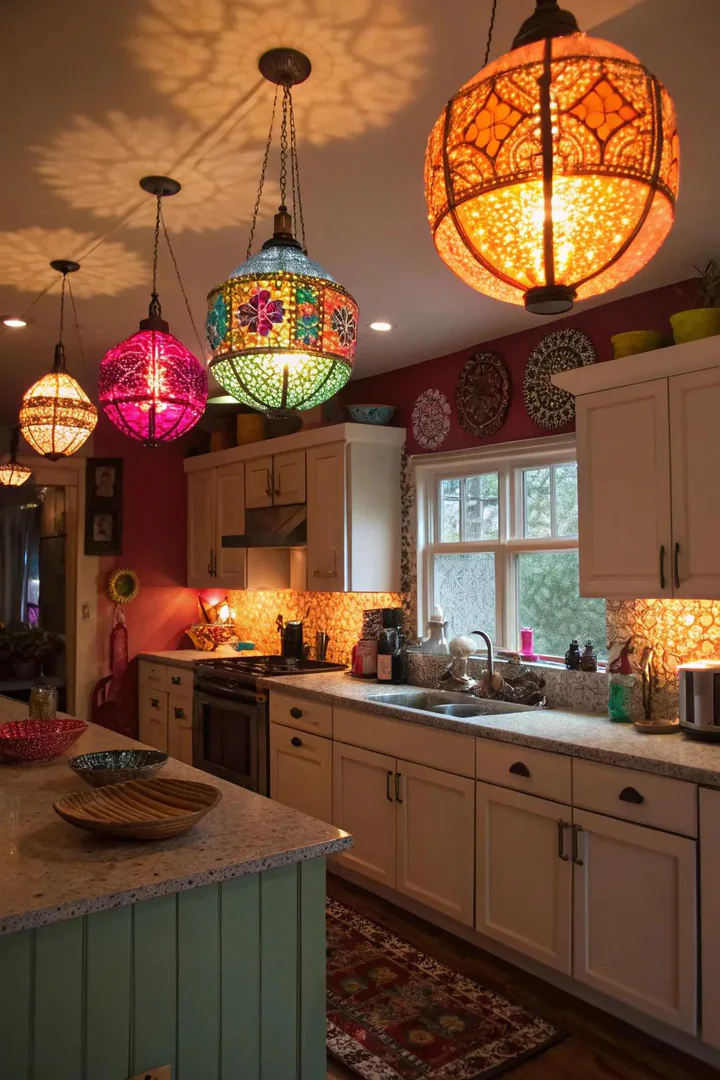
A brightly colored pendant or shade — cobalt blue, tomato red, sunny yellow, or emerald green — adds a targeted pop of color to a kitchen without the commitment of painted cabinets or colored tile. Barn Light Electric, Rejuvenation, and Muuto all produce pendant lights in saturated colors that serve as the room’s accent color and can be swapped out in a single afternoon if your taste changes. A pair of matching colored pendants over an island costs less than a single tile backsplash and makes a comparable visual impact.
Choose a fixture color that appears in at least one other element in the kitchen — a dish towel, a small appliance, a piece of pottery on the shelf — so the colored pendant reads as part of a palette rather than an isolated statement. A red pendant with a red KitchenAid stand mixer and a red-striped runner creates a coordinated accent color. A blue pendant alone in an all-white kitchen can look like a mistake unless the blue is clearly intentional and repeated in accessories.
17. Fixtures Made from Natural Materials
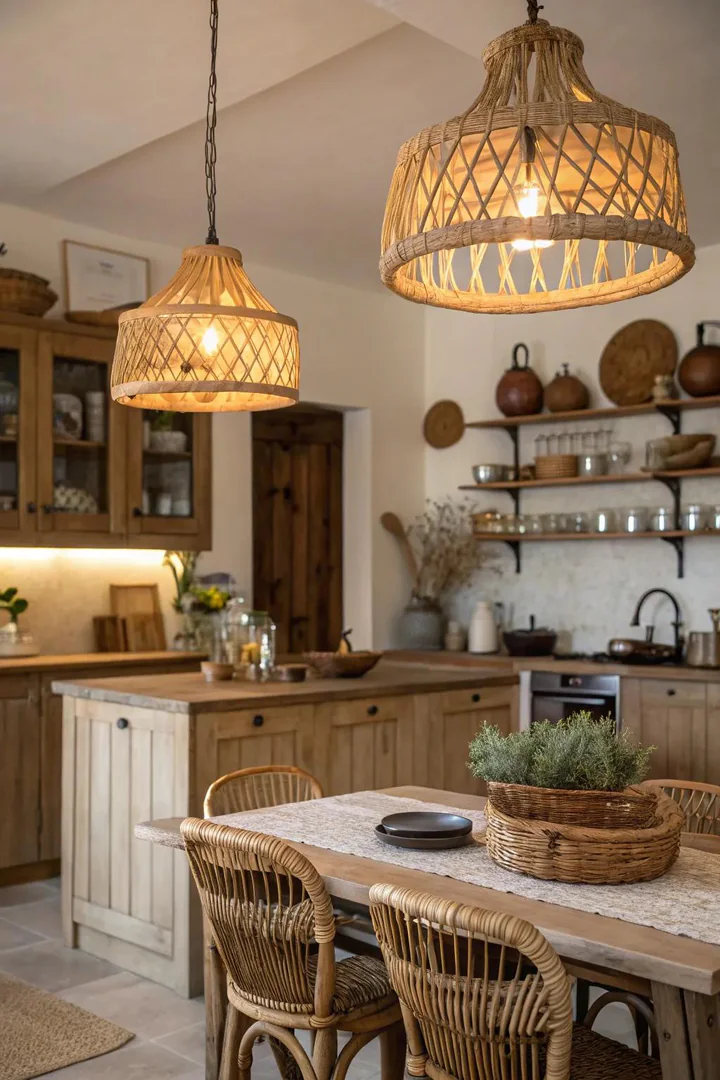
Fixtures made from rattan, woven seagrass, turned wood, cork, or bamboo bring an organic warmth to the kitchen ceiling that metal and glass fixtures cannot match. These natural-material shades filter and diffuse light through their woven or textured surfaces, creating a soft, pattern-cast glow on the surrounding ceiling and walls. Serena & Lily, Pottery Barn, and Lulu & Georgia carry woven rattan and seagrass pendants in drum, bell, and lantern shapes that suit coastal, bohemian, and Scandinavian kitchens.
Natural-material fixtures pair best with kitchens that already incorporate organic textures — wood cabinets, stone countertops, terracotta tile, linen curtains. In an all-white or all-grey modern kitchen, a rattan pendant can feel like it wandered in from a different house. If the kitchen leans modern, choose a turned-wood pendant or a cork fixture with clean geometric lines (Muuto Grain pendant, Hay Nelson Ball) that bridges the gap between natural material and modern form.
18. Manufacturing Atmosphere
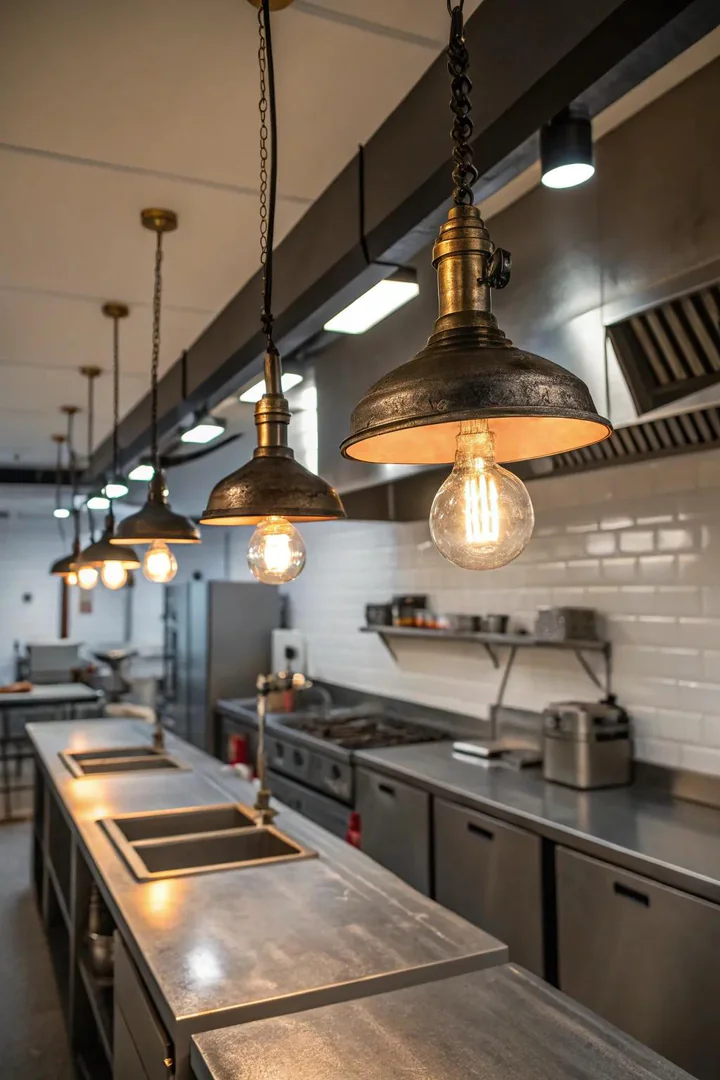
Industrial lighting — gooseneck barn lights, wire-cage pendants, pulley-system fixtures, and exposed-conduit wall sconces — draws from factory and warehouse architecture to create a kitchen that feels raw, utilitarian, and honest about its function. The industrial style exposes the fixture’s hardware (visible screws, unfinished welds, raw metal patina) rather than hiding it behind polished surfaces. Troy Lighting, Savoy House, and Hubbardton Forge all produce industrial-style fixtures with the scale and weight of authentic factory lighting.
Industrial fixtures need at least one contrasting soft element in the room to prevent the kitchen from feeling cold — a wooden island top, a woven rug, a set of ceramic canisters, or a vase of fresh greenery softens the hard-edged metal and exposed-bulb aesthetic. The best industrial kitchens balance the roughness of the fixtures with the warmth of natural materials and the softness of textiles, creating a space that feels intentionally raw rather than accidentally unfinished.
19. Welcome Natural Light
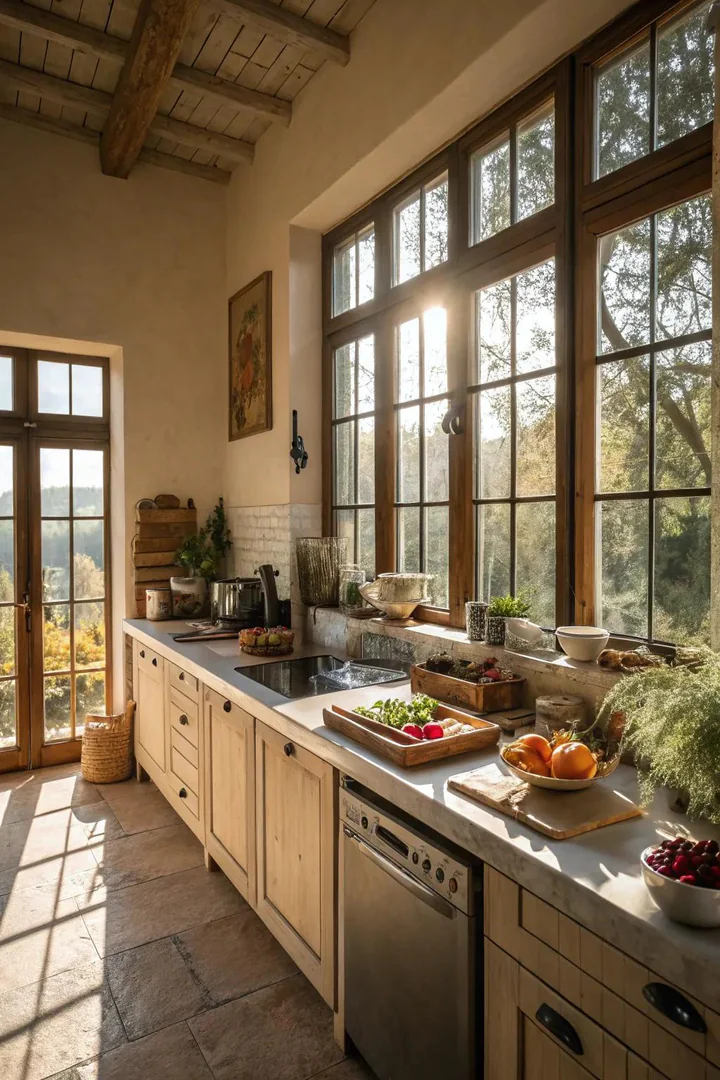
Natural daylight is the highest-quality light source available — it renders colors accurately, shifts in warmth throughout the day, and has been shown to improve mood and productivity in the spaces it reaches. Maximize natural light in the kitchen by keeping windows unobstructed (use cafe curtains or top-down/bottom-up shades rather than full-length drapes), choosing light-reflective surfaces for the backsplash and countertop, and painting walls in high-LRV (light reflectance value) colors that bounce daylight deeper into the room.
If the kitchen’s window area is limited, consider adding a tubular skylight (Velux Sun Tunnel or Solatube) that channels daylight from the roof through a reflective tube into the ceiling — a project that costs $500 to $1,500 installed and brings natural light to kitchens with no exterior wall access. For kitchens with existing windows, a kitchen window seat built into a bay or box window expands the glass area and creates a daylight-filled seating nook that doubles as storage.
How to Plan Your Kitchen Lighting Layout
Mapping Your Work Zones
Before choosing fixtures, map the kitchen into functional zones: the primary prep zone (main countertop run), the cooking zone (stove and oven area), the cleanup zone (sink and dishwasher), the island or peninsula (if present), and any dining or seating area within the kitchen footprint. Each zone needs its own light source — a single overhead fixture cannot adequately light all five zones because the cook’s body blocks the light in at least two of them at any given time. Assign one task light source to each zone and one ambient source to the overall room.
Choosing the Right Bulb Temperature
Keep all kitchen light sources within a 300K range of each other (for example, all between 2700K and 3000K) so the room’s light reads as consistent from fixture to fixture. Mixing a 2700K pendant with a 5000K under-cabinet strip creates visible color banding where the warm and cool zones overlap, making the countertop look different colors depending on which fixture illuminates it. Choose 2700K for warmth-first kitchens, 3000K for a neutral middle ground, or 3500K for kitchens where accurate color rendering for cooking is the top priority.
Wiring and Switch Planning
Plan your switch locations before choosing fixtures — the number of circuits determines how many lighting layers you can control independently. At minimum, wire the kitchen with three circuits: one for overhead ambient (recessed cans or flush-mount), one for task (under-cabinet and pendants), and one for accent (in-cabinet, toe-kick, or decorative). Each circuit should have its own dimmer switch. Group the switches at the primary kitchen entry point so you can set the mood as you walk in. Smart dimmers (Lutron Caseta, Leviton Decora) allow scene programming — one button press sets all three circuits to your preferred cooking, dining, or evening levels.
Kitchen Lighting Types Comparison
| Fixture Type | Best Use | Typical Spacing | Cost Range |
|---|---|---|---|
| Recessed can lights | Ambient (whole room) | 4–6 ft apart in grid | $20–$60 each |
| Pendant lights | Task + decorative (island) | 24–30 in apart | $80–$800 each |
| Under-cabinet LED strips | Task (countertop) | Continuous run | $30–$150 per run |
| Chandeliers | Decorative + ambient | One per area | $200–$3,000 |
| Track lighting | Directional accent | Heads 12–18 in apart | $80–$300 per track |
| Flush-mount ceiling | Ambient (low ceilings) | One per 80–100 sq ft | $40–$400 each |
| Toe-kick / cove LEDs | Accent / nightlight | Continuous run | $20–$80 per run |
Common Kitchen Lighting Mistakes to Avoid
Relying on a single ceiling fixture. One flush-mount or dome light in the center of the kitchen casts flat, even light that leaves the countertop edges in shadow and makes every surface look the same brightness. Add at least one task light source (under-cabinet or pendant) and one accent source (in-cabinet or toe-kick) to create depth and contrast.
Choosing the wrong color temperature. A 5000K daylight bulb in a warm-toned kitchen (wood cabinets, cream walls, stone countertops) makes the room look blue-grey and washes out the warm materials. Match the bulb temperature to the room’s palette — 2700K to 3000K for warm kitchens, 3500K for neutral kitchens. Never mix temperatures within the same room.
Skipping dimmers. A kitchen that can only be fully on or fully off has one mood — bright work mode. Dimmers on every circuit let you shift the room from cooking brightness to dinner ambiance to late-night pathway lighting. The cost of adding dimmers during construction is minimal ($25 to $80 per switch); retrofitting later costs more in labor.
Placing recessed lights directly over the counter edge. When you stand at the counter, your body blocks the overhead light and your shadow falls exactly where you are working. Place recessed cans 24 to 30 inches from the wall — directly above the back of the countertop or the cabinet face — so the light falls on the work surface from behind you rather than from directly above.
Frequently Asked Questions
How many recessed lights do I need in my kitchen?
A general rule is one recessed can per every 20 to 25 square feet of floor area, using six-inch housings with LED modules. A 200-square-foot kitchen needs eight to ten cans in a grid pattern spaced four to six feet apart. Supplement the recessed grid with under-cabinet task lighting and pendant fixtures over the island for full coverage.
What is the best color temperature for kitchen lighting?
3000K (warm white) is the most popular kitchen color temperature because it balances warm, comfortable ambiance with enough accuracy for food preparation. Choose 2700K if warmth and coziness are your priority, or 3500K if color-accurate task lighting matters more than atmosphere. Avoid mixing different temperatures in the same room.
Should kitchen island lights be centered over the island?
Yes. Center the pendant group over the island’s length and position each fixture along the island’s centerline. For a standard island, hang the bottom of the pendant shade 30 to 36 inches above the countertop. If the island is narrower than 24 inches, a single linear fixture works better than multiple round pendants.
Can I mix different light fixture styles in one kitchen?
Yes, and mixing styles often produces a more interesting kitchen than matching everything. The key is maintaining one consistent thread across all fixtures — the same metal finish, the same bulb temperature, or the same design era. Three different fixture shapes in brushed brass read as coordinated; three different shapes in three different finishes read as random.
Is under-cabinet lighting worth the cost?
Under-cabinet LED lighting is the highest-impact kitchen lighting upgrade per dollar spent. A full run of LED strip lights costs $30 to $150 in materials and eliminates the countertop shadow zone that every cook works in. Hardwired installations look cleaner and connect to a wall switch; plug-in strips install in minutes with adhesive backing. Visit The Designers Company for installation guides and product comparisons.
How do I light a kitchen with low ceilings?
Use flush-mount or semi-flush fixtures that sit close to the ceiling (no more than four inches below it) instead of hanging pendants that reduce headroom. Recessed can lights are ideal for low ceilings because they sit inside the ceiling cavity and add zero visual depth. Under-cabinet LED strips and toe-kick lighting add brightness without occupying any ceiling space at all.
Conclusion
The best kitchen lighting uses multiple fixture types working together — ambient recessed cans for overall brightness, task strips and pendants for focused work light, and accent fixtures for warmth and visual depth. Each layer should be on its own dimmer so you can tune the room’s brightness and mood from full task mode to soft evening glow without changing a single bulb or fixture.
Start with the functional layer: under-cabinet task lights and properly spaced recessed cans that eliminate shadows on every work surface. Then add the decorative layer — pendants, chandeliers, or statement fixtures — that give the kitchen its personality and style. Keep all bulbs within a 300K color-temperature range, put every circuit on a dimmer, and test your layout under real cooking conditions before finalizing fixture positions. A well-lit kitchen makes every other design decision in the room look better.