
Natural Stone Backsplash Kitchen Ideas: 13 Stunning Designs to Try
Natural stone backsplash kitchen ideas bring quarried, split, and polished earth materials into the space between countertop and upper cabinets — the vertical zone that catches splashes, grease, and steam from daily cooking while serving as one of the kitchen’s most visible design surfaces. Unlike manufactured tile or glass, natural stone carries the geological signatures of the ground it came from: the fossilized shells in travertine, the layered cleavage planes in slate, the crystalline veining in quartzite, and the soft color banding in sandstone.
The 13 natural stone backsplash kitchen ideas below cover every stone type available for kitchen use — from the most popular (travertine, marble, granite) to the most unusual (onyx, pebble tile, stacked ledger stone). Each idea includes specific stone names, supplier recommendations, finish options, sealing requirements, and pairing suggestions so you can select the right stone for your kitchen’s style, budget, and maintenance tolerance.
1. Adopt Natural Hues with Travertine
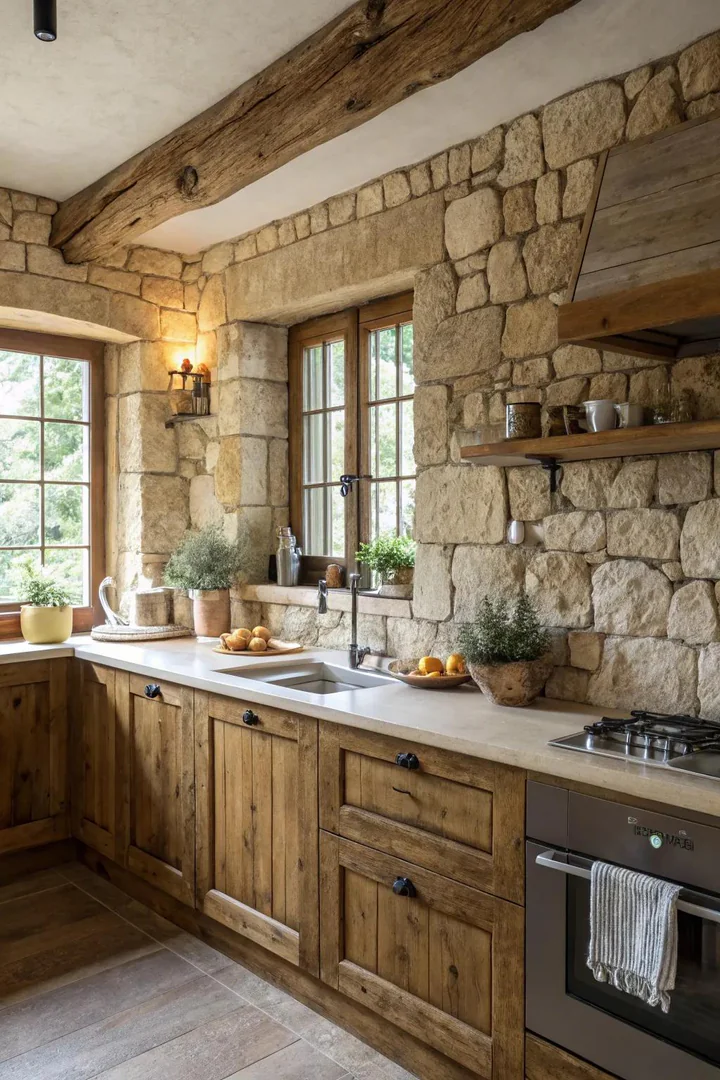
Travertine is a sedimentary limestone formed in hot mineral springs, and it carries a warm, honey-toned palette (ivory, gold, walnut, and rust) that instantly warms any kitchen it enters. The stone’s natural pitting — small surface holes created by gas bubbles during formation — gives travertine a textured, aged appearance that reads as organic and imperfect in a way that manufactured tile cannot replicate. Travertine backsplash tiles are available from MSI, Floor & Decor, Daltile, and The Tile Shop in 3×6 subway, 4×4 field tile, and tumbled mosaic formats.
Choose between filled and unfilled travertine: filled travertine has the surface pits filled with matching resin for a smoother, more uniform face, while unfilled travertine retains the open pits for maximum rustic texture. Tumbled travertine (with softened, rounded edges) creates the most authentically aged look, while honed travertine (flat, smooth face) creates a cleaner, more modern surface. Seal travertine backsplash tiles with a penetrating impregnating sealer (StoneTech BulletProof, Miracle Sealants 511, or Tuff Duck) before grouting and again after grouting to protect the porous stone from cooking oil and tomato-based stains.
2. Craft a Rustic Appeal Using Brick Tiles
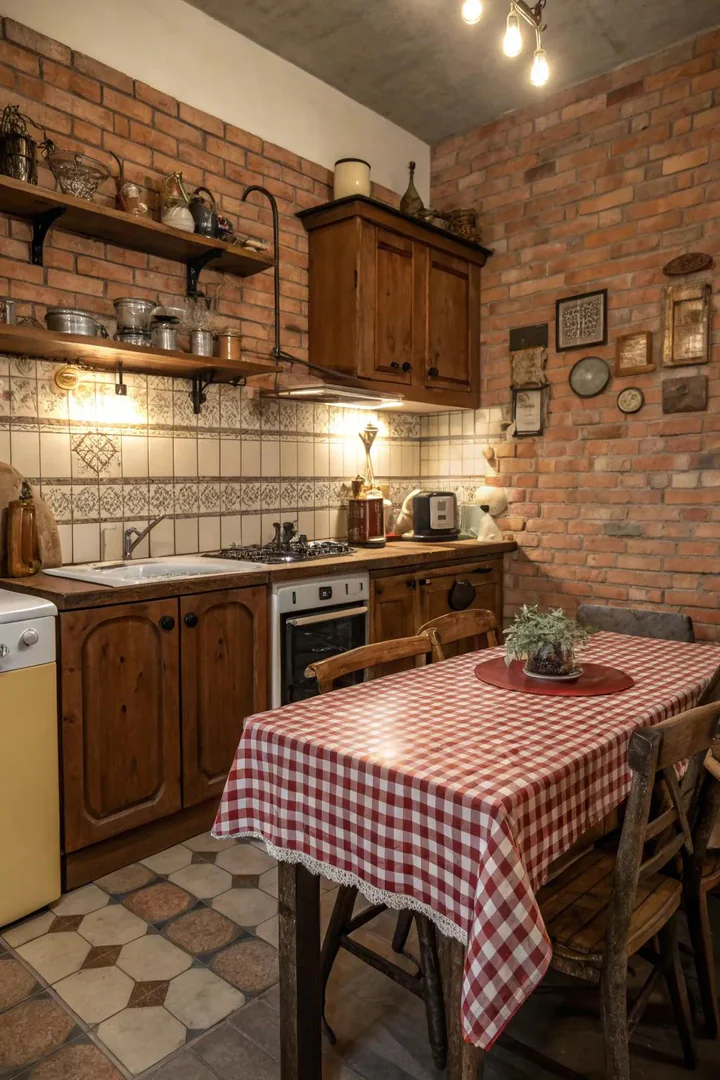
Thin brick veneer tiles — sliced from kiln-fired clay bricks to a thickness of approximately half an inch — bring the texture, color variation, and industrial character of a full brick wall to the backsplash zone without the weight and depth of full-size bricks. Brick backsplash tiles suit farmhouse, industrial, and rustic kitchen styles where exposed brick would appear on walls, columns, or archways in the original building construction.
Brick veneer tiles are available from Brickweb, Old Mill Brick, General Shale, and Reclaimed DesignWorks in standard brick module sizes (approximately 2.25 by 7.5 inches) and in colors ranging from whitewashed and tumbled cream to deep red, charcoal, and multicolor blends. Apply thin-set mortar to the backsplash area and press the brick tiles into the mortar, grouting with a sanded grout in a color that matches (for a subtle look) or contrasts (white grout on red brick for a bold look) the brick. Seal the finished surface with a penetrating masonry sealer to prevent grease absorption.
3. Be Daring with Granite
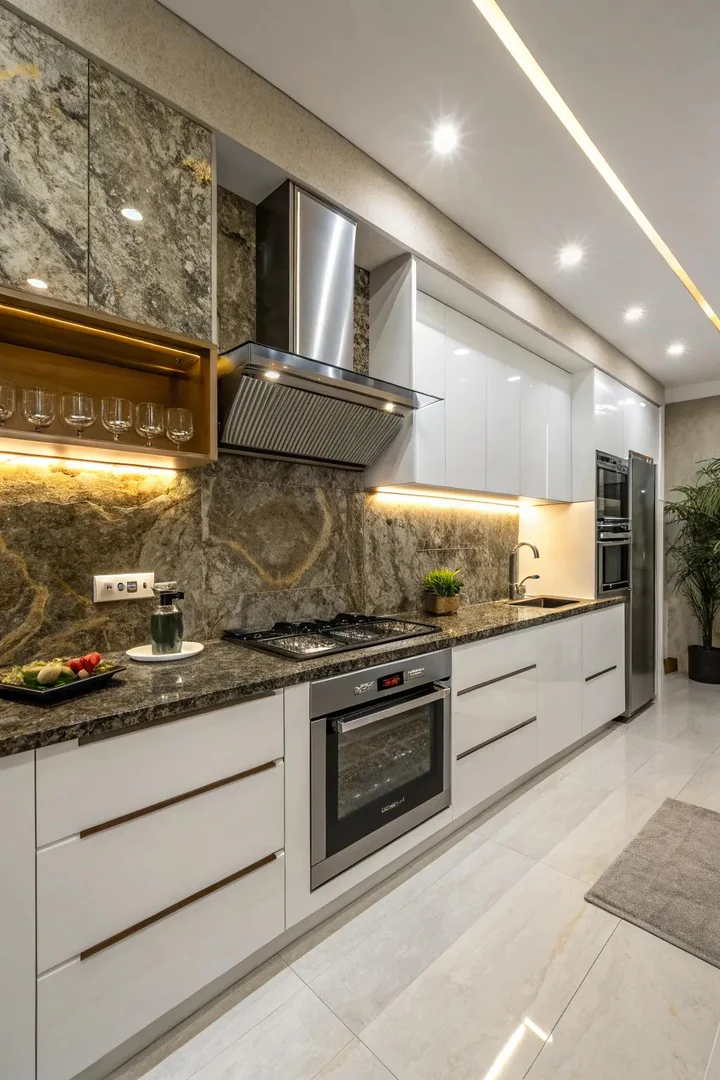
A granite backsplash — either a full-height slab that matches the countertop or a cut piece in a contrasting granite — creates a unified, monumental stone surface that runs uninterrupted from the counter up to the upper cabinets. Granite is an igneous rock with a crystalline structure that produces dramatic patterns: the black-and-white speckles of Absolute Black or Black Galaxy, the brown-and-gold movement of Giallo Ornamental, or the white-and-grey veining of White Ice or Alaska White.
The most visually striking approach is to extend the countertop granite up the wall as a full-height backsplash (typically 18 to 22 inches tall), using the same slab so the veining and pattern flow continuously from the horizontal to the vertical surface. This requires coordinating with your stone fabricator during the initial slab selection — ask them to cut the backsplash pieces from the same slab as the countertop and book-match the grain for a continuous pattern. Granite is one of the most durable backsplash materials: it resists heat, scratches, and stains when properly sealed.
4. Choose the Longevity of Slate
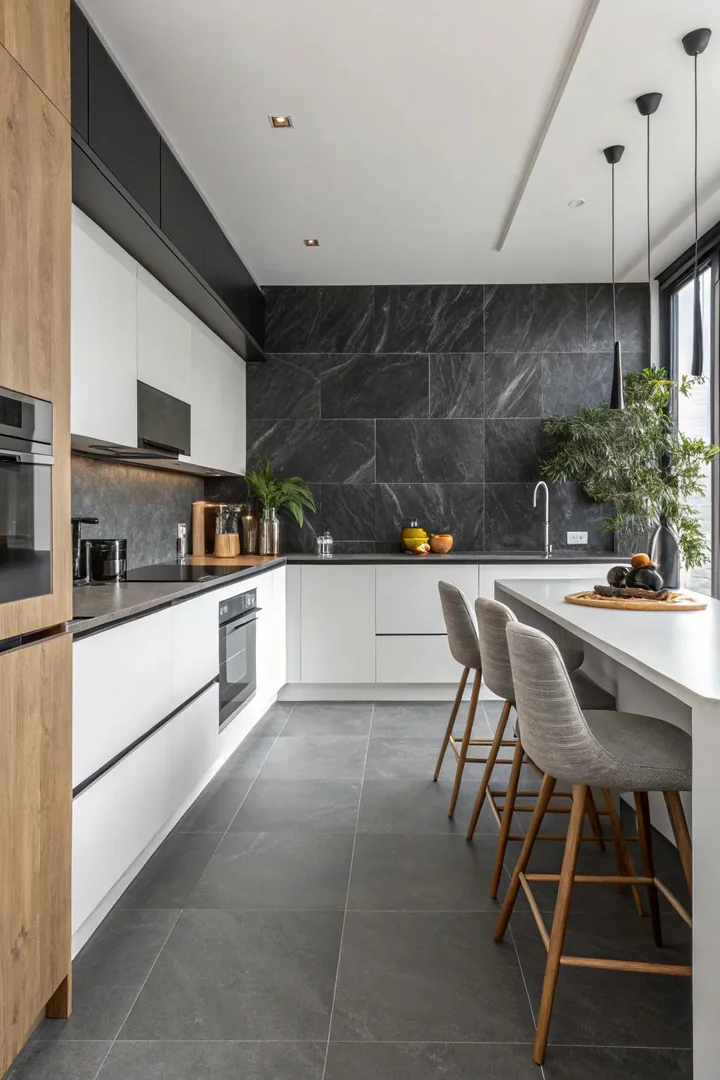
Slate is a metamorphic rock formed under intense pressure, which gives it a naturally layered, cleft surface texture and a rich, dark color palette (charcoal, deep green, blue-grey, rust, and multicolor blends). Slate’s natural cleft face — the rough, textured surface created when the stone splits along its foliation planes — provides a three-dimensional backsplash that catches light and casts shadows in a way that flat tiles cannot.
Slate backsplash tiles are available in square (4×4, 6×6), subway (3×6), and mosaic formats from MSI, Floor & Decor, and Vermont slate quarries. Choose “gauged” slate (machine-cut to a uniform thickness) for easier installation and a flatter finished surface, or “ungauged” natural cleft slate (variable thickness) for maximum texture and rusticity. Slate requires sealing — apply a penetrating sealer before and after grouting. The “enhancing” sealer type (like StoneTech Enhancer Pro) deepens the stone’s natural colors and gives the surface a rich, wet look; the “natural” sealer type preserves the stone’s original matte, dry appearance.
5. Embrace Contemporary Minimalism with Limestone
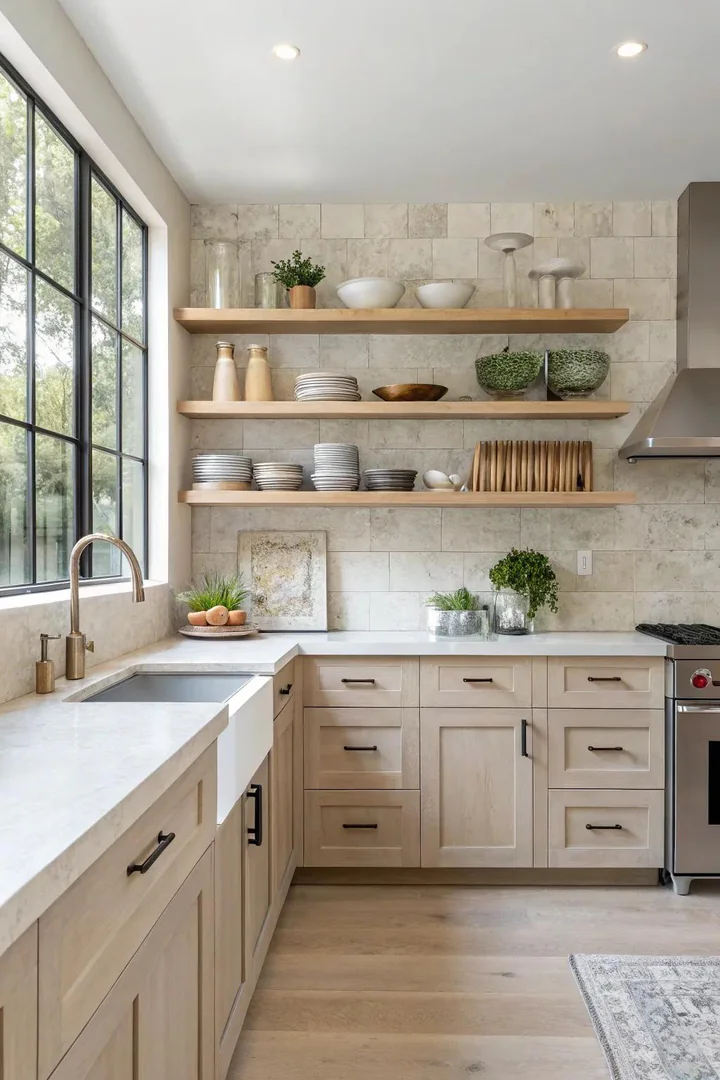
Limestone is a soft, fine-grained sedimentary stone with a smooth, chalky texture and a muted, neutral palette (cream, beige, pale grey, and soft taupe) that creates a quiet, understated backsplash with less visual intensity than marble or granite. The stone’s subtle, uniform coloring makes it the ideal background material — it recedes visually, letting the cabinets, countertop, and hardware hold the spotlight.
Honed limestone (smooth, matte finish) is the most common choice for backsplash applications because the flat surface is easy to clean and the matte finish hides minor surface imperfections. Jerusalem Gold, Jura Beige, and Crema Marfil are popular limestone varieties for kitchen backsplashes. Limestone is one of the softer and more porous natural stones — it is more susceptible to etching from acidic foods (lemon juice, vinegar, tomato sauce) than granite or quartzite. Seal limestone before installation and reseal annually. For pairing ideas, see our guide to kitchen cabinet color combinations.
6. Integrate Natural Beauty Using Pebble Tiles
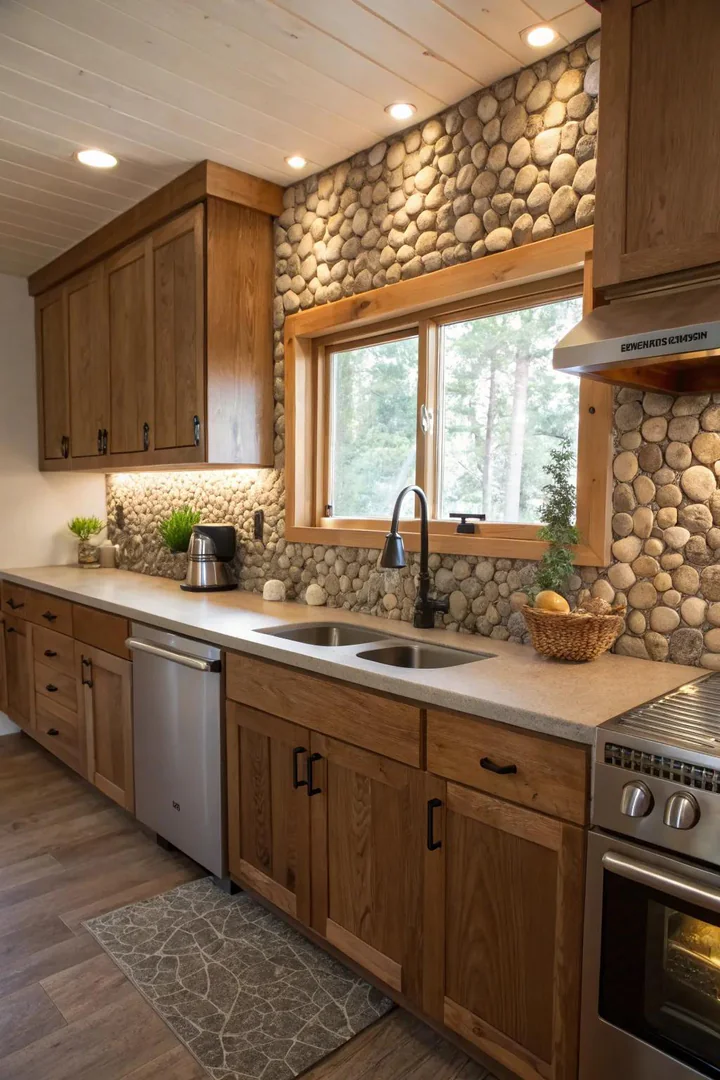
Pebble tile backsplashes use smooth, river-tumbled stones mounted on mesh-backed sheets that install like standard mosaic tile but create an entirely different visual and tactile effect — a field of rounded, irregularly shaped stones that evokes a riverbed, a beach, or a Japanese garden. Each pebble is unique in shape, size, and color, producing a backsplash with more natural variation than any cut-stone tile.
Pebble tile sheets (12×12 inches, mesh-backed) are available from Solistone, Island Stone, and Floor & Decor in flat-face (sliced flat on one side for a smooth wall surface) or natural round profiles. Color ranges include warm tans and browns (Bali), cool greys and blacks (Java), and mixed multicolor blends. Grouting pebble tile requires more material than flat tile because the grout fills the irregular gaps between the rounded stones — use an unsanded grout for the smaller joints or a sanded grout for larger gaps, and apply with a grout float, pressing firmly into all the crevices.
7. Attain Timelessness with Soapstone
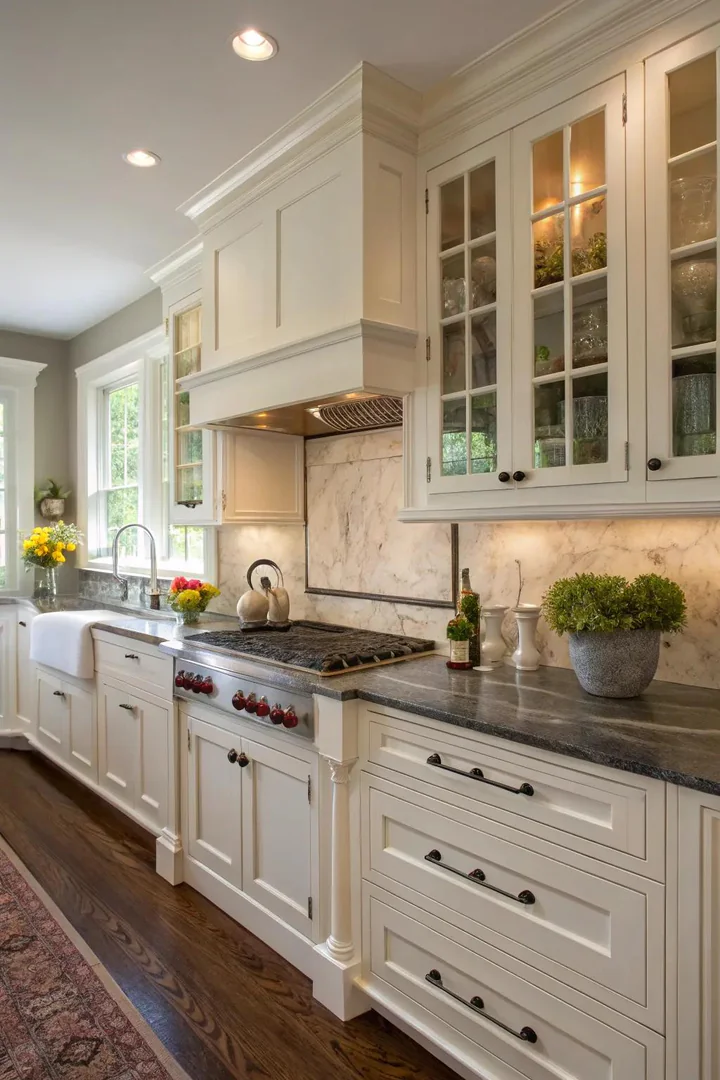
Soapstone is a metamorphic rock composed primarily of talc, which gives it a smooth, silky feel (hence the name) and a dark, chalky grey-green color that deepens to charcoal-black over time through natural oxidation. Unlike marble, granite, and limestone, soapstone is non-porous and does not require sealing — acids like lemon juice and vinegar will not etch the surface, making it one of the most chemically resistant natural stones for kitchen use.
Soapstone backsplash slabs are typically cut from the same material as soapstone countertops, creating a continuous dark stone surface from counter to upper cabinet. Suppliers include Vermont Soapstone, Bucks County Soapstone, and M. Teixeira Soapstone. The stone is available in honed finish only (soapstone is too soft for polishing). Apply mineral oil to accelerate the natural darkening process — new soapstone is light grey-green, but oiled soapstone turns to a deep, rich charcoal within weeks. Without oil, the stone darkens naturally over several months of kitchen use.
8. Enhance Texture Using Stacked Stone
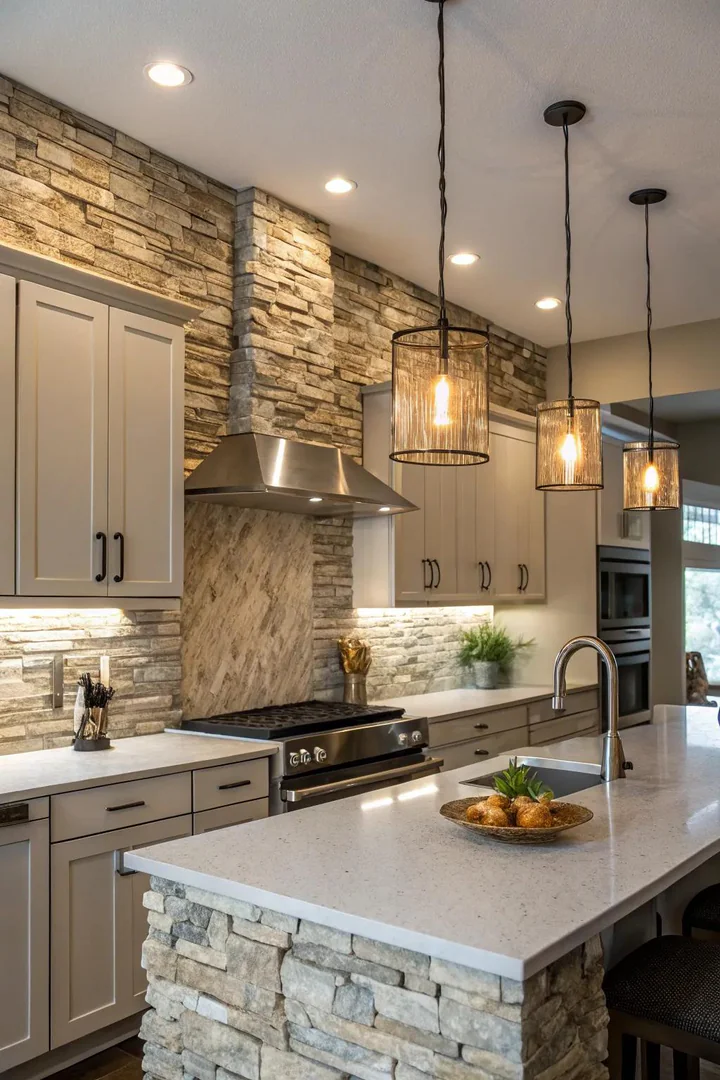
Stacked stone (also called ledger stone or split-face stone) uses thin, horizontally layered stone strips assembled on interlocking panels to create a three-dimensional backsplash with pronounced shadow lines and rugged texture. The protruding stone faces catch overhead and under-cabinet light at different angles, producing a constantly shifting pattern of light and shadow that flat tile cannot replicate.
Stacked stone panels (typically 6×24 inches, interlocking for seamless installation) are available from MSI, Daltile, and Norstone in quartzite, slate, travertine, and marble varieties. Golden Honey (warm tan quartzite), Arctic White (bright white quartzite), and Charcoal (dark grey slate) are the most popular backsplash colors. Install stacked stone with a construction adhesive or modified thin-set mortar applied to the back of each panel. Stacked stone backsplashes do not use grout — the panels interlock dry, and the shadow lines between the stone strips are part of the design.
9. Embrace the Spirit of Nature with Quartzite
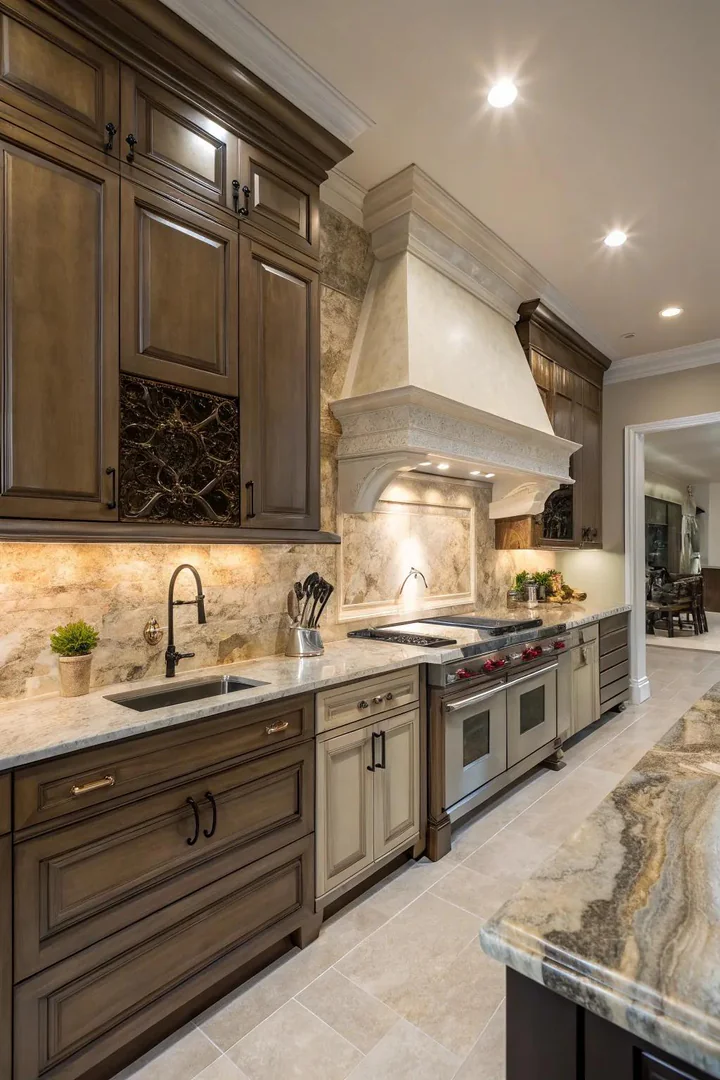
Quartzite is a metamorphic rock formed when sandstone is subjected to extreme heat and pressure, and it produces some of the most visually dramatic natural stone available — the sweeping veins and translucent crystalline structure of quartzite varieties like Taj Mahal, Sea Pearl, Calacatta Macaubas, and Patagonia rival the beauty of the finest marbles while offering significantly greater hardness and scratch resistance.
A full-height quartzite backsplash slab (from the same slab as the countertop) creates a seamless stone wall that showcases the stone’s dramatic veining in a large, uninterrupted format. Quartzite rates 7 on the Mohs hardness scale (harder than granite, which rates 6 to 6.5), making it extremely resistant to scratching, chipping, and abrasion. Most quartzites require sealing — apply a penetrating impregnating sealer annually. For a different backsplash material entirely, see our glass backsplash kitchen guide.
10. Opt for Versatility with Ceramic Stone Appearance Tiles
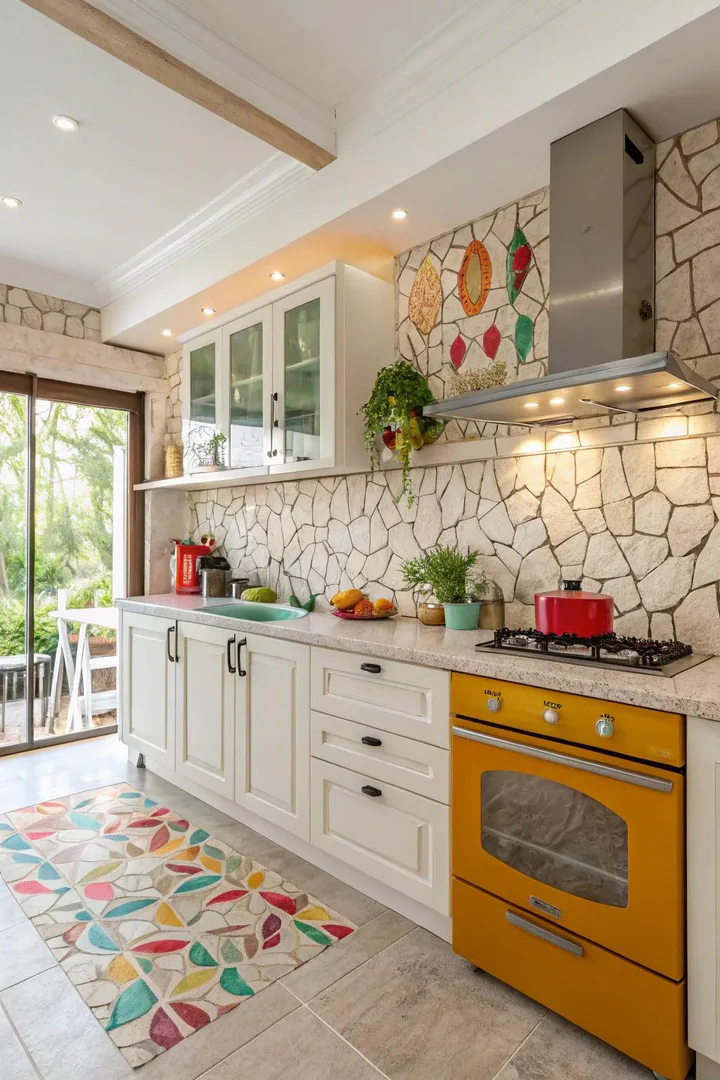
Ceramic and porcelain tiles manufactured with high-resolution inkjet printing now reproduce the color, veining, and surface texture of natural stone with remarkable accuracy — giving homeowners the visual effect of marble, travertine, or slate without the sealing requirements, acid sensitivity, or cost of the real stone. Modern stone-look ceramic tiles from manufacturers like Daltile (Perpetuo line), MSI (Pietra line), and Porcelanosa can be nearly indistinguishable from natural stone at backsplash viewing distances.
Stone-look porcelain tile offers zero porosity (no sealing required, no staining risk), consistent thickness for easy installation, and a significantly lower cost per square foot ($3-8 versus $15-50 for natural stone). The trade-off is authenticity — real stone has depth, variation, and randomness that inkjet printing approximates but cannot perfectly replicate, especially at close viewing distance. Use stone-look tiles in kitchens where the budget, maintenance preferences, or cooking habits (heavy use of acidic ingredients) make real stone impractical.
11. Illuminate Areas with Light-Hued Onyx
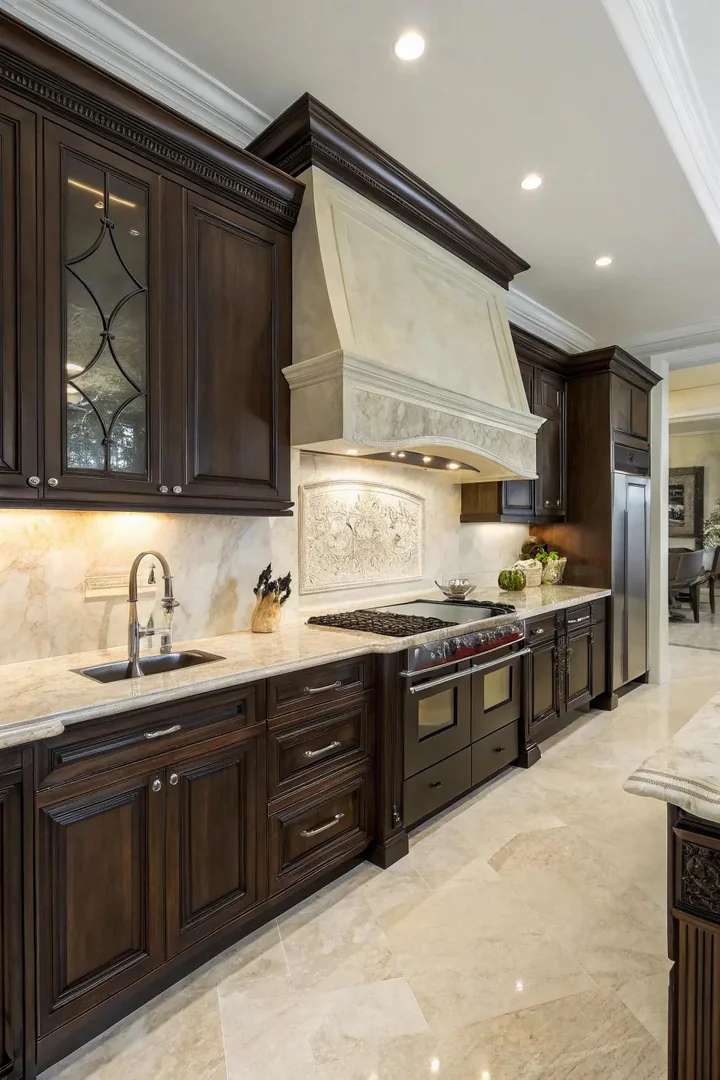
Onyx is a translucent, banded stone that allows light to pass through its surface, creating a glowing, jewel-like backsplash when backlit with LED panels mounted behind the stone slab. No other natural stone material can transmit light this way — onyx backsplashes create a luminous focal point that functions as both a backsplash and a decorative light feature, especially striking in the evening when the backlighting is the dominant light source in the kitchen.
Light-colored onyx varieties — White Onyx, Honey Onyx, Green Onyx, and Pink Onyx — transmit the most light and create the most dramatic backlighting effect. A typical backlit onyx installation uses a 2-centimeter-thick onyx slab mounted 1 to 2 inches in front of an LED light panel (warm white, 3000K). The stone fabricator and electrician must coordinate to create a shadow box behind the onyx slab with the LED panels mounted flat against the wall. Onyx is one of the softest and most fragile natural stones — it requires a fiberglass mesh backing for structural support during fabrication and installation.
12. Choose the Natural Appearance of Sandstone
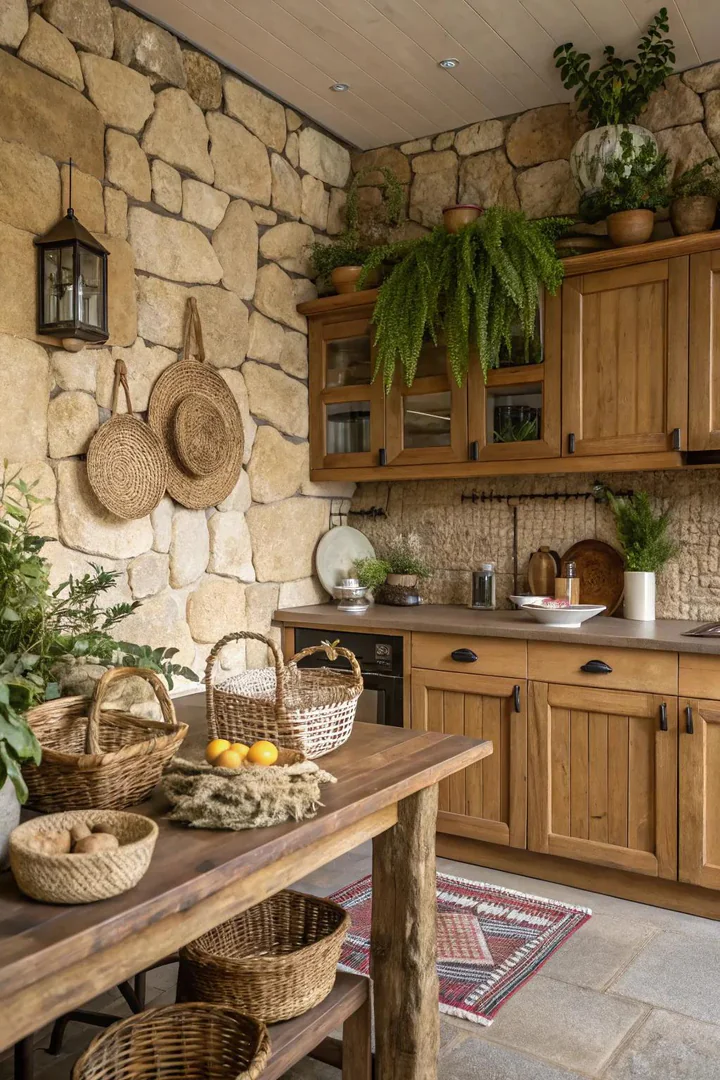
Sandstone carries the layered, banded color patterns of ancient desert and seabed deposits — warm tans, burnt oranges, red-browns, and gold bands that stripe horizontally across the stone face. The stone’s visible sedimentary layers give it a geological narrative quality that connects the kitchen to the landscape. Sandstone is widely used in exterior architecture (brownstone buildings, canyon walls) but is less common in kitchens, which makes it a distinctive and unexpected backsplash choice.
Sandstone is a relatively soft, porous stone (softer than granite, slate, and quartzite) that requires careful sealing to prevent staining in the kitchen environment. Apply two coats of a penetrating impregnating sealer (Miracle Sealants 511 or DuPont StoneTech) before installation and reseal every 6 to 12 months depending on cooking intensity. Indian sandstone (from Rajasthan quarries) and Australian sandstone are the most commonly available varieties. Choose a honed or natural cleft finish — polished sandstone is rare and loses its characteristic texture.
13. Attain Elegance with Refined Stone
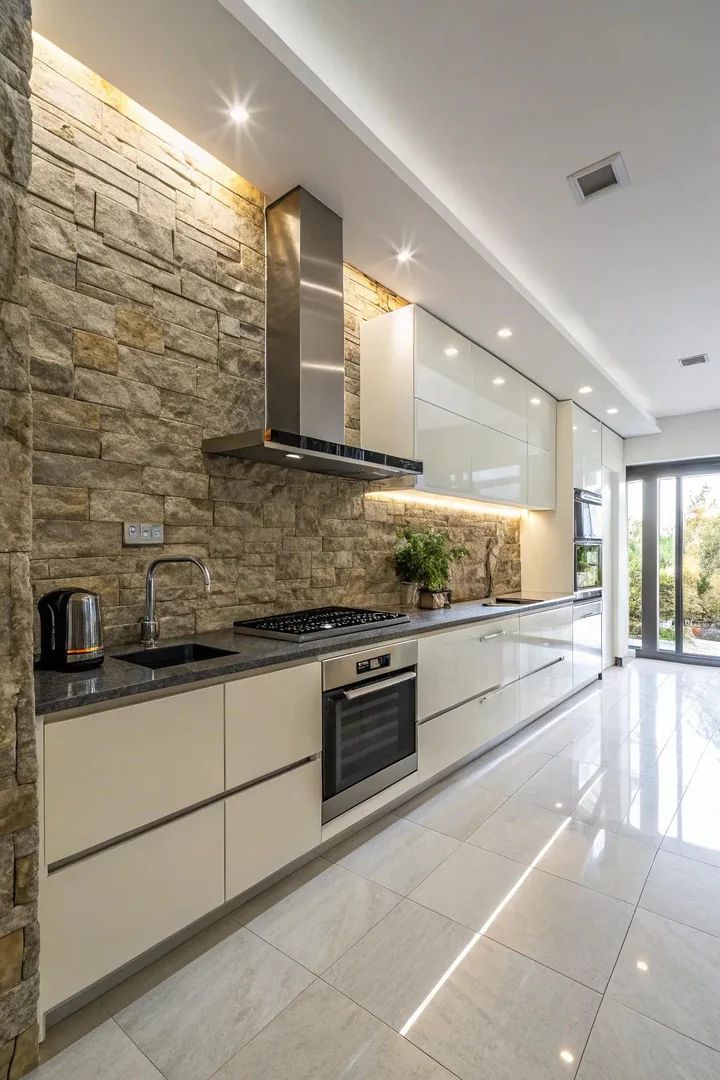
A polished stone backsplash — marble, granite, or quartzite with a high-gloss, mirror-like surface created by progressive grinding with increasingly fine abrasive pads — represents the most refined and formal application of natural stone in the kitchen. The polished finish deepens the stone’s natural colors and makes the veining patterns more vivid and contrasty than honed or matte finishes, producing a jewel-like surface quality.
Polished marble (Calacatta Gold, Statuario, or Arabescato) is the quintessential refined backsplash stone — the white base with grey or gold veining creates a surface that has signified luxury for thousands of years. Polished granite (Absolute Black for a mirror-like dark surface, or White Fantasy for a bright, veined surface) provides the same reflective finish with greater hardness and stain resistance. For ideas on pairing polished stone backsplashes with oak cabinet tones, see our dedicated article.
How to Choose a Natural Stone Backsplash
Matching Stone to Kitchen Style
Rustic and farmhouse kitchens pair best with textured, warm-toned stones — travertine, stacked stone, sandstone, and tumbled marble. Modern and contemporary kitchens suit smooth, clean-lined stones — honed limestone, polished granite slab, or a full-height quartzite slab with dramatic veining. Transitional kitchens (blending traditional and modern elements) work well with versatile stones like honed marble, soapstone, or slate, which read as neither too rustic nor too polished.
Understanding Maintenance Requirements
Every natural stone except soapstone requires sealing, but the frequency and urgency vary. Dense stones (granite, quartzite) need sealing once a year and resist stains even if you forget. Porous stones (marble, limestone, travertine, sandstone) need sealing twice a year and will absorb cooking oils and acids within minutes on an unsealed surface. Test your stone’s sealing status with the “water drop test” — place a few drops of water on the surface and wait 10 minutes. If the water darkens the stone, it needs sealing.
Setting a Budget for Stone Backsplash
Natural stone backsplash materials cost $10 to $50 per square foot for tile formats and $40 to $200 per square foot for full-height slab installations (including fabrication). A typical kitchen backsplash covers 25 to 40 square feet. Budget tile options include travertine ($8-15/sq ft), slate ($10-20/sq ft), and ceramic stone-look tile ($3-8/sq ft). Premium options include quartzite slab ($60-150/sq ft), onyx slab ($100-200/sq ft), and polished marble slab ($50-150/sq ft). Professional installation adds $10 to $25 per square foot on top of material costs.
Natural Stone Backsplash Options Comparison
| Stone Type | Hardness | Sealing Needed | Cost per Sq Ft | Best For |
|---|---|---|---|---|
| Travertine | Soft-medium | Yes, twice yearly | $8-20 | Warm, rustic kitchens |
| Granite | Hard | Yes, annually | $15-50 | Bold pattern, durability |
| Slate | Medium-hard | Yes, annually | $10-25 | Dark, textured finishes |
| Limestone | Soft | Yes, twice yearly | $12-30 | Modern, neutral palettes |
| Soapstone | Soft | No | $50-100 | Low maintenance, dark tones |
| Quartzite | Very hard | Yes, annually | $30-80 | Dramatic veining, high traffic |
| Onyx | Very soft | Yes, twice yearly | $100-200 | Backlit feature walls |
Common Natural Stone Backsplash Mistakes to Avoid
Skipping the sealer on porous stones. Marble, travertine, limestone, and sandstone will absorb cooking oils, tomato sauce, and wine within minutes if unsealed, creating permanent dark stains that cannot be removed without professional honing. Seal before grouting, seal after grouting, and reseal on schedule (every 6 to 12 months for porous stones, annually for dense stones).
Using the wrong grout color. White grout on a dark stone (slate, soapstone, dark granite) creates a grid pattern that overpowers the stone’s natural beauty and makes every grout line the focal point rather than the stone itself. Match the grout color to the stone’s dominant tone — dark grout on dark stone, warm grout on warm stone — to let the stone’s pattern and texture lead the design.
Choosing a rough-textured stone behind the stove. Stacked stone, natural cleft slate, and pebble tile have deep crevices that trap cooking grease and food splatter and are extremely difficult to clean. Use smooth, sealed, flat-surface stones (honed granite, polished marble, or slab backsplash) in the 12-inch zone directly behind the range or cooktop, where splatter is most intense. Save textured stones for the sink wall and side walls where exposure to cooking splatter is minimal.
Failing to book-match slab backsplash with countertop. If you are extending the countertop stone up the wall as a full-height slab backsplash, the backsplash pieces must be cut from the same slab as the countertop and positioned so the veining flows continuously from the horizontal to the vertical surface. Mismatched slabs — even of the same stone variety — create a visible discontinuity that looks like an afterthought. Visit The Designers Company for more backsplash inspiration and kitchen design guides.
Frequently Asked Questions
Is natural stone a good choice for a kitchen backsplash?
Yes — natural stone is one of the most durable and beautiful backsplash materials when properly sealed and maintained. Dense stones like granite, quartzite, and soapstone handle the kitchen environment without issue. Softer, more porous stones like marble and limestone require more frequent sealing and careful cleaning but reward the maintenance with beauty that manufactured materials cannot match.
How do I seal a natural stone backsplash?
Apply a penetrating impregnating sealer (StoneTech BulletProof, Miracle Sealants 511, or Tuff Duck) with a clean cloth or foam applicator, let it soak for 5 to 15 minutes, then wipe off the excess. Allow 24 hours to cure before exposing to water or cooking. Test the seal annually with the water drop test — if water absorbs into the stone within 10 minutes, it is time to reseal.
Which natural stone is the most durable for backsplash use?
Quartzite is the hardest and most scratch-resistant natural stone (Mohs hardness 7), followed by granite (Mohs 6-6.5). Both resist heat, scratching, and chemical exposure better than softer stones. Soapstone is soft but uniquely chemical-resistant — it does not etch from acids that damage marble and limestone. For maximum durability with minimum maintenance, choose granite or quartzite.
Can I use marble behind a stove?
You can, but marble will etch over time from heat and acidic splatter (tomato sauce, vinegar, citrus). Honed marble shows etching less than polished marble because the matte surface masks the dull spots. Seal the marble before and after installation, and wipe up acidic splatter immediately. Accept that a marble backsplash behind the stove will develop a patina over time — many homeowners prefer this aged look as part of the stone’s character.
How much does a natural stone backsplash cost?
Natural stone backsplash tile costs $8 to $50 per square foot for materials, plus $10 to $25 per square foot for professional installation. A typical 30-square-foot backsplash costs $500 to $2,000 in tile format. Full-height slab backsplash (cut from the same stone as the countertop) costs $40 to $200 per square foot installed, with a typical 30-square-foot installation running $1,200 to $6,000. Budget options include travertine tile and ceramic stone-look tile; premium options include onyx slab and backlit installations.
Do I need to match the backsplash stone to the countertop?
Matching is the safest approach — using the same stone (from the same slab) for both countertop and backsplash creates a unified, monumental stone surface with continuous veining. But contrasting is also effective: a white marble backsplash above a dark soapstone counter, or a textured slate backsplash behind a smooth quartz counter, creates visual interest through material contrast. The key is to choose stones that share a compatible color temperature (warm with warm, cool with cool). For more color pairing advice, see our kitchen color ideas guide.
Conclusion
Natural stone backsplash kitchen ideas bring millions of years of geological history into the most functional room in the house — and no two installations are identical because no two pieces of quarried stone are identical. Whether you choose the warm pitting of travertine, the dark silkiness of soapstone, the dramatic veining of quartzite, or the glowing translucency of backlit onyx, a natural stone backsplash adds a depth of material presence that manufactured tiles, glass, and metal simply cannot replicate.
Start with your kitchen’s style (rustic, modern, or transitional) and your maintenance tolerance (high-maintenance marble or low-maintenance granite and soapstone) to narrow the stone type. Choose a finish (honed for modern, tumbled for rustic, polished for formal) that matches the kitchen’s mood. Seal the stone before and after installation, and commit to the annual resealing schedule that each stone type requires. The result is a backsplash that ages with the kitchen — developing character, patina, and depth that grow more beautiful with every year of use.