Blue Kitchen Cabinets with Gold Hardware: 17 Luxe Designs to Copy
Blue kitchen cabinets with gold hardware pair a cool-toned cabinet finish against warm metallic pulls, knobs, and hinges to produce a kitchen that reads both polished and inviting. The combination works across paint shades from deep Benjamin Moore Hale Navy to soft Sherwin-Williams Languid Blue, while gold hardware in satin brass, antique bronze-gold, and champagne finishes adds warmth that white or chrome pulls cannot match. Below are 17 fully styled designs covering Shaker profiles, slab doors, glass-front uppers, island-only applications, and mixed-metal layouts, followed by a step-by-step installation guide, a comparison table, and FAQs on finish durability, paint brands, and pairing countertops.
1. Classic Navy Shaker Cabinets with Satin Brass Cup Pulls
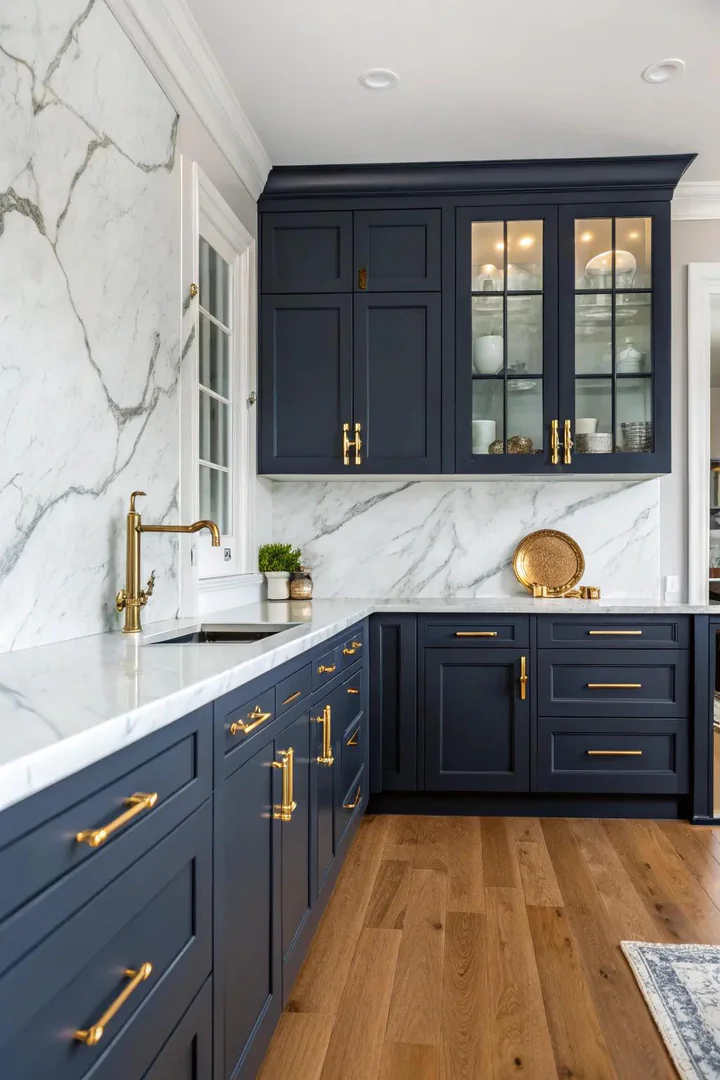
A full wall of navy Shaker-style cabinets finished in Benjamin Moore Naval (2164-10) anchors the room with a rich, saturated backdrop. Satin brass cup pulls from Amerock Mulholland sit along every drawer front, and matching knobs top each upper door. Cup pulls work especially well on Shaker profiles because the curved handle echoes the recessed panel shape.
White Carrara marble countertops break up the deep blue and reflect overhead pendant light back into the room. A subway-tile backsplash in glossy white runs from counter to upper cabinets, keeping the wall bright without competing with the hardware. Pairing navy cabinets with gold hardware has remained a go-to in traditional and transitional kitchens for over a decade because neither finish trends out quickly.
2. Powder Blue Uppers with Champagne Gold Pulls
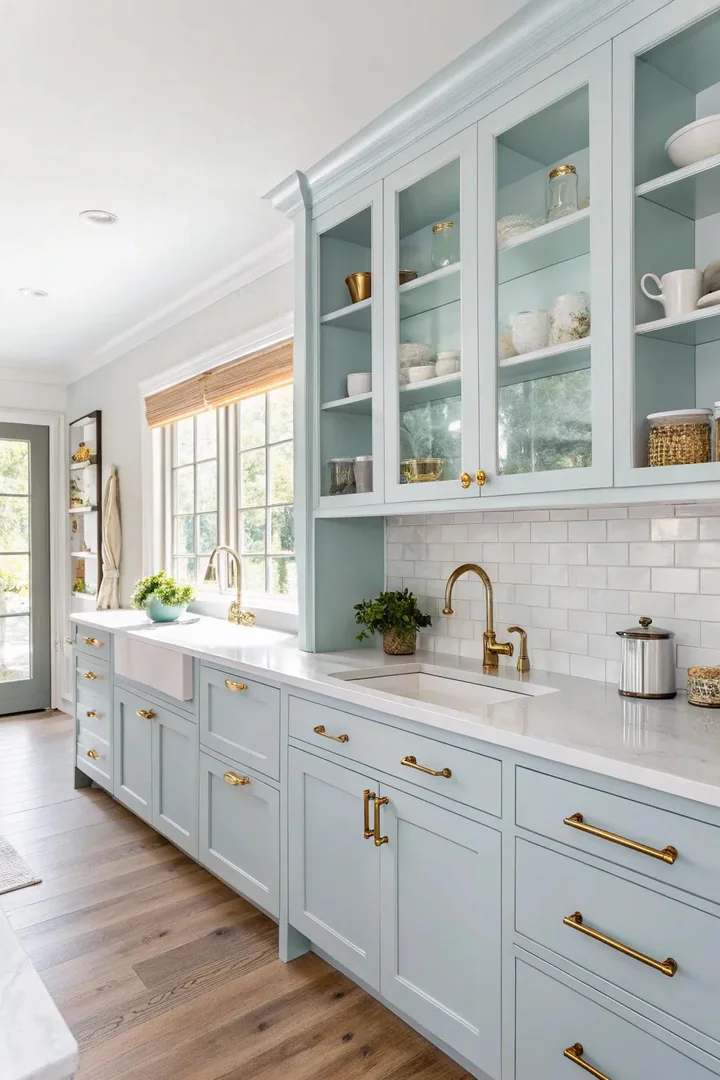
A lighter blue like Sherwin-Williams Languid Blue (SW 6226) opens up a smaller kitchen by bouncing natural light across the cabinet faces. Champagne gold bar pulls from Brainerd Bar Pull collection add just enough metallic contrast without the heavy yellow tone of polished brass. Champagne gold sits between silver and gold on the color wheel, making the transition from stainless steel appliances less jarring.
Butcher-block walnut countertops warm up the cool blue and introduce a natural grain pattern. Open wood shelving beside the range hood holds everyday dishes and keeps the layout from feeling closed in. Powder blue cabinets pair naturally with white oak flooring, linen curtains, and woven pendant shades for a relaxed coastal or cottage-style kitchen. Homeowners exploring housewarming gift ideas for the kitchen often choose brass utensil holders or gold-framed recipe stands that complement a palette like this one.
3. Two-Tone Navy Lowers and White Uppers with Brushed Gold Knobs
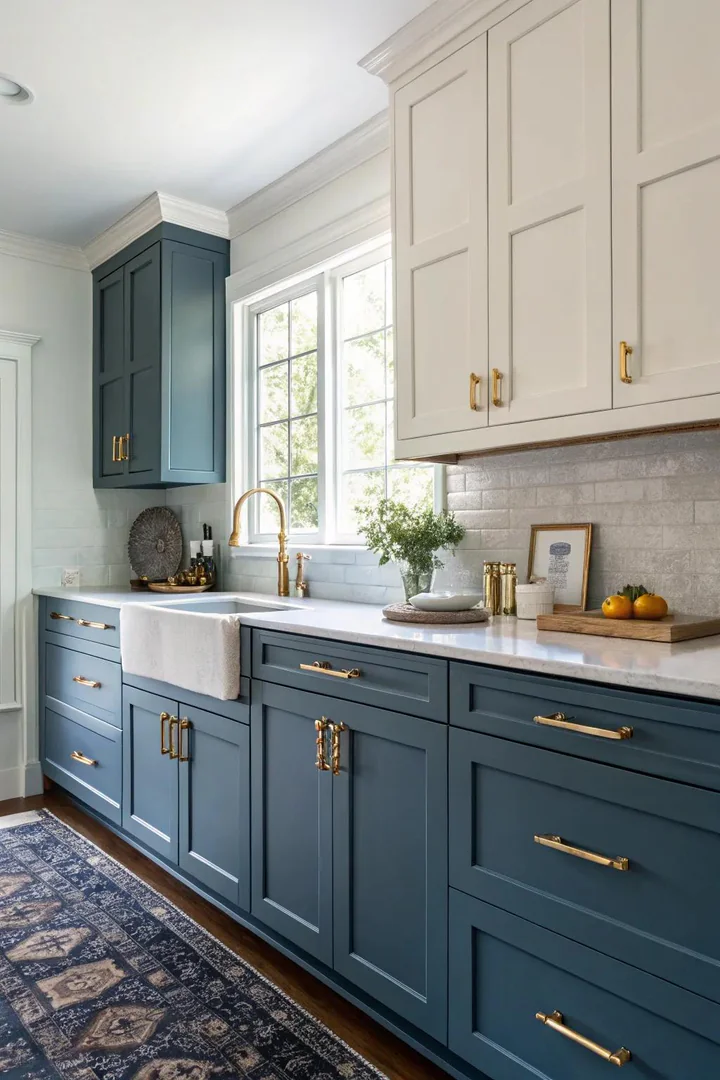
Splitting the color across upper and lower cabinets gives the room depth without the weight of floor-to-ceiling blue. Navy lowers in Farrow & Ball Stiffkey Blue (No. 281) ground the base, while white uppers in Benjamin Moore Simply White (OC-17) keep sightlines open. Brushed gold round knobs tie both zones together because the same hardware finish runs on every door.
A quartz countertop in Caesarstone Calacatta Nuvo (5131) bridges the color gap with soft gray veining on a white base. Gold pendant lights above the island repeat the hardware tone overhead, and a gold-trimmed faucet in the same brushed finish completes the metallic layer. Two-tone layouts photograph well from every angle, which explains the popularity of the approach on Pinterest and Houzz design boards.
4. Statement Blue Island with Gold Accent Hardware
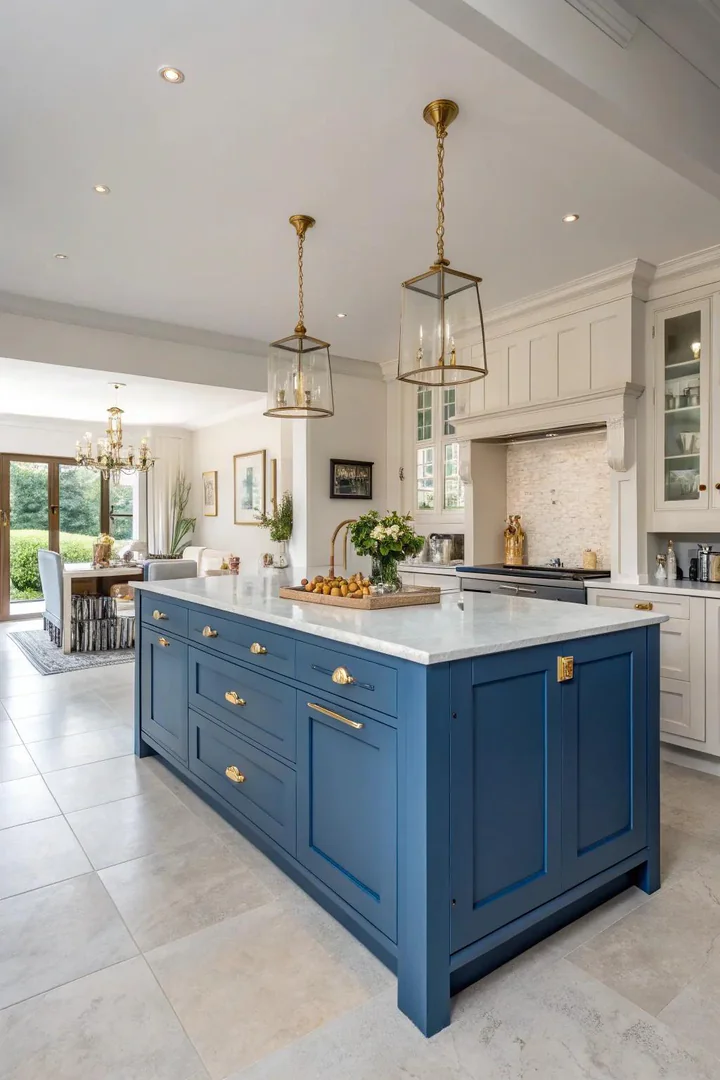
Painting only the island in a bold blue like Sherwin-Williams Indigo Batik (SW 7602) creates a focal point without committing the entire kitchen to color. Gold bin pulls from Liberty Hardware Notched Backplate line the island drawers, and a waterfall-edge Calacatta Laza quartzite slab wraps the sides. White perimeter cabinets stay neutral so the island commands attention.
Bar stools with gold-finished legs and navy cushions connect the island to the seating area. Under-counter lighting in warm 2700K LED strips washes the gold hardware from below when the overhead fixtures dim. An island-only color strategy costs less in paint and labor because only 8 to 12 linear feet of cabinetry need refinishing, compared to 30 or more for the full kitchen.
5. Open Upper Shelving with Blue Base Cabinets and Gold Brackets
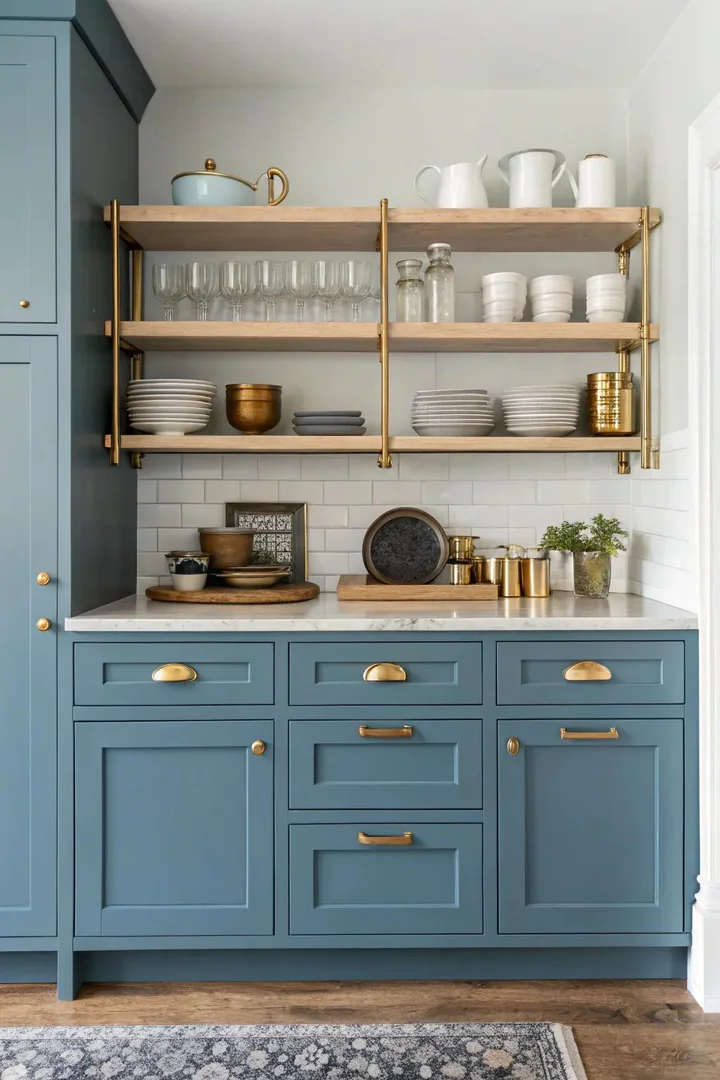
Removing upper cabinet boxes and replacing them with floating shelves on gold-finished iron brackets opens the wall plane and makes a galley or U-shaped kitchen feel twice its size. Blue base cabinets in Benjamin Moore Van Deusen Blue (HC-156) hold the storage weight below, and matching gold bar pulls run along every drawer. The open shelves hold white dishes, glass jars, and a few cookbooks, keeping daily items within arm’s reach.
A matte white ceramic tile backsplash runs behind the shelves and contrasts with the blue below. Gold shelf brackets from Cascade Iron Co. sit at 24-inch intervals and support 10-inch-deep solid maple shelves. Designers working on eat-in kitchen ideas frequently pair open shelving with a small dining nook to maintain an airy, connected feel across the cooking and eating zones.
6. Glass-Front Blue Uppers with Antique Gold Hinges and Latches
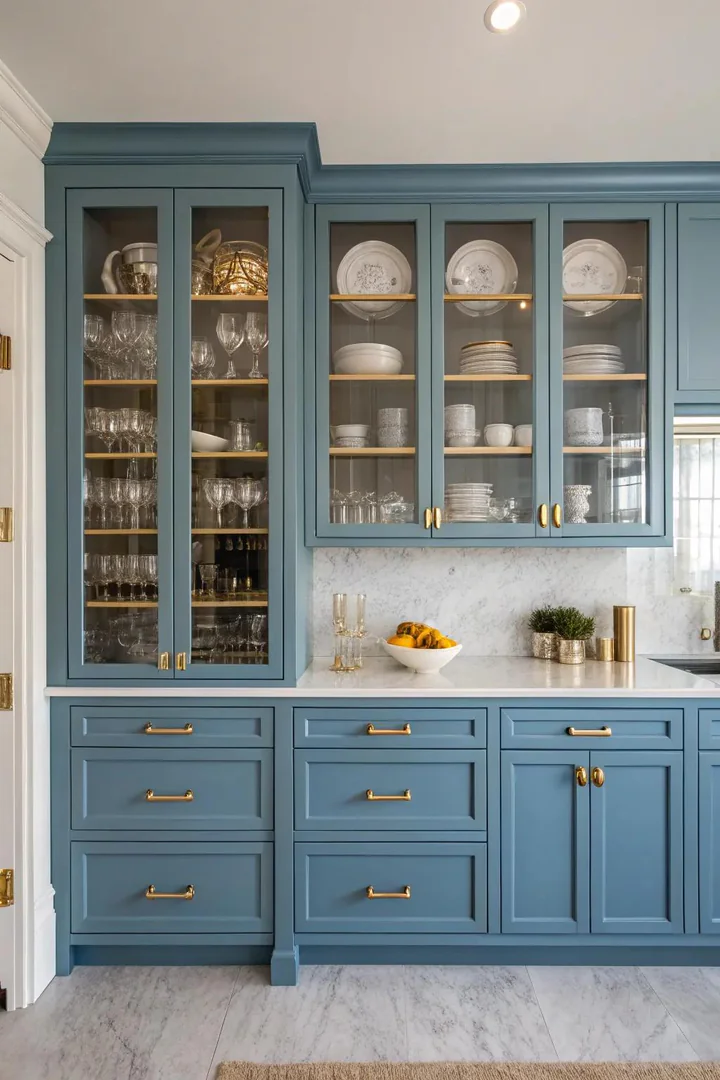
Clear glass panel inserts in blue-framed upper cabinet doors put dishware, stemware, and pottery on display while still keeping dust out. Antique gold surface-mount hinges and turn-button latches replace modern concealed hinges for a period-accurate look that suits Colonial Revival and English cottage kitchens. Painting the interior cabinet backs in a lighter blue or warm white makes the displayed pieces stand out.
Seeded glass is another option for homeowners who want texture without full transparency. Seeded panels diffuse the view of stacked plates and mismatched mugs, softening the look. A Rejuvenation ice-box latch in unlacquered brass develops a patina over months, giving the hardware a lived-in warmth that lacquered finishes cannot replicate. Glass-front cabinets require internal organization, so adding small LED puck lights inside each box (3000K warm white) turns the display into a design feature day and night.
7. Farmhouse Blue Cabinets with Reclaimed Wood and Gold Ring Pulls
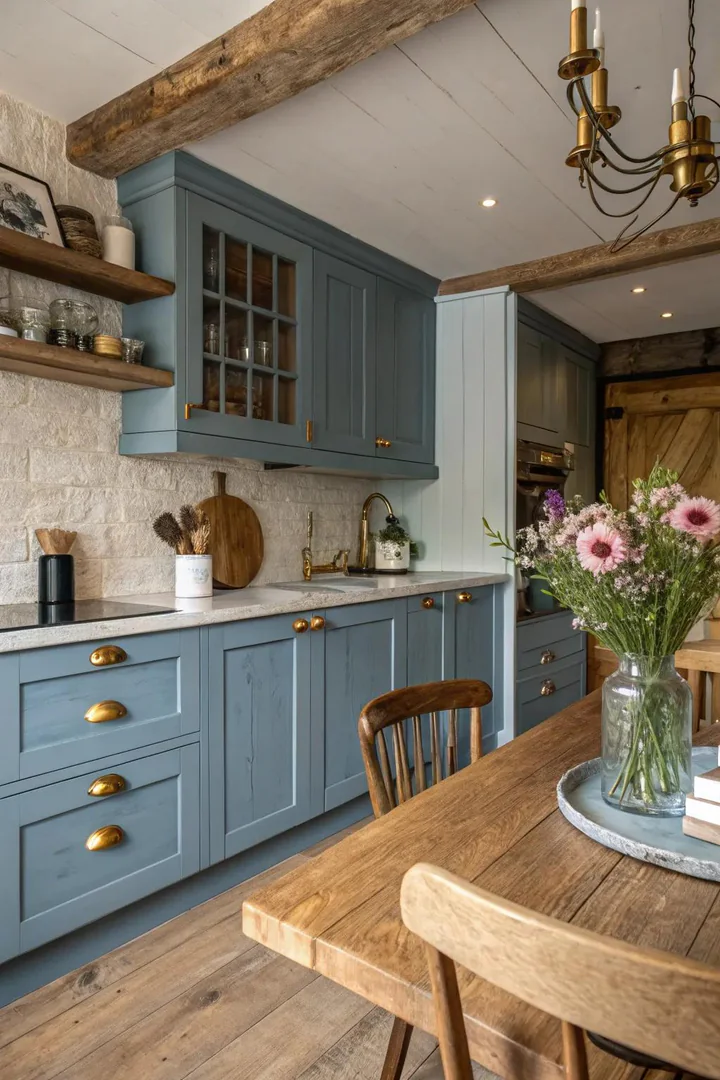
Mixing reclaimed barnwood open shelving with blue-painted Shaker lowers brings rustic texture into a traditional kitchen frame. Gold ring pulls from Top Knobs Brixton sit on each lower door panel, and their ring shape nods to old apothecary and general-store hardware. A beam-wrapped range hood in the same reclaimed timber bridges the upper shelf zone and the lower cabinetry.
Honed soapstone countertops in charcoal-gray ground the blue and wood tones with a matte, mineral surface. Soapstone requires periodic mineral-oil treatment every 4 to 6 weeks but develops a natural darkening patina that farmhouse kitchens favor. A white apron-front sink from Kohler Whitehaven (K-6489) pairs with a gold bridge faucet to tie the metallic accents together. Browse more rustic layout concepts in our collection of basement kitchen ideas, where reclaimed materials and warm metals appear in below-grade cooking spaces.
8. Flat-Panel Slab Blue Cabinets with Slim Gold T-Bar Pulls
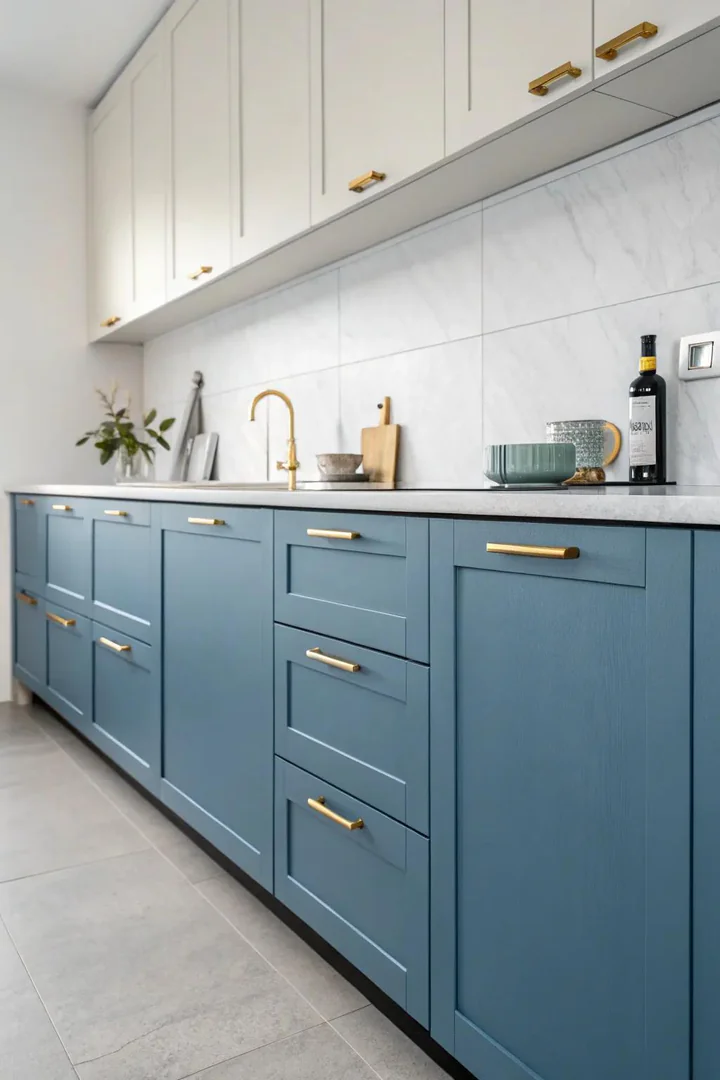
Flat slab-front doors in Farrow & Ball De Nimes (No. 299) strip away frame-and-panel detail for a clean, mid-century-modern silhouette. Slim 6-inch gold T-bar pulls from Goldenwarm mount horizontally on drawers and vertically on doors, maintaining the linear geometry. Cabinet faces sit flush rather than overlay, so the hardware line reads as one continuous metallic stripe across the run.
A white quartz waterfall island with no visible seam on the mitered edge extends the minimal approach. Integrated appliance panels hide the refrigerator and dishwasher behind matching slab fronts, keeping the run unbroken. Slab doors cost less than Shaker profiles because the manufacturing skips the cope-and-stick joinery step, saving $15 to $30 per door at most cabinet shops.
9. Eclectic Mixed-Hardware Blue Kitchen with Gold and Brass Accents
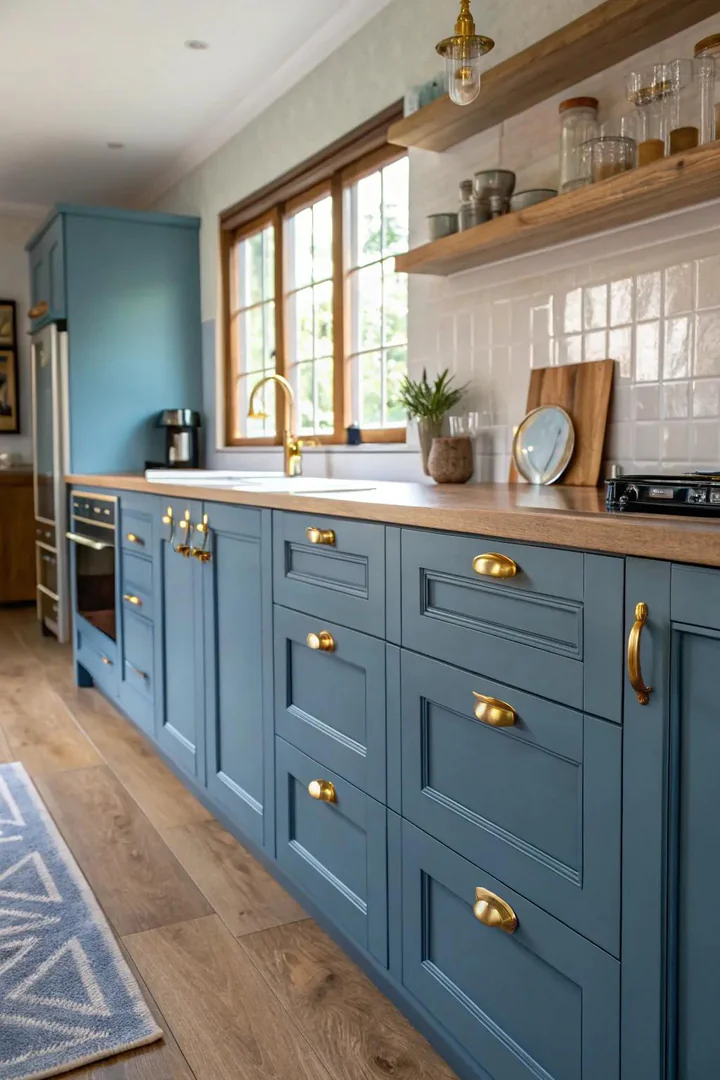
Deliberately mixing hardware styles across the kitchen produces a collected-over-time look rather than a matching showroom set. Base drawers carry oversized unlacquered brass bin pulls, upper doors wear small round knobs in satin gold, and the island gets Schoolhouse Electric Utilitarian pulls in raw brass. The shared warm-metal family keeps the mix cohesive even though no two pulls are identical.
Open plate racks, a pegboard wall for copper pots, and vintage ceramic canisters reinforce the eclectic character. Blue paint in a mid-range dusty tone like Benjamin Moore Normandy Blue (2129-40) serves as a neutral enough backdrop for the hardware variety. Mixing hardware shapes does require planning: assign one shape per zone (pulls for drawers, knobs for doors, latches for specialty cabinets) so the variety reads intentional.
10. Blue Cabinets with Gold Hardware and White Marble Countertops
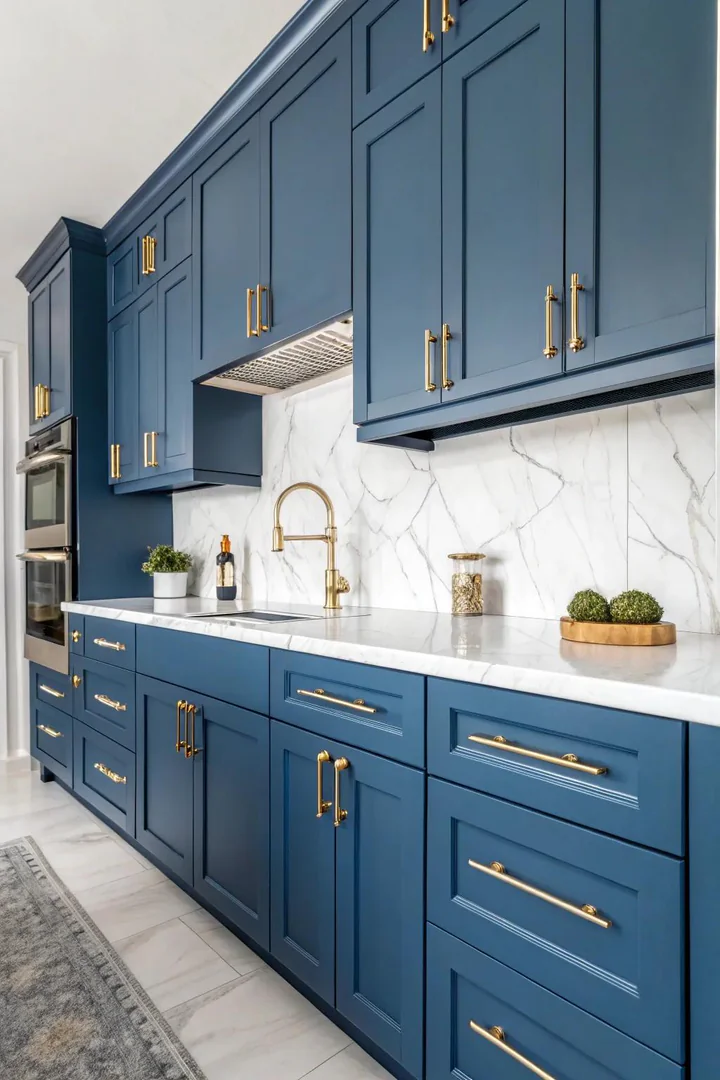
A Calacatta Borghini marble slab with bold gray-and-gold veining on a warm white base connects the blue cabinetry below to the gold hardware in a single geological pattern. Marble countertops 3 cm thick with a polished finish bounce light from under-cabinet puck fixtures back onto the hardware. Matching marble used as a full-height backsplash eliminates the grout-line interruption of tile and creates one unbroken stone surface.
Marble does require sealing once or twice a year with an impregnating sealer like Tenax Hydrex to resist oil and acid stains. Homeowners who want the veining pattern without the maintenance can choose Dekton Aura 15 or Cambria Brittanicca porcelain and quartz alternatives that replicate the look at zero-porosity. Gold hardware in a warm satin finish sits closer to marble’s natural gold veining than chrome or nickel, which explains why marble-and-brass pairings dominate high-end renovations.
11. Vintage-Inspired Blue Cabinets with Antique Gold Bail Pulls
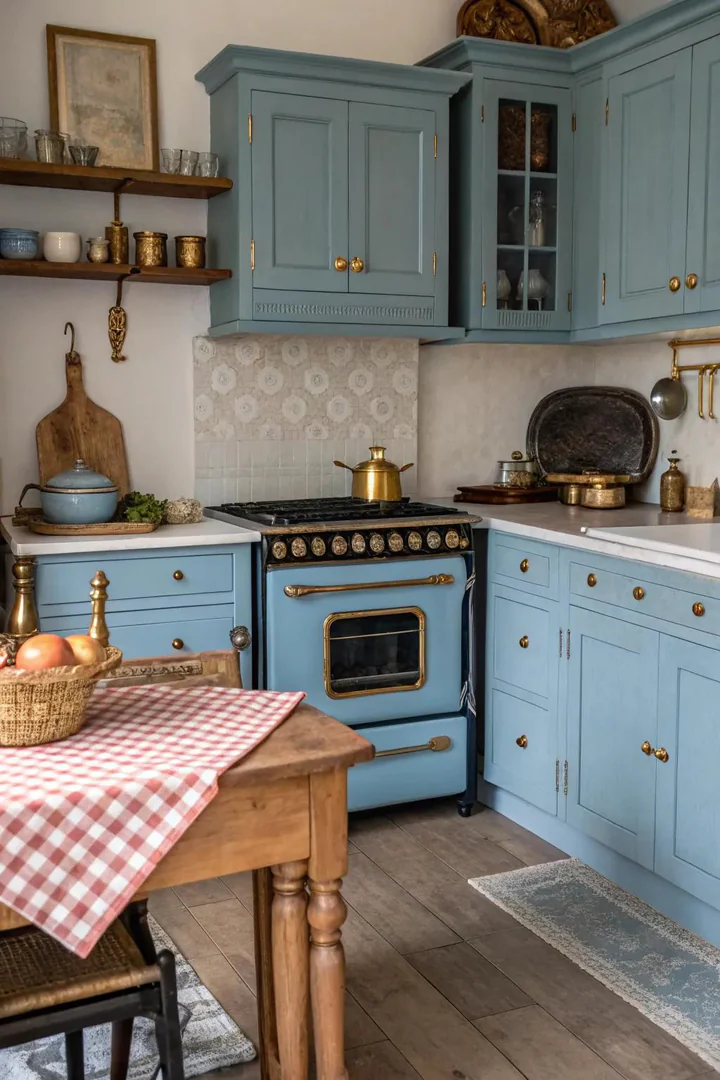
Bail pulls, also called drop pulls, hang from a fixed backplate and swing freely, giving cabinets the look of an antique dresser or Hoosier cabinet. Antique gold bail pulls in a 3-inch center-to-center size from Hickory Hardware Windover pair with inset cabinet doors where the door sits flush inside the frame opening. A muted blue like Benjamin Moore Buxton Blue (HC-149) reads as a soft slate that belongs in a 1920s bungalow kitchen.
Beadboard panels inside glass-front doors and on the back wall of open niches add period texture. A cast-iron farmhouse sink, bin-style bread drawer, and brass gas-conversion range knobs round out the vintage hardware story. Period-correct detailing raises the perceived value of the kitchen at resale because the style reads as curated rather than catalog-ordered. Homeowners drawn to warm neutrals in lower cabinets may also like our guide to dark beige kitchen cabinet ideas, where muted earth tones play a similar supporting role.
12. Symmetrical Blue Cabinet Wall with Balanced Gold Pulls
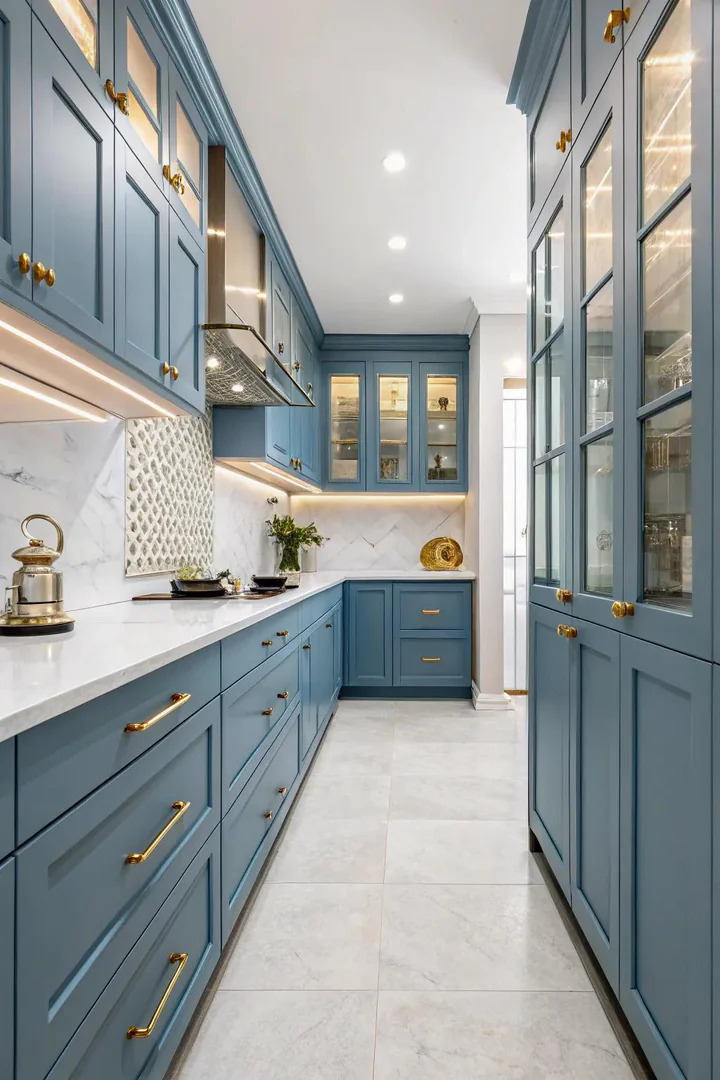
Centering the range or cooktop on the main cabinet wall and flanking both sides with identical blue cabinet stacks produces a formal, balanced composition. Gold bar pulls mounted at the same height on every door reinforce the mirror-image layout. 128 mm center-to-center bar pulls in brushed gold from Cosmas Hardware sit 2.5 inches from the bottom edge of each upper door and centered on every lower drawer face.
A decorative range hood with a gold strap detail becomes the centerpiece above the cooktop. Tall pantry cabinets bookend the run and carry the blue paint from floor to ceiling, framing the cooking zone. Symmetrical kitchens work best in rooms wider than 12 feet where the flanking cabinets have equal wall space, because asymmetric filler panels break the visual rhythm.
13. Industrial Blue Cabinets with Gold and Black Metal Accents
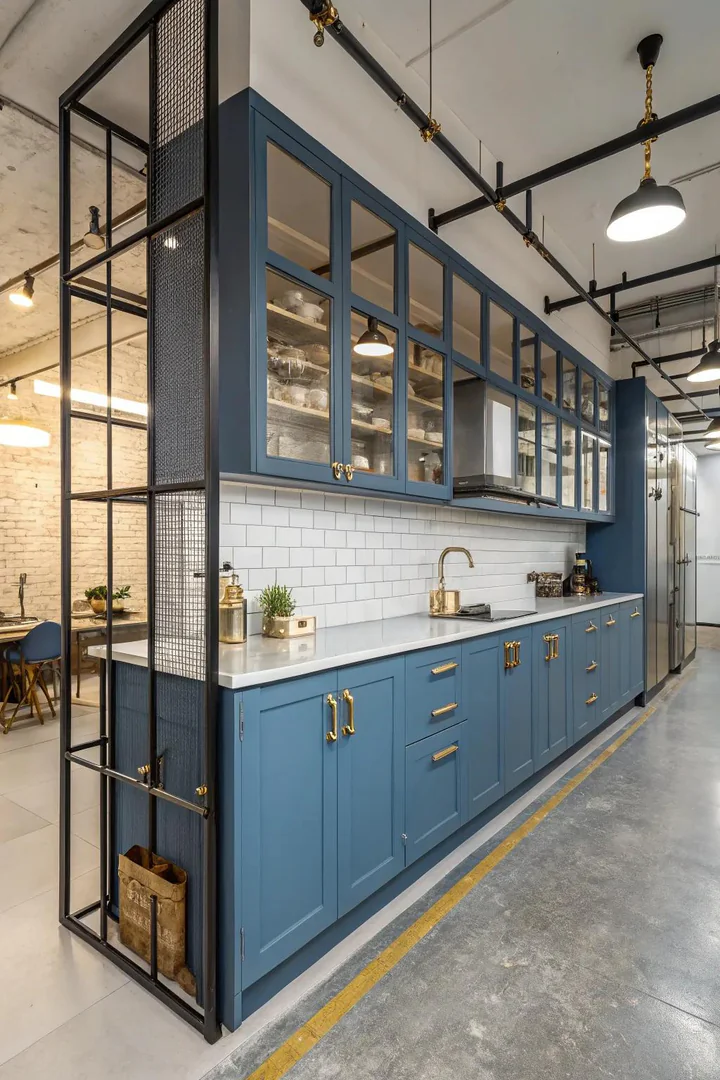
Exposed steel shelving brackets, a blackened-steel range hood, and raw concrete countertops set the industrial stage, while gold cabinet pulls on deep blue fronts introduce warmth that softens the raw materials. Matte gold 5-inch flat bar pulls from Franklin Brass Bayview pair well with matte black hinges and black iron shelf brackets without creating a metal clash. Mixing gold and black works when each finish owns a distinct zone: gold on cabinet fronts, black on structural and overhead elements.
Pendant lights with exposed Edison-style filament bulbs in brass cage shades reinforce the gold layer above the island. A concrete countertop sealed with Cheng Pro-Formula sealer resists staining but holds the matte, raw finish that industrial kitchens favor. Steel-framed glass cabinet inserts on two or three upper doors combine the glass-front display idea with the metal-frame aesthetic, bridging the blue cabinetry and the industrial hardware.
14. Layered Pendant and Under-Cabinet Lighting with Blue Cabinets and Gold Fixtures
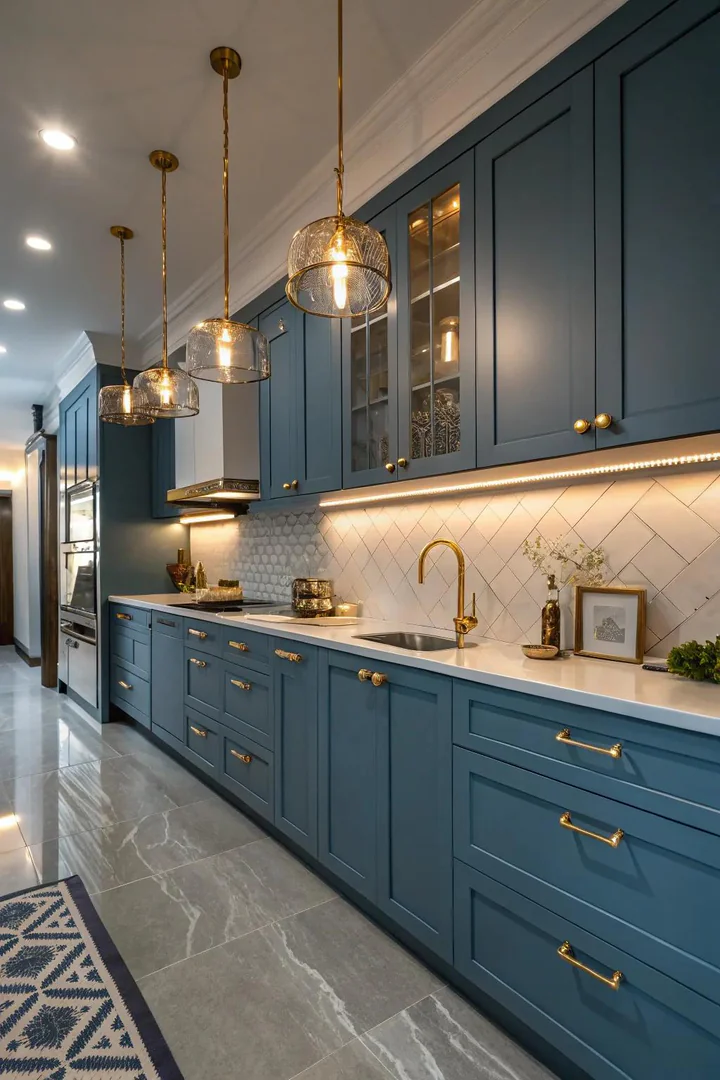
Treating gold as a lighting finish in addition to a hardware finish creates a layered metallic presence across three planes: cabinet face, ceiling, and under-counter. Gold dome pendant lights from Visual Comfort Thomas O’Brien Eugene hang above the island at 30 to 34 inches above the counter surface, putting the gold shade at eye level. Under-cabinet LED strip lights in warm white (2700K) wash the countertop and backlight the gold bar pulls from above.
Recessed ceiling cans on a dimmer circuit provide general fill light and let the pendants and under-cabinet strips handle task and accent duty. A gold-finished flush mount or semi-flush fixture from Hudson Valley Lighting centers over the main sink when pendant spacing does not cover that zone. Lighting designers recommend a minimum of three independent circuits in a kitchen: general, task, and accent. Matching all accent and decorative fixtures to the cabinet hardware finish ties the gold through the room without overloading any single surface.
15. Monochromatic Blue Kitchen with Tone-on-Tone Gold Accents
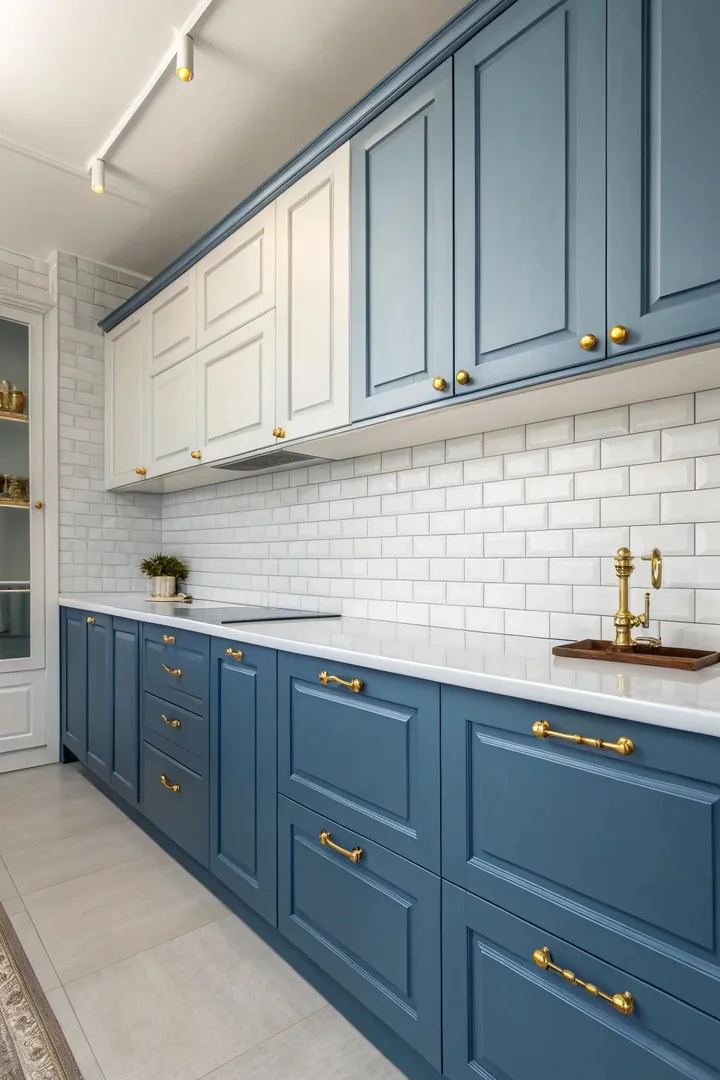
Using three to four shades of blue across cabinets, backsplash tile, wall paint, and open-shelf accessories creates a tonal gradient that feels intentional and calm. Dark navy on lowers, medium steel blue on uppers, and a pale blue-gray on the walls layer depth without introducing a competing color. Gold hardware in a single satin-brass finish becomes the only warm accent in the room, drawing the eye to each pull and knob like punctuation.
A Moroccan zellige tile backsplash in a blue glaze slightly different from the cabinet shade adds handmade texture and tonal variation to the wall plane. Gold grout lines between the tiles pick up the hardware color at a subtle scale. Monochromatic schemes reward careful sample testing: order 4-inch paint swatches and view them on the actual cabinet surface under the room’s installed lighting at both midday and 8 PM, because blue shifts dramatically under warm versus cool light sources.
16. Textured Blue Cabinet Fronts with Gold Edge Pulls
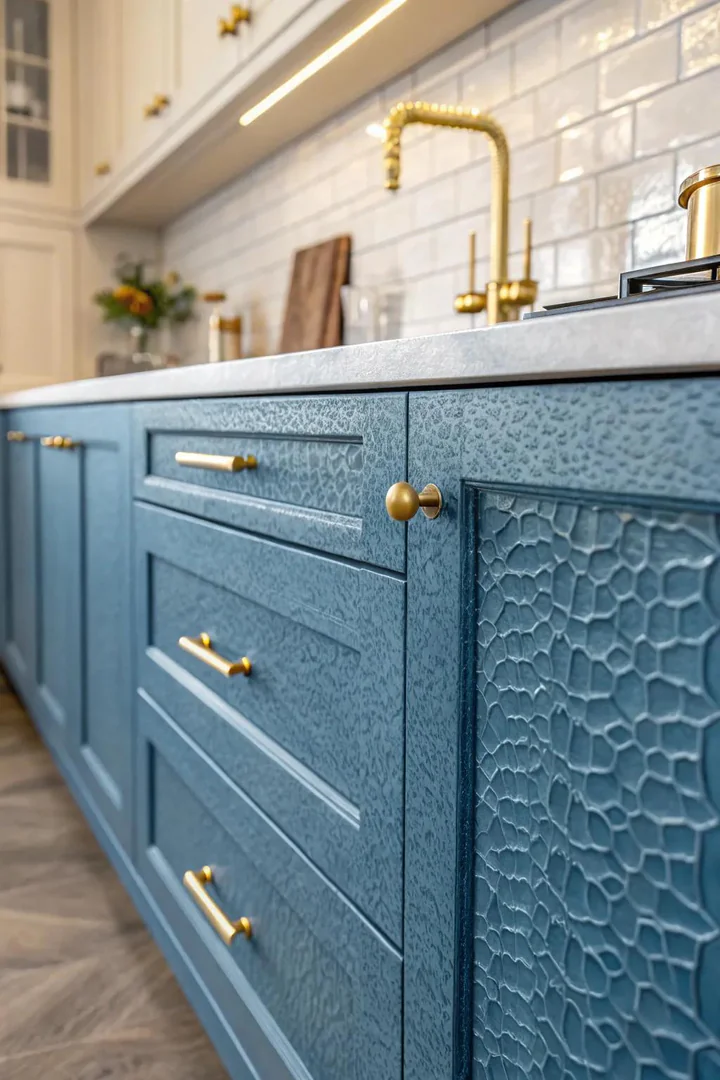
Reeded, fluted, or V-groove panel fronts introduce vertical ridges that catch side light and add shadow lines across the cabinet face. Brushed gold edge pulls mounted to the top or side of each door sit flush with the surface and let the texture command attention. DERA Slim Edge pulls in brushed gold measure only 3/8 inch deep, keeping the profile minimal on a textured door where a protruding bar pull would compete with the ridges.
Fluted MDF panels from Ekena Millwork can be applied over existing flat doors as an overlay, turning a standard slab cabinet into a textured front without full door replacement. Painting the fluted surface in Sherwin-Williams Refuge (SW 6228), a warm medium blue, lets the ridges create natural light-and-shadow variation across a single color. Edge pulls cost $5 to $12 each, making them one of the most affordable hardware upgrades per linear foot of cabinetry. Discover more kitchen projects at The Designers Company, where every guide covers materials, dimensions, and product sources.
17. Art-Inspired Blue Kitchen with Gold Gallery Rail and Statement Pulls
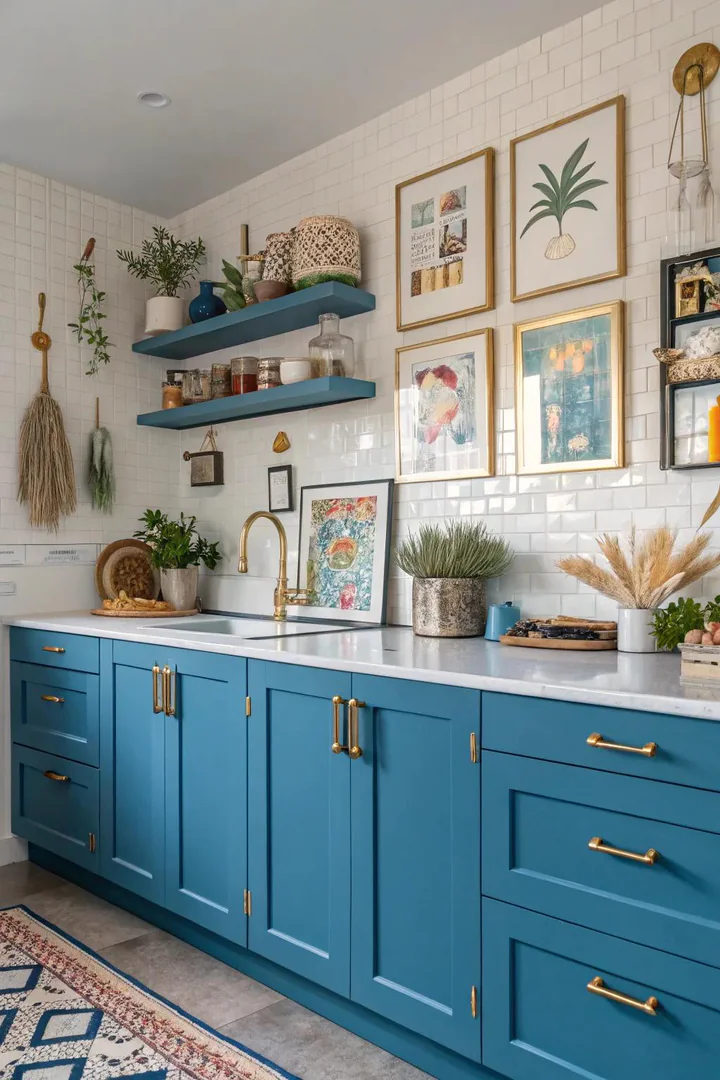
A narrow gold picture rail or gallery ledge mounted above the backsplash displays framed prints, postcards, and small ceramics, turning the kitchen wall into a rotating art installation. Oversized 8-inch gold arc pulls from Lew’s Hardware Bar Pull collection on the island drawers act as sculptural objects in their own right. Blue cabinets in Farrow & Ball Pitch Blue (No. 220) provide a gallery-wall-worthy backdrop for both the art and the statement hardware.
Floating open shelves with gold brackets above the range hold a mix of functional and decorative pieces: a brass salt cellar, a blue ceramic vase, stacked cookbooks, and a small potted herb. Pendant lights with hand-blown glass shades in an amber tint bridge the gold hardware and the art display. Art-forward kitchens perform well on resale in urban markets where buyers value personality and craft over matching everything to a single catalog page.
How to Install Gold Hardware on Blue Kitchen Cabinets
1. Choose the Right Pull Size and Style for Your Cabinet Profile
Measure the existing bore holes on each cabinet door and drawer front before shopping. Standard bore spacing runs 3 inches, 3.75 inches (96 mm), or 5 inches (128 mm) center-to-center. Shaker doors look best with cup pulls or classic bar pulls, flat slab fronts pair with slim T-bars or edge pulls, and raised-panel traditional doors suit knobs or bail pulls. Ordering one sample pull in each size from Amazon or Build.com and test-fitting on the actual cabinet catches sizing errors before a full set ships.
2. Select a Gold Finish That Matches Your Fixtures
Gold hardware comes in satin brass, polished brass, brushed gold, champagne gold, antique brass, and unlacquered brass. Hold candidate pull samples against the kitchen faucet, pendant light, and any visible door hinges to confirm the undertone matches. Satin brass reads warm-neutral and pairs with most stainless steel appliances, while polished brass carries a strong yellow tone best reserved for fully brass-committed rooms. Unlacquered brass develops a patina within 6 to 12 months and needs periodic polishing with Bar Keeper’s Friend or Brasso to maintain its original color.
3. Mark and Drill Consistent Hole Positions
Use a cabinet hardware jig like the True Position TP-1935 or Liberty Align Right to mark every hole at the same distance from the door edge and bottom. Set the jig once and clamp it to each door in turn, marking through the guide holes with a spring-loaded center punch. Drill with a 3/16-inch or 7/32-inch bit depending on the bolt diameter, using a backer board behind the door to prevent blowout on the painted back face.
4. Mount the Pulls and Tighten the Machine Screws
Insert the machine screw from inside the cabinet through the drilled hole, thread the pull onto the screw from the outside, and hand-tighten. Finish with a screwdriver or cordless drill on the lowest torque setting to snug the pull without spinning the screw head through the interior MDF. Apply a drop of Loctite Threadlocker Blue 242 to each screw if the cabinet doors vibrate when closing, preventing pulls from loosening over months of daily use.
5. Clean and Maintain Gold Finishes for Long-Term Durability
Wipe lacquered gold pulls with a damp microfiber cloth and mild dish soap weekly to remove cooking grease and fingerprints. Avoid abrasive cleaners, steel wool, and ammonia-based sprays because these strip the lacquer coating and expose the base metal. For unlacquered brass, a monthly wipe with a paste of equal parts lemon juice and baking soda restores shine, while skipping the wipe allows the natural patina to develop for a lived-in antique look.
Blue Cabinet Paint and Gold Hardware Comparison
| Blue Paint Color | Brand | Undertone | Best Gold Finish Pairing | Best Cabinet Style | Price per Gallon (approx.) |
|---|---|---|---|---|---|
| Naval (2164-10) | Benjamin Moore | Deep navy, slight purple | Satin brass | Shaker, inset | $80–$90 |
| Hale Navy (HC-154) | Benjamin Moore | True navy, neutral | Brushed gold | Shaker, flat panel | $80–$90 |
| Languid Blue (SW 6226) | Sherwin-Williams | Soft powder blue, gray | Champagne gold | Cottage, open shelving | $70–$80 |
| Stiffkey Blue (No. 281) | Farrow & Ball | Inky dark blue, warm | Unlacquered brass | Traditional, two-tone | $110–$120 |
| Indigo Batik (SW 7602) | Sherwin-Williams | Deep indigo, cool | Polished brass | Island accent, slab | $70–$80 |
| De Nimes (No. 299) | Farrow & Ball | Mid-blue denim, warm | Satin brass | Slab, mid-century modern | $110–$120 |
| Van Deusen Blue (HC-156) | Benjamin Moore | Rich colonial blue | Antique gold | Farmhouse, open shelving | $80–$90 |
| Pitch Blue (No. 220) | Farrow & Ball | Bright mid-blue, green | Polished brass | Eclectic, art-inspired | $110–$120 |
Frequently Asked Questions
Does gold hardware go with blue cabinets in a modern kitchen?
Gold hardware complements blue cabinets in modern kitchens when the gold finish stays matte or satin rather than high-gloss polished. Satin brass and brushed gold read contemporary, especially on flat-panel slab doors with minimal profiles. Pair the combination with quartz countertops, integrated appliance panels, and slim edge or T-bar pulls for a clean mid-century or Scandinavian-modern result.
What countertop materials pair best with blue cabinets and gold pulls?
White marble (Carrara, Calacatta Borghini) ranks as the top pairing because its warm veining echoes the gold hardware. White quartz alternatives from Caesarstone, Cambria, or Silestone replicate the marble look at lower maintenance. Butcher-block walnut adds warmth in cottage and farmhouse kitchens, honed soapstone brings depth in rustic layouts, and concrete countertops ground industrial-style blue cabinets.
Will satin brass hardware tarnish or change color over time?
Lacquered satin brass hardware resists tarnishing because the clear-coat seals the metal from moisture and oils. Most mass-market brands like Amerock, Brainerd, and Liberty apply a baked-on lacquer rated for 5+ years of daily use before any wear-through. Unlacquered brass does tarnish and darken within 3 to 6 months, developing a patina that some homeowners prefer. Restoring the original shine requires polishing with a brass cleaner like Bar Keeper’s Friend or Brasso every few months.
How many pulls and knobs do blue kitchen cabinets typically need?
Count one pull per drawer front and one knob or pull per door. A standard 10-by-12-foot U-shaped kitchen with 20 drawers and 18 doors requires roughly 38 pieces of hardware. Budget $4 to $15 per knob and $8 to $25 per bar pull for mid-range satin brass from brands like Cosmas, Goldenwarm, or Amerock. Higher-end options from Rejuvenation, Waterworks, or Schoolhouse Electric run $20 to $50 per piece.
Can gold hardware work with stainless steel kitchen appliances?
Mixing gold hardware and stainless appliances works well when the gold finish leans warm-neutral (satin brass or champagne gold) rather than bright yellow (polished brass). The contrast between warm pulls and cool appliance faces adds depth. Many designers intentionally mix two metal finishes in a kitchen: one warm (hardware and lighting) and one cool (appliances and faucet), keeping each finish consistent within its category.
What is the best way to test blue paint samples before committing to a full kitchen repaint?
Purchase 4-ounce sample pots from Benjamin Moore, Sherwin-Williams, or Farrow & Ball and brush two coats onto 12-by-12-inch foam-core boards. Tape each board to the actual cabinet face at eye level and view the samples at three different times: morning natural light, midday direct sun, and evening under the kitchen’s installed artificial lighting. Blue shifts dramatically under warm incandescent versus cool LED bulbs, so testing under real conditions prevents a $3,000 repaint surprise.
Should upper and lower cabinets both be blue, or just one zone?
Full blue reads bold and works in kitchens with plenty of natural light and white countertops or backsplash to offset the saturation. Painting only the lowers in blue and keeping uppers white (or vice versa) suits smaller kitchens where wall-to-wall color feels heavy. An island-only approach uses the least paint and introduces blue as an accent rather than the dominant surface, making future color changes faster and less expensive.