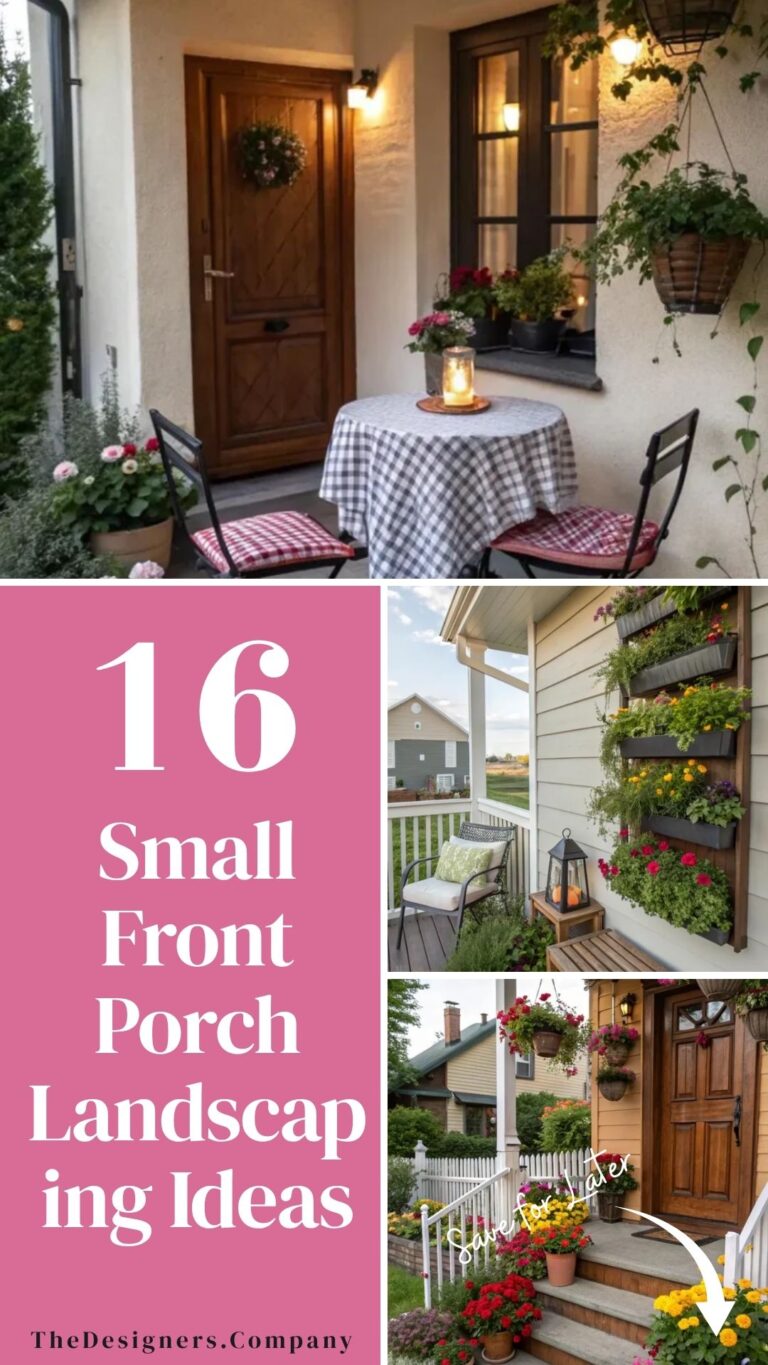
Small Brick Patio Ideas to Transform 25 Tiny Yards into Havens

Small brick patio ideas let you turn a narrow side yard, a 10 x 10-foot backyard corner, or an unused strip beside the garage into a usable outdoor room with just a few hundred bricks and a weekend of labor. Below are 25 small brick patio designs sorted by pattern, style, and function, each with specific brick types, layout dimensions, base-preparation steps, and cost estimates so you can pick the right plan for your space and budget.
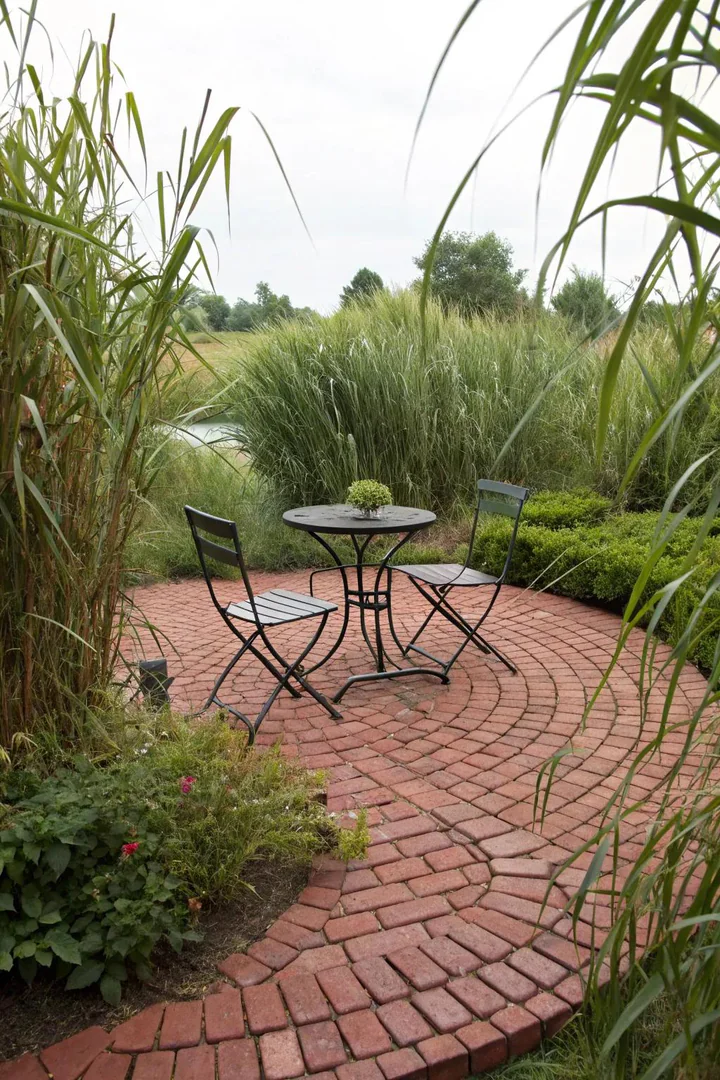
1. Cozy Circular Brick Patio
A circular patio built from standard 4 x 8-inch clay pavers arranged in concentric rings fills a tight backyard corner without the sharp edges that rectangular layouts create. Start with a 10-foot-diameter circle (about 78 square feet) staked from a center pin and string line, and lay the bricks in a radial fan pattern with tapered cuts at each ring’s end.
Excavate 7 inches deep, compact 4 inches of crushed limestone base (#411 or QP stone) with a plate compactor, spread 1 inch of coarse concrete sand, and screed level. A 10-foot circle uses roughly 440 standard pavers at $0.50 to $1.00 each from suppliers like Boral, Pine Hall, or General Shale. Fill the joints with polymeric sand (Techniseal HP2 or Alliance Gator Maxx G2) and mist to activate.
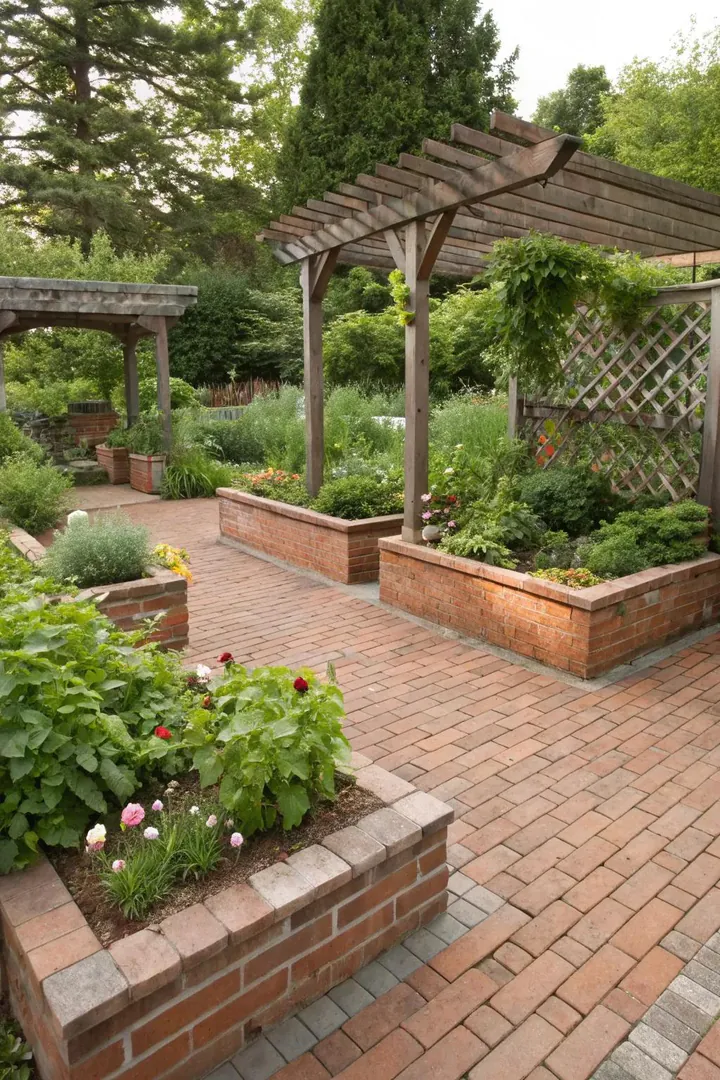
2. Raised Garden Brick Patio
Raising a small patio 12 to 18 inches above the surrounding grade separates the sitting area from garden beds and creates built-in retaining walls that double as casual seating. Build the walls from matching brick laid in a standard running bond pattern with Type S mortar joints at 3/8-inch thickness.
Fill behind the walls with compacted gravel, top with filter fabric, and lay the paver surface on a sand-set bed inside the raised frame. An 8 x 10-foot raised patio needs approximately 120 linear feet of wall brick (three courses high at 2.25 inches per course) plus 560 pavers for the floor surface.
3. Basketweave Brick Pattern
Basketweave is one of the simplest brick patterns to lay because every pair alternates between horizontal and vertical orientation with zero angled cuts. A standard 4 x 8-inch paver produces a perfect basketweave with no waste, and the pattern looks complete at any patio size because the two-brick module repeats identically across the full surface.
Set the border course first using soldier-style bricks standing on end in a trench 4.5 inches wide, then fill the interior field with alternating pairs. A 100-square-foot basketweave patio uses about 450 pavers and takes a single person four to six hours to lay after the base preparation is finished.
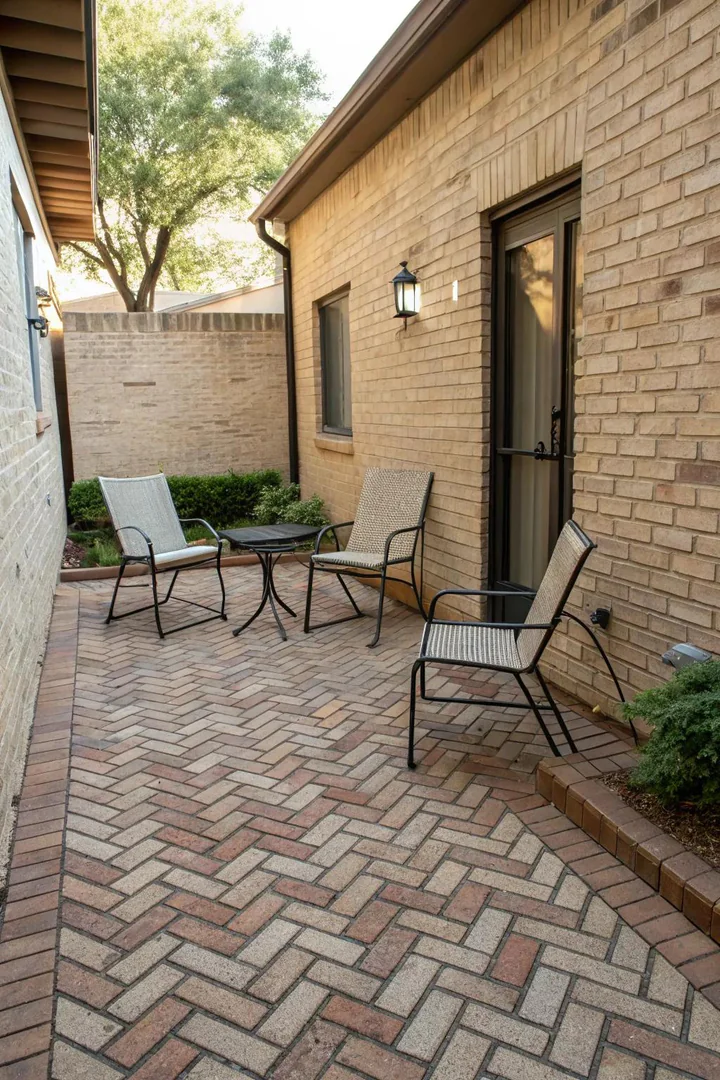
4. Urban Courtyard Brick Patio
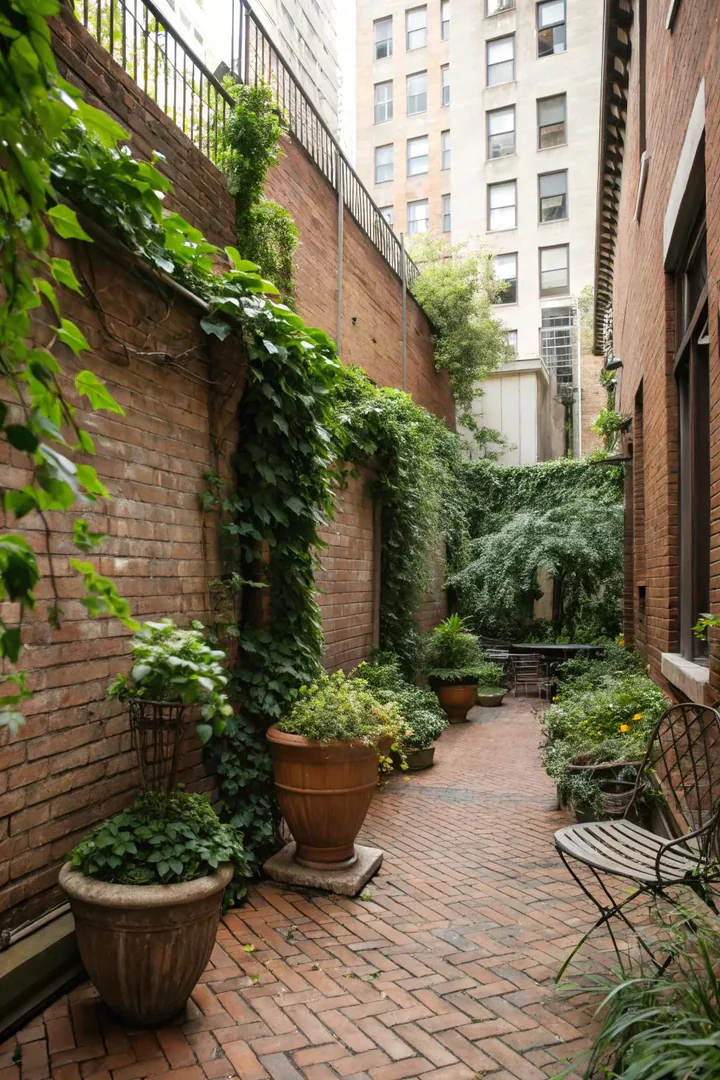
A narrow courtyard between buildings, typically 6 to 10 feet wide and 15 to 20 feet long, becomes a private dining nook when paved with brick and framed by tall planters. Lay dark-toned bricks like Boral Savannah or Pine Hall English Edge in a herringbone pattern to visually widen the space, and paint the adjacent walls white or pale cream to bounce light into the corridor.
Mount wall planters at staggered heights with Boston fern, trailing pothos, or English ivy to soften the hard surfaces. Add a small bistro table set (30-inch round table, two folding chairs) from brands like Fermob or Grand Patio for a compact dining spot that seats two without blocking the walkway.
5. Brick Patio with Water Feature
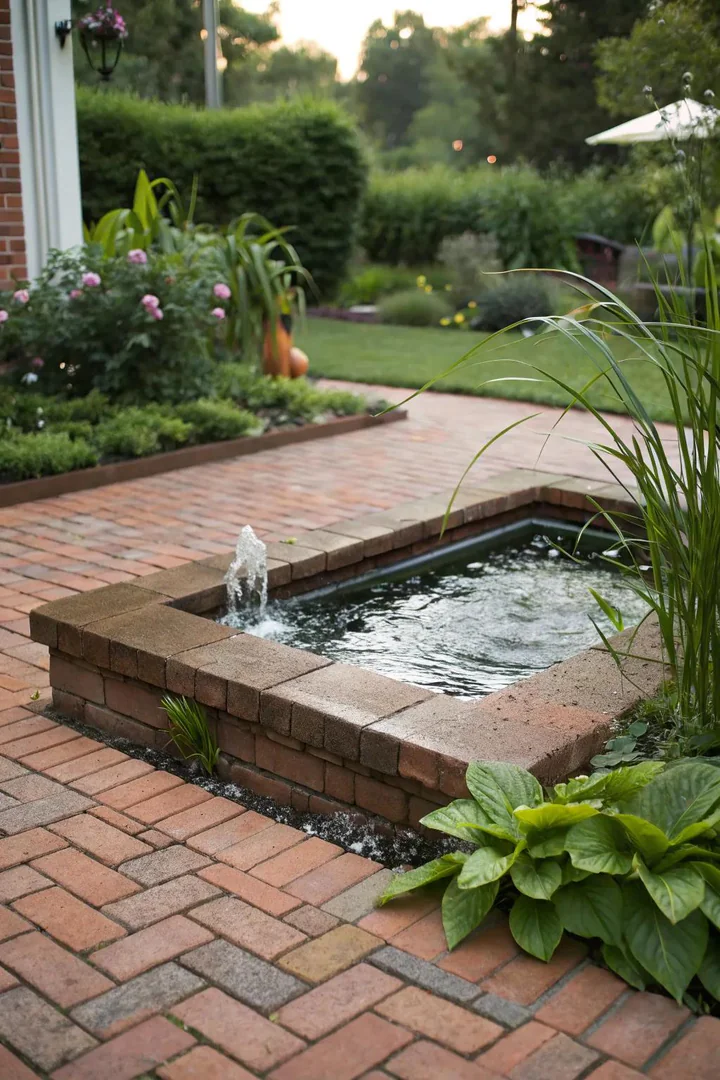
A self-contained bubbling fountain or pondless waterfall adds ambient sound to a small patio without taking up floor space for seating. Install a recessed basin (Aquascape AquaBasin 30 or similar, $100 to $150) below grade at the patio center or one corner, cover with a decorative stone or drilled basalt column, and run a 400-GPH submersible pump on a standard outdoor GFCI outlet.
Route the pump cord through a 1-inch PVC conduit under the brick surface to the nearest outlet so no visible wires cross the patio. A bubbling rock feature adds $200 to $500 total to the patio build and uses roughly the same electricity as a 40-watt light bulb running eight hours per day.
6. Whitewashed Brick Patio
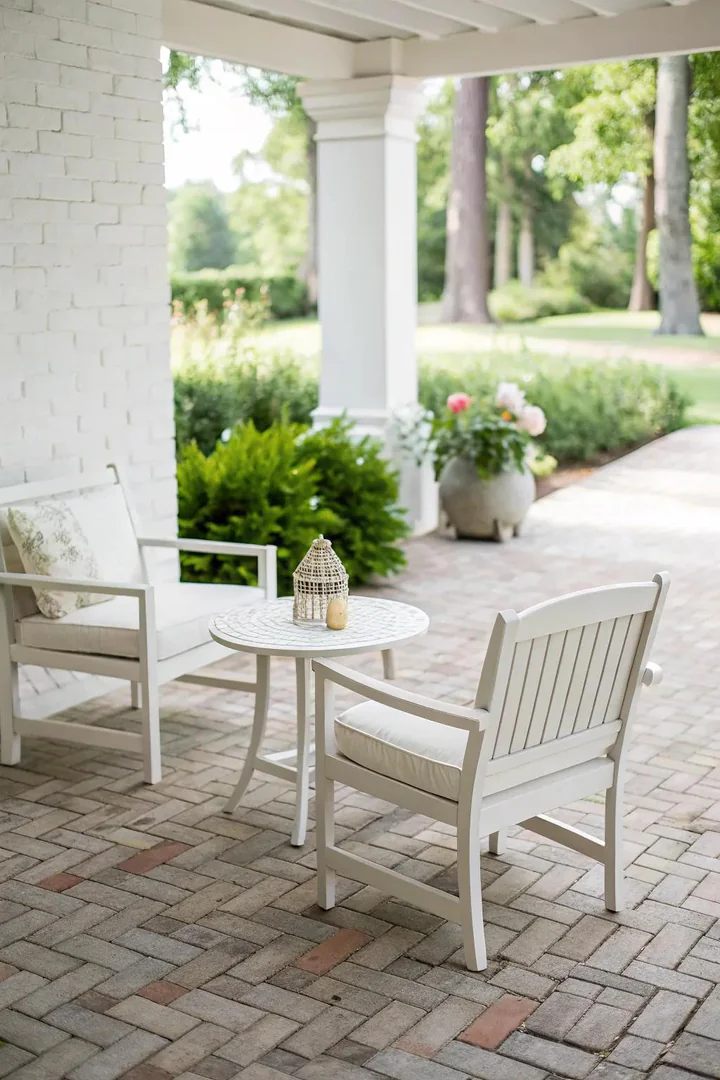
Whitewashing brick pavers with a diluted lime wash (1 part hydrated lime to 3 parts water, brushed on) creates a pale, chalky surface that brightens a shaded side yard and makes a small patio feel larger. Apply the wash with a wide masonry brush in long strokes, and leave some areas thinner than others for a naturally varied finish.
Romabio Classico Limewash ($45 per gallon, covers 100 to 200 square feet) is a ready-mixed option that bonds directly to clay or concrete pavers. Reapply every three to five years as the lime slowly weathers. Pair whitewashed brick with dark-stained outdoor furniture and deep-colored cushions for strong contrast.
7. Modular Seating Brick Patio
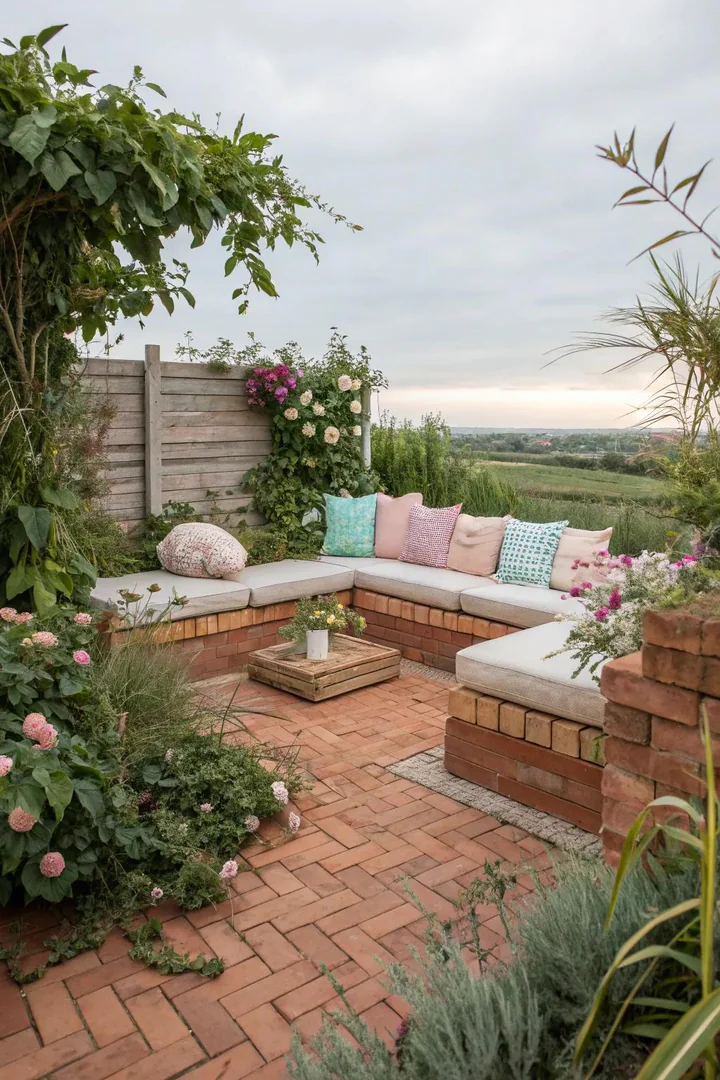
Built-in brick benches along two sides of a small patio eliminate the need for freestanding furniture and keep the center open for foot traffic. Construct each bench as a double-wythe wall (8 inches wide) three courses tall with a 16-inch-deep x 2-inch-thick bluestone or flagstone cap for the seat surface.
A 6-foot L-shaped bench uses roughly 150 bricks and 15 linear feet of capping stone ($8 to $12 per linear foot for natural bluestone). Add 3-inch-thick outdoor cushions with Sunbrella fabric covers ($80 to $150 per bench section from Wayfair or Pottery Barn) for comfort. A built-in bench holds up to 300 pounds per linear foot when mortared on a compacted gravel footing.
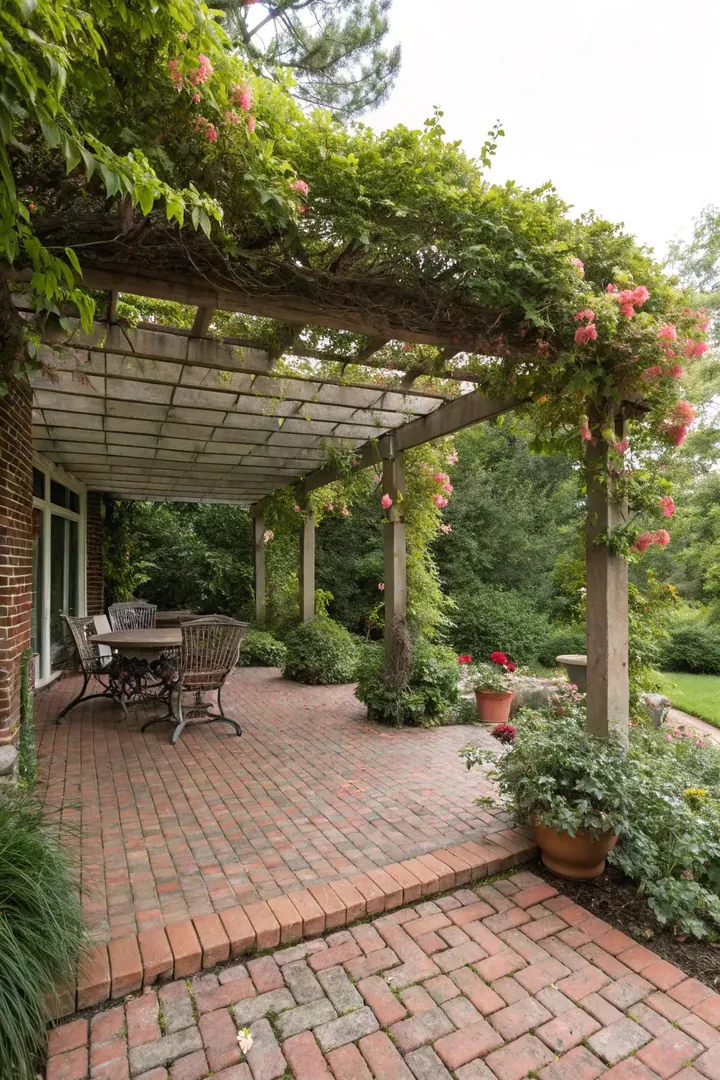
8. Pergola-Covered Brick Patio
Adding a pergola over a small brick patio gives vertical presence to an otherwise flat space and provides a frame for hanging lights, fans, or shade cloth. Size the pergola 2 feet wider and 2 feet deeper than the patio surface so the posts land outside the brick field and anchor into separate footings rather than through the paver surface.
A 10 x 12-foot cedar pergola with 6 x 6-inch posts costs $1,000 to $2,000 in lumber and hardware. Run 14/2 outdoor-rated UF-B cable through one post to power a ceiling fan or two weatherproof pendant lights at the center beam. Browse more covered porch and pergola designs for overhead structure options that match brick patios.
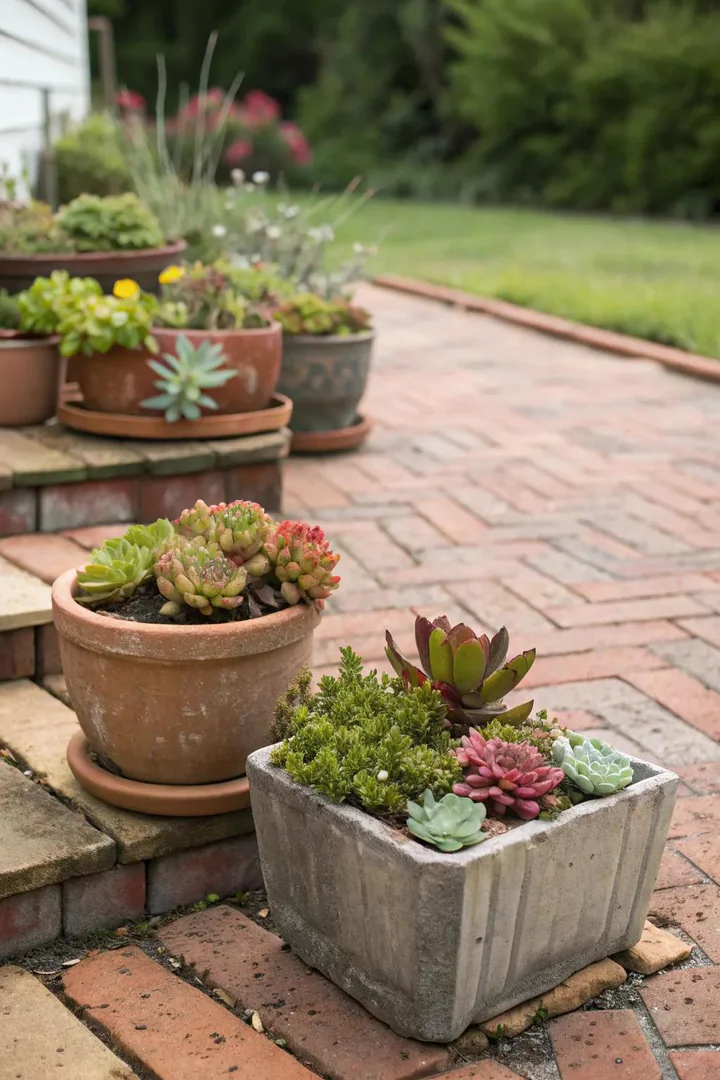
9. Succulent-Bordered Brick Patio
Surrounding a brick patio with a 12 to 18-inch gravel strip planted with low-water succulents creates a finished edge that needs no mowing or trimming. Plant Sempervivum (hens and chicks), Sedum spurium (Dragon’s Blood), and Echeveria in clusters of three to five at 8-inch spacing in a bed of 3/4-inch decomposed granite over garden fabric.
Succulents need full sun and fast-draining soil, making the gravel border next to a brick patio an ideal growing environment. A 50-linear-foot border strip uses about 30 to 40 plants at $3 to $6 each from nurseries like Mountain Crest Gardens or Succulent Source, plus two cubic yards of decomposed granite at $30 to $50 per yard delivered.
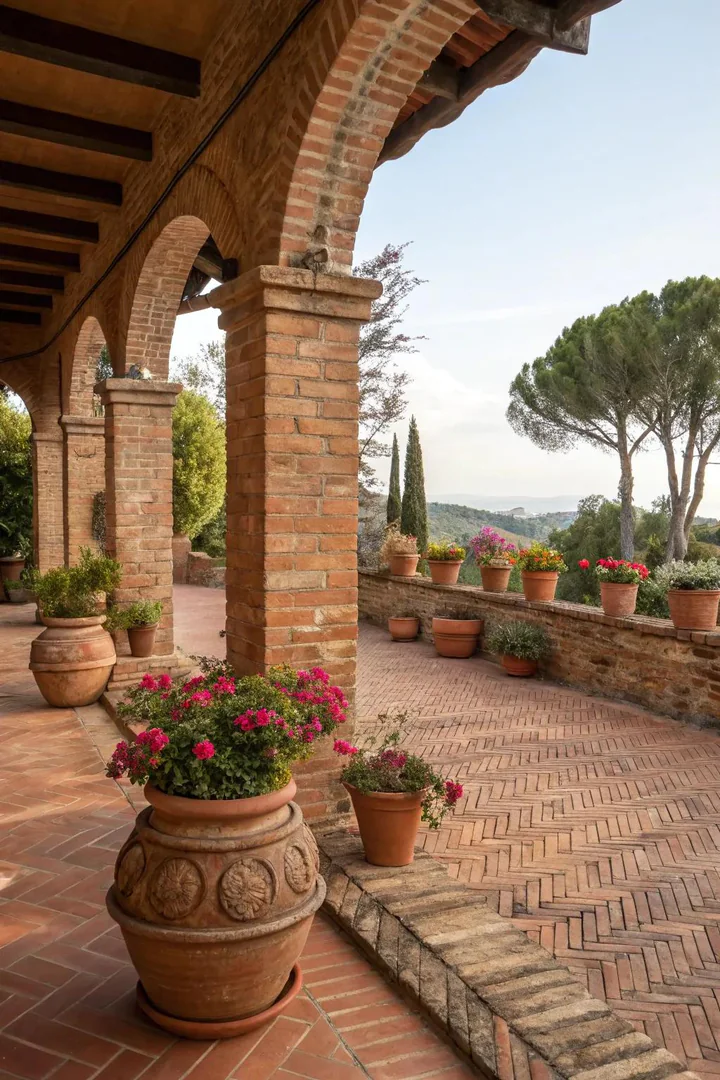
10. Mediterranean-Style Brick Patio
Warm terracotta-colored brick pavers paired with cobalt blue tile accents, glazed ceramic planters, and olive or citrus trees recreate a Southern European courtyard in a small backyard. Use tumbled clay pavers with irregular edges (Old Chicago style at $1.50 to $2.50 each) for an aged, weathered appearance straight from the box.
Add a 4-inch accent band of hand-painted Talavera tiles ($8 to $15 per tile from Mexican Tile Designs or Latin Accents) set into the brick surface at the patio border or around a central focal point. Plant a dwarf Arbequina olive tree in a 24-inch glazed Italian terracotta pot as the centerpiece, and add trailing rosemary or lavender at the patio edges for scent.
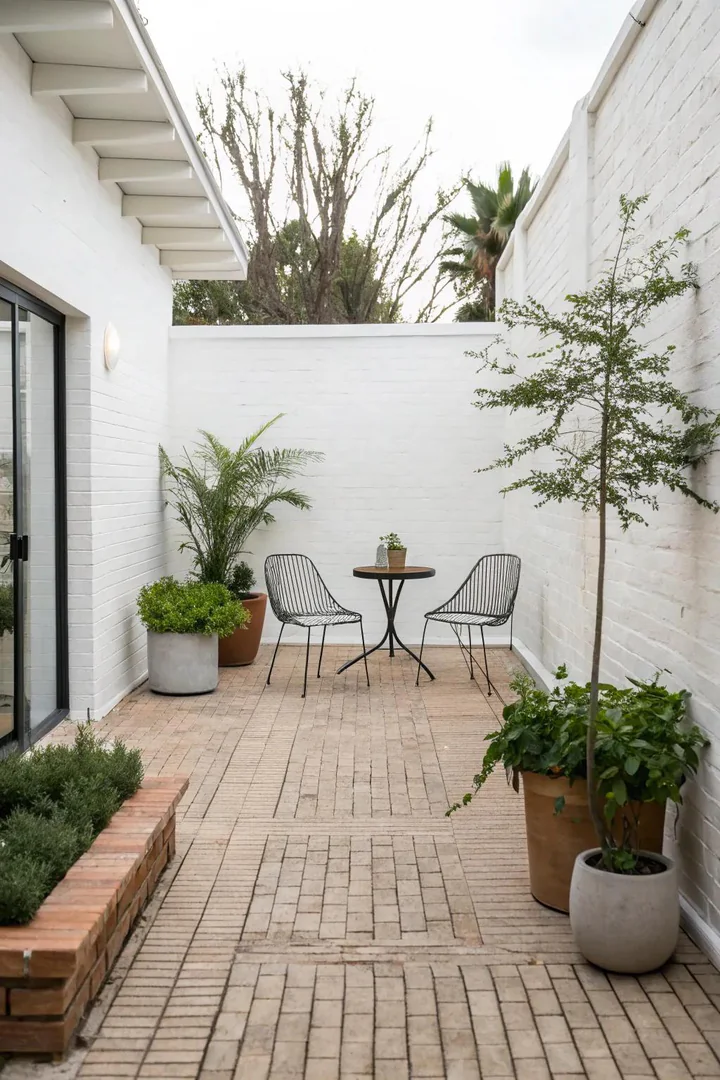
11. Minimalist Zen Brick Patio
A minimalist approach uses a single brick bond pattern with no accent borders, one piece of low-profile furniture, and a single specimen tree or boulder to create a calm outdoor room. Lay gray or charcoal-colored brick pavers (Belgard Holland Stone in Charcoal or Unilock Brussels Block in Midnight) in a simple stack bond (all bricks facing the same direction) for the cleanest possible line.
Place one Japanese maple, one large weathered granite boulder (200 to 400 pounds, $100 to $250 from stone yards), and a single teak meditation bench at the far edge. Surround the patio with raked pea gravel and three to five upright ornamental grasses (Miscanthus sinensis Morning Light or Karl Foerster) for soft vertical movement.
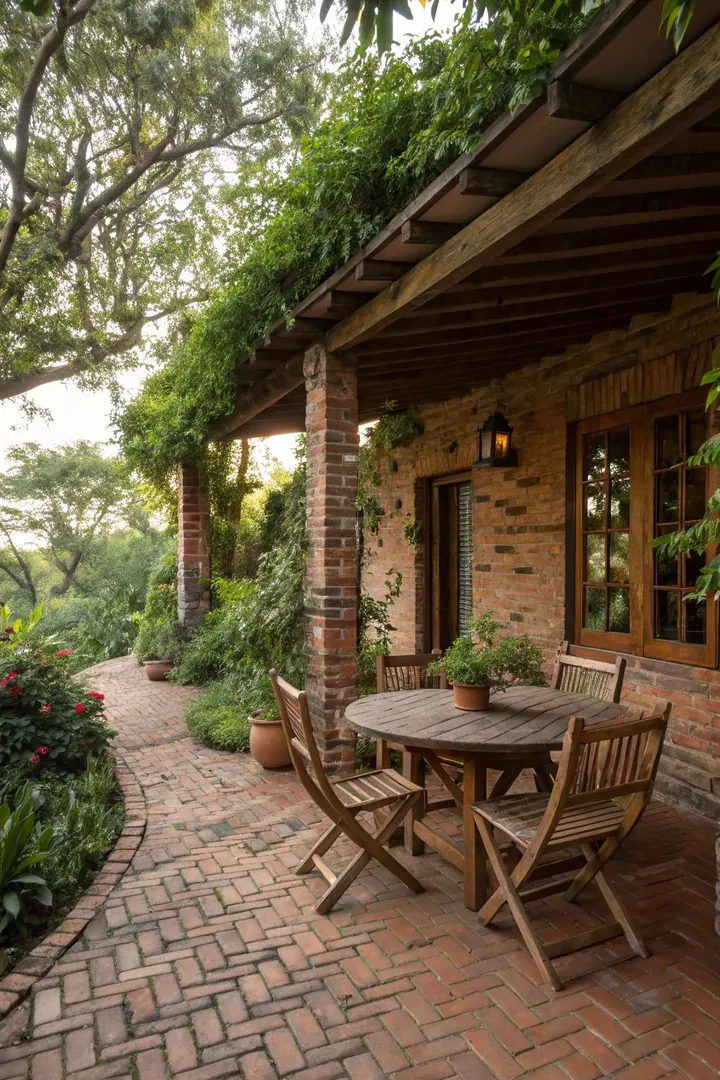
12. Rustic Reclaimed Brick Patio
Salvaged bricks from demolished chimneys, old sidewalks, or torn-down buildings cost $0.25 to $0.60 each and carry natural color variation, chipped edges, and old mortar marks that new pavers cannot replicate. Mix red, brown, and buff-colored reclaimed bricks randomly across the patio surface for a patchwork look, and leave slightly wider joints (1/2 inch versus the standard 1/4 inch) to account for size inconsistencies.
Pair a reclaimed brick patio with pallet garden furniture and weathered wooden accessories to match the aged character. Source reclaimed brick from local salvage yards, Craigslist, or specialty dealers like Gavin Historical Bricks ($0.50 to $1.50 per brick for hand-cleaned stock).
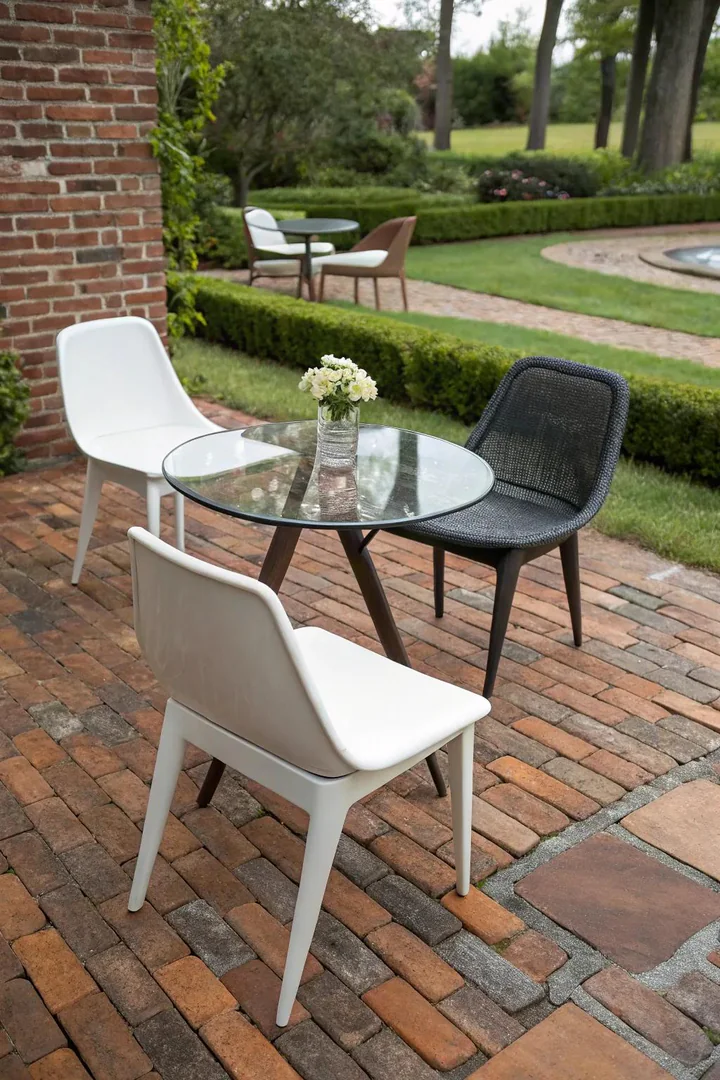
13. Modern and Classic Brick Blend
Combining traditional red clay brick in the center field with a sleek gray concrete paver border creates a two-tone effect that bridges old and new styles. Lay the red brick interior in a herringbone pattern and frame the border with 12 x 12-inch square concrete pavers from Belgard or Pavestone in a smooth charcoal finish for a clean geometric frame.
Keep the border width at 12 to 16 inches (one or two paver widths) for small patios under 150 square feet so the frame does not overpower the brick center. Use a rigid PVC paver edging strip (Dimex EasyFlex or SnapEdge) between the two materials to maintain a straight separation line and prevent lateral shifting over time.
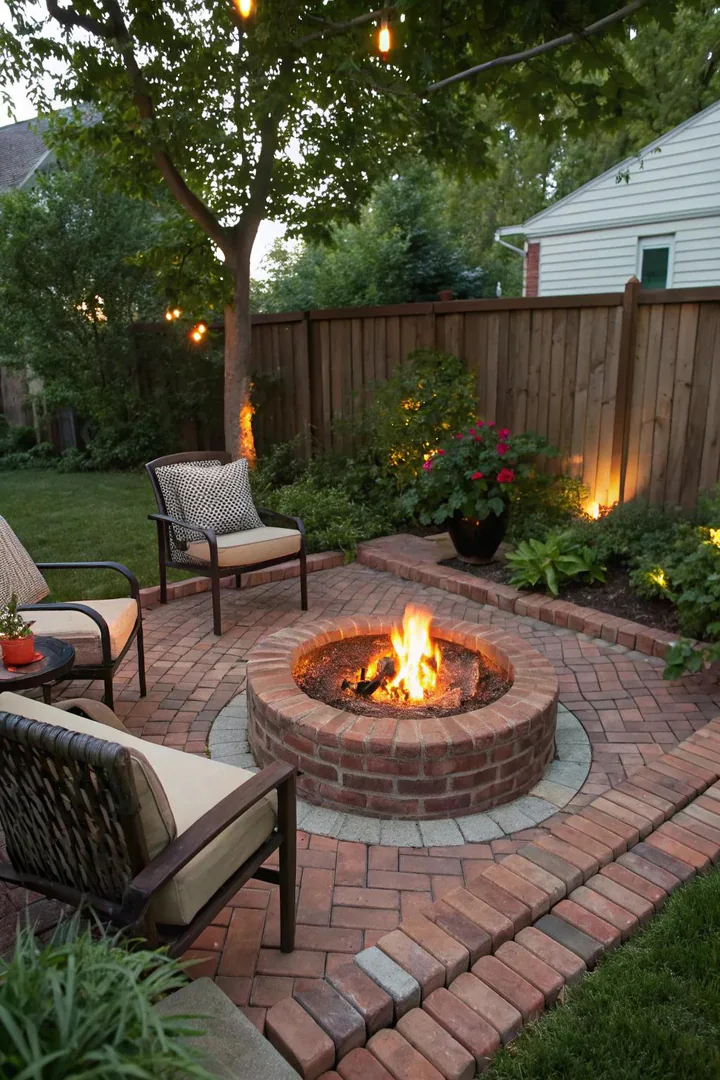
14. Brick Patio with Fire Pit
A built-in brick fire pit at the center of a small patio serves as the anchor point for seating and adds warmth for three-season use. Build a 36-inch inside-diameter circular pit from fire-rated brick (split firebrick or refractory brick rated to 2,300°F) lined inside with a steel fire ring insert ($40 to $80 from Sunnydaze or Blue Sky Outdoor Living).
Keep the fire pit at least 10 feet from any structure, fence, or overhead branch per most local fire codes. A 12 x 14-foot patio with a center pit leaves a 3-foot walkway on all sides for chair placement. Use a spark screen cover when burning and install a gas conversion kit (Stanbroil or American Fireglass, $80 to $150) for push-button ignition with propane or natural gas.
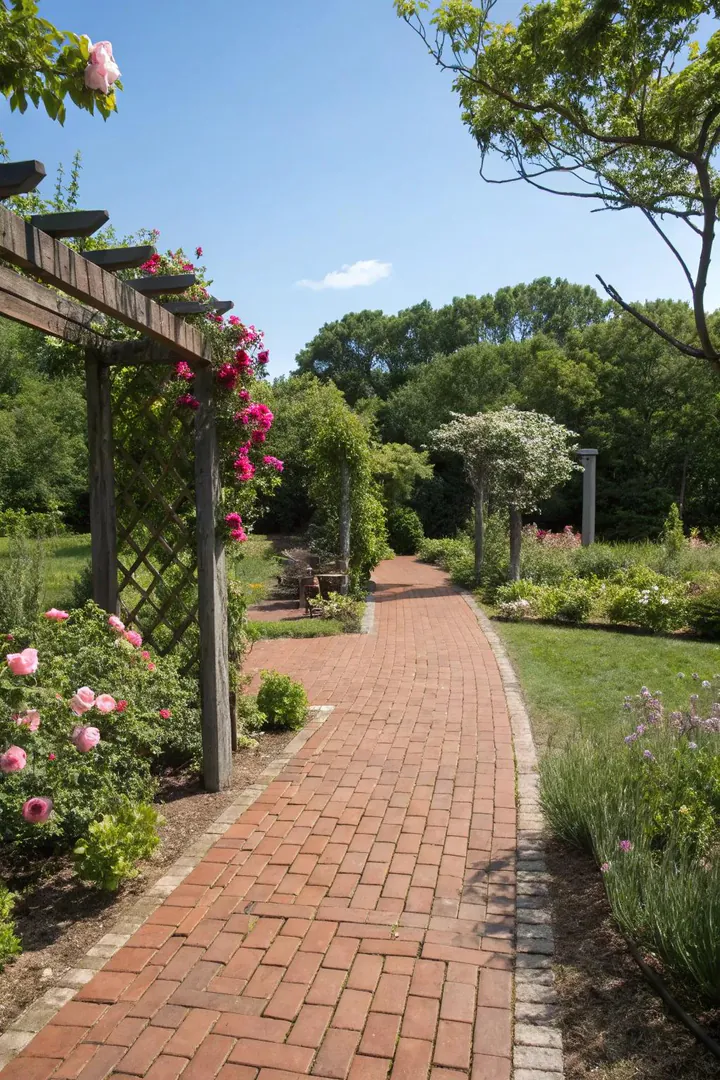
15. Garden Pathway Brick Connection
Extending a narrow brick path from the patio out to a garden shed, raised bed area, or backyard play zone ties the outdoor space together and keeps foot traffic off wet grass. A 3-foot-wide path needs only two pavers across plus a half-brick on each edge, using about 4.5 pavers per linear foot.
Curve the path gently rather than running a straight line to create a sense of distance in a small yard. Cut curves by scoring each brick with a diamond blade on a 4.5-inch angle grinder (DeWalt DWE402 or Makita GA4530) and snapping along the line. A 30-foot connecting path uses roughly 135 pavers and takes two to three hours to lay on a prepared sand bed.
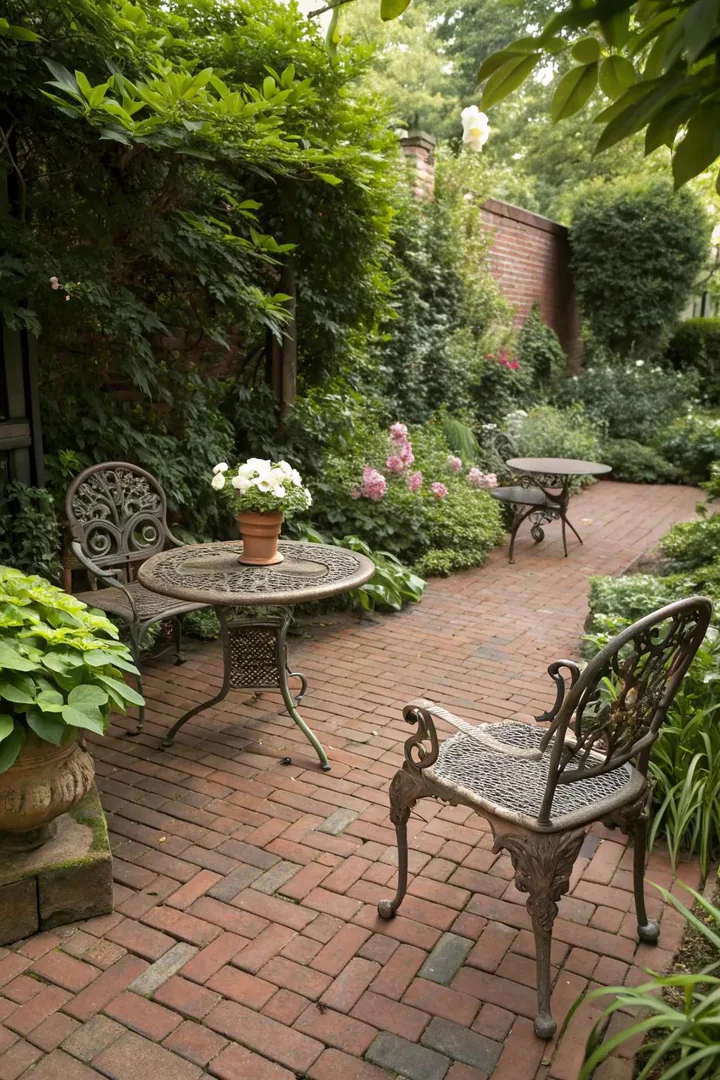
16. Vintage Brick Patio
A vintage-themed patio pairs old-stock red clay bricks with wrought iron furniture, cast iron planters, and flowering annuals like geraniums, petunias, and marigolds for a look pulled from a 1940s garden catalog. Source used wire-cut bricks with a rough texture and inconsistent color from salvage dealers, or buy tumbled “antique” pavers from manufacturers like Old Mill Brick or Brick It.
Set the pavers in a running bond pattern with sand-colored polymeric joint sand for a traditional grouted appearance. Add a vintage-reproduction cast aluminum bistro set ($200 to $400 from Amazon Basics or Christopher Knight Home) with scrollwork detailing and an oil-rubbed bronze finish.
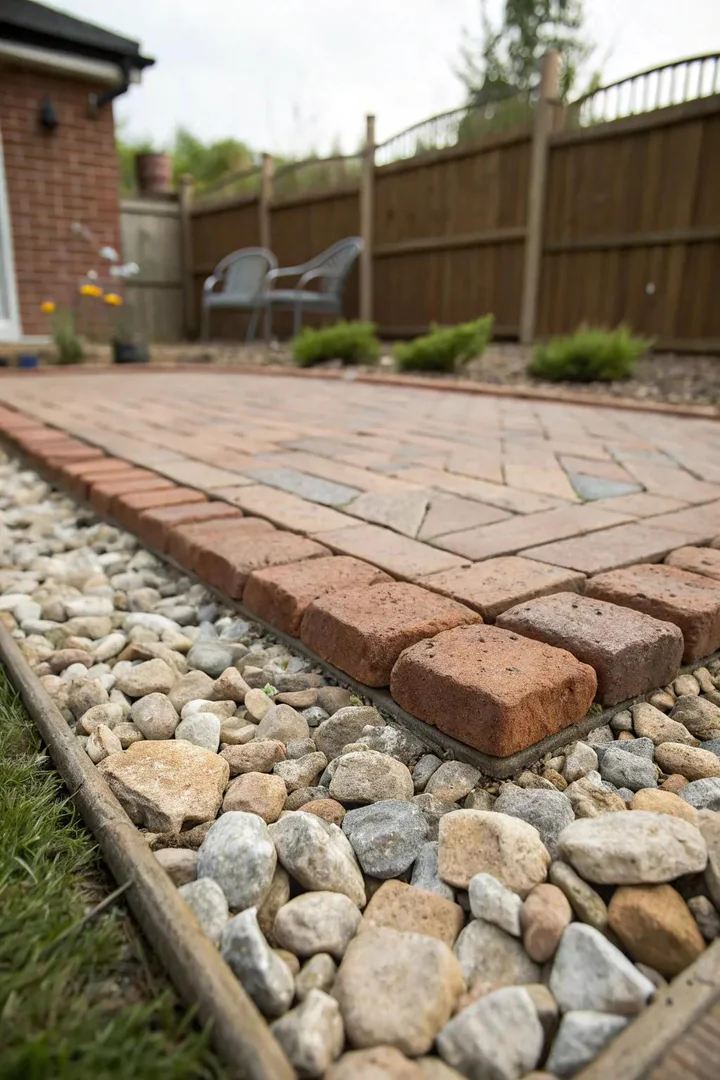
17. Floating Brick Patio
A “floating” patio separates the brick surface from the surrounding lawn or garden with a 4 to 6-inch gap filled with white marble chips, river rock, or crushed oyster shell, creating the visual effect of a platform hovering above the ground. Line the gap trench with heavy-duty garden fabric to prevent weed growth and fill to the level of the brick surface.
Bright white 3/8-inch marble chips from Vigoro or Southwest Boulder ($5 to $8 per 0.5 cubic foot bag) provide the strongest contrast against red or brown brick. A 10 x 10-foot patio with a 6-inch border gap needs roughly eight bags of stone. Edge both the inner brick field and the outer lawn border with aluminum paver edging to maintain clean separation lines.
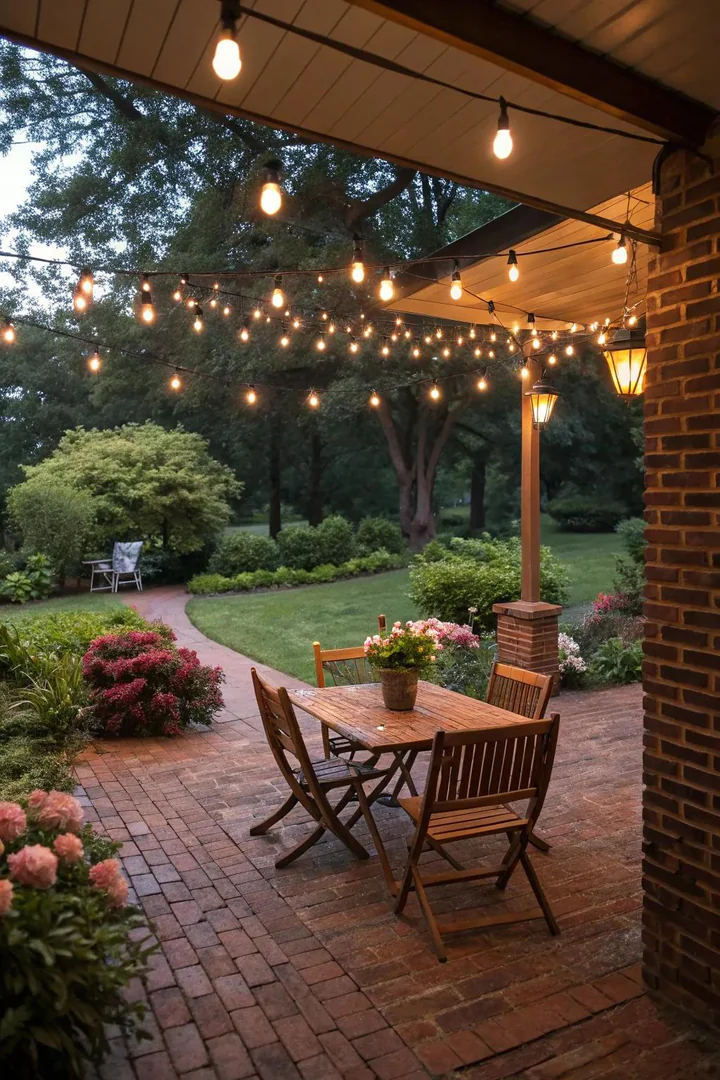
18. Outdoor Dining Brick Patio
Sizing a patio specifically for outdoor dining means allowing a 5-foot clear diameter per table (for a 42-inch round table with pulled-out chairs) plus a 3-foot service path around the perimeter. A dedicated 10 x 12-foot dining patio comfortably holds one 6-person rectangular table or two 2-person bistro sets.
Lay the brick in a 90-degree herringbone pattern for maximum interlock strength under heavy table and chair legs, which concentrate load on small contact points. Level the surface to within 1/8 inch over 10 feet using a laser level or a long straightedge and torpedo level. Set a picnic table on the finished surface for a casual family dining spot that handles six to eight guests.
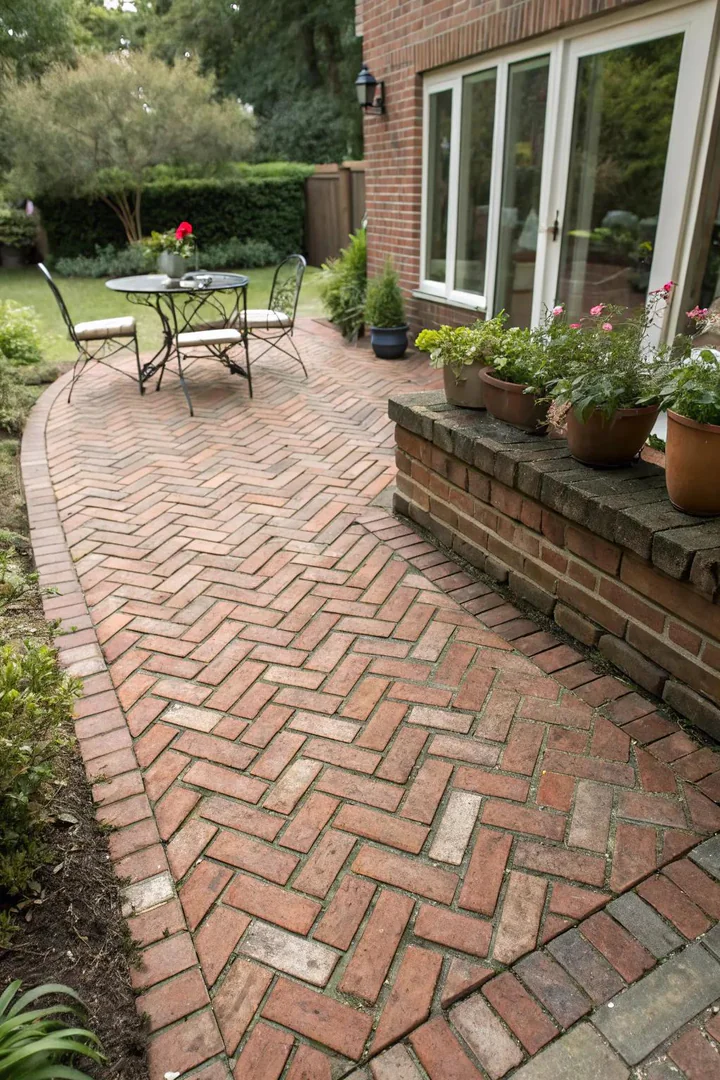
19. Herringbone Brick Pattern
Herringbone is the strongest sand-set paver pattern because each brick locks against its neighbor at 45 or 90 degrees, preventing lateral shifting under foot traffic and furniture weight. A 45-degree herringbone (bricks set diagonally to the border) looks bolder than a 90-degree version but generates more waste from perimeter cuts, roughly 10 to 15 percent versus 5 percent.
Start the pattern from the center of the patio and work outward to keep the visual alignment balanced. Cut the half-bricks at the border with a guillotine-style brick splitter (Bon Tool 11-590 or QEP 32400, $70 to $100) for fast, straight cuts without dust. A soldier-course border (bricks standing upright on their long edge) frames the herringbone field and provides a rigid edge against the lawn.
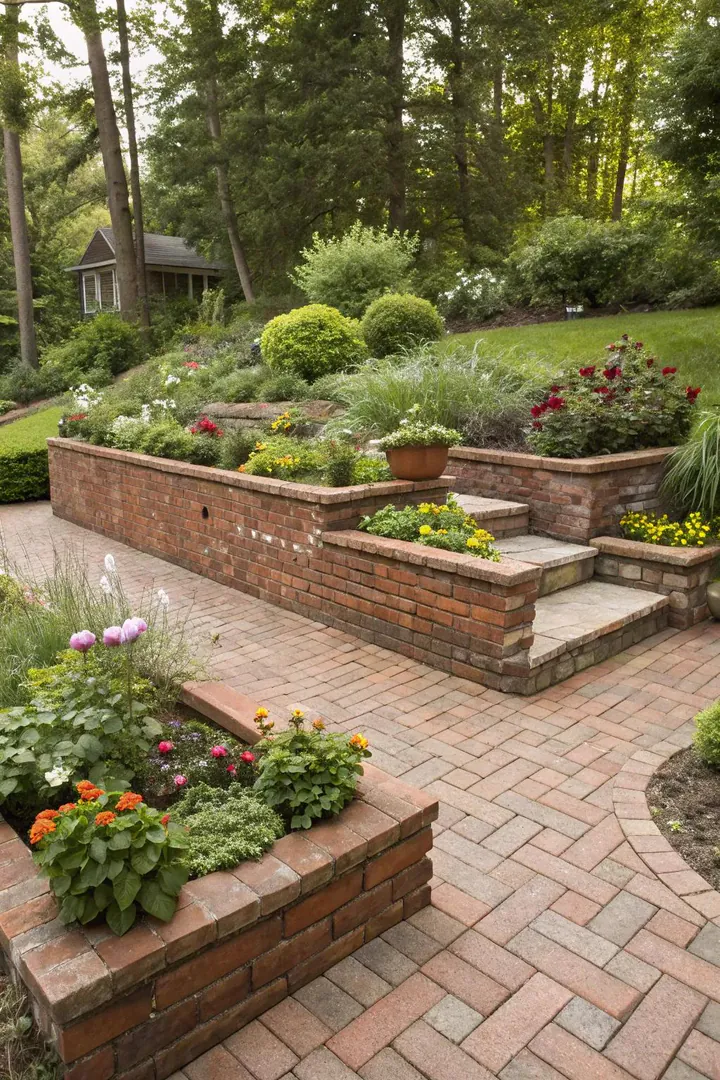
20. Layered Planting Bed Border
Building tiered brick planting beds along one edge of a small patio adds vertical greenery without reducing the usable floor area. Stack three beds at 8, 16, and 24 inches tall against a fence or wall, each bed 12 inches deep and lined with pond liner or a commercial planting membrane.
Fill each tier with a 60/40 mix of topsoil and compost, and plant trailing varieties (creeping jenny, sweet potato vine, trailing verbena) in the top tier so foliage drapes over the brick face. A 6-foot-wide three-tier planter wall uses roughly 200 bricks and 6 bags of Miracle-Gro All Purpose Garden Soil ($6 to $8 per 1-cubic-foot bag).
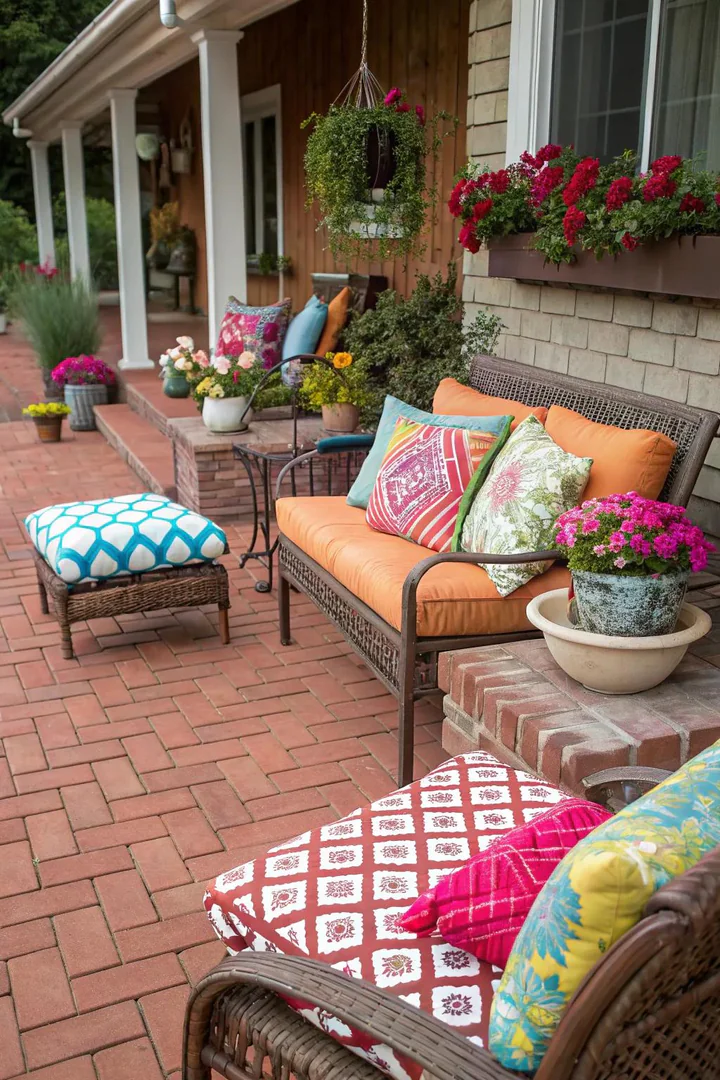
21. Colorful Accent Brick Patio
Painting select bricks in bold accent colors creates custom borders, stripes, or medallion shapes within a standard red or brown brick field. Use Rust-Oleum Concrete and Masonry Paint ($30 per gallon) or Behr Masonry, Stucco, and Brick Paint ($35 per gallon) applied with a 4-inch foam roller for even coverage on the rough paver surface.
Mask adjacent bricks with painter’s tape (FrogTape Multi-Surface for the best edge seal) before painting, and apply two coats with four hours of drying time between. Popular accent patterns include a single contrasting border row, a center diamond, or alternating colored bricks at every fifth position in the field. Choose colors with a UV-stable formula to prevent fading over two to three outdoor seasons.
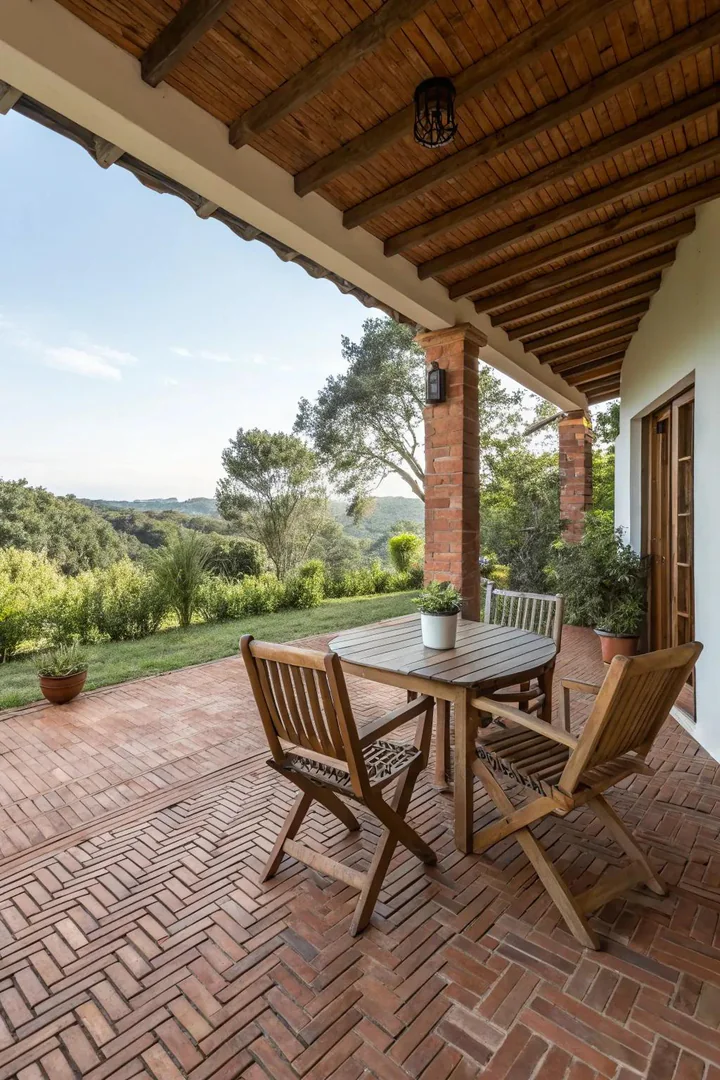
22. Brick and Wood Combination Patio
Alternating 3-foot sections of brick pavers and cedar or ipe deck boards across the same patio surface creates a striped material pattern that breaks up the visual weight of a single surface. Lay the brick sections on a standard compacted gravel and sand base, and build the wood sections as mini deck frames (2 x 6 joists on adjustable deck pedestals) set to the exact same finished height.
Use ipe hardwood ($4 to $7 per linear foot) or thermally modified ash ($3 to $5 per foot) for the wood sections because both species resist rot for 20-plus years without chemical treatment. Match the transition between materials with a Z-flashing strip or an aluminum T-bar ($2 per linear foot) to keep the joint clean and prevent sand migration between sections.
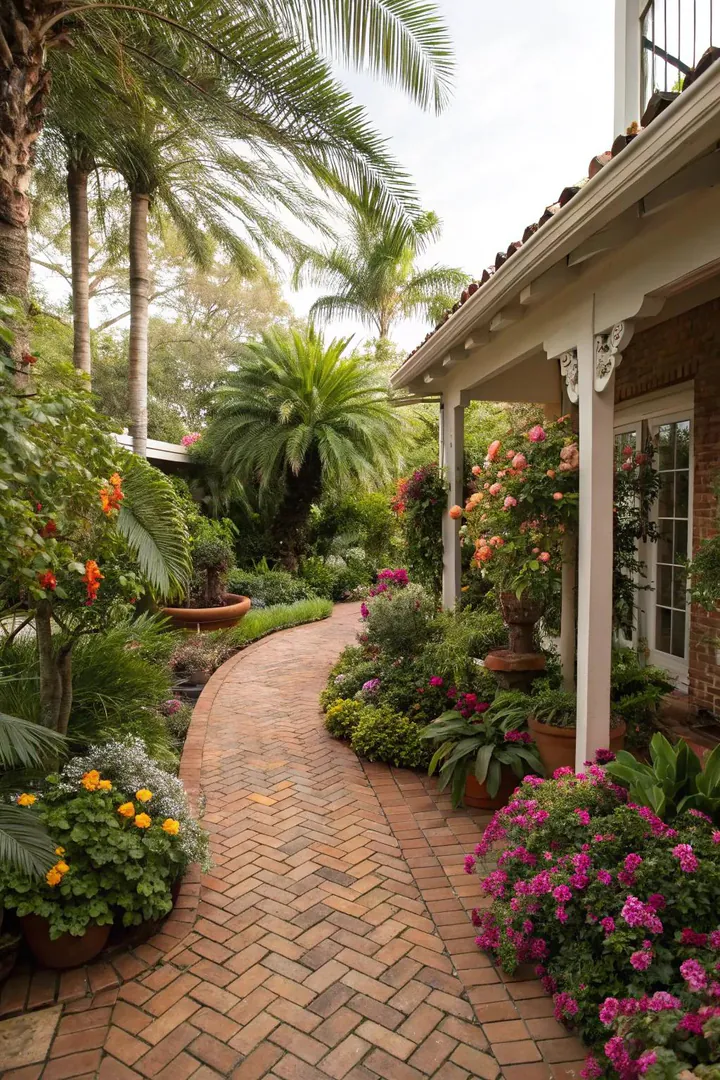
23. Tropical Brick Patio
Dense tropical planting around a small brick patio produces a private, enclosed feel even in a suburban backyard. Plant tall screening species like Bambusa multiplex (clumping bamboo, non-invasive, USDA zones 7 to 11) or Musa basjoo (cold-hardy banana, zones 5 to 10) at the back and sides, and fill the mid-ground with Strelitzia reginae (bird of paradise) and Philodendron bipinnatifidum for large-leaf texture.
Choose warm-toned brick pavers in coral, salmon, or gold (Belgard Dublin Cobble in Harvest Blend or Pavestone Rumblestone in Sierra Blend) to match the tropical color palette. Add a 4-foot tiki torch set ($20 to $40 for a four-pack from TIKI Brand) and a small tabletop water fountain for sound and atmosphere during evening gatherings.
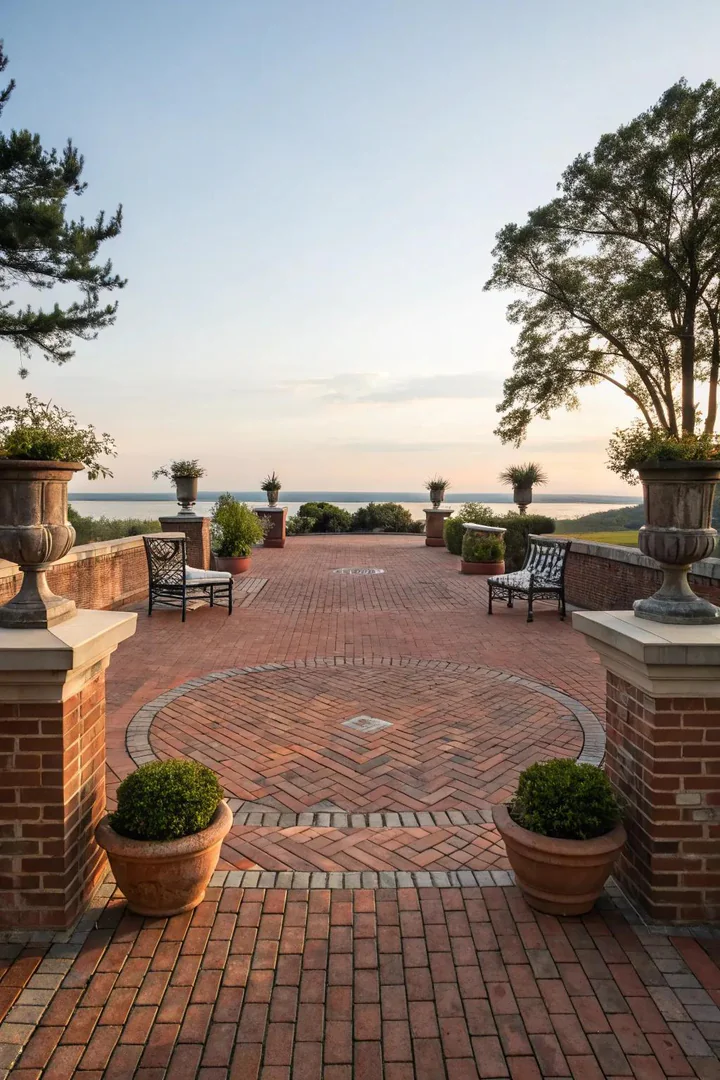
24. Symmetrical Brick Layout
A symmetrical design places matching furniture, planters, and greenery on both sides of a center axis line running through the patio for a formal, balanced composition. Mark the centerline with a chalk snap line before laying any bricks, and build the pattern outward from that axis so the bond lines mirror perfectly on left and right.
Place two identical planters (cast stone or fiberglass urns, 24-inch diameter) with matching spiral or ball topiary boxwood at the patio entrance. Set two identical benches or chairs on opposite sides at equal distances from center. A formal symmetrical layout works best on rectangular patios at least 8 x 12 feet where the long axis provides the visual centerline.
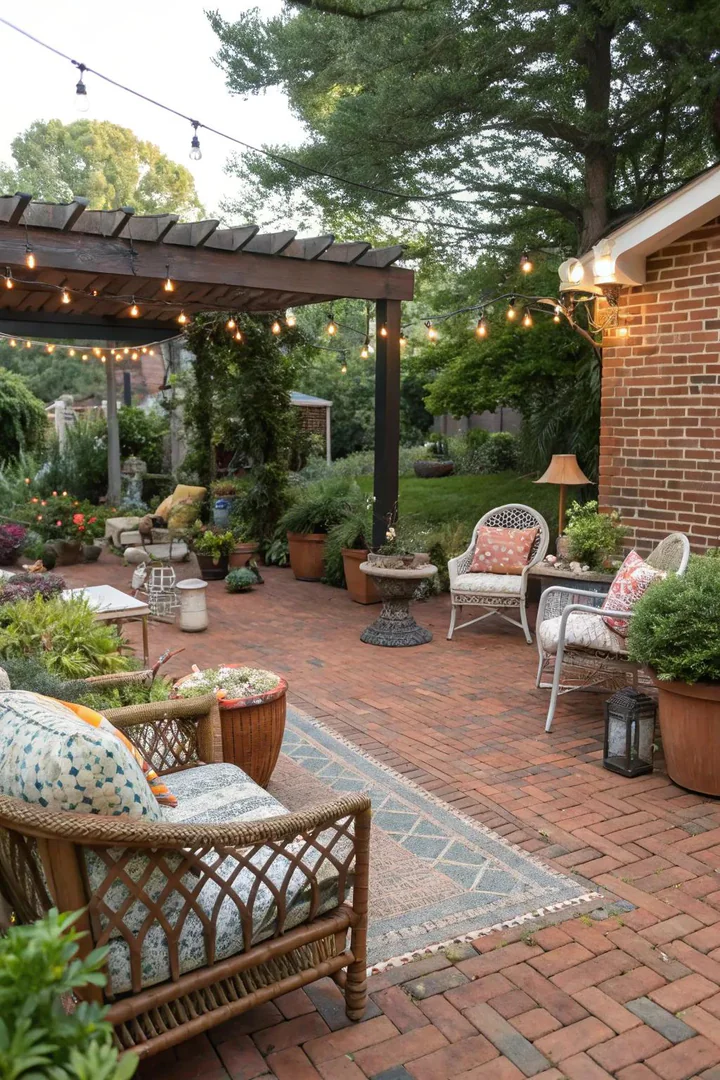
25. Eclectic Mixed-Material Patio
An eclectic patio mixes two or three paving materials (brick, cobblestone, flagstone, or exposed aggregate) in distinct zones separated by metal or stone edging strips. Assign each material to a function: brick for the dining area, flagstone for the lounge zone, and cobblestone for the pathway connections between zones.
Use flexible aluminum edging (Col-Met 14-gauge or Master Mark Pro-Series) between materials to maintain clean borders. Keep the color palette limited to warm earth tones (red, brown, tan, gray) so the mixed textures read as intentional rather than random. A 120-square-foot three-zone patio costs roughly $400 to $900 in materials depending on the mix of brick, stone, and aggregate prices in your area.
How to Build a Small Brick Patio
1. Mark the Layout and Excavate
Outline the patio shape with spray paint or garden hoses, then drive 1 x 2 wooden stakes every 4 feet around the perimeter and run mason’s line between them at the finished patio height. Excavate the marked area 7 to 8 inches deep (4 inches of gravel base + 1 inch of sand bed + 2.25 inches of paver thickness) using a flat-bottom shovel and a wheelbarrow. Slope the excavation 1/4 inch per foot away from any adjacent building foundation for proper water drainage.
2. Compact the Gravel Base
Fill the excavation with 4 inches of crushed limestone aggregate (AASHTO #57 or #411 dense-grade) spread in two 2-inch lifts, compacting each lift with a gas-powered plate compactor (rent from Home Depot or Sunbelt for $80 to $100 per day). Run the compactor in overlapping passes until the surface feels solid underfoot and shows no visible movement. A well-compacted base prevents settling and uneven brick surfaces after the first rain.
3. Screed the Sand Bed
Spread 1 inch of coarse concrete sand (ASTM C33 specification) over the compacted base. Lay two 1-inch-diameter metal conduit pipes parallel on the gravel as screed guides, spaced 4 feet apart, and drag a straight 2 x 4 board across the pipes to level the sand to a uniform 1-inch depth. Remove the pipes and fill the channels by hand with sand after screeding each section.
4. Lay the Bricks and Set the Border
Start laying bricks from one corner or from the center axis (for herringbone patterns) and work outward, placing each brick directly onto the screeded sand without sliding. Leave 1/8 to 1/4-inch gaps between bricks for joint sand. Install rigid paver edging (Dimex EasyFlex No-Dig, $0.60 per linear foot) along all exposed edges and stake every 12 inches with 10-inch galvanized ground spikes.
5. Fill Joints and Compact the Surface
Sweep polymeric sand (Techniseal HP2 or Alliance Gator Maxx G2, $25 per 50-pound bag) across the entire surface using a push broom, working the sand into every joint. Run the plate compactor over the finished brick surface with a rubber pad attached to prevent chipping the pavers. Mist the surface gently with a garden hose nozzle set to shower mode until water pools briefly in the joints, activating the polymer binder. Allow 24 hours of dry weather before placing furniture on the finished patio.
Brick Patio Pattern Comparison
| Pattern | Difficulty | Waste from Cuts | Interlock Strength | Best Patio Size | Visual Effect |
|---|---|---|---|---|---|
| Running Bond | Easy | 5% | Moderate | Any size | Traditional, linear |
| Basketweave | Easy | Under 3% | Moderate | Square or rectangular | Woven texture, classic |
| 90° Herringbone | Moderate | 5 to 8% | High | Medium to large | Strong visual anchor |
| 45° Herringbone | Moderate-Hard | 10 to 15% | Highest | Medium to large | Diagonal movement, bold |
| Stack Bond | Easy | Under 2% | Low | Small, accent areas | Clean grid, modern |
| Circular/Radial | Hard | 15 to 20% | Moderate | Small circles (8 to 12 ft) | Focal point, organic |
Frequently Asked Questions
How many bricks do you need for a small patio?
A standard 4 x 8-inch clay paver covers 0.22 square feet, so one square foot of patio needs 4.5 pavers. A 10 x 10-foot patio (100 square feet) requires approximately 450 bricks, plus 5 to 15 percent extra for cuts and waste depending on the pattern. Running bond and basketweave generate the least waste (5 percent), while 45-degree herringbone and circular patterns need 10 to 20 percent overage. Order all bricks from the same production lot to ensure consistent color.
How much does a small brick patio cost to build?
A DIY 100-square-foot brick patio costs $300 to $800 in materials: $200 to $450 for pavers, $50 to $100 for gravel base and sand, $25 to $40 for polymeric joint sand, $20 to $30 for edging, and a plate compactor rental at $80 to $100 for one day. Hiring a contractor raises the total to $10 to $25 per square foot installed ($1,000 to $2,500 for 100 square feet), with the labor portion accounting for 50 to 60 percent of the bill.
Can you lay brick pavers directly on dirt without a gravel base?
Laying bricks directly on compacted soil works only in sandy, well-drained ground where the native soil already passes the Proctor density test at 95 percent compaction. Clay soils, expansive soils, and any area with poor drainage will cause pavers to shift, sink, and become uneven within one to two years without a proper gravel base. Always install a minimum 4-inch compacted aggregate base for long-term stability, even on seemingly firm ground.
What is the easiest brick pattern for beginners?
Basketweave is the easiest pattern because every paver lays flat with no angled cuts, and the repeating two-brick module is simple to follow. Running bond (half-offset rows, like a brick wall turned sideways) is the second-easiest and needs only half-brick cuts at the row ends. Avoid 45-degree herringbone and circular patterns for a first project because both require an angle grinder or wet saw for dozens of perimeter cuts. Visit The Designers Company for step-by-step pattern guides and more outdoor building projects.
How do you prevent weeds from growing between brick patio joints?
Polymeric sand (Techniseal HP2, Alliance Gator Maxx G2, or Sakrete Paver Set) fills the joints with a polymer-modified sand that hardens when misted with water, blocking weed seeds from germinating in the gaps. Reapply polymeric sand every three to five years as the original fill erodes from rain and pressure washing. For existing weeds, spray a non-selective herbicide (concentrated glyphosate at 41 percent) directly into affected joints, wait seven days for the roots to die, scrape out the old sand, and refill with fresh polymeric sand.
How long does a brick patio last?
A properly installed clay brick patio on a compacted gravel base lasts 25 to 50 years with minimal maintenance. Clay pavers do not fade because the color runs through the full thickness of the brick, unlike concrete pavers that rely on surface pigment and can lighten over time. The most common maintenance task is refilling polymeric sand joints every three to five years and releveling any settled bricks by lifting, adding sand underneath, and resetting.
What size brick patio works for a small backyard?
A 64-square-foot patio (8 x 8 feet) is the minimum size for two chairs and a small side table. A 100-square-foot patio (10 x 10 feet) fits a 4-person dining set. A 120-square-foot patio (10 x 12 feet) accommodates a 6-person table with chairs pushed back. Measure your available space, subtract 2 feet on each side for buffer clearance from fences and walls, and choose the largest size that fits within those boundaries.