
Kitchen Wall Decor Ideas: 18 Stunning Ways to Transform Your Space
Kitchen wall decor ideas use art, objects, shelving, and paint treatments to fill the vertical surfaces of a kitchen with visual interest, color, texture, and personality. Unlike living rooms and bedrooms, kitchens have limited wall space — broken up by cabinets, backsplashes, windows, and appliances — which makes every available wall surface a high-impact decorating opportunity where even one well-chosen piece can set the tone for the entire room.
The 18 kitchen wall decor ideas below cover decorative plates, oversized mirrors, family photo walls, botanical prints, diptych art, cutting board galleries, vintage signs, open shelving, black-and-white photography, food-themed prints, painted accent walls, basket collections, framed recipes, travel posters, abstract art, photo ledges, hanging herb gardens, and vintage advertising. Each idea includes specific product recommendations, placement guidance, and styling tips for turning bare kitchen walls into finished, intentional design statements.
1. Collection of Decorative Plates

A curated arrangement of decorative plates — hung directly on the wall using disc hangers, plate wire hangers, or adhesive disc mounts — fills a large wall area with color, pattern, and dimension without the weight or bulk of framed art. Plates work especially well in kitchens because they echo the room’s purpose and they come in an endless range of sizes, colors, and patterns that can be mixed and matched into a one-of-a-kind wall composition.
Start with 7 to 12 plates in a mix of sizes (6-inch, 8-inch, and 10-inch diameters) and complementary colors. Blue-and-white plates (from brands like Spode Blue Italian, Royal Copenhagen, or Portuguese azulejo reproductions) create a classic, cohesive collection. For a more eclectic arrangement, mix patterns — florals with geometrics, solids with hand-painted designs — in a shared color palette. Lay the plates out on the floor first to test arrangements before hanging. Use disc hangers (from Flatirons Disc Hangers) for a clean, invisible mount that holds each plate flush against the wall without visible wire or hardware.
2. Oversized Framed Mirror
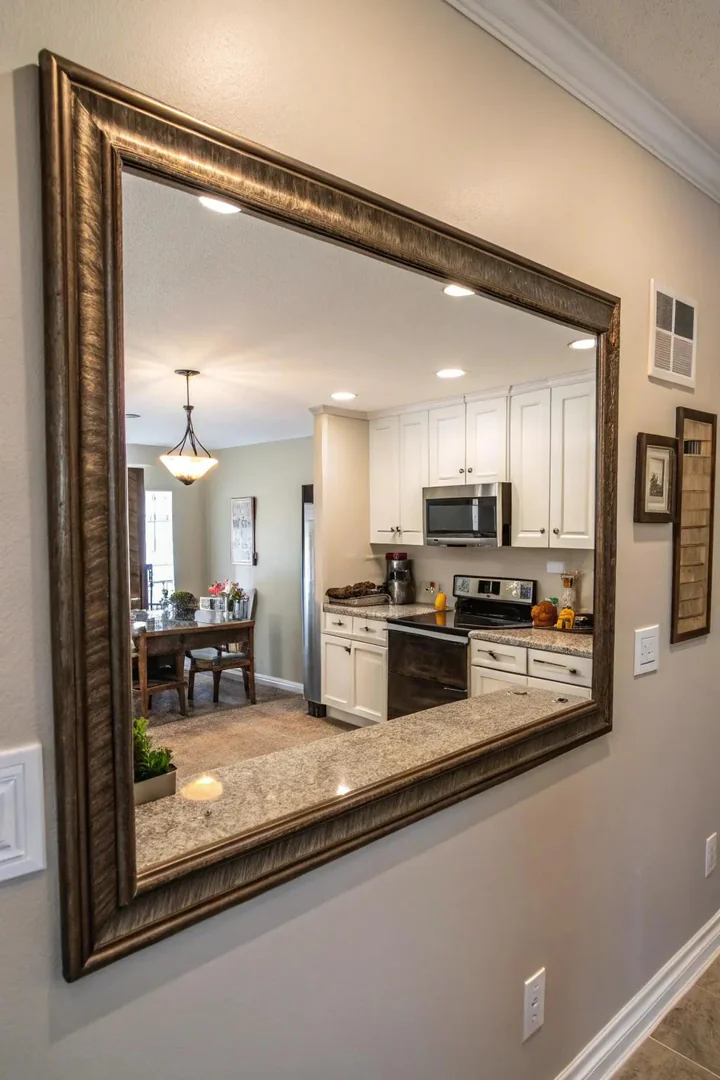
An oversized framed mirror (36 inches wide or larger) mounted on a kitchen wall reflects light from windows and fixtures, doubles the visual depth of the room, and serves as a bold decorative focal point that requires no additional styling. In small or dim kitchens, a large mirror is one of the most effective single-piece solutions for making the space feel brighter, bigger, and more open without any structural changes.
Choose a frame that matches the kitchen’s existing hardware and fixture finishes — a gold or brass frame for kitchens with brass cabinet pulls and warm-toned fixtures, a black iron frame for industrial or modern kitchens, or a whitewashed wood frame for farmhouse and coastal styles. Position the mirror on the largest uninterrupted wall, ideally opposite or adjacent to a window so it catches and reflects natural light. Lean an oversized floor mirror (from Pottery Barn, CB2, or IKEA Mongstad) against the wall on a countertop or sideboard for a casual, unfussy look that avoids the need for heavy-duty wall anchors. For more ideas on how wall colors and finishes interact with reflective surfaces, see our kitchen color ideas guide.
3. Wall of Family Photographs
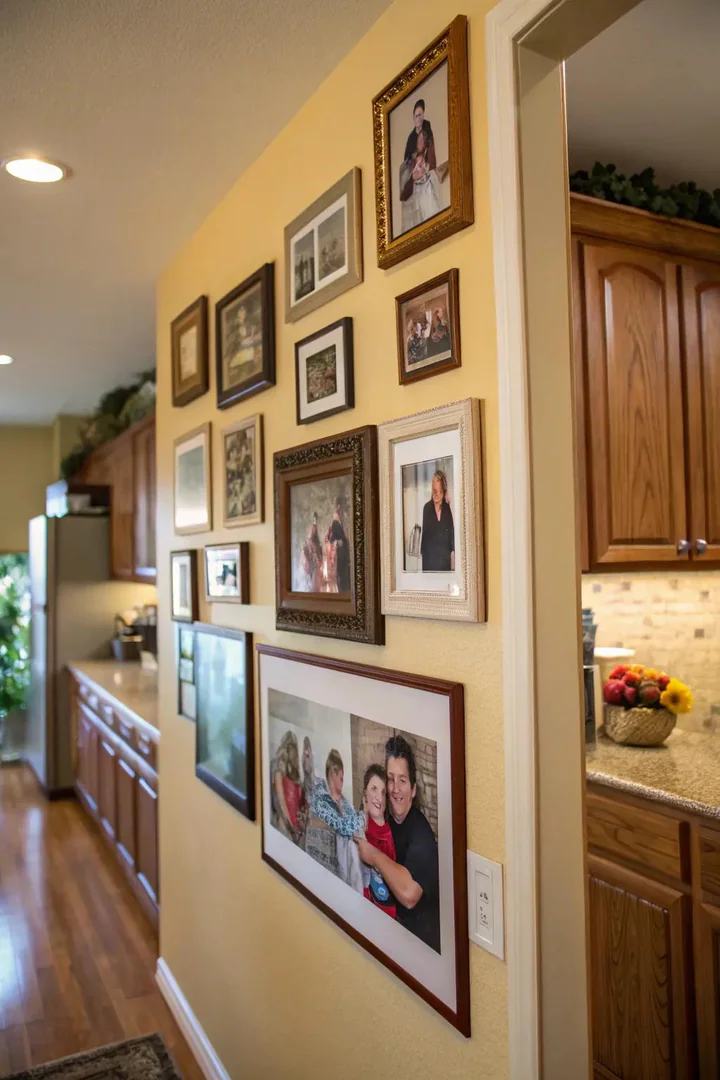
A gallery wall of family photographs — printed, matted, and framed in a coordinated set of frames — turns a kitchen wall into a personal timeline of birthdays, holidays, vacations, and everyday moments. The kitchen is the most-used room in most homes, which makes it the ideal location for a photo wall that the family sees and enjoys throughout the day during meals, cooking, and casual gathering.
Use matching frames in one finish (all black, all white, all natural wood) with white mats for a clean, gallery-style look, or mix frame styles (wood, metal, acrylic) for a collected, organic feel. Print photos in a consistent style — all black-and-white, all color, or all sepia — to unify the wall even if the frame styles vary. Start with 9 to 15 photos in a mix of sizes (5×7, 8×10, and 11×14) and lay them out on the floor in a grid or salon-style cluster before transferring the arrangement to the wall. Use a level and painter’s tape to mark positions before drilling. Gallery wall frame sets from Framebridge, Artifact Uprising, or IKEA simplify the process with pre-coordinated sizes and hanging templates.
4. Plant Illustration Series
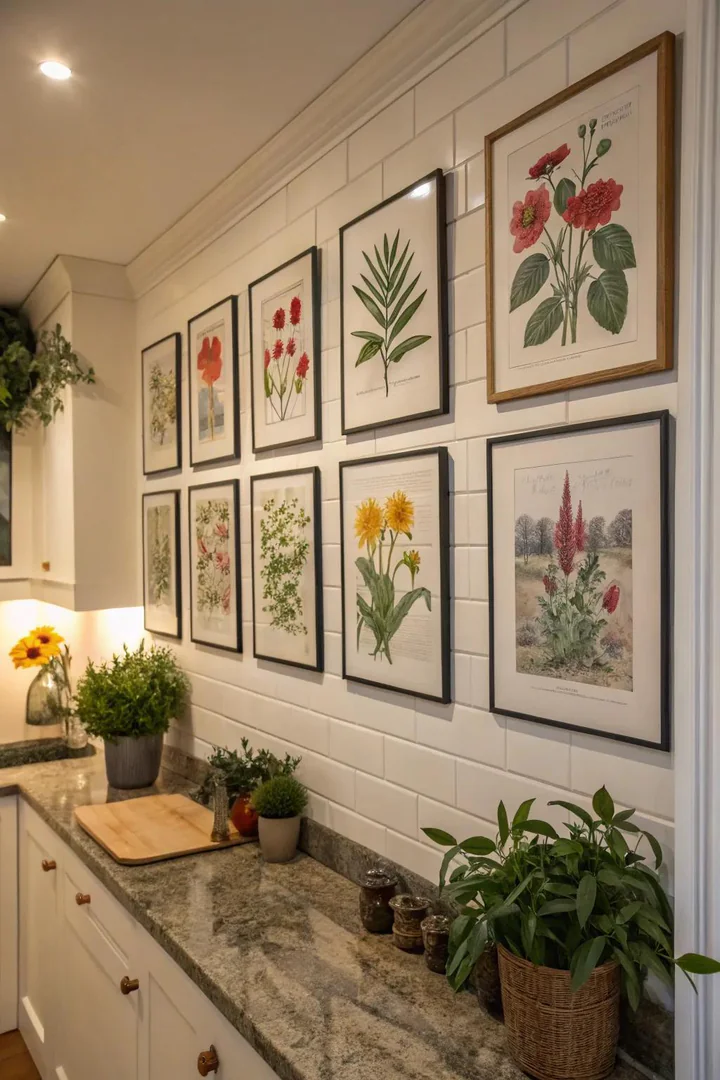
A set of botanical prints — detailed illustrations of herbs, vegetables, fruit, or flowering plants — hung in a row or grid formation brings the organic beauty of the garden indoors and connects the kitchen to the ingredients used in cooking. Botanical illustrations have been a staple of decorative art for centuries, from 18th-century herbarium illustrations to modern watercolor renderings, giving you a wide range of artistic styles to match your kitchen’s aesthetic.
Choose prints that relate to cooking — herb series (rosemary, basil, thyme, sage), citrus fruit series (lemon, lime, orange, grapefruit), or vegetable series (artichoke, tomato, pepper, eggplant) — for kitchen-specific relevance. Purchase reproduction prints from the New York Botanical Garden, Kew Gardens, or the Cavallini & Co. collection, or order custom botanical watercolors from Etsy artists. Frame in thin gold, black, or natural wood frames with white or cream mats. Hang a series of 4 to 6 prints in a horizontal line above a countertop, or arrange 9 prints in a 3×3 grid on a larger wall for maximum visual impact.
5. Vibrant Diptych Artwork
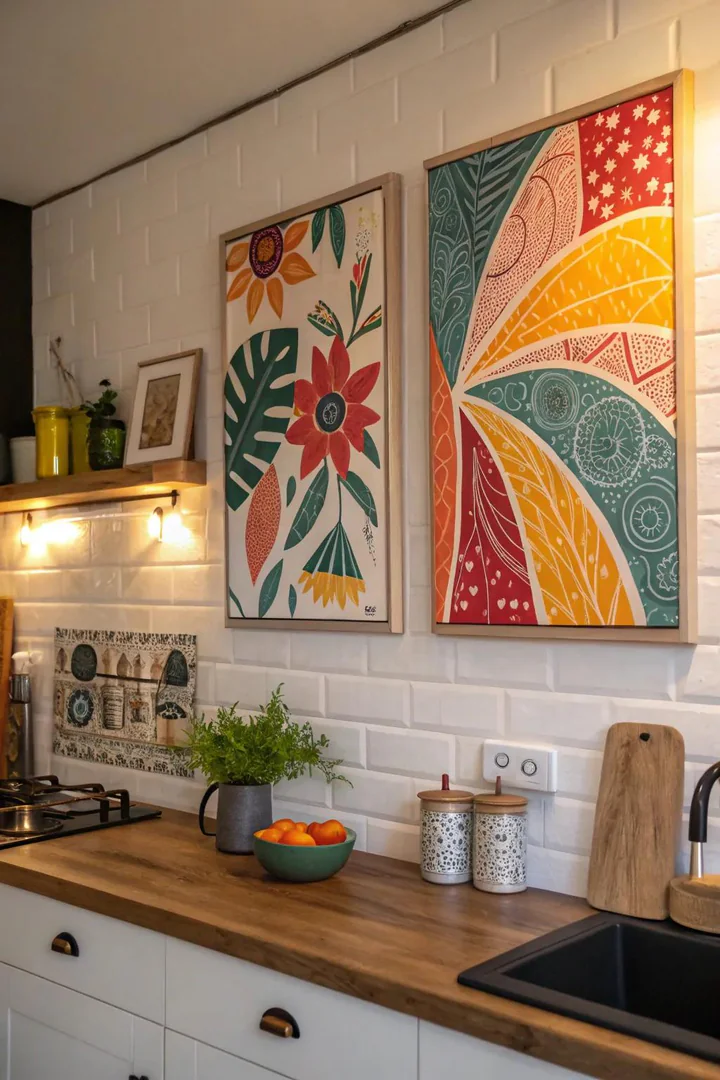
A diptych — two related paintings or prints displayed side by side — fills a wide wall space with bold color and visual energy while maintaining a sense of artistic intentionality that a single random print lacks. Diptychs work particularly well on the long, horizontal wall spaces common in kitchens (above cabinets, between windows, along an eat-in wall) because the two-panel format fits a wide, shallow display area.
Select a diptych with colors that complement or contrast your kitchen’s palette — warm tones (red, orange, gold) for kitchens with cool cabinets and countertops, or cool tones (blue, green, teal) for kitchens with warm wood and warm-toned finishes. Abstract diptychs (from artists on Minted, Saatchi Art, or Society6) are the safest choice because abstract compositions don’t compete with the visual busyness of a kitchen’s pots, utensils, and food. Hang both panels 2 to 3 inches apart at the same height, centered on the wall, with the bottom edge 6 to 8 inches above the countertop or table below.
6. Gallery Wall of Cutting Boards
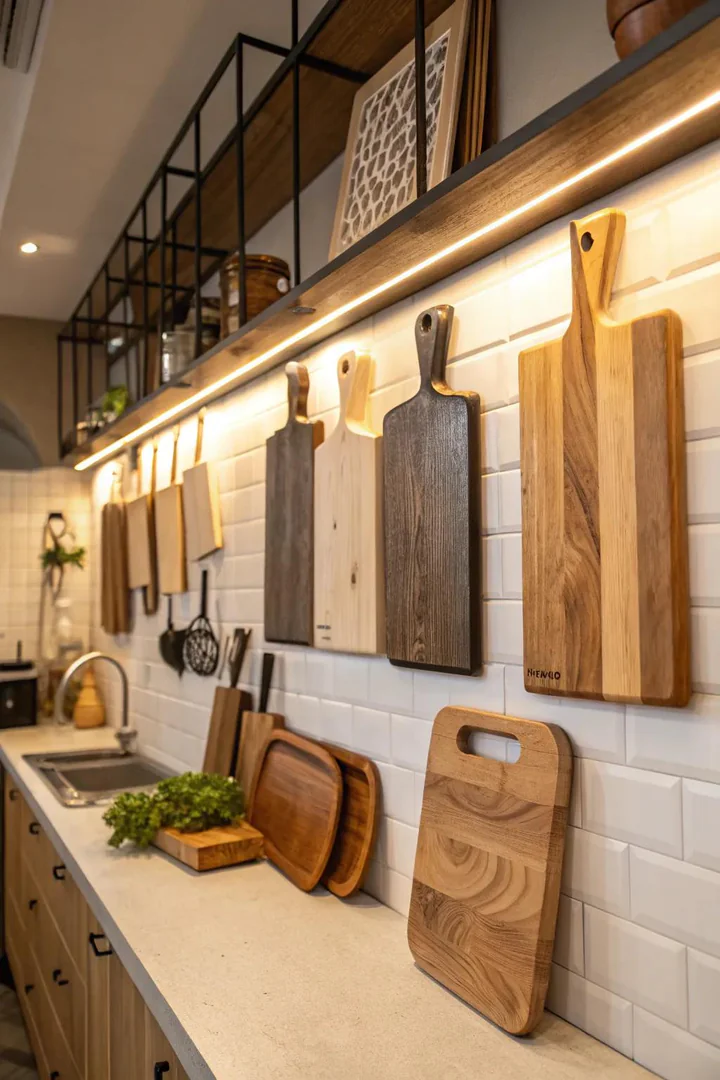
Hanging a collection of wood cutting boards and breadboards on the kitchen wall — in a variety of shapes, sizes, wood species, and grain patterns — creates a warm, textured, kitchen-specific display that doubles as accessible storage for boards you actually use in daily cooking. Unlike formal art, cutting boards look better with age, patina, knife marks, and oil stains, meaning the display improves over time rather than degrading.
Collect 5 to 10 boards in varying shapes (round, rectangular, paddle-shaped, handled) and wood species (walnut, maple, olive wood, acacia, cherry) for maximum visual variety. Hang boards on individual nails, J-hooks, or decorative iron hooks screwed directly into the wall. Arrange the boards in an organic, overlapping cluster rather than a rigid grid — the casual arrangement matches the utilitarian nature of the objects. Mix in a few vintage or antique boards (from estate sales, flea markets, or Etsy) alongside new boards from Boos, BoardSmith, or Virginia Boys Kitchens for a collected-over-time look.
7. Retro Signage
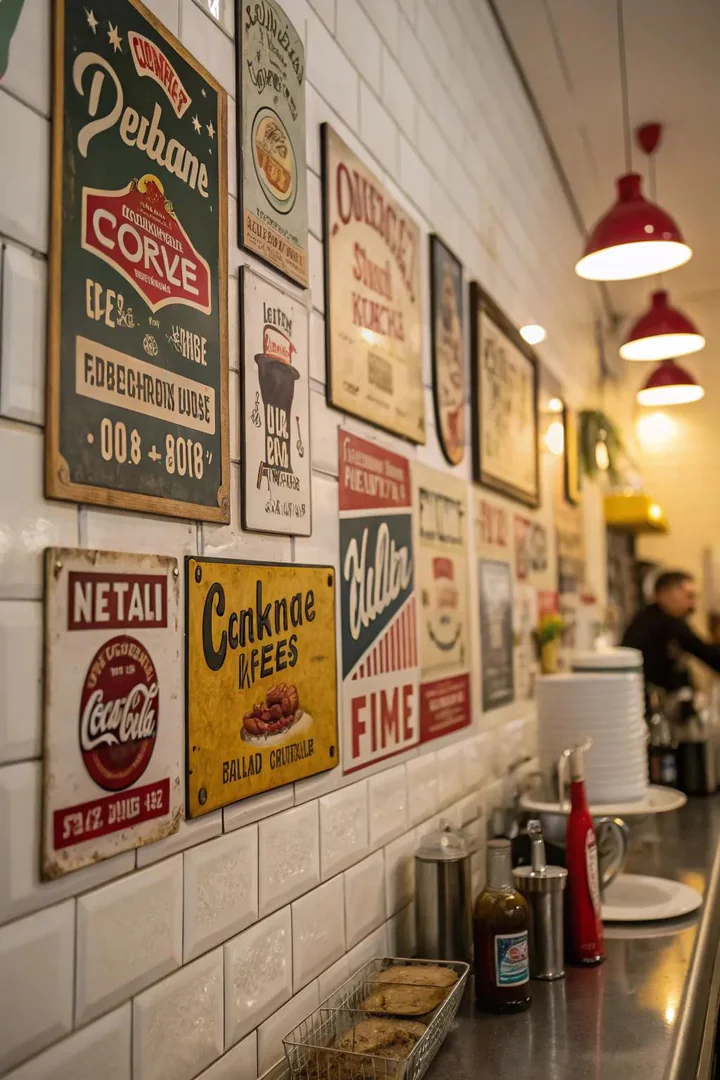
Vintage signs — original or reproduction metal, tin, enamel, or painted wood signs from old bakeries, cafes, grocery stores, dairies, and food brands — bring nostalgic character, typography, and graphic design history to kitchen walls. A single well-placed vintage sign can anchor the personality of the entire kitchen, whether the style leans farmhouse, industrial, retro diner, or French bistro.
Source authentic vintage signs from antique shops, architectural salvage yards, flea markets, and online sellers on eBay, Chairish, and 1stDibs. Reproduction signs (from Pottery Barn, Anthropologie, and specialty makers like Original Tin Sign Co.) offer the vintage look without the hunt. Popular kitchen-relevant categories include old Coca-Cola signs, French bakery and patisserie signs, painted farm stand signs, enamel dairy and milk signs, and hand-lettered menu boards. Hang a single large sign (24×36 inches or bigger) as a standalone statement piece, or group 3 to 5 smaller signs in a loose cluster above a countertop or eat-in area.
8. Decorative Open Shelving
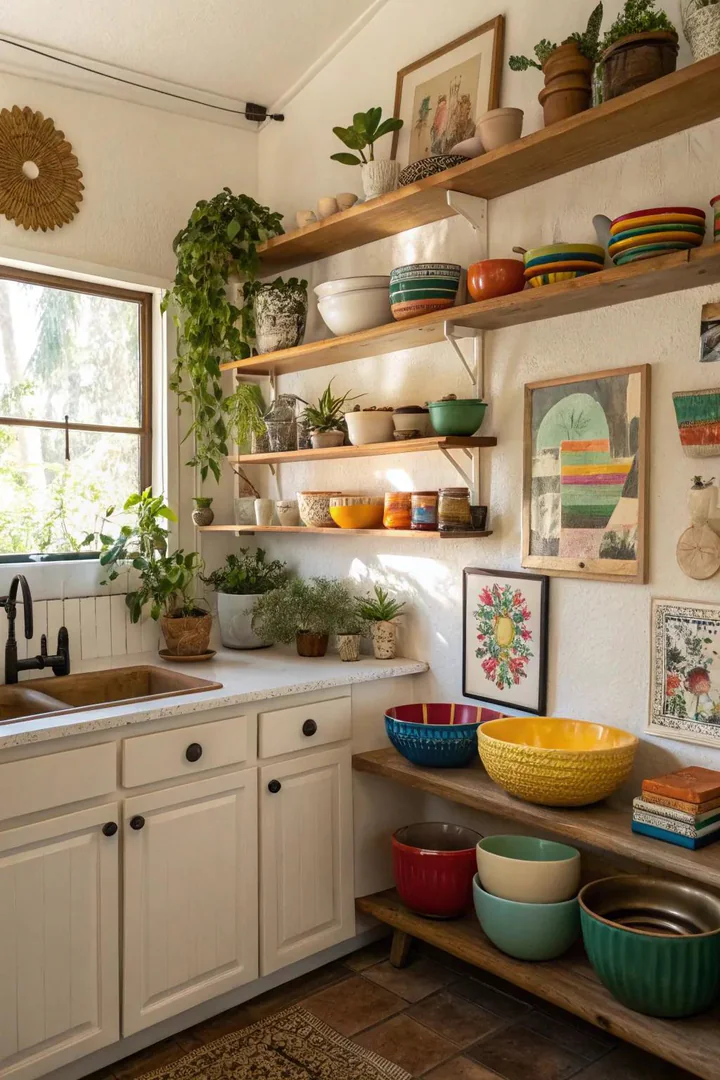
Open shelves — floating shelves, bracket shelves, or pipe shelves mounted on the wall in place of upper cabinets — serve as both storage and a display platform for decorative objects, cookbooks, ceramics, glassware, plants, and art. The open shelving itself becomes wall decor because the items on display create a curated, styled vignette that changes the look and feel of the kitchen wall entirely.
Install 2 to 3 floating shelves (from?”West Elm, Rejuvenation, or a custom carpenter) in solid wood (walnut, white oak, or reclaimed pine) with concealed mounting brackets for a clean, minimal look. Space shelves 12 to 16 inches apart vertically to accommodate tall items on the lower shelf and shorter items above. Style each shelf with a mix of functional items (stacked plates, mugs, glass jars with dry goods) and decorative items (a small framed print, a potted plant, a ceramic vase, a cookbook propped upright). Limit each shelf to 5 to 7 items with breathing room between them — overcrowded shelves look cluttered rather than curated.
9. Monochrome Photography
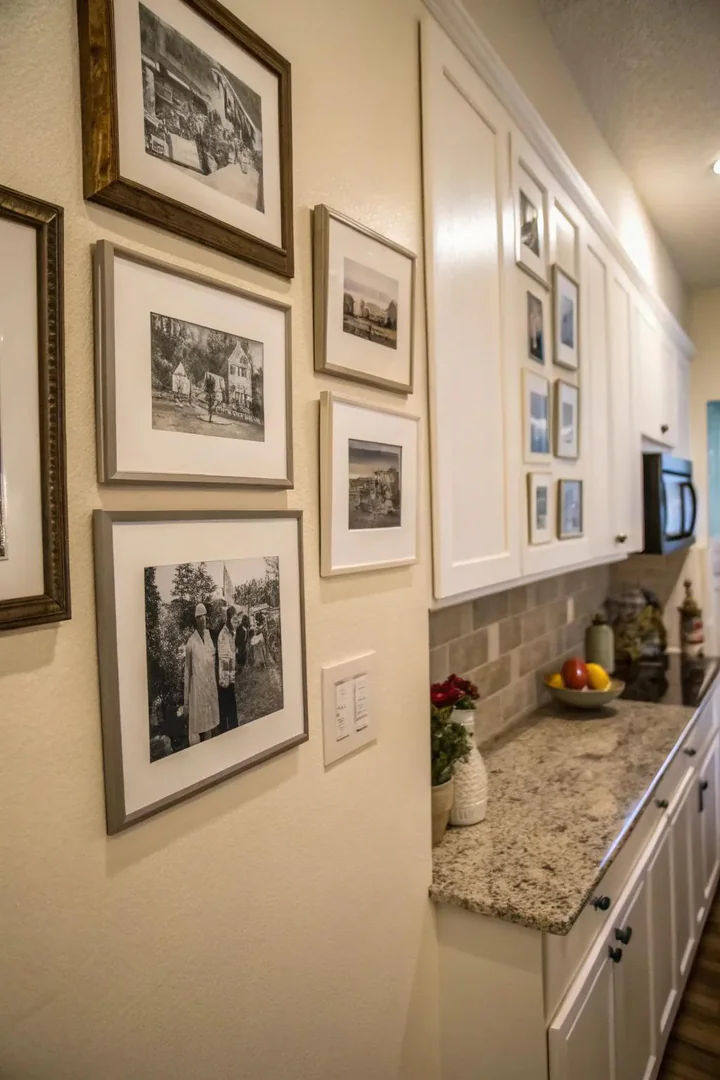
Black-and-white photography — framed prints of food photography, market scenes, architectural details, or portraits — adds a sophisticated, gallery-quality presence to kitchen walls without introducing competing colors that might clash with the kitchen’s existing palette. The tonal simplicity of black-and-white photographs makes them the safest art choice for kitchens with busy patterns, bold cabinet colors, or colorful backsplashes.
Choose subject matter with a connection to food, cooking, or gathering — a black-and-white image of a Parisian market stall, a close-up of artisan bread, an Italian trattoria storefront, or a family cooking scene. Print large (16×20 or 20×30 inches) for a single statement piece, or print a series of 3 to 5 images in a uniform size and frame for a cohesive gallery row. Use simple, thin black or white frames with white mats. For kitchen lighting that highlights framed wall art and photography, see our kitchen lighting ideas guide.
10. Culinary-Inspired Artwork
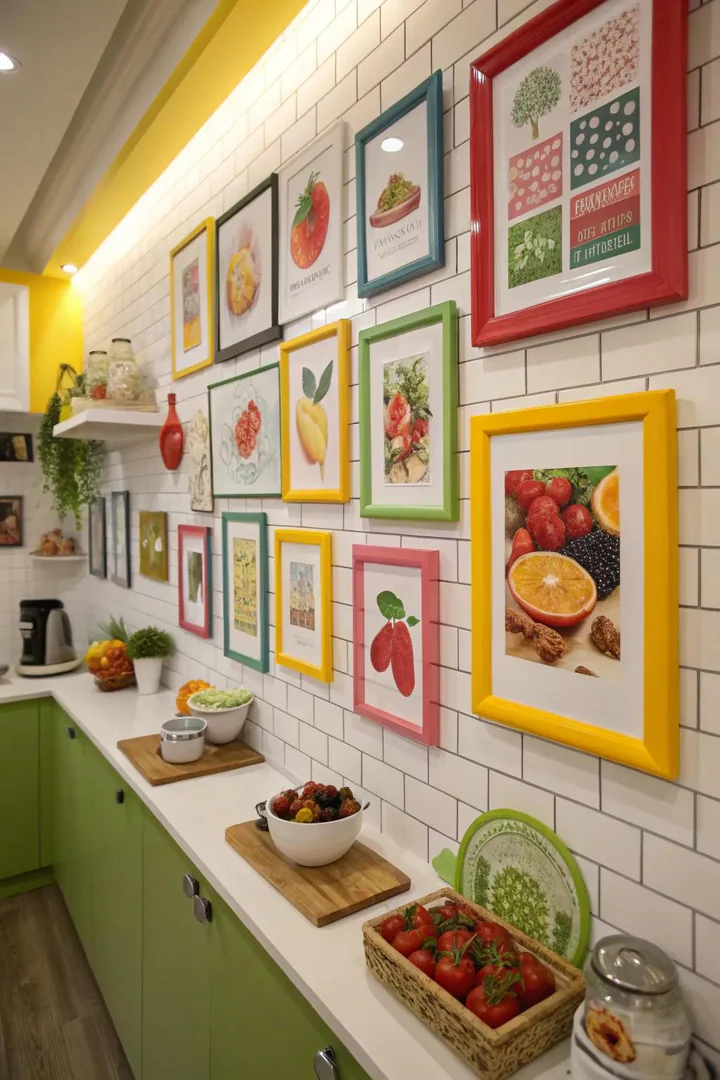
Food-themed art — illustrations, paintings, or prints of fruits, vegetables, wine bottles, cheese wheels, kitchen utensils, or dining scenes — is the most directly kitchen-relevant wall decor category and instantly signals that the room is a space for cooking, eating, and enjoying food. The best food art balances appetizing subject matter with artistic quality so the prints look like art, not cafeteria posters.
Look for food art from established printmakers and illustrators — Wayne Thiebaud’s cake and pie paintings, Maira Kalman’s food illustrations, or the classic French food prints from the Larousse Gastronomique. Contemporary food illustrators on Society6, Minted, and Etsy offer affordable prints of everything from coffee cups and wine bottles to avocados and oysters. Pair food prints with simple, matching frames and hang them where the subject matter connects to the nearby activity — a coffee print near the coffee station, a wine print near the bar cart, a fruit print near the breakfast nook.
11. Decorative Painted Wall
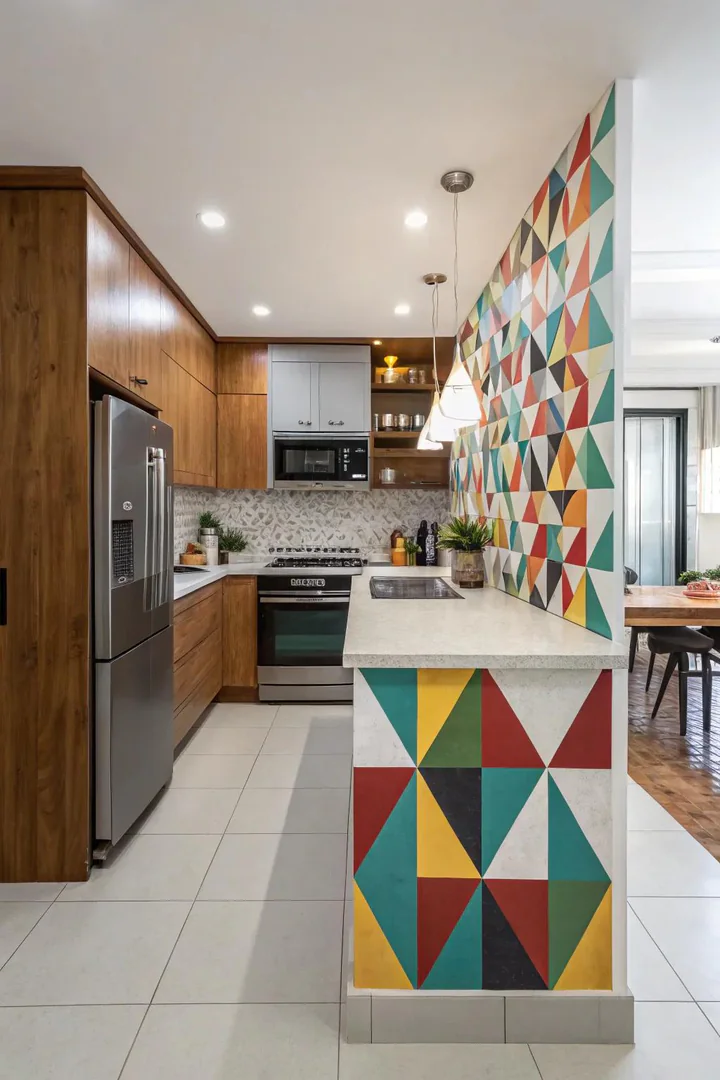
A painted accent wall — a single wall finished in a bold, contrasting, or decorative paint treatment — turns the wall itself into the decor, eliminating the need for art, shelving, or objects. Options include a solid bold color (deep navy, forest green, terracotta, charcoal), a color-blocked pattern (two-tone with a horizontal dividing line), a hand-painted mural, or a stenciled pattern (Moroccan tile, damask, geometric).
Choose the wall with the fewest interruptions (no windows, minimal cabinets, no major appliances) as your accent wall. Use a high-quality kitchen-grade paint with a satin or semi-gloss finish (from Benjamin Moore Regal Select, Sherwin-Williams Emerald, or Farrow & Ball Modern Emulsion) for durability and washability in the kitchen’s high-moisture, high-grease environment. Benjamin Moore Hale Navy (HC-154), Sherwin-Williams Evergreen Fog (SW 9130), and Farrow & Ball Jitney (No. 293) are popular accent wall colors that work with a wide range of kitchen cabinet and countertop combinations.
12. Collection of Baskets
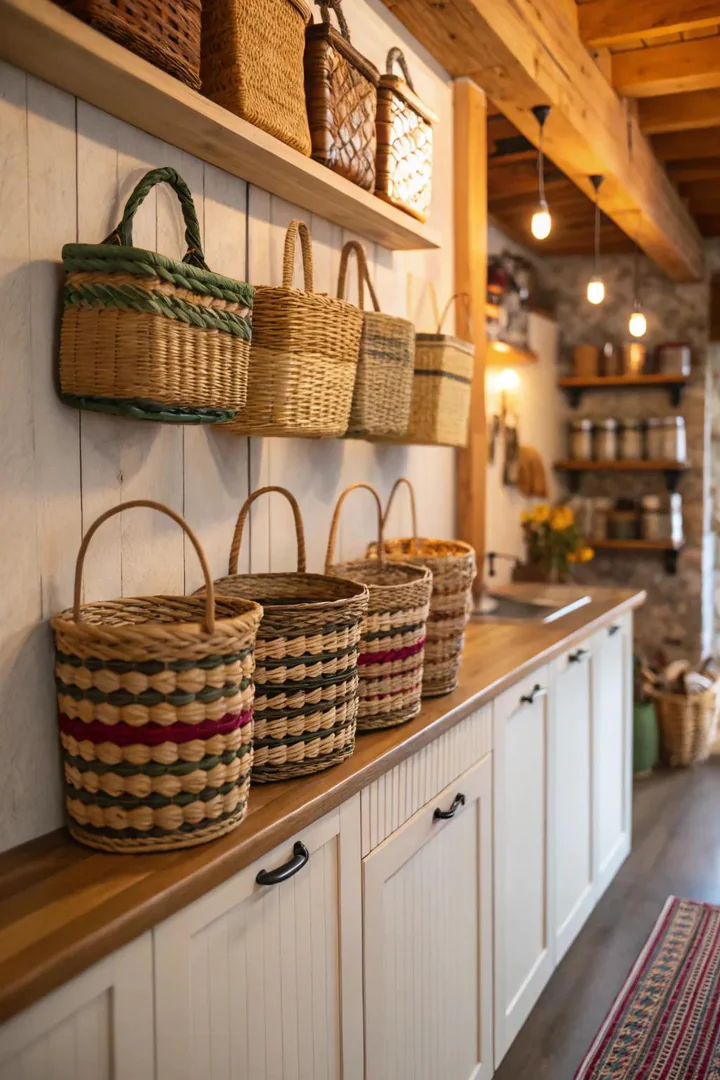
Flat-backed woven baskets — hung on the wall in a clustered arrangement — add warmth, texture, and dimensional depth that flat art and framed prints cannot achieve. A basket wall introduces natural fibers, handcrafted patterns, and earthy tones that soften a kitchen dominated by hard surfaces (stone, tile, stainless steel, laminate) and create a collected, worldly, well-traveled feel.
Collect 7 to 15 baskets in a range of sizes (6-inch to 18-inch diameter), shapes (round, oval, fan-shaped), weave patterns, and natural colors (tan, brown, black, cream, with accents of indigo or rust). Source baskets from African basket importers (The Citizenry, Kazi Goods, All Across Africa), vintage and thrift stores, or global home retailers (World Market, Target’s Threshold line). Hang baskets using small finish nails or Command strips, overlapping the edges slightly for a layered, dimensional effect. Cluster baskets above a sideboard, along a staircase wall adjacent to the kitchen, or on the wall opposite the main cooking area.
13. Recipe Cards in Frames
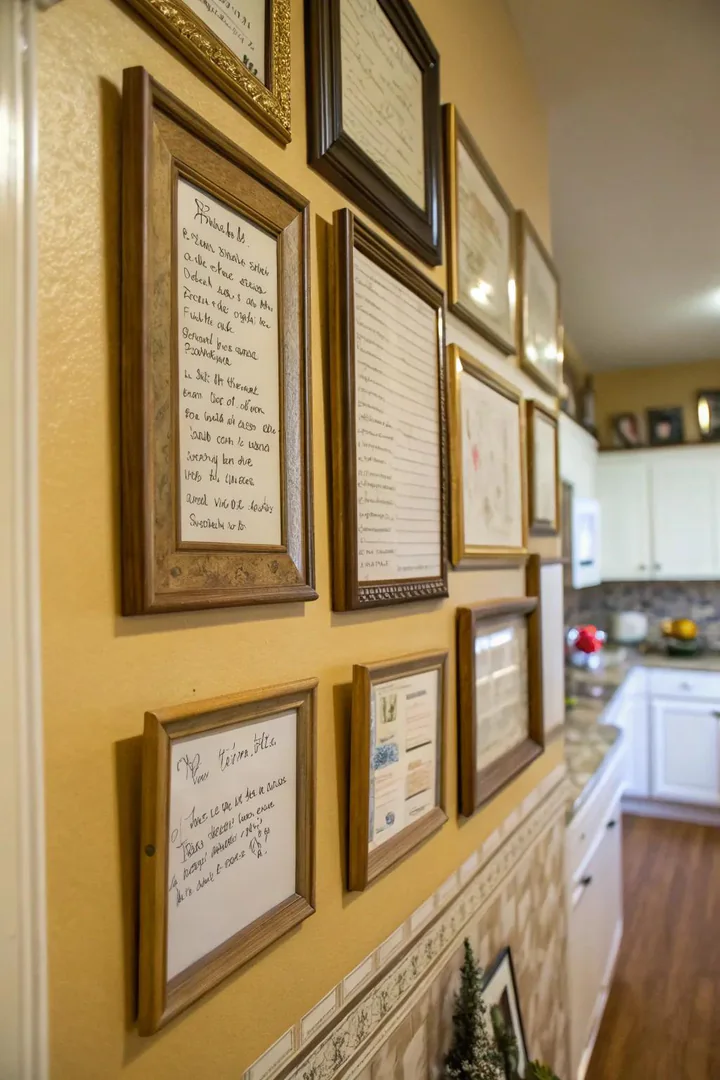
Handwritten recipe cards — from a grandmother, a parent, or your own collection — matted and framed behind glass, preserve family cooking history as wall art that is deeply personal, meaningful, and completely unique to your kitchen. The handwriting itself is the art — the loops, scratches, stains, and faded ink tell the story of the person who wrote the recipe and the meals it produced over decades.
Select 3 to 6 recipe cards with legible handwriting and, ideally, visible stains, annotations, or wear that show the card was actually used. Have each card professionally matted with an archival mat (acid-free, to prevent yellowing) and framed in a matching frame. Use 5×7 or 8×10 frames with wide white mats so the small recipe card is presented with gallery-worthy proportions. Hang the framed recipes in a tight horizontal row above a countertop or in a small grid beside the stove — positioning them near the cooking area reinforces the connection between the framed recipe and the act of cooking.
14. Classic Travel Advertisements
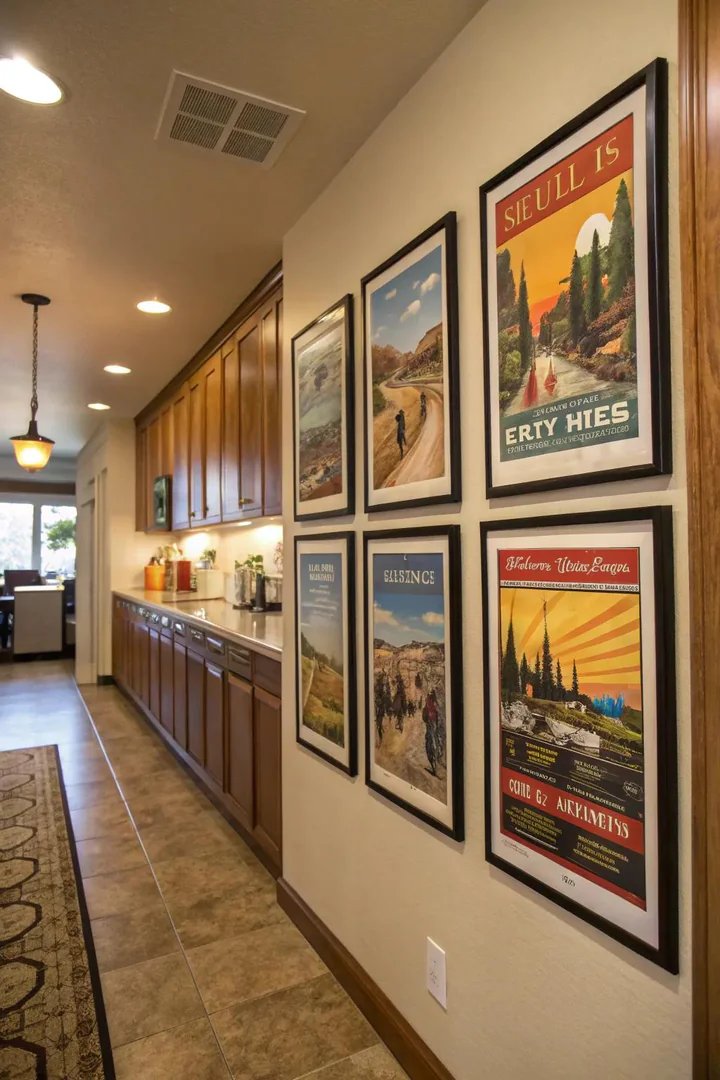
Vintage travel posters — the bold, illustrative advertisements for airlines, railways, and destinations produced from the 1920s through the 1960s — bring vibrant color, graphic design history, and a sense of wanderlust to kitchen walls. Travel posters featuring food-centric destinations (Italy, France, Spain, Japan, Morocco) connect the culinary traditions of those regions to your own kitchen.
Source reproduction travel posters from specialty printers (Allposters, Art.com, or the International Poster Gallery) or purchase authenticated originals from auction houses and poster galleries for investment-quality pieces. Frame posters in simple, thin frames (black or natural wood) with no mat for a clean, poster-shop look, or add a wide white mat and a gallery frame for a more formal presentation. Hang 2 to 4 posters in a horizontal row above a dining nook or breakfast bar, or lean a single large poster on a countertop against the backsplash wall for a casual, European cafe feel.
15. Non-Representational Art
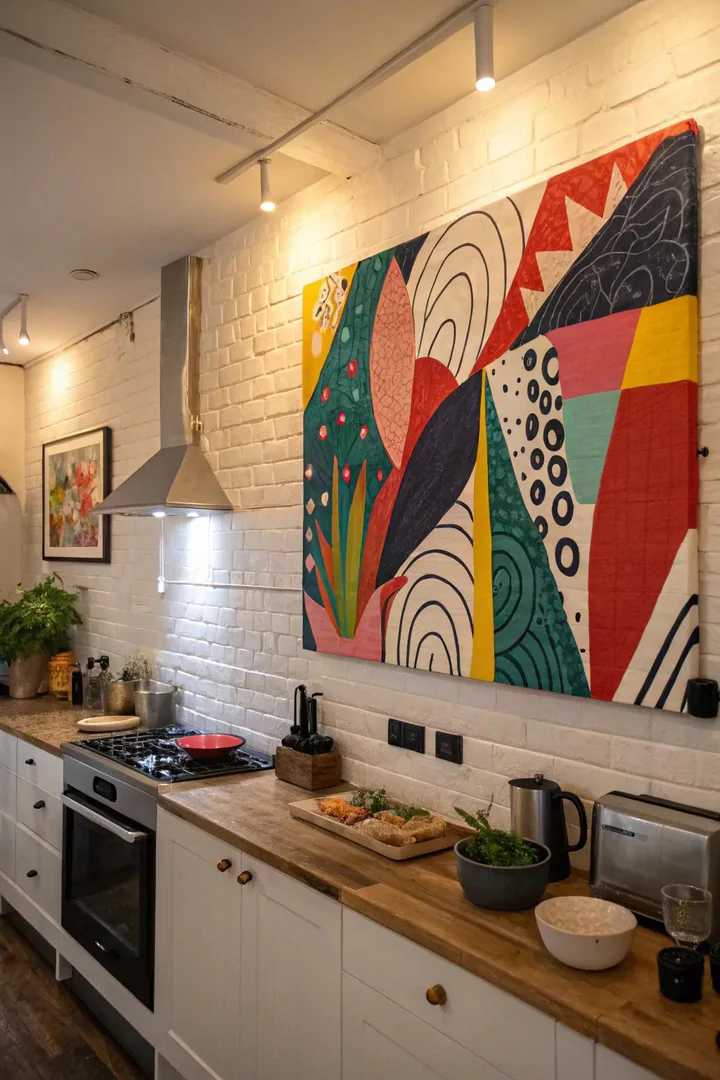
Abstract art — paintings, prints, or mixed-media works that use color, form, line, and texture rather than recognizable subjects — is the most versatile kitchen wall art category because abstracts harmonize with any kitchen style (modern, traditional, farmhouse, industrial) and they introduce color and energy without competing with the visual complexity of a working kitchen’s tools, food, and surfaces.
Choose abstract art based on color first: pull 2 to 3 colors from your existing kitchen palette (cabinet color, countertop veining, backsplash accent, or hardware finish) and select an abstract piece that features those colors. This approach ensures the art feels connected to the room rather than randomly placed. Purchase original abstract paintings from local art fairs, open studio events, or online galleries (Saatchi Art, Artfinder, Ugallery) for one-of-a-kind pieces, or buy high-quality prints from Minted or Society6 for more affordable options. For guidance on coordinating art colors with cabinet and wall finishes, visit our kitchen cabinet color ideas page.
16. Picture Shelf
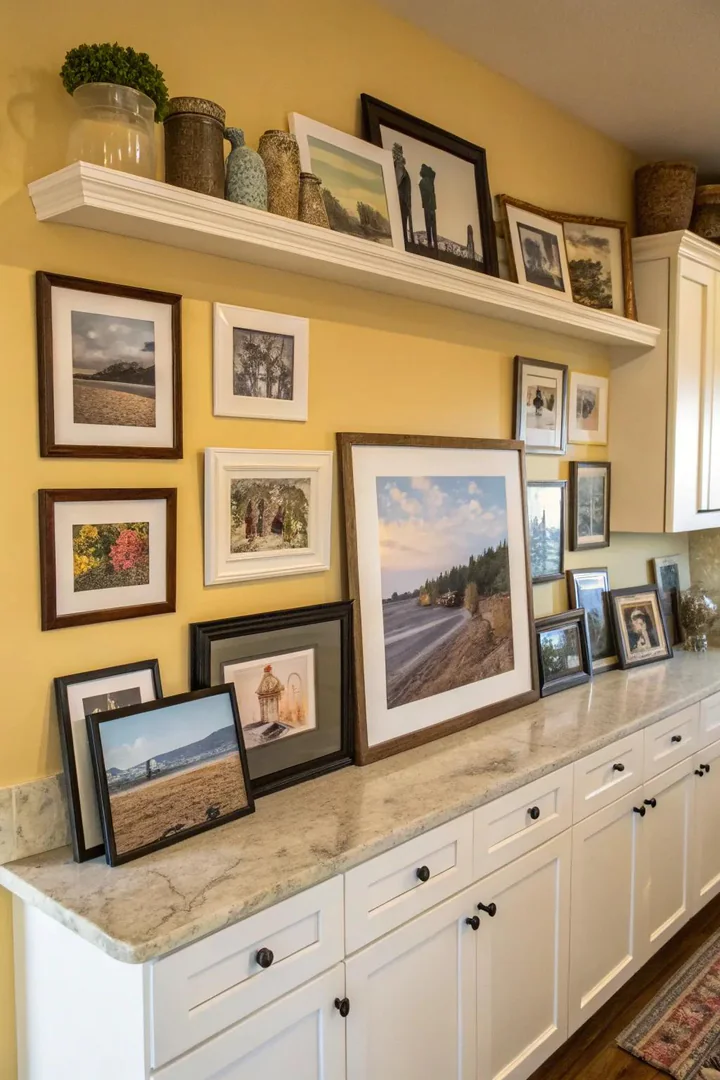
A photo ledge — a narrow, lipped shelf (2 to 4 inches deep) mounted on the wall to display framed photos, prints, postcards, and small objects — offers the visual impact of a gallery wall with the flexibility to swap, rearrange, and update the display anytime without adding new nail holes. Photo ledges suit kitchens perfectly because the display can change with the seasons, holidays, or your mood, and because the narrow depth doesn’t interfere with counter space or traffic flow.
Install 1 to 3 photo ledges (from IKEA Mosslanda, Pottery Barn Holman, or a custom carpenter) in a stacked arrangement with 10 to 14 inches of vertical space between ledges. Place 3 to 5 items per ledge — mix framed photos, small art prints, postcards, a tiny potted plant, and a small decorative object — and overlap frames slightly for a layered, casual look. Photo ledges work especially well above a kitchen table, breakfast nook, or on the wall between the kitchen and an adjacent dining or living area.
17. Suspended Herb Garden
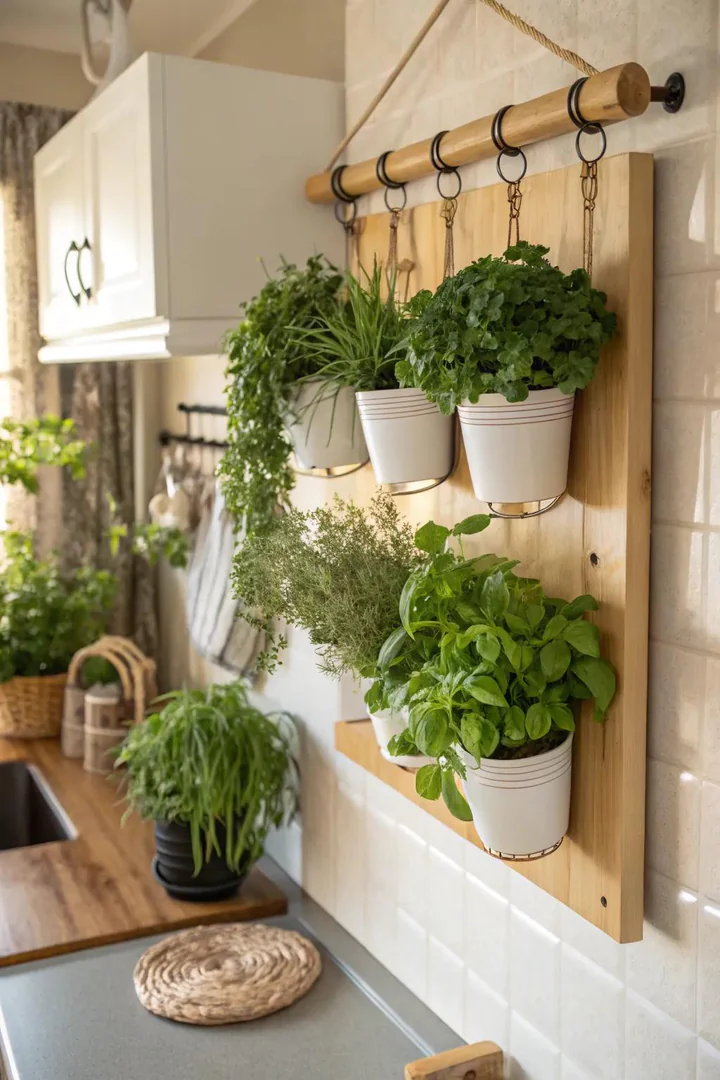
A wall-mounted or hanging herb garden — living herbs growing in mounted pots, planters, or a vertical garden system attached to the kitchen wall — is wall decor that is alive, fragrant, edible, and constantly changing with the growth of the plants. A kitchen herb wall provides fresh herbs within arm’s reach of the stove and cutting board while adding the greenery and organic beauty that most kitchens lack.
Choose a wall location that receives at least 4 to 6 hours of natural light daily (near a window) or install a grow light strip above the planting area for kitchens with limited natural light. Use wall-mounted planters (from West Elm, Anthropologie, or Mkono on Amazon), a vertical garden system (from Lettuce Grow, AeroGarden, or Click and Grow), or a simple DIY approach with mason jars in metal rings screwed to a reclaimed wood board. Plant kitchen staples that thrive indoors: basil, mint, parsley, cilantro, chives, thyme, and rosemary. Water consistently (most herbs need watering every 2 to 3 days indoors) and trim regularly to encourage bushy, compact growth.
18. Classic Promotions
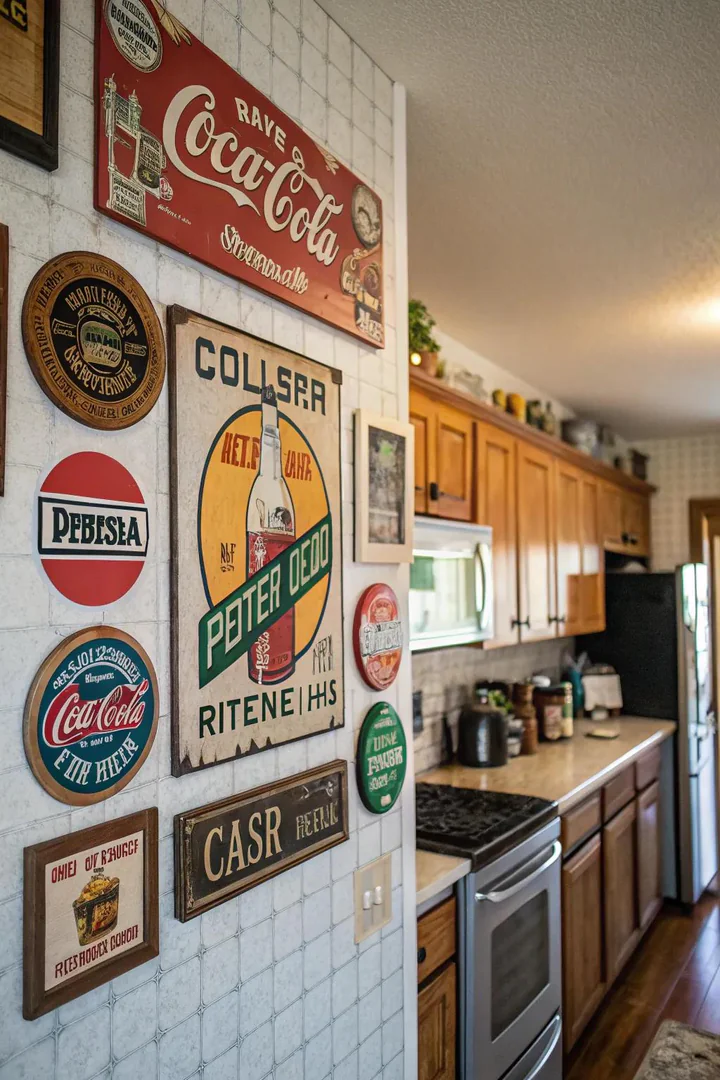
Vintage advertising art — framed reproductions or original prints of early-to-mid 20th century food, beverage, and household product advertisements — combines graphic design history, typography, illustration, and nostalgia into wall decor that tells a story about the history of eating, drinking, and domestic life. These advertisements were designed by professional illustrators and graphic designers to be visually striking, which means they function as high-quality art with built-in color, composition, and visual appeal.
Look for advertisements featuring kitchen-relevant products: coffee (Maxwell House, Folgers, Illy), baking (Betty Crocker, Pillsbury, King Arthur), beverages (Coca-Cola, Perrier, Campari), dairy (Land O’Lakes, Borden), and appliances (KitchenAid, General Electric, Frigidaire). Find reproductions at AllPosters, Vintage Ad Browser, and specialty Etsy shops, or hunt for authenticated originals at antique shows, poster galleries, and auction sites. Frame in period-appropriate frames — thin gold or dark wood for mid-century ads, rustic wood or metal for earlier pieces — and group 3 to 5 related ads (all coffee, all baking, or all from the same decade) for a thematic display. For more ways to style and arrange your kitchen space around wall decor, browse our kitchen decor ideas gallery.
How to Choose Kitchen Wall Decor
Matching Decor to Kitchen Style
The wall decor should reinforce the kitchen’s existing design language, not fight against it. Modern and contemporary kitchens (flat-panel cabinets, quartz counters, minimal hardware) pair best with abstract art, monochrome photography, and clean-lined floating shelves. Farmhouse and country kitchens (shaker cabinets, wood counters, open shelving) suit vintage signs, basket walls, cutting board displays, and botanical prints. Traditional kitchens (raised-panel cabinets, granite or marble, crown molding) work with decorative plates, framed recipe cards, and formal gallery walls with matted and framed prints. Industrial kitchens (exposed brick, concrete, metal accents) respond well to oversized typography, metal signs, and black-and-white photography.
Sizing and Placement Guidelines
Wall decor should fill roughly two-thirds to three-quarters of the available wall space — too small looks lost, too large overwhelms. A single statement piece should be at least 24×36 inches to anchor a wall. For gallery walls and clustered displays, map the full arrangement on the floor first, then transfer measurements to the wall with painter’s tape. Hang art with its center at 57 to 60 inches from the floor (standard gallery height), or 6 to 8 inches above a countertop, table, or piece of furniture for art displayed above a surface. In kitchens, avoid hanging anything directly above the stove or in the splash zone behind the sink.
Protecting Wall Decor in the Kitchen Environment
Kitchens produce heat, steam, grease, and moisture that damage unprotected art and objects faster than any other room in the house. Frame all paper-based art (prints, photos, posters, recipe cards) behind glass or acrylic glazing — UV-protective glazing (from TruVue or Museum Glass) prevents fading from sunlight and kitchen lighting. Seal natural wood items (cutting boards, wooden signs, shelf brackets) with mineral oil or a food-safe polyurethane to prevent grease absorption and moisture damage. Position the most delicate items (paper art, fabric, photographs) on walls away from the stove and sink, and reserve the walls nearest the cooking area for durable items like metal signs, ceramic plates, and stainless shelves.
Kitchen Wall Decor Options Comparison
| Decor Type | Cost Range | Best Kitchen Style | Maintenance |
|---|---|---|---|
| Decorative plates | $50-300 | Traditional, farmhouse | Dust monthly |
| Oversized mirror | $100-800 | Modern, transitional | Clean glass weekly |
| Gallery photo wall | $100-500 | Any style | Dust frames monthly |
| Botanical prints | $60-300 | Farmhouse, traditional | Dust frames monthly |
| Open shelving display | $50-400 | Modern, farmhouse | Dust and restyle weekly |
| Vintage signs | $30-500+ | Industrial, farmhouse, retro | Wipe monthly |
| Wall-mounted herb garden | $30-200 | Any style | Water every 2-3 days |
| Painted accent wall | $50-200 (DIY) | Any style | Touch up as needed |
Common Kitchen Wall Decor Mistakes to Avoid
Hanging art too high. The most common wall decor mistake in any room — and especially kitchens where counter height, cabinet height, and ceiling height create confusing reference points — is hanging art too high. Art should be centered at 57 to 60 inches from the floor (average eye level) or 6 to 8 inches above the nearest surface below it. Hanging art at the midpoint between the counter and the upper cabinets (rather than at eye level) is a frequent kitchen-specific error.
Choosing art that is too small for the wall. A single small print on a large wall looks like an afterthought. As a general rule, wall decor should occupy at least 50% of the available wall width. A 4-foot-wide wall needs at least a 24-inch-wide piece; a 6-foot wall needs at least a 36-inch piece or a grouped arrangement that spans 36+ inches. When in doubt, go bigger.
Ignoring the kitchen’s grease and moisture zones. Paper art, fabric pieces, and unfinished wood items hung directly above or beside the stove or sink degrade rapidly from cooking grease, steam, and water splashes. Reserve the stove-adjacent and sink-adjacent walls for durable, wipeable materials (metal, ceramic, glass-framed pieces) and place delicate items on distant walls.
Mixing too many unrelated styles on one wall. A wall with a modern abstract print next to a rustic cutting board next to a sleek chrome shelf next to a vintage travel poster lacks cohesion and reads as random rather than curated. Commit to one decor style per wall or display area, and let each wall tell a single design story.
Frequently Asked Questions
What can I put on my kitchen walls besides art?
Functional and decorative alternatives to framed art include open shelving with styled objects, wall-mounted herb gardens, decorative plate arrangements, cutting board collections, woven basket walls, vintage signage, mounted pot racks, chalkboard or whiteboard panels, wall-mounted spice racks, and decorative tile accent panels. Many of these options combine storage, function, and visual appeal — a wall-mounted knife strip, a hanging produce basket, or a row of copper pots on a rail rack are all working kitchen tools that double as wall decor.
How do I protect kitchen wall decor from grease and steam?
Frame all paper-based art behind glass or acrylic glazing and position it away from the stove and sink (at least 3 to 4 feet from the cooktop). Use a range hood and run it during cooking to capture grease and steam before it reaches wall decor. Seal wood items (cutting boards, signs, shelves) with mineral oil or polyurethane. Clean glass-framed art and mirrors with glass cleaner monthly. For metal signs and ceramic plates, wipe with a damp cloth and dry immediately. If your kitchen has poor ventilation, stick to durable, wipeable decor (metal, ceramic, sealed wood, glass-framed pieces) and avoid unframed paper, fabric, or porous materials.
What is the best wall color to display art in a kitchen?
Neutral wall colors — white, off-white, light gray, warm beige, and soft greige — provide the cleanest, most gallery-like backdrop for displaying art because they do not compete with the art’s colors or impose a dominant tone. Benjamin Moore White Dove (OC-17), Sherwin-Williams Agreeable Gray (SW 7029), and Farrow & Ball Wimborne White (No. 239) are popular kitchen wall colors that let art stand out. If your kitchen already has bold cabinets or a colorful backsplash, keep the art wall neutral to balance the room’s overall color load.
How many pieces of wall decor does a kitchen need?
There is no fixed number — the right amount depends on the available wall space and the size of each piece. A single large statement piece (an oversized mirror, a big abstract painting, or a large vintage sign) can be enough for a kitchen with limited wall space. A kitchen with one or two large open walls might support a gallery wall of 9 to 15 pieces plus a separate decorative shelf display. The key principle: every piece should be intentional and contribute to a cohesive look. Stop adding pieces when the walls feel finished, not cluttered.
Can I hang wall decor above kitchen cabinets?
Yes, the space between the top of upper cabinets and the ceiling (the soffit area) is a usable display area for items that do not need to be accessed frequently. Place decorative objects (baskets, vases, ceramic bowls, vintage tins, trailing plants) on top of the cabinets, or hang flat items (plates, small signs, framed prints) on the wall above the cabinet line. Keep the display simple — 1 to 3 items per cabinet section — because the above-cabinet area is visually compressed and overloading it makes the kitchen feel heavy and cluttered.
Should kitchen wall decor match the backsplash?
Wall decor does not need to match the backsplash exactly, but it should not clash with it either. The safest approach is to pull one or two colors from the backsplash and echo those colors in the wall decor — a blue accent in the backsplash tile can be picked up by a blue-toned abstract print, or a warm terracotta backsplash can be complemented by warm-toned botanical prints. If the backsplash is bold and busy (patterned cement tile, colorful mosaic), keep wall decor on adjacent walls simple and understated so the two do not compete for attention. Visit The Designers Company for more kitchen styling and wall decor inspiration.
Conclusion
Kitchen wall decor fills the vertical surfaces of your kitchen with personality, color, texture, and visual interest that finished cabinetry, countertops, and appliances alone cannot provide. The 18 ideas above — from decorative plates and oversized mirrors to hanging herb gardens and vintage advertising — cover every major wall decor category, every price point, and every kitchen design style, giving you a menu of options for every available wall surface in your kitchen.
Start with the wall that bothers you most (the blank one that feels unfinished) and choose the decor type that matches your kitchen’s style and your personal taste. Measure the wall, follow the sizing guidelines, position art at the correct height, protect pieces from kitchen grease and moisture, and commit to one cohesive look per wall rather than mixing unrelated items. One well-chosen, properly hung piece of wall decor will change the feel of the entire kitchen more than you expect.